Disclosure: As an Amazon Associate, airfryerkitchensupply.com earns from qualifying purchases. Links on this page are affiliate links; they cost you nothing extra. Prices and availability change often, so check the current Amazon listing before you buy.
Is a kitchen cart worth it? Short answer: is a kitchen cart worth it when your counters overflow weekly, an appliance has no home, or serving means crossing the room with full hands — and it is not worth it when the floor has nowhere to park it or the real problem is something a cart cannot fix. This guide prices the decision in space, habits and years of daily use rather than in slogans.
Key Takeaways
- Worth it if: you will roll it, prep on it or store in it at least several times a week.
- Not worth it if: it would park in a doorway, block a door swing, or duplicate storage you already have.
- The value is daily and compounding — thousands of small rescues, not one dramatic transformation.
- Habits protect the value: lock casters, board the top, load heavy things low, store knives in a block or on a strip.
- An entry-tier cart used daily is worth more than a premium cart used monthly.
Worth it if you cook often in a small or busy kitchen and will maintain the simple habits. Not worth it if the space maths fails or you are really shopping for a fixed island and will resent the compromise.
In this guide
What You Actually Get
Start with the job, not the furniture. A kitchen cart earns its place in exactly three ways: it adds a work surface where the counters run out, it adds storage where the cabinets fall short, or it moves things — appliances, ingredients, a loaded tray — from one side of the kitchen to the other without a juggling act. Most carts do two of those jobs well and the third adequately, and the whole art of choosing is deciding which two matter in your kitchen. A cart bought for a job it does poorly becomes expensive clutter on wheels, while a cart bought for the right two jobs gets used every single day and quietly changes how the room works.
Storage style is a personality test disguised as furniture. Closed cabinets hide visual noise and keep dust off stored food and linens, which matters in a busy family kitchen, but they ask you to remember what lives behind each door. Open shelves show everything at a glance and suit cooks who think visually and grab fast, but they collect dust and demand a certain tidiness to look calm. Drawers are the peacemakers: one shallow drawer for tools and one deeper one for linens or wraps will swallow most of the small clutter that otherwise colonises the work top.
Think about the second job before you buy for the first. The cart that holds the air fryer on weekdays becomes the drinks station at a party, the baking centre on a Sunday, the homework dock on a school night and the extra landing strip beside the stove on every holiday. Versatility lives in plain surfaces, neutral storage and casters that actually roll, not in novelty features used twice. A spice rack insert, a wine grid or a towel bar is lovely when it matches your habits and dead weight when it does not, so let your real routines vote on every feature.
The Real Costs Beyond Money
Measure the room honestly before you fall for any photograph. Walk the path the cart will travel, from its parking spot to the stove, the sink and the table, and notice door swings, rug edges, the dishwasher door when it is down and the oven door when it is open. A cart that fits its parking spot but blocks a door in use is a cart you will curse weekly. Leave comfortable clearance on the working side, because you will stand there with a hot pan in both hands, and remember that casters need a little roll room to turn rather than a corridor measured to the last fraction.
Care is mostly a damp cloth and prompt attention. Wipe spills the day they happen, especially anything acidic, coloured or sugary, because finishes forgive speed and punish patience. Keep the casters free of the hair, string and grit they collect, since a choked wheel drags, marks floors and makes the cart feel heavier than it is. Tighten a loose handle the week it loosens. None of this is skilled work; it is the ordinary kindness that keeps a hard-working piece of furniture working hard, and five minutes a month covers nearly all of it.
The learning curve is short but real: a week of remembering to lock casters, a month of settling into where things live, and a small standing routine of wiping, oiling wood where fitted, and clearing the wheels of the grit they collect. Accessories can creep — boards, bins, a knife block, shelf liners — each sensible, together a reminder to buy the cart for the job and let the extras earn their way in one at a time.
Who It Pays Off For
The Small-Kitchen Daily Cook
Small kitchens gain the most and forgive the least. In a compact room a cart must park flush, roll without a three-point turn, and ideally offer a drop leaf, a sliding shelf or a top that overhangs nothing. Renters should favour carts that need no wall fixing and leave no trace, and everyone in a small space should prize vertical storage — shelves that use height the room can spare instead of floor it cannot. The test is simple: with the cart parked, can two people still pass, cook and open everything? If yes, the cart fits your life, not just your floor.
The Baker and Batch Cook
Families add their own clauses to the contract. Rounded corners matter where small heads travel at table height. Locking casters matter where toddlers treat furniture as climbing frames. Closed storage matters where curious hands go looking for the interesting bottles. None of this rules a cart out of a family kitchen — quite the opposite, since a cart can give children their own low shelf for cups and snacks and keep the breakable and the sharp stored high and closed. It simply means the safety details stop being footnotes and become the headline features to check first.
The Host Who Serves Across a Room
Think about the second job before you buy for the first. The cart that holds the air fryer on weekdays becomes the drinks station at a party, the baking centre on a Sunday, the homework dock on a school night and the extra landing strip beside the stove on every holiday. Versatility lives in plain surfaces, neutral storage and casters that actually roll, not in novelty features used twice. A spice rack insert, a wine grid or a towel bar is lovely when it matches your habits and dead weight when it does not, so let your real routines vote on every feature.
Casters are the difference between a cart and a cupboard, so judge them like wheels, not decorations. Larger wheels roll more easily over grout lines, rug edges and the threshold strip between rooms, and at least two casters should lock firmly and release easily with a toe tap. Swivel casters at one end make steering through a galley kitchen simple, while fixed wheels at the other end keep the cart tracking straight on a long push. Test the locks with the cart loaded, not empty: a lock that holds an empty cart and creeps under a loaded one is a decoration, not a brake.
Who Should Skip It
Measure the room honestly before you fall for any photograph. Walk the path the cart will travel, from its parking spot to the stove, the sink and the table, and notice door swings, rug edges, the dishwasher door when it is down and the oven door when it is open. A cart that fits its parking spot but blocks a door in use is a cart you will curse weekly. Leave comfortable clearance on the working side, because you will stand there with a hot pan in both hands, and remember that casters need a little roll room to turn rather than a corridor measured to the last fraction.
Skip it, too, if your kitchen’s real shortage is fridge space, oven capacity or a second sink — a cart solves none of those, and money spent pretending otherwise is the definition of not worth it. And skip the premium tier if you cook twice a month: the value of a great top is measured in preps, and infrequent preps cannot repay it.
Strengths and Trade-Offs of Owning One
- Strength: daily surface and storage without renovation, permission or permanence.
- Strength: one purchase that serves prep, storage, serving and clearing in rotation.
- Strength: reversible — sell it, move it or re-task it when life changes.
- Trade-off: a permanent claim on floor space and a parking negotiation in small rooms.
- Trade-off: habits are part of the price — locking, loading and oiling are not optional extras.
- Trade-off: it will not fix a badly laid-out kitchen; it will only make a workable one much better.
Alternatives to Consider
If a cart is not the answer, the honest alternatives are a fixed cabinet for storage alone, open shelving for wall-led capacity, or a butcher-block-topped cart as the premium version of the idea itself. The families below mark the range from utility to premium so you can see what each step buys.
Catskill Craftsmen Kitchen Cart
a wood-forward cart in the classic American workshop tradition, built around a solid work top and enclosed storage below. It suits cooks who want the cart to feel like furniture rather than equipment, who store flour, mixing bowls and a stand mixer behind doors, and who like a top that reads as a real piece of kitchen joinery. In daily use its strength is calm: doors that close on the clutter, a top that takes a hot sheet pan without complaint once the casters are locked, and a footprint that parks neatly against a wall between jobs.
Alternative note: compare by job, not by looks — the alternative that does your leading job best is the one worth its space.
Home Styles Kitchen Cart
a broad, furniture-style cart family that leans toward extra surface and generous cabinet space. It suits households that need the cart to double as a serving station and a storage cabinet at once, and that prefer a finished look from every side so the cart can stand in the open rather than hide in a corner. Its strength is versatility of layout: drawers for tools, cabinets for appliances, and a top wide enough to hold a coffee station on one end and a prep board on the other.
Alternative note: compare by job, not by looks — the alternative that does your leading job best is the one worth its space.

Winsome Kitchen Cart
a lighter, simpler cart in the open-shelf tradition, easy to move and easy to live with. It suits renters, first kitchens and anyone who wants storage they can see at a glance, with baskets and bins doing the organising instead of doors. Its strength is honesty: nothing is hidden, nothing is heavy, assembly is straightforward, and the whole piece can be re-tasked from kitchen to craft room to entryway without drama when life changes.
Alternative note: compare by job, not by looks — the alternative that does your leading job best is the one worth its space.

Giantex Kitchen Cart
a practical, value-minded cart that typically pairs a work top with shelves, a drawer and often a towel or spice detail. It suits cooks who want the most functions per footprint in a small kitchen and who are happy to trade heirloom materials for a sensible layout at an entry tier. Its strength is the checklist it covers at once: a place for the microwave or air fryer, open storage for daily staples, and casters that make a tiny kitchen rearrangable in minutes.
Alternative note: compare by job, not by looks — the alternative that does your leading job best is the one worth its space.
AmazonBasics Kitchen Cart
a plain-spoken utility cart in the house-brand tradition, metal-framed and shelf-based, built for garages, pantries and hard-working kitchens alike. It suits buyers who care about load and mobility more than looks, and who want shelves that wipe clean and adjust to tall bottles and bulk buys. Its strength is indifference to abuse: spills, flour dust and heavy jars are all just another Tuesday, and the cart keeps rolling through all of it without asking for special care.
Alternative note: compare by job, not by looks — the alternative that does your leading job best is the one worth its space.
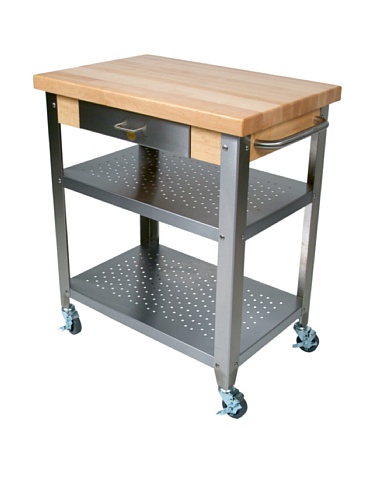
John Boos Kitchen Cart
a premium butcher-block cart from a maker whose name is attached to serious work surfaces. It suits committed cooks who prep daily, who want a top with genuine substance under the knife board, and who are willing to maintain real wood properly in exchange for decades of service. Its strength is the top itself and the frame beneath it: this is the cart you buy once, oil faithfully, and hand on, and it behaves like a small island rather than a trolley.
Alternative note: compare by job, not by looks — the alternative that does your leading job best is the one worth its space.
Keep reading across the cluster as you decide: the companion guide to kitchen cart review, the companion guide to kitchen cart reviews, the companion guide to kitchen cart buying guide, the matching bar cart guide, bar cart review, small kitchen rugs that survive life around a rolling cart, closet organiser ideas that translate to cart storage, kitchen vacuums for the crumbs a cart collects. Each companion piece takes one angle in depth, so together they cover the decision without repeating it.
How to Get the Most Value If You Buy
Weight distribution is the quiet safety rule that separates a well-loaded cart from a tippy one. Put heavy appliances low — the stand mixer, the food processor, the cast-iron pot — on the bottom shelf or in the base cabinet, and keep the top and upper shelves for light, bulky things like mixing bowls, linens and cereal boxes. A top-heavy cart feels nervous when it rolls, strains its casters at one end, and in the worst case can tip toward a child or a pet that leans on it. Loaded low, the same cart feels planted, rolls straight, and stops without drama.
The work surface deserves the sternest honesty in this whole guide. Lock the casters before you use the top as a prep surface, every time, without exception — a cart that can roll will roll, usually at the exact moment a knife or a full bowl is involved. Treat the top as a landing and assembly surface first. A cart top is not a chopping block unless it is a rated butcher-block top, and even then you should work on a board placed on it, so the board takes the cuts, the board goes to the sink, and the top stays smooth and food-safe for years instead of scarred in a season.
Knife storage on a cart follows one rule with no exceptions: knives live in a block or on a magnetic strip, never loose in a drawer with other tools. A loose knife in a shared drawer dulls against everything it touches, hides its edge exactly where reaching fingers expect a spoon, and turns a rummage into a risk. A slim block on the cart top or a strip mounted on the cart’s side keeps edges protected, visible and instantly reachable while you prep, and it keeps the drawer for the tools that belong there — peelers, thermometers, tongs and the rest of the harmless crowd.
Assembly is part of the product, whether the listing dwells on it or not. A well-made cart arrives with labelled parts, holes that line up the first time and instructions written by someone who has built the thing. A poor one turns an evening into a negotiation with misaligned panels. Whatever you choose, build it on a blanket to protect the finish, keep the fasteners in a bowl so none escape, tighten in stages rather than fully at each step, and re-check every bolt after the first week of rolling, because new joints settle and a small wobble ignored becomes a loose frame.
Is a Kitchen Cart Worth It — The Final Test
Here is the final test for is a kitchen cart worth it in your home: picture the cart parked in its spot on an ordinary Tuesday, loaded the way you would really load it, and count the jobs it did that day without being asked. If the honest count is two or more, it is worth it. If the picture feels like furniture waiting for a purpose, it is not — yet.
The Decision Checklist
- Do my counters overflow at least several times a week?
- Is there an appliance or category with no real home today?
- Can the cart park without blocking any door, drawer or walkway?
- Will I lock casters, use a board and load heavy items low, every time?
- Does the pattern match my storage temperament — closed and calm, or open and instant?
- Am I buying for my three most repeated cooking jobs, not a fantasy one?
Five or six yes answers: buy with confidence, at the tier your cooking frequency justifies. Three or fewer: solve the real problem first and revisit the cart afterwards.
In Depth: Living With the Cart Day to Day
A cart changes how children learn a kitchen, for the better when it is set up with intent. A low shelf that is theirs — cups, a water jug they can manage, the snack boxes — gives small people a legitimate destination that is not the cook’s drawers. The same cart keeps the serious things high, closed and out of the story: knives in their block, glass and bottles behind doors, cleaning things elsewhere entirely. Furniture that gives children a place tends to be respected by them; furniture that is only forbidden tends to be climbed.
Electricity deserves one practical paragraph. Carts increasingly host appliances — the air fryer, the kettle, the mixer — and appliances need outlets, ventilation and a cord path that does not cross a walkway or dangle near water. Park an appliance cart within honest reach of an outlet, leave breathing room behind heat-making machines, and never run a cord under the cart’s own wheels. The cart should bring the appliance to the power safely, not stretch the power to the appliance dangerously, and a five-minute thought at setup prevents the daily tangle.
Smell and hygiene separate kitchen furniture from other furniture. A cart lives among onions, oils and dishwater, and its materials either shrug those off or absorb them. Sealed surfaces, washable bins and a top that tolerates a proper wipe-down stay fresh; raw, unsealed surfaces in splash zones slowly take on the kitchen’s biography. This is another argument for the board-on-top habit and for prompt wiping: the cart that is easy to clean gets cleaned, and the cart that gets cleaned stays welcome in the room where food happens.
Finally, trust the two-week rule for any big impression. In the first fortnight you will learn where the cart truly wants to park, what you actually reach for daily, and which shelf arrangement your hands prefer. Good carts invite rearrangement — bins move, shelves swap, the drawer changes jobs — and the willingness to re-sort once, early, is what turns a purchase into a system. Judge the cart after that re-sort, not before it, and choose a pattern flexible enough to deserve the second arrangement as much as the first.
Consider the morning test, because it reveals more than any showroom visit. On a weekday morning the cart either holds the coffee things where your half-awake hands expect them, parks clear of the kettle’s steam and the fridge door’s swing, and rolls aside without a thought — or it is in the way, and being in the way at seven in the morning is how furniture gets quietly hated. When you picture a cart, picture it at your least patient moment of the day, loaded with your real breakfast things, and ask whether the room still flows. If the answer is yes at breakfast, it will be yes at dinner.
Think about landing zones, the unglamorous places hot and heavy things go for ten seconds. Every kitchen runs out of them at the worst moment: the tray out of the oven, the pot off the hob, the shopping bag that cannot go on the floor. A cart parked beside the stove becomes the landing zone the kitchen was missing, and that single role justifies it on busy nights even if its shelves held nothing at all. Judge a cart’s top partly as a runway — clear, heat-aware with a trivet, close to the action — and keep it uncluttered enough to land on at short notice.
Noise is a quality nobody lists and everybody hears. A cart that rattles over grout lines, whose doors thud and whose drawers slam, makes a kitchen feel cheaper every time it moves. Solid frames, well-seated shelves and wheels that roll rather than skitter keep the piece quiet, and quiet reads as quality in daily life far more than any finish. When you roll a cart in a shop or imagine one from a description, listen in your mind: the right cart moves like furniture, not like luggage.
Light matters more than most buyers expect. A tall, dark, enclosed cart in a small north-facing kitchen can swallow the room’s brightness and make the corner it owns feel like a cupboard that escaped. Lighter finishes, open shelves and slimmer frames keep a small room airy, while a substantial wood cart in a large bright kitchen adds exactly the visual weight the space wants. Match the cart’s visual mass to the room’s light and size, not just its floor plan, and the piece will look chosen rather than parked.
Plan for the clean-out day, because it is coming. Once a season, empty the cart completely: the expired spice, the third peeler, the appliance you kept for a recipe you never repeated. A cart makes this easy — roll it to the table, unload, wipe every shelf, reload only what earns its place — and that ease is a hidden virtue. Storage that is painful to audit becomes storage that hides drift. The carts that stay useful for years are the ones their owners can empty in twenty minutes without dreading it.
Height relationships decide whether a cart feels like a colleague or an obstacle. A top that sits near your counter height lets you slide boards, bowls and trays across without lifting, and keeps prep posture natural through a long session. A much lower top turns every transfer into a stoop; a much higher one turns the cart into a shelf you reach up to. There is no universal right answer, only the right relationship to your counters and your own height, so picture the actual hand movements of your most common recipe before you choose.
Edges and corners carry the scars of a cart’s life, so look at them first. The corners meet door frames, the edges meet hips and pan handles, and the finish there tells you how the piece will age. Rounded or well-finished edges survive the meetings gracefully; sharp, thinly finished ones chip and show every encounter. In a family kitchen, rounded corners are also simply kinder to small heads at exactly cart height. A cart is the most mobile furniture in the room, and mobile furniture should be built — and chosen — for contact.
Think in zones and the cart finds its job description. Kitchens work when the prep zone, the cooking zone and the cleaning zone each hold their own tools, and most kitchens have one zone starved of storage while another overflows. A cart is the only storage you can assign to the starved zone without building anything: park the baking zone beside the oven, the coffee zone beside the water, the prep zone beside the board and knives — in a block or on a strip, never loose. Let the zones vote on where the cart lives and what it carries.
The secondhand and hand-me-down angle is worth a thought, because good carts circulate. A solid wood or metal cart survives owners the way a good pan does, and buying the solid pattern new means yours can be sold, gifted or re-tasked rather than landfilled when the kitchen changes. Flimsier pieces have one life and it is a short one. This is not sentiment; it is arithmetic about cost per year of service, and it is the same reasoning that favours the repairable top and the replaceable caster over the sealed, disposable design.
Guests reveal a cart’s social life. A cart becomes the drinks station, the dessert trolley, the place the extra chairs’ worth of dishes lands during a long dinner, and it does all of it without anyone standing in the cook’s working triangle. If you entertain, judge the cart partly as hosting equipment: does it present well from the dining side, roll quietly on your floors, and hold a serving load steady with its casters locked? A piece that works all week and hosts all weekend is earning its floor space twice.
Seasonal cooking changes what the cart must be. In preserving season it is a jar-and-lid staging post; in baking season it is flour, tins and cooling racks; in the holidays it is the overflow landing strip that saves the meal. A cart with flexible storage — shelves that take bins, a drawer that takes linens, a top that clears completely — adapts to each season without new furniture. Fixed, novelty storage adapts to one season and stores air for the other three, which is why plain, flexible layouts outlast clever ones in real kitchens.
Floor protection is a small clause with long consequences. Hard casters on soft floors, and grit trapped under any wheel, will mark a floor over months of rolling. Felt-friendly wheel materials, a habit of lifting rather than dragging a loaded cart over thresholds, and a quick sweep of the cart’s usual route before a long push all protect the surface underneath. Renters should care twice: the cart that was meant to leave no trace should not sign its name in scratches across the kitchen floor.
Each Pattern, Considered Closely
Catskill Craftsmen Kitchen Cart
In depth, the Catskill pattern rewards the cook who treats the cart as a small piece of joinery. The enclosed body keeps the visual field calm, the top invites a board and a bowl rather than clutter, and the whole piece improves with the same care you would give a good table: prompt wiping, oiling where the wood is natural, and a caster check each season. Its best room is a kitchen that is cooked in daily and seen by guests often, where calm storage and a furniture feel are worth more than featherweight mobility.
Home Styles Kitchen Cart
In depth, the Home Styles pattern is the diplomat of the range: broad enough to host a coffee station and a prep board at once, finished enough to stand in the open, and storage-rich enough to swallow a family’s awkward middle layer of kitchen things. It rewards households that serve from the cart as often as they prep on it. Its best room is the open-plan kitchen, where the cart is seen from the dining side all day and must earn its place visually as well as functionally.
Winsome Kitchen Cart
In depth, the Winsome pattern proves how far simplicity travels. Open shelves make every stored thing instantly findable, the light frame makes rearrangement a one-person whim, and the whole piece re-tasks gracefully when a kitchen’s needs change or a household moves. It rewards renters, first kitchens and visual cooks who think in glances. Its best room is the small or changing kitchen, where flexibility and low visual weight matter more than concealment, and where bins and baskets can supply whatever order the shelves leave open.
Giantex Kitchen Cart
In depth, the Giantex pattern is the checklist made furniture: top, drawer, shelves and small thoughtful extras combined in a compact footprint at an entry tier. It rewards buyers who measure success in functions covered per corner of floor. The honest trade is materials and heft — this is sensible, serviceable construction rather than heirloom joinery — and for a first cart, a small flat or a student kitchen, that trade is frequently the right one. Its best room is the compact kitchen that needs everything at once and forgives a practical finish.
AmazonBasics Kitchen Cart
In depth, the AmazonBasics pattern strips the idea to its working skeleton: frame, shelves, wheels, done. That plainness is its virtue in pantries, utility corners and kitchens that treat a cart as equipment. Shelves wipe clean, loads sit low and steady, and the cart shrugs off the flour dust and splashes that would worry a finer finish. It rewards buyers who rank load and mobility above looks. Its best room is the hard-working kitchen or the pantry wall, where the question is never how it photographs but how much it carries.
John Boos Kitchen Cart
In depth, the John Boos pattern is the connoisseur’s answer, and it asks connoisseur habits in return: oil the block by eye, board the heavy knife work anyway, and let the top gather the honest patina of daily prep rather than the scars of carelessness. In exchange it offers the most substantial work surface in this guide and a frame built for decades. It rewards the daily cook who preps seriously and maintains willingly. Its best room is the cook’s kitchen, where the cart is not furniture near the work but part of the work itself.
In Depth: Living With the Cart Day to Day
A cart changes how children learn a kitchen, for the better when it is set up with intent. A low shelf that is theirs — cups, a water jug they can manage, the snack boxes — gives small people a legitimate destination that is not the cook’s drawers. The same cart keeps the serious things high, closed and out of the story: knives in their block, glass and bottles behind doors, cleaning things elsewhere entirely. Furniture that gives children a place tends to be respected by them; furniture that is only forbidden tends to be climbed.
Electricity deserves one practical paragraph. Carts increasingly host appliances — the air fryer, the kettle, the mixer — and appliances need outlets, ventilation and a cord path that does not cross a walkway or dangle near water. Park an appliance cart within honest reach of an outlet, leave breathing room behind heat-making machines, and never run a cord under the cart’s own wheels. The cart should bring the appliance to the power safely, not stretch the power to the appliance dangerously, and a five-minute thought at setup prevents the daily tangle.
Smell and hygiene separate kitchen furniture from other furniture. A cart lives among onions, oils and dishwater, and its materials either shrug those off or absorb them. Sealed surfaces, washable bins and a top that tolerates a proper wipe-down stay fresh; raw, unsealed surfaces in splash zones slowly take on the kitchen’s biography. This is another argument for the board-on-top habit and for prompt wiping: the cart that is easy to clean gets cleaned, and the cart that gets cleaned stays welcome in the room where food happens.
Finally, trust the two-week rule for any big impression. In the first fortnight you will learn where the cart truly wants to park, what you actually reach for daily, and which shelf arrangement your hands prefer. Good carts invite rearrangement — bins move, shelves swap, the drawer changes jobs — and the willingness to re-sort once, early, is what turns a purchase into a system. Judge the cart after that re-sort, not before it, and choose a pattern flexible enough to deserve the second arrangement as much as the first.
Consider the morning test, because it reveals more than any showroom visit. On a weekday morning the cart either holds the coffee things where your half-awake hands expect them, parks clear of the kettle’s steam and the fridge door’s swing, and rolls aside without a thought — or it is in the way, and being in the way at seven in the morning is how furniture gets quietly hated. When you picture a cart, picture it at your least patient moment of the day, loaded with your real breakfast things, and ask whether the room still flows. If the answer is yes at breakfast, it will be yes at dinner.
Think about landing zones, the unglamorous places hot and heavy things go for ten seconds. Every kitchen runs out of them at the worst moment: the tray out of the oven, the pot off the hob, the shopping bag that cannot go on the floor. A cart parked beside the stove becomes the landing zone the kitchen was missing, and that single role justifies it on busy nights even if its shelves held nothing at all. Judge a cart’s top partly as a runway — clear, heat-aware with a trivet, close to the action — and keep it uncluttered enough to land on at short notice.
Noise is a quality nobody lists and everybody hears. A cart that rattles over grout lines, whose doors thud and whose drawers slam, makes a kitchen feel cheaper every time it moves. Solid frames, well-seated shelves and wheels that roll rather than skitter keep the piece quiet, and quiet reads as quality in daily life far more than any finish. When you roll a cart in a shop or imagine one from a description, listen in your mind: the right cart moves like furniture, not like luggage.
When a Kitchen Cart Earns Its Place: The Long-Term Ownership Test
Whether a kitchen cart is worth it is rarely decided on the day it arrives. The answer builds over months of small moments: the days it quietly does its job, the days it frustrates, and the day you realise you would replace it without hesitation, or would not. This section works through that longer test in practical terms.
The value case for a kitchen cart rests on repetition. It exists for extra counter space, storage and a movable serving station, so multiply a small daily convenience by the number of times your household actually does that job in a year, and the purchase usually justifies itself on arithmetic alone. The case collapses just as quickly for households where the job is monthly or seasonal, because an excellent tool used rarely is still mostly storage.
Running costs here are mostly attention. Ownership asks that you accept wiping the top after prep work and tightening caster fittings that loosen with movement, and accept the occasional frustration when a cart that drifts or rattles because the casters are unlocked or unevenly loaded. Households that treat that upkeep as part of the routine report the kitchen cart as an easy yes years later; households that resent every minute of maintenance experience the same product as a burden, which is why identical items earn opposite verdicts in different homes.
So run the replacement test. Imagine the kitchen cart vanished tomorrow: would you reorder the same thing within the month, borrow one in the meantime, or quietly enjoy the cleared space? Add the edge case, loading heavy appliances on top, which changes both stability and how easily it rolls, and ask whether it handled yours well enough to matter. If you would replace it quickly and it passed your hardest regular test, it was worth it by the only definition that counts, your own revealed behaviour.
A Final Decision Checklist
- Count the weekly uses honestly, since value here comes from extra counter space, storage and a movable serving station repeated, not occasional.
- Subtract the attention cost, because wiping the top after prep work and tightening caster fittings that loosen with movement is part of the price you pay forever.
- Forgive rare frustrations, but not weekly ones, and the recurring one is a cart that drifts or rattles because the casters are unlocked or unevenly loaded.
- Ask the replacement question: if it vanished, would you reorder before the month ends.
- Check it still fits your life as routines change, since caster quality for your floor type and whether the cart must pass through narrow doorways.
- Test the moment that justifies ownership, because loading heavy appliances on top, which changes both stability and how easily it rolls.
- Keep packaging and paperwork until the first full week, while the decision is still reversible.
- Photograph the setup once it works well, a small record of the version you would replace like for like.
- Notice how often the person who cleans it most a veto, because their friction decides how long it stays in service.
- Track for a month whether the largest regular job, not the largest imaginable one, when judging whether the size is right.
- Ask whether you would miss notes on what worked, in the room where the kitchen cart is used, where future-you will actually find them.
- Count the weeks when compatibility once more before ordering parts or accessories, remembering that caster quality for your floor type and whether the cart must pass through narrow doorways.
- Ask whether you would miss seasonal differences, since heat, guests and holiday loads test a kitchen cart differently from ordinary weeks.
Frequently Asked Questions
Can I really prep food on a kitchen cart top?
Yes, with two habits locked in. Lock the casters before you start, every time, so the surface cannot drift under a knife or a bowl, and work on a cutting board placed on the top rather than directly on it. A cart top is not a chopping block unless it is a rated butcher-block top, and even then the board should take the cuts and go to the sink afterwards. Used that way, a cart top is an excellent prep surface for assembly, rolling, mixing and landing hot pans on a trivet.
Where should heavy appliances live on a cart?
Low, always. The stand mixer, food processor and cast-iron cookware belong on the bottom shelf or in the base cabinet, where their weight steadies the cart instead of straining it. Light and bulky items — mixing bowls, linens, cereal boxes, a bread bin — belong up high. A low-loaded cart rolls straighter, stops more predictably, and is far less likely to feel tippy when a child leans on it or a caster meets a rug edge at an angle.
How do I look after a butcher-block cart top?
Keep it clean and dry day to day, and oil it with a food-safe board oil whenever it starts to look dry, pale or thirsty. Wipe the surface down first, work the oil in with the grain, let it absorb, then buff away the excess so the top feels dry rather than greasy. That is the whole routine, done qualitatively by eye rather than by calendar. Oiled block resists water rings and stains gracefully; neglected block dries out, dulls and can eventually split along its seams.
What is the safest way to store knives on a cart?
In a block or on a magnetic strip, never loose in a drawer with other tools. A loose knife dulls against everything around it and hides its edge exactly where fingers go rummaging for a spoon. A slim block on the top or a strip mounted on the side of the cart keeps edges protected, visible and within reach while you prep, and it keeps drawers for the harmless tools that belong there. It is one of the cheapest safety upgrades in the whole kitchen.
Do I need locking casters, or are they a nice extra?
Treat them as essential. At least two casters should lock, and the locks should hold with the cart fully loaded, not just empty. You will use the top as a work surface, lean on it while you roll dough, and park it beside a hot stove; in all three moments a cart that can creep is a hazard rather than a help. Test the locks on your own floor, including over any rug edge or threshold the cart will cross in normal use.
Will a kitchen cart work in a rental or a very small kitchen?
Usually, yes — carts are one of the few upgrades a renter can take with them. Choose a footprint that parks flush against a wall, casters that turn without a wide sweep, and a design that needs no wall fixing. Measure with doors and appliance doors open, not just against the empty room, and walk the route the cart will roll. If two people can still pass and cook with the cart parked, it fits your life as well as your floor.
Keep reading across the cluster as you decide: the companion guide to kitchen cart pros and cons, the companion guide to how to choose a kitchen cart, the companion guide to kitchen cart vs bar cart, the matching bar cart guide, bar cart reviews, compact air fryers for small kitchens that pair well with a cart, affordable kitchen mixers that often live on a cart’s low shelf, storage thinking for the bulky and the awkward. Each companion piece takes one angle in depth, so together they cover the decision without repeating it.
