Disclosure: As an Amazon Associate, airfryerkitchensupply.com earns from qualifying purchases. Links on this page are affiliate links; they cost you nothing extra. Prices and availability change often, so check the current Amazon listing before you buy.
Knowing how to clean a gas range properly is the difference between an appliance that looks cared for after five years and one that seems tired after one. The method is not complicated, but it is specific: everything cools completely first, grates and burner parts come off exactly as the manual directs, nothing goes back wet or crooked, and the flames get checked before the job counts as finished. This guide walks through the full routine step by step, covers the oven interior and the control panel, and sets out a rhythm that keeps the whole task light enough to actually happen.
A final word on expectations: no domestic gas range does everything perfectly. The strongest searing burner rarely simmers the most gently, the largest oven is rarely the quickest to preheat, and the prettiest front is rarely the easiest to keep spotless. Mature buying means choosing which compromises you will enjoy living with, because you agree with the priorities behind them. Read the critical sections of any guide, including this one, as a map of those compromises, and the model that emerges as your best fit will usually be obvious and, more importantly, durable.
Daily care is mostly about timing. A quick wipe of the cooktop surface once everything has cooled completely takes a minute and prevents the cooked-on film that makes deep cleaning miserable. Keep a dedicated cloth for the range so grease does not travel around the kitchen, and deal with sugary spills promptly once the surface is safe to touch, because sugar is the spill most likely to set hard and stain finishes. Small, regular attention is the entire secret behind ranges that still look cared for after years of heavy family use.
Key Takeaways
- Judge a gas range by burner layout and oven behaviour, not by headline features.
- Professional installation, leak testing and an anti-tip bracket are part of the purchase, never optional extras.
- Ventilation and a working carbon monoxide detector belong in every gas kitchen plan.
- Convection, a divided oven and smart controls only earn their tier if your cooking calendar uses them.
- Keep grates and burner parts clean, dry and correctly seated, and a gas range rewards you for decades.
- Match the range to your largest real meal and your most-used pans, and the right model usually becomes obvious.
In this guide
How to Clean a Gas Range: What You Need Before You Start
Energy behaviour at home is mostly about matching burner to pan. A small pan on the largest burner wastes heat around its sides and can overheat handles, while a huge pot on the smallest burner takes forever and cooks unevenly. Centring pans, using lids for anything that simmers, and bringing liquids to the boil before dropping to a gentle flame are habits that save fuel and improve results at the same time. None of this needs special equipment; it is simply the craft of cooking on an open flame, learned in the first month and used for years.
Noise and feel are legitimate buying criteria that never appear in advertisements. Some ranges click persistently as they reignite to hold temperature, some oven fans run louder than others, and some knobs feel precise while others feel vague between settings. If you are sensitive to kitchen noise, or you cook in an open-plan space where the range shares air with the living room, weigh these qualities seriously. Reading owner discussions with an eye for repeated comments about sound and control feel will tell you more than any showroom visit, where the appliance is never actually lit.
Resale and renovation thinking can sharpen a decision. A standard size, a neutral finish and a widely serviced brand protect the value of a kitchen if you sell, while an unusual size or colour is a personal pleasure you should buy with open eyes. Landlords and renovators often choose simpler models for exactly this reason, and owner-occupiers who cook seriously choose the opposite, and both are right. The mistake is only in mixing the logics: paying a premium for a statement appliance in a kitchen you plan to sell, or economising on the range in a home you will cook in for decades.
Troubleshooting: When a Burner Misbehaves After Cleaning
Warranties deserve a plain reading before purchase. Note what is covered, for how long, and what counts as a service call in your area, and keep the paperwork with the installation documents. A slightly longer or clearer warranty from a brand with local technicians can be worth more than a small feature difference, because the cost of a range is not only its purchase tier but the disruption when it stops working. Register the appliance if the manufacturer asks, store the model and serial details somewhere findable, and future you, standing in a kitchen with a cold oven, will be grateful.
Second-hand gas ranges deserve special caution, and the caution is simple: any used appliance still needs professional installation and leak testing in its new home, and its history is unknown in ways that matter for gas parts. Valves, igniters and flexible connectors age, and a bargain that needs several professional repairs is not a bargain. If you do buy used, factor the licensed installation and a professional inspection into the true cost from the start, and be ready to walk away if the numbers stop making sense. New appliances with full support exist at accessible tiers for a reason.
Ranges Noted for Easier Cleaning

Frigidaire Gallery Gas Range
Frigidaire Gallery is the value-leaning line in this group, aimed at buyers who want convection cooking and a respectable cooktop without paying for a flagship badge. The design language is straightforward, the controls are generally easy to read, and the feature set focuses on the things most families use weekly rather than novelties. It suits first-time gas buyers, rental upgrades done properly by a licensed installer, and households replacing an ageing range on a sensible budget. Cooks chasing the heaviest grates or the most refined low simmer in this group should compare it side by side with the premium lines before committing.
Best for: cooks whose habits match the strengths described above, and whose kitchen, fuel supply and installation plan have been confirmed with a licensed professional before ordering. Not suited for: buyers whose priorities point the other way on controls, oven style or service network, because living with the wrong fit costs more than choosing carefully now. As with every pick in this guide, treat the listing as a starting point, confirm the exact configuration and dimensions against your space, and check price on Amazon or with your chosen retailer when you are ready to compare current offers.
LG ProBake Gas Range
LG builds this line around even oven baking, with the heating arrangement designed to move hot air more consistently through the cavity than a basic single-point setup. For bakers who have fought pale centres and dark edges on the same tray, that promise is the whole point of the range. The cooktop follows a conventional multi-burner layout with continuous grates on many configurations, and the styling leans clean and contemporary. It suits regular bakers and roast cooks who want steadier results without stepping up to a professional-style model, while very heavy wok users should study the centre burner layout closely before deciding.
Best for: cooks whose habits match the strengths described above, and whose kitchen, fuel supply and installation plan have been confirmed with a licensed professional before ordering. Not suited for: buyers whose priorities point the other way on controls, oven style or service network, because living with the wrong fit costs more than choosing carefully now. As with every pick in this guide, treat the listing as a starting point, confirm the exact configuration and dimensions against your space, and check price on Amazon or with your chosen retailer when you are ready to compare current offers.

GE Profile Gas Range
GE Profile sits in the upper middle of the mainstream market, and this line is aimed at cooks who want a connected, feature-rich range from a brand with a wide service network. Expect an emphasis on convection baking, flexible burner layouts and smart controls that let you preheat or check a timer from another room. That breadth is its strength and its complication: there is more to learn, and more electronics to live with for the life of the appliance. It suits busy households that will genuinely use the connected features, and cooks who value dealer and parts support when they choose an appliance.
Best for: cooks whose habits match the strengths described above, and whose kitchen, fuel supply and installation plan have been confirmed with a licensed professional before ordering. Not suited for: buyers whose priorities point the other way on controls, oven style or service network, because living with the wrong fit costs more than choosing carefully now. As with every pick in this guide, treat the listing as a starting point, confirm the exact configuration and dimensions against your space, and check price on Amazon or with your chosen retailer when you are ready to compare current offers.
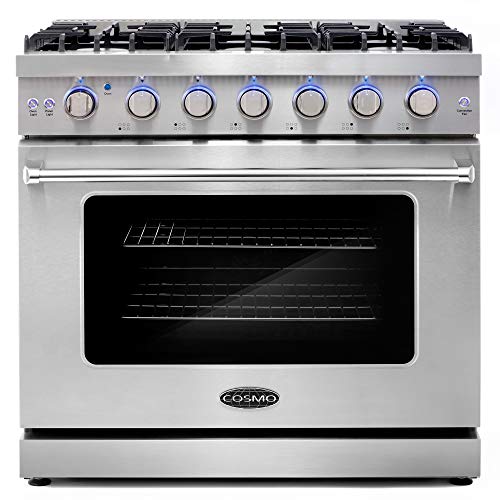
Cosmo Gas Range
Cosmo occupies the style-forward, value-conscious corner of the gas range market, with designs that borrow the visual cues of professional ranges at a more accessible tier. For buyers remodelling a kitchen around a bold centrepiece, that look is the draw, and the cooktop layouts generally follow the multi-burner pattern home cooks expect. It suits confident buyers who have read the ownership basics, checked service options in their area, and know exactly which size and fuel configuration they need. Buyers who want the deepest local service network or the longest track record in this category may be happier with one of the long-established brands.
Best for: cooks whose habits match the strengths described above, and whose kitchen, fuel supply and installation plan have been confirmed with a licensed professional before ordering. Not suited for: buyers whose priorities point the other way on controls, oven style or service network, because living with the wrong fit costs more than choosing carefully now. As with every pick in this guide, treat the listing as a starting point, confirm the exact configuration and dimensions against your space, and check price on Amazon or with your chosen retailer when you are ready to compare current offers.
Keeping It Working: The Maintenance Rhythm
Finally, remember that a range is bought for a household, not a person. The tallest cook and the shortest, the baker and the stir-fry enthusiast, the adult who cleans and the teenager learning to fry an egg all have to live with the choice. Front or rear controls, knob stiffness, oven light brightness and how the door handle feels are shared experiences. Letting the household handle the shortlisted models, even briefly in a showroom, surfaces preferences no single shopper would think of, and it turns the final decision into one the whole kitchen can stand behind.
Grates respond best to soaking and patience rather than aggression. Once cool, lift them as the manual directs, soak them in hot soapy water, and work on softened deposits with a non-scratch pad. Abrasive powders and metal scourers can damage enamel coatings, and damaged grates then rust and stain more easily, so gentler and longer beats harsher and faster. Dry grates thoroughly before they go back, and never put a wet grate back over a burner you are about to light, because trapped moisture and heat are poor companions.
Burner caps and heads need the lightest touch of any part of the range. Food deposits around the ports affect how evenly the flame burns, so keep them clean using the method the manufacturer describes, typically a soft brush or cloth and, only where the manual allows, a gentle clearing of the ports. Do not soak parts that the instructions say to keep dry, do not enlarge or force anything through the ports, and let everything dry completely before reassembly. A clean, dry, correctly seated burner lights promptly and burns with the steady flame you expect.
Surfaces, Finishes and What to Avoid
The oven interior asks for a different strategy. Many gas ranges offer a self-cleaning cycle or steam-assisted cleaning, and both come with instructions about removing racks, locking the door and ventilating the room that must be followed exactly. Households that prefer manual cleaning should use products the manufacturer approves for the cavity finish, with the range cool and the room ventilated. Never apply cleaners to a hot oven, and never use the oven’s own heat to speed up a chemical clean unless the product and the manual both explicitly describe that method.
Knobs, control panels and glass need restraint. Remove knobs only if the manual says they come off, wash them gently, and make certain they are dry and correctly oriented before refitting, because a knob pushed back carelessly can mislead the next cook about whether a burner is off. Glass cleaner belongs on a cloth, not sprayed directly at a control panel where liquid can creep behind it. Stainless finishes wipe best along the grain with a soft cloth, and the reward for that small discipline is a front panel that stays clear and legible for years.
Gas Safety: Installation, Ventilation and Daily Habits
Installation is professional work, full stop. A gas range must be connected to the gas supply, and that connection, along with leak testing of every joint, must be carried out only by a licensed or certified gas fitter or installer working to your local code. This guide will never walk you through connecting a gas line yourself, because a joint that seems fine can leak slowly into a closed kitchen. Budget for proper installation from the start, keep the installer’s paperwork, and treat anyone who suggests a casual do-it-yourself hookup as a reason to walk away.
An anti-tip bracket is a small piece of hardware with a serious job. It anchors the range so the appliance cannot tip forward if weight lands on an open oven door, and it must be fitted as part of a proper installation. Ask your installer to confirm it is in place, and check it again any time the range is moved for cleaning or flooring work and then pushed back. It takes seconds to verify and it prevents one of the most dangerous accidents a range can be involved in, especially in homes with children.
Every gas household should have a working carbon monoxide detector, and a kitchen with a gas range is no exception. Fit detectors where the manufacturer and your local guidance direct, test them on the schedule the instructions set out, and replace them at the end of their stated life rather than when they fail. Carbon monoxide cannot be seen or smelled, so the detector is not an optional extra or a box to tick once; it is a permanent part of cooking on gas, as normal and as necessary as a smoke alarm elsewhere in the house.
If you ever smell gas strongly, hear hissing near the appliance, or feel unwell in a way that clears outdoors, stop and treat it as urgent. Do not light anything, do not operate electrical switches, leave the building, and contact your gas supplier’s emergency line or local emergency services from outside. Those steps are the whole procedure for a householder; investigating a suspected leak yourself is not part of it. Leak detection and repair belong to the gas supplier and licensed professionals, and no recipe, schedule or dinner guest is worth improvising around that rule.
Day-to-day vigilance is simpler and calmer than emergency procedure. Keep the area around burners clear of towels, packaging and loose sleeves, never leave a lit burner unattended with oil heating, and make a habit of glancing at the knobs when you leave the kitchen so an unlit but open burner is caught immediately. Many modern ranges add flame-failure features on some markets, but habits remain the foundation. Gas cooking is safe in millions of homes precisely because those households treat small, boring routines as non-negotiable rather than as fussiness.
The Full Cleaning Routine, Step by Step
Step 1: Let Everything Cool Completely and Prepare the Space
Cleaning starts with patience. Turn everything off, then wait until grates, caps and surfaces are completely cool to the touch, however long that takes after cooking. Clear the surrounding counters, put a towel down for removed parts, and gather soft cloths, a non-scratch pad, hot soapy water and the manufacturer’s manual. Rushing a warm cooktop risks burns and warped parts, and spraying cleaner onto hot surfaces creates fumes and baked-on residue. A calm setup also means the parts you remove have a safe place to rest while they soak.
Step 2: Remove Grates and Burner Parts as the Manual Directs
Lift the grates off in the order and direction the manual describes, then remove burner caps and heads exactly as instructed, noting how each piece seats so reassembly is certain rather than hopeful. Keep each burner’s parts together, because similar-looking caps are not always interchangeable. If a part resists, stop and reread the instructions rather than forcing it; seized parts are a reason for professional help, not stronger tools. Photograph the assembled cooktop before you start if your memory for orientation is anything like most people’s.
Step 3: Soak and Wash the Grates
Soak the cool grates in hot soapy water long enough for deposits to soften, then work over them with a non-scratch pad, rinsing and repeating rather than reaching for abrasives. Enamel coatings chip and scratch under harsh treatment, and damaged grates stain faster and can rust at the chips, so patience genuinely protects the appliance. Stubborn carbon softens with repeated soaking far better than with force. When the grates are clean, dry them completely, because a damp grate returned to the cooktop invites corrosion and can affect the next ignition.
Step 4: Clean Burner Caps and Heads Without Flooding Them
Wash caps and heads gently, following the manual on what may be soaked and what should only be wiped, and take special care that no water is left sitting in the ports or inside the heads. Deposits around the ports can be loosened with a soft brush or cloth; never force objects through the ports or enlarge them. Then let every part dry fully, ideally air-drying on the towel while you clean the surface below. A burner reassembled wet or crooked is the single most common cause of poor lighting after cleaning.
Step 5: Wipe the Cooktop Surface and Wells
With the burners removed, the surface and burner wells are exposed and easy to clean properly. Wipe up crumbs and loose debris first so you are not pushing grit around in soapy water, then wash the surface with a soft cloth, working around the igniters gently rather than scrubbing across them. For enamel and stainless surfaces alike, avoid abrasive powders that dull the finish. Rinse with a clean damp cloth so no detergent film remains to bake on during the next cooking session, and dry the surface so the reassembled burners sit on a clean, dry base.
Step 6: Clean the Oven Interior by an Approved Method
Choose the cleaning method your manual approves for your model: a self-cleaning cycle run exactly as instructed with racks removed and the room ventilated, a steam-assisted cycle where fitted, or manual cleaning with a product approved for the cavity finish, applied only while the oven is cool. Never improvise with heat and chemicals together, and never use cleaners on surfaces the manual excludes, such as door gaskets. Wipe out ash or residue afterwards with a damp cloth, and check the door seal is sitting correctly before the oven is used again.
Step 7: Reassemble Carefully, Then Check the Flames
Refit the burner heads and caps exactly as they came off, confirming each sits level and stable, then replace the dry grates. Light each burner in turn and look at the flames: they should light promptly and burn steady and even, mostly blue. If a burner struggles, clicks on, or burns unevenly, turn it off and check seating and dryness once more; if the problem persists, leave it and arrange professional service. This two-minute flame check after every deep clean is the habit that keeps small assembly slips from becoming lingering faults.
Deeper Considerations Before You Decide
A gas range puts an open flame under your cookware and a gas-fired oven below it, and that directness is why many cooks refuse to give it up. Heat changes the moment you turn a knob, with no waiting for an element to cycle up or down, and you can see the size of the flame and judge it at a glance. That visual, immediate control shapes everything from a rolling boil to the gentlest melt, and it is the starting point for understanding both the strengths and the responsibilities that come with cooking on gas.
Low heat is where a good gas range quietly earns its keep. A small, stable flame that does not keep flaring or dying lets you hold a custard, a risotto or a delicate sauce at the edge of a simmer for as long as the dish needs. When you test ranges in a showroom you cannot light them, so read the burner layout carefully, look for a dedicated small burner rather than one oversized burner expected to do everything, and plan to judge simmer behaviour in the first week of ownership while adjustments are still easy to arrange.
High heat matters just as much, but it is about shape as much as strength. A wide, even ring of flame under a heavy pan sears more evenly than a fierce hotspot in the middle, and a burner that matches the base of your favourite skillet wastes less heat up the sides. Cooks who use a wok should look for a layout that supports the pan securely and centres it over the flame, and everyone should remember that the biggest pan they own, not the average one, is the right test of whether a cooktop layout really works.
The oven half of a gas range behaves differently from the cooktop, and it rewards a short learning period. Gas ovens introduce moisture as part of combustion, which many bakers find kind to roasts and breads, and the heat tends to feel less drying than a basic electric cavity. Temperatures can vary from front to back and top to bottom until you learn your particular oven, so an inexpensive oven thermometer and a few test bakes are worth more than any brochure claim during the first month in a new kitchen.
Convection is the feature that most changes oven results on a modern gas range. A fan circulates hot air so multiple trays bake more evenly and roasting skin crisps more consistently, and most owners who have it use it far more than they expected. It is not compulsory: a single-tray baker with simple habits can be perfectly happy without it. But households that batch-cook, bake on two racks, or roast vegetables while a main dish rests will feel the difference every single week, which is why convection sits high on most sensible priority lists.
Grates look like a styling detail and behave like a working tool. Heavy continuous grates let you slide a full pot from a strong burner to a gentle one without lifting, which matters more with every year a heavy Dutch oven gets used. Lighter grates cost less and are easier to lift into the sink, but can feel less planted under big cookware. Check how the grates sit, whether they wobble, and how the pieces divide for cleaning, because you will handle them far more often than almost any other part of the range.
Burner caps, bases and grates are also the parts that decide how cleaning feels six months in. Smooth, sealed burner areas stop spills reaching places you cannot clean, and finishes that wipe down without special products save real time. Before you buy, picture the worst spill you make in a normal month, usually a boiled-over pot or a splattering fry, and judge each range by how that cleanup would go. A cooktop that is merely beautiful in the showroom but miserable after a pasta night will quietly discourage you from cooking.
Size is the first hard constraint and it is not negotiable. Most homes take a standard-width slide-in or freestanding range, and the cutout, the counter depth and the swing of nearby doors all have to agree with the model you choose. Measure the space, the route through the house, and the doorway widths before you fall for a wider professional-style model. A range that cannot reach the kitchen, or that overwhelms the cabinets around it, is the wrong range no matter how well it cooks, so the tape measure comes before the brochure every time.
Slide-in and freestanding designs differ in more than looks. A slide-in range puts the controls at the front, overlaps the counter slightly for a built-in feel and usually costs more, while a freestanding model has a backguard with controls and finished sides that tolerate being placed at the end of a run. Neither cooks better by definition. Choose based on your counters, your backsplash, and whether small children make front controls a consideration, and remember that the gap behind and beside the range affects both cleaning and how finished the installation looks.
Fuel configuration deserves a calm, early decision. Homes with a natural gas supply are the straightforward case, while homes relying on propane need a range and conversion handled correctly for that fuel, and that work belongs to a licensed professional, not a weekend project. Dual-fuel models pair a gas cooktop with an electric oven and suit bakers who want flame control up top with very even electric baking below, at a premium tier. Whatever you choose, the fuel decision comes before shopping, because it quietly removes whole sections of the catalogue from consideration.
Controls shape daily satisfaction in ways specifications never capture. Chunky metal-feel knobs that turn with a positive action are easier to use with wet or floury hands than touch panels, while electronic oven controls make precise temperatures and timers simple to set. Many ranges mix both, knobs for burners and a panel for the oven, which most cooks find a happy compromise. In the showroom, work every control with one hand, then with a damp hand, and be honest about whether the layout will still feel friendly on a tired weeknight.
The broiler is the most under-tested part of most ranges. Its position, whether in the main oven or in a drawer below, changes how you use it and how safely you can watch food that browns in moments. If you broil fish, toast toppings or finish gratins often, put the broiler on your shortlist criteria rather than treating it as a footnote. Check the rack positions, how far the food sits from the element or flame, and whether the pan supplied feels sturdy, because broiling is fast, hot work that punishes flimsy equipment.
Storage drawers, warming drawers and divided ovens all promise extra usefulness, and all of them trade against main oven space. A divided oven that lets you bake two dishes at different temperatures is genuinely valuable for entertainers and holiday cooks, and mostly wasted on households that cook one dish at a time. A simple storage drawer full of sheet pans may serve a small kitchen better. Judge these features against your real cooking calendar, the biggest meal you actually host each year, not an imaginary banquet, and the right configuration usually becomes obvious.
Cookware compatibility is a quiet advantage of gas. Almost any flat-based pan works on a flame, including the cast iron, carbon steel and older aluminium pieces that induction cannot always use, and pans that have warped slightly over the years still sit acceptably on grates. Very small pans can be unstable on wide grates, and delicate glass or clay cookware needs care with direct flame, but for most households the existing cupboard simply works. That compatibility saves real money and waste, and it is one reason changing to gas rarely triggers a cookware replacement spree.
Running costs are only part of the ownership picture, and they vary too much by region and tariff to promise savings in either direction. The honest comparison includes the cost of proper installation by a licensed professional, any ventilation upgrade the kitchen needs, and the value of your own time in cleaning and maintenance. A range that is cheap to buy but expensive to install correctly, or that fights your kitchen layout for a decade, is not a bargain. Total the whole project, in plain language, before you compare one model against another.
Ventilation is part of the appliance, whether it is sold that way or not. Cooking on gas produces heat, moisture and combustion by-products that a decent range hood, vented outdoors where possible, is there to remove. If your current hood is weak, undersized or merely recirculating through an old filter, upgrading it belongs in the same project plan as the range itself. Good ventilation protects cabinets and paint, keeps the kitchen comfortable during long cooks, and is one of the simplest, most effective safety habits a gas household can build.
Practical Notes From Everyday Use
Reliability in this category is mostly about simplicity and support. Ranges with fewer electronic boards and widely available parts tend to be easier and cheaper to keep running, and brands with strong local service networks shorten the miserable week when something does fail. Ask who services the brand near you before you buy, not after, and favour models whose common wear parts, igniters, knobs, grates and gaskets, are easy to source. A range is a ten-to-fifteen-year appliance in most homes, so the ownership infrastructure matters almost as much as the first month of cooking.
Ignition sounds like a detail until it misbehaves. Modern gas ranges light electronically, and a healthy burner lights promptly with a steady blue flame. Yellow tipping, lazy ignition or a burner that pops and struggles are all signs to have the appliance checked rather than tolerated. Owners should know the normal sound and look of their burners the way drivers know the normal sound of their car, because changes in flame behaviour are the earliest, clearest signal that cleaning or professional attention is due, and catching them early keeps small issues small.
Families with children read a gas range differently, and rightly so. Front controls can be reached by curious hands, open flame demands clear rules about sleeves, towels and supervision, and a cool, locked-down kitchen routine matters. None of this rules gas out for family homes, millions cook this way daily, but it does mean choosing knob designs that resist accidental turning, keeping the area around the range disciplined, and teaching the household rules early. The right model plus the right habits is the real safety feature, and both halves deserve equal attention.
For bakers, the questions are about evenness, rack positions and how the oven recovers after the door opens. For sauce cooks, everything is about the lowest stable flame and a burner small enough for a little pan. For entertainers, oven capacity and a centre burner or griddle zone decide the matter. Naming your cooking style honestly, before you read a single review, turns a confusing market into a short list, because most disappointment with a range comes from buying for a cook you are not, rather than from any flaw in the appliance itself.
Oven capacity numbers only become real when you picture your largest actual cookware. A big roasting pan with handles, a deep Dutch oven with its lid, or two trays side by side are the honest tests, and they depend on usable width and rack spacing more than on a headline figure. If you bake large batches or host holidays, take the pan measurements to the showroom or compare them carefully against the cavity dimensions in the manual. An oven that swallows your real cookware without tilting or scraping is worth more than a nominally larger one that does not.
Rack positions and rack quality are small details with daily consequences. Sturdy racks that slide without tipping, a position low enough for a tall stockpot and high enough for proper browning, and handles or stops that feel secure with a heavy, hot dish all separate thoughtful ovens from adequate ones. Some models add a gliding rack on bearings, which heavy casserole cooks genuinely appreciate. Check the racks with the same seriousness as the burners, because you will trust them with the heaviest, hottest loads in your kitchen while wearing oven gloves.
A centre oval burner or a fitted griddle divides households. For pancake Saturdays, big breakfasts and tortilla warming it can be the most-used part of the cooktop, while cooks who rarely make those foods gain an awkward long burner that complicates pan placement. Be honest about your last twenty breakfasts before paying for the feature. If a griddle is your world, look for even heating across it and a surface that cleans without drama; if it is not, a simple four or five burner layout with generous spacing may serve you better every day.
Air fry modes inside gas ovens have become common, and they are best understood as energetic convection with a marketing name. Used with a suitable tray and sensible spacing, the mode crisps frozen foods and vegetables well and saves heating a separate countertop appliance. It does not change the fundamentals: food needs air around it, batches need room, and results depend on the fan and cavity design. Treat the mode as a useful bonus on a range you already like, rather than a reason to choose a model whose burners or oven disappoint you.
A temperature probe, where fitted, is one of the few features that reliably improves results for roast cooks. Taking the guesswork out of a large joint or a holiday bird prevents both dry meat and anxious carving, and it frees you from opening the door repeatedly and losing heat. If you roast often, probe availability is worth weighing; if your cooking rarely involves large pieces, it will sit in a drawer. As with every feature on a modern range, the question is never whether it is clever, but whether your calendar will actually use it.
Cleaning a Gas Range Without Causing the Damage You Are Trying to Prevent
Buying a gas range takes an afternoon; living with it happens at the kitchen run, connected to gas and ventilation, while daily hob cooking plus oven meals that anchor family eating, and that daily reality is what this section judges. So work backwards from daily life: fix the routine, the space and the people in your mind first, and only then weigh the features that looked persuasive on a product page. Before anything else, settle the burner layout against your largest pans and the oven size against your trays; it is the unglamorous detail that quietly decides whether the rest of the specification ever gets a chance to matter. Try this decision exercise: write down three non-negotiable jobs, one acceptable compromise and one walk-away flaw. If a candidate survives that list, it deserves its place on the shortlist.
A slightly less capable gas range that stays clean will outperform a superior one that is neglected, which is why care burden belongs near the top of any comparison. When performance slips, troubleshoot in order: position, load, cleanliness, alignment and whether the routine has quietly changed since the gas range arrived all come before blaming the item itself. Beware of solving a problem you do not have, because the largest or most elaborate version of a gas range adds cleaning, storage and cost in effort to a routine a simpler version would have served perfectly. For something used every day, durability and fit deserve the larger share of your attention, because the purchase happens once and the using happens hundreds of times.
- Work in sequence and change one habit at a time.
- Pause at any resistance and diagnose before forcing anything.
- End with the reset, clean and dry the task demands.
- Set out the space and materials before beginning.
- Note what went wrong and adjust the routine next time.
Dead heats between two candidates are broken by weaknesses, not strengths: pick the gas range whose compromises fall on the jobs you do least often. Get the tape measure out before you get the shortlist out. Written measurements settle arguments that photographs start, especially around clearances that only matter when the gas range is actually in use. Weekday and weekend versions of the same routine can want different things from a gas range, so check your choice against both rhythms rather than averaging them into a routine nobody actually lives. There is always a learning curve, however small. Decide who in the household faces the steepest part of it with this gas range and whether the design helps or hinders them.
Delegation exposes weak choices. A gas range that only works in one person’s hands, with one person’s knack, is a fragile solution for a shared home. A gas range rarely has one user. Children, partners, guests and grandparents all interact with it differently, and the best choice is the one the whole household can live with, not just the purchaser. Photograph complicated setups before you change them and note settings that worked. With a gas range, your own records become the manual for your particular home. Uncertainty about your own routine cannot be fixed by research about products. Settle how, where and how often the gas range will be used, and the shortlist usually shortens itself.
Frequently Asked Questions
Is a gas range safe to use in a family home?
Yes, when it is installed and used properly, as millions of households demonstrate every day. The foundations are professional installation with leak testing by a licensed fitter, a fitted anti-tip bracket, working carbon monoxide detectors, sensible ventilation and calm habits around open flame. Children need clear rules and supervision, and any strong smell of gas means leaving the building and calling the emergency line from outside. Safety with gas is a system of small, ordinary precautions, and households that keep those routines find cooking on gas completely unremarkable.
Do I need a professional to install a gas range?
Yes, always. Connecting a range to the gas supply and testing every joint for leaks is work for a licensed or certified gas installer, and in many places it is a legal requirement as well as a safety one. The same visit should confirm the anti-tip bracket is fitted and the appliance is level and correctly set up for your fuel. This guide deliberately gives no do-it-yourself connection instructions. Book the installer before delivery day, keep the paperwork, and treat proper installation as part of the price of the appliance.
What should I do if a burner will not light properly?
Start with the simple, safe checks: make sure the burner cap and head are clean, completely dry and seated exactly as the manual shows, because moisture or a crooked cap after cleaning is the most common cause. If the burner still lights lazily, burns unevenly or shows a lot of yellow flame, stop experimenting and arrange professional service. Ignition and gas delivery are not areas for household improvisation. Noting when the problem started, and whether it followed cleaning, helps the technician solve it quickly.
How often does a gas range need professional servicing?
There is no single interval that suits every home, but a reasonable pattern is to have the appliance checked whenever flame behaviour changes, ignition becomes unreliable, or anything smells or sounds different, and otherwise on the rhythm your manufacturer or installer recommends. Heavy daily use justifies more frequent attention than occasional weekend cooking. Between visits, your own observations do the early-warning work: steady blue flames, prompt ignition and familiar sounds are the baseline, and any drift from that baseline is the signal to book a professional rather than wait.
Can I use my existing pans on a gas range?
Almost certainly yes, which is one of the quiet advantages of gas. Cast iron, carbon steel, stainless steel and aluminium all work over a flame, and slightly warped bases that struggle on flat glass cooktops usually sit acceptably on grates. Very small pans may need care on wide grates, and delicate glass or clay pieces should be protected from fierce direct heat. Check that your largest pan fits the burner layout with room for neighbouring pots, because that single measurement predicts everyday happiness better than any other cookware test.
Does a gas range need a range hood?
A good hood, vented outdoors where possible, is strongly recommended and in some places required by code. Cooking on gas releases heat, moisture and combustion by-products, and the hood is what removes them, protecting your air, your cabinets and your comfort during long cooking sessions. A weak recirculating hood is better than nothing but is not the equal of proper extraction. Treat ventilation as part of the range project when you budget and plan, and size and position the hood following professional guidance for your kitchen layout.
Related Guides
Keep exploring with these companion guides from the same kitchen series: gas range review, gas range reviews compared, gas range buying guide, how to choose a gas cooktop, gas cooktop buying guide, best gas cooktops for everyday cooking, cookware sets that suit a gas stove, Samsung gas cooktop options, GE Profile cooktop options. Each one takes a different angle on cooking with gas, so together they cover choosing, comparing, using and caring for the appliance at the centre of the kitchen.


