Disclosure: As an Amazon Associate, airfryerkitchensupply.com earns from qualifying purchases. Links on this page are affiliate links; they cost you nothing extra. Prices and availability change often, so check the current Amazon listing before you buy.
A good gas range buying guide does not start with models; it starts with your kitchen, your fuel supply and the way your household actually cooks. This guide works in that order, explaining the types of gas range, the criteria that genuinely change daily results, and how to prioritise when the budget will not stretch to everything. The picks that follow, from Samsung, LG, GE, Frigidaire, Bosch and Cosmo, are positioned by tier and best fit rather than by price, so the shortlist you build here stays useful whatever the current listings happen to say on the day you shop.
The broiler is the most under-tested part of most ranges. Its position, whether in the main oven or in a drawer below, changes how you use it and how safely you can watch food that browns in moments. If you broil fish, toast toppings or finish gratins often, put the broiler on your shortlist criteria rather than treating it as a footnote. Check the rack positions, how far the food sits from the element or flame, and whether the pan supplied feels sturdy, because broiling is fast, hot work that punishes flimsy equipment.
Families with children read a gas range differently, and rightly so. Front controls can be reached by curious hands, open flame demands clear rules about sleeves, towels and supervision, and a cool, locked-down kitchen routine matters. None of this rules gas out for family homes, millions cook this way daily, but it does mean choosing knob designs that resist accidental turning, keeping the area around the range disciplined, and teaching the household rules early. The right model plus the right habits is the real safety feature, and both halves deserve equal attention.
Key Takeaways
- Judge a gas range by burner layout and oven behaviour, not by headline features.
- Professional installation, leak testing and an anti-tip bracket are part of the purchase, never optional extras.
- Ventilation and a working carbon monoxide detector belong in every gas kitchen plan.
- Convection, a divided oven and smart controls only earn their tier if your cooking calendar uses them.
- Keep grates and burner parts clean, dry and correctly seated, and a gas range rewards you for decades.
- Match the range to your largest real meal and your most-used pans, and the right model usually becomes obvious.
In this guide
Gas Range Buying Guide: Types, Formats and Fuel
Storage drawers, warming drawers and divided ovens all promise extra usefulness, and all of them trade against main oven space. A divided oven that lets you bake two dishes at different temperatures is genuinely valuable for entertainers and holiday cooks, and mostly wasted on households that cook one dish at a time. A simple storage drawer full of sheet pans may serve a small kitchen better. Judge these features against your real cooking calendar, the biggest meal you actually host each year, not an imaginary banquet, and the right configuration usually becomes obvious.
Cookware compatibility is a quiet advantage of gas. Almost any flat-based pan works on a flame, including the cast iron, carbon steel and older aluminium pieces that induction cannot always use, and pans that have warped slightly over the years still sit acceptably on grates. Very small pans can be unstable on wide grates, and delicate glass or clay cookware needs care with direct flame, but for most households the existing cupboard simply works. That compatibility saves real money and waste, and it is one reason changing to gas rarely triggers a cookware replacement spree.
Running costs are only part of the ownership picture, and they vary too much by region and tariff to promise savings in either direction. The honest comparison includes the cost of proper installation by a licensed professional, any ventilation upgrade the kitchen needs, and the value of your own time in cleaning and maintenance. A range that is cheap to buy but expensive to install correctly, or that fights your kitchen layout for a decade, is not a bargain. Total the whole project, in plain language, before you compare one model against another.
How Much Oven Capacity Do You Really Need?
Ventilation is part of the appliance, whether it is sold that way or not. Cooking on gas produces heat, moisture and combustion by-products that a decent range hood, vented outdoors where possible, is there to remove. If your current hood is weak, undersized or merely recirculating through an old filter, upgrading it belongs in the same project plan as the range itself. Good ventilation protects cabinets and paint, keeps the kitchen comfortable during long cooks, and is one of the simplest, most effective safety habits a gas household can build.
Reliability in this category is mostly about simplicity and support. Ranges with fewer electronic boards and widely available parts tend to be easier and cheaper to keep running, and brands with strong local service networks shorten the miserable week when something does fail. Ask who services the brand near you before you buy, not after, and favour models whose common wear parts, igniters, knobs, grates and gaskets, are easy to source. A range is a ten-to-fifteen-year appliance in most homes, so the ownership infrastructure matters almost as much as the first month of cooking.
Recommended Ranges From This Gas Range Buying Guide
Confirm dimensions, fuel configuration and installation arrangements before comparing current offers.

Samsung Flex Duo Gas Range
Samsung takes a flexibility-first approach with this line, and the appeal is easy to understand for households that cook more than one thing at once. The oven concept is built around dividing the cavity so a casserole and a tray of vegetables can run on different settings without sharing the same air, while the cooktop keeps a familiar layout of burners sized for everyday pans. It suits cooks who like connected features and a modern control panel, and who actually use divided-oven cooking often enough to value it. Households that prefer simple knobs and the fewest possible electronics may find the extra features more than they need.
Best for: cooks whose habits match the strengths described above, and whose kitchen, fuel supply and installation plan have been confirmed with a licensed professional before ordering. Not suited for: buyers whose priorities point the other way on controls, oven style or service network, because living with the wrong fit costs more than choosing carefully now. As with every pick in this guide, treat the listing as a starting point, confirm the exact configuration and dimensions against your space, and check price on Amazon or with your chosen retailer when you are ready to compare current offers.
LG ProBake Gas Range
LG builds this line around even oven baking, with the heating arrangement designed to move hot air more consistently through the cavity than a basic single-point setup. For bakers who have fought pale centres and dark edges on the same tray, that promise is the whole point of the range. The cooktop follows a conventional multi-burner layout with continuous grates on many configurations, and the styling leans clean and contemporary. It suits regular bakers and roast cooks who want steadier results without stepping up to a professional-style model, while very heavy wok users should study the centre burner layout closely before deciding.
Best for: cooks whose habits match the strengths described above, and whose kitchen, fuel supply and installation plan have been confirmed with a licensed professional before ordering. Not suited for: buyers whose priorities point the other way on controls, oven style or service network, because living with the wrong fit costs more than choosing carefully now. As with every pick in this guide, treat the listing as a starting point, confirm the exact configuration and dimensions against your space, and check price on Amazon or with your chosen retailer when you are ready to compare current offers.

GE Profile Gas Range
GE Profile sits in the upper middle of the mainstream market, and this line is aimed at cooks who want a connected, feature-rich range from a brand with a wide service network. Expect an emphasis on convection baking, flexible burner layouts and smart controls that let you preheat or check a timer from another room. That breadth is its strength and its complication: there is more to learn, and more electronics to live with for the life of the appliance. It suits busy households that will genuinely use the connected features, and cooks who value dealer and parts support when they choose an appliance.
Best for: cooks whose habits match the strengths described above, and whose kitchen, fuel supply and installation plan have been confirmed with a licensed professional before ordering. Not suited for: buyers whose priorities point the other way on controls, oven style or service network, because living with the wrong fit costs more than choosing carefully now. As with every pick in this guide, treat the listing as a starting point, confirm the exact configuration and dimensions against your space, and check price on Amazon or with your chosen retailer when you are ready to compare current offers.

Frigidaire Gallery Gas Range
Frigidaire Gallery is the value-leaning line in this group, aimed at buyers who want convection cooking and a respectable cooktop without paying for a flagship badge. The design language is straightforward, the controls are generally easy to read, and the feature set focuses on the things most families use weekly rather than novelties. It suits first-time gas buyers, rental upgrades done properly by a licensed installer, and households replacing an ageing range on a sensible budget. Cooks chasing the heaviest grates or the most refined low simmer in this group should compare it side by side with the premium lines before committing.
Best for: cooks whose habits match the strengths described above, and whose kitchen, fuel supply and installation plan have been confirmed with a licensed professional before ordering. Not suited for: buyers whose priorities point the other way on controls, oven style or service network, because living with the wrong fit costs more than choosing carefully now. As with every pick in this guide, treat the listing as a starting point, confirm the exact configuration and dimensions against your space, and check price on Amazon or with your chosen retailer when you are ready to compare current offers.

Bosch 800 Series Gas Range
Bosch brings a European design sensibility to this line, with an emphasis on fit, finish and a composed, built-in look at the front of the kitchen. The cooking story centres on controlled, even heat and a cooktop layout intended to feel orderly rather than crowded. It tends to appeal to renovators who are coordinating several appliances and want them to share a design language. It suits buyers who put build feel and kitchen integration high on the list, and who are comfortable paying a premium tier price for it. Anyone prioritising the largest possible oven or the simplest possible controls should weigh those needs first.
Best for: cooks whose habits match the strengths described above, and whose kitchen, fuel supply and installation plan have been confirmed with a licensed professional before ordering. Not suited for: buyers whose priorities point the other way on controls, oven style or service network, because living with the wrong fit costs more than choosing carefully now. As with every pick in this guide, treat the listing as a starting point, confirm the exact configuration and dimensions against your space, and check price on Amazon or with your chosen retailer when you are ready to compare current offers.
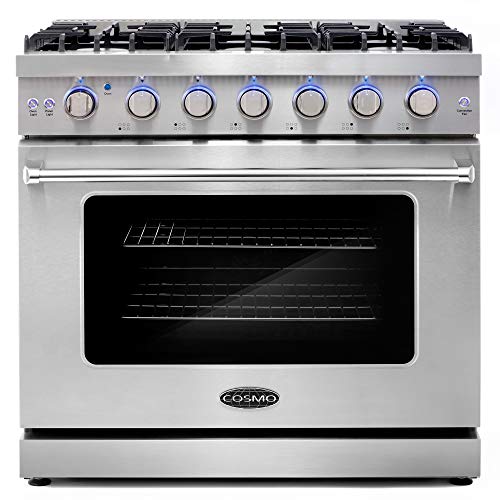
Cosmo Gas Range
Cosmo occupies the style-forward, value-conscious corner of the gas range market, with designs that borrow the visual cues of professional ranges at a more accessible tier. For buyers remodelling a kitchen around a bold centrepiece, that look is the draw, and the cooktop layouts generally follow the multi-burner pattern home cooks expect. It suits confident buyers who have read the ownership basics, checked service options in their area, and know exactly which size and fuel configuration they need. Buyers who want the deepest local service network or the longest track record in this category may be happier with one of the long-established brands.
Best for: cooks whose habits match the strengths described above, and whose kitchen, fuel supply and installation plan have been confirmed with a licensed professional before ordering. Not suited for: buyers whose priorities point the other way on controls, oven style or service network, because living with the wrong fit costs more than choosing carefully now. As with every pick in this guide, treat the listing as a starting point, confirm the exact configuration and dimensions against your space, and check price on Amazon or with your chosen retailer when you are ready to compare current offers.
Which Burner Layout Suits Your Cooking?
Ignition sounds like a detail until it misbehaves. Modern gas ranges light electronically, and a healthy burner lights promptly with a steady blue flame. Yellow tipping, lazy ignition or a burner that pops and struggles are all signs to have the appliance checked rather than tolerated. Owners should know the normal sound and look of their burners the way drivers know the normal sound of their car, because changes in flame behaviour are the earliest, clearest signal that cleaning or professional attention is due, and catching them early keeps small issues small.
For bakers, the questions are about evenness, rack positions and how the oven recovers after the door opens. For sauce cooks, everything is about the lowest stable flame and a burner small enough for a little pan. For entertainers, oven capacity and a centre burner or griddle zone decide the matter. Naming your cooking style honestly, before you read a single review, turns a confusing market into a short list, because most disappointment with a range comes from buying for a cook you are not, rather than from any flaw in the appliance itself.
Oven capacity numbers only become real when you picture your largest actual cookware. A big roasting pan with handles, a deep Dutch oven with its lid, or two trays side by side are the honest tests, and they depend on usable width and rack spacing more than on a headline figure. If you bake large batches or host holidays, take the pan measurements to the showroom or compare them carefully against the cavity dimensions in the manual. An oven that swallows your real cookware without tilting or scraping is worth more than a nominally larger one that does not.
How to Prioritise by Use Case
Rack positions and rack quality are small details with daily consequences. Sturdy racks that slide without tipping, a position low enough for a tall stockpot and high enough for proper browning, and handles or stops that feel secure with a heavy, hot dish all separate thoughtful ovens from adequate ones. Some models add a gliding rack on bearings, which heavy casserole cooks genuinely appreciate. Check the racks with the same seriousness as the burners, because you will trust them with the heaviest, hottest loads in your kitchen while wearing oven gloves.
A centre oval burner or a fitted griddle divides households. For pancake Saturdays, big breakfasts and tortilla warming it can be the most-used part of the cooktop, while cooks who rarely make those foods gain an awkward long burner that complicates pan placement. Be honest about your last twenty breakfasts before paying for the feature. If a griddle is your world, look for even heating across it and a surface that cleans without drama; if it is not, a simple four or five burner layout with generous spacing may serve you better every day.
Gas Safety: Installation, Ventilation and Daily Habits
Installation is professional work, full stop. A gas range must be connected to the gas supply, and that connection, along with leak testing of every joint, must be carried out only by a licensed or certified gas fitter or installer working to your local code. This guide will never walk you through connecting a gas line yourself, because a joint that seems fine can leak slowly into a closed kitchen. Budget for proper installation from the start, keep the installer’s paperwork, and treat anyone who suggests a casual do-it-yourself hookup as a reason to walk away.
An anti-tip bracket is a small piece of hardware with a serious job. It anchors the range so the appliance cannot tip forward if weight lands on an open oven door, and it must be fitted as part of a proper installation. Ask your installer to confirm it is in place, and check it again any time the range is moved for cleaning or flooring work and then pushed back. It takes seconds to verify and it prevents one of the most dangerous accidents a range can be involved in, especially in homes with children.
Every gas household should have a working carbon monoxide detector, and a kitchen with a gas range is no exception. Fit detectors where the manufacturer and your local guidance direct, test them on the schedule the instructions set out, and replace them at the end of their stated life rather than when they fail. Carbon monoxide cannot be seen or smelled, so the detector is not an optional extra or a box to tick once; it is a permanent part of cooking on gas, as normal and as necessary as a smoke alarm elsewhere in the house.
If you ever smell gas strongly, hear hissing near the appliance, or feel unwell in a way that clears outdoors, stop and treat it as urgent. Do not light anything, do not operate electrical switches, leave the building, and contact your gas supplier’s emergency line or local emergency services from outside. Those steps are the whole procedure for a householder; investigating a suspected leak yourself is not part of it. Leak detection and repair belong to the gas supplier and licensed professionals, and no recipe, schedule or dinner guest is worth improvising around that rule.
Day-to-day vigilance is simpler and calmer than emergency procedure. Keep the area around burners clear of towels, packaging and loose sleeves, never leave a lit burner unattended with oil heating, and make a habit of glancing at the knobs when you leave the kitchen so an unlit but open burner is caught immediately. Many modern ranges add flame-failure features on some markets, but habits remain the foundation. Gas cooking is safe in millions of homes precisely because those households treat small, boring routines as non-negotiable rather than as fussiness.
Controls, Convection and Smart Features Weighed
Air fry modes inside gas ovens have become common, and they are best understood as energetic convection with a marketing name. Used with a suitable tray and sensible spacing, the mode crisps frozen foods and vegetables well and saves heating a separate countertop appliance. It does not change the fundamentals: food needs air around it, batches need room, and results depend on the fan and cavity design. Treat the mode as a useful bonus on a range you already like, rather than a reason to choose a model whose burners or oven disappoint you.
A temperature probe, where fitted, is one of the few features that reliably improves results for roast cooks. Taking the guesswork out of a large joint or a holiday bird prevents both dry meat and anxious carving, and it frees you from opening the door repeatedly and losing heat. If you roast often, probe availability is worth weighing; if your cooking rarely involves large pieces, it will sit in a drawer. As with every feature on a modern range, the question is never whether it is clever, but whether your calendar will actually use it.
First Setup and Care Essentials
Finishes are a practical decision disguised as a style one. Stainless steel hides in most kitchens and shows fingerprints in all of them, black finishes can flatter the flame and hide light soiling, and white remains the easiest to judge for cleanliness at a glance. Pro-style ranges add visual weight that small kitchens must be able to carry. Whichever you choose, confirm that the finish is applied to the parts you touch daily, knobs and handles included, and think about how the surface will look after a year of wiping rather than a minute of showroom lighting.
The oven door and window deserve a moment of testing. A door that opens smoothly, stays where you leave it and seals evenly keeps heat in and tempers out of faces and arms. A large, clear window plus a bright oven light lets you check browning without opening the door and dumping heat, which matters for cakes and souffles alike. On divided ovens, check how the doors or drawers for each section operate with full hands. These are the interactions you repeat thousands of times, and small friction here compounds into lasting irritation.
Top Picks at a Glance
The table below positions the ranges in this guide by tier and best fit, in words rather than prices, so you can shortlist by lifestyle before comparing current listings.
| Range | Tier | Best fit |
|---|---|---|
| Samsung Flex Duo Gas Range | Premium tier | Divided-oven flexibility |
| LG ProBake Gas Range | Mid to premium tier | Even baking focus |
| GE Profile Gas Range | Mid to premium tier | Connected features and support |
| Frigidaire Gallery Gas Range | Accessible tier | Everyday value with convection |
| Bosch 800 Series Gas Range | Premium tier | Design-led built-in look |
| Cosmo Gas Range | Accessible to mid tier | Pro-style looks |
Deeper Considerations Before You Decide
Smart and connected features split buyers cleanly. Remote preheating, timer alerts on your phone and voice control genuinely help households that cook while doing three other things, and they add cost and complexity that other households will never touch. There is no correct answer, only an honest one. If you choose a connected model, set it up properly during the first week while the manuals are out, connect the features you will use, and ignore the rest without guilt. If you choose a simple model, enjoy the fact that there is nothing to update.
Levelling and stability sound like installer trivia and turn out to be cooking quality. A range that is not level pools oil to one side of every pan, bakes unevenly in ways owners blame on the oven, and can rock under a heavy pot. Proper installation includes levelling the appliance and confirming the anti-tip bracket, another reason the professional visit matters beyond the gas connection itself. Once installed, resist sliding the range casually for cleaning; if it must move, recheck its level, its bracket and its stability when it goes back into place.
Delivery day has its own checklist. Measure the route again, protect floors, and have the old appliance’s removal arranged lawfully and safely, remembering that disconnecting a gas appliance is also professional work. When the new range arrives, inspect it before the installer begins, confirm the model and fuel configuration match your order, and keep every manual and document together. A calm, prepared installation day, with the licensed fitter booked and the kitchen cleared, is the unglamorous foundation under years of good cooking, and it is worth organising with the same care as the purchase itself.
Temperature accuracy in the oven is best verified, not assumed. An inexpensive oven thermometer, checked in a couple of positions after a thorough preheat, tells you whether your particular oven runs true, and most ovens can be calibrated following the manual if they drift. Bakers especially should do this in the first fortnight, before blaming recipes. Keep notes from your first bakes: rack position, mode, and result. That small log turns the learning curve of a new oven from months of guesswork into a few weeks of deliberate, delicious experiments.
The sound of the ignition and the feel of the flame adjustment become part of your cooking instincts. Within a few weeks you will know the click pattern of a healthy light, the look of the lowest stable simmer and the exact knob position for your favourite pan of eggs. That familiarity is an argument for choosing a range you enjoy interacting with, not merely one that wins on paper. Appliances you like get maintained; appliances that irritate get neglected. Enjoyment, in a working kitchen tool, is a practical quality rather than a luxury.
Think about the second decade as well as the first month. Grates chip, igniters age, knobs loosen and oven door seals soften, and the ranges that age gracefully are those whose makers keep supplying these ordinary parts. Before buying, glance at the availability of replacement grates, caps and gaskets for the model family, and note the local service options one more time. A range is infrastructure, not a gadget cycle purchase, and choosing for maintainability is the quiet decision that separates satisfied long-term owners from people shopping again too soon.
Griddle plates, wok rings and simmer plates are the accessories most worth considering, and only when they match your cooking. A maker-supplied wok ring that seats a round-bottom wok securely over the flame transforms stir-frying; a generic ring that wobbles is a hazard. Simmer plates can help very small pans and delicate sauces, used as the manufacturer directs. Buy accessories from the range maker’s own range first, confirm compatibility in writing, and resist the drawer full of universal gadgets that fit nothing well. The best accessory is the one designed for your exact cooktop.
Holiday cooking is the stress test that reveals whether a range suits a household. Two oven dishes at different temperatures, four burners busy, the broiler finishing a topping and a cook who is also hosting: that hour explains the value of oven space, burner spacing and controls you can read at a glance. When you shortlist models, walk each one through your biggest real meal of the year, dish by dish and burner by burner. The range that handles that menu calmly, on paper, is very likely the range that will handle it calmly in November.
A final word on expectations: no domestic gas range does everything perfectly. The strongest searing burner rarely simmers the most gently, the largest oven is rarely the quickest to preheat, and the prettiest front is rarely the easiest to keep spotless. Mature buying means choosing which compromises you will enjoy living with, because you agree with the priorities behind them. Read the critical sections of any guide, including this one, as a map of those compromises, and the model that emerges as your best fit will usually be obvious and, more importantly, durable.
Energy behaviour at home is mostly about matching burner to pan. A small pan on the largest burner wastes heat around its sides and can overheat handles, while a huge pot on the smallest burner takes forever and cooks unevenly. Centring pans, using lids for anything that simmers, and bringing liquids to the boil before dropping to a gentle flame are habits that save fuel and improve results at the same time. None of this needs special equipment; it is simply the craft of cooking on an open flame, learned in the first month and used for years.
Noise and feel are legitimate buying criteria that never appear in advertisements. Some ranges click persistently as they reignite to hold temperature, some oven fans run louder than others, and some knobs feel precise while others feel vague between settings. If you are sensitive to kitchen noise, or you cook in an open-plan space where the range shares air with the living room, weigh these qualities seriously. Reading owner discussions with an eye for repeated comments about sound and control feel will tell you more than any showroom visit, where the appliance is never actually lit.
Resale and renovation thinking can sharpen a decision. A standard size, a neutral finish and a widely serviced brand protect the value of a kitchen if you sell, while an unusual size or colour is a personal pleasure you should buy with open eyes. Landlords and renovators often choose simpler models for exactly this reason, and owner-occupiers who cook seriously choose the opposite, and both are right. The mistake is only in mixing the logics: paying a premium for a statement appliance in a kitchen you plan to sell, or economising on the range in a home you will cook in for decades.
Warranties deserve a plain reading before purchase. Note what is covered, for how long, and what counts as a service call in your area, and keep the paperwork with the installation documents. A slightly longer or clearer warranty from a brand with local technicians can be worth more than a small feature difference, because the cost of a range is not only its purchase tier but the disruption when it stops working. Register the appliance if the manufacturer asks, store the model and serial details somewhere findable, and future you, standing in a kitchen with a cold oven, will be grateful.
Second-hand gas ranges deserve special caution, and the caution is simple: any used appliance still needs professional installation and leak testing in its new home, and its history is unknown in ways that matter for gas parts. Valves, igniters and flexible connectors age, and a bargain that needs several professional repairs is not a bargain. If you do buy used, factor the licensed installation and a professional inspection into the true cost from the start, and be ready to walk away if the numbers stop making sense. New appliances with full support exist at accessible tiers for a reason.
Finally, remember that a range is bought for a household, not a person. The tallest cook and the shortest, the baker and the stir-fry enthusiast, the adult who cleans and the teenager learning to fry an egg all have to live with the choice. Front or rear controls, knob stiffness, oven light brightness and how the door handle feels are shared experiences. Letting the household handle the shortlisted models, even briefly in a showroom, surfaces preferences no single shopper would think of, and it turns the final decision into one the whole kitchen can stand behind.
Daily care is mostly about timing. A quick wipe of the cooktop surface once everything has cooled completely takes a minute and prevents the cooked-on film that makes deep cleaning miserable. Keep a dedicated cloth for the range so grease does not travel around the kitchen, and deal with sugary spills promptly once the surface is safe to touch, because sugar is the spill most likely to set hard and stain finishes. Small, regular attention is the entire secret behind ranges that still look cared for after years of heavy family use.
Practical Notes From Everyday Use
Grates respond best to soaking and patience rather than aggression. Once cool, lift them as the manual directs, soak them in hot soapy water, and work on softened deposits with a non-scratch pad. Abrasive powders and metal scourers can damage enamel coatings, and damaged grates then rust and stain more easily, so gentler and longer beats harsher and faster. Dry grates thoroughly before they go back, and never put a wet grate back over a burner you are about to light, because trapped moisture and heat are poor companions.
Burner caps and heads need the lightest touch of any part of the range. Food deposits around the ports affect how evenly the flame burns, so keep them clean using the method the manufacturer describes, typically a soft brush or cloth and, only where the manual allows, a gentle clearing of the ports. Do not soak parts that the instructions say to keep dry, do not enlarge or force anything through the ports, and let everything dry completely before reassembly. A clean, dry, correctly seated burner lights promptly and burns with the steady flame you expect.
The oven interior asks for a different strategy. Many gas ranges offer a self-cleaning cycle or steam-assisted cleaning, and both come with instructions about removing racks, locking the door and ventilating the room that must be followed exactly. Households that prefer manual cleaning should use products the manufacturer approves for the cavity finish, with the range cool and the room ventilated. Never apply cleaners to a hot oven, and never use the oven’s own heat to speed up a chemical clean unless the product and the manual both explicitly describe that method.
Knobs, control panels and glass need restraint. Remove knobs only if the manual says they come off, wash them gently, and make certain they are dry and correctly oriented before refitting, because a knob pushed back carelessly can mislead the next cook about whether a burner is off. Glass cleaner belongs on a cloth, not sprayed directly at a control panel where liquid can creep behind it. Stainless finishes wipe best along the grain with a soft cloth, and the reward for that small discipline is a front panel that stays clear and legible for years.
A sensible rhythm keeps all of this light. Wipe the surface after cooking days, soak grates weekly if you cook daily, check burner flames whenever you clean so changes are spotted early, and give the oven a proper clean on a seasonal rhythm or after any major spill, whichever comes first. Write the rhythm on the calendar the way you would any other household maintenance, and cleaning a gas range stops being a dreaded project and becomes a set of small, known tasks that protect both the appliance and the quality of everything it cooks.
A gas range puts an open flame under your cookware and a gas-fired oven below it, and that directness is why many cooks refuse to give it up. Heat changes the moment you turn a knob, with no waiting for an element to cycle up or down, and you can see the size of the flame and judge it at a glance. That visual, immediate control shapes everything from a rolling boil to the gentlest melt, and it is the starting point for understanding both the strengths and the responsibilities that come with cooking on gas.
Low heat is where a good gas range quietly earns its keep. A small, stable flame that does not keep flaring or dying lets you hold a custard, a risotto or a delicate sauce at the edge of a simmer for as long as the dish needs. When you test ranges in a showroom you cannot light them, so read the burner layout carefully, look for a dedicated small burner rather than one oversized burner expected to do everything, and plan to judge simmer behaviour in the first week of ownership while adjustments are still easy to arrange.
Before You Buy: A Gas Range Fit, Space and Routine Checklist
The purchase is the easy part. A gas range proves itself at the kitchen run, connected to gas and ventilation, in the middle of daily hob cooking plus oven meals that anchor family eating, long after the packaging has gone. Judge in this order: routine first, space second, features last. Reversing that order is how most disappointing purchases of a gas range begin. The first check is the burner layout against your largest pans and the oven size against your trays, and it outranks everything else, because no styling or extra capacity compensates when that basic fit is wrong. Long-term performance usually comes down to whether you keep up with one routine: keeping burners and caps clean, checking grates sit level and wiping spills before they carbonise. Decide honestly whether your household will do it before you rely on it.
Guides can only rank products in general terms. This section ranks your questions, which is the part no general guide can do for your particular home. For something used every day, durability and fit deserve the larger share of your attention, because the purchase happens once and the using happens hundreds of times. Beware of solving a problem you do not have, because the largest or most elaborate version of a gas range adds cleaning, storage and cost in effort to a routine a simpler version would have served perfectly. Check what the purchase does not include, because the missing mat, fitting, filter, cover, tool or connector discovered after delivery is a small cost and a large irritation.
- Settle the weekly care routine and the storage or drying spot in advance.
- List three must-do jobs and the single compromise you are willing to live with.
- Check what is included in the current listing and what you must supply.
- Confirm the first two fit checks against your own home, not a showroom.
- Measure the real space, including every clearance the item needs in use.
Spaces lie in photographs and tape measures do not, so record the available dimensions, the swing and access clearances, and the route the gas range takes through the door before it ever arrives. Try this decision exercise: write down three non-negotiable jobs, one acceptable compromise and one walk-away flaw. If a candidate survives that list, it deserves its place on the shortlist. Notice when the gas range will be used in a hurry and when it will be used with time to spare, because speed and ceremony reward different designs. Anything heavy, hot, sharp, load-bearing or electrically powered deserves a respectful pause in the decision, and the maker’s own guidance, read before purchase, is part of the specification.
Consider what the gas range gives off while it works and what it leaves behind afterwards, because living with the by-products is part of living with the product. Think about handing the task over: if someone else had to use, clean or reset the gas range from your brief description alone, the design and your setup would pass or fail together. First impressions flatter almost everything. The one-month verdict, after the routine has tested the gas range properly, is the opinion worth trusting and acting on. Plan the end at the beginning: a gas range should be repairable, passable on, recyclable or at least easy to dispose of responsibly when its service ends, and designs differ widely on this.
Frequently Asked Questions
What should I do if a burner will not light properly?
Start with the simple, safe checks: make sure the burner cap and head are clean, completely dry and seated exactly as the manual shows, because moisture or a crooked cap after cleaning is the most common cause. If the burner still lights lazily, burns unevenly or shows a lot of yellow flame, stop experimenting and arrange professional service. Ignition and gas delivery are not areas for household improvisation. Noting when the problem started, and whether it followed cleaning, helps the technician solve it quickly.
How often does a gas range need professional servicing?
There is no single interval that suits every home, but a reasonable pattern is to have the appliance checked whenever flame behaviour changes, ignition becomes unreliable, or anything smells or sounds different, and otherwise on the rhythm your manufacturer or installer recommends. Heavy daily use justifies more frequent attention than occasional weekend cooking. Between visits, your own observations do the early-warning work: steady blue flames, prompt ignition and familiar sounds are the baseline, and any drift from that baseline is the signal to book a professional rather than wait.
Can I use my existing pans on a gas range?
Almost certainly yes, which is one of the quiet advantages of gas. Cast iron, carbon steel, stainless steel and aluminium all work over a flame, and slightly warped bases that struggle on flat glass cooktops usually sit acceptably on grates. Very small pans may need care on wide grates, and delicate glass or clay pieces should be protected from fierce direct heat. Check that your largest pan fits the burner layout with room for neighbouring pots, because that single measurement predicts everyday happiness better than any other cookware test.
Does a gas range need a range hood?
A good hood, vented outdoors where possible, is strongly recommended and in some places required by code. Cooking on gas releases heat, moisture and combustion by-products, and the hood is what removes them, protecting your air, your cabinets and your comfort during long cooking sessions. A weak recirculating hood is better than nothing but is not the equal of proper extraction. Treat ventilation as part of the range project when you budget and plan, and size and position the hood following professional guidance for your kitchen layout.
Is a gas range safe to use in a family home?
Yes, when it is installed and used properly, as millions of households demonstrate every day. The foundations are professional installation with leak testing by a licensed fitter, a fitted anti-tip bracket, working carbon monoxide detectors, sensible ventilation and calm habits around open flame. Children need clear rules and supervision, and any strong smell of gas means leaving the building and calling the emergency line from outside. Safety with gas is a system of small, ordinary precautions, and households that keep those routines find cooking on gas completely unremarkable.
Do I need a professional to install a gas range?
Yes, always. Connecting a range to the gas supply and testing every joint for leaks is work for a licensed or certified gas installer, and in many places it is a legal requirement as well as a safety one. The same visit should confirm the anti-tip bracket is fitted and the appliance is level and correctly set up for your fuel. This guide deliberately gives no do-it-yourself connection instructions. Book the installer before delivery day, keep the paperwork, and treat proper installation as part of the price of the appliance.
Related Guides
Keep exploring with these companion guides from the same kitchen series: gas range review, gas range reviews compared, gas range pros and cons, how to choose a gas cooktop, gas cooktop buying guide, best gas cooktops for everyday cooking, best 36 inch gas cooktops compared, cookware sets that suit a gas stove, Samsung gas cooktop options. Each one takes a different angle on cooking with gas, so together they cover choosing, comparing, using and caring for the appliance at the centre of the kitchen.


