Disclosure: As an Amazon Associate, airfryerkitchensupply.com earns from qualifying purchases. Links on this page are affiliate links; they cost you nothing extra. Prices and availability change often, so check the current Amazon listing before you buy.
This garden edging buying guide walks you through choosing edging the way a landscaper would specify it: start with the border’s job, then the soil and grass you are fighting, then the material, and only at the end the product. Garden edging looks like one of the simplest purchases in the garden centre, yet it fails in predictable ways — wavy lines, lifted strips, grass marching underneath — almost always because the format was wrong for the ground, not because the product was badly made. Below you will find the main types explained plainly, the questions that actually decide a purchase, profiles for common gardens, mini-reviews of the six reference products, and the setup and care basics that determine whether any of them succeed.
Key Takeaways From This Garden Edging Buying Guide
- Depth is the specification that matters most: tidying a line needs little; stopping running grass needs a genuinely buried barrier.
- Geometry picks the material: coils for curves, boards and steel for straights, sections for short runs and repairs.
- Plastic is a consumable, metal is an investment: buy the tier that matches how long the garden itself will stay unchanged.
- Installation effort is part of the price: a cheap product in a badly dug trench loses to a modest product installed carefully, every time.
- Safety is a buying criterion: call 811 before any trench, and on metal, insist on a safe top edge, capped ends and a flush finish.
In this guide
What Garden Edging Does and the Main Types
Flexible Plastic Coil Edging
The coil is the default home-garden format: a long flexible strip, trenched shallowly or laid no-dig with spikes, finished with a rounded bead at the top. It exists to make curved beds tidy and to hold mulch in place at the lowest cost per length. Its virtues are speed, forgiveness and curve handling; its vices are a tendency to wave if installed carelessly, vulnerability to ultraviolet ageing, and shallow anchoring that determined grass can undermine. Within the family, wall thickness and bead size separate the satisfying products from the frustrating ones more than any branding does.
Rigid Plastic Boards and Pound-In Sections
Rigid boards — the terrace-board style — trade flexibility for a straight, chunky, knock-resistant line, and suit vegetable plots, drives and working borders. Pound-in sections trade continuity for convenience: individual pieces driven with a mallet, ideal for tree rings, short runs and repairs. Both are plastic, so both eventually age in sun, but their thickness gives them a longer, tougher service life than thin coil. Boards need a trench to shine; sections need firm soil to grip. Together they cover most of the middle ground between the coil aisle and the metal shelf.
Steel and Aluminium Edging
Metal is the professional format: straight lengths, joined and staked, finishing flush to give the crispest line in the category and the longest service life by far. Steel is stiff, trimmer-tolerant and comparatively affordable among metals; aluminium is lighter, easier to cut and immune to rust, at a higher tier and with slightly less resistance to dents. Both demand respect in handling — edges can be sharp, gloves are essential, cut ends need capping or burying — and both reward precise levelling, because a metal line shows every error a coil would hide. Buy metal when the garden is permanent and the line is part of the design.
Masonry, Timber and Living Edges
Brick-on-edge, stone, sleepers and even a maintained trench-cut soil edge all border a garden without a strip product at all. They suit some plots beautifully — a cottage garden with a hand-cut edge and a half-moon tool kept sharp is a legitimate, product-free system — but they are projects rather than purchases, with their own costs in labour and upkeep. This guide concentrates on strip and band products; if your heart is set on masonry, treat it as small construction, with foundations and drainage to match.
Top Picks at a Glance
Six reference products anchor this guide. Confirm specifications on the current listing before buying, and judge each by the physical basics its review names.
- Best Overall for most homes: Dimex EasyFlex No-Dig Landscape Edging — the forgiving all-rounder for curved beds.
- Best Permanent: Coyote Landscape Steel Edging — the decades-long line for designed gardens.
- Best for Lawn Edges: EverEdge Metal Lawn Edging — drive-in metal sections for refreshing tired edges.
- Best for Utility Borders: Master Mark Plastics boards — straight, tough, and unbothered by knocks.
- Best for Quick Jobs: Gardeneer by Dalen HammerEdge — pound-in sections for tree rings and repairs.
- Best Budget Length: Amazon Basics Landscape Edging Coil — maximum metres for large, low-stakes projects.
How Deep Does Your Edging Need to Go?
Depth is really two questions. How deep do the grass roots and stems you are fighting actually travel — because the barrier must pass below them — and how much anchoring does your ground need to hold a line through frost and rain? For a bed beside clumping ornamental grasses or a path, a shallow strip or spiked no-dig foot is plenty. For a lawn of running grass pressing against a flower bed, only a properly buried band works, and even then it works as part of a system with a maintained cut edge. Gardeners routinely buy shallow products for deep problems because the shallow products are easier to install; the disappointment is structural, not bad luck. Be honest about which job your border needs, and the depth — and therefore the format — chooses itself.
How Much Does Curve Versus Straight Matter?
Enormously, and it is the second decision to lock. Walk your borders and classify each run: flowing curve, gentle sweep, dead straight, or short connector. Coils own the first, sections handle the second and fourth, boards and steel own the third. Mixed gardens — most real gardens — often justify two products: coil for the beds, steel or board for the path and drive lines. Trying to force one product around every geometry is how wavy straights and kinked curves happen. Note also that curves consume more length than the straight-line distance suggests; measure with a rope laid along the actual line before ordering anything.
How Long Should It Last — and What Ages It?
Three forces age edging: ultraviolet light, which embrittles plastic over seasons; frost heave, which lifts every material a little each winter and tilts lines over years; and contact, because mower wheels and string trimmers scar, dent and eventually cut most edging. Metal shrugs off the first and third and can be re-levelled after the second for decades. Thick plastic resists contact reasonably and ages slowly in shade. Thin coil in full sun on a frost-prone plot lives the hardest life in the category. None of this is a scandal — it is a service-life ladder, and the buying skill is matching the rung to your horizon: a garden you will rework in three years should not carry thirty-year edging, and a permanent garden should not be re-edged every few seasons because the first purchase was priced like a consumable.
How Much Installation Can You Honestly Take On?
Be realistic about the install, because installation quality is the largest single factor in how edging looks and lasts. No-dig and pound-in formats ask for a cleared line, a mallet and an hour or two. Trenched plastic and boards ask for a marked line, a spade, a level, staged backfilling and most of a day for a typical garden. Steel asks for all of that plus patience at the joints and care with sharp edges throughout. Renters and first-timers should start at the easy end and earn their confidence on one bed. And whatever the format, one step is not optional: before any digging, call 811 (or your local equivalent) so buried utilities are marked — edging trenches run exactly where shallow services hide.
How to Prioritise by Use Case
The new gardener with curving beds and a modest budget should buy a decent no-dig coil, install one bed beautifully, and learn the craft before edging the whole plot. The homeowner building a permanent front garden with straight lines and gravel should go straight to steel, installed once and levelled properly, because the line is the design. The vegetable grower should buy rigid boards for straight, knock-proof plot edges that survive wheelbarrows and boots. The gardener refreshing a tired lawn on good soil should look at drive-in metal sections. The renter should buy pound-in sections or coil — removable, cheap, and kind to a deposit. Each profile spends differently, and each is right; the buying guide’s job is to stop each of them buying the others’ product.
The Six Reference Products in Mini-Review

Dimex EasyFlex No-Dig Landscape Edging
Best for: beginners, curves and flat flower beds. Not suited for: slopes and running-grass walls. Strengths — fast reversible installation, graceful curves, a tidy beaded line. Trade-offs — shallow anchoring, plastic ageing in sun. Entry tier. The default first purchase for most homes, and the benchmark every other no-dig product is compared against.
Coyote Landscape Steel Edging
Best for: permanent straight runs, gravel paths and designed gardens. Not suited for: tight curves and rushed weekends. Strengths — crispest line in the category, decades of service, trimmer tolerance. Trade-offs — sharp edges needing gloves and capped ends, precise levelling, the slowest install here. Premium tier, justified by lifespan.
EverEdge Metal Lawn Edging
Best for: refreshing lawn edges on firm, stone-free soil. Not suited for: stony ground or deep root barriers. Strengths — metal longevity without a trench, flush mowing line, sections that follow gentle curves. Trade-offs — grip depends on soil, moderate depth. Mid-to-premium tier.
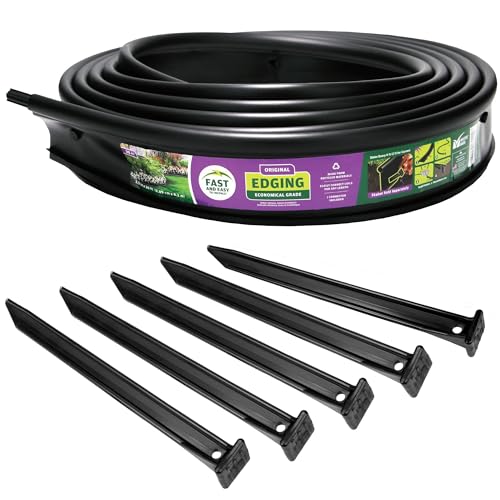
Master Mark Plastics Landscape Edging
Best for: vegetable plots, drives and straight working borders. Not suited for: serpentine beds. Strengths — thick, straight, knock-resistant boards that double as shallow retention. Trade-offs — trench installation, functional looks, eventual ultraviolet ageing. Entry-to-mid tier with excellent durability for the money.

Gardeneer by Dalen HammerEdge Edging
Best for: tree rings, short runs, repairs and renters. Not suited for: long formal lines. Strengths — the fastest install in this guide, piece-by-piece repairability. Trade-offs — shallow anchoring, slight stepping possible on uneven ground. Entry tier.

Amazon Basics Landscape Edging Coil
Best for: edging a whole back garden on a budget. Not suited for: showcase front beds. Strengths — length for the money, standard coil convenience and curve handling. Trade-offs — judge thickness and stakes in hand; expect normal plastic ageing. Entry tier, the value end of the market.
First Setup and Care Essentials
Setup success is decided before the edging leaves its packaging: mark the line with a rope, live with it overnight, clear turf and roots from the strip, and — for anything involving a trench — call 811 first and have utilities marked. Handle metal with gloves from the first minute, plan where cut ends will be capped or buried, and aim for a finished top edge flush with the ground, especially anywhere near a walkway, so the edge can never act as a raised blade or trip lip. Backfill in stages and firm as you go; loose backfill is an anchor that has not happened yet. Care afterwards is a rhythm, not a burden: a spring walk to tap frost-lifted sections back to level, a check after the first mows for trimmer damage, mulch raked back after storms, and an occasional inspection of joints and plastic surfaces for the chalkiness that signals ageing. The full method is in how to install garden edging.
Mistakes to Avoid
The expensive mistakes repeat across gardens. Buying shallow edging to fight deep-rooted running grass. Forcing rigid products around curves or coils along showcase straights. Under-measuring, then running short with a trench open. Skipping the utility check before digging. Leaving a metal edge proud beside a path. Staking too sparsely on a slope. And judging every product by one criterion — usually price per length — when service life per length is the number that matters. Avoid those seven and almost any product in this guide will serve you well. For the counter-argument before you spend anything, read garden edging pros and cons and is garden edging worth it; for product-by-product depth, see our garden edging reviews. Finish the space beyond the border too — best patio table and chairs for a finished outdoor corner shows how an edged planting frame lifts a whole seating corner.
Edging by Border Type: A Specification for Every Line in the Garden
Lawn-to-bed borders are the classic purchase and the most forgiving: the job is line, mulch and moderate grass defence, the geometry is usually curved, and almost every format in this guide can succeed if its depth matches the grass. Specify coil or sections for curves, boards or steel for straights, and set the top edge flush for the mower. Path borders are sterner: they hold back gravel or soil against foot traffic, so firmness and depth outrank flexibility, and the flush rule becomes a safety rule, because a path is where a proud edge trips someone. Driveway borders are the sternest of all, with tyres and turning wheels in the load case; thick boards or steel only, anchored deep, corners expected to need attention over the years.
Tree rings are a special case disguised as a simple one. The circle must expand as the root flare grows, which promotes sectional and coil formats that can be lifted, widened and reset in an hour, and demotes rigid rings that turn into a slow conflict with the tree. Keep the ring clear of the flare itself and mulch inside it lightly. Borders against walls and fences are mostly about a clean mowing strip and keeping mulch off masonry: almost any format works, shallow included, and the main specification is a finish that lets you trim without scarring the wall. Borders on slopes, covered elsewhere in this guide, are an anchoring specification first and a product choice second. Read your garden as a set of these border types and the buying list practically writes itself — often with two products on it, which is a sign of a garden understood, not a budget failed.
Understanding Specifications Without a Datasheet
Edging is sold with fewer hard numbers than most garden products, so buyers must learn to read physical evidence instead. Length per pack is stated and matters — measure your runs with a rope and compare honestly. Height of the strip matters more than most labels admit: the visible reveal is a small part of it, and the below-ground portion is what anchors and blocks roots, so a taller strip is generally a deeper-working product. Wall thickness on plastic is rarely printed and must be judged in hand — flex the sample, look at the bead’s profile, compare against a known brand. On metal, the equivalent evidence is the top edge: folded or rolled profiles signal a product designed to be handled and lived with; a raw edge signals the opposite, whatever the paint promises.
Stake and connector counts are the specification most often quietly short. A kit’s included stakes may assume firm flat loam at generous spacing; slopes and soft soils need closer spacing, and running short mid-install produces exactly the wavy, bowing lines buyers blame on the strip. Count what the box includes against what your ground demands before purchase, not during installation. Finally, treat every unverified number with suspicion: this guide deliberately avoids quoting dimensions it cannot confirm, and buyers should prefer products whose physical basics they can inspect over products whose marketing is merely louder.
Edging and Garden Design: Lines That Earn Their Keep
A buying guide that ignores design undersells the purchase, because the line you choose will organise how the whole garden is read. Straight metal lines belong to contemporary and formal designs, where geometry is the aesthetic and a crisp edge is load-bearing. Flowing coil lines belong to cottage and informal planting, where the edge should tidy without announcing itself. Hidden installation — top edge just below the surface — suits naturalistic gardens that still need grass control, trading the visible line for invisibility while keeping the barrier’s work. The design question to answer before buying is whether the edge is a feature, a servant or a secret; each answer points at different products and different installation depths.
Repetition is the designer’s trick worth copying: the same edge treatment repeated around every border unifies a garden more cheaply than any planting scheme, which argues for choosing one family per garden zone and sticking to it. Mixed materials are fine across zones — steel at the formal front, coil in the relaxed back — because visitors read zones separately. What reads as carelessness is variation within a single run: a border that changes product halfway looks repaired rather than designed. Buy enough of one product to finish each run completely, including the margin for mistakes, and let repetition do the unifying work.
Seasonal Buying and Installation Timing
When you buy and install matters more than most guides admit. Soil in the shoulder seasons — spring after the worst wet, autumn while the ground is still warm — digs cleanly, levels honestly and firms predictably. Mid-winter waterlogged soil smears and settles; high-summer baked soil fights every spade and hides its soft spots until rain finds them. Installing into bad soil manufactures the waviness and lifting that buyers later blame on frost and product. If a promotion tempts you to buy in the wrong season, buy then by all means — but store the product and install when the ground cooperates; edging keeps in its packaging far better than it performs in a bad install.
Season also steers material handling. Coils unroll flattest after warming in sun, which makes a bright installation day a genuine tool. Metal is season-neutral to handle but miserable to level into frozen or sodden ground. Frost-prone regions should avoid installing immediately before the hardest freezes, not because new edging is fragile but because its first heave arrives before the backfill has fully consolidated, exaggerating movement. None of this requires a calendar superstition — just the ordinary respect for ground conditions that every landscaper in this guide’s research treated as non-negotiable.
Edging for Wildlife, Pets and Play
A buying guide for family gardens must price the non-human users. Dogs patrol borders and dig at fence lines; edging along a run needs anchoring that survives paws, and metal at a dog run should be specified with its top edge folded and its finish flush, because a running dog meets a border at speed. Cats, indifferent to all human geometry, will use any edge as a path — harmless to every material here. Children change the specification most: borders near play areas argue for plastic’s softer risk profile, or metal only where the flush finish and capped ends can be guaranteed and inspected, because the cost of a mistake is measured differently at ankle height in a play zone.
Wildlife considerations run the other way — the garden’s uninvited residents. A deep, continuous barrier slightly impedes ground-level movement for some creatures at the border line, a minor effect most gardeners will never notice, and gaps at path crossings remain open in any case. Hedgehog-friendly gardens can leave deliberate breaks at fence-line borders. None of the products in this guide presents a chemical concern to wildlife; the honest summary is that edging is one of the more benign interventions a gardener can make, provided its physical edges are managed with the same care owed to the human users.
The Total Cost of Ownership, in Words
Since this guide quotes no prices, it owes buyers the shape of the cost instead. The purchase itself is one line; the others are installation day labour (yours or hired), the small extras kits forget — stakes, caps, connectors — the annual spring reset measured in minutes, and eventual replacement for plastic formats measured in years. Spread across service life, metal’s premium tier frequently works out as the cheapest permanent border a garden can own, while plastic’s entry tier is the cheapest temporary one — and the expensive option, reliably, is the mismatch: premium product ripped out early by a changed layout, or bargain product replaced repeatedly in a permanent bed.
Buyers should also price the cost of not edging, because the comparison is not edging versus free. Unedged borders consume labour every season — re-cut lines, rescued mulch, excavated grass — and that labour has a value even when it is your own Saturday. For many gardens the honest arithmetic is that edging converts an endless small tax into a single project plus a small annual one. Where that conversion is worth making is the subject of the companion worth-it analysis; this guide’s narrower claim is that buyers who price all four lines — purchase, installation, upkeep, replacement — choose better tiers than buyers who price only the first.
Questions From Real Buyers, Answered Straight
Buyers ask whether edging can be installed over an existing messy border without clearing it, and the honest answer is that the clearing is the installation: every format in this guide sits on the ground it is given, and ground covered in root mat and rubble gives a wavy, unstable line. Buyers ask whether they can edge one side of a bed and leave the rest; they can, and phased buying is financially sensible, but a partially edged bed directs water and mulch migration toward its unedged exits, so phase by complete borders rather than by fractions of them. Buyers ask if premium steel can be cut with ordinary tools; it can, with a hacksaw, patience and a file for the cut end — plus caps, which belong in the same basket.
Buyers ask whether black is the only colour worth considering; it is the default because it disappears against soil and shadow, while brown and green variants serve gardens where the edge is meant to be seen against pale gravel or lawn. Buyers ask whether to edge before or after planting a new bed; before, always — the trench work and levelling belong to the empty-bed stage, and plants installed first will be disturbed by exactly the digging the edging needs. And buyers ask, most often of all, which single product this guide recommends — to which the guide replies, for the last time, with its method: the garden decides, and the sections above are how you hear its decision.
Edging for New-Build Gardens and Bare Plots
A bare plot is the one garden where edging decisions are both easiest and most consequential: easiest because trenches can be dug before a single plant complicates them, most consequential because the lines chosen now will organise every later phase. The buying advice for new builds is to edge the permanent structure first — paths, main lawn shapes, the borders that the design fixes — in materials matched to the plot’s final horizon, and to leave experimental beds unedged or cheaply edged until the planting plan settles. New-build soil is often compacted, rubble-laced subsoil wearing a thin costume of topsoil; the inspection step matters doubly, because anchoring into builder’s fill is unreliable and deeper, firmed installation earns its effort.
New builds also offer the one chance to coordinate edging with services before either is buried: irrigation, lighting and drainage can be routed with the borders in mind, and the utility-marking step becomes a design conversation rather than a warning. Gardeners who seize that chance report the smoothest installations in the category. Those who edge a bare plot casually, by contrast, discover in year two that they have permanently framed a layout they improvised in a weekend — the strongest argument in this guide for marking lines and living with them before any product is ordered.
Reading Reviews and Listings Like a Buyer, Not a Fan
Product listings in this category reward a sceptical reading method. Photographs show installation day, never year three; mentally weather every image before trusting it. Kit contents deserve arithmetic: divide included stakes by the product’s length and compare the spacing against your soil’s demands, because sparse staking is the hidden economy in many budget kits. Length claims should be checked against your rope measurement with margin to spare. Material descriptions should be translated into the physical evidence this guide has taught — wall, bead, top-edge profile, joint design — and where a listing will not show those details, the absence itself is information.
Owner reviews repay the same scepticism in the opposite direction: read the failures first and ask whether each describes the product or the installation, the ground or the geometry. A one-star review from a gardener who laid coil on a bank tells you about banks, not coils. A five-star review from a loam gardener with clumping grass tells you about loam. Your garden’s conditions are the filter through which every testimony must pass, and the buyers who read that way are, by the evidence of their own later reviews, the category’s most satisfied owners.
The Buying Guide’s Final Shortlist, by Garden
For the cottage garden with curving beds and a relaxed horizon: the Dimex EasyFlex, installed bed by bed, with the Amazon Basics coil as the bulk alternative for the back garden’s far reaches. For the formal or contemporary garden with straight runs and a permanent horizon: Coyote steel, bought once, installed slowly, with aluminium as the rust-free variant where pale paving makes staining a concern. For the working garden — vegetables, drives, play: Master Mark boards on the straights, Gardeneer HammerEdge sections for the odd corners and tree rings. For the tired lawn on good soil: EverEdge sections, driven in a weekend, transforming the mowing line by Monday.
Notice that the shortlist assigns every reference product in this guide a garden where it is the right answer, and no product a garden where it is the universal one. That is not diplomacy; it is the shape of the category. If your garden resembles two of these — most do — buy two products without a flicker of guilt, finish each run in a single material, and let the borders be judged individually, the way everyone who walks your garden will judge them anyway.
Edging Heights, Reveals and the Look of the Finished Line
Buyers fixate on length and forget height, yet height decides both function and appearance. The below-ground portion does the anchoring and root-blocking; the above-ground reveal does the visual work and the mulch-holding. A product can only spend its height once, so a tall strip set deep buys defence at the price of reveal, while the same strip set shallow buys a proud lip that holds mulch beautifully and catches every mower wheel in the parish. The buying implication: for lawn borders, favour products whose height lets you bury generously and still finish flush; for raised-bed surrounds and gravel retention, favour height you can spend above ground. When a listing gives one dimension and hides the other, assume the hidden one is the compromise.
The reveal also has a style grammar worth buying deliberately. A hairline reveal — the metal line that reads as a shadow gap — suits contemporary and formal gardens. A modest beaded reveal reads as cottage craft. A chunky board reveal reads as working garden, honest and unembarrassed. None is superior; each is a sentence in a different dialect, and the buying error is mixing dialects within one border. Choose the reveal the way you choose the material: by the garden the border lives in, not by the photograph that happened to be lit best.
Guarantees, Returns and Buying From the Right Seller
Edging is a product where the return window matters more than the guarantee, because its defects announce themselves physically and early: a coil that will not unroll flat, stakes that flex, a metal profile with a savage edge. Buy from sellers whose returns survive an opened package and a trial metre, keep packaging until the trial bed is in, and photograph any defect before installation rather than after — a wavy line in the ground proves nothing about the product, as this guide has repeated, but a creased, kinked strip on the patio proves plenty. Guarantees in this category mostly promise replacement of the strip itself, never the labour around it, which is one more economic argument for the trial bed: your day is the uninsurable part of the purchase.
A second seller consideration is continuity. Edging projects grow — a bed extended next year, a damaged section replaced in five — and a product line that disappears forces visible patchwork. Established makers with long-running lines, the names that anchor this guide’s reference set among them, offer a continuity that anonymous listings cannot. It is not a reason to pay any premium asked, but at equal tiers it is a rational tiebreaker, and on metal — the decades-long purchase — it may be the tiebreaker that matters most.
From Guide to Basket: A Worked Buying Example
A buyer with a medium garden — thirty metres of curving flower beds against lawn, ten metres of straight path, one slope corner, clay soil, a decade’s horizon — can watch this guide convert itself into an order. The beds need grass defence on clay, so a trenched coil or board-depth product goes on the bed list despite the curves; the path takes steel for its straight, trafficked line; the slope corner is assigned to whichever of the two formats anchors harder, with extra stakes added to the basket as a line item, not an afterthought. Caps are added for the steel’s cut ends. The total order contains two products, three accessories and one deliberate omission — the far side bed, deferred to a second phase once the trial sections have survived a winter.
Nothing in that basket came from a ranking. Every line came from a border’s job, a soil’s testimony, a run’s geometry and a household’s horizon — the four questions this guide has asked in rotation since its first page. A reader who finishes the guide able to write their own version of that paragraph, for their own garden, has extracted everything the guide contains. The products will change their packaging next year; the paragraph will still be correct.
A Note on Colour, Finish and Disappearing Acts
Colour is the last specification buyers consider and the first one visitors see. Black remains the default because soil and shadow are dark, and a black line reads as the border’s own shadow rather than as an object. Brown serves gardens built on warm gravels and bark tones, where black can look like a draughtsman’s line accidentally left in the scene. Green attempts camouflage against lawn and usually achieves only a different kind of visibility, since no manufactured green matches a living one for long. Metal finishes range from galvanised brightness — which weathers down over a season — to dark coated profiles that aim for the same shadow trick as black plastic.
The deeper buying point is that finish is a commitment to a visibility strategy: disappear, harmonise or declare. Disappearing suits most planting-led gardens; declaring suits formal and contemporary designs where the line is a feature; harmonising suits the middle gardens that are honestly most gardens. Decide the strategy before the product, because the same strip in the wrong finish is a daily small irritation, while a modest strip in the right finish is invisible infrastructure. It is the cheapest satisfaction in the entire purchase, and it costs nothing but a decision made in the right order.
After the Purchase: Storing, Handling and First-Day Checks
The buying process does not end at the till. Store coils flat or hung, out of prolonged direct sun, because a coil that spends a summer baking in a shed corner arrives at installation pre-aged and pre-curled. Keep metal lengths flat, dry and handled with gloves from the first lift; a length bent in transport will never fully apologise in the ground. On opening any kit, perform the count the listing promised — lengths, stakes, connectors, caps — while returning it is still a conversation rather than an archaeology project, and flex one stake and inspect one joint as the physical audit this guide has taught.
Schedule the installation while the return window is still open and the soil is workable; the trial bed, installed in that window, is simultaneously a quality check on the product, the ground and the plan. Buyers who treat the purchase as a process ending at a verified trial bed, rather than as a transaction ending at a receipt, are the buyers this guide was written to produce — and their gardens, border by border, are the evidence it worked.
The Guide’s One-Paragraph Summary
If this entire guide were reduced to the paragraph a buyer reads in the shop, it would say: decide what each border must stop, dig one hole to learn your soil and your grass, let curves choose flexible products and straights choose rigid or metal ones, match the material’s lifespan to the border’s lifespan, count the stakes, cap the metal ends, call the utility line before any trench, and install one trial bed before committing the garden. Everything else in these pages is commentary on those nine clauses — the evidence for them, the exceptions to them, and the stories of the gardens that ignored them. A buyer who follows the paragraph will choose well; a buyer who reads the commentary will know why, which is the difference between a good purchase and an understood one. This guide has aimed, throughout, at the second.
Before You Commit: A Garden Edging Fit and Compatibility Checklist
A buying guide earns its keep in the last ten minutes before you order, when broad advice has to become a yes or no for one specific home. Use this section as that final pass for a garden edging: it turns the criteria covered earlier into checks you can physically make, in order, so the version you choose fits your space, your habits and the other items it has to work alongside.
Work through fit before features, in this exact order. First confirm the total border length, including curves, before choosing pack quantities; write the numbers down, because memory rounds measurements in the direction of the product you already want. Then settle compatibility in plain terms: soil type, slope and whether the edging style suits straight runs or bends. Only once both pass should you compare the shortlist, and when a listing names a model such as Coyote Landscape Steel Edging, confirm the exact variant and included parts on that listing rather than assuming every version is identical.
Now price the decision in effort rather than money. The upkeep reality is simple: re-seating shifted sections each spring and clearing soil that builds up against the line. If that routine fits a habit you already keep, ownership will feel easy; if it demands a new ritual you know you will skip, the garden edging will age badly no matter how well it scores elsewhere. The same honesty applies to storage, setup time and the person who will actually do the cleaning, whose opinion deserves the casting vote.
Close the decision with the hardest test, not the easiest: tree roots and frost movement, which push borders out of line slowly over seasons. If the garden edging you favour handles that case and your two most frequent uses comfortably, stop researching and buy it. If it fails either test, walk away even from an attractive offer, because you will re-live that failure every time the situation repeats, long after the saving is forgotten.
A Final Decision Checklist
- Start the shortlist with size: confirm the total border length, including curves, before choosing pack quantities before comparing any features.
- Then settle fit with what you already own: soil type, slope and whether the edging style suits straight runs or bends.
- Ask how it fails before how it shines: the usual story is edging that heaves or tilts after wet weather because it was seated too shallowly.
- Check the upkeep suits your routine, since re-seating shifted sections each spring and clearing soil that builds up against the line.
- End with the hardest regular test, because tree roots and frost movement, which push borders out of line slowly over seasons.
- Judge finalists against your two most frequent uses, written down, not against occasional ones.
- Keep packaging and paperwork until a full week of real use has passed without a problem.
- Photograph the setup once it works well, so you can restore it after cleaning or rearranging.
- Confirm compatibility once more before ordering parts or accessories, remembering that soil type.
- Verify instructions photographed on your phone, so troubleshooting never starts with a search through drawers.
- Write down and check the largest regular job, not the largest imaginable one, when judging whether the size is right.
- Write down and check every included part against the listing description on arrival day, while an exchange is still painless.
- Re-check the footprint with tape on the floor for a day if space is tight, and live around the outline first.
- Put on the list and check sound, weight and effort during normal use, the everyday qualities that decide long-term satisfaction.
- Verify the fit again after a week of real use, when the total border length can be judged against experience rather than hope.
- Write down and check the upkeep into an existing routine, because re-seating shifted sections each spring and clearing soil that builds up against the line only happens reliably when it rides on a habit.
- Re-check the failure signs monthly, so you catch the stage where edging that heaves or tilts after wet weather because it was seated too shallowly is still a five-minute fix.
- Verify seasonal differences, since heat, guests and holiday loads test a garden edging differently from ordinary weeks.
- Put on the list and check the person who cleans it most a veto, because their friction decides how long it stays in service.
- Confirm the storage spot honestly: if putting it away is awkward, the garden edging will slowly stop being used.
- Put on the list and check the edge case on a quiet day first, since tree roots and frost movement is a poor thing to meet unprepared.
Frequently Asked Questions
What is the best type of garden edging for beginners?
A no-dig flexible coil, installed on one bed first. It needs no trench, forgives mistakes because spikes can be pulled and re-laid, follows curves naturally, and teaches you the core skills — line marking, levelling, firm backfill — without committing you to a whole garden. Graduate to boards or metal for later projects once you know your soil and your geometry. The beginner’s real enemy is not the product; it is installing fifty metres badly on the first day.
How do I know if I need deep edging?
Look at what is invading and from where. Running lawn grasses that spread by underground stems need a barrier buried below those stems, with tight joints. Mulch escaping onto a path needs only a tidy, firm strip. Slopes need anchoring strength more than raw depth. If you are unsure, dig one small inspection hole at the border and look at where the roots actually are — ten minutes with a trowel answers the question better than any label.
Is metal edging worth the extra cost over plastic?
When the garden is permanent and the runs are straight, usually yes: metal lasts decades, holds the crispest line and tolerates trimmer contact, so its cost spreads over far more seasons. When the garden will change, the tenancy is short, or the beds curve tightly, plastic’s lower tier is the rational buy. The mistake is buying either by habit. Match the material’s lifespan to the border’s lifespan and both choices become easy.
Can edging damage my mower or trimmer?
The traffic is mostly the other way — mower wheels and trimmer line damage edging — but a badly installed metal edge standing proud can catch a mower deck and is a genuine hazard to feet. Set every edge flush, choose folded or beaded top profiles, cap cut metal ends, and trim with a little care along the line. Installed that way, edging makes mowing faster and safer rather than riskier, because the machine follows a defined border instead of chewing into bed soil.
How much edging do I need for an average garden?
Measure, do not guess: lay a rope along every border exactly where the edging will sit, including around curves and corners, then measure the rope. Add a margin for cuts, joints and mistakes, and check the stake count in any kit against the spacing your soil and slope demand. Most under-ordering happens on curves, which consume noticeably more length than the straight-line distance across the bed suggests.
Does edging help with drainage or flooding?
Only marginally, and it should never be sold as drainage. A firm edge can slow surface wash and keep mulch from migrating in heavy rain, but it does not move water, and edging installed across a boggy border will heave and tilt because the soil beneath it never stabilises. Fix drainage first with grading or a proper drain; then edge the result. Gardeners who reverse that order re-install their edging within a couple of seasons.
Related Reading
Compare products in garden edging reviews, go deep in the garden edging review, choose step by step with how to choose garden edging, and soften finished borders with indoor outdoor rugs for patios and porches.