Disclosure: As an Amazon Associate, airfryerkitchensupply.com earns from qualifying purchases. Links on this page are affiliate links; they cost you nothing extra. Prices and availability change often, so check the current Amazon listing before you buy.
Learning how to choose garden edging is mostly learning how to read your own garden, because the right product is decided by your soil, your grass, your geometry and your horizon long before brand names matter. This guide on how to choose garden edging works through the decision in the order a landscaper would: what the border must do, what the ground will allow, which material family fits, and which specific product earns the job. Follow the steps and the shortlist narrows itself; skip them and you join the long line of gardeners who bought a wavy coil for a straight showcase bed, or a shallow strip to fight deep running grass, and blamed the product for a selection error.
Key Takeaways: How to Choose Garden Edging in Brief
- Job first: tidying, mulch retention, grass defence and slope holding are different jobs needing different depths.
- Geometry second: coils for curves, boards and steel for straights, sections for short runs — the border’s shape picks the family.
- Horizon third: plastic for gardens that will change, metal for gardens that will not.
- Ground always: soil type, stones and drainage can veto any product, so inspect before you order.
- Safety throughout: call 811 before any trench; on metal, require a safe top edge, capped ends and a flush finish.
The short answer to how to choose garden edging: decide the deepest job the border must do, match the material to your curves and your timescale, verify your soil can accept the format, and trial one bed before committing the garden. Everything below expands those four moves into a method you can reuse for every border you own.
In this guide
What You Need to Know Before Comparing Products
Edging is a barrier, and barriers are specified by what they must stop and how they are anchored. A strip that must stop underground grass stems needs burial depth and tight joints. A strip that must hold mulch on a slope needs anchoring strength and firm backfill. A strip that merely draws a line needs only to be level, continuous and flush. Products fail when they are bought for a deeper job than their design performs — no-dig formats are excellent line-drawers and mulch-holders on flat ground, and structurally incapable of being deep root walls. Knowing this one principle prevents most bad purchases, because it converts shopping from comparing colours and lengths into matching mechanisms to jobs.
The second thing to know is that your ground is a co-author of the result. Loam accepts everything. Clay heaves more in frost and digs hard when dry. Sand anchors weakly and lets spiked products work loose. Stony soil fights trenches and drive-in teeth alike. None of these veto gardening; all of them steer format choice. The third thing is that time acts differently on materials: ultraviolet light embrittles plastic over seasons, frost heave lifts everything a little each winter, and mower or trimmer contact marks most edging — so the product you choose is also a maintenance commitment you are choosing. Go in with those three realities priced in, and the steps below become straightforward.
How to Choose Garden Edging in Seven Steps
Step 1: Name the Job Each Border Must Do
Walk every border and write down its primary job: draw a line, hold mulch, stop grass, hold a slope, or protect a path from soil wash. Many borders need two jobs; specify the harder one. This step feels bureaucratic until you watch it eliminate products: the bed beside a path needs tidiness, the bed against running lawn grass needs depth, the bank needs anchoring. Gardeners who skip this step buy one product for the whole garden and discover that a garden is several different problems wearing one name. Take ten minutes, take a notebook, and let each border declare itself before any catalogue is opened.
Step 2: Inspect Your Soil and Grass
Dig one small hole at a representative border and look: how deep do grass roots and stems run, how stony is the soil, does water sit or drain? Identify your lawn grass honestly — running types that spread by underground stems demand a buried barrier; clumping types forgive almost anything. Note sun exposure too, because a south-facing bed ages plastic fastest and may justify metal or thicker boards. This inspection is the highest-value ten minutes in the whole purchase: it converts guesses about depth and format into observations, and it frequently saves buyers from the classic error of a shallow product bought for a deep problem.
Step 3: Classify Your Geometry
Classify each run as flowing curve, gentle sweep, dead straight or short connector. Coils own flowing curves. Pound-in and drive-in sections own short connectors and gentle sweeps. Boards and steel own dead straights. Mixed gardens — most gardens — legitimately need two products, and accepting that early produces better borders than forcing one format everywhere. Measure each run with a rope laid along the true line, since curves consume more length than pacing suggests, and record the metreage per class. You now have a shopping list written by your garden rather than by a promotion.
Step 4: Set Your Horizon and Budget Tier
Decide how long each border will exist in its current form. Under three years — a rental, a planned rework, a trial layout — argues for entry-tier plastic formats that install fast and remove cleanly. Beyond a decade argues for metal on straights, whose premium tier amortises across seasons plastic cannot survive. In between, thick boards and quality coils earn their mid positions. Be honest about the difference between the garden you have and the garden you describe at dinner parties; horizons set by hope produce metal edging ripped out in year two, which is the most expensive outcome in the category.
Step 5: Choose the Material Family
Now the families decide themselves. Flexible plastic coil: curves, speed, forgiveness, consumable lifespan. Rigid plastic board: straights, knocks, utility borders, mid lifespan. Pound-in plastic sections: short runs, repairs, tree rings, minimal commitment. Steel: permanent straights and gentle sweeps, crispest line, longest life, sharpest handling. Aluminium: metal manners without rust, lighter and easier to cut, premium tier, slightly softer against dents. If a family’s weakness is exactly your border’s main demand — coil against running grass, steel around tight curves — eliminate it without sentimentality and move on.
Step 6: Check the Physical Details That Actually Differ
Within a family, judge what your hands can judge. On plastic: wall thickness, a bead that holds its profile, stakes that feel like tools rather than toys, and enough of them for your slope. On metal: a folded or rolled top edge rather than a raw one, a joining system that holds lengths in one plane, and a plan for capping cut ends. On everything: length per pack against your measured runs, and whether the finish suits visible or hidden installation. These details — not branding, not box photography — are what separate the satisfying product from the frustrating one after a winter outdoors.
Step 7: Trial One Bed Before Committing
Buy enough for your smallest, most typical border. Install it properly — marked line, level base, staged firm backfill, flush top edge — and live with it through several mows and one heavy rain. Watch whether it holds mulch, whether the line pleases you at standing height, whether the trimmer behaves along it. A month of evidence from your own soil outranks every review ever written, including the companion pieces to this guide. If the trial disappoints, you have lost one bed’s worth of material and gained certainty; if it pleases, order the garden’s worth with confidence.
Gear for This Guide: Four Reference Products
The products below illustrate the families in this guide. Confirm specifications on the current listing before buying.

Dimex EasyFlex No-Dig Landscape Edging — The Coil Choice
Choose it when your beds curve, your ground is reasonably flat, and your horizon is flexible. Its spiked no-dig format is the fastest route to a tidy line in this guide, and its forgiveness makes it the natural trial-bed product. Avoid it for slope holding and deep grass defence. Entry tier. Best for: beginners and cottage-style beds. Not suited for: banks and running-grass walls.
Coyote Landscape Steel Edging — The Permanent Choice
Choose it when the runs are straight, the garden is permanent and the line is part of the design. Nothing else holds geometry or survives decades like steel, and nothing else demands as much of the installer — gloves, capped ends, flush fitting, patient joints. Premium tier. Best for: designed gardens and gravel paths. Not suited for: tight curves, short tenancies or rushed installs.
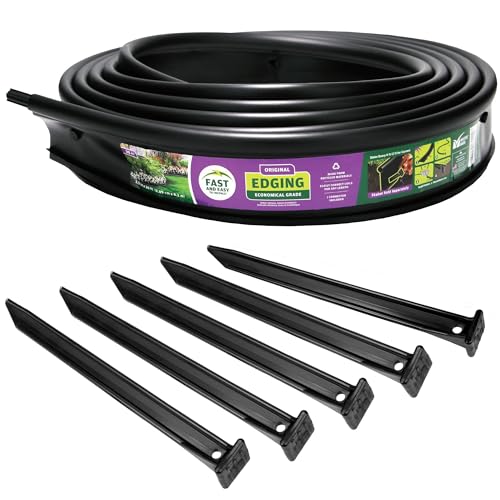
Master Mark Plastics Landscape Edging — The Utility Choice
Choose the boards when the border works for a living: vegetable plots, drives, play-area edges and any straight run that takes knocks. Thick, straight and durable, they are the mid-ground between coil convenience and metal permanence. Entry-to-mid tier. Best for: working gardens. Not suited for: serpentine beds or anyone seeking an elegant visible line.
EverEdge Metal Lawn Edging — The Lawn-Refresh Choice
Choose the drive-in steel sections when a lawn edge has gone soft and wavy and you want metal’s lifespan without a full trench — provided your soil is firm and reasonably stone-free, because the teeth are the anchoring. Mid-to-premium tier. Best for: established lawns on workable ground. Not suited for: stony plots or deep-barrier jobs. Two further names complete the reference set: Gardeneer by Dalen HammerEdge sections for tree rings and repairs, and the Amazon Basics coil when a large back garden needs maximum length at the entry tier.
Common Mistakes When Choosing
Buying by price per length instead of service per length. Choosing a shallow format for a deep grass problem. Forcing one product around every geometry in the garden. Ignoring sun exposure when buying plastic for a permanent bed. Under-measuring curves. Forgetting that metal’s sharpness is a selection criterion around play areas, not a footnote. And skipping the soil inspection — ten minutes with a trowel — that would have prevented most of the above. Every one of these mistakes is a selection error, not a product defect, which is precisely why a choosing method matters more than a product ranking. The balanced ledger behind these choices is in garden edging pros and cons.
Pro Tips From the Trade
Landscapers warm coils in the sun before installing so they unroll flat instead of fighting their packaging memory. They set a string line for straights and never trust an eye over distance. They backfill and firm in stages, walking the line to feel for soft spots. They keep the top edge a fraction below the turf line on lawn borders so the mower passes as if the edging were not there. And they choose the spring or autumn shoulder seasons — workable soil, no baking heat — for installation, because the install day decides the result. Borrow all five habits; they cost nothing and they are worth more than the difference between adjacent price tiers. Once your borders are set, the spaces inside them come together quickly — see indoor outdoor rugs for patios and porches for the patio layer and outdoor deck chairs for relaxed seating for seating that suits a disciplined lawn.
Worked Examples: Three Buyers, Three Right Answers
The renter with curving beds and an eighteen-month tenancy: no-dig coil, one trial bed, whole garden by the second weekend, removed cleanly at the end. Total commitment small, benefit collected weekly — the correct answer is the cheapest adequate format. The homeowner building a permanent front garden with straight gravel paths: steel, installed once with obsessive levelling, because the line is the architecture and the horizon is decades. The allotment gardener with straight plots, wheelbarrow traffic and a tight budget: rigid boards, trenched once, knocked about happily for years. Three gardens, three different right products — and each buyer would have been wrong to copy either of the others. That is the whole lesson of how to choose garden edging, and it is why this guide teaches a method rather than naming a winner. For the value argument behind the method, read is garden edging worth it; for product depth, garden edging reviews; for the buying checklist, the garden edging buying guide.
Choosing for Difficult Ground: Clay, Sand, Stone and Slope
Clay is the first difficult ground most choosers meet. It digs hard when dry, smears when wet, grips edging firmly once installed, and heaves it enthusiastically in frost. The choosing implications: favour formats whose reset you can perform — metal and modern flexible plastic over anything that will be brittle in five years — and schedule installation for the workable middle, neither baked nor sodden. Sand inverts the problem: digging is easy and anchoring is the battle, so choose trenched formats with serious backfill firming over spiked formats that sand gradually releases, and stake closer than pride suggests. Stony ground vetoes drive-in teeth and turns trenching into the day’s main labour; flexible coil laid in a hand-cleared shallow trench, or boards where the trench can be won, are the pragmatic choices, and a trial bed on stony soil is not optional — it is the decision itself.
Slopes choose anchoring above all else, as this guide’s steps insist, but the chooser should also decide the line’s relationship to the gradient before buying: stepping down in level sections suits metal and boards, flowing with the slope suits coil, and drifting between the two is the one choice that always looks wrong. Very steep ground should exit this guide entirely toward terracing. Difficult ground does not make edging a bad idea; it makes the choosing steps non-skippable, because the margin for a mismatched format is exactly what difficult ground removes.
Choosing With Children, Dogs and Daily Life in Mind
Household reality is a specification. Where children play barefoot, the chooser’s first filter is the top edge: plastic formats pass automatically, metal passes only with folded profiles, capped ends and a guaranteed flush finish that someone will actually inspect each spring. Where dogs patrol, anchoring strength joins the filter — a border along a dog run takes lateral force that decorative installations never meet, promoting boards and well-staked trenched formats. Where the garden doubles as an entertaining space, the line beside seating earns a premium for neatness, because it is the border your guests will actually see at close range for hours.
None of these filters appears on packaging, which is why choosing methods outperform product rankings for real households. The exercise is simple: list the three hardest uses your borders will meet — play, pets, parties, barrows, bikes — and eliminate any format whose known weakness is one of them. What survives that elimination is a shortlist fitted to your life rather than to a showroom, and it is remarkable how often the surviving answer is a mid-tier product bought with unusual confidence.
Choosing the Second Time: Upgrades and Replacements
Many readers of this guide are not first-time buyers but owners replacing a failed or aged edge, and their choosing problem is different: they hold evidence. A coil that waved was telling you about base preparation or bead quality; a coil that cracked was reporting ultraviolet exposure and horizon mismatch; a steel line that stepped was reporting joint work, not material failure. The second purchase should be prescribed from the first one’s autopsy. If the failure was installation, the same product installed properly is a legitimate choice. If the failure was lifespan — plastic expiring in a permanent sunny bed — the upgrade to boards or metal is the entire lesson, and repeating the original purchase is the definition of a false economy.
Replacement also offers the one moment when changing systems is cheap: the trench, however degraded, is already located, the line is already chosen, and the ground is already understood. Owners upgrading from coil to steel along the same line routinely report the second installation taking half the time of the first, because every decision except the product has already been made and tested. Choosing the second time is therefore the highest-leverage choosing of all — the garden has run the trial for you, at full scale, over real seasons. Read its results honestly and the replacement almost chooses itself.
A Chooser’s Walkthrough: One Garden, Every Step Applied
Consider a typical plot: a curving main bed against running lawn grass on clay, a straight gravel path, two young trees, and a household horizon of at least a decade. Step one names the jobs — grass defence on the main bed, gravel retention on the path, tidy rings at the trees. Step two’s inspection finds roots running deeper than a no-dig foot and clay that will heave. Step three classifies geometry: flowing curve, dead straight, two circles. Step four sets the horizon — long — which promotes durable materials where the budget reaches. Step five now chooses almost by itself: a trenched, deeper format for the main bed despite its curve, because the grass job outranks geometry; steel for the path, where straightness and traffic meet; sectional rings for the trees, sized to be widened as the flares grow.
Step six inspects the physical details — bead and wall on the bed product, folded top and joints on the steel, stake counts against clay and slope. Step seven trials the main bed first, because it carries the hardest job. Notice what the walkthrough never did: it never asked which product is ‘best’. It asked what each border must do, what the ground allows, and how long the answer must last — and three different products fell out, each correct. That is the method working as designed, and it will work on your garden’s particular combination for the same reason: the questions are ordered the way the failures are.
Choosing by Garden Style: Formal, Cottage, Contemporary, Wild
Style is a legitimate choosing criterion — not decoration on the decision but part of it, because an edge that fights the garden’s intent will be resented at any performance level. Formal gardens choose steel or aluminium in straight runs, installed to architectural tolerance, and treat the line as a design element to be seen. Cottage gardens choose coil or sections, valuing the tidy-but-soft boundary that planting can spill over, and forgive the gentle irregularity that formal gardens would call failure. Contemporary gardens choose metal or invisibility — crisp steel against minimal planting, or a hidden barrier where the design wants no line at all — and reject visible plastic as a tonal error regardless of its competence.
Wild and naturalistic gardens choose mostly by refusal: a hand-cut edge for the few borders that need definition, a hidden barrier where grass pressure is real, and no visible strip anywhere the planting is meant to blur. The chooser’s discipline is to let the style cast its vote early, at the family stage, rather than discovering at installation that a technically perfect product looks like a clerical error in the garden it was bought for. Style cannot rescue a product from the wrong depth or the wrong ground — but among products that pass the functional steps, it is the rightful tiebreaker.
Choosing With a Partner, a Budget and a Deadline
Real choosing happens under social and financial weather that guides rarely mention. Two gardeners sharing one plot may weight line crispness and wildness differently; the choosing method helps here precisely because it separates the functional steps — job, soil, geometry, horizon, on which evidence usually produces agreement — from the style tiebreak, where compromise formats genuinely exist: hidden barriers, coil in the back and steel in the front, a trial bed as an armistice with data. Budgets bind differently than buyers expect: the constraint is rarely the strip, which is cheap in plastic and finite in metal, but the installation day — and a household short on weekends should choose formats whose install fits the time actually available, not the time theoretically deserved.
Deadlines distort choosing in one predictable direction: toward the fastest format regardless of fit, because a garden being readied for an event rewards the visible line today over the correct barrier for next decade. The method’s defence is the trial-bed step run in miniature — if the deadline forces coil onto a border that needs depth, install it knowingly as a temporary, price its replacement into the plan, and let the event pass before judging the category by a compromise you chose with open eyes. Choosing well is mostly this: knowing which compromises you are making, and refusing to let a calendar make them for you in secret.
The Chooser’s Checklist, Printed on One Card
Before ordering anything, be able to answer, in writing, the following. What job does each border need done — line, mulch, grass, slope — and which is the hardest? How deep do the grass roots at my worst border actually run? What is my soil — clay, sand, loam, stone — and how does it heave, grip and drain? Which runs are curves, which are straights, and what is each run’s rope-measured length? How many years will each border keep its current shape? Who uses the borders — children, dogs, barrows, guests — and what does that demand of the top edge and the anchoring? Have I called 811, or the local equivalent, if any trench is planned? Which single bed is my trial?
A chooser who can answer those eight questions will select well from any catalogue, including a future one with products this guide has never seen, because the questions encode the physics and the household rather than the current market. A chooser who cannot answer them is not ready to be sold anything, by anyone, however persuasive the packaging. Print the card, walk the garden with it, and let the answers accumulate in pencil. The order you place afterwards will feel less like shopping and more like what it actually is: specifying a small piece of infrastructure for a particular piece of ground.
Choosing Edging for Specific Features: Ponds, Decks and Play Areas
Pond margins choose for softness of a different kind: the edging must hold a liner’s edge or a gravel margin against water that constantly tests it, and plastic formats earn a point here for their indifference to permanent damp, while metal near water should be specified with corrosion behaviour in mind and inspected at the waterline yearly. The flush rule relaxes visually — a small reveal helps define the water’s edge — but never where feet land in the dark. Deck surrounds choose for the drip line: water concentrates off a deck edge, so anchoring and backfill firmness outrank all other criteria, and shallow no-dig feet are the wrong tool in a splash zone whatever their other virtues.
Play areas choose for the top edge above everything: plastic passes by nature, metal passes only on folded profiles, capped ends and a flush finish that a named adult inspects each spring — and if that inspection will not happen, the method’s answer is plastic, full stop. Vegetable features choose boards for the reasons the worked examples gave. Water features, play features and food features thus each cast a veto before the general steps begin, which is the correct order: vetoes first, preferences second, brands last. A chooser who lists their garden’s veto features before opening a catalogue has done the single most protective act in the whole method.
Choosing When the Garden Is Not Yours Yet
New owners inherit borders mid-story: edging of unknown age and material, lines drawn by someone else’s intent. The choosing method adapts into an audit. Identify the material by eye and hand — chalky, brittle plastic is announcing its remaining life; sound metal is an asset to keep regardless of taste. Test the line’s honesty with a level and a low sightline; inherited waviness is usually inherited base work, correctable in a weekend per run. Then decide per border whether the existing choice passes your own steps — job, soil, geometry, horizon — because keeping a predecessor’s correct decision is the cheapest choosing there is, and replacing their correct decision with your preference is the most expensive.
The audit often reveals the previous gardener’s whole philosophy, and occasionally their mistakes preserved in steel — a permanent answer to a temporary layout. Even then, the method counsels patience: live one season with inherited lines before ripping any out, because a border’s job only becomes visible across the mowing and storming of a full year. Choosing for a garden you have not yet watched through its seasons is choosing with half the evidence, and the method’s final step — the trial — applies to inheritances exactly as it applies to purchases.
The Method, Restated as Five Questions
Everything in this guide compresses into five questions a chooser can ask standing in any garden, catalogue closed. What must this border stop, hold or merely say? What does my ground — its soil, stones, slope and water — permit and forbid? What shapes must the line take, run by run? How many years must the answer last? And whose safety and habits must the finished edge respect? A product that survives all five questions is the right purchase with a reliability no ranking can match, because the questions are the failure modes wearing their working clothes: depth failures, ground failures, geometry failures, horizon failures and household failures account for essentially every disappointed edging owner ever surveyed by their own garden.
Ask the five questions in order, because each narrows the field before the next spends effort: job eliminates the shallow, ground eliminates the unanchorable, geometry eliminates the rigid or the flimsy, horizon eliminates the wrong tier, and household eliminates the unsafe. What remains is rarely more than two products, and between two survivors the trial bed decides with evidence. Choosing garden edging was never a search for the best product. It is the disciplined elimination of wrong ones — and that, a gardener can learn in one walk around their own borders.
Choosing Accessories: Stakes, Connectors, Caps and the Half-Moon Edger
The chooser’s work is not finished at the strip, because the accessories decide whether the strip performs as chosen. Stakes are the first accessory to choose deliberately: the kit’s included count is a manufacturer’s assumption about average soil, and slopes, sand and soft loam all argue for more, closer spacing — buying a supplementary pack at the original order is cheaper than a mid-install discovery. On metal, connectors and corner pieces from the same system are worth choosing over improvised overlaps wherever the run is visible, because a system’s joint holds one plane by design while an overlap holds it by luck. Caps for cut ends are not an accessory at all in any household with feet; they are part of the product, and a chooser who cannot source them for a given metal line should let that absence veto the line.
The half-moon edger deserves honorary product status in this guide: whichever strip is chosen, the cut soil edge beside it still wants periodic dressing, and the tool that dresses it is the difference between a border that looks maintained and one that merely looks installed. Choose one with a comfortable tread and a blade you can sharpen. Together — stakes enough, joints systematic, ends capped, edger sharp — the accessories convert a correct product choice into a correct border, which was the object of the exercise all along.
Choosing for the Second Garden: Renting, Moving and Handing Over
Mobility rewrites the choosing steps in a predictable direction, and gardeners who expect to move within a few years should choose with the removal day in mind: sectional and no-dig formats lift cleanly and travel to the next plot in a car boot, boards lift with effort, and steel lifts like infrastructure — possible, rarely worth it, and usually bequeathed to the buyer as a feature. The bequest itself can be a choosing argument: a well-edged front garden is part of a home’s presentation, and a seller choosing edging in the final year is buying presentation, for which neatness of installation outranks every other criterion including lifespan.
Handing a garden down within a family poses the gentlest version of the same problem: choose the formats the next gardener’s body and habits can maintain — the reset they will actually perform, the material whose ageing they will recognise — and leave the garden plan that says what is buried where. Choosing well has always been choosing for a future gardener; mobility and inheritance merely make that gardener a different person, and the method’s questions — job, ground, geometry, horizon, household — survive the change of hands intact, because they were never really about the chooser. They were about the garden, which stays.
Choosing Under Uncertainty: When You Cannot Inspect, Test or Wait
Sometimes the method’s luxuries are unavailable — a house completed on Friday, a garden centre closing, a gift to buy for someone else’s plot. Choosing under uncertainty has its own discipline: default to the forgiving. A quality no-dig coil or sectional product, bought for an uninspected garden, fails soft in every direction — it installs on unknown soil, follows unknown curves, lifts out if the guess was wrong — while a wrong steel purchase fails hard, expensively and sharply. Gift-buying follows the same rule with the household questions answered conservatively: plastic, unless the recipient’s garden is known to be formal, permanent and straight. Uncertainty is not a reason to abandon the method; it is a reason to weight its reversibility step above all others.
And when even the product class is uncertain — when the chooser genuinely cannot tell whether the border needs edging at all — the correct purchase is the smallest one that generates evidence: one bed’s worth of the forgiving format, installed properly, watched for a season. Choosing under uncertainty is still choosing, and the method’s last gift to the uncertain is permission to buy information instead of infrastructure. The garden will grade the experiment honestly, as it grades everything, and the second decision — the one that spends real money — will be made by a chooser who has seen their own soil vote.
A Last Word Before You Order
Choosing feels, from inside the catalogue, like a search for the product that will not disappoint you. This guide has argued the opposite framing all along: disappointment in this category is manufactured at the matching stage, not the manufacturing stage, and it is therefore within the chooser’s power to prevent almost all of it. The questions are asked, the ground has testified, the geometry is classified, the horizon is set, the household is accounted for, the trial is planned. What remains is the smallest step in the whole method and the one gardeners postpone longest: placing the order for the trial bed, this week, while the season for installing it is still open. Gardens reward decided choosers with evidence; they punish perpetual researchers with another year of creeping grass. Choose the trial, and let the garden itself cast the deciding vote it has been waiting to cast all along.
Postscript: Choosing as a Gardening Skill
It is worth noticing, at the end of a long guide, that the skill practised here is not really about edging. Reading a border’s job from its evidence, interrogating your own ground before a catalogue, matching a material’s lifespan to a plan’s horizon, trialling small before committing large — that is the master method of every good garden decision, from trees to irrigation, wearing edging’s clothes for one article. A gardener who learns to choose this way here will choose well everywhere, because gardens punish the same error in every department: the purchase made from the photograph instead of from the ground. Edging merely teaches the lesson cheaply, in a product small enough to forgive. Take the lesson with the strip; it is the most valuable thing in the basket.
Envoi: The Garden Has Already Answered
Here is the quiet truth the whole method has been circling: your garden answered every choosing question before you thought to ask it. The grass announced its depth in its roots, the soil announced its temper in the first spadeful, the borders announced their geometry to anyone who walked them slowly, and the household announced its horizon in how it talks about next year. Choosing garden edging well is not invention; it is transcription — writing down what the garden has already said, in the order the failures taught us to listen. Do the transcription faithfully and the order you place will look, in retrospect, less like a decision and more like a recognition. That recognition is the method’s final product, and unlike the edging, it never needs replacing.
A Step-by-Step Fit Check Before You Choose a Garden Edging
Choosing a garden edging goes wrong most often not through ignorance but through sequence: people fall for a style or a feature before checking the basics that decide whether it works at home. This section gives you a deliberate order of operations, from measuring to shortlisting, so each decision narrows the field for a practical reason.
Step one is to measure before you look at a single product: confirm the total border length, including curves, before choosing pack quantities, and photograph the space or item with the tape in frame, so you can check listings later without re-measuring. Step two is to define the job in one sentence, which for most households is neat borders between lawn, beds and paths. Any option that does not serve that sentence is out, however attractive, because features outside your actual job are decoration you will pay for in size, upkeep or complexity.
Step three is the compatibility pass: soil type, slope and whether the edging style suits straight runs or bends. Do this against your real home, not the imagined renovated version, and be strict, because almost-fits are the source of most returns in this category. Step four is to shortlist two or three survivors and compare them on upkeep, asking honestly whether you will sustain the routine, since re-seating shifted sections each spring and clearing soil that builds up against the line. If a shortlisted name such as Coyote Landscape Steel Edging is in play, verify its exact variant and included parts on the listing itself at this stage.
The final step is the edge-case rehearsal: tree roots and frost movement, which push borders out of line slowly over seasons. Picture it in detail with each finalist, including the cleaning afterwards and where everything gets put away. Then stop. Choosing well is mostly the discipline of eliminating for practical reasons in the right order, and once one option survives measurement, job, compatibility, upkeep and edge case, further comparison produces anxiety, not better decisions.
A Final Decision Checklist
- Step one, measure: confirm the total border length, including curves, before choosing pack quantities and photograph the space with the tape visible.
- Step two, name the job in one sentence: neat borders between lawn, beds and paths.
- Step three, the compatibility pass: soil type, slope and whether the edging style suits straight runs or bends, judged against your home as it is today.
- Step four, shortlist on upkeep you will actually sustain, since re-seating shifted sections each spring and clearing soil that builds up against the line.
- Step five, rehearse the edge case with each finalist, because tree roots and frost movement, which push borders out of line slowly over seasons.
- Write down your two most frequent uses and eliminate any option that serves neither.
- Keep packaging and paperwork until the first full week confirms the choice.
- Photograph the setup once it works well, so the winning arrangement is easy to restore.
- Decide in advance the shortlist against your written criteria, not against whichever listing photographs best.
- Eliminate options by the person who cleans it most a veto, because their friction decides how long it stays in service.
- Work the list on the storage spot honestly: if putting it away is awkward, the garden edging will slowly stop being used.
- Shortlist by every included part against the listing description on arrival day, while an exchange is still painless.
- Shortlist by the largest regular job, not the largest imaginable one, when judging whether the size is right.
- Eliminate options by the edge case on a quiet day first, since tree roots and frost movement is a poor thing to meet unprepared.
- Shortlist by the upkeep into an existing routine, because re-seating shifted sections each spring and clearing soil that builds up against the line only happens reliably when it rides on a habit.
- Step through seasonal differences, since heat, guests and holiday loads test a garden edging differently from ordinary weeks.
- Decide in advance the footprint with tape on the floor for a day if space is tight, and live around the outline first.
- Work the list on compatibility once more before ordering parts or accessories, remembering that soil type.
- Step through notes on what worked, in the room where the garden edging is used, where future-you will actually find them.
- Step through instructions photographed on your phone, so troubleshooting never starts with a search through drawers.
- Work the list on the second year in advance: replaceable parts and a serviceable design matter more than launch-day shine.
- Decide in advance the failure signs monthly, so you catch the stage where edging that heaves or tilts after wet weather because it was seated too shallowly is still a five-minute fix.
- Eliminate options by sound, weight and effort during normal use, the everyday qualities that decide long-term satisfaction.
- Step through the fit again after a week of real use, when the total border length can be judged against experience rather than hope.
Frequently Asked Questions
What is the most important factor when choosing garden edging?
The job the border must do — specifically its required depth. A line-drawing border, a mulch-holding border and a grass-stopping border are three different specifications, and buying a shallow product for a deep job is the category’s most common and most predictable failure. Decide the job first, then geometry, then horizon; material and brand fall out of those three decisions almost automatically. Ten minutes inspecting your soil and grass roots will tell you more than any product label.
Should I choose plastic or metal edging?
Choose metal when the border is permanent, the runs are straight or gently sweeping, and you will manage its sharp edges properly — gloves, capped ends, flush fitting. Choose plastic when the beds curve, the horizon is short or uncertain, or the budget is tight. Choose thick boards in the middle ground of straight utility borders. The materials are not rivals so much as tools for different gardens; the chooser’s task is recognising which garden is theirs.
How do I choose edging for a sloped garden?
Prioritise anchoring over everything: trenched formats with firm staged backfill, toothed metal sections fully driven, or boards set deep — and stake more closely than the instructions suggest. Avoid relying on shallow no-dig feet on a bank, because rain wash and gravity work them loose. Consider terracing very steep borders instead of edging them; a slope that moves soil will move any strip, and the honest solution is to change the slope, not the strip.
What edging should I choose for a vegetable garden?
Rigid plastic boards are the usual right answer: straight runs suit plot geometry, the thickness shrugs off wheelbarrow and boot knocks, and the boards double as shallow retention for raised beds. Keep the top edge flush so tools and hoses pass cleanly, and avoid metal where plot layouts change annually, because boards lift and re-lay more forgivingly. For paths between plots that must stay gravel-clean, a trenched board or steel line both serve well.
How much should I budget for garden edging?
Budget by service, not by length: entry-tier plastic for short horizons, mid-tier boards for working borders, premium metal only where decades of use will amortise it. Add the unglamorous extras to the plan — stakes if the kit is short, caps for metal ends, a half-moon edger for the cut line — and reserve your own installation day as the real investment. The cheapest purchase in this category is the one you install once, correctly, in the right ground.
Can I mix different edging types in one garden?
Yes, and most experienced gardeners do. Coil around the curving beds, steel or board along the straight path and drive lines, sections around trees. The eye reads each border separately, so consistency within a run matters far more than uniformity across the garden. Mixing by job and geometry is not a compromise — it is the correct application of the choosing method, and it usually saves money compared with forcing a premium product around curves it hates.
Related Reading
Apply the method with the garden edging buying guide, compare the candidates in garden edging reviews, then install with how to install garden edging.