Disclosure: As an Amazon Associate, airfryerkitchensupply.com earns from qualifying purchases. Links on this page are affiliate links; they cost you nothing extra. Prices and availability change often, so check the current Amazon listing before you buy.
These garden edging reviews compare the products home gardeners actually shortlist — no-dig coils, pound-in sections, rigid boards and proper metal edging — and judge them the way you will: by how they install on a Saturday, how they behave through frost and mowing season, and how the line looks a year later. Garden edging reviews often read like a catalogue of lengths and colours, but the differences that matter are structural: anchoring depth, wall or gauge thickness, the finish of the top edge, and how a product forgives mistakes. This roundup works through six reference products, explains the testing logic behind the verdicts, and finishes with the buying mistakes that waste more money than any single product choice.
Key Takeaways From Our Garden Edging Reviews
- Best all-round for beginners: Dimex EasyFlex No-Dig Landscape Edging — fast, forgiving, and genuinely curve-friendly.
- Best permanent line: Coyote Landscape Steel Edging — the crispest, longest-lived edge here, with the most demanding install.
- Best lawn-edge refresh: EverEdge Metal Lawn Edging — metal longevity in drive-in sections that skip the trench.
- Best for straight utility runs: Master Mark Plastics boards — chunky, knock-resistant and honest value.
- Best for quick jobs and repairs: Gardeneer by Dalen HammerEdge sections — pound in an hour’s worth of border at a time.
- Best bulk budget coil: the Amazon Basics Landscape Edging Coil — judge it by thickness in hand, not branding.
Use these garden edging reviews to build a shortlist and confirm specifications on the current listing before you buy. Lengths, stake counts and kit contents change between production runs, and the physical product in your hand — its thickness, its edge finish, its stakes — is what you are really buying.
In this guide
How We Judge Garden Edging
Five criteria drive every verdict in these reviews. First, anchoring: how the product stays where you put it — spikes, teeth, trench depth or board mass — because an edge that migrates is worse than no edge. Second, line quality: whether the finished border reads as one continuous line or a series of compromises, judged on both curves and straights. Third, durability in the real enemies’ hands — ultraviolet light, frost heave, mower wheels and string trimmers — rather than in a showroom. Fourth, handling safety and installation effort, including how sharp the product is out of the box and how much digging the design demands. Fifth, honesty of value: whether the tier the product sits in matches the service life you can reasonably expect, with plastic judged as a consumable and metal as an investment.
A note on what reviews cannot tell you: soil. The same edging that locks solidly into loam can skate on stony ground or wallow in sand, and no reviewer gardens in your soil. That is why each review below names the ground it suits. It is also why the most useful purchase test is a short trial run: buy enough for one bed, live with it through a few mows, and only then commit to the whole garden. Edging is sold in lengths that make this cheap to do, and one bed’s evidence beats a hundred paragraphs — including these.
Garden Edging Reviews: The Six Products Compared

Dimex EasyFlex No-Dig Landscape Edging — Best for Beginners and Curves
The EasyFlex concept removes the trench entirely: a flexible strip with a perforated anchoring foot that you spike to the ground along a cleared line, then dress with mulch. Installation is genuinely quick, and the strip follows the kind of lazy, natural curves that rigid products turn into arguments. The finished line looks tidy from standing height, the bead hides minor undulations, and mistakes are reversible — pull the spikes, re-lay, spike again. Weaknesses appear where depth matters. Running grass treats the shallow foot as a suggestion, slopes work the spikes loose over a wet season, and the plastic itself will chalk and embrittle in strong sun over the years. Verdict — Best for: first-time edgers, curved flower beds, rented gardens and flat ground. Not suited for: steep banks, running-grass defence, or permanent installations. Entry tier, and fairly priced for a consumable.
Coyote Landscape Steel Edging — Best Permanent Line
Steel edging from a landscape-supply heritage is a different species from the coil aisle. Lengths arrive straight and stay straight; joints, made carefully, disappear; and the finished edge has the architectural crispness that makes gravel, lawn and paving look designed rather than accumulated. In service it shrugs off trimmer contact that scars plastic, and frost movement can be corrected with a lever and a level for decades. The costs are front-loaded: the most measuring, the most levelling, gloves throughout, cut ends that need capping or burying, and a top edge that must finish flush so it never becomes a cut or trip hazard where people walk. Curves are possible only as gentle sweeps or faceted segments. Verdict — Best for: permanent, design-led gardens and long straight runs. Not suited for: tight curves, rushed installs, or play borders. Premium tier, earned through lifespan.
EverEdge Metal Lawn Edging — Best Lawn-Edge Refresh
EverEdge sections answer a specific frustration: the lawn edge that has gone wavy and soft, in a garden whose owner wants metal’s lifespan without digging a trench the length of the plot. The sections carry integral spikes, join into a continuous band, and drive in with a mallet and a block of wood, following gentle curves and finishing flush for clean mowing. Performance is soil-dependent in a way coil reviews rarely admit: firm, stone-free ground grips the teeth superbly, while loose sand lets sections work and stony ground fights every spike. Depth is moderate, so it tidies and retains rather than forming a deep root wall. Verdict — Best for: refreshing established lawn edges on workable soil. Not suited for: stony plots or deep-barrier jobs. Mid-to-premium tier.
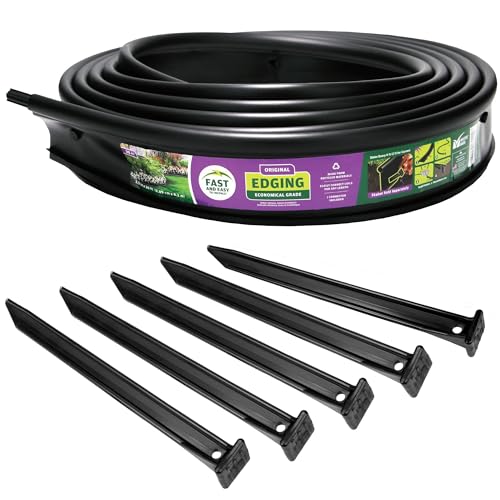
Master Mark Plastics Landscape Edging and Terrace Boards — Best for Straight Utility Runs
Master Mark’s boards are the edging equivalent of a good fence panel: thick, straight, unbothered by knocks, and entirely uninterested in elegance. In vegetable gardens, along drives, and around working areas they outlast thin coils by years, hold a ruler-straight line, and double as shallow retention for raised beds and terraced corners. The install is a trench job — measure, dig, level, backfill firmly — and the payoff is a border you mostly forget. Ultraviolet ageing still applies eventually, and on serpentine beds the boards simply refuse the geometry. Pair them with seating areas and they disappear under planting happily; our notes on patio dining chairs for everyday outdoor meals show the kind of everyday outdoor corner where a straight, sturdy edge quietly does its job. Verdict — Best for: straight runs, vegetable plots and high-knock borders. Not suited for: curves or showcase planting. Entry-to-mid tier.

Gardeneer by Dalen HammerEdge Edging — Best for Quick Jobs and Repairs
HammerEdge sections trade continuity for convenience, and for many gardens that is the right trade. You drive individual sections down with a mallet, connecting as you go, so a tree ring, a short bed or a repair to a damaged stretch takes an hour rather than a weekend. The sectional design is also the most repairable format in this roundup: frost lifts one piece, you tap it back; a trimmer destroys one piece, you replace one piece. The compromises are depth and line purity — sections can step slightly against each other on uneven ground, and like all surface-anchored systems this is a tidying barrier, not a deep grass wall. Verdict — Best for: small projects, tree rings, renters and repairs. Not suited for: long formal runs. Entry tier.

Amazon Basics Landscape Edging Coil — Best Bulk Budget Coil
Own-brand coils live or die on physical basics, and the sensible review of the Amazon Basics coil is a checklist rather than a poem: unroll it and see whether it lies reasonably flat after warming in the sun; feel the wall thickness against a known brand; check the bead holds a round profile; count and flex the stakes. Where it passes those tests, it does the standard coil job — fast curved borders on flat beds at the lowest cost per length in this roundup, which matters when a whole back garden needs edging. Where it fails them, no saving justifies a wavy line you will look at for years. Expect normal plastic ageing in sun. Verdict — Best for: large, low-stakes projects on a budget. Not suited for: showcase front beds. Entry tier, the cheapest seat in the category.
Side-by-Side: Which Edging Suits Which Garden
Curved cottage beds on flat ground: the Dimex EasyFlex or the Amazon Basics coil, with the Dimex ahead on anchoring design. Straight modern runs and gravel paths: Coyote steel, unchallenged. Tired lawn edges on decent soil: EverEdge sections. Vegetable plots, drives and working borders: Master Mark boards. Tree rings, short runs and repairs: Gardeneer HammerEdge. Notice that the garden chooses the product more than preference does — soil, geometry and permanence narrow the field to one or two names before taste gets a vote. The fuller decision framework is in how to choose garden edging, and the single-product deep dive is in our garden edging review.
The Safety and Honesty Notes Every Review Should Carry
Three disclosures belong in any honest set of garden edging reviews. First, digging: several of these products need a trench, and before any trench you should call 811 (or your local equivalent) to have buried utilities marked — irrigation, cable and shallow services sit exactly at edging depth. Second, metal: steel and aluminium edges can be genuinely sharp, especially at cut ends, so gloves during installation, capped or buried ends, and a finished line set flush — never a raised blade across a walkway — are non-negotiable, not fine print. Third, time: frost heave lifts all of these products over seasons, plastic embrittles in ultraviolet light, and mower or trimmer contact damages most edging eventually. A review that promises a fit-and-forget edge is selling you something; the products above are good tools inside those limits, and the maintenance ritual they ask for is about an hour each spring.
Buying Mistakes These Reviews Exist to Prevent
Under-measuring is the classic: buyers pace a bed, order that length, and discover curves consume far more edging than the straight-line distance, leaving a run short by an embarrassing final stretch. Overlooking stakes is next — some kits assume them, some include too few, and sparse staking is the direct cause of wavy lines and slope failures. Buying depth-blind is third: a shallow tidy-up strip purchased to stop running grass will fail at that specific job no matter how well it is installed. Fourth is ignoring the top edge — a raw, sharp, proud metal edge beside a path is an injury waiting for a bare foot. Fifth is judging plastic by metal’s lifespan or metal by plastic’s price; each material is honest inside its own tier. Finally, skipping the trial bed: one short run, lived with for a month, teaches more than any review — including, we admit, this one. Round out a finished border with the right soft furnishings and the whole space lifts; see outdoor rugs that handle rain for the patio side of that picture.
Final Verdict
If you buy one product from these garden edging reviews, match it to your ground: Dimex EasyFlex for easy curves, Coyote steel for permanence, EverEdge for the lawn-edge refresh, Master Mark for straight utility work, Gardeneer HammerEdge for quick jobs, and the Amazon Basics coil when length matters more than pedigree. Respect the safety basics, expect the spring re-levelling ritual, and the line you cut this season will still be flattering your garden years from now. For the value argument in full, read is garden edging worth it; for the balanced downside list, read garden edging pros and cons; and before ordering, work through the garden edging buying guide.
Edging for Raised Beds and Vegetable Plots: What the Reviews Mean in Practice
Vegetable gardeners judge edging by different evidence than flower gardeners, and the products above reorder themselves under that light. Straight runs dominate plot geometry, which promotes the Master Mark boards from utility pick to first choice: they trench in once, shrug off wheelbarrow knocks, and double as shallow retention when a bed is mounded with compost. The Dimex EasyFlex serves the paths between plots where a curve sneaks in, while steel — superb elsewhere — often loses on allotments because layouts change with rotation plans and a permanent edge resists next year’s better idea. Gardeneer HammerEdge sections find steady work here too, fencing a single bed for a single season’s experiment.
Raised beds themselves are edging at furniture scale, and the border around them still needs a strip solution: a mowing and mulch line that stops the surrounding lawn or gravel invading the bed’s skirts. Reviews that ignore this double role undersell boards, whose chunky profile handles both the plot edge and the bed surround without complaint. The practical verdict from the vegetable patch is unfashionable and firm: buy thickness and straightness, forgive plain looks, and spend the savings on compost.
Front Garden Versus Back Garden: Different Judges, Different Winners
Front gardens are judged by strangers at walking pace, in winter, from the pavement. That scrutiny promotes the products with the purest line — steel first, well-installed boards second — and demotes anything prone to waviness, because a front border has nowhere to hide. Front gardens also carry the highest safety stakes: the path to the front door is the walkway where a proud metal edge or an exposed cut end matters most, so folded profiles, capped ends and a genuinely flush finish stop being preferences and become requirements. Several products in this roundup can serve a front garden beautifully; all of them demand their best installation there.
Back gardens are judged by their owners at leisure, among planting that forgives a multitude of sins. Curves multiply, experiments happen, children and dogs test everything, and the coil and sectional products come into their own — cheap to extend, easy to move when a bed is rethought, kind to bare feet. The Amazon Basics coil edging a whole back garden while steel holds the front path is not an inconsistent garden; it is a correctly specified one. Reviews that crown a single winner for both territories are answering a question no real garden asks.
Edging and Water: Drainage, Irrigation and Heavy Rain
Every product in this roundup interacts with water, and the interaction decides more installations than any feature list. A firm edge across a slope becomes a tiny dam: water ponds behind it, mulch floats, and the first storm rearranges the bed. The fix is not a different product but a drainage decision — gaps at low points, a gravel channel, or regrading so water crosses the border where you choose. Gardeners in wet climates should treat any edging plan as a water plan first; the prettiest line in the county will tilt within two winters if it stands in a seasonal pond.
Irrigation changes the digging risk as well as the watering. Drip lines and sprinkler pipework run at edging depth along exactly the borders you will trench, which is why the call to 811 (or your local equivalent) and a careful hand near marked or suspected lines appears in every responsible review. Once installed, edging helps irrigation efficiency quietly: water stays in the bed it was delivered to instead of sheeting onto paths, and mulch held in place keeps soil moisture steadier. None of the six products markets itself as a water tool, yet all of them perform as one — for better or worse — from the first rain.
Accessibility and Ageing Gardeners: An Overlooked Test
Edging changes a garden’s physical demands, and for gardeners managing reduced mobility that change can matter more than any aesthetic verdict. A defined edge removes the weekly rescue work at borders — the kneeling to weed grass out of beds, the bending to rake mulch off paths — and replaces it with an upright spring walk with a mallet. Installation, however, is the most physical day of the product’s life, and reviews should say so plainly: trenched and steel formats may need a helper or a professional for the install, after which the owner collects the low-effort years. No-dig and pound-in formats keep the whole lifecycle within one gardener’s capacity, at the price of depth.
Tool weight and grip matter in this test too. Coils are light and safe to carry; steel lengths are awkward, sharp-edged freight that genuinely requires gloves and ideally a second pair of hands. Seating and rest points near long borders — the kind of everyday outdoor furniture covered in our notes on garden seating — turn an install day from an endurance event into a paced project. The best edging for an ageing gardener is the one whose installation they can complete safely and whose maintenance they can perform standing up; by that measure the sectional and no-dig products earn reviews warmer than their depth specifications suggest.
What Professional Landscapers Actually Fit
Ask landscapers what they install and a pattern emerges that validates this roundup’s structure. For designed residential work with straight geometry, steel is the default — specified for its line and its decades, installed with string lines and levels, and priced into the job as a permanent feature. For curved planting in the same gardens, many switch to quality coil or sectional products without embarrassment, because geometry outranks material loyalty. For commercial and utility work, boards dominate on durability per length. The own-brand bulk coil appears on large, low-visibility jobs where metreage rules.
Two professional habits are worth stealing regardless of product. First, landscapers install in shoulder seasons when soil works easily, and they refuse to edge waterlogged or baked ground — the install day is treated as a quality input, not a scheduling detail. Second, they hand over a maintenance expectation with the job: a spring check, a careful trim line, a mulch rake after storms. The gap between professional and amateur results in this category is rarely the product on the invoice; it is those two habits, and both are free to copy.
Long-Term Ownership: The Second and Fifth Years
Year two is when installation quality sends its invoice. Well-bedded edging of any material settles into invisibility, needing only the spring reset; poorly bedded edging announces every shortcut — the dip where the base was soft, the joint that was never plane, the slope stretch staked too wide. Products get blamed for all of it, which is why this roundup keeps separating product verdicts from installation verdicts. By year two, plastic in full sun also shows its first chalkiness on the surface; it is cosmetic at this stage, but it starts the countdown that honest buyers priced in from the start.
Year five separates the category cleanly. Steel and aluminium are mid-life and essentially unchanged beyond joint checks. Thick boards are weathered, sound, and usually forgotten — the utility ideal. Thin coils in exposed sites are approaching replacement, having delivered several seasons of tidy borders at an entry tier; judged as consumables, they have succeeded, and judged as permanent features, they were never the right purchase. The fifth year is therefore less a product test than a mirror: it shows whether the buyer matched material lifespan to border lifespan back at the choosing stage. Everything in these reviews is aimed at making that match happen the first time.
Head-to-Head: Coil Versus Steel, the Contest Behind Every Review
Strip away the brand names and this roundup reduces to one recurring contest. Coil argues: I am a tenth of the commitment, I follow any curve your garden invents, I forgive your mistakes by lunchtime, and when I tire in the sun I am cheap to replace. Steel argues: I am the line itself, straight as the design intended, immune to your trimmer’s moods, and I will still be arguing my case when the coil has been replaced twice. Both arguments are true, which is why the verdict is a matching exercise — horizon, geometry, ground — and why reviewers who crown either side universally are answering a simpler question than the one gardens ask.
The middle products exist because the contest’s extremes leave most gardens unserved. Boards answer the gardener who wants steel’s straightness without its handling discipline. Drive-in metal sections answer the gardener who wants steel’s lifespan without its trench. Pound-in plastic answers the gardener who wants coil’s ease in discrete, repairable pieces. Read the six reviews above as positions along those three axes — commitment, geometry, lifespan — and the roundup becomes a map rather than a league table, which is the most useful thing a set of reviews can be.
Reviews Revisited: What Owners Report After the First Year
Owner reports, gathered across the category, repeat a handful of themes with remarkable consistency. First, nobody regrets the trial bed, and a striking number of dissatisfied owners volunteer that they skipped it. Second, the spring reset surprises only the owners who were promised permanence; everyone else describes it the way they describe sharpening tools — as ownership, not failure. Third, trimmer damage is reported as a behaviour problem far more often than a product problem: the same coil described as fragile by one household is described as scarred-but-serviceable by another whose trimming hand is gentler. Fourth, metal owners complain about installation day and then fall silent for years, the review profile of a cost paid once.
Fifth, and most instructive: almost no owner reports the failure mode the marketing warned them about, and almost every failure reported traces to the unglamorous trio of base, backfill and anchoring. The products in this roundup are, by owner consensus, more reliable than their installations. That is either depressing or empowering depending on temperament — empowering, this roundup maintains, because installation is the variable entirely within the buyer’s control.
Edging Around Decks, Patios and Outdoor Rooms
Outdoor living areas raise the stakes on edging because the borders there are experienced at close range, seated, for hours. The bed that frames a patio is read like furniture: its line should be as deliberate as the paving pattern, its top edge flush enough that chair legs and bare feet crossing to the lawn meet no surprises. Steel earns its warmest reviews in this setting, with boards a serviceable second where the geometry is straight and the budget is not. The planting side matters too — an edge that holds mulch crisply against paving makes the whole outdoor room look maintained even when the planting is between seasons.
Decks add a specific technical note: the border beneath a deck edge must manage the drip line, where roof and deck water concentrates, and shallow products there live in a permanent splash zone that tests anchoring and ages plastic faster. Trenched formats with firmed backfill cope best. Gardeners furnishing these spaces will find the seating and surface decisions in our related guides — the point here is sequencing: edge first, furnish second, because the border is the frame the furniture sits inside, and frames are not retrofitted gracefully.
A Note on Prices, Tiers and Review Honesty
These reviews quote no prices and award no star ratings, deliberately. Prices in this category move with season and retailer, and a printed figure would be stale before it was useful; the tier language — entry, mid, premium — is the durable information, because it tells you where a product sits relative to its rivals and what lifespan that position implies. Star ratings compress exactly the conditional judgements this roundup exists to preserve: a product that is perfect for curves and wrong for slopes cannot be honestly summarised as a number, and the compression is where buyers get misled.
The same honesty applies to this roundup’s limits. Specifications, kit contents and included stake counts change between production runs, and the current listing — checked by you, at purchase time — is the authority. What does not change between runs is the physics this roundup is built on: depth anchors, ultraviolet ages plastic, frost lifts everything, and sharp metal needs respect. Buy on the physics and the reviews will hold; buy on a photograph and they may not.
What These Reviews Would Say to Six Specific Buyers
To the first-time homeowner with forty metres of curving beds and a finite weekend: buy the Dimex EasyFlex, install the worst bed first while your care is freshest, and let the Amazon Basics coil finish the far back corner where only you will ever inspect it. To the couple building a courtyard with straight gravel paths: buy the Coyote steel, hire the installation day if your levelling patience is theoretical, and cap every end like you mean it. To the gardener whose lawn edge has gone wavy on good loam: the EverEdge sections were designed for your exact Saturday. To the allotment holder: Master Mark boards, a sharp spade, and no regrets. To the tenant with a tree and a dream: Gardeneer sections around the tree, coil on the bed, deposit intact. To the sceptic who has read all six reviews and still cannot decide: buy the smallest quantity of the product your geometry favours, install one bed, and let your own garden file the deciding review — it is the only one written in your soil.
Durability Testing You Can Do in One Afternoon
Before committing to a full order, put a sample length through the afternoon test this roundup wishes every buyer would run. Bury or set one metre exactly as the full installation would go, in your real border, at your real depth. Water it heavily and watch whether the line holds its height as the backfill settles. Run the mower past it at your normal care level, then the trimmer, and inspect the top edge at fingertip range. Lever it gently upward to feel what frost will feel in January. Then pull it out and examine the anchoring: spikes bent, teeth clogged, backfill voids — each finding is a forecast, and forecasts are what durability claims are made of.
The test’s real value is comparative discipline: run two candidate products side by side in the same border and the afternoon will separate them more honestly than a month of reading. One will sit flatter, anchor firmer, trim cleaner. Reviews — this one included — can narrow the field to the two worth testing; they cannot garden your soil for you, and any review that claims otherwise has confused its postcode with yours.
The Roundup’s Verdict, Restated Without the Catalogue
If the six products above were people, the EasyFlex would be the helpful neighbour, the Coyote the master craftsman, the EverEdge the clever engineer, the Master Mark boards the dependable farmhand, the HammerEdge the odd-job specialist, and the Amazon Basics coil the cheerful apprentice. Gardens need different characters at different borders, and the mature purchase is a cast, not a champion. That is this roundup’s actual verdict, underneath the badges: match character to border, install with the care the base deserves, respect the sharp edges and the buried cables, and keep the spring appointment. Do those things and any of the six will earn its place; skip them and none of them will — a conclusion the products themselves, if they could read their own reviews, would probably endorse.
How These Products Age in Photographs: A Visual Audit
Judge edging the way time does — in pictures taken from the same spot across seasons — and the six products sort themselves visually with unusual clarity. The steel line photographs in year three almost exactly as it did on installation day, its only tells being a softened paint sheen and planting grown up to meet it. The boards weather to a matte, workmanlike grey-brown that disappears under planting, which their owners count as a feature. The quality coil holds its portrait well in shade and begins, in sun, to show the slight chalk and the first waviness at its weakest-staked stretch — a photograph that argues for the spring reset more eloquently than any manual.
The sectional products age in pieces, which photographs kindly: one lifted section after a hard winter is a blemish, not a failure, and it is corrected in the time a kettle boils. The bulk coil’s portrait depends entirely on the installation it received; photographed honestly, it is the roundup’s best evidence that the installer, not the invoice, is the product. A visual audit is not a superficial test in a category whose entire purpose includes looking like something — and on that test, installed well, all six pass in their intended gardens, which is the most this roundup has ever claimed for them.
If the Budget Allows Only One Upgrade
Buyers who have absorbed this roundup often ask a narrower question: given a fixed garden and a fixed purse, where does the single upgrade go — better product, or better installation of a modest one? The reviews’ collective answer is unfashionable and firm: installation first. A mid-tier product on a levelled base with firmed, staged backfill and honest stake spacing will out-perform a premium product laid casually, in looks by the first month and in service by the first winter. Spend the upgrade on the string line, the level, the extra stakes, the caps, the unhurried day — the unglamorous inputs that never appear in a product’s feature list because they are not the product.
The exception proves the rule by its narrowness: where the border is permanent, straight and sun-exposed, the upgrade to metal buys a lifespan no installation quality can lend to plastic, because ultraviolet chemistry does not care how level the base was. Know which constraint binds your border — workmanship or chemistry — and spend the single upgrade there. That sentence, applied honestly, is worth more than the rest of this roundup combined.
One Last Comparison: Edging Versus the Hand-Cut Edge, Reviewed as a Product
Every roundup should review the free alternative as if it were a product, because for many readers it is the real competitor. The hand-cut edge — a half-moon tool, a string line and a gardener’s recurring hour — scores as follows. Installation cost: nothing but the tool. Line quality: potentially the most beautiful in this entire roundup, because a fresh-cut soil edge has a softness no manufactured strip can imitate. Durability: the worst here by design, since the product is labour and evaporates on schedule, needing renewal through the season. Grass defence: moderate, since the trench profile discourages surface creep while offering no buried barrier. Safety: impeccable. Verdict — Best for: small, soft, naturalistic gardens and gardeners who enjoy the ritual. Not suited for: large formal plots or anyone counting weekends. Reviewed fairly, it beats half the catalogue in the gardens it suits — which is exactly the standard the six products above were held to, and the note on which this roundup is content to end.
The Reviewers’ Own Gardens: A Disclosure
Full transparency about the perspective behind this roundup: the reviewers garden on mixed soil — loam that flatters everything, a clay corner that heaves like it is paid to, and one shaded border where plastic has outlived every prediction made for it in print. Products were judged against that ground, and the judgements carry its accent: a bias toward anchoring honesty learned from the clay, a softness toward coil learned from the shade, and a respect for steel learned from the one straight run where nothing else would hold the line the design demanded. Readers on sand, on rock, or in climates with harder winters or stronger sun should translate accordingly, using the mechanisms this roundup has named — depth, anchoring, chemistry, profile — as the translation key. A review that admits its own soil is worth more than one that pretends to have gardened everywhere, and this is that admission, offered as the roundup’s final specification.
Postscript: The Edge as the Garden’s Signature
Stand at any garden gate and your eye finds the edges before it finds the flowers; that is the perceptual fact this entire category trades on, and it is why six humble products deserved six careful reviews. A border is a signature — written in steel by one gardener, in forgiving coil by another, in nothing at all by a third whose signature is the cut soil line — and signatures are judged whole, at a glance, forever. Choose yours with the seriousness that permanence of impression deserves, install it like you will be reading it daily for a decade, because you will, and the reviews above will have done the only work reviews can do: they will have made the signature deliberate.
Envoi: Reading a Border at a Glance
One metre of well-kept edging tells a passer-by more about a household than the front door does: someone here decides, maintains and finishes. One metre of failed edging tells the opposite story with equal fluency. The six products reviewed above can each write the first sentence; none can write it alone. That is the roundup’s last word, and it belongs to the installer standing behind every product ever sold in this category — choose the character that fits your border, give it a true base and an honest day, and the signature at your garden’s edge will read the way you intended.
Patterns Across Garden Edging Listings Worth Verifying Yourself
Reading across many garden edging listings and owner reports, the same patterns surface again and again, and they are more useful than any single verdict. This section gathers those recurring signals, explains what each one usually means in practice, and shows how to verify the important ones against the specific listing you are considering.
Across owner reports on the garden edging, praise clusters in a predictable place: households whose routine centres on neat borders between lawn, beds and paths are consistently the happiest, and their reviews read almost boringly satisfied. Complaints cluster just as predictably around fit, which is why the first pattern to check in any listing is whether it states clearly the facts behind the total border length, including curves, before choosing pack quantities. Vague dimensions in a listing correlate with disappointed reviews more than any design flaw does.
The second pattern is the slow complaint. Early reviews glow; the criticisms that arrive months later describe edging that heaves or tilts after wet weather because it was seated too shallowly. When you read reviews, sort mentally by ownership length rather than enthusiasm, and give extra weight to anyone describing the upkeep honestly, because re-seating shifted sections each spring and clearing soil that builds up against the line. Reports that mention a model like EverEdge Metal Lawn Edging holding up after a year of regular use tell you more than a dozen five-line first impressions.
The third pattern is mismatch, not malfunction. Owners who checked compatibility in advance, meaning soil type, slope and whether the edging style suits straight runs or bends, rarely report the product failing them, while owners who assumed it would fit their setup supply most of the one-paragraph horror stories. Use reviews, then, as a checklist of things to verify on your chosen listing, and run the edge case early yourself: tree roots and frost movement, which push borders out of line slowly over seasons. Verified against your own home, the crowd consensus becomes a reliable guide instead of background noise.
A Final Decision Checklist
- In listings, look first for clear statements behind the total border length, including curves, before choosing pack quantities; vagueness here predicts complaints.
- In owner reports, weight long-term posts describing how edging that heaves or tilts after wet weather because it was seated too shallowly developed.
- Treat upkeep reports as data, because re-seating shifted sections each spring and clearing soil that builds up against the line is where ownership verdicts are decided.
- Cross-check compatibility claims, since soil type, slope and whether the edging style suits straight runs or bends is the mismatch owners report most.
- Verify the edge case yourself rather than trusting reviews, because tree roots and frost movement, which push borders out of line slowly over seasons.
- Write down your two most frequent uses and search reviews from owners with the same ones.
- Keep packaging and paperwork until your own first week confirms the consensus.
- Photograph the setup once it works well, so you can compare it with review photographs later.
- Verify against listings that the largest regular job, not the largest imaginable one, when judging whether the size is right.
- Cross-check seasonal differences, since heat, guests and holiday loads test a garden edging differently from ordinary weeks.
- Cross-check notes on what worked, in the room where the garden edging is used, where future-you will actually find them.
- Look for reports that the storage spot honestly: if putting it away is awkward, the garden edging will slowly stop being used.
- Look for reports that compatibility once more before ordering parts or accessories, remembering that soil type.
- Note how often owners sound, weight and effort during normal use, the everyday qualities that decide long-term satisfaction.
- Cross-check the fit again after a week of real use, when the total border length can be judged against experience rather than hope.
- Search owner reports for the footprint with tape on the floor for a day if space is tight, and live around the outline first.
- Search owner reports for the failure signs monthly, so you catch the stage where edging that heaves or tilts after wet weather because it was seated too shallowly is still a five-minute fix.
- Verify against listings that the upkeep into an existing routine, because re-seating shifted sections each spring and clearing soil that builds up against the line only happens reliably when it rides on a habit.
- Search owner reports for the shortlist against your written criteria, not against whichever listing photographs best.
- Verify against listings that every included part against the listing description on arrival day, while an exchange is still painless.
- Cross-check instructions photographed on your phone, so troubleshooting never starts with a search through drawers.
- Note how often owners the edge case on a quiet day first, since tree roots and frost movement is a poor thing to meet unprepared.
Frequently Asked Questions
Which garden edging is best for curved beds?
Flexible coils win curves outright. A no-dig coil such as the Dimex EasyFlex follows flowing lines without fighting you, and pound-in sections handle curves one piece at a time for shorter runs. Rigid boards refuse curves, and steel manages only gentle sweeps or deliberately faceted angles. The tighter and more frequent your curves, the more flexible your edging material needs to be — that single rule settles most curved-bed purchases.
Which garden edging lasts the longest?
Metal, by a wide margin. Steel and aluminium edging can serve for decades with nothing more than re-levelling after frost heave and occasional joint checks, and they tolerate trimmer contact that scars plastic. Thick plastic boards occupy the middle ground. Thin coils are consumables with a service life measured in years, shortened by strong sun. Match your expectation to the tier and none of these products will disappoint you.
Is no-dig edging as good as trenched edging?
For tidying a line and holding mulch on flat beds, yes — no-dig products install in a fraction of the time and look just as neat. For stopping running grass, holding a slope, or forming a deep root barrier, no: depth is the mechanism, and surface-anchored products do not have it. The honest question is which job your border needs done, and the answer picks the format for you.
How do I stop edging from lifting over winter?
You cannot stop frost heave entirely — freezing soil expands and lifts everything in it — but firm backfilling, full-depth driving of spikes or teeth, and good drainage beneath the border all reduce movement. Then adopt the spring ritual: walk the line, tap or press lifted sections back to level, re-firm the soil. Metal and flexible plastic forgive this reset; aged, brittle plastic may crack instead, which is a sign it is due for replacement.
Is steel edging safe around children and pets?
It can be, with the conditions treated seriously: choose products with a folded or rolled top edge where possible, cap or bury cut ends, wear gloves during installation, and set the finished edge flush with the ground so nothing stands proud to catch a bare foot or a paw. Keep it out of borders that double as play edges if you cannot guarantee the flush finish. Plastic removes the sharpness concern entirely for households that prefer not to manage it.
How much edging should I order?
Measure along the actual line the edging will follow — a rope or hose laid around the bed, then measured — rather than pacing straight distances, because curves consume length. Add a margin for cutting, joining and the inevitable mis-measured corner, and confirm how many stakes the kit includes against the spacing your soil needs. Ordering slightly long is cheap insurance; running short mid-install, with a trench open, is the expensive version of the same lesson.
Related Reading
Go deeper with the full garden edging review, the step-by-step how to install garden edging, and lawn chairs that sit well on grass for seating that completes an edged lawn.