Disclosure: As an Amazon Associate, airfryerkitchensupply.com earns from qualifying purchases. Links on this page are affiliate links; they cost you nothing extra. Prices and availability change often, so check the current Amazon listing before you buy.
So, is a box grater worth it for a kitchen that already owns knives, and maybe a food processor too? The short answer: is a box grater worth it if you cook from scratch weekly, because it turns cheese, vegetables and aromatics into recipe-ready shreds in moments with almost no setup or washing. It is not worth it if your grating is rare, your quantities are crowd-sized, or you know you will rush the end of every piece of food, because those teeth punish rushing. The rest of this page argues both sides properly.
Key Takeaways
- Worth it if: weekly scratch cooking, family-sized quantities, limited storage, and willingness to learn a two-minute safety habit.
- Not worth it if: grating is a twice-a-year event, or every job is a mountain better suited to a processor disc.
- The real return is time and texture: even shreds, ready instantly, washed in seconds.
- The real costs are cupboard space, careful washing, and permanent respect for the teeth.
- The food processor grating disc is the serious alternative; the honest answer for many kitchens is the box for daily work and the machine for feasts.
In this guide
Is a Box Grater Worth It? What You Actually Get
What you actually get is four capabilities in one standing tool. Coarse shreds for cheese, carrots, potatoes and zucchini. Medium shreds for firmer work. Fine grating that powders hard cheese, nutmeg and chocolate and ribbons citrus zest. And a basic slicer for quick cucumber and radish. None of these needs assembly, power or a manual, and together they cover the overwhelming majority of grating a home kitchen ever attempts.
You also get texture that knives struggle to match at speed. Even shreds melt evenly, fry evenly and soften evenly, and evenness is the quiet difference between a good gratin and a great one. Bakers get measured, container-caught shreds of butter and cheese. Meal preppers get a Sunday rhythm of grating straight into storage. These are small wins, but they repeat every week, and repeated small wins are what worth-it calculations are made of.
You get independence from bigger kit, too. The box works when the processor is dirty, when the power is out, and when the job is too small to justify machinery, which is most jobs. Cooks comparing the machine route in detail can read our overview of food processors with grating discs and judge the partnership for themselves.
The Real Costs Beyond Money
The purchase itself sits in qualitative tiers, entry, mid and premium, and even the premium tier is modest. The real costs are elsewhere. Space: a tower needs a cupboard corner or a safe drawer slot, because its teeth cannot live loose where hands rummage. Attention: every use asks for the end-of-piece discipline described below, forever, without exception. Washing: thirty careful seconds with a brush, or a dishwasher slot, every time. Learning: one short week of consciously slow finishes before the habit runs itself.
There is also the cost of the wrong purchase. A flimsy tower that flexes and dulls teaches you to hate grating and quietly taxes every recipe that needs it. If you decide the category is worth it, the version is worth choosing with the help of our {link(‘box grater buying guide’, ‘box-grater-buying-guide’)}, because the difference between tiers is paid back in effort on every stroke.
Who It Pays Off For
The Weekly Scratch Cook
You cook dinners from ingredients most nights, and grating appears in your week like weather: cheese for pasta and eggs, carrots for slaw and soup, potatoes for cakes, ginger for stir-fries. For you the box pays for itself in the first month, in minutes and in texture, and the safety habit becomes as automatic as drying a knife. This is the profile the tool was designed for, and the fit is exact.
The Baker and Meal Prepper
You grate in batches and store the results. A container model turns grating into measuring and storing in one motion, and the week’s cooking starts prepped. Your risk is fatigue at the end of a long prep session, so grate early, while your hands are fresh, and treat the holder as standard equipment rather than a concession.
The Small-Kitchen Cook
You have no room for a processor and no patience for single-purpose gadgets. One tower replaces a drawer of tools and asks only for a safe corner. Pair it with a stable board, as in our guide to cutting boards that give a grater a stable base, and a small kitchen gains a full grating station in a footprint smaller than a shoebox.
Who Should Skip It
The Rare Grater
If your grating is a dusting of cheese at Christmas and a carrot cake in spring, the tower will spend its life as cupboard furniture with sharp edges. Borrow, improvise with a knife, or buy the simplest value model with clear eyes. Worth-it is about use, and twice a year is not use.
The Volume Cook
If your grating arrives in mountains, cheese for gatherings, potatoes for parties, slaw for a crowd, the box is the wrong tool and no affection for it changes the arithmetic. Your hands tire, your pace drops, and tired hands near sharp teeth are the risk this page keeps naming. The processor disc exists for you.
The Rusher
Be honest with yourself here. If you know you will grate fast, chase the last nub with fingertips and fish shreds out of the box with a bare hand, the box grater is not worth it for you at any tier, because its cost will eventually be collected in skin. Choose a rotary grater, which keeps fingers entirely away from the cutting drum, and enjoy the same shreds with a design that forgives your temperament.
Strengths and Trade-Offs of Owning One
Strengths
- Instant readiness for the small, frequent jobs that dominate home grating.
- Even shreds and powders that improve melting, frying and baking in ways you can taste.
- One small footprint, no power, no parts to lose, and washing that takes seconds when done promptly.
Trade-Offs
- Teeth that demand a permanent safety habit at the end of every piece of food.
- Real effort at volume, where a machine wins without argument.
- A mediocre slicer face and fine faces that clog on fibrous or soft foods.
Alternatives to Consider
The food processor with a grating disc is the heavyweight alternative, and it deserves a fair hearing. It grates a mountain in seconds, handles the volume cook’s whole repertoire, and then asks for its payment in assembly, washing and storage. Argued honestly, it wins on throughput and loses on everything daily. Many kitchens conclude that the box is worth it precisely because the processor is too much tool for a handful of cheese, and keep both, each in its lane. Our look at food processors with grating discs shows the machine side in full.
The rotary grater is the safety-first alternative: the food sits in a hopper, a crank turns the drum, and fingers never approach the teeth. It wins for rushers, learners and anyone grating hard cheese at the table, and loses on face variety and wet vegetables. The flat grater is the minimalist alternative, fine for garnish quantities. And the knife is the zero-cost alternative whose shreds are uneven and whose time cost is real. Against all four, the box’s claim is balance, which our box grater pros and cons page weighs line by line.
If You Buy One, the Models Worth a Look
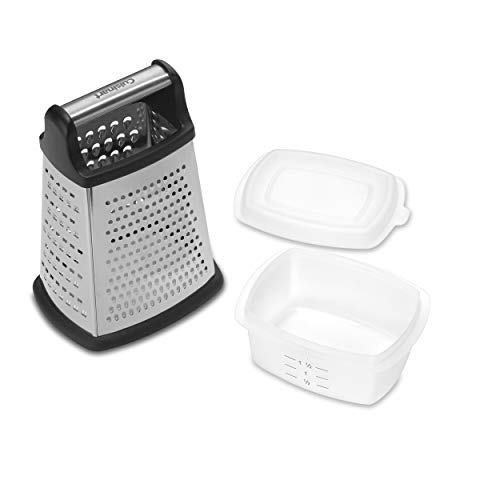
Cuisinart Box Grater
The Cuisinart box grater is the familiar stainless four-sided tower that many home cooks picture first: coarse, medium and fine grating faces, a slicer side, a comfortable top handle and a non-slip base ring on many versions. It is the safe, mainstream interpretation of the design, easy to find and easy to replace. In worth-it terms it is a pick: judge its tier against your weekly grating load, confirm the exact version on the current listing, and remember that the best value is the model whose teeth and handle you will still enjoy in year three. Best for: the profiles above that match its character. Not suited for: volume grating, where no tower earns its keep.

Microplane Box Grater
The Microplane box grater is the premium-leaning option from the brand famous for photo-etched blades. Its grating teeth are cut rather than punched, so they shave instead of tear, and the box typically adds a finer zesting face and a detachable measuring container on some versions. It suits cooks who grate hard cheese and aromatics often. In worth-it terms it is a pick: judge its tier against your weekly grating load, confirm the exact version on the current listing, and remember that the best value is the model whose teeth and handle you will still enjoy in year three. Best for: the profiles above that match its character. Not suited for: volume grating, where no tower earns its keep.
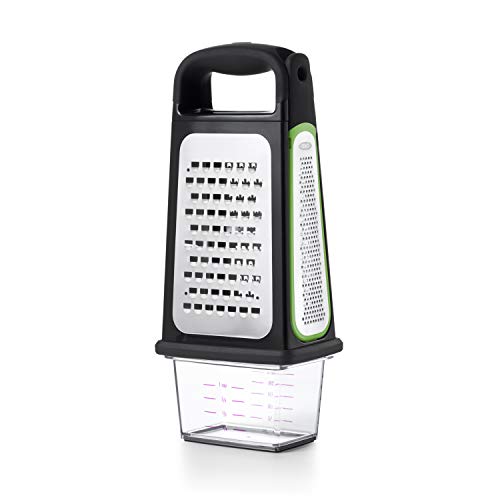
OXO Good Grips Box Grater
The OXO Good Grips box grater is the ergonomics-first take: a soft, oversized handle, a non-slip bottom, and a snap-on container with a lid that catches shreds and stores them. OXO designs for wrists and grip strength as much as for teeth, which makes it a kind choice for cooks with tired hands. In worth-it terms it is a pick: judge its tier against your weekly grating load, confirm the exact version on the current listing, and remember that the best value is the model whose teeth and handle you will still enjoy in year three. Best for: the profiles above that match its character. Not suited for: volume grating, where no tower earns its keep.
KitchenAid Box Grater
The KitchenAid box grater is the colourful, counter-friendly option, often sold with a catch container that doubles as a measuring cup. It covers the standard four faces and leans on brand familiarity and easy dishwasher care rather than exotic extras. In worth-it terms it is a pick: judge its tier against your weekly grating load, confirm the exact version on the current listing, and remember that the best value is the model whose teeth and handle you will still enjoy in year three. Best for: the profiles above that match its character. Not suited for: volume grating, where no tower earns its keep.

Deiss Pro Box Grater
The Deiss box grater is the value-minded stainless option that frequently bundles the grater with a container and lid. It covers the same four jobs in a slightly lighter build and is often the pick for a second grater, a holiday home or a first apartment. In worth-it terms it is a pick: judge its tier against your weekly grating load, confirm the exact version on the current listing, and remember that the best value is the model whose teeth and handle you will still enjoy in year three. Best for: the profiles above that match its character. Not suited for: volume grating, where no tower earns its keep.

Spring Chef Box Grater
The Spring Chef box grater is the budget-friendly tower with a detachable base container on many versions, pitched at everyday cheese and vegetable work. It is a sensible starter grater whose edges and handle reward a gentler hand. In worth-it terms it is a pick: judge its tier against your weekly grating load, confirm the exact version on the current listing, and remember that the best value is the model whose teeth and handle you will still enjoy in year three. Best for: the profiles above that match its character. Not suited for: volume grating, where no tower earns its keep.
How to Get the Most Value If You Buy
Value starts with keeping the tool, and yourself, intact. The safety routine is the highest-return habit in this entire guide, because an injury is the one outcome that makes any purchase retroactively worthless:
Slow down as the piece shrinks. The last third of a block of cheese or a carrot is where knuckles meet teeth, because your fingers creep closer with every stroke and the food gets harder to hold. The moment the piece feels small in your hand, change your grip: flatten your palm and press with your whole hand, fingers held up and away, or stop entirely and switch to a food holder or guard that keeps a barrier between skin and steel.
Never chase the final nub with your fingertips. That last sliver of parmesan or potato is not worth a scraped knuckle, and scraped knuckles on a grater are uniquely miserable because the teeth take a row of tiny bites at once. Eat the nub as a cook’s snack, save it for stock, or grate it later with a holder. Professional cooks throw the nub in the soup pot without a second thought, and you should too.
A cut-resistant glove is a legitimate option, not an admission of defeat. Thin cut-resistant gloves give you a confident grip on slippery food and turn a glancing contact into a non-event. They are especially helpful for younger cooks learning the motion, for anyone grating firm vegetables at speed, and for the final section of any job when concentration fades.
Wash the grater with a brush, moving away from the teeth, and never reach a bare hand inside the box to fish out stuck shreds. A stiff brush or an old toothbrush clears the teeth from the smooth back side, pushing residue out the way it came in. If you wash by hand in soapy water, keep the grater visible rather than buried under suds, because a hidden grater bites the hand that goes searching for the sponge.
Store the grater so its teeth cannot catch a hand rummaging in a drawer. Keep it in its box, in a dedicated slot, or with a simple guard or folded towel over the coarsest face. A box grater loose in a crowded utensil drawer is a trap for the next person who reaches in quickly, and the coarse face is always the one facing up.
Rinse the grater immediately after use, before cheese or potato starch dries onto the teeth. Dried residue is what turns a ten-second rinse into a scrubbing session, and scrubbing is when hands get careless around sharp edges. A quick rinse under a strong tap, from the inside out, knocks most shreds free while they are still soft.
Most stainless box graters are dishwasher safe, and the dishwasher is honestly the safest wash method because no hand goes near the teeth. Stand the grater where water can reach all four faces, and check the base and handle joints afterwards, because trapped moisture in seams is what eventually dulls and spots cheaper steel.
Dry the grater before it goes away, especially around the folded seams at the corners and under a rubber base ring if yours has one. Those seams are the first places to show rust freckles on lower-grade steel. A minute on a dish rack, teeth facing up and away from traffic, handles nearly all of it.
Keep the teeth honest by grating a piece of stale bread or a raw potato after sticky jobs like soft cheese. The firm, dry texture pushes residue out of the teeth without any tool near your fingers. It is an old kitchen trick, and it works better than poking at the holes with a knife tip, which risks both the knife and the hand holding it.
Inspect the faces now and then. Teeth that have been flattened by a knock in the drawer, a bent corner, or a handle that wobbles all change how the grater behaves, and a grater that flexes under pressure is a grater that can skid. A stable, sharp box grater is a safe one; a tired one earns its retirement.
Set the grater on a damp towel or a non-slip mat before you start. A box grater that walks across the counter forces you to grip the food harder and chase the tower, and chasing is how strokes go sideways into knuckles. Many models add a rubber base ring for exactly this reason, and it is one of the features genuinely worth having.
Use long, even strokes and let the teeth do the work. Pressing harder does not grate faster; it bends the food, packs the teeth and tires your arm. Light pressure with a steady rhythm produces cleaner shreds, less waste stuck in the teeth and far more control at the end of each stroke.
Grate on the coarse face first when a recipe allows a choice. Coarse shreds melt evenly, roast without scorching at the edges and are far more forgiving than fine shreds, which can clump and disappear into a dish. Save the fine face for hard cheese over pasta, nutmeg, chocolate and citrus zest, where a powder is the point.
Chill soft cheese before grating it. A short rest in the freezer firms mozzarella, cheddar and other soft blocks so they shred instead of smearing across the face. Smearing is not just ugly; the extra pressure people apply to force soft cheese through is a classic cause of slipped grips and grazed fingers.
Grate over a wide bowl or straight into the catch container if your model has one. Shreds that land in a bowl are shreds you can measure, season and move without sweeping them off the board with the side of your hand, which is another quiet way hands drift toward the teeth during cleanup.
Work with the food at a comfortable height. A grater on a low counter while you stand hunched invites rushed, angled strokes. Raising the work on a stable board or simply clearing space so your elbow moves freely makes the motion smoother, and smooth motion is safe motion.
Two more value habits: grate with a plan, batching the week’s cheese and vegetables in one session so the setup and wash happen once, and keep the grater where your scratch cooking happens, not in a distant cupboard. Cooks who grate aromatics constantly may add a dedicated tool from our roundup of ginger graters that handle fibrous roots or a press from our guide to garlic presses for the jobs a grater cannot do, and let the box do what it does best.
The Decision Checklist
- Do I grate cheese, vegetables or aromatics at least weekly? Yes points to buying.
- Are my quantities family-sized rather than crowd-sized? Yes points to the box over the machine.
- Do I have a safe storage spot where teeth cannot catch a reaching hand? If not, create one first.
- Will I slow down at the end of each piece and use a palm, holder or glove? Honest yes required.
- Is my current alternative costing me time or texture I actually notice? Yes means the upgrade is real.
- Can I rinse or load it in the dishwasher immediately after use? Yes keeps the chore at seconds.
Four or more yes answers: buy, and buy the best teeth your tier allows, using our {link(‘box grater review’, ‘box-grater-review’)} and {link(‘box grater reviews’, ‘box-grater-reviews’)} to choose the model. Two or fewer: skip it without regret and spend the money where your cooking actually lives. In between: buy the value tier, live with it for a season, and let your real habits cast the deciding vote.
The Honest Maths of a Grating Habit
Try the maths in time, because time is the currency this purchase actually trades in. A weekly cook grating at three meals spends perhaps ten minutes a week at the tower, saving several minutes per meal against knife work and far more against assembling and washing a processor for small jobs. Across a year that is hours returned, and the hours arrive in the pleasant form of dinners that start faster and clean up simpler. Few kitchen purchases of any size return hours at all.
Now the texture side of the ledger, which cooks feel but rarely count. Even shreds melt into a sauce instead of clumping, fry into crisp strands instead of steaming, and disappear into a cake instead of sinking. Recipes that quietly left your rotation because the prep was annoying, gratins, slaws, vegetable cakes, proper cheese sauces, tend to return when grating becomes easy. A tool that changes what you cook is worth more than a tool that merely speeds what you already cook.
Set against that the honest debits. The tower asks for a safe storage corner in a kitchen where corners are contested. It asks for thirty seconds of careful washing or a dishwasher slot at the end of tiring evenings. It asks, permanently, for the last-section discipline with every piece of food, and it collects on any lapse immediately and memorably. None of these debits is large; all of them are recurring, and recurring small costs are exactly what a worth-it judgement should weigh.
There is one more credit worth naming: confidence. Cooks who own a good tower stop substituting away from grated ingredients. The recipe that wants a pile of shredded courgette gets its courgette; the cheese sauce gets fresh-grated cheese that melts properly instead of a bagged substitute with anti-caking dust. Small fidelities like these are how home cooking quietly improves, and they trace back to a tool that made the faithful version the easy version.
And one more debit, for completeness: the tower will not grow with you into every ambition. The day you cater a wedding or prep for a freezer-filling marathon, it will watch from its corner while the processor works. Worth-it was never a claim about every possible job. It is a claim about your ordinary week, and on the ordinary week the arithmetic in this section is the arithmetic that decides.
Three Households, Revisited in Detail
Household one is a couple who cook six nights a week and keep their processor in a high cupboard because the kitchen is small. For them the question answered itself within a fortnight: the tower lives by the boards, grates something at almost every meal, and washes while the pan is still warm. Their verdict, worth it without qualification, rests less on any single session than on the accumulation of two hundred small ones a year, each a few minutes smoother than the knife-and-effort alternative they used before.
Household two is a family of five with a processor on the counter and a standing Sunday prep session. Their answer is the partnership this page keeps recommending: the processor takes the mountain, the tower takes the week. The tower’s worth, in their accounting, is measured in the jobs too small for the machine, which turned out to be most of them, and in a teenager who learned grating safely on the box, with a holder and a glove, before graduating to the machine’s sharper furniture.
Household three is a single cook in a studio flat who eats out half the week and grates cheese for weekend pasta. Their first answer was no, and it was correct at the time: the tower sat in a drawer, its teeth a hazard to rummaging hands, used too rarely to justify even its small footprint. What changed the answer was not the grater but the cooking, a winter of soups, gratins and bakes that moved grating from monthly to weekly. The lesson generalises: worth-it follows your repertoire, and the same household can honestly answer no in one season and yes in the next.
A fourth household deserves mention because its answer stayed no, permanently and correctly. They host large gatherings monthly, grate in quantities that belong to a machine, and keep a rotary grater for table cheese. For them the tower would be the worst of both worlds, too slow for their volume and too sharp for their storage. Worth-it pages earn their honesty from cases like this: the product did not fail them; the fit did, and recognising a bad fit before purchase is the entire point of asking the question.
Across all four households, one factor predicted the verdict better than budget, kitchen size or even cooking skill: the frequency of small grating jobs. Households with several small jobs a week always landed on yes. Households whose grating arrived rarely, or only in bulk, always landed on no or on the partnership. If you take one sentence from this page into your decision, take that one, and count your own small jobs honestly for a week before you spend anything.
If You Said No, and If You Said Yes
If you said no, make the no work well rather than wistfully. A sharp knife and a coarse, patient technique cover garnish quantities honestly. A borrowed or value-tier tower, stored safely in its box, covers the annual carrot cake without pretending to a larger role. And a rotary grater, if your no was about fingers rather than frequency, is not a compromise at all but the correct tool for your temperament, worth buying properly rather than apologising for. A good no, acted on, beats a reluctant yes that gathers dust and resentment in equal measure.
If you said yes, spend the first ten grates deliberately. Grate something coarse and forgiving first, a carrot, then something soft with the freezer trick, then something fine and fragrant, and rehearse the flat-palm finish on every single piece while the stakes are low and the pace is yours. Ten grates is enough to install the habits this page has repeated, and habits installed early are the ones still protecting your knuckles, unconsidered, in year three.
Whichever way you answered, revisit the answer when your cooking changes, because the verdict tracks the repertoire and the repertoire is not fixed. New households, new diets, new enthusiasms for baking or batch cooking all rewrite the small-jobs count that decides the question. The tower itself will wait patiently in the shop, unchanged and unhurried, exactly as it waits in the cupboard of everyone who already owns one. That patience, in the end, is rather the point of the tool.
One last consideration belongs to households deciding together, where one cook grates daily and another fears the teeth. The partnership answer is a comfort-handle tower, a holder and a glove kept with it, and an agreement that the fearful cook’s jobs route to the rotary grater or the knife without debate. Tools should lower the temperature of a kitchen, never raise it, and a worth-it verdict that ignores the household’s least confident cook is only half a verdict.
The Counterfactual Kitchen
Imagine the kitchen without the tower, honestly and in detail, because the counterfactual is where worth-it verdicts are actually decided. The cheese for tonight’s pasta is cut with a knife into strips that melt unevenly, or the processor comes out for a job smaller than its own washing. The carrots for the slaw are chopped, and the slaw is fine, and fine is the word that keeps recurring in the counterfactual kitchen: everything works, nothing sings, and several recipes have quietly left the rotation because their prep was a nuisance.
Now price the counterfactual fairly, because it has its own credits. That kitchen owns one less sharp object to store, wash and respect. It never thinks about the end of a piece of food. For a household whose grating is genuinely rare, those credits win, and this page has said so from its first paragraph. The counterfactual is not a scare tactic; it is a mirror, and what it reflects depends entirely on how often your real kitchen reaches for shreds.
There is a subtler counterfactual worth imagining too: the kitchen that bought the tower and never built the habits. In that kitchen the tool migrates to the back of the cupboard after one scraped knuckle, and its owner concludes, wrongly but sincerely, that box graters are not worth it. The product was identical; the onboarding was not. This is why the worth-it question cannot be separated from the two-minute routine, and why this page has treated a safety habit as part of the price, stated in full, rather than as fine print.
Set beside the counterfactual, the owning kitchen’s ledger is mostly small print of the pleasant kind. A drawer corner surrendered. Thirty seconds at the sink. A holder in the same drawer, a glove beside it. In exchange, a standing capability that touches breakfast eggs, weeknight pastas, Sunday bakes and the occasional feast’s garnish with the same unshowy competence. Worth-it, in the end, is rarely about the dramatic purchase. It is about whether a small, repeated ease outweighs a small, repeated care, and for the weekly cook that arithmetic has been settled the same way for a very long time.
If you are still circling, borrow the tiebreaker that undecided readers report most often: buy the mid-tier tower from a seller with an easy return, cook your real repertoire for a fortnight, and count the small jobs. Fewer than a handful, and the return is your answer, honestly earned. A handful or more, and the question will feel faintly comic, the way most settled kitchen questions do once the tool has started, quietly and repeatedly, to pay.
The Verdict, Stress-Tested
Stress-test the yes with the busiest week of your year. In that week the tower will be used tired, hurried and one-handed more than once, and the question is whether its habits hold under pressure. Owners report that they do, provided the habits were installed in calm weeks first: the palm flattens by itself, the holder is already in the drawer, the rinse happens while the pan heats. A yes that survives the busiest week is a yes you can sign; a yes that only works in leisure is a rotary grater waiting to be bought instead.
Stress-test the no with the most grating-heavy recipe you love. Make it once with your current tools and watch the clock and your own temper. If the recipe still delights you and the prep felt like cooking rather than toll-paying, your no is sound and this page congratulates it. If the recipe felt diminished, or if you caught yourself substituting an inferior shortcut, the no was protecting a principle your cooking does not actually hold, and the tower has just made its case in the only court that matters.
Stress-test both answers against the people who share your kitchen. A yes is stronger when every cook in the house can use the tower safely, and weaker when one person’s enthusiasm becomes another’s hazard. A no is stronger when it is unanimous and weaker when one cook is quietly grating with a knife at midnight, wishing. Worth-it is a household verdict wearing a personal disguise, and the households that ask the question out loud tend to answer it better.
Finally, stress-test the verdict against time itself. The tower you buy this year is the tower of the next several years, through recipe phases, household changes and at least one kitchen reorganisation. Its design has already survived a century of such changes without needing to become something else. Very few purchases in a modern kitchen can say that, and while longevity alone does not make anything worth it, longevity in a tool that also saves you minutes weekly is the closest thing this category has to a guarantee.
So the page ends where it began, with the short answer now fully priced. Worth it, if your week is full of small grating jobs and your hands will learn one small habit. Not worth it, if your grating is rare, bulk or rushed beyond reform. The middle cases resolve by counting, and the counting takes a week. However you land, land deliberately: the cooks who regret this purchase are never the ones who asked the question carefully. They are the ones who never asked it at all.
What Owners Say a Year Later
A year later, the yes households have mostly stopped thinking about the question, which is itself the answer they would give if asked. The tower hangs or stands where it lives, comes down several times a week, and returns washed within the minute. When owners do reflect, they talk about recipes rather than tools: the gratin that entered the rotation, the slaw that stopped being a project, the cheese sauce that finally melts the way the book promised. A purchase that dissolves into better dinners has justified itself in the only currency that was ever really at stake.
A year later, the no households have also stopped thinking about the question, and their silence is equally informative. Nothing in their cooking pulled the tower back into the conversation, which confirms that their no was a reading of their repertoire rather than a failure of nerve. The healthiest outcome in consumer decisions is not always yes; it is a verdict, either way, that time keeps ratifying. Both groups in this paragraph got exactly that, and both would give the same advice: answer the question from your week, not from anyone else’s.
The households still arguing a year later are, without exception, the ones that bought against their own evidence: the rare graters who bought premium, the volume cooks who bought small, the rushers who bought sharp and hoped. Their experience writes the final line of this page more plainly than any argument could. The tool is worth it when it fits the life it enters, and the fit is knowable in advance, cheaply, by counting small jobs for a single week. Count first, and the verdict takes care of itself.
One Small Test Before You Decide
If the counting week feels like homework, shrink it to a single evening. Choose the most grating-heavy meal you cook, and make it twice in one week: once with whatever you use now, once with a borrowed tower if a friend or neighbour can lend one. Time the prep, time the washing, and taste the difference in the finished dish with the honesty of someone feeding people they love. Two evenings will tell you more than two weeks of deliberation, because the worth-it question was never really about the tool. It was about your dinners, and dinners can be tested directly.
Then notice the morning after. The borrowed tower, rinsed and rack-dried, asks nothing of you; the processor, if that was your first evening’s tool, may still be occupying the draining board in pieces. Small frictions and small eases compound across a year of evenings into the real price and the real return of any kitchen tool. Judge the week, judge the morning after, and the verdict that emerges will be the one your household keeps, which is the only verdict this page has ever been trying to help you reach.
Worth It for Whom? A Box Grater Break-Even Test Based on Your Actual Routine
The purchase is the easy part. A box grater proves itself at the kitchen counter, board or bowl it works over, in the middle of preparing cheese, vegetables and zest for everyday cooking, long after the packaging has gone. Judge in this order: routine first, space second, features last. Reversing that order is how most disappointing purchases of a box grater begin. Start with the stability of the base and handle while you apply downward pressure. If that check fails, stop there, since the remaining virtues of any box grater are built on a foundation your home has already rejected. Edge cases matter here: grating a small amount, where washing the whole tool can feel like the real cost. A box grater chosen with that situation in mind will not need replacing the first time life deviates from the brochure.
Storage between uses is part of ownership, so decide where the box grater and anything it needs will live when idle, and be honest if the only answer is a surface you cannot spare. There is always a learning curve, however small. Decide who in the household faces the steepest part of it with this box grater and whether the design helps or hinders them. The purchase price is the smallest part of some ownership stories. Space, upkeep and the occasional replacement part are where a box grater keeps charging you. If the honest answer is that a borrowed, shared or simpler alternative covers your real need, believe it, because a box grater that sits idle is not a bargain at any specification.
- State what the simpler alternative leaves undone.
- Add storage, cleaning and replacement-part costs to the reckoning.
- Decide the usage level below which it stops earning its place.
- Estimate real monthly uses without optimism.
- Calendar a one-month check against your prediction.
If you cannot name those things yet, you are not ready to choose, and an hour spent clarifying the routine will save more disappointment than an hour spent comparing near-identical listings. Get the tape measure out before you get the shortlist out. Written measurements settle arguments that photographs start, especially around clearances that only matter when the box grater is actually in use. If a shortlist is already forming, run these checks against the exact listings you are comparing, for example the Cuisinart Box Grater and the Microplane Box Grater, reading the current listing details rather than relying on memory. Nothing is kept forever. Favour the box grater you could repair, rehome or responsibly retire over the one that becomes an awkward problem the day it stops working.
Prevention is unglamorous and effective: washing and drying it straight after use so edges stay clean and rust-free, done consistently, protects performance better than any occasional rescue effort after problems have set in. If two options still look equal, choose the one whose weaknesses land where you care least, because every design trades something away and the honest question is which trade your household tolerates best. Try this decision exercise: write down three non-negotiable jobs, one acceptable compromise and one walk-away flaw. If a candidate survives that list, it deserves its place on the shortlist. Consider what the box grater gives off while it works and what it leaves behind afterwards, because living with the by-products is part of living with the product.
Check for duplicated function in your own home first, because the item you already own that does part of this job changes what the new box grater actually needs to be. Next, consider whether every face you will actually use is easy to wash afterwards. Listings rarely volunteer this information, so you have to go looking for it, and the looking is worth the minutes it takes. Ask which part of the box grater will look tired first and whether that tiredness is cosmetic, cleanable, repairable or terminal, because the answer sets the realistic lifespan. For items that suffer from constant use without rest, a planned spare is not extravagance; it is how the routine survives the day the main one is wet, dirty, broken or missing.
Most disappointment with a box grater traces back to grated food clogging the teeth and knuckles meeting the surface on short pieces. It is a slow, predictable process, which is good news, because predictable problems can be designed out before you buy. Cleaning time is an ownership cost like any other, so favour the design whose care routine fits the time you genuinely have, not the time you would have in an ideal week. Anything heavy, hot, sharp, load-bearing or electrically powered deserves a respectful pause in the decision, and the maker’s own guidance, read before purchase, is part of the specification. Do not test your decision against a calm day. Test it against the rushed morning, the crowded evening or the week everything happens at once, because that is when a box grater earns or loses its place.
Frequently Asked Questions
Is a box grater worth it if I own a food processor?
Usually yes, for daily quantities. The box is ready instantly and washes in seconds, so the handful of cheese or single carrot that makes up most grating never justifies assembling the machine. The processor keeps the volume jobs. Most cooks who own both use the box far more often.
How much should I spend on a box grater?
Think in tiers rather than figures. Entry tiers suit rare use, mid tiers suit weekly cooking, and premium etched teeth repay daily fine grating in reduced effort. The expensive mistake is the flimsiest tier bought for heavy use, because flexing steel is slower and less safe. Buy the tier that matches your load.
Is a box grater dangerous?
It is unforgiving rather than dangerous when used with the standard habit: slow down as the piece shrinks, finish with a flat palm or a food holder, never chase the last nub with fingertips, and wash with a brush away from the teeth. Cooks who will not adopt that habit should choose a rotary grater instead.
What do people use a box grater for most?
Cheese first, then vegetables such as carrots, potatoes and zucchini, then the fine jobs: hard cheese, citrus zest, nutmeg, chocolate, garlic and ginger. The slicer face handles occasional cucumber and radish. If that list matches your weekly cooking, the tool will earn its space; if not, it will not.
How long does a box grater take to pay for itself?
In time rather than money, a weekly cook feels the return within the first month: faster prep, better texture and seconds of washing, repeated at every meal. The purchase tiers are modest enough that the honest calculation is effort saved per week, not a date on a calendar.
Can a box grater replace a mandoline or a rotary grater?
Not fully. Its slicer face is a bonus, not a mandoline, and a rotary grater keeps fingers safer by design. The box replaces the middle ground: everyday shredding and fine grating in family quantities. Kitchens with slicing-heavy or safety-first needs should keep the specialist tools alongside it.
Related Guides
Keep exploring this corner of the kitchen: the box grater review; box grater reviews compared; the box grater buying guide; box grater pros and cons; food processors with grating discs; cutting boards that give a grater a stable base.


