Disclosure: As an Amazon Associate, airfryerkitchensupply.com earns from qualifying purchases. Links on this page are affiliate links; they cost you nothing extra. Prices and availability change often, so check the current Amazon listing before you buy.
Weighing up box grater pros and cons is refreshingly simple compared with most kitchen purchases, because the tool is honest: four sharp faces, no motor, no mystery. This rundown of box grater pros and cons gives each side its full weight, including the con nobody should soften, which is what those teeth do to careless knuckles. Read both columns before you decide, and notice how many of the cons shrink with technique while the pros stay exactly as advertised.
Box Grater Pros and Cons: Quick Verdict and Key Takeaways
The box grater suits cooks who grate weekly and want one ready tool for cheese, vegetables and aromatics. It does not suit cooks grating for crowds, cooks who will not slow down at the end of a piece of food, or cooks whose grating is so rare that a borrowed flat grater covers the year. The pros are structural and permanent; the cons are mostly about volume, the slicer face, and respect for sharp steel.
- Pros: four tools in one footprint, clean shreds, no setup, easy washing, tiny storage, decades-long design life.
- Cons: unforgiving teeth, slow for bulk, a mediocre slicer, clogging fine faces, and cheap versions that flex and rust.
- The biggest pro is readiness: the grater is working before a machine would be assembled.
- The biggest con is injury risk at the end of each piece, managed by flat palms, holders, gloves and patience.
- Most cons are technique problems in disguise; the pros are design facts that technique cannot create.
In this guide
The Pros
Four Tools in One Small Footprint
Coarse shredder, medium shredder, fine grater and slicer stand in a single corner of a cupboard, always assembled. In small kitchens this consolidation is the whole argument: one purchase, one wash, one storage slot, four jobs covered. Even in large kitchens, the tower displaces a drawer of single-purpose gadgets that each did one of its jobs worse.
Clean Shreds That Cook Better
Sharp teeth cut food into even strands and powders, and evenness is flavour. Cheese shreds of one thickness melt together instead of leaving raw clumps beside scorched wisps. Potato shreds of one thickness fry at the same rate. Carrot strands of one thickness soften together in a cake or slaw. A knife can approximate this with time; the grater does it by design, every stroke.
Ready Before Anything Else Is
There is no assembly, no cord, no battery and no manual. You take the tower down, set it on a towel, and grate. For the small, frequent jobs that make up most home grating, a handful of cheese, a carrot, a knob of ginger, the box grater is finished and rinsed before a food processor would be out of its cupboard. Readiness is why owners actually use it instead of working around it.
Gentle on the Washing Up
Used and rinsed promptly, a box grater cleans in seconds, and most stainless models can simply go in the dishwasher, which is also the safest wash because no hand approaches the teeth. Compare that with a processor’s bowl, lid, disc and pusher, each with its own edges and crevices, and the box’s advantage compounds across a year of dinners.
Cheap to Buy, Cheaper to Own
Even the premium end of this category costs little against any electric alternative, and ownership adds nothing: no filters, no blades to replace on a schedule, no proprietary parts. A well-made tower bought once serves for years, and the value models serve occasional cooks honestly. The tiers are qualitative, entry, mid and premium, and even the top tier is a modest, one-time decision.
No Power, No Noise, No Fuss
The grater works during a power cut, at a campsite table, and at midnight without waking the house. It gives tactile feedback a machine cannot: you feel the cheese firm up as it chills, feel the carrot resist, feel the teeth begin to clog, and adjust in real time. That feedback is part of why experienced cooks keep one even beside powerful machines.
Portion Control Built In
Grating by hand makes quantity visible. You see the pile grow and stop when the recipe has enough, rather than processing a whole block because the machine was already dirty. Container models extend this with measurement marks, turning the grater into its own portioning tool for bakers and meal preppers.
The Cons
The Teeth Are Unforgiving
This is the con that matters most, so it comes first and unsweetened. Grating surfaces take skin exactly as efficiently as they take cheese, and the classic injury, a row of scraped knuckles, happens in the last strokes of a piece when fingers are closest and attention wanders. The mitigation is real but it is behavioural: slow down as the piece shrinks, switch to a flat palm or a food holder for the last part, never chase the final nub with fingertips, and consider a cut-resistant glove. A cook unwilling to do those things should choose a rotary grater instead.
Slow and Tiring at Volume
For a family portion the box is quick; for a crowd it is a workout. Grating cheese for a large gathering or potatoes for a party-sized dish takes sustained effort, heats the holding hand and tests patience precisely when the cook is busiest. A food processor with a grating disc does the same mountain in seconds, and pretending otherwise would be dishonest. Volume cooks should weigh this con heavily.
The Slicer Face Disappoints
On most towers the slicer produces uneven slices at one fixed thickness, demands its own careful technique, and still loses to a knife for control. Buyers who purchase the box mainly for slicing will feel misled. Treat the slicer as a bonus for a quick cucumber, keep fingers guarded or use a holder on it, and let the three grating faces justify the purchase.
Fine Faces Clog
Fibrous ginger, soft cheese and wet vegetables pack fine teeth, slowing the work and tempting cooks to pick at the blockage with a fingertip, which is precisely the wrong tool. The fixes are mundane: chill soft foods, use short strokes, tap the face over the bowl, and clear teeth with a brush from the smooth back side. Mundane or not, the clogging is a recurring friction the pros column cannot erase.
Cheap Versions Flex, Spot and Dull
The category’s low end includes towers with thin steel that bows under pressure, seams that trap moisture and spot with rust, and teeth that were never sharp. A flexing grater is not merely unpleasant; it is less safe, because pressure plus flex plus a skid is the injury recipe. This con is avoidable by buying mid-tier or better, but it is real for anyone tempted by the very cheapest shelf.
Storage Has Teeth, Literally
A box grater stored loose in a drawer is a hazard to the next hand that reaches in, and its bulk, while small, is awkward among flat utensils. It needs its box, a guard, a dedicated slot or a cupboard corner. That is a small demand, but households that ignore it convert a storage question into a first-aid question.
One More Thing to Wash by Hand, Carefully
If your model or your habits keep it out of the dishwasher, hand washing a box grater demands a brush and attention: strokes away from the teeth, no bare hand inside the box fishing for shreds, and care in soapy water where a hidden grater waits for the searching hand. It is thirty seconds of care, but it is care, every time.
What the Trade-Offs Mean for You
For the weekly scratch cook, the pros land daily and the cons visit rarely: volume is modest, the slicer is a bonus, and the safety habit becomes automatic within a fortnight. For the batch and party cook, the volume con grows teeth of its own, and the honest answer may be the box for daily work plus a processor for feasts; our overview of food processors with grating discs prices that partnership in effort rather than money. For the rare grater, the pros barely get a chance to operate, and the storage and washing cons dominate a tool used twice a year.
For cooks with grip or dexterity concerns, the balance hinges on accessories: a comfort-handle model, a cut-resistant glove and a food holder convert the headline con into a managed routine, and the readiness pro remains. For households teaching children to cook, the same accessories plus supervision make the box a fine teaching tool, because its feedback is immediate and its lessons about respecting blades transfer to every knife skill that follows, especially alongside a stable base from our guide to cutting boards that give a grater a stable base.
How the Box Grater Compares With the Alternatives
Against a flat grater, the box wins faces, stability and shred collection, and loses drawer-friendliness. Against a rotary grater, the box wins versatility and loses the rotary’s total finger separation, which is why the rotary is the recommendation for anyone who will not adopt the flat-palm finish. Against a mandoline, the box wins safety and loses slicing, which was never its strength. Against the food processor, the box wins readiness, washing and storage, and loses volume by a distance. No alternative wins everything, which is the sign of a healthy category. Readers who want model-level guidance can continue to our {link(‘box grater reviews’, ‘box-grater-reviews’)} or the step-by-step {link(‘box grater buying guide’, ‘box-grater-buying-guide’)}.
How to Buy Smart
Buy the teeth first: etched if you grate finely and often, cleanly punched if your work is coarse and weekly. Buy stiffness second: faces that spring rather than bow, seams folded smooth. Buy the handle third, with your own hand as the judge. Decide about the container by your routine, not by the photograph. And buy the safety kit in the same basket if you do not own it: a holder or guard, and a cut-resistant glove if your household includes beginners. Finally, verify the exact version on the listing, because face line-ups and accessories vary between production runs of the same model name.
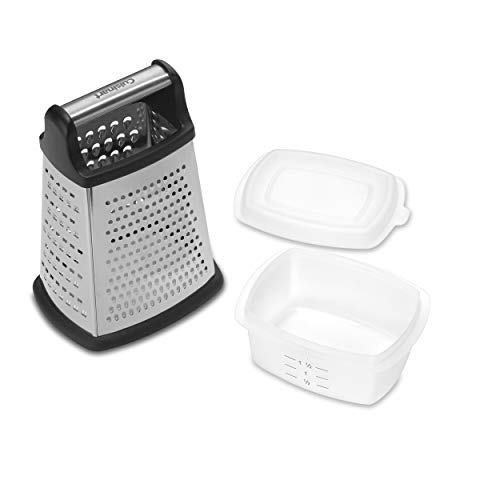
Cuisinart Box Grater
In pros-and-cons terms, the Cuisinart box grater is the mainstream default whose pros are balance and availability. It is the familiar stainless four-sided tower that many home cooks picture first: coarse, medium and fine grating faces, a slicer side, a comfortable top handle and a non-slip base ring on many versions. It is the safe, mainstream interpretation of the design, easy to find and easy to replace. Like every pick here it is: confirm the current version’s configuration before buying. Its cons are the category cons, teeth, slicer, clogging, plus whatever lightness or plainness its tier implies.

Microplane Box Grater
In pros-and-cons terms, the Microplane box grater is the etched-teeth option whose pro is effortless fine cutting. It is the premium-leaning option from the brand famous for photo-etched blades. Its grating teeth are cut rather than punched, so they shave instead of tear, and the box typically adds a finer zesting face and a detachable measuring container on some versions. It suits cooks who grate hard cheese and aromatics often. Like every pick here it is: confirm the current version’s configuration before buying. Its cons are the category cons, teeth, slicer, clogging, plus whatever lightness or plainness its tier implies.
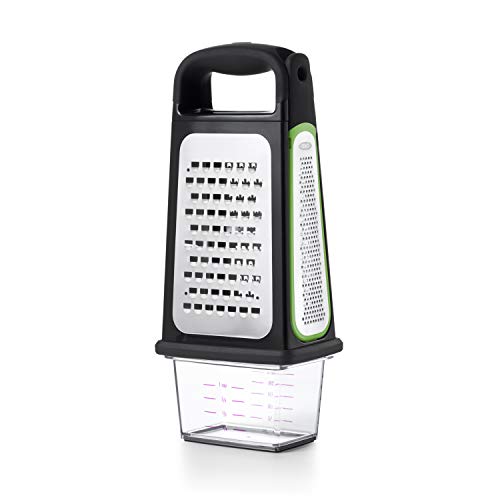
OXO Good Grips Box Grater
In pros-and-cons terms, the OXO Good Grips box grater is the comfort option whose pros are handle, grip and container. It is the ergonomics-first take: a soft, oversized handle, a non-slip bottom, and a snap-on container with a lid that catches shreds and stores them. OXO designs for wrists and grip strength as much as for teeth, which makes it a kind choice for cooks with tired hands. Like every pick here it is: confirm the current version’s configuration before buying. Its cons are the category cons, teeth, slicer, clogging, plus whatever lightness or plainness its tier implies.
KitchenAid Box Grater
In pros-and-cons terms, the KitchenAid box grater is the cheerful all-rounder whose pro is easy, colourful convenience. It is the colourful, counter-friendly option, often sold with a catch container that doubles as a measuring cup. It covers the standard four faces and leans on brand familiarity and easy dishwasher care rather than exotic extras. Like every pick here it is: confirm the current version’s configuration before buying. Its cons are the category cons, teeth, slicer, clogging, plus whatever lightness or plainness its tier implies.

Deiss Pro Box Grater
In pros-and-cons terms, the Deiss box grater is the value option whose pro is a complete set for occasional work. It is the value-minded stainless option that frequently bundles the grater with a container and lid. It covers the same four jobs in a slightly lighter build and is often the pick for a second grater, a holiday home or a first apartment. Like every pick here it is: confirm the current version’s configuration before buying. Its cons are the category cons, teeth, slicer, clogging, plus whatever lightness or plainness its tier implies.

Spring Chef Box Grater
In pros-and-cons terms, the Spring Chef box grater is the budget starter whose pro is learning your habits cheaply. It is the budget-friendly tower with a detachable base container on many versions, pitched at everyday cheese and vegetable work. It is a sensible starter grater whose edges and handle reward a gentler hand. Like every pick here it is: confirm the current version’s configuration before buying. Its cons are the category cons, teeth, slicer, clogging, plus whatever lightness or plainness its tier implies.
Setup and Care That Reduce the Cons
Most cons in the list above shrink under one discipline, so it is stated here in full rather than summarised. The grating surfaces are unforgiving, and the routine that tames them is short enough to memorise in one reading:
Slow down as the piece shrinks. The last third of a block of cheese or a carrot is where knuckles meet teeth, because your fingers creep closer with every stroke and the food gets harder to hold. The moment the piece feels small in your hand, change your grip: flatten your palm and press with your whole hand, fingers held up and away, or stop entirely and switch to a food holder or guard that keeps a barrier between skin and steel.
Never chase the final nub with your fingertips. That last sliver of parmesan or potato is not worth a scraped knuckle, and scraped knuckles on a grater are uniquely miserable because the teeth take a row of tiny bites at once. Eat the nub as a cook’s snack, save it for stock, or grate it later with a holder. Professional cooks throw the nub in the soup pot without a second thought, and you should too.
A cut-resistant glove is a legitimate option, not an admission of defeat. Thin cut-resistant gloves give you a confident grip on slippery food and turn a glancing contact into a non-event. They are especially helpful for younger cooks learning the motion, for anyone grating firm vegetables at speed, and for the final section of any job when concentration fades.
Wash the grater with a brush, moving away from the teeth, and never reach a bare hand inside the box to fish out stuck shreds. A stiff brush or an old toothbrush clears the teeth from the smooth back side, pushing residue out the way it came in. If you wash by hand in soapy water, keep the grater visible rather than buried under suds, because a hidden grater bites the hand that goes searching for the sponge.
Store the grater so its teeth cannot catch a hand rummaging in a drawer. Keep it in its box, in a dedicated slot, or with a simple guard or folded towel over the coarsest face. A box grater loose in a crowded utensil drawer is a trap for the next person who reaches in quickly, and the coarse face is always the one facing up.
Rinse the grater immediately after use, before cheese or potato starch dries onto the teeth. Dried residue is what turns a ten-second rinse into a scrubbing session, and scrubbing is when hands get careless around sharp edges. A quick rinse under a strong tap, from the inside out, knocks most shreds free while they are still soft.
Most stainless box graters are dishwasher safe, and the dishwasher is honestly the safest wash method because no hand goes near the teeth. Stand the grater where water can reach all four faces, and check the base and handle joints afterwards, because trapped moisture in seams is what eventually dulls and spots cheaper steel.
Dry the grater before it goes away, especially around the folded seams at the corners and under a rubber base ring if yours has one. Those seams are the first places to show rust freckles on lower-grade steel. A minute on a dish rack, teeth facing up and away from traffic, handles nearly all of it.
Keep the teeth honest by grating a piece of stale bread or a raw potato after sticky jobs like soft cheese. The firm, dry texture pushes residue out of the teeth without any tool near your fingers. It is an old kitchen trick, and it works better than poking at the holes with a knife tip, which risks both the knife and the hand holding it.
Inspect the faces now and then. Teeth that have been flattened by a knock in the drawer, a bent corner, or a handle that wobbles all change how the grater behaves, and a grater that flexes under pressure is a grater that can skid. A stable, sharp box grater is a safe one; a tired one earns its retirement.
Set the grater on a damp towel or a non-slip mat before you start. A box grater that walks across the counter forces you to grip the food harder and chase the tower, and chasing is how strokes go sideways into knuckles. Many models add a rubber base ring for exactly this reason, and it is one of the features genuinely worth having.
Use long, even strokes and let the teeth do the work. Pressing harder does not grate faster; it bends the food, packs the teeth and tires your arm. Light pressure with a steady rhythm produces cleaner shreds, less waste stuck in the teeth and far more control at the end of each stroke.
Grate on the coarse face first when a recipe allows a choice. Coarse shreds melt evenly, roast without scorching at the edges and are far more forgiving than fine shreds, which can clump and disappear into a dish. Save the fine face for hard cheese over pasta, nutmeg, chocolate and citrus zest, where a powder is the point.
Chill soft cheese before grating it. A short rest in the freezer firms mozzarella, cheddar and other soft blocks so they shred instead of smearing across the face. Smearing is not just ugly; the extra pressure people apply to force soft cheese through is a classic cause of slipped grips and grazed fingers.
Grate over a wide bowl or straight into the catch container if your model has one. Shreds that land in a bowl are shreds you can measure, season and move without sweeping them off the board with the side of your hand, which is another quiet way hands drift toward the teeth during cleanup.
Work with the food at a comfortable height. A grater on a low counter while you stand hunched invites rushed, angled strokes. Raising the work on a stable board or simply clearing space so your elbow moves freely makes the motion smoother, and smooth motion is safe motion.
Bottom Line
The pros are what the box grater is; the cons are mostly how it asks to be treated. If your cooking is weekly and your quantities are household-sized, the pros win comfortably and the cons reduce to a safety habit and a mediocre slicer you will rarely use. If your quantities are crowd-sized or your patience with sharp edges is thin, the cons win and the alternatives deserve your money. Either way, you now hold the whole balance sheet. Our {link(‘box grater review’, ‘box-grater-review’)} tests the design in daily use, and {link(‘whether a box grater is worth it’, ‘is-a-box-grater-worth-it’)} turns this balance into a final yes or no.
The Balance Sheet, Kitchen by Kitchen
In a small flat with one cupboard for tools, the balance sheet tilts hard toward the pros. The tower replaces a drawer of gadgets, asks for a corner, and covers every grating job the household attempts. The cons that remain are the safety habit and the washing care, both cheap at this scale. For this kitchen the verdict is not close, and the only real decision is which tier of teeth the cooking justifies.
In a family kitchen cooking for six, the sheet stays positive but the volume con starts to negotiate. Weeknight quantities still favour the box, while weekend batches argue for machine help. Many such kitchens settle the argument by division of labour: the box owns the week, the processor owns the feast, and the pros of each cover the cons of the other. That partnership is the most common end state this balance sheet produces.
In a kitchen where a keen teenager is learning to cook, the sheet gains a line on each side. Pro: the box teaches knife-adjacent respect, pressure control and mise en place better than any machine, because its feedback is immediate and honest. Con: the teaching must include the end-of-piece routine from the very first session, with a holder and a glove treated as standard kit rather than optional extras. Supervised properly, the pro outweighs the con and the lesson transfers to every blade that follows.
In a kitchen serving someone with arthritis or reduced grip, the sheet depends entirely on model choice. A classic narrow-handle tower scores its worst result here, while a comfort-handle model with a gripping base and a cut-resistant glove converts the same category into a genuinely kind tool. The pros of readiness and texture remain; the headline con shrinks to a managed routine. This is the kitchen where buying advice matters most, and where the generic verdict matters least.
In a holiday home or rental kitchen, the value models write their own verdict. The pros of coverage and readiness apply in full, the cons of lighter steel barely matter at holiday frequency, and the whole question resolves for the price of a single restaurant starter. The one non-negotiable remains storage: even a holiday grater lives in its box or a guard, because the next hand in that drawer belongs to a guest who does not know it is there.
In a professional-leaning home kitchen, where a processor, mandoline and rotary grater already live, the box still earns its corner, and the reason is the readiness pro in its purest form. For the handful of cheese, the single carrot, the knob of ginger, no other tool in that arsenal is working as fast as the tower is. The cons are all priced in and managed by existing habits. Even surrounded by specialists, the generalist keeps its job.
Myths, Half-Truths and the One-Month Test
Myth one: a box grater is dangerous and should be avoided. The honest version is narrower: a box grater is unforgiving of one specific habit, chasing small pieces with fingertips, and entirely manageable with the flat-palm, holder and glove routine described in this piece. Kitchens that adopt the routine report years of uneventful grating. The myth survives because the injury is memorable and the thousand safe sessions are not, which is a reason to respect the teeth, not to fear the tool.
Myth two: more faces always means more value. Half-true at best. The standard four faces cover the home repertoire; additional novelty faces mostly add washing and storage. What actually adds value is the quality of the faces you use weekly and the mundane extras, grip, container, handle, that remove steps from your routine. A four-face tower with excellent teeth outperforms a gadget-laden tower with mediocre ones at every meal that matters.
Myth three: the dishwasher ruins graters. For stainless towers the opposite is closer to the truth: the dishwasher is the safest and most thorough routine wash, keeping hands away from teeth and water moving through every face. The genuine enemies are overnight soaking, trapped moisture in seams and being buried under suds during a hand wash. Dry the tower after any wash and the myth loses its last foothold.
Myth four: a grater is a grater, so buy the cheapest. The one-month test refutes it in kitchens that grate weekly. In week one the cheap and mid-tier towers feel similar; by week four the flex, the walking base and the tearing teeth of the flimsiest models have taxed every session, while the mid-tier tower has disappeared into the routine. Frequency is the variable the myth ignores, and frequency is precisely what a pros-and-cons page exists to weigh.
The one-month test, stated plainly, is this: grate your real repertoire for four weeks and count three things. Count the sessions where the tool was ready faster than any alternative, which is the readiness pro made measurable. Count the sessions where you pressed harder than you wanted, which is the teeth and flex cons made measurable. And count the near-misses at the end of pieces, which is your technique, made honest. Those three numbers settle the balance sheet for your kitchen better than any general verdict, including the one in this article.
A last half-truth deserves its sentence: that the box grater is old-fashioned. It is, in the same way a knife is old-fashioned. The design persists because the problem it solves, turning firm food into even shreds at human scale, has not changed, and because its solution needs nothing the centuries have improved except the steel and the handles, both of which the modern versions quietly provide.
The Cons, Revisited One Year Later
A year of ownership edits the cons list in instructive ways. The washing con, which looms large in week one, shrinks to nearly nothing in households that adopted the prompt rinse or the dishwasher habit; owners describe thirty seconds they no longer notice. The storage con similarly evaporates in households that solved it once with a box or a slot. Cons that depend on a single decision turn out to be the cheapest cons a product can have, because they are paid once and never again.
The clogging con edits itself by food rather than by time. Ginger still clogs in month twelve exactly as in week one, and owners simply price it in: short strokes, a tap, a brush, done. Soft cheese stops clogging the moment the freezer habit forms. What remains is a small, known friction with a known routine, which owners rate very differently from the surprise it was at first. Predictability, it turns out, is most of what people mean by quality in a simple tool.
The slicer con does not edit at all, and honesty requires saying so. A year later it is still the weakest face, still uneven, still a bonus. Owners have made their peace by demoting it in their expectations, which is a reminder that some cons are not problems to be solved but facts to be priced. If slicing matters to your cooking, price this con at full weight and buy the box for its three grating faces alone.
The volume con grows or shrinks with the household, not the tool. Families that grew, hosted more or took up batch cooking found the con heavier each season and eventually added the processor partnership. Households whose cooking stayed steady found the con theoretical, a line in a review about a life they do not live. This is why the pros-and-cons format insists on profiles: the same con is decisive in one kitchen and invisible in another, and both reports are true.
The injury-risk con, revisited honestly, divides owners into two groups with almost no middle. Those who built the end-of-piece routine report a non-event year, hundreds of sessions without incident. Those who treated the routine as optional report the scrape, usually singular, usually at a piece’s end, usually in a hurry. The tool did not change between those groups. The behaviour did, and a pros-and-cons page that failed to say so plainly would be failing its only important job.
What would change the verdict entirely? Three developments, none of them likely. A genuinely better slicer face would retire the oldest con. A guard system as standard, fitted, stored on the tower and impossible to lose, would retire most of the injury con rather than merely managing it. And a step change in home food processors, silent, tiny and self-cleaning, would retire the readiness pro that anchors the other column. Until one of those arrives, the balance in this article stands as written, and the tower keeps its corner of the cupboard on merit.
Voices From Both Columns
The pros column, in owners’ own paraphrases, sounds like relief. Relief that the cheese is grated before the pasta water boils. Relief that the washing is a rinse while the pan is still warm. Relief that one tool ended the drawer of single-purpose gadgets, each bought for a job the tower does better. When a simple product’s praise takes the form of relief, it is usually because the product removed a recurring friction so completely that owners notice the absence rather than the tool, and that is the highest state a kitchen staple can reach.
The cons column, paraphrased the same way, sounds like respect and one recurring irritation. Respect for teeth that have never been given the chance to teach their lesson twice. Irritation at a fine face full of ginger at the end of a long day, at a slicer that promised more than it delivers, at a cheap first purchase that had to be made twice. Notice that the irritation is specific and survivable, while the relief is general and daily. That asymmetry is the sound of a balance sheet tipping, and it tips the same way in most kitchens that grate weekly.
There is a third voice worth hearing: the cook who sold the tower at a yard sale and bought another within the year. Their testimony is the most persuasive in this entire piece, because it was paid for. They report that the alternatives each solved one problem and created another, the processor its washing, the flat grater its instability, the knife its evenings, until the tower’s particular bundle of pros and ordinary, manageable cons looked, in retrospect, like the best deal in the drawer. Absence is a rigorous reviewer.
Balance requires the opposite voice too: the cook who gave the tower away and never missed it. Their grating was rare, their processor was already out for other jobs, and their drawer space was worth more than the tower’s readiness. Their verdict is not a refutation of this article but a confirmation of its method, because pros and cons only ever resolve inside a particular kitchen. The page’s job is to hand you the scales, not to press its thumb on them.
If the voices leave you undecided, borrow the decision procedure owners recommend most: cook one deliberately grating-heavy week with whatever you currently own. Count the jobs, feel the friction, notice the textures. Then read this page again. The pros and cons will have stopped being abstractions and become descriptions of your own evenings, and the verdict, whichever way it falls, will be yours rather than ours, which is the only kind that survives contact with a real kitchen.
The Small Print, Read Aloud
Small print one: the pros assume a tower in decent condition. A bent, rusted or dulled grater does not deliver the left-hand column, and no loyalty to a failing tool is owed. The pros describe the design in working order; keeping yours in working order is the care routine, and replacing it when the routine stops working is part of the deal rather than a betrayal of it.
Small print two: the cons assume the safety routine is available to you. A household that cannot store the tower safely, cannot fit a holder into its routine, or cannot slow down at the end of a piece should read the cons column at double weight, because for that household the headline con is not a manageable risk but a recurring appointment. Pros and cons are always conditional, and this page would rather state its conditions than hide them.
Small print three: quantities in this article mean household quantities, the cheese for a family’s pasta, the carrots for a week’s slaw. Readers grating for institutions, events or businesses should not stretch a home verdict across a commercial load. At those volumes the cons win quickly and the alternatives stop being alternatives and become requirements. Knowing which side of that line your cooking sits on is the reader’s part of the bargain.
Small print four: prices were deliberately kept out of this balance sheet, in tiers rather than figures, because the tiers are stable and the figures are not. Entry, mid and premium describe the category’s shape honestly at any moment, while any printed figure would be wrong by the time it mattered. If a con or a pro in this article ever seems to hinge on a specific figure, distrust the hinge; the real arguments here are made of effort, texture, time and skin, and none of those go on sale.
Read aloud, the small print amounts to a single sentence: a sound tower, safely stored, used at household scale with the end-of-piece routine, delivers every pro in this article and charges only the manageable cons. That sentence is the whole review, and everything above it is evidence. Weigh your kitchen against it, and the verdict will not need this page’s help to reach itself.
A Closing Word on Respect
It is worth ending on the word that has run quietly through both columns: respect. The pros of this tool are what it gives a cook who respects it, speed, texture, readiness, economy. The cons are what it charges a cook who does not, in effort at volume, in clogged teeth cleared carelessly, and, at the end of a small piece of food, in skin. Few products state their terms as plainly as a box grater does. It hides nothing, it forgives much, and it asks one thing. Kitchens that accept the terms tend to keep the tool for years and describe it, without irony, as a friend. Kitchens that want the gifts without the terms should choose a different tool and be equally happy. Both decisions are successes of the same kind: a cook who read the balance sheet and believed it.
And if you are reading this final section still undecided, take the smallest possible step that produces evidence: borrow a tower for one grating-heavy week. Cook the recipes your current tools make you avoid. Keep count of the sessions, the near-misses and the textures. Then return to the two columns at the top of this page, which will no longer read as arguments but as a description of your own week, and let the description decide. That is all a pros-and-cons page can ask, and it is enough.
The Trade-Offs in Daily Life: Where a Box Grater Earns Its Place and Where It Does Not
The purchase is the easy part. A box grater proves itself at the kitchen counter, board or bowl it works over, in the middle of preparing cheese, vegetables and zest for everyday cooking, long after the packaging has gone. So work backwards from daily life: fix the routine, the space and the people in your mind first, and only then weigh the features that looked persuasive on a product page. The first check is the stability of the base and handle while you apply downward pressure, and it outranks everything else, because no styling or extra capacity compensates when that basic fit is wrong. Separate the fatal flaws from the manageable ones: a con answered by a simple routine belongs in a different column from a con built into the design.
Oversizing is the quietest buying mistake: capacity you never use still has to be stored, cleaned, moved and worked around every single day. Add up the minutes honestly: the washing, wiping, descaling, emptying, airing or reassembly a box grater demands each week is part of its real specification. Try this decision exercise: write down three non-negotiable jobs, one acceptable compromise and one walk-away flaw. If a candidate survives that list, it deserves its place on the shortlist. Routines change across the year, so ask whether the box grater still makes sense in the opposite season, during holidays, or when the household grows, shrinks or rearranges the room it lives in.
- Give daily annoyances more weight than twice-a-year inconveniences.
- Sort disadvantages into fatal flaws and ones a routine can manage.
- Re-read the verdict imagining your busiest week, not your calmest.
- Choose the compromise your household complains about least.
- Score every advantage by how often your household will feel it.
Spaces lie in photographs and tape measures do not, so record the available dimensions, the swing and access clearances, and the route the box grater takes through the door before it ever arrives. Where the box grater involves weight, heat, blades, water or power, and most do in some combination, the safe choice is the one whose correct use is also its easiest use. Ask which part of the box grater will look tired first and whether that tiredness is cosmetic, cleanable, repairable or terminal, because the answer sets the realistic lifespan. The opposite mistake is just as costly over time: a box grater that is slightly too small, too light or too basic for a daily routine will be resented long after the saving is forgotten.
Weekday and weekend versions of the same routine can want different things from a box grater, so check your choice against both rhythms rather than averaging them into a routine nobody actually lives. Set a review date about a month after purchase and judge the box grater then against the three jobs you named, while adjusting, exchanging or returning is still practical. Attention is a budget too. A box grater that needs remembering, scheduling, monitoring or special handling spends it, so count that cost alongside the physical ones. Next, consider whether every face you will actually use is easy to wash afterwards. Listings rarely volunteer this information, so you have to go looking for it, and the looking is worth the minutes it takes.
Think about what the box grater has to live alongside. The neighbouring furniture, fittings and appliances in your home are fixed facts, and the newcomer is the one that has to fit in. A rotation or spare strategy suits some households, where one box grater rests, dries, charges or waits in reserve while another works, and it can double useful life for surprisingly little organisation. If a shortlist is already forming, run these checks against the exact listings you are comparing, for example the Cuisinart Box Grater and the Microplane Box Grater, reading the current listing details rather than relying on memory. Photograph complicated setups before you change them and note settings that worked. With a box grater, your own records become the manual for your particular home.
There is always a learning curve, however small. Decide who in the household faces the steepest part of it with this box grater and whether the design helps or hinders them. When every option looks equally good, the missing information is rarely about the products; it is about your household, and that is the gap to close before spending anything. Nothing is kept forever.
Frequently Asked Questions
What is the biggest advantage of a box grater?
Readiness combined with range. Four faces stand assembled in a cupboard corner, so the tool is grating before a machine would be set up, and it covers shreds, powders and quick slices in one footprint. For the small, frequent jobs that dominate home cooking, that combination beats every alternative on total effort.
What is the biggest disadvantage of a box grater?
The unforgiving teeth. Knuckle scrapes happen at the end of a piece of food when fingers are close and attention drifts. The fix is behavioural: slow down as the piece shrinks, finish with a flat palm or a food holder, never chase the last nub with fingertips, and consider a cut-resistant glove.
Is a box grater safer than a mandoline?
Generally yes. The box’s faces are less exposed than a mandoline’s open blade, the food moves against a standing tower rather than toward a flat blade, and three of its four faces grate rather than slice. The slicer face deserves mandoline-level respect, with a holder for small pieces, but the grating faces are the more forgiving tool.
Do box graters rust?
Quality stainless resists rust for years, especially when dried before storage. Cheaper steel can spot at the folded seams and under base rings where moisture lingers. A prompt rinse, a thorough dry and avoiding overnight soaking keep even modest graters presentable, and the dishwasher is safe for most stainless models.
Can a box grater handle hard cheese well?
Yes, on the fine face, where hard wedges become a dry powder for pasta and sauces. Etched teeth make this noticeably easier than punched teeth. Keep the wedge large enough to hold safely, slow down as it shrinks, and let the final nub go to the soup pot rather than chasing it with fingertips.
Who should not buy a box grater?
Cooks who grate mainly for crowds, who already use a processor happily for every grating job, or who know they will not adopt the end-of-piece safety habits. For those cooks a processor or a rotary grater, which keeps fingers fully separated from the drum, is the more honest purchase.
Related Guides
Keep exploring this corner of the kitchen: the box grater review; box grater reviews compared; the box grater buying guide; whether a box grater is worth it; ginger graters that handle fibrous roots; garlic presses for the jobs a grater cannot do.


