Disclosure: As an Amazon Associate, airfryerkitchensupply.com earns from qualifying purchases. Links on this page are affiliate links; they cost you nothing extra. Prices and availability change often, so check the current Amazon listing before you buy.
A box grater buying guide should save you from the two classic mistakes: buying the cheapest tower and fighting it for years, or buying features you never use. This box grater buying guide explains the types, the teeth, the handles and the honest trade-offs in plain language, then matches picks to real kitchens. One theme runs through every section: the right grater is also the safer grater, because sharp teeth, a steady base and a comfortable handle are exactly what keep your knuckles away from the steel.
Box Grater Buying Guide: Key Takeaways
- Teeth come first: etched teeth cut with less pressure; punched teeth cost less and ask more of your arm.
- Four faces cover the standard repertoire; containers, lids and rubber bases are quality-of-life extras worth having if you prep often.
- Judge build by stiffness, seams and stability, not by weight or shine.
- Match the pick to your dominant job: fine grating, batch prep, mixed cooking or occasional use.
- Plan the safety system at purchase time: a food holder, a cut-resistant glove, and storage that keeps teeth away from reaching hands.
In this guide
What a Box Grater Does and the Main Types
The Classic Four-Sided Tower
The standard box grater stands on the counter with coarse, medium and fine faces plus a slicer. It is the type this guide centres on because it covers the widest repertoire in one footprint: shreds for cheese and vegetables, powder for hard cheese and spices, and quick slices in a pinch. Every pick below is a variation on this tower, differing in teeth, handles, bases and containers rather than in the basic idea.
Container Models
Container graters add a fitted box or cup at the base that catches shreds as they fall, often with measurement marks and a lid for storage. For bakers and meal preppers this is a genuine workflow upgrade: grate, measure, lid, fridge, with one less bowl to wash. The cost is storage bulk and one more part to keep track of in a busy drawer.
Comfort and Grip-First Models
Some towers are designed around the holding hand: oversized soft handles, bases that grip hard, and faces angled to reduce wrist strain. If your hands tire, cramp or simply dislike the classic narrow handle, this type is not a luxury. A relaxed holding hand keeps strokes vertical and controlled, which is a safety feature in everything but name.
Value and Compact Models
Lighter towers serve occasional grating, small kitchens, caravans and second homes. They cover the same four jobs with thinner steel and simpler finishing, and they are a rational buy when the grater works monthly rather than daily. If your volume grows, the machine route exists too; see food processors with grating discs for what that involves.
Top Picks at a Glance
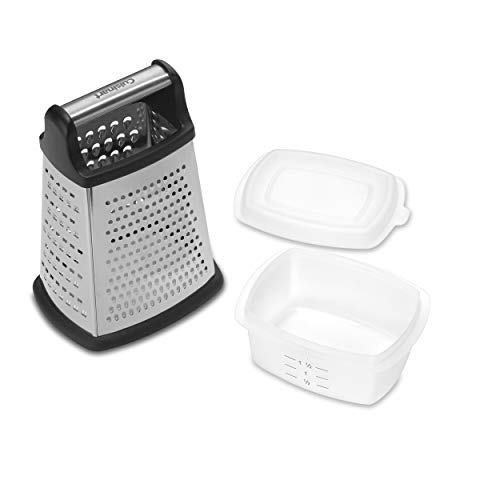
Cuisinart Box Grater — Best for Fine Grating
The Cuisinart box grater is the familiar stainless four-sided tower that many home cooks picture first: coarse, medium and fine grating faces, a slicer side, a comfortable top handle and a non-slip base ring on many versions. It is the safe, mainstream interpretation of the design, easy to find and easy to replace. It appears in this guide as a pick: check the current listing for the exact configuration before buying, since versions vary. Best for: the role in its badge. Not suited for: bulk grating for crowds, which no hand tower does well.

Microplane Box Grater — Best for Comfort and Prep
The Microplane box grater is the premium-leaning option from the brand famous for photo-etched blades. Its grating teeth are cut rather than punched, so they shave instead of tear, and the box typically adds a finer zesting face and a detachable measuring container on some versions. It suits cooks who grate hard cheese and aromatics often. It appears in this guide as a pick: check the current listing for the exact configuration before buying, since versions vary. Best for: the role in its badge. Not suited for: bulk grating for crowds, which no hand tower does well.
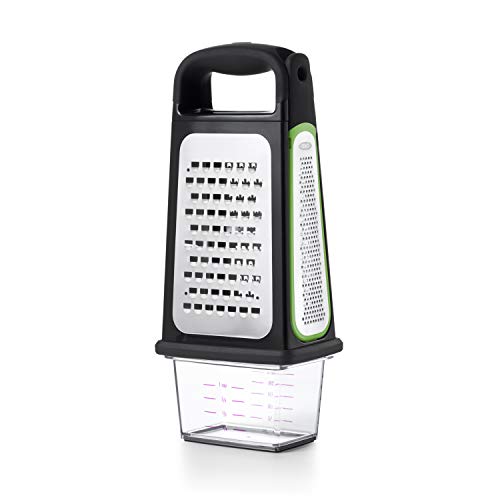
OXO Good Grips Box Grater — Best Mainstream All-Rounder
The OXO Good Grips box grater is the ergonomics-first take: a soft, oversized handle, a non-slip bottom, and a snap-on container with a lid that catches shreds and stores them. OXO designs for wrists and grip strength as much as for teeth, which makes it a kind choice for cooks with tired hands. It appears in this guide as a pick: check the current listing for the exact configuration before buying, since versions vary. Best for: the role in its badge. Not suited for: bulk grating for crowds, which no hand tower does well.
KitchenAid Box Grater — Best Cheerful All-Rounder
The KitchenAid box grater is the colourful, counter-friendly option, often sold with a catch container that doubles as a measuring cup. It covers the standard four faces and leans on brand familiarity and easy dishwasher care rather than exotic extras. It appears in this guide as a pick: check the current listing for the exact configuration before buying, since versions vary. Best for: the role in its badge. Not suited for: bulk grating for crowds, which no hand tower does well.

Deiss Pro Box Grater — Best Value Spare
The Deiss box grater is the value-minded stainless option that frequently bundles the grater with a container and lid. It covers the same four jobs in a slightly lighter build and is often the pick for a second grater, a holiday home or a first apartment. It appears in this guide as a pick: check the current listing for the exact configuration before buying, since versions vary. Best for: the role in its badge. Not suited for: bulk grating for crowds, which no hand tower does well.

Spring Chef Box Grater — Best Budget Starter
The Spring Chef box grater is the budget-friendly tower with a detachable base container on many versions, pitched at everyday cheese and vegetable work. It is a sensible starter grater whose edges and handle reward a gentler hand. It appears in this guide as a pick: check the current listing for the exact configuration before buying, since versions vary. Best for: the role in its badge. Not suited for: bulk grating for crowds, which no hand tower does well.
What Kind of Teeth Do You Need?
Teeth decide effort, and effort decides safety. Etched teeth are cut into the steel and finished to a fine edge; they shave food with light pressure and excel at zest, hard cheese and aromatics. Punched teeth are pressed out of the sheet; they are durable and cheaper, and they tear a little more, so you press a little harder. For weekly grating, either works. For daily fine work, etched teeth repay their premium on every stroke, because light pressure means control, and control is what keeps the last section of any piece from becoming an injury.
How Many Faces and Extras Are Worth Having?
Four faces is the sweet spot: coarse, medium, fine and a slicer you will use occasionally and forgive often. Extra faces, rotary attachments and novelty cutters add cost and storage bulk faster than they add usefulness. The extras that do earn their place are mundane: a rubber base that truly grips, a container that truly fits, and a handle that truly fits your hand. Judge extras by whether they remove a step or a risk from your actual routine.
How Much Stability and Build Quality Do You Need?
More than the price tags suggest. A tower that flexes or walks makes you grip harder and stroke unevenly. Look for faces that feel springy rather than soft, corners folded smooth, and a base that sits dead flat. Test stability the moment it arrives, on your own counter, with a carrot: long strokes should feel planted, and the tower should not twist. A stable board underneath helps too, which is why our guide to cutting boards that give a grater a stable base pairs naturally with this one.
How Will You Wash and Store It?
Decide this before you buy, because it decides whether the grater gets used. If you are a dishwasher household, confirm the model is dishwasher safe and picture where it will stand in the rack. If you hand wash, picture the brush you will use, moving away from the teeth, and never a bare hand inside the box. For storage, picture the drawer or cupboard: the teeth must not sit where a reaching hand will find them by accident, so a box, a guard or a dedicated slot is part of the purchase, not an afterthought.
How to Prioritise by Use Case
The Fine-Grating Cook
You finish pasta with hard cheese, bake with zest, and grate ginger and garlic into marinades weekly. Prioritise etched teeth and a fine face you love, accept a plainer handle, and keep a small brush by the sink for the fine face’s clogging habits. Your alternative for aromatics at volume is a press for garlic, covered in our guide to {link(LIVE[1][0], LIVE[1][1])}.
The Batch Prepper
You grate cheese, carrots and zucchini in quantity on one day and cook from the containers all week. Prioritise the container models with lids, a base that grips through long sessions, and a handle that stays kind over hundreds of strokes. Your safety risk is fatigue, so schedule the grating early in the prep session, not last.
The Mixed Weekly Cook
You grate a bit of everything and want one tool that never draws attention to itself. Prioritise the mainstream towers, punched or etched teeth by budget, and spend your attention on stiffness and seams. This is the easiest brief in the guide and the hardest to get wrong, provided you avoid the flimsiest steel.
The Occasional Grater
You grate for a handful of recipes a year. Prioritise honest value, store the tower safely, and do not let anyone talk you into a premium tool that will mostly hold a cupboard shelf. If your handful of recipes grows, upgrade then, informed by real habits; our {link(‘box grater review’, ‘box-grater-review’)} and the model notes in our {link(‘box grater reviews’, ‘box-grater-reviews’)} will still be here.
Mini-Reviews: The Picks Revisited
Cuisinart Box Grater
Verdict on the Cuisinart box grater: the familiar stainless four-sided tower that many home cooks picture first: coarse, medium and fine grating faces, a slicer side, a comfortable top handle and a non-slip base ring on many versions. It is the safe, mainstream interpretation of the design, easy to find and easy to replace. Strengths in brief: it matches its badge role above without demanding new habits. Trade-offs in brief: like every tower here, its slicer is a bonus rather than a star, and its teeth demand the same end-of-piece respect. Best for: its badge role. Not suited for: bulk volume work.
Microplane Box Grater
Verdict on the Microplane box grater: the premium-leaning option from the brand famous for photo-etched blades. Its grating teeth are cut rather than punched, so they shave instead of tear, and the box typically adds a finer zesting face and a detachable measuring container on some versions. It suits cooks who grate hard cheese and aromatics often. Strengths in brief: it matches its badge role above without demanding new habits. Trade-offs in brief: like every tower here, its slicer is a bonus rather than a star, and its teeth demand the same end-of-piece respect. Best for: its badge role. Not suited for: bulk volume work.
OXO Good Grips Box Grater
Verdict on the OXO Good Grips box grater: the ergonomics-first take: a soft, oversized handle, a non-slip bottom, and a snap-on container with a lid that catches shreds and stores them. OXO designs for wrists and grip strength as much as for teeth, which makes it a kind choice for cooks with tired hands. Strengths in brief: it matches its badge role above without demanding new habits. Trade-offs in brief: like every tower here, its slicer is a bonus rather than a star, and its teeth demand the same end-of-piece respect. Best for: its badge role. Not suited for: bulk volume work.
KitchenAid Box Grater
Verdict on the KitchenAid box grater: the colourful, counter-friendly option, often sold with a catch container that doubles as a measuring cup. It covers the standard four faces and leans on brand familiarity and easy dishwasher care rather than exotic extras. Strengths in brief: it matches its badge role above without demanding new habits. Trade-offs in brief: like every tower here, its slicer is a bonus rather than a star, and its teeth demand the same end-of-piece respect. Best for: its badge role. Not suited for: bulk volume work.
Deiss Pro Box Grater
Verdict on the Deiss box grater: the value-minded stainless option that frequently bundles the grater with a container and lid. It covers the same four jobs in a slightly lighter build and is often the pick for a second grater, a holiday home or a first apartment. Strengths in brief: it matches its badge role above without demanding new habits. Trade-offs in brief: like every tower here, its slicer is a bonus rather than a star, and its teeth demand the same end-of-piece respect. Best for: its badge role. Not suited for: bulk volume work.
Spring Chef Box Grater
Verdict on the Spring Chef box grater: the budget-friendly tower with a detachable base container on many versions, pitched at everyday cheese and vegetable work. It is a sensible starter grater whose edges and handle reward a gentler hand. Strengths in brief: it matches its badge role above without demanding new habits. Trade-offs in brief: like every tower here, its slicer is a bonus rather than a star, and its teeth demand the same end-of-piece respect. Best for: its badge role. Not suited for: bulk volume work.
First Setup and Care Essentials
First setup includes your safety setup, because the first week with a new grater is when habits form and when unfamiliar teeth surprise people. Start slow, on a big carrot, and rehearse the finish before you need it at speed:
Slow down as the piece shrinks. The last third of a block of cheese or a carrot is where knuckles meet teeth, because your fingers creep closer with every stroke and the food gets harder to hold. The moment the piece feels small in your hand, change your grip: flatten your palm and press with your whole hand, fingers held up and away, or stop entirely and switch to a food holder or guard that keeps a barrier between skin and steel.
Never chase the final nub with your fingertips. That last sliver of parmesan or potato is not worth a scraped knuckle, and scraped knuckles on a grater are uniquely miserable because the teeth take a row of tiny bites at once. Eat the nub as a cook’s snack, save it for stock, or grate it later with a holder. Professional cooks throw the nub in the soup pot without a second thought, and you should too.
A cut-resistant glove is a legitimate option, not an admission of defeat. Thin cut-resistant gloves give you a confident grip on slippery food and turn a glancing contact into a non-event. They are especially helpful for younger cooks learning the motion, for anyone grating firm vegetables at speed, and for the final section of any job when concentration fades.
Wash the grater with a brush, moving away from the teeth, and never reach a bare hand inside the box to fish out stuck shreds. A stiff brush or an old toothbrush clears the teeth from the smooth back side, pushing residue out the way it came in. If you wash by hand in soapy water, keep the grater visible rather than buried under suds, because a hidden grater bites the hand that goes searching for the sponge.
Store the grater so its teeth cannot catch a hand rummaging in a drawer. Keep it in its box, in a dedicated slot, or with a simple guard or folded towel over the coarsest face. A box grater loose in a crowded utensil drawer is a trap for the next person who reaches in quickly, and the coarse face is always the one facing up.
Rinse the grater immediately after use, before cheese or potato starch dries onto the teeth. Dried residue is what turns a ten-second rinse into a scrubbing session, and scrubbing is when hands get careless around sharp edges. A quick rinse under a strong tap, from the inside out, knocks most shreds free while they are still soft.
Most stainless box graters are dishwasher safe, and the dishwasher is honestly the safest wash method because no hand goes near the teeth. Stand the grater where water can reach all four faces, and check the base and handle joints afterwards, because trapped moisture in seams is what eventually dulls and spots cheaper steel.
Dry the grater before it goes away, especially around the folded seams at the corners and under a rubber base ring if yours has one. Those seams are the first places to show rust freckles on lower-grade steel. A minute on a dish rack, teeth facing up and away from traffic, handles nearly all of it.
Set the grater on a damp towel or a non-slip mat before you start. A box grater that walks across the counter forces you to grip the food harder and chase the tower, and chasing is how strokes go sideways into knuckles. Many models add a rubber base ring for exactly this reason, and it is one of the features genuinely worth having.
Use long, even strokes and let the teeth do the work. Pressing harder does not grate faster; it bends the food, packs the teeth and tires your arm. Light pressure with a steady rhythm produces cleaner shreds, less waste stuck in the teeth and far more control at the end of each stroke.
Mistakes to Avoid
The common buying mistakes are buying on shine instead of stiffness, ignoring the handle because the teeth looked good in a photo, and assuming the slicer face replaces a mandoline. The common using mistakes are worse: rushing the end of a piece, pressing harder when teeth clog instead of clearing them with a tap or a brush, washing with a bare hand inside the box, and storing the tower loose in a drawer where its coarse face waits for the next reaching hand. Every one of those is avoidable with the habits in this guide.
If you are still weighing whether the category belongs in your kitchen at all, read whether a box grater is worth it for the honest both-sides argument, and box grater pros and cons for the balance sheet. Buyers who grate ginger constantly may also want our look at ginger graters that handle fibrous roots before deciding where their money works hardest.
Worked Examples: Three Shoppers, Three Right Answers
Shopper one cooks for two, grates cheese for pasta twice a week and bakes with zest most weekends. Her dominant jobs are fine and frequent, so this guide steers her to etched teeth and lets the handle be simple. She skips the container because she grates into the bowl she is already using. Six months on, her grating takes half the effort it used to, and the purchase that looked like a premium reads as the cheapest upgrade in her kitchen.
Shopper two preps Sunday lunches for a family and stores grated cheese, carrots and zucchini for the week. His dominant job is batch volume in household quantities, so the guide steers him to a container model with a lid, a base that grips through long sessions and a handle built for comfort. He adds a food holder to the same purchase, because his last task of every prep session is exactly when tired hands meet small pieces.
Shopper three is setting up a first kitchen on a tight budget and grates mainly for tacos and the occasional carrot cake. The guide steers her to an honest value tower, bought with clear eyes about lighter steel, plus the two free upgrades that matter most: the freezer trick for soft cheese and the damp towel under the base. If her cooking grows, she will upgrade informed by real habits rather than by marketing, and the value tower becomes a perfectly good spare.
Notice what none of the three shoppers bought on: the slicer face. In each worked example the slicer was treated as a bonus, and in each case that ordering of priorities produced a buyer who stayed satisfied. The slicer is the feature most likely to be overweighted in a shop and underused in a kitchen, and a buying guide exists largely to correct exactly that kind of weighting.
Notice also what all three bought, in effect: a safety routine. The holder in the basket, the glove considered, the storage spot decided before the tower came home. None of that appears on a specification list, and all of it decides whether the purchase is still making its owner happy, and uninjured, a year later. When you run your own version of these examples, write the safety line into the budget first.
A fourth, cautionary example is worth one paragraph. A shopper who bought mainly on shine, the prettiest tower with the thinnest steel, found grating a chore within a month: the faces flexed, the tower walked, and the recipes that needed shreds quietly left the rotation. The replacement, bought on teeth, stiffness and handle, cost less than the original. The lesson generalises beyond graters: in simple tools, the unglamorous properties are the product.
The Fitting Room: Judging a Grater in Your Hands
Judge the steel with your fingers before your eyes. A good face feels springy when you press its centre lightly with a thumb on the smooth back side: it gives a fraction and returns. A face that stays bent, or that oil-cans with a soft pop, will flex under food and make you press harder for every shred. That flex is not a cosmetic flaw; it is the mechanism by which cheap graters become slow and then unsafe, and it is the first thing this guide tells you to reject.
Judge the corners next. The four folded seams are where hands dry, where moisture hides and where cheap finishing leaves burrs. Run a fingertip along each seam, on the smooth outside only, and feel for anything that catches. A tower whose seams snag a fingertip will snag a drying cloth and shelter rust, and neither problem improves with age. Smooth seams are the visible signature of a maker who finished the tool properly.
Judge the base by standing the tower on the hardest, slickest surface you own and pressing down while twisting gently. A base that grips, or a design that sits so flat and stable that a damp towel completes it, passes. A tower that skates at this stage will skate under a carrot, and skating is the parent of skids. If you shop in person, this ten-second test eliminates more bad purchases than any review, including this one.
Judge the handle with a wet hand, because grating hands are rarely dry. The handle should fill your grip without forcing it, leave room for your knuckles, and stay secure when you mime a long stroke. Oversized soft handles suit most hands and tire them least; slim classic handles suit smaller hands and tighter storage. There is no universal winner, only the shape your hand stops noticing, and that invisibility is the correct target.
Judge the face line-up against your real recipes, not your aspirational ones. If your week is cheese, carrots and potatoes, the coarse and medium faces will do ninety percent of your grating, and the fine face’s quality is a bonus. If your week is zest, hard cheese and spices, reverse the weighting entirely and let the fine face choose the model. Buying for the cook you are, this month, is the discipline that separates satisfied owners from upgraders.
Judge the container as furniture, not as a feature. It will live somewhere, be washed often and be searched for when separated from its tower. A container that nests, lids securely and measures honestly earns its cupboard space in a prepper’s kitchen. In any other kitchen it is a box looking for a purpose. Picture its home before you buy it, and if no home presents itself, buy the plain tower with a clear conscience.
Judge the whole purchase by its return path. Simple tools vary between production runs, and the unit in your hand is the only one that matters. A seller who makes exchanging a flexing or burred tower painless is worth favouring, because the fitting-room tests in this section only work if a failed test has a remedy. Check the tower the day it arrives, while the remedy is still easy.
Finally, judge your own readiness as part of the fitting. The best tower in this guide still asks for the flat-palm finish, the holder for small pieces, the brush for washing and the guarded slot for storage. If your kitchen can offer those four small things, every model shortlisted here will fit you. If it cannot yet, spend the first part of the budget making it able to, because that spending protects every grating session you will ever have.
After the Purchase: Making the Choice Pay
The first month with a new tower decides whether the purchase pays, and it divides into two habits. The first is placement: the grater must live where the grating happens, within one reach of the boards, in its box or guard, because a tool stored awkwardly is a tool subconsciously avoided. The second is the prompt rinse, performed while the pan warms, until it stops feeling like a rule and starts feeling like part of grating itself. Buyers who install those two habits in month one almost never regret the purchase, whatever tier they chose.
Accessories deserve a planned second look rather than an impulse basket. After a month of real use you will know whether a holder would have helped, whether a glove suits your household’s learners, and whether a dedicated brush by the sink would end the fine face’s clogging complaints. Buying accessories in that order, from evidence, is cheaper and more useful than buying the whole catalogue on day one out of anxiety. This guide’s only day-one accessory is the storage solution, because that one protects people rather than preferences.
If the tower disappoints in month one, diagnose before you replace. Flex and walking are product faults and justify an exchange. Smearing cheese and clogging ginger are usually technique and temperature, solved by the freezer trick and the brush. A handle that hurts is a fit fault, and fit faults do not improve with familiarity, so exchange early while the remedy is easy. Honest diagnosis keeps good purchases from being returned and bad ones from being endured.
Gifting follows from everything above. A box grater makes an excellent first-kitchen gift when it is mid-tier or better, arrives with a holder or a glove, and comes with the two sentences of safety advice that matter: slow down at the end of the piece, and never chase the nub. Gifted that way, it teaches confidence. Gifted as the cheapest tower on the shelf with no word of guidance, it teaches avoidance, and the difference is entirely in the giving.
A word on buying a second tower, because this guide’s readers often return for exactly that. The usual triggers are a second home, a baking station, or a household member whose hands prefer a different handle. Buy the second one from your evidence: you now know your dominant face, your handle preference and your container opinion, which makes the second purchase the easiest in the category. Many owners report the second tower is the one they would recommend, because it was chosen by a cook who had become an expert in their own kitchen.
Finally, a note on seasonality, because grating has seasons. Winter asks for roots, potatoes and baking; summer asks for zucchini, salads and zest. A tower bought in one season will be judged by the other within months, which is another argument for the four-face standard over any specialised variant. Buy for the whole year’s repertoire and the tool will never meet a month it cannot handle, which is the quiet definition of a good purchase.
Reading a Listing Like an Inspector
A listing photograph can tell you more than its caption if you know where to look. Zoom into the teeth: even rows with clean, consistent shapes suggest decent tooling, while ragged or irregular rows predict tearing. Look at the corners for smooth folds rather than pinched, sharp-looking seams. Look at the base for width and for any sign of a grip ring. None of this is conclusive, but it triages a long shortlist into a short one before money moves.
Read the description for what it avoids. Listings that name the steel type, describe the faces plainly and state dishwasher suitability in words are usually describing a real product. Listings that lean on exclamation, novelty face counts and lifestyle photography while avoiding every material fact are describing a margin. This guide cannot inspect your exact unit, but it can teach the scepticism that inspects listings, and scepticism is the more durable gift.
Check the accessories list twice, because versions of the same model name ship with different contents. One box contains the container and lid; another, identically named, contains the tower alone. The disappointment of discovering this at the unboxing is entirely preventable in the listing, and it is the single most common avoidable complaint in this category. Match the contents to the routine you planned, not to the photograph of the fullest set.
Consider who else will use the tower before you finalise the handle. A household grater serves the smallest and the largest hands in the home, plus the occasional guest cook. Where hands differ widely, the mid-sized comfort handle is the usual peace treaty, and the holder and glove stop being accessories and become the equalisers that let every hand use the same tower safely. Buying for the household, not the individual, is a buying-guide habit that prevents the second purchase nobody budgeted for.
Think about the board and the bowl while you are at it. A tower works best over a wide bowl or a container, standing on a board or towel that does not skate on your counter material. If your counters are polished stone and your boards are small, part of the budget honestly belongs to a non-slip mat, which will serve every knife task you own as well. The grater is a station, not an island, and stations are bought whole or not at all.
Price the purchase against your actual alternative, not against zero. If the alternative is a processor’s setup and washing at every small job, the tower pays in minutes weekly. If the alternative is a perfectly good flat grater you already own and enjoy, the tower must justify itself on faces and stability alone, and for garnish-only cooks it may fail that test honourably. A buying guide that only ever says buy is a catalogue; this one would rather send a few readers away empty-handed and right.
Watch for the bundle trap in both directions. Bundles that add a holder, a glove and a brush to a sound tower are often the best value in the category, because those are the items this guide tells you to own anyway. Bundles that add novelty peelers, corers and slicers to a mediocre tower are charging you for a drawer of regrets. Judge the tower naked first; then let useful company join it, and refuse the other kind.
Delivery day deserves a ritual, and this guide prescribes it in full. Unbox over a clear counter. Wash and dry the tower. Run the fitting-room tests: base flat, seams smooth, teeth even, handle kind. Grate one carrot slowly, rehearsing the flat-palm finish before the piece is small enough to need it. Then store the tower in its decided home. Fifteen minutes, once, and the purchase is properly begun rather than merely received.
If the ritual finds a fault, act within days, not months. Exchanging a flexing tower is a errand; enduring it is a year of small punishments. Keep the packaging until the first real grating session has happened, because a tower can pass the counter tests and still disappoint under a potato, and that session, not the unboxing, is the true end of the fitting room.
A final buying thought, on timing. Kitchens discover their grating needs at odd moments: a new diet, a baking enthusiasm, a child old enough to help, a recipe that becomes a household institution. Buy when the need is real and current, in the tier your frequency justifies, and let the tool start paying immediately. The worst purchase in this category is the speculative one, bought for a cook you have not yet become, stored where its teeth wait for hands that were only reaching for something else.
One Last Fitting: The Two-Hand Test
Before the guide closes, one last fitting test deserves its own space, because it catches what the others miss. Grate two-handed in your imagination, then in fact: one hand holds the tower’s handle, the other works the food, and your body stands where it will stand every time. Is the counter height kind to your back over a full session? Does your elbow clear the cupboard above? Can the holding hand stay relaxed while the working hand keeps its rhythm? A tower that fits your hands but fights your kitchen will lose, slowly, to a tool that fits both.
The two-hand test also reveals the truth about size. A full-size tower gives the working hand a long stroke and the holding hand a stable post, which is why it suits weekly cooking. A compact tower shortens both, and the saving in cupboard space is paid for at every session in extra strokes. Neither is wrong; the test simply makes the trade visible before the money moves, which is all any fitting can honestly promise.
And it reveals the truth about your dominant side. Most cooks grate with one hand and hold with the other without ever choosing, and the tower that feels natural in that arrangement is the right one regardless of its other virtues. If a model’s handle or base quietly asks you to swap roles, it will annoy you in small ways forever. Trust the arrangement your body chooses in the first minute; it has grated more than your opinions have.
With that, the fitting room closes. You know how to judge teeth, seams, bases, handles, faces, containers and listings, and how to match them to the cook you actually are. The rest is one careful purchase, one slow first carrot, and a year of shreds that arrive exactly when the recipe asks for them.
Before You Buy: A Box Grater Fit, Space and Routine Checklist
Most advice about a box grater focuses on the day you buy it, yet satisfaction is decided later, at the kitchen counter, board or bowl it works over, during preparing cheese, vegetables and zest for everyday cooking. This section therefore starts with your routine rather than the product, because features only matter once they survive contact with your space, your schedule and your household. The first check is the stability of the base and handle while you apply downward pressure, and it outranks everything else, because no styling or extra capacity compensates when that basic fit is wrong. Think about what the box grater has to live alongside. The neighbouring furniture, fittings and appliances in your home are fixed facts, and the newcomer is the one that has to fit in.
Guests are an honest test: anything that needs explaining, warning or apologising for when visitors use the box grater is telling you something about its everyday fit as well. Shortlists should shrink ruthlessly. A box grater that fails a basic fit check is not a bargain at a lower price or a compromise worth making; it is simply the wrong item. Nothing is kept forever. Favour the box grater you could repair, rehome or responsibly retire over the one that becomes an awkward problem the day it stops working. A rotation or spare strategy suits some households, where one box grater rests, dries, charges or waits in reserve while another works, and it can double useful life for surprisingly little organisation.
- Decide the care routine and where it will be stored or dried.
- Test the two main fit checks against your rooms, surfaces and fittings.
- Measure the real space, including every clearance the item needs in use.
- Verify the included parts in the current listing and note anything extra to source.
- Name the three jobs it must do well and the one compromise you accept.
A slightly less capable box grater that stays clean will outperform a superior one that is neglected, which is why care burden belongs near the top of any comparison. When every option looks equally good, the missing information is rarely about the products; it is about your household, and that is the gap to close before spending anything. Notice when the box grater will be used in a hurry and when it will be used with time to spare, because speed and ceremony reward different designs. Where a thing lives determines how often it is used. If reaching the box grater involves moving other things first, usage will quietly fall away, whatever your intentions at purchase.
As a buying guide, this article has ranked the criteria already; the extra value here is order of operations, so settle fit and routine first, shortlist second and appearance last. Prevention is unglamorous and effective: washing and drying it straight after use so edges stay clean and rust-free, done consistently, protects performance better than any occasional rescue effort after problems have set in. Imagine the routine at its most demanding rather than its most pleasant, and notice which weaknesses in a box grater would stop being theoretical and start being daily. Delegation exposes weak choices. A box grater that only works in one person’s hands, with one person’s knack, is a fragile solution for a shared home.
Edge cases matter here: grating a small amount, where washing the whole tool can feel like the real cost. A box grater chosen with that situation in mind will not need replacing the first time life deviates from the brochure. A useful test is to name the three jobs this box grater must do well, the one job it may do merely adequately, and the one situation in which you would replace it without regret. Measure the real space, including clearance for doors, drawers, lids, handles and people passing, and write the numbers down before comparing anything, because memory is generous in exactly the wrong direction. Other people in the household get a vote too, since the person who cleans, moves, stores or shares the box grater will find friction that the buyer, focused on the main job, can easily miss.
Most disappointment with a box grater traces back to grated food clogging the teeth and knuckles meeting the surface on short pieces. It is a slow, predictable process, which is good news, because predictable problems can be designed out before you buy. First impressions flatter almost everything. The one-month verdict, after the routine has tested the box grater properly, is the opinion worth trusting and acting on. Shortlisted models, perhaps the Cuisinart Box Grater and the Microplane Box Grater, should each be put through the same checks in the same order, using the current listing details rather than an older screenshot or a remembered specification.
Frequently Asked Questions
What should I look for first in a box grater?
Teeth, then stability, then handle. Cleanly formed or etched teeth cut with light pressure, a tower that sits flat and does not flex keeps strokes controlled, and a handle your hand likes keeps you using it. Containers and lids are worthwhile extras for preppers, and the slicer face should never drive the decision.
Are etched teeth worth paying more for?
For frequent or fine grating, yes. Etched teeth shave zest, hard cheese and aromatics with noticeably less pressure, and less pressure means more control and safer finishes. For occasional coarse shredding, punched teeth cover the job and the saving is rational.
Do I need a grater with a storage container?
If you grate into storage or measure as you go, it removes a bowl from washing up and keeps shreds tidy. If you grate straight into the pan, a plain tower stores smaller and works identically at the grating itself. Match the feature to your routine, not to the packaging.
How do I avoid cutting myself on a box grater?
Slow down as the piece shrinks, finish with a flat palm or a food holder, and never chase the last nub with fingertips. Consider a cut-resistant glove. Wash with a brush away from the teeth, never a bare hand inside the box, and store it so the teeth cannot catch a hand in a drawer.
Can a box grater replace a food processor?
For everyday quantities, yes; for volume, no. The box is faster to start and wash for a family portion, while a processor’s grating disc handles crowd quantities in seconds at the cost of assembly and cleanup. Many kitchens own the box for daily work and use the machine only for feasts.
What size box grater should I buy?
The standard full-size tower suits most kitchens because its faces give long, efficient strokes and room for shreds to fall. Compact models suit tiny kitchens and occasional use but shorten the stroke and fill faster. Choose by your counter, cupboard and typical quantity rather than by novelty.
Related Guides
Keep exploring this corner of the kitchen: the box grater review; box grater reviews compared; box grater pros and cons; whether a box grater is worth it; garlic presses for the jobs a grater cannot do; food processors with grating discs.


