Disclosure: As an Amazon Associate, airfryerkitchensupply.com earns from qualifying purchases. Links on this page are affiliate links; they cost you nothing extra. Prices and availability change often, so check the current Amazon listing before you buy.
Roundups of box grater reviews tend to crown a winner and move on, but box grater reviews are more useful when they match the grater to the cook. These box grater reviews walk through the leading styles of four-sided tower, what living with each one is like across a year of cheese, carrots and cleanup, and where each design quietly annoys its owners. Read for the match, not the medal, and pay attention to the safety notes, because every model in this roundup shares the same sharp truth about fingertips and teeth.
Key Takeaways
- There is no single best box grater; there is a best match for your hands, your recipes and your storage.
- Etched teeth cut cleaner with less pressure, which makes them both faster and safer in practiced hands.
- Catch containers and lids matter more in daily life than any extra face or novelty feature.
- Handle comfort decides long-term satisfaction, because the holding hand works as hard as the grating hand.
- Every model demands the same end-of-piece discipline: flat palm, food holder, or stop and save the nub.
The pattern across these reviews is consistent. Owners love the grater that fits their dominant task: the hard-cheese cook loves etched teeth, the meal prepper loves the container, the small-kitchen cook loves the lightest mainstream tower. Owners sour on graters for predictable reasons too: flexing faces, handles that pinch, seams that rust, and teeth that were never sharp. The model-by-model notes below translate those patterns into buying decisions.
In this guide
What Box Grater Reviews Consistently Show
Read enough owner experience and three lessons repeat. First, teeth quality dominates everything. A grater whose teeth shave cleanly turns a block of cheddar into shreds with a light, rhythmic stroke; a dull one makes you lean on the food, and leaning is when towers skid and knuckles land on steel. Second, the base matters more than the brochure suggests, because a tower that walks forces a gripping, chasing technique. Third, washing decides whether the tool gets used on a tired Tuesday: models that rinse clean in seconds get used; models that trap residue get avoided.
These reviews therefore judge each model on teeth, stability, handle, cleanup and storage, in that order. If you want the underlying decision framework rather than model notes, our box grater buying guide lays it out step by step, while our single-design deep dive, the box grater review, tests the tower concept itself.
One more shared finding deserves emphasis before the models: nearly every grating injury owners describe happens in the last few strokes of a piece of food, when the hand is closest to the face and attention has already moved to the next task. The model you buy cannot fix that. Your technique can, and each review below repeats the fix because repetition is what builds the habit.
Box Grater Reviews: The Models, One by One
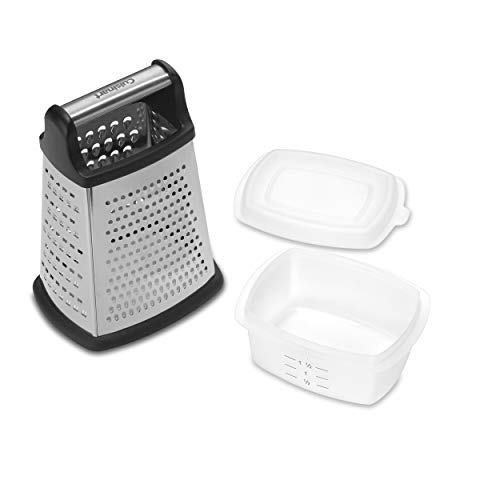
Cuisinart Box Grater
The Cuisinart box grater is the familiar stainless four-sided tower that many home cooks picture first: coarse, medium and fine grating faces, a slicer side, a comfortable top handle and a non-slip base ring on many versions. It is the safe, mainstream interpretation of the design, easy to find and easy to replace.
Living with it means predictability. The faces cover the standard jobs, the tower feels familiar from the first use, and replacement is painless if you ever bend a face in a crowded drawer. Owners who cook widely rather than deeply, a bit of everything each week, tend to be happiest here. As with every pick in these reviews, it is a recommendation: versions differ in handles, containers and face line-ups, so confirm the exact configuration on the current listing before you decide.
Verdict: Choose it as the household default. Pass if you grate hard cheese daily and want the easiest possible stroke, where etched teeth pull ahead. Best for: the cook described above. Not suited for: anyone whose main grating work is bulk volume, where a processor disc wins regardless of brand.

Microplane Box Grater
The Microplane box grater is the premium-leaning option from the brand famous for photo-etched blades. Its grating teeth are cut rather than punched, so they shave instead of tear, and the box typically adds a finer zesting face and a detachable measuring container on some versions. It suits cooks who grate hard cheese and aromatics often.
Living with it means noticing how little pressure grating can take. Zest comes off in fragrant ribbons without pith, hard cheese powders instead of crumbling, and the fine face does work that punched teeth smear. The premium character shows most in small, frequent jobs rather than in bulk shredding. As with every pick in these reviews, it is a recommendation: versions differ in handles, containers and face line-ups, so confirm the exact configuration on the current listing before you decide.
Verdict: Choose it for hard cheese, zest, nutmeg and ginger. Pass if your grating is mostly big soft blocks, where its finesse buys you less. Best for: the cook described above. Not suited for: anyone whose main grating work is bulk volume, where a processor disc wins regardless of brand.
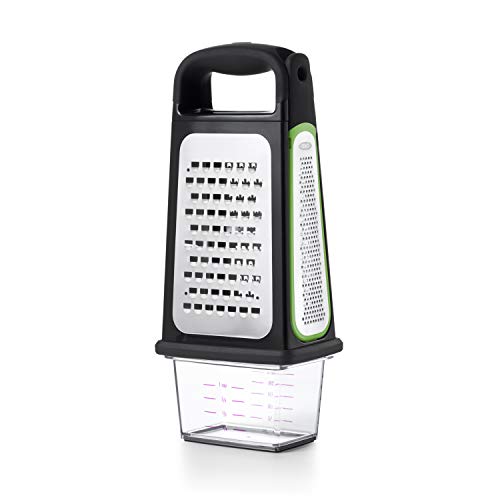
OXO Good Grips Box Grater
The OXO Good Grips box grater is the ergonomics-first take: a soft, oversized handle, a non-slip bottom, and a snap-on container with a lid that catches shreds and stores them. OXO designs for wrists and grip strength as much as for teeth, which makes it a kind choice for cooks with tired hands.
Living with it means thinking about your hands less. The handle welcomes a relaxed grip, the base stays put, and the container catches, measures and stores in one motion, which quietly removes two washing-up items from every session. Cooks with grip issues consistently rate this style kindly. As with every pick in these reviews, it is a recommendation: versions differ in handles, containers and face line-ups, so confirm the exact configuration on the current listing before you decide.
Verdict: Choose it for comfort and meal prep. Pass if cupboard space is tight and a container base feels like clutter rather than help. Best for: the cook described above. Not suited for: anyone whose main grating work is bulk volume, where a processor disc wins regardless of brand.
KitchenAid Box Grater
The KitchenAid box grater is the colourful, counter-friendly option, often sold with a catch container that doubles as a measuring cup. It covers the standard four faces and leans on brand familiarity and easy dishwasher care rather than exotic extras.
Living with it means colour and convenience. It does the standard four jobs, goes in the dishwasher without drama, and the container versions suit bakers who grate butter, cheese and chocolate straight into a measured store. It rarely tops any single test and rarely fails one either. As with every pick in these reviews, it is a recommendation: versions differ in handles, containers and face line-ups, so confirm the exact configuration on the current listing before you decide.
Verdict: Choose it for an easy, cheerful all-rounder. Pass if you want the sharpest available teeth as your first priority. Best for: the cook described above. Not suited for: anyone whose main grating work is bulk volume, where a processor disc wins regardless of brand.

Deiss Pro Box Grater
The Deiss box grater is the value-minded stainless option that frequently bundles the grater with a container and lid. It covers the same four jobs in a slightly lighter build and is often the pick for a second grater, a holiday home or a first apartment.
Living with it means accepting a lighter build in exchange for value. The faces handle everyday cheese and vegetables well, the bundled container is genuinely useful, and the whole set suits a second kitchen, a rental or a first home where the grater works weekly rather than daily. As with every pick in these reviews, it is a recommendation: versions differ in handles, containers and face line-ups, so confirm the exact configuration on the current listing before you decide.
Verdict: Choose it as a capable spare or starter. Pass if you are hard on tools and want the heaviest steel you can find. Best for: the cook described above. Not suited for: anyone whose main grating work is bulk volume, where a processor disc wins regardless of brand.

Spring Chef Box Grater
The Spring Chef box grater is the budget-friendly tower with a detachable base container on many versions, pitched at everyday cheese and vegetable work. It is a sensible starter grater whose edges and handle reward a gentler hand.
Living with it means gentle hands are rewarded. Everyday shredding is fine, the container base keeps counters tidier, and the price of entry is low enough that many owners treat it as the gateway grater they upgrade from once they know their habits. As with every pick in these reviews, it is a recommendation: versions differ in handles, containers and face line-ups, so confirm the exact configuration on the current listing before you decide.
Verdict: Choose it to learn your grating habits cheaply. Pass if you already know you grate daily and want a decade-long tool. Best for: the cook described above. Not suited for: anyone whose main grating work is bulk volume, where a processor disc wins regardless of brand.
Design, Build and Setup Across the Range
Across all six styles, the build tells are identical. Run a thumb lightly along a folded corner, not across the teeth, and feel for burrs. Stand the tower on a flat counter and press the top: any rock or twist will be magnified once food is involved. Look at the teeth against the light; even, cleanly formed rows cut well, while ragged or flattened rows explain most disappointing first uses. None of this needs numbers, and these reviews deliberately report none.
Setup differences are small but real. Container models need the container seated before the first stroke or shreds escape underneath. Rubber-base models still benefit from a damp towel on slick stone counters. Every model benefits from a first wash and a practice carrot, and every model should be dried before it is put away, because the seams where faces fold are where moisture lingers longest.
Set the grater on a damp towel or a non-slip mat before you start. A box grater that walks across the counter forces you to grip the food harder and chase the tower, and chasing is how strokes go sideways into knuckles. Many models add a rubber base ring for exactly this reason, and it is one of the features genuinely worth having.
Use long, even strokes and let the teeth do the work. Pressing harder does not grate faster; it bends the food, packs the teeth and tires your arm. Light pressure with a steady rhythm produces cleaner shreds, less waste stuck in the teeth and far more control at the end of each stroke.
Grate on the coarse face first when a recipe allows a choice. Coarse shreds melt evenly, roast without scorching at the edges and are far more forgiving than fine shreds, which can clump and disappear into a dish. Save the fine face for hard cheese over pasta, nutmeg, chocolate and citrus zest, where a powder is the point.
Chill soft cheese before grating it. A short rest in the freezer firms mozzarella, cheddar and other soft blocks so they shred instead of smearing across the face. Smearing is not just ugly; the extra pressure people apply to force soft cheese through is a classic cause of slipped grips and grazed fingers.
Grate over a wide bowl or straight into the catch container if your model has one. Shreds that land in a bowl are shreds you can measure, season and move without sweeping them off the board with the side of your hand, which is another quiet way hands drift toward the teeth during cleanup.
Work with the food at a comfortable height. A grater on a low counter while you stand hunched invites rushed, angled strokes. Raising the work on a stable board or simply clearing space so your elbow moves freely makes the motion smoother, and smooth motion is safe motion.
Performance in Real Use, Model by Model Themes
Cheese Night After Night
Cheese exposes the teeth gap fastest. Etched faces keep cutting as the block warms; punched faces on the value models ask for the freezer trick more often, chilling soft blocks briefly so they shred instead of smear. Coarse faces across the range handle firm cheese well, and the honest difference is effort over a month of dinners, not any single dramatic test. In every case, slow down as the block shrinks and finish with a flat palm or holder.
Vegetables and Prep Work
For carrots, potatoes and zucchini, stability separates the field: grippy bases and confident handles let you keep long strokes, while lighter towers need the damp-towel assist. Wet vegetables reward grating straight into a colander or onto a towel for draining. The prep-heavy cook should also weigh the machine alternative honestly, and our overview of food processors with grating discs shows the trade clearly: minutes saved on volume, minutes spent on washing.
Small Jobs: Zest, Spices and Aromatics
Fine faces diverge most in the small jobs. Zest, nutmeg, garlic and ginger reward the sharpest teeth, and this is where the premium style earns its reputation in these reviews. Fibrous ginger clogs any fine face eventually; short strokes and a tap over the bowl clear it, never a fingertip. Cooks who live on aromatics might also browse our notes on ginger graters that handle fibrous roots for a dedicated option.
Cleanup, the Deciding Chore
Every model here rinses clean if you rinse it at once, and every model becomes a chore if cheese dries on overnight. Container models add a part but remove a bowl, roughly a wash. Dishwasher loading is the safest route for all of them, and hand washing means a brush moving away from the teeth and no bare hand ever reaching inside the box to chase a stuck shred.
Strengths and Trade-Offs of the Category
Strengths
- Real choice at every level: etched or punched teeth, container or plain tower, comfort handle or classic grip.
- Consistent four-job coverage, so any model here handles the standard home repertoire.
- Mature, repairable-by-replacement design with no motors, cords or proprietary parts.
- Dishwasher-friendly stainless across the range, keeping cleanup safe and simple.
Trade-Offs
- Marketing differences exceed real ones in the middle of the range; several models grate near-identically.
- Value models trade steel weight and edge finishing for their price of entry.
- No model fixes the slicer face, which stays the weakest side across brands.
- No model protects your knuckles for you; technique remains the safety system.
How the Models Compare
Put side by side, the field sorts into three temperaments. The cut-first temperament, led by the etched-teeth style, rewards cooks whose grating is frequent and fine. The comfort-first temperament, led by the big-handle container style, rewards cooks who prep in batches and cooks whose hands tire. The value temperament rewards occasional use and second kitchens. The mainstream towers sit between the first two, which is exactly why they sell steadily. If a plain-language balance sheet helps, our companion piece on {link(‘box grater pros and cons’, ‘box-grater-pros-and-cons’)} weighs the design itself, and {link(‘whether a box grater is worth it’, ‘is-a-box-grater-worth-it’)} asks the prior question of whether to buy one at all.
Who Each Style Suits and Who Should Skip
Match the temperament to your week. Daily fine grating points to etched teeth. Batch prep and tired hands point to the comfort container style. A mixed, moderate repertoire points to the mainstream towers. Rare, light use points to the value pair, bought with clear eyes about build weight. Skip the category entirely if your grating is mostly bulk or mostly garnish; a processor or a small flat grater serves those extremes better, and a stable base from our guide to {link(LIVE[3][0], LIVE[3][1])} helps every style work safer.
Whatever you choose, budget the same first week for habit-building: one slow practice session, a decision about where the grater lives so its teeth cannot catch a rummaging hand, and a holder or glove if your household includes learners. Reviews can rank steel; only routine ranks safety.
Care and Maintenance Essentials
Across every model in these reviews, the safety guidance is identical, because the teeth do not care which brand you bought. Treat it as part of the product, not an accessory:
Slow down as the piece shrinks. The last third of a block of cheese or a carrot is where knuckles meet teeth, because your fingers creep closer with every stroke and the food gets harder to hold. The moment the piece feels small in your hand, change your grip: flatten your palm and press with your whole hand, fingers held up and away, or stop entirely and switch to a food holder or guard that keeps a barrier between skin and steel.
Never chase the final nub with your fingertips. That last sliver of parmesan or potato is not worth a scraped knuckle, and scraped knuckles on a grater are uniquely miserable because the teeth take a row of tiny bites at once. Eat the nub as a cook’s snack, save it for stock, or grate it later with a holder. Professional cooks throw the nub in the soup pot without a second thought, and you should too.
A cut-resistant glove is a legitimate option, not an admission of defeat. Thin cut-resistant gloves give you a confident grip on slippery food and turn a glancing contact into a non-event. They are especially helpful for younger cooks learning the motion, for anyone grating firm vegetables at speed, and for the final section of any job when concentration fades.
Wash the grater with a brush, moving away from the teeth, and never reach a bare hand inside the box to fish out stuck shreds. A stiff brush or an old toothbrush clears the teeth from the smooth back side, pushing residue out the way it came in. If you wash by hand in soapy water, keep the grater visible rather than buried under suds, because a hidden grater bites the hand that goes searching for the sponge.
Store the grater so its teeth cannot catch a hand rummaging in a drawer. Keep it in its box, in a dedicated slot, or with a simple guard or folded towel over the coarsest face. A box grater loose in a crowded utensil drawer is a trap for the next person who reaches in quickly, and the coarse face is always the one facing up.
Rinse the grater immediately after use, before cheese or potato starch dries onto the teeth. Dried residue is what turns a ten-second rinse into a scrubbing session, and scrubbing is when hands get careless around sharp edges. A quick rinse under a strong tap, from the inside out, knocks most shreds free while they are still soft.
Most stainless box graters are dishwasher safe, and the dishwasher is honestly the safest wash method because no hand goes near the teeth. Stand the grater where water can reach all four faces, and check the base and handle joints afterwards, because trapped moisture in seams is what eventually dulls and spots cheaper steel.
Dry the grater before it goes away, especially around the folded seams at the corners and under a rubber base ring if yours has one. Those seams are the first places to show rust freckles on lower-grade steel. A minute on a dish rack, teeth facing up and away from traffic, handles nearly all of it.
Keep the teeth honest by grating a piece of stale bread or a raw potato after sticky jobs like soft cheese. The firm, dry texture pushes residue out of the teeth without any tool near your fingers. It is an old kitchen trick, and it works better than poking at the holes with a knife tip, which risks both the knife and the hand holding it.
Inspect the faces now and then. Teeth that have been flattened by a knock in the drawer, a bent corner, or a handle that wobbles all change how the grater behaves, and a grater that flexes under pressure is a grater that can skid. A stable, sharp box grater is a safe one; a tired one earns its retirement.
Final Verdict
These box grater reviews end without a single crowned winner, deliberately. Buy the temperament that matches your cooking, verify the exact version on the listing, learn the flat-palm finish, and any of these six will serve you well. The best grater is the one whose teeth you respect and whose handle your hand likes, because that is the one still being used, happily and safely, a year from now.
What Owners Argue About, and What Six Months Changes
Ask owners of different models what matters and the first argument is always teeth. The etched-teeth loyalists describe grating as nearly effortless and cannot understand why anyone tolerates punched teeth. The punched-teeth majority answer that their coarse shredding, which is most of what they do, feels identical, and that the premium buys finesse they rarely use. Both are right about their own kitchens, which is why these reviews match models to cooks instead of crowning one tower for everyone.
The second argument is the container. Owners who prep in batches call it transformative: grate, measure, lid, fridge, with the counter staying clean and the bowl staying in the cupboard. Owners who grate straight into a pan call it a part to lose, wash and store. The container is the clearest example in this category of a feature that is genuinely valuable and genuinely optional at the same time, and your routine, not a reviewer, should settle it.
The third argument is handle comfort, and it splits by hand rather than by budget. Cooks with large hands find classic narrow handles cramped over a long session; cooks with smaller hands sometimes find the oversized comfort handles harder to control. There is no substitute for imagining your own hand on the shape, and these reviews flag handle style in every model note for exactly that reason.
Six months of ownership changes opinions in predictable ways. The shine of novelty features fades completely; nobody in month six mentions the slicer. What owners praise in month six is boring: the base still grips, the seams have not rusted, the teeth still cut the first carrot of the week as cleanly as the first carrot of the year. Durability of the ordinary is the real premium in this category.
Six months also settles the safety question into routine. Owners describe the flat-palm finish and the holder habit as automatic by the second month, no more conscious than drying a knife. The owners who report scrapes almost always describe the same scene: a hurry, a small piece, a decision to just finish it with fingertips. The models differ in steel; the injuries do not differ at all, because they were never about the model.
Regret, when owners express it, clusters at the extremes. Buyers of the flimsiest towers regret flex and dullness within weeks. Buyers of the most elaborate sets regret storage bulk and parts they never use. The middle of the range produces the fewest regrets in these reviews, which is why the mainstream towers anchor the recommendations even though they top no single test.
Another six-month finding: households grate more than they expected once a good tower is in the cupboard. Recipes that were quietly avoided, anything asking for a pile of shreds, come back into rotation. Several owners describe the grater changing their cooking rather than merely serving it, which is the strongest endorsement a simple tool can earn and a pattern worth weighing if your current grating is rare because your current tool is unpleasant.
Owners also converge on washing wisdom. The rinse-immediately households report a tool that always looks new. The soak-overnight households report spotted seams and a fine face that never quite clears. Same steel, different thirty seconds. These reviews treat the prompt rinse as part of the product, because in ownership terms it is: it decides the grater you are holding in year three.
Finally, owners argue about replacement timing and mostly agree on the signals: a rock in the base, a wobble in the handle, rust freckles that survive drying, or teeth that need real pressure to bite. That last signal matters beyond economy, because pressing hard is how towers skid. A grater retired a season early is cheaper than a single scraped knuckle, and owners who replace on time describe the category as entirely injury-free across years of weekly use.
Head-to-Head Themes Owners Keep Returning To
Etched versus punched, revisited after months rather than minutes, is the theme that dominates long-term owner discussion. In week one the difference feels subtle; by month three the etched owners describe grating as a lighter chore in a way that compounds, a few saved seconds and a little saved effort at every meal. The punched owners who grate coarsely and weekly report no such accumulation. The theme resolves, as these reviews keep concluding, into frequency and fineness: the more often and the finer you grate, the more the etched premium behaves like a bargain.
Container versus plain tower also changes with time. New owners overestimate how often they will grate into storage and underestimate how often they will grate over a pan. Owners in month six have usually sorted themselves honestly: preppers who use the lid weekly, and everyone else, for whom the container lives in a cupboard as a perfectly good spare box. Neither group is wrong; the reviews simply note that the plain tower never becomes the wrong purchase, while the container occasionally does.
Handle shape turns out to be the most personal variable in the whole category. Reviews of the same model split cleanly between owners who find a handle secure and owners who find it awkward, and the split follows hand size and grip style more than it follows the handle itself. The practical conclusion across these reviews is to treat handle descriptions as hypotheses about your own hand, and to favour sellers whose returns make testing the hypothesis cheap.
Dishwasher households and hand-wash households report different graters after a year, even with identical models. The dishwasher route keeps seams cleaner and hands entirely out of the story, and its owners report the fewest rust freckles. Committed hand-washers who brush away from the teeth and dry thoroughly match them; the only group with complaints is the soak-and-forget group. The theme is not the method but the promptness, repeated so consistently across owners that these reviews state it as a rule.
Storage stories divide owners just as sharply. Households that gave the tower a box, a guard or a dedicated slot report a non-issue across years. Households that tossed it loose into a utensil drawer report the category’s most avoidable injuries, usually to a hand that was reaching for something else entirely. No model in this roundup ships with a force field; the storage decision is part of the product, and owners who made it well never think about it again.
The slicer face generates the most consistent owner verdict in the category: fine, occasionally handy, never the point. Owners who bought for the slicer feel misled; owners who treated it as a bonus feel pleasantly surprised twice a year. These reviews align with the second group and repeat the advice in every model note, because expectation management is half of owner satisfaction with this tool.
Noise, or its absence, is an underrated theme in owner reports. Households with sleeping babies, thin walls or early risers mention the silent grater with genuine affection, contrasting it with every motorised alternative. It is a small theme with a real constituency, and it belongs in any honest roundup of why a centuries-old design still sells beside machines.
Gift-giving is another recurring theme: the box grater is a staple of first-kitchen presents, and the follow-up reports are unusually warm when the giver chose mid-tier steel and included a holder or a glove in the parcel. The same reports turn cool when the gift was the flimsiest available tower. If these reviews change one gifting habit, it is that: the accessories are not an upsell, they are the difference between a tool that teaches confidence and one that teaches avoidance.
Second-grater purchases tell their own story. Owners buy a second tower for a holiday home, a caravan, a baking station or a grown child’s first kitchen, and they overwhelmingly buy the same temperament they already own, comfort people buying comfort, etched people buying etched. That loyalty-by-temperament is the strongest evidence in these reviews that matching model to cook, rather than chasing a universal winner, is the right way to shop this category.
Finally, owners return again and again to one shared sentence, phrased a dozen ways: it just works, every time, without being asked twice. In a kitchen filling with charged, updated and subscription-adjacent devices, the tower’s refusal to need anything is itself the feature owners praise most in month six. These reviews record that sentiment without embarrassment, because reliability this plain is rare enough to be worth naming.
Scenario Tests: Five Evenings, Six Towers
Scenario one is taco night for six, the coarse face’s busiest hour. Every tower in this roundup finishes the cheese, but the evening separates them by effort and tidiness: the container models keep the counter cleanest, the comfort handles leave hands freshest, and the lightest value towers ask for the damp towel and a mid-job regrip. Owners running this scenario weekly should weight those differences heavily, because a weekly scenario repeated fifty times a year is where small frictions become opinions.
Scenario two is a baking day: zest, nutmeg, chocolate and cold butter across one long morning. Here the fine faces take over the verdict. The etched style turns the morning into a pleasure, the punched styles complete it with more pressure and more clearing taps, and every model benefits from the chilled-butter trick with the wrapper kept on as a grip. Bakers reading these reviews should let this scenario outrank all others, because it is the one their year actually contains.
Scenario three is Sunday meal prep, an hour of carrots, zucchini, cheese and potatoes destined for containers. Endurance is the test: handles that were fine for five minutes reveal themselves at forty, bases either grip for the whole session or begin their slow migration, and the holding hand’s fatigue becomes the safety story of the day. The comfort-first models were designed for exactly this scenario, and their owners’ reports glow accordingly, while everyone else learns to grate first and chop later.
Scenario four is the dinner-party garnish, small and visible: hard cheese at the table, chocolate over a dessert, zest over a cocktail. The towers that look at home on a counter earn quiet points here, and the fine faces do the talking. It is the scenario where the premium style’s finesse is most legible to guests, and the one where the value towers most obviously do the same job with a little more effort and no apology needed.
Scenario five is teaching a teenager to grate for the first time, and it reorders every priority in this roundup. The best teaching tower is the one with the steadiest base and the kindest handle, paired with a holder and a cut-resistant glove, on a big carrot, at a clear counter, with time to go slowly. Owners who ran this scenario well describe it as the moment the tool stopped being theirs and became the household’s, which may be the most valuable outcome any kitchen purchase can produce.
Across the five scenarios, a pattern emerges that these reviews consider their most useful finding: the ranking of the six towers changes with the scenario, but the membership of the top group barely does. The same three temperaments, cut-first, comfort-first and mainstream, take turns leading, while the value pair trail respectably and win outright only where frequency is low. Shopping by scenario rather than by headline is therefore not a nuance; it is the method.
One more scenario belongs in the record even though it is really an anti-scenario: the week the grater is not used at all. Owners in busy or travelling weeks report the tower simply waiting, taking its corner, asking nothing, expiring nothing. Machines with seals and reservoirs forgive absence less gracefully. A tool that tolerates your life at every tempo, frantic and idle alike, earns a kind of loyalty that feature lists cannot capture, and owner reports are full of it.
Care Notes That Differ by Model
Care differs by model more than the marketing admits. Container models reward a rinse of the container itself, because trapped shreds under a lid sour quietly and teach owners to distrust a tool that is actually innocent. The fix is a habit, not a product change: rinse the container with the tower, dry both, and store them nested only when fully dry, because nested-and-damp is how seams and boxes alike develop the smells that owners later blame on the steel.
Etched-teeth models reward gentler washing than punched ones. Their fine edges do their work by sharpness rather than by force, and banging them around a crowded sink dulls the very quality their owners paid for. A brush, a rinse and a rack are the whole regime. Punched models tolerate rougher handling, which is a genuine, unglamorous point in their favour for busy family kitchens where the grater will not be treated as an instrument.
Rubber bases and feet need their own sentence in every care discussion. Shreds and moisture collect underneath them, and owners who never lift and rinse beneath a base ring eventually meet a smell or a spot they cannot explain. Thirty seconds, once a week, prevents it entirely. Comfort handles with soft grips similarly reward a proper dry rather than a damp drawer, because soft materials forgive water more slowly than steel does.
Owners also differ in how they dry, and the difference shows after a year. Rack-dried towers, teeth up and air moving, stay bright at the seams. Towel-dried towers stay bright too, provided the towel work stays on the smooth backs and outsides and never wraps the teeth, because a cloth dragged across teeth sheds fibres into them and brings fingers closer than any other moment in the tool’s life. The rack is the lazier and safer method, and these reviews recommend it without hesitation.
Sharpening deserves an honest paragraph: home cooks do not sharpen box graters, and any guide pretending otherwise is selling something. Teeth are maintained by treatment, not by edges refreshed at home. What owners can do is protect the teeth from knocks, avoid grating anything frozen solid or mineral-hard, and replace the tower when pressure becomes the only way to make it bite. That replacement moment, recognised early, is the real maintenance schedule of this category.
Reading Box Grater Reviews Critically: Patterns That Matter More Than One Opinion
Most advice about a box grater focuses on the day you buy it, yet satisfaction is decided later, at the kitchen counter, board or bowl it works over, during preparing cheese, vegetables and zest for everyday cooking. This section therefore starts with your routine rather than the product, because features only matter once they survive contact with your space, your schedule and your household. Start with the stability of the base and handle while you apply downward pressure. If that check fails, stop there, since the remaining virtues of any box grater are built on a foundation your home has already rejected. If a guest can use the box grater correctly without instruction, the design is intuitive; if they cannot, expect the same friction, softened only by habit, in your own routine.
Think about what the box grater has to live alongside. The neighbouring furniture, fittings and appliances in your home are fixed facts, and the newcomer is the one that has to fit in. Sometimes the right purchase is smaller than planned because an existing possession covers the heavy or rare jobs, leaving the new box grater to specialise in the frequent ones. Next, consider whether every face you will actually use is easy to wash afterwards. Listings rarely volunteer this information, so you have to go looking for it, and the looking is worth the minutes it takes. Specification creep is real. Each extra feature on a box grater must be paid for in money, space or maintenance, so make every addition justify itself against your actual routine.
- Read extreme stories as anecdotes until a pattern confirms them.
- Favour reviewers whose homes and routines resemble yours.
- Record owner workarounds and decide honestly if you would adopt them.
- Look for the same specific observation repeated by different owners.
- Read the newest comments to catch version changes.
The easiest items to own are the ones that ask for nothing between uses. If a box grater asks for something, make sure the routine gives it automatically rather than relying on memory. Decide whether the placement is permanent or provisional, and buy accordingly, because a box grater chosen for a fixed home and one chosen to move, fold or travel are different designs wearing similar names. Nothing is kept forever. Favour the box grater you could repair, rehome or responsibly retire over the one that becomes an awkward problem the day it stops working. Give extra weight to reviewers whose routine resembles yours and discount praise or complaints rooted in uses, spaces or expectations your home does not share.
Wear arrives at predictable points: hinges, seals, edges, handles, surfaces and anything that is folded, dragged, filled or emptied. Inspect those areas in photographs and descriptions before you buy. Measure the real space, including clearance for doors, drawers, lids, handles and people passing, and write the numbers down before comparing anything, because memory is generous in exactly the wrong direction. When every option looks equally good, the missing information is rarely about the products; it is about your household, and that is the gap to close before spending anything. Notice when the box grater will be used in a hurry and when it will be used with time to spare, because speed and ceremony reward different designs.
The care habit that matters most is simple: washing and drying it straight after use so edges stay clean and rust-free. Built into the routine from the first week, it prevents most of the decline owners later blame on the product. Apply this thinking to real candidates, such as the Cuisinart Box Grater or the Microplane Box Grater: open the current listing, confirm the dimensions, parts and care details, and only then judge the photographs. Where the box grater involves weight, heat, blades, water or power, and most do in some combination, the safe choice is the one whose correct use is also its easiest use. A rotation or spare strategy suits some households, where one box grater rests, dries, charges or waits in reserve while another works, and it can double useful life for surprisingly little organisation.
Volume changes what comments mean. One complaint is a story; the same complaint from unrelated owners, in different words, is a characteristic of the box grater. Delegation exposes weak choices. A box grater that only works in one person’s hands, with one person’s knack, is a fragile solution for a shared home. If two options still look equal, choose the one whose weaknesses land where you care least, because every design trades something away and the honest question is which trade your household tolerates best.
Frequently Asked Questions
Which box grater is best overall?
There is no universal winner, only a best match. Etched-teeth models grate hard cheese and zest with the least effort, comfort-handle container models suit batch prep and tired hands, and mainstream towers suit mixed weekly cooking. Choose by your dominant task, then confirm the exact version, handle and container on the current listing.
Are expensive box graters worth it over cheap ones?
If you grate often, usually yes. The money buys cleaner teeth, stiffer steel and better finishing at the seams, which together mean less pressure, less flex and safer strokes. If you grate a few times a month, a value model covers the same jobs and the difference is mostly effort, not capability.
How do I stop grating my knuckles?
Slow down as the piece shrinks and change your finish: flat palm pressing from above with fingers lifted, or a food holder or guard for the last section. Never chase the final nub with fingertips. A cut-resistant glove helps, and so does keeping the tower planted on a damp towel so it cannot skid mid-stroke.
Do I need a box grater with a container?
Only if you grate into storage or measure as you go. A container catches shreds, doubles as a measuring cup on many models and removes a bowl from the washing up. If you grate straight into pans and bowls, a plain tower is simpler to store and just as capable at the grating itself.
Can all these graters go in the dishwasher?
Stainless box graters are generally dishwasher safe, and the dishwasher is the safest wash because hands stay away from the teeth. Hand washing means a brush moving away from the teeth, never a bare hand inside the box, and a thorough dry around seams and bases before storage.
When should I replace a box grater?
When the faces bend or rock, when seams rust or split, when the handle loosens, or when teeth feel dull enough that you are pressing hard to get shreds. Hard pressing is the warning sign that matters most, because it is when towers skid and knuckles meet teeth.
Related Guides
Keep exploring this corner of the kitchen: the single-design box grater review; the box grater buying guide; box grater pros and cons; whether a box grater is worth it; ginger graters that handle fibrous roots; cutting boards that give a grater a stable base.


