Disclosure: As an Amazon Associate, airfryerkitchensupply.com earns from qualifying purchases. Links on this page are affiliate links; they cost you nothing extra. Prices and availability change often, so check the current Amazon listing before you buy.
If you have read a dozen takes and still want one honest box grater review before you spend anything, start here. This box grater review looks at the classic four-sided tower the way a home cook actually lives with it: weeknight cheese, Sunday potatoes, the odd knob of ginger, and the washing up afterwards. No single model wins every kitchen, so this review judges the design itself, names the models worth a closer look, and is blunt about the one real cost of ownership, which is your knuckles if you rush.
Key Takeaways
- A box grater is four tools in one footprint: coarse shredder, medium shredder, fine grater or zester, and a slicer, all standing in a corner of a cupboard.
- The design suits cooks who grate cheese, vegetables and aromatics weekly and want tidy shreds without setting up a machine.
- Teeth quality matters more than extras: sharp, well-formed teeth cut cleanly, while dull punched teeth tear, pack and demand dangerous pressure.
- Knuckle safety is a technique, not a talent: slow down as the piece shrinks, finish with a flat palm or a food holder, and never chase the last nub with fingertips.
- Skip the box if you mostly grate in bulk for crowds; a food processor with a grating disc does volume work far faster.
The short verdict: for most home kitchens the box grater remains the right tool, and the models below split cleanly by priority. Choose cut quality and the Microplane style of etched teeth if you grate hard cheese often. Choose comfort and the OXO style if grip and a catch container matter. Choose the Cuisinart or KitchenAid style for a mainstream middle, and the Deiss or Spring Chef style when the grater will be an occasional, lighter-duty helper. The rest of this review explains why.
In this guide
What a Box Grater Is and Where the Box Grater Review Fits
A box grater is a hollow, four-sided tower of stainless steel, each face punched or etched with a different cutting pattern. The coarse face makes long shreds for cheese and vegetables. The medium face handles firmer cheese, chocolate and vegetables you want finer. The fine face, sometimes a starburst of small points, powders hard cheese, nutmeg and zest. The fourth face is a simple slicer blade for cucumber, potato and cheese slices. You stand it on the counter, hold the top handle, and draw food down a face in long strokes.
It fits in the gap between a flat handheld grater and a food processor. A flat grater is quicker to grab for a single job but offers one or two faces and nowhere for shreds to land. A processor grates a mountain in seconds but asks for assembly, washing and cupboard space. The box grater is the middle path: always assembled, four faces ready, shreds collected underneath or in a container, and a wash that takes under a minute when you rinse it promptly.
Kitchens that cook from scratch feel the benefit most. Taco night, homemade pizza, potato cakes, coleslaw, carrot cake and a hundred pasta finishes all run through these four faces. If your grating is mostly a dusting of hard cheese now and then, even this simple tool may be more than you need, and the worth-it discussion in our companion guide goes deeper; see whether a box grater is worth it for you for that honest argument.
The design has barely changed in decades because it works. What has changed is the detail: etched teeth that cut instead of tear, handles shaped for real hands, rubber bases that stop the tower walking, and catch containers that turn the grater into its own measuring cup. This review weighs those details heavily, because in daily use they are the difference between a tool you reach for and a tool you avoid. Readers comparing the wider family may also enjoy our look at ginger graters that handle fibrous roots, where the same teeth questions appear in miniature.
The Models in This Review
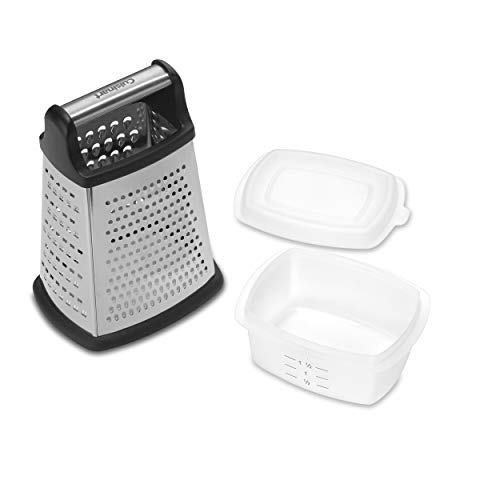
Cuisinart Box Grater
The Cuisinart box grater is the familiar stainless four-sided tower that many home cooks picture first: coarse, medium and fine grating faces, a slicer side, a comfortable top handle and a non-slip base ring on many versions. It is the safe, mainstream interpretation of the design, easy to find and easy to replace. In this review it earns its place on the shortlist on design and reputation rather than on any single headline feature, and it is treated here as a pick: check the current listing for the exact configuration, because handles, containers and face patterns vary between versions and production runs.
Best for: cooks whose priorities match its character above. Not suited for: anyone expecting it to behave like a different style of grater entirely. Whichever Cuisinart box grater version you consider, judge it by the same tests used throughout this review: teeth that look cleanly formed rather than ragged, seams that feel smooth, a base that sits flat without rocking, and a handle you can hold with a wet hand.

Microplane Box Grater
The Microplane box grater is the premium-leaning option from the brand famous for photo-etched blades. Its grating teeth are cut rather than punched, so they shave instead of tear, and the box typically adds a finer zesting face and a detachable measuring container on some versions. It suits cooks who grate hard cheese and aromatics often. In this review it earns its place on the shortlist on design and reputation rather than on any single headline feature, and it is treated here as a pick: check the current listing for the exact configuration, because handles, containers and face patterns vary between versions and production runs.
Best for: cooks whose priorities match its character above. Not suited for: anyone expecting it to behave like a different style of grater entirely. Whichever Microplane box grater version you consider, judge it by the same tests used throughout this review: teeth that look cleanly formed rather than ragged, seams that feel smooth, a base that sits flat without rocking, and a handle you can hold with a wet hand.
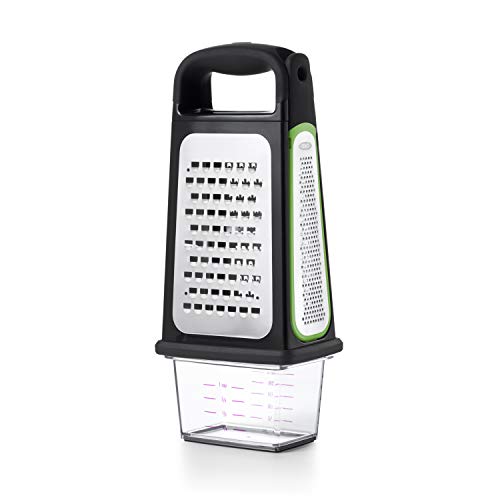
OXO Good Grips Box Grater
The OXO Good Grips box grater is the ergonomics-first take: a soft, oversized handle, a non-slip bottom, and a snap-on container with a lid that catches shreds and stores them. OXO designs for wrists and grip strength as much as for teeth, which makes it a kind choice for cooks with tired hands. In this review it earns its place on the shortlist on design and reputation rather than on any single headline feature, and it is treated here as a pick: check the current listing for the exact configuration, because handles, containers and face patterns vary between versions and production runs.
Best for: cooks whose priorities match its character above. Not suited for: anyone expecting it to behave like a different style of grater entirely. Whichever OXO Good Grips box grater version you consider, judge it by the same tests used throughout this review: teeth that look cleanly formed rather than ragged, seams that feel smooth, a base that sits flat without rocking, and a handle you can hold with a wet hand.
KitchenAid Box Grater
The KitchenAid box grater is the colourful, counter-friendly option, often sold with a catch container that doubles as a measuring cup. It covers the standard four faces and leans on brand familiarity and easy dishwasher care rather than exotic extras. In this review it earns its place on the shortlist on design and reputation rather than on any single headline feature, and it is treated here as a pick: check the current listing for the exact configuration, because handles, containers and face patterns vary between versions and production runs.
Best for: cooks whose priorities match its character above. Not suited for: anyone expecting it to behave like a different style of grater entirely. Whichever KitchenAid box grater version you consider, judge it by the same tests used throughout this review: teeth that look cleanly formed rather than ragged, seams that feel smooth, a base that sits flat without rocking, and a handle you can hold with a wet hand.

Deiss Pro Box Grater
The Deiss box grater is the value-minded stainless option that frequently bundles the grater with a container and lid. It covers the same four jobs in a slightly lighter build and is often the pick for a second grater, a holiday home or a first apartment. In this review it earns its place on the shortlist on design and reputation rather than on any single headline feature, and it is treated here as a pick: check the current listing for the exact configuration, because handles, containers and face patterns vary between versions and production runs.
Best for: cooks whose priorities match its character above. Not suited for: anyone expecting it to behave like a different style of grater entirely. Whichever Deiss box grater version you consider, judge it by the same tests used throughout this review: teeth that look cleanly formed rather than ragged, seams that feel smooth, a base that sits flat without rocking, and a handle you can hold with a wet hand.

Spring Chef Box Grater
The Spring Chef box grater is the budget-friendly tower with a detachable base container on many versions, pitched at everyday cheese and vegetable work. It is a sensible starter grater whose edges and handle reward a gentler hand. In this review it earns its place on the shortlist on design and reputation rather than on any single headline feature, and it is treated here as a pick: check the current listing for the exact configuration, because handles, containers and face patterns vary between versions and production runs.
Best for: cooks whose priorities match its character above. Not suited for: anyone expecting it to behave like a different style of grater entirely. Whichever Spring Chef box grater version you consider, judge it by the same tests used throughout this review: teeth that look cleanly formed rather than ragged, seams that feel smooth, a base that sits flat without rocking, and a handle you can hold with a wet hand.
Design, Build and Setup
Build quality on a box grater shows in three places. First, the steel itself: a good tower feels springy rather than tinny, with faces that resist flexing when you press food against them. Flex is the enemy, because a face that bows under pressure changes the cutting angle mid-stroke and can skid. Second, the folded corners, where the faces meet, should be smooth and tight, with no sharp burrs waiting for the hand that dries the grater. Third, the handle and base, which decide whether the tool feels planted or precarious.
Setup is a generous word for a tool with no assembly, but the first-use routine matters. Wash the grater before its first job to remove manufacturing residue, dry it fully, and take one slow practice pass with a carrot on the coarse face to learn the pressure it likes. Check how the shreds fall: a well-shaped tower drops them inside the box or into its container rather than spraying them across the board. That small test tells you more about a specific unit than any packaging claim.
There is no specification sheet worth memorising for a box grater, and this review deliberately avoids invented numbers. What matters is qualitative: how many faces, what kind of teeth, whether a container is included, whether the base grips, and whether the whole thing goes in the dishwasher. Judge any listing against those five plain questions and you will not go far wrong. Cooks who want the full decision framework can work through our {link(‘box grater buying guide’, ‘box-grater-buying-guide’)} alongside this review.
Set the grater on a damp towel or a non-slip mat before you start. A box grater that walks across the counter forces you to grip the food harder and chase the tower, and chasing is how strokes go sideways into knuckles. Many models add a rubber base ring for exactly this reason, and it is one of the features genuinely worth having.
Use long, even strokes and let the teeth do the work. Pressing harder does not grate faster; it bends the food, packs the teeth and tires your arm. Light pressure with a steady rhythm produces cleaner shreds, less waste stuck in the teeth and far more control at the end of each stroke.
Grate on the coarse face first when a recipe allows a choice. Coarse shreds melt evenly, roast without scorching at the edges and are far more forgiving than fine shreds, which can clump and disappear into a dish. Save the fine face for hard cheese over pasta, nutmeg, chocolate and citrus zest, where a powder is the point.
Performance in Real Use
Cheese, From Soft Blocks to Hard Wedges
Cheese is the box grater’s home turf. On the coarse face, a chilled block of cheddar or mozzarella becomes even shreds that melt predictably, far better than the thick, uneven strands a dull grater tears. The trick with soft cheese is temperature: a brief chill firms the block so it cuts instead of smearing, and a light hand keeps the teeth clear. Hard wedges like parmesan belong on the fine face, where they fall as a dry snow that disappears into pasta and risotto.
Watch your pace as the block shrinks, because cheese is slippery and the last section is exactly where fingertips drift toward the teeth. Slow down, flatten your palm across the top of the piece, and finish the job with the flat of your hand doing the pressing while your fingers stay lifted. The final nub is a snack, not a challenge.
Vegetables: Carrots, Potatoes, Zucchini and More
Vegetables separate good graters from mediocre ones. Carrots should come off the coarse face in clean strands, not bent shards. Potatoes for cakes and hash browns need a face that cuts without crushing, so the shreds fry crisp instead of gumming together. Zucchini and other wet vegetables grate fast on any face, and the honest advice is to salt and drain the shreds for recipes where excess water ruins the texture.
Onion is the face’s sternest test: a sharp grater reduces it to a juicy pulp for sauces and dressings, while a dull one makes you press, slip and weep. Keep strokes long and vertical, keep the tower planted on a damp towel, and keep your guiding hand high on the piece. The same stability advice underpins our guide to cutting boards that give a grater a stable base, because a grater is only as steady as what it stands on.
The Fine Face: Zest, Nutmeg, Chocolate and Ginger
The fine face earns its keep in small, fragrant jobs. Citrus zest for baking, a grating of nutmeg over a sauce, chocolate shaved over desserts, garlic and ginger reduced to a paste-like mince for marinades: these are the tasks where the box grater quietly replaces three gadgets. Etched teeth shine here, shaving zest without digging into bitter pith, while punched teeth need a lighter touch to achieve the same control.
Ginger deserves a special note because its fibres clog fine teeth. Work with a chilled, peeled knob, use short strokes, and tap the face over the bowl to clear it rather than picking at the teeth with a fingertip. For cooks who grate ginger constantly, a dedicated tool may serve better, which is why our roundup of ginger graters that handle fibrous roots exists; for everyone else, the box’s fine face is plenty.
The Slicer Face, Judged Honestly
The slicer side is the box grater’s weakest face on most models, and an honest review should say so. It produces serviceable cucumber and radish slices and can shave cheese for a sandwich, but thickness is fixed, the cut takes practice, and a mandoline or a sharp knife does the job better. Treat the slicer as a bonus for small jobs, never as the reason to buy, and guard your fingers exactly as you would on any exposed blade, finishing small pieces with a holder rather than fingertips.
Strengths and Trade-Offs
Strengths
- Four tools in one small footprint, always ready with no assembly, no cord and nothing to charge.
- Clean, even shreds that cook and melt better than torn strands from dull teeth or a knife.
- Fast for everyday quantities: a family portion of cheese or carrots in a minute or two of steady work.
- Easy to live with: prompt rinse or a dishwasher cycle, no blades to store separately, nothing delicate.
- Catch containers on many models turn grating into measuring, with fewer shreds escaping across the counter.
Trade-Offs
- The teeth are unforgiving: careless speed near the end of a piece will scrape knuckles, every time.
- Volume work is slow and tiring compared with a food processor’s grating disc.
- The slicer face is mediocre on most models and the fine face can clog with fibrous or soft foods.
- Cheap steel flexes, spots and dulls, and a flexing grater is both slower and less safe.
- The hollow box traps shreds inside its faces, so a prompt rinse matters more than with a flat grater.
How It Compares
Against a flat handheld grater, the box wins on stability, face choice and shred collection, and loses on grab-and-go simplicity and drawer space. Against a rotary grater, the box wins on versatility and loses on finger distance, since a rotary keeps hands entirely away from the drum. Against a food processor, the honest comparison this review keeps returning to, the box wins on setup, washing and storage, and loses heavily on volume and speed; our overview of food processors with grating discs shows what the machine route involves. Most well-equipped kitchens end up owning the box for daily work and borrowing machine power only for feasts.
Among the models in this review, the split is about priorities rather than a single champion. Etched-teeth models cut hard cheese and zest with noticeably less effort. Container models suit bakers and meal preppers who grate straight into storage. The simplest mainstream towers suit everyone else. Our companion piece weighing box grater pros and cons in plain language may help if you are still on the fence, and the plural take in our box grater reviews roundup compares owner experience model by model.
Who Should Buy It and Who Should Skip It
Buy a box grater if you cook from scratch several times a week, if cheese, slaws, gratins and vegetable cakes appear on your table, and if you value a tool that is ready before a machine would even be assembled. Buy the best teeth you can justify, because you will feel that quality on every stroke for years.
Skip it, or buy the simplest version, if your grating is rare, if arthritis or grip problems make the holding hand unreliable without a glove or holder, or if you regularly grate for a crowd and a processor already lives on your counter. There is no virtue in owning the tower and never using it.
Before you buy, run this checklist: the tower sits flat and does not rock; the handle fits your hand with room to spare; the teeth look evenly formed with no bent rows; the seams feel smooth; the base grips or a mat can supply the grip; and you have a plan for the last nub of every piece, which is a holder, a glove or the soup pot.
Setup, Care and Maintenance Essentials
Safety is not a sidebar with this tool; it is the main skill. The grating surfaces are unforgiving, and every experienced cook treats the end of each piece of food as the dangerous part, because it is.
Slow down as the piece shrinks. The last third of a block of cheese or a carrot is where knuckles meet teeth, because your fingers creep closer with every stroke and the food gets harder to hold. The moment the piece feels small in your hand, change your grip: flatten your palm and press with your whole hand, fingers held up and away, or stop entirely and switch to a food holder or guard that keeps a barrier between skin and steel.
Never chase the final nub with your fingertips. That last sliver of parmesan or potato is not worth a scraped knuckle, and scraped knuckles on a grater are uniquely miserable because the teeth take a row of tiny bites at once. Eat the nub as a cook’s snack, save it for stock, or grate it later with a holder. Professional cooks throw the nub in the soup pot without a second thought, and you should too.
A cut-resistant glove is a legitimate option, not an admission of defeat. Thin cut-resistant gloves give you a confident grip on slippery food and turn a glancing contact into a non-event. They are especially helpful for younger cooks learning the motion, for anyone grating firm vegetables at speed, and for the final section of any job when concentration fades.
Wash the grater with a brush, moving away from the teeth, and never reach a bare hand inside the box to fish out stuck shreds. A stiff brush or an old toothbrush clears the teeth from the smooth back side, pushing residue out the way it came in. If you wash by hand in soapy water, keep the grater visible rather than buried under suds, because a hidden grater bites the hand that goes searching for the sponge.
Store the grater so its teeth cannot catch a hand rummaging in a drawer. Keep it in its box, in a dedicated slot, or with a simple guard or folded towel over the coarsest face. A box grater loose in a crowded utensil drawer is a trap for the next person who reaches in quickly, and the coarse face is always the one facing up.
Rinse the grater immediately after use, before cheese or potato starch dries onto the teeth. Dried residue is what turns a ten-second rinse into a scrubbing session, and scrubbing is when hands get careless around sharp edges. A quick rinse under a strong tap, from the inside out, knocks most shreds free while they are still soft.
Most stainless box graters are dishwasher safe, and the dishwasher is honestly the safest wash method because no hand goes near the teeth. Stand the grater where water can reach all four faces, and check the base and handle joints afterwards, because trapped moisture in seams is what eventually dulls and spots cheaper steel.
Dry the grater before it goes away, especially around the folded seams at the corners and under a rubber base ring if yours has one. Those seams are the first places to show rust freckles on lower-grade steel. A minute on a dish rack, teeth facing up and away from traffic, handles nearly all of it.
Keep the teeth honest by grating a piece of stale bread or a raw potato after sticky jobs like soft cheese. The firm, dry texture pushes residue out of the teeth without any tool near your fingers. It is an old kitchen trick, and it works better than poking at the holes with a knife tip, which risks both the knife and the hand holding it.
Inspect the faces now and then. Teeth that have been flattened by a knock in the drawer, a bent corner, or a handle that wobbles all change how the grater behaves, and a grater that flexes under pressure is a grater that can skid. A stable, sharp box grater is a safe one; a tired one earns its retirement.
Chill soft cheese before grating it. A short rest in the freezer firms mozzarella, cheddar and other soft blocks so they shred instead of smearing across the face. Smearing is not just ugly; the extra pressure people apply to force soft cheese through is a classic cause of slipped grips and grazed fingers.
Grate over a wide bowl or straight into the catch container if your model has one. Shreds that land in a bowl are shreds you can measure, season and move without sweeping them off the board with the side of your hand, which is another quiet way hands drift toward the teeth during cleanup.
Work with the food at a comfortable height. A grater on a low counter while you stand hunched invites rushed, angled strokes. Raising the work on a stable board or simply clearing space so your elbow moves freely makes the motion smoother, and smooth motion is safe motion.
Final Verdict
This box grater review lands where most honest testing lands: the four-sided tower is a small, cheap, durable idea that earns its cupboard space in any kitchen that cooks. Buy on teeth, handle and stability rather than on novelty, learn the flat-palm finish and the holder habit in your first week, and the tool will repay you with a decade of clean shreds. Respect the teeth, and they will never have a reason to remind you why you should.
A Week of Dinners With the Tower
Monday is pasta night, and the review tower earns its first marks before the water boils. A wedge of hard cheese goes over the fine face while the pot heats, falling as a dry snow that will disappear into the sauce. The lesson of the first night is pacing: the wedge starts large and safe, and the cook who slows down for the final third finishes with clean knuckles and a full bowl. This rhythm, fast on the bulk, gentle on the finish, is the whole safety system in one gesture.
Tuesday tests the coarse face with carrots for a slaw. Long strokes produce long strands, and long strands are what a slaw wants, because they keep their crunch under dressing. The tower stays planted on its damp towel through the whole bunch, which sounds like a small thing until you have used a grater that walks. Stability is invisible when it works, and this review counts that invisibility as a genuine feature rather than a given.
Wednesday is where the slicer face gets its honest trial, on cucumbers for a salad. The slices come out serviceable and slightly uneven, exactly as the main review predicted, and the cook finishes the last of the cucumber with a holder rather than fingertips. Verdict after one use: fine for a quick salad, not a reason to retire a knife, and a face that demands the same respect as any exposed blade in the kitchen.
Thursday brings potatoes, the coarse face’s hardest exam. The shreds need to fry crisp, which means the teeth must cut rather than crush, and a crushed shred weeps starch and steams instead of crisping. The tower passes with clean strands that brown at the edges. The holding hand works hard here, potatoes are dense, and the review notes again that a comfortable handle is not a luxury but the difference between the fourth potato and the first.
Friday is pizza night, which means mozzarella, the smearing test. The block goes into the freezer while the dough is shaped, and the chilled cheese shreds cleanly instead of dragging across the face. This single habit, a short chill for soft cheese, rescues more grating sessions than any upgrade in steel, and it costs nothing. The review repeats it because readers consistently report it as the tip that changed their results.
Saturday morning is baking: citrus zest and a grating of nutmeg for a cake. The fine face earns its keep in ninety seconds of fragrant work that a knife simply cannot do. Zest comes off in ribbons without bitter pith when the pressure stays light, and the nutmeg powders evenly. Small jobs like these are where etched teeth justify themselves most clearly, because the difference between shaving and tearing is the difference between zest and pith.
Sunday is the audit: washing, drying and a look at the week’s wear. A prompt rinse after every job meant the Sunday wash was no harder than the Monday one. The seams are dry, the base ring is clean underneath, and the teeth still bite a test carrot cleanly. A week of dinners is the right unit for judging this tool, and on that unit the tower passes: present at every meal, invisible in the washing up, and respected, briefly and deliberately, at the end of every piece of food.
One more pattern from the week deserves recording. Every near-miss, every moment a hand drifted too close, happened in the final strokes of a piece and always when the cook was thinking about the next task. The fix that worked was embarrassingly simple: treat the last section as its own job. Put the pan down, finish the grating with full attention, then move on. Attention, rationed correctly, is the cheapest safety equipment in the kitchen.
The review also tracked what the tower did not do all week. It did not grate for a crowd, because no crowd came. It did not slice a week’s vegetables, because knives did. It did not replace the food processor, which stayed in its cupboard for a stock-making day that never arrived. Judged on what a home week actually contains, rather than on imaginary feasts, the box grater covered nearly everything asked of it, and that coverage is the core finding of this review.
Grating, Food by Food: The Extended Notes
Hard cheese is the fine face’s defining job, and the review’s extended notes start there. A cold, firm wedge, held with a paper towel for grip if your hands are warm, powders beautifully with downward strokes and almost no pressure. The moment you find yourself pressing, the wedge has warmed or the piece has shrunk; both are signals to slow down, regrip with a flat palm, and accept that the last sliver belongs to the cook, not the recipe.
Soft cheese rewards preparation over force. Mozzarella, young cheddar and Monterey Jack all smear when warm and shred when cold, and the difference between a frustrating session and a clean one is a short chill and a light hand. If smearing starts mid-block, stop, rechill briefly, and clear the face with a brush from the back. Forcing soft cheese through with pressure is how towers skid, and a skid near the fine face is a knuckle’s worst appointment.
Root vegetables are the coarse face’s daily bread. Carrots want long strokes for long strands; parsnips behave the same with a slightly softer hand; beetroot works beautifully and stains everything it touches, including the towel under the tower, which is an argument for dedicating a dark towel to the station. Peel first, top and tail for a flat starting face, and keep the piece long as long as you can, because length is grip and grip is safety.
Potatoes deserve their own note because their shreds misbehave in two directions. Grated too coarsely for a cake, they cook unevenly; crushed by a dull face, they weep starch and steam instead of frying. The review’s advice is to grate, then immediately squeeze the shreds in a clean towel, which is the difference between crisp edges and a soggy middle, and to work quickly because cut potato discolours while it waits for the pan.
Watery vegetables, zucchini above all, test your recipe judgement more than the steel. The coarse face turns them to shreds in seconds, and those shreds carry enough water to sink a fritter or flood a bake. Salt them, rest them, squeeze them, and the same shreds become an asset. The grater’s part in this is speed: it produces the volume so fast that the salting step, not the grating step, becomes the schedule.
Chocolate on the medium or fine face is a small luxury this review refuses to skip. A chilled bar shaves into curls and dust for cakes, drinks and desserts, and the only disciplines are cold chocolate, cold hands or a towel grip, and stopping before the last square, which is, by long tradition, the cook’s fee. Warm chocolate smears exactly like soft cheese and responds to exactly the same chill.
Citrus zest is where the fine face justifies the entire purchase for bakers. The technique is restraint: light strokes, constant turning, and stopping at the coloured layer, because the white pith beneath is bitter and because digging for the last zest brings fingers closest to the teeth. Wash and dry the fruit first, zest before juicing while the fruit is firm and easy to hold, and let the tower, not your thumbnail, collect the fall.
Whole spices, nutmeg above all, powder on the fine face with a fragrance no pre-ground jar survives. Hold the nutmeg with fingertips well back and use short strokes, or better, use a holder once the piece is small, because a nutmeg is precisely the size and hardness that tempts people into the fingertip finish this review keeps warning against. Freshly grated spice is a small effort with an outsized return, and it is one of the tower’s quietest triumphs.
Breadcrumbs from stale bread are the coarse face’s party trick and a cleaning tip in disguise. Firm, dry bread grates into even crumbs for coatings and toppings, and grating a piece after a sticky cheese session pushes residue out of the teeth as a bonus. It is the rare task that leaves the tool cleaner than it found it, and the review recommends ending cheese-heavy sessions this way whenever stale bread is at hand.
Cold butter, grated on the coarse face, is the baker’s shortcut this review saved for last. Frozen or well-chilled butter shreds into flakes that cut into flour in seconds for pastry, scones and crumbles, distributing fat more evenly than cubes ever manage. Keep the butter’s wrapper on the held end as a grip and a shield, work quickly, and flour the shreds as they fall so they stay separate. It is the single most persuasive demonstration for anyone who thinks a box grater is only for cheese.
Onion, garlic and ginger close the extended notes because they test judgement. Onion on the coarse face gives a juicy pulp that melts into sauces invisibly; garlic on the fine face becomes a paste that behaves like a press’s output; ginger clogs, complains and still delivers. For all three, the pattern is identical: sharp teeth, patient strokes, a brush for clearing, and fingers that stay high and dry-eyed. Master these three and no grating task in the home repertoire will surprise you.
Loose Ends This Review Should Not Leave
One loose end is grating for someone else’s recipe, where the shred size is specified loosely and your faces must translate. When a recipe says grated and means ribbons, the medium face is usually the honest translation; when it says finely grated, the fine face with light pressure is. When it says nothing at all, choose the coarse face, because coarse shreds forgive timing errors in the pan that fine shreds punish. Translation is a real part of living with four faces, and the review’s rule, coarse by default, fine on request, will serve nearly every recipe you meet.
Testing a Box Grater Properly: What to Check in the First Week of Use
The purchase is the easy part. A box grater proves itself at the kitchen counter, board or bowl it works over, in the middle of preparing cheese, vegetables and zest for everyday cooking, long after the packaging has gone. This section therefore starts with your routine rather than the product, because features only matter once they survive contact with your space, your schedule and your household. The first check is the stability of the base and handle while you apply downward pressure, and it outranks everything else, because no styling or extra capacity compensates when that basic fit is wrong. Sometimes the right purchase is smaller than planned because an existing possession covers the heavy or rare jobs, leaving the new box grater to specialise in the frequent ones.
Your own first week is the review that matters most, so record annoyances as they happen rather than trusting a general feeling at the end of it. Specification creep is real. Each extra feature on a box grater must be paid for in money, space or maintenance, so make every addition justify itself against your actual routine. Prevention is unglamorous and effective: washing and drying it straight after use so edges stay clean and rust-free, done consistently, protects performance better than any occasional rescue effort after problems have set in. Think a year ahead rather than a week. The box grater that suits this season, this household size and this room layout should ideally still suit the next version of all three.
- Check fit, finish and moving parts again after several real uses.
- Judge it against the three jobs named before purchase.
- Put it through the toughest ordinary use in week one.
- Make the keep-or-return call from your notes while you still can.
- Note every small friction point as it happens, not from memory later.
Attention is a budget too. A box grater that needs remembering, scheduling, monitoring or special handling spends it, so count that cost alongside the physical ones. Before ordering, list everything the first week of use requires and confirm, item by item, whether it arrives with the box grater or has to be found separately. Ask the least enthusiastic person in the home what would annoy them about it. Their answer usually identifies the storage, cleaning or noise issue that the buyer was too optimistic to see. Measure the real space, including clearance for doors, drawers, lids, handles and people passing, and write the numbers down before comparing anything, because memory is generous in exactly the wrong direction.
First impressions flatter almost everything. The one-month verdict, after the routine has tested the box grater properly, is the opinion worth trusting and acting on. Wear arrives at predictable points: hinges, seals, edges, handles, surfaces and anything that is folded, dragged, filled or emptied. Inspect those areas in photographs and descriptions before you buy. Delegation exposes weak choices. A box grater that only works in one person’s hands, with one person’s knack, is a fragile solution for a shared home. Flexibility is worth paying for only if you will use it. A box grater that folds, moves or converts impresses in the listing and matters only if your routine actually asks it to.
Ownership is easier with a small paper trail. Keep the instructions, note the model details from the listing, and record any quirk as it appears rather than reconstructing it months later. If a shortlist is already forming, run these checks against the exact listings you are comparing, for example the Cuisinart Box Grater and the Microplane Box Grater, reading the current listing details rather than relying on memory. Edge cases matter here: grating a small amount, where washing the whole tool can feel like the real cost. A box grater chosen with that situation in mind will not need replacing the first time life deviates from the brochure. Most disappointment with a box grater traces back to grated food clogging the teeth and knuckles meeting the surface on short pieces. It is a slow, predictable process, which is good news, because predictable problems can be designed out before you buy.
Test the box grater under the hardest normal condition your home offers rather than a gentle demonstration, since performance on easy days tells you almost nothing you did not already know.
Frequently Asked Questions
Is a box grater better than a flat grater?
For most kitchens, yes. The box stands on its own, offers four faces instead of one or two, and catches shreds underneath or in a container. A flat grater is quicker to grab for one tiny job and easier to store in a drawer. Many cooks own both and reach for the box whenever the quantity is more than a garnish.
How do I grate cheese without scraping my knuckles?
Slow down as the block shrinks, because that final section is where injuries happen. Switch to a flat palm pressing from above with fingers lifted, or use a food holder or guard for the last part. Never chase the final nub with your fingertips; eat it, or save it for soup. A cut-resistant glove is a sensible extra if you grate often.
Can a box grater go in the dishwasher?
Most stainless models can, and the dishwasher is the safest wash because no hand goes near the teeth. Stand it so water reaches all four faces. If you hand wash, use a brush moving away from the teeth, never a bare hand inside the box, and dry around the seams and base to protect cheaper steel from rust spots.
What is the slicer side of a box grater actually good for?
Quick cucumber, radish and cheese slices in small quantities. It is the weakest face on most models, with a fixed thickness that takes practice to use evenly. For regular slicing, a knife or a mandoline does better. Treat the slicer as a bonus, keep your fingers guarded, and finish small pieces with a holder.
How long should a box grater last?
A well-made stainless tower lasts for years of weekly use. Teeth dull slowly rather than suddenly, and the usual end comes from bent faces, rusting seams on cheaper steel or a wobbling handle. Rinsing promptly, drying before storage and avoiding knocks in crowded drawers all extend its working life considerably.
What can I use instead of a box grater?
A food processor with a grating disc for volume, a flat or rotary grater for small jobs, or a sharp knife and patience for coarse work. Each alternative trades something away: setup time, face choice or shred quality. The box remains the middle path, which is why it survives in kitchens that own several of its rivals.
Related Guides
Keep exploring this corner of the kitchen: the box grater buying guide; box grater pros and cons in plain language; whether a box grater is worth it; box grater reviews compared; garlic presses for the jobs a grater cannot do; food processors with grating discs.


