Disclosure: airfryerkitchensupply.com is reader-supported. When you buy through links on our site, we may earn an affiliate commission at no extra cost to you.
Where to buy
For readers comparing the best office chairs for long sitting and comfort, every chair below was cross-checked against the Amazon catalog data available to us, and each pick links straight to its Amazon listing so you can check the current price on Amazon and read the full specification sheet before you commit. If a chair is listed here, it is a complete chair sold as a complete chair — no parts, no add-ons dressed up as picks. Start with these links:
- Flash Furniture Hercules 24/7 Big & Tall Fabric Office Chair (400 LB) — Check the current price on Amazon
- Flash Furniture HERCULES 24/7 Intensive Use Chair (500 lb) — Check the current price on Amazon
- Long-Hours Ergonomic Mesh Office Chair (4-Way Lumbar, 3.5″ Cushion) — Check the current price on Amazon
- 500lbs Executive Office Chair with Air-Lumbar Support — Check the current price on Amazon
- Steelcase Leap Office Chair (Onyx) — Check the current price on Amazon
- NEO CHAIR Office Desk Chair with Headrest (Extended Sitting) — Check the current price on Amazon
The best office chairs for long sitting and comfort are not the chairs that feel wonderful for the first ten minutes. A showroom sit tests the cushion’s welcome; a ten-hour day tests everything else — whether the foam still supports you at hour seven, whether the backrest follows you when you shift, whether heat builds up until you are squirming, whether the arms are where your elbows actually are. Long-sitting comfort is an endurance specification, and it is won by chairs designed for duty cycles: intensive-use and 24/7-rated chairs, all-day comfort models with thick stated cushions, and premium ergonomic chairs whose support systems adjust instead of merely padding.
That is the shape of this guide. We cross-checked candidates through the site’s Amazon listing data access and kept only chairs whose listing titles state something concrete about long sitting: a 24/7 or intensive-use rating, an all-day or long-hours comfort claim with a stated cushion, an extended-sitting design brief, or a recognized ergonomic support system. Vague ‘comfortable ergonomic chair’ language was not enough — the catalog is full of it, and it predicts nothing about hour eight. Each pick below quotes what its title actually states, and flags what it does not, so you can see the evidence the recommendation stands on.
A word of plain dealing about long sitting itself: no chair makes twelve motionless hours healthy, and we will not pretend otherwise. What a good long-sitting chair does is remove the chair as a source of misery — distributing pressure, supporting posture changes, shedding heat — while you do the rest with breaks, movement and a sane desk setup. The buying guide covers that system honestly. The chairs here are the part of the system you can buy.
Key Takeaways
- Duty ratings beat adjectives: the two 24/7-rated picks are the strongest endurance evidence in this guide.
- Match stated capacity to your weight with headroom — 330, 400 and 500 lb figures here are printed exactly as titles state them.
- Adjustable or re-tunable lumbar support (4-way, knob, air) outperforms any fixed pad across a long day.
- No chair replaces breaks: pair the chair with hourly movement for a complete long-sitting setup.
In this guide
Quick Picks
Flash Furniture Hercules 24/7 Big & Tall Fabric Office Chair (400 LB) — Best Overall: A chair whose title carries a 24/7 designation and a 400 LB capacity, with a lumbar adjustment knob and adjustable arms — built for shift-length sitting, priced for home offices. Check on Amazon
Flash Furniture HERCULES 24/7 Intensive Use Chair (500 lb) — Best Heavy-Duty Endurance: The intensive-use flagship: 24/7 rated, 500 lb capacity, mesh executive format with a ratchet back — for heavier users whose sitting day is genuinely long. Check on Amazon
Long-Hours Ergonomic Mesh Office Chair (4-Way Lumbar, 3.5″ Cushion) — Best All-Day Mesh: A chair titled for long hours and all-day comfort, with a stated 3.5-inch cushion, 4-way lumbar, breathable mesh and BIFMA testing — the measured-spec pick. Check on Amazon
500lbs Executive Office Chair with Air-Lumbar Support — Best for All-Day Sitting, Heavy Users: A 500lbs executive chair whose title says ‘for all-day sitting’ outright, with air-lumbar support you can inflate to taste and flip-up armrests. Check on Amazon
Steelcase Leap Office Chair (Onyx) — Best Premium Ergonomics: The Leap’s stated LiveBack and Natural Glide systems adjust support as you move — the premium answer to long sitting, for buyers who adjust their chair and mean it. Check on Amazon
NEO CHAIR Office Desk Chair with Headrest (Extended Sitting) — Best with Headrest: A high-back mesh chair whose title says it was designed for extended sitting comfort, with adjustable headrest and lumbar and flip-up armrests. Check on Amazon
How These Picks Were Chosen
Selection started from the site’s verified catalog data. A chair qualified by stating at least one concrete long-sitting credential in its title: a 24/7 or intensive-use designation, an explicit all-day or long-hours comfort design with a stated cushion dimension, or a named ergonomic support technology. We excluded seat cushions and add-on pads — this guide recommends complete chairs — and excluded chairs whose only comfort claim was the word ‘comfortable.’
The six finalists cover the realistic strategies for long sitting. Two Flash Furniture Hercules models carry actual 24/7 intensive-use ratings at 400 and 500 lb capacities — chairs built for shift work, where ‘long sitting’ is a specification, not a mood. Two mesh chairs state all-day or extended-sitting designs with measured cushions (3.5 inches) and multi-way lumbar systems. The Steelcase Leap represents the premium adjustable-ergonomics route, with its stated LiveBack and Natural Glide systems. Capacities, cushion thicknesses and warranty terms quoted below come only from the verified titles; anything a title leaves unstated is flagged rather than invented.
The 6 Best Office Chairs for Long Sitting and Comfort

Flash Furniture Hercules 24/7 Big & Tall Fabric Office Chair (400 LB) — Best Overall
The 24/7 in this chair’s name is the most meaningful comfort claim in this entire guide, because it is a duty rating rather than an adjective. Chairs designated for 24/7 use are built for environments — dispatch centers, control rooms, security desks — where the chair is occupied around the clock by different people, and where failure is a facilities problem, not an inconvenience. Bringing that class of chair home is the single most reliable shortcut to long-sitting comfort: the frame, foam and mechanisms are specified for a workload your home office will never match.
The stated details support the rating. Capacity is 400 LB, the lumbar support adjusts via a knob so you can set its pressure rather than accept a fixed pad, and the arms adjust — a small thing at minute ten, a large thing at hour nine, when your shoulders start negotiating with anything fixed. The fabric upholstery is a deliberate long-sitting choice too: fabric breathes better than bonded leather over long sessions and does not go clammy against clothing in a warm room.
The trade-offs are aesthetic and tactile. This is a utilitarian chair — it looks like equipment, because it is — and fabric shows wear and absorbs spills in ways wipe-clean surfaces do not. The title does not state cushion thickness or a headrest, so if those matter to you, compare the all-day mesh picks below. But if your question is ‘which chair will still feel fine at the end of a long day, at a price a home office can justify,’ the 24/7 rating is the strongest evidence on this page.
Strengths
- 24/7 duty designation stated in the title — a real endurance specification
- 400 LB stated capacity suits a wide range of users
- Adjustable lumbar pressure via knob, plus adjustable arms
Trade-offs
- Utilitarian looks; fabric upholstery needs more care than wipe-clean finishes
- Cushion thickness is not stated in the title
- No headrest mentioned in the title
| Spec (as stated in the listing title) | Detail |
|---|---|
| Duty rating (title-stated) | 24/7 |
| Capacity (title-stated) | 400 LB |
| Lumbar (title-stated) | Lumbar adjustment knob |
| Arms (title-stated) | Adjustable arms |
Best for: Long daily hours on a sensible budget / Not suited for: Users who want mesh ventilation or premium finishes
Check the current price on Amazon
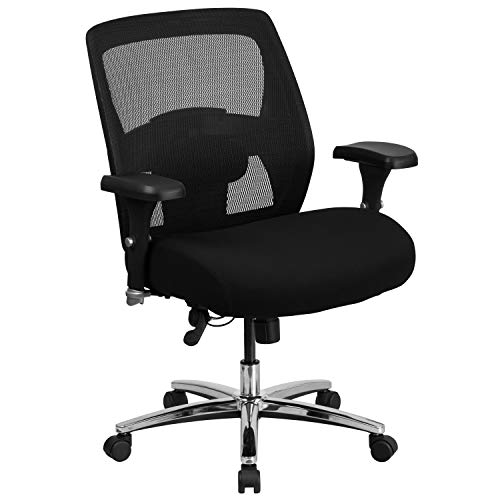
Flash Furniture HERCULES 24/7 Intensive Use Chair (500 lb) — Best Heavy-Duty Endurance
If the 400 LB model is the sensible default, this is the heavy artillery: the title states 24/7 intensive use and a 500 lb rating in the same breath. Intensive use is the designation for chairs that must survive not just long hours but long hours under heavier loads — the combination that destroys ordinary chairs, whose foams pack down and mechanisms loosen precisely when the user can least afford a sagging seat. For a heavier reader whose workday is ten hours at the desk, this rating is worth more than any cushion adjective in the catalog.
The ratchet back is the feature to notice. A ratcheting backrest adjusts in height in set increments, which lets you place the back’s lumbar curve where your lumbar curve actually is — a fit detail that matters more over long sitting than any amount of padding, because a support in the wrong place is just a lump. The mesh executive format keeps the back ventilated through long sessions, addressing the heat build-up that makes padded chairs miserable by afternoon.
Size is the caveat, in both directions. This chair is built for big and tall users; a smaller person will find the seat wide, the back tall, and the minimum heights potentially awkward, and should look at the standard-capacity picks in this guide instead. The title also leaves arm adjustability and cushion construction unstated, so check the full listing for those specifics. Judged on its stated evidence — duty rating, capacity, adjustable back height, mesh ventilation — it is the endurance pick for heavier long-sitters.
Strengths
- 24/7 intensive-use rating stated in the title
- 500 lb stated capacity — built for long hours under heavy loads
- Ratchet back places the lumbar curve at your height; mesh back ventilates
Trade-offs
- Oversized for smaller users
- Arm and cushion details are not stated in the title
- Executive bulk needs a roomy desk setup
| Spec (as stated in the listing title) | Detail |
|---|---|
| Duty rating (title-stated) | 24/7 intensive use |
| Capacity (title-stated) | 500 lb |
| Back (title-stated) | Ratchet back |
| Format (title-stated) | Mesh executive |
Best for: Heavier users sitting long shifts / Not suited for: Petite users — the frame is sized for big and tall
Check the current price on Amazon

Long-Hours Ergonomic Mesh Office Chair (4-Way Lumbar, 3.5″ Cushion) — Best All-Day Mesh
Most comfort claims in this category are weather reports — ‘comfy,’ ‘cozy,’ ‘cloud-like.’ This chair’s title instead reads like a spec sheet: designed for long hours, all-day comfort, a 3.5-inch cushion, 4-way lumbar support, breathable mesh, tilt and rock, a 330 lbs capacity, and BIFMA testing with stated warranty and returns terms. We cannot verify performance beyond what the title states, but a manufacturer willing to print measurements is giving you something checkable, and checkable is what this guide rewards.
The 4-way lumbar is the substantive feature. Lumbar supports that adjust in more directions can be positioned in height and depth, which is how a support ends up in your lumbar curve rather than above or below it. Over a long day, that placement is the difference between a backrest that carries you and one you unconsciously avoid by perching forward. Paired with a 3.5-inch cushion — thick enough to resist bottoming for most users at this capacity — and a mesh back for heat management, the specification addresses the three classic long-sitting failures: pressure, posture and temperature.
Capacity is the hard limit: 330 lbs is stated, and heavier users should take the Hercules picks above, which state 400 and 500. The brand behind this listing is not a household name, which cuts both ways — the stated BIFMA testing and warranty terms are the reassurance offered, and we quote them as title claims rather than endorsements. For a mid-capacity user who wants a mesh chair specified in numbers, this is the most transparent listing in the guide.
Strengths
- Title states measurable specs: 3.5″ cushion, 4-way lumbar, 330 lbs
- Breathable mesh back manages heat over long sessions
- BIFMA testing and warranty terms stated in the title
Trade-offs
- 330 lbs stated capacity excludes heavier users
- Lesser-known brand; reassurance rests on stated testing and terms
- Tilt and rock only — no stated multi-level tilt lock
| Spec (as stated in the listing title) | Detail |
|---|---|
| Cushion (title-stated) | 3.5″ cushion |
| Lumbar (title-stated) | 4-way lumbar |
| Capacity (title-stated) | 330 lbs |
| Testing (title-stated) | BIFMA-tested |
Best for: Mesh fans who want stated numbers, not adjectives / Not suited for: Users above the stated 330 lbs capacity
Check the current price on Amazon
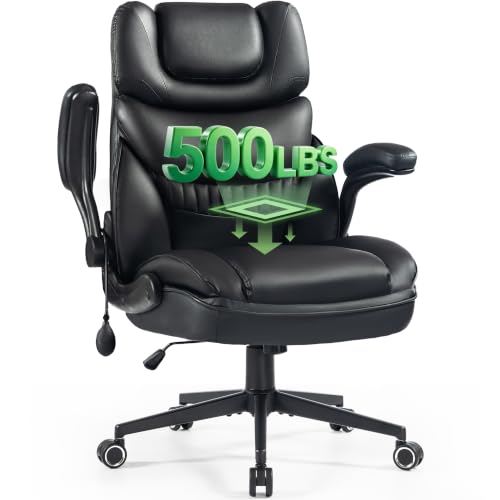
500lbs Executive Office Chair with Air-Lumbar Support — Best for All-Day Sitting, Heavy Users
Air-lumbar support is an underrated long-sitting feature, and this chair’s title leads with it alongside a 500lbs capacity and an explicit all-day sitting brief. An inflatable lumbar bladder lets you change the support’s firmness in seconds — firmer in the morning when you sit tall, softer in the afternoon when you settle — and, more importantly, re-tune it months later after the seat cushion has broken in and your sitting position has dropped a few millimeters. Fixed lumbar pads cannot follow that change; air can. For a heavier user spending all day in the chair, that adaptability is a genuine endurance feature.
The format is executive: leather-style upholstery, a high back, flip-up armrests. Flip-up arms suit long days better than fixed ones because they let you vary your posture radically — arms down for typing stretches, arms up and chair pulled close for reading, sideways sits during calls — and posture variety across a day is itself a comfort strategy. The 500lbs rating gives the frame and mechanism the headroom that long hours under load demand.
The honest trade-offs: leather-style upholstery does not breathe like mesh, so in a hot room this chair will feel warmer by hour six than the mesh picks here. The title does not state cushion thickness or tilt-lock positions, so those specifics need the full listing. And an air bladder is a component that can eventually leak — a repairable nuisance rather than a fatal flaw, but worth knowing. For heavier all-day sitters who run cool and want tunable support, it earns its place.
Strengths
- Air-lumbar support can be re-tuned as the cushion breaks in
- 500lbs stated capacity with an explicit all-day sitting brief
- Flip-up arms allow real posture variety across the day
Trade-offs
- Leather-style upholstery runs warmer than mesh
- Cushion thickness is not stated in the title
- Air bladder is an extra component that could eventually leak
| Spec (as stated in the listing title) | Detail |
|---|---|
| Capacity (title-stated) | 500lbs |
| Lumbar (title-stated) | Air-lumbar support |
| Design (title-stated) | For all-day sitting |
| Arms (title-stated) | Flip-up armrests |
Best for: Heavier users who want tunable lumbar firmness / Not suited for: Users who prefer mesh over leather-style upholstery
Check the current price on Amazon

Steelcase Leap Office Chair (Onyx) — Best Premium Ergonomics
The Steelcase Leap takes the opposite approach to comfort from the padded executive chairs: instead of cushioning you into one position, it is engineered to keep supporting you as you change positions. The title names its two systems. LiveBack describes a backrest designed to flex and follow the shape of your spine as you move; the Natural Glide System describes a seat that glides forward as you recline, so reclining does not pull your feet off the floor or your eyes away from the screen. Over a long day of unconscious shifting — upright for typing, leaned for thinking, back for calls — a chair that stays correct through the movement beats a chair that is perfect in one pose and wrong in three others.
This is the chair for the user who will actually use adjustments. Premium ergonomics only pays out if you spend the first week dialing the chair to your body — seat depth, back tension, arm position — and most Leap owners describe exactly that honeymoon of tweaking followed by years of not thinking about the chair at all. That disappearance is the real product: at hour nine, the chair is not a topic. For long sitters with the budget, that is the outcome every pick in this guide is chasing by different means.
Two flags from the title itself. First, this listing states wheels for carpet — on hard floors, use a chair mat or accept that you have bought the wrong caster variant; our laminate guide covers that problem in depth. Second, the Leap’s comfort is engineered rather than plush: if your idea of comfort is sinking into a deep soft seat, the executive picks will feel better to you in the first minute, whatever happens by hour eight. And it sits in the premium price tier — check the current price on Amazon and weigh it against the 24/7-rated picks, which deliver endurance by durability rather than by adjustability.
Strengths
- LiveBack and Natural Glide systems stated in the title — support that follows movement
- Deep adjustability rewards users who dial in their fit
- A proven premium design with a long service reputation
Trade-offs
- Premium price tier
- This listing states carpet wheels — hard floors need a mat
- Engineered feel is firmer than plush executive cushioning
| Spec (as stated in the listing title) | Detail |
|---|---|
| Back (title-stated) | LiveBack technology |
| Seat motion (title-stated) | Natural Glide System |
| Wheels (title-stated) | Wheels for carpet |
Best for: Long sitters who will actually use deep adjustability / Not suited for: Set-and-forget buyers; also states carpet-floor wheels
Check the current price on Amazon

NEO CHAIR Office Desk Chair with Headrest (Extended Sitting) — Best with Headrest
Long sitting is not all upright. Real desk days include leaning back to read a long document, think through a problem, or take a call — and in a chair without a headrest, those are the minutes your neck pays for the previous hours. The NEO CHAIR’s title states its brief directly: designed for extended sitting comfort while working, with an adjustable headrest and adjustable lumbar support on a high-back mesh frame. A headrest that adjusts to your height turns the lean-back from a posture break into actual rest, and across a ten-hour day those micro-rests accumulate.
The flip-up armrests support the same varied-day logic as the air-lumbar pick above: arms present for typing, arms gone when you pull in close or sit sideways with a notebook. The mesh back handles the thermal side of long sitting, and the grey finish suits home offices better than the black-on-black of most task chairs — a trivial point until you remember you will look at this chair every day for years.
The flag on this pick is capacity: the title does not state one, so heavier users should choose from the explicitly rated picks in this guide rather than guess. The title likewise leaves cushion construction unstated. Within those limits, this is the balanced home-office pick of the six — no duty rating, no premium badge, but a stated extended-sitting brief and the two adjustments (headrest, lumbar) that long days most often demand.
Strengths
- Adjustable headrest — rare at this tier and valuable across long days
- Title states an extended-sitting design brief
- Flip-up arms and a breathable mesh high back suit varied home-office days
Trade-offs
- No weight capacity stated in the title
- Cushion construction is not stated
- No intensive-use or 24/7 duty rating
| Spec (as stated in the listing title) | Detail |
|---|---|
| Design brief (title-stated) | Extended sitting comfort |
| Headrest (title-stated) | Adjustable headrest |
| Lumbar (title-stated) | Adjustable lumbar support |
| Arms (title-stated) | Flip-up armrests |
Best for: Long sitters who lean back to think and want neck support / Not suited for: Users who need a stated high capacity — none is in the title
Check the current price on Amazon
Comparison Table
| Pick | Badge | Key spec | Best for |
|---|---|---|---|
| Flash Furniture Hercules 24/7 Big & Tall Fabric Office Chair (400 LB) | Best Overall | 24/7 designation; 400 LB capacity; lumbar adjustment knob | Long daily hours on a sensible budget |
| Flash Furniture HERCULES 24/7 Intensive Use Chair (500 lb) | Best Heavy-Duty Endurance | 24/7 intensive use; 500 lb rated; ratchet back | Heavier users sitting long shifts |
| Long-Hours Ergonomic Mesh Office Chair (4-Way Lumbar, 3.5″ Cushion) | Best All-Day Mesh | 3.5″ cushion; 4-way lumbar; 330 lbs; BIFMA-tested (title-stated) | Mesh fans who want stated numbers, not adjectives |
| 500lbs Executive Office Chair with Air-Lumbar Support | Best for All-Day Sitting, Heavy Users | Air-lumbar support; 500lbs capacity; all-day sitting design | Heavier users who want tunable lumbar firmness |
| Steelcase Leap Office Chair (Onyx) | Best Premium Ergonomics | LiveBack technology; Natural Glide System (title-stated) | Long sitters who will actually use deep adjustability |
| NEO CHAIR Office Desk Chair with Headrest (Extended Sitting) | Best with Headrest | Designed for extended sitting (title-stated); adjustable headrest & lumbar | Long sitters who lean back to think and want neck support |
What Actually Wears Out Over a Long Sitting Day
Long-sitting discomfort arrives in a predictable order, and knowing the order tells you what to shop for. First comes heat: within a couple of hours, a padded chair in a warm room raises skin temperature at the contact points, and restlessness follows. Mesh backs and fabric upholstery exist to delay exactly this. Second comes pressure concentration: as foam compresses under your sitting bones, load that was spread at hour one focuses onto smaller areas, which is why cushion thickness, density and — in the heavy-duty picks — duty rating matter more than initial softness. A cushion that feels luxurious for ten minutes can be the worst seat in the room by hour seven if it bottoms out.
Third comes postural drift. Nobody holds a perfect posture for ten hours; you shift, slump, perch, lean. Chairs cope with drift in two ways: support that adjusts to follow you (the Leap’s stated glide and flex systems, multi-way lumbar supports you can reposition), or support you can re-tune (the air-lumbar bladder, the lumbar adjustment knob on the 24/7 chair). Fixed, non-adjustable support assumes a statue. Fourth — and no chair solves this — comes simple stillness. Blood flow, spinal discs and attention all want movement. The best long-sitting setup pairs a supportive chair with a timer, a water glass that needs refilling, and a printer in another room. Buy the chair for the hours; keep the habits for the health.
How to Choose a Chair for Long Sitting
Begin with your real hours, not your aspirational ones. If your chair is occupied ten-plus hours a day, start from the duty-rated end of this guide: a 24/7 or intensive-use designation is the only comfort claim in the industry that is fundamentally about time. If your day is six to eight hours with natural breaks, the all-day mesh picks with stated cushions and adjustable lumbar will serve you well and cost less. Matching the chair’s design brief to your actual occupancy is the highest-value decision in this category — more than brand, more than looks.
Then fit capacity with headroom, because long hours multiply load effects. A chair near its rated limit will compress its cushion fully and work its mechanism hard for every one of your long days; a chair with capacity to spare stays in the comfortable middle of its range. Heavier users should read the stated capacities in this guide literally — 330, 400, 500 lbs are printed in the titles precisely so you can choose with margin. After capacity, prioritize in this order: lumbar adjustability you can reach and change, cushion thickness or construction stated in numbers, back ventilation for your room’s temperature, and arm adjustability matched to your desk height.
Finally, plan the first fortnight as a fitting period, not a verdict. Adjust one thing at a time — seat height first (feet flat, knees easy), then lumbar position, then arms, then tilt tension — and give each setting a full day before judging it. Long-sitting comfort is a tuned state, and the chairs in this guide all offer enough adjustment to find it. If a chair still fights you after honest tuning, the stated returns terms on several of these listings exist for a reason. The goal is a chair you stop noticing; give the process the two weeks it deserves.
Cushion Science in Plain Language: Foam, Springs and Mesh Seats
Three seat constructions appear across this guide’s picks, and long sitters should know their characters. Foam is the default: a block of polyurethane foam over a seat pan. Its comfort over years depends on density more than thickness — a thick, low-density cushion feels wonderful in week one and packs into a hammock by year two, while a firmer, denser cushion feels austere at first and sits almost unchanged for years. This is why the guide values stated numbers (the 3.5-inch cushion on the long-hours mesh pick) and duty ratings (the Hercules pair) over softness language: both are proxies for foam that will still be working at hour eight of year three.
Pocket springs, found in some heavy-duty executive chairs, borrow the mattress solution: individual coils that compress independently, so pressure spreads and the seat resists the single deep crater that foam develops under the sitting bones. For heavier long sitters especially, a spring seat’s support curve stays flatter across the day. Mesh seats take the opposite path — no cushion at all, a suspended membrane that distributes load by tension and breathes completely. Mesh never packs down, but it never feels plush either, and its support depends entirely on the frame’s shape fitting yours.
There is no universal winner, only a match. Warm rooms favor mesh; cold rooms and users who dislike a firm sit favor foam or springs; heavier users should weight duty rating and capacity headroom above construction fashion. What every long sitter should avoid is the unexamined default: the chair whose listing says nothing about its seat at all. In a category where the seat is the product, silence about it is the loudest specification of all — and it is why every pick in this guide states something checkable about the part of the chair you will spend your decade on.
When to Replace a Long-Sitting Chair: Reading the Signs
Long-sitting chairs rarely die dramatically; they fade, and because the fade is gradual, users adapt to a failing chair for months before naming it. Learn the signs and you will replace chairs on evidence instead of in crisis. The first is the morning-after test: a chair that leaves you stiff in a new place, consistently, after days that used to be fine, is telling you its cushion or support has changed. Foam failure announces itself exactly this way — support that was there at purchase has compressed into a shape that no longer matches you, and no amount of re-adjustment restores material that is no longer there. Press the seat center with your hand: if you can feel the hard pan through the cushion with modest pressure, the foam’s working life is over, whatever the chair looks like.
The second sign is mechanical drift. A gas lift that sinks an inch over a morning, a tilt lock that slips a notch under load, armrests that wobble after retightening, casters that track sideways — each is a small tax on every hour, and together they convert a supportive chair into a negotiation. Individual parts can sometimes be replaced, and on premium chairs that is worthwhile; on value chairs, two failing systems usually mean the third is close behind. The third sign is thermal and tactile: upholstery cracked at the seat edge, fabric worn shiny, mesh sagging into a hammock. These are not cosmetic complaints on a chair you sit in for ten hours — a sagging mesh back is a lumbar support that has resigned.
Set a review rhythm so the decision is never a surprise: once a year, sit in your chair and audit it deliberately — cushion press test, lift test (raise it fully and see if it holds through a day), a slow recline to feel for slips, a look at the upholstery in daylight. If it passes, it has earned another year at a fraction of replacement cost. If it fails on cushion or lift, start shopping while the old chair is still tolerable, because the worst long-sitting purchases are the urgent ones, made in a weekend with a sore back doing the choosing. The chairs in this guide were selected to delay that audit’s verdict as long as the category allows — duty ratings, stated capacities, honest cushions — but no chair is exempt from it, and the reader who audits yearly will never spend a year wondering why every day ends at the same ache.
How to Set Up Your Chair for a Long Sitting Day
Set the chair before the day starts, in this order. Seat height first: sit with your feet flat on the floor, knees bent at roughly a right angle or slightly open, and no pressure digging into the underside of your thighs from the seat’s front edge — that edge pressure is the most common cause of afternoon leg discomfort and the easiest to fix. If your feet dangle at the height your desk demands, the answer is a footrest, not a lower chair that wrecks your elbow angle.
Lumbar next. Sit fully back so the backrest actually carries you — most long-sitting pain starts as perching — and position the lumbar support in the small of your back, at belt-line height, firm enough that you feel contact without being pushed. On the air-lumbar pick, inflate until you feel that contact, then stop; on the knob-adjusted 24/7 chair, dial in the same gentle pressure. Set the tilt tension so you can lean back with slight effort and return without pushing off the desk, then unlock the tilt: a chair that can move a few degrees all day will keep you shifting subtly, and subtle shifting is the closest thing to a long-sitting strategy a chair can offer.
Arms last: raise them to where your forearms rest with shoulders completely dropped, elbows near ninety degrees, and check that the arms clear the desktop when you roll in — if they collide, your desk and chair are negotiating your posture for you, and flip-up or lower arms solve it. Then set your day up around the chair: water within reach but a refill point across the room, a standing break on the hour, and one task per day deliberately done standing or walking. The chair’s job is to make the sitting hours neutral. The breaks do the rest.
Common Buying Mistakes
Judging comfort by the first sit. Showroom softness predicts almost nothing about hour eight. Duty ratings, stated cushion dimensions and adjustable support predict far more.
Buying capacity at your exact weight. Long hours at a chair’s limit compress cushions fully and wear mechanisms fast. Choose a stated rating with real headroom.
Locking the tilt bolt upright all day. A fixed spine angle for ten hours is a recipe for stiffness. Set the tension properly and let the chair move with you.
Perching on the seat edge. If you never touch the backrest, its lumbar support cannot help you. Sit back, adjust the support to meet you, and raise your screen instead of leaning to it.
Expecting the chair to replace breaks. No chair makes motionless sitting healthy. The chair removes itself as a problem; movement is still your job.
Final Recommendation
For most long-sitters, the Flash Furniture Hercules 24/7 at 400 LB is the recommendation: a genuine duty rating, adjustable lumbar pressure and adjustable arms at a home-office price. Heavier users should step to the 500 lb intensive-use Hercules or the air-lumbar executive, both built for long hours under load. If you prefer mesh and measurable specs, the long-hours chair with the stated 3.5-inch cushion and 4-way lumbar is the transparent choice; if you lean back to think, the NEO CHAIR’s adjustable headrest earns its keep daily; and if budget allows one chair for a decade, the Steelcase Leap’s movement-following support is the premium answer.
Set the chair up properly, tune it over two weeks, and keep your breaks. Long sitting will never be a health activity — but with the right chair, it stops being the reason your day hurts.
Best Office Chairs For 12 Hour Days Best Extended Use Office Chairs Best Office Chairs Home Office Chairs Best Office Chairs For Laminate Flooring
Frequently Asked Questions
What does a 24/7 chair rating actually mean?
It designates a chair built for continuous, around-the-clock occupancy — shift-work environments where the chair rarely sits empty. The frames, foams and mechanisms are specified for that duty cycle. For a home user sitting long days, it is the strongest endurance evidence a listing can offer, which is why two picks in this guide carry it.
Is a thicker cushion always better for long sitting?
Not by itself. Thickness helps only if the foam is dense enough not to bottom out under your weight — which is why capacity headroom matters alongside cushion dimensions. The picks here state either a cushion measurement, a duty rating, or both, so you are not relying on adjectives.
Mesh or padded seat for long hours?
Mesh breathes and stays cooler, which matters in warm rooms and for users who run hot. Padded seats — especially thick or pocket-spring cushions — spread pressure more softly and suit cooler rooms and users who dislike mesh’s firmer feel. Both appear in this guide deliberately; match the material to your room and your preference.
How long should a good office chair last with daily long use?
A duty-rated or premium chair should give years of daily service; entry-level chairs used ten hours a day often feel tired within a couple of years as foam compresses. We print no lifespan promises — usage and user weight vary too much — but buying a chair whose stated brief matches your hours is the best predictor of longevity.
Do I need a headrest for long sitting?
Only if you lean back during the day — to read, think or take calls. If your work keeps you upright and forward, a headrest adds nothing. If your day mixes both, the NEO CHAIR pick shows why an adjustable headrest is worth having: it supports the lean-back minutes instead of leaving your neck to hold your head at an angle.
Can the right chair fix my back pain from sitting?
We make no medical claims, and no chair should be sold as a treatment. A well-fitted chair removes common aggravations — edge pressure, unsupported lumbar curves, heat build-up — and that matters for comfort. Persistent pain deserves professional assessment, not a furniture purchase based on marketing.
Should I stand instead of buying a better chair?
Standing all day trades one set of problems for another; the evidence-supported pattern for desk workers is alternation — sit, stand, walk — rather than any single posture held for hours. A sit-stand desk plus a good chair covers more of the day than either alone. If budget forces a choice, most long sitters get more relief from a properly supportive chair first, since sitting remains the majority posture even at adjustable desks.
I sit long hours but my room is small — do the duty-rated chairs fit?
The 24/7 and intensive-use chairs in this guide are full-size chairs, and the 500 lb model in particular is built on a big and tall frame. Measure before you commit: the chair’s width with arms against your desk opening, and the roll-back space behind your desk for reclining and getting in and out. If the room cannot take the heavy-duty frame, the long-hours mesh pick — standard-sized, with a stated 3.5-inch cushion and 4-way lumbar — delivers the long-sitting brief in a smaller footprint. What you should not do is solve a space problem by buying an undersized chair for your body: capacity and fit come first, and a smaller room is better served by rearranging furniture than by shrinking the one object you sit in all day.


