Disclosure: airfryerkitchensupply.com is reader-supported. When you buy through links on our site, we may earn an affiliate commission at no extra cost to you.
Where to buy
This best slippers shoes for plantar fasciitis guide links only to listings verified for this site. Every pick below was cross-checked and linked to its exact verified listing, where you can check the current price on Amazon and confirm sizing. A plain-language note before the links: this guide covers comfort features only. Slippers are not medical devices, they do not treat plantar fasciitis or any other foot condition, and nothing in this guide promises pain relief or a health outcome. If you have foot pain, the right first step is a clinician; the right second step, if you want supportive house footwear for comfort, is a careful read of what each listing below actually states.
- Vionic Women’s Indulge Carlin Flannel Mule Slipper — check price on Amazon
- Orthofeet Charlotte Women’s Slippers (Taupe) — check price on Amazon
- Orthofeet Asheville Men’s House Slippers (Brown) — check price on Amazon
- COFACE Women’s Memory Foam Slippers with Arch Support — check price on Amazon
- VALSOLE Orthopedic Slippers for Women and Men — check price on Amazon
- ONCAI Men’s Slippers with Arch Support — check price on Amazon
People searching for the best slippers shoes for plantar fasciitis are usually looking for one practical thing: house footwear with real arch support and cushioning, instead of the flat, flimsy slippers that leave feet feeling unsupported at home. This guide answers that practical search with strict honesty about language. The six picks below were chosen because their verified listings state comfort features in plain terms — arch support, cushioning, structured insoles, wide toe boxes where listed.
That boundary deserves one clear paragraph, not fine print. Slippers do not treat, cure or fix plantar fasciitis or any other condition, and no pick in this guide is presented as doing so. What supportive house slippers can legitimately offer is comfort: a contoured footbed instead of a flat one, cushioning under the heel and forefoot, a fit that holds the foot instead of letting it slide, and a sole with grip for hard floors. Many people with sensitive feet find that combination more comfortable for time at home — that is a comfort statement, and it is the only kind this guide makes. Persistent foot pain belongs in a clinician’s office, not in a product listing.
Within that frame, the six picks divide sensibly: two structured orthopedic-style brands (Vionic and Orthofeet) whose listings center on arch-support insoles and cushioning, and four comfort-led house slippers whose listings state arch support alongside memory foam or plush warmth. Each review sticks to stated features, names the trade-offs, and leaves medical conclusions where they belong — out of the article.
In this guide
Quick Picks
Six house slippers whose listings state arch support and cushioning in plain comfort terms — structured insoles, contoured footbeds, wide toe boxes — compared on features, not on medical promises.
- Best Structured Insole: Vionic Women’s Indulge Carlin Flannel Mule Slipper — A flannel mule whose listing states Three-Zone Comfort with an orthotic insole and arch support, in a medium fit across sizes 5–12. Check the current price on Amazon.
- Best Adjustable Fit: Orthofeet Charlotte Women’s Slippers (Taupe) — A hands-free, adjustable slip-on whose listing states arch support, comfortable cushioning and a wide toe box. Check the current price on Amazon.
- Best Men’s Structured Fit: Orthofeet Asheville Men’s House Slippers (Brown) — The men’s counterpart: a hands-free adjustable slip-on with arch support, cushioning and a wide toe box. Check the current price on Amazon.
- Best Warm Support Combo: COFACE Women’s Memory Foam Slippers with Arch Support — A women’s moccasin-style house slipper combining memory foam, stated arch support, a faux fur collar and a hard rubber sole. Check the current price on Amazon.
- Best Unisex Support: VALSOLE Orthopedic Slippers for Women and Men — A unisex house shoe whose listing states arch support and comfort cushioning for indoor and outdoor wear. Check the current price on Amazon.
- Best Men’s Warm Support: ONCAI Men’s Slippers with Arch Support — A men’s bedroom house shoe whose listing states arch support and memory foam in a warm, cozy design. Check the current price on Amazon.
How These Picks Were Chosen
Verification followed this site’s standard: Amazon listing data searches by brand and model, titles matched against API responses, ASINs taken from the responses, and size or color variants of one product counted once. Only complete house slippers were eligible — no insoles sold separately, no inserts, no outdoor shoes — because the search asks for slipper-shoes worn at home.
Feature criteria were limited to what a listing can legitimately state about comfort: arch support named on the listing, cushioning described, an insole or footbed structure mentioned, fit features such as adjustable closures or wide toe boxes, and a real sole for hard floors. Listings whose pitch was primarily medical language — promises aimed at conditions rather than descriptions of construction — were passed over in favor of listings that describe what the slipper is.
Two exclusions are worth stating. First, any product whose comfort case rested only on a brand name, with no stated support features, was left out. Second, this guide makes no recommendation about what any individual with a foot condition should wear; it compares stated comfort features of house slippers, and readers with pain or a diagnosis should take footwear decisions to their clinician.
The 6 Best Slippers Shoes for Plantar Fasciitis — Comfort Construction Compared
Each review describes the slipper’s stated comfort construction — arch support, cushioning, fit features — and its trade-offs. None of these slippers treats a medical condition, and none is reviewed as if it does.

Vionic Women’s Indulge Carlin Flannel Mule Slipper — Best Structured Insole
The Carlin is the guide’s reference for structured comfort: Vionic’s listing states Three-Zone Comfort with an orthotic insole and arch support, in a flannel mule. Strip away the brand language and the verifiable content is a house slipper built around a shaped insole rather than a flat foam pad — which is the construction difference this whole keyword is really about. For home wear, that means the foot rests on a contoured surface with a defined arch, inside a soft flannel upper that keeps the experience slipper-like rather than shoe-like.
The mule format suits the way these slippers get used: slipped on for mornings, evenings and desk days, in a medium fit across a stated size range. The flannel keeps it firmly in house-slipper territory — this is not an outdoor shoe and is not presented as one — while the insole does the work that flat slippers leave undone.
Set the expectation correctly: a structured footbed feels firmer than a plush foam slipper, deliberately. Buyers who want cloud-soft will prefer the memory foam picks below; buyers who want their house footwear to have an actual shape under the arch are the Carlin’s audience. Comfort is the claim — nothing more, and nothing less is needed.
Strengths
- The most explicit support construction in this guide: a named insole system and arch support stated on the listing
- Flannel mule format is soft and warm while the footbed does the structured work underneath
- A stated size range and medium fit make ordering more predictable than range-sized foam slippers
Trade-offs
- A mule is an open-back style — less heel security than the adjustable closed designs below
- Structured footbeds feel firmer than plush foam slippers; that firmness is the point, but it surprises buyers expecting a soft sink
- Positioned at the premium end of this guide’s range
| Support | Three-Zone Comfort with orthotic insole; arch support (as listed) |
| Upper | Flannel mule (as listed) |
| Fit | Medium fit; sizes 5–12 (as listed) |
| Style | Spa house slipper (as listed) |
| Color | Light Grey |
Best for: Women who want a shaped, arch-supporting insole inside a soft house mule for everyday home comfort / Not suited for: Buyers wanting a plush, sink-in foam feel or a closed-back secure fit
Check on Amazon to see the current listing, size and color options, and delivery details for this pick.

Orthofeet Charlotte Women’s Slippers (Taupe) — Best Adjustable Fit
The Charlotte’s listing leads with fit engineering: a hands-free, adjustable slip-on with arch support, comfortable cushioning and a wide toe box, in a faux fur finish. Each of those stated features answers a real house-footwear complaint. Adjustability answers feet that change through the day. The wide toe box answers the squeezed-toe feeling of tapered slippers. Hands-free entry answers the daily friction of putting the things on.
Orthofeet positions its slippers around supportive construction, and the Charlotte’s stated specification is consistent with that: support and cushioning named, fit features named, nothing in the article’s hands beyond what the listing says. As with every pick here, the claim is comfort — a slipper whose shape and fit are designed to feel supportive at home.
The trade-offs are aesthetic and procedural. It reads as a functional slipper-shoe rather than a spa accessory, and the adjustable fit asks for one proper fitting session. For women whose priority is a supportive, adaptable fit at home, those are the right trade-offs to accept.
Strengths
- Adjustability is the standout: a slip-on you can fine-tune beats a fixed slipper when feet vary through the day
- A wide toe box, stated on the listing, gives toes room instead of compressing them — a comfort feature many slippers ignore
- Hands-free slip-on design suits anyone who dislikes bending to pull a heel on
Trade-offs
- A structured, shoe-like slipper is less dainty than spa mules — it looks like what it is
- Adjustable features only help if adjusted; the first fitting takes a few minutes
- Premium positioning within this guide
| Support | Arch support (as listed) |
| Cushioning | Comfortable cushioning (as listed) |
| Fit | Adjustable; hands-free slip-on; wide toe box (as listed) |
| Upper | Faux fur (as listed) |
| Color | Taupe |
Best for: Women who want an adjustable, wide-toe-box fit with stated arch support for all-day home wear / Not suited for: Buyers prioritizing a delicate spa-slipper look or the lowest tier
Check on Amazon to see the current listing, size and color options, and delivery details for this pick.

Orthofeet Asheville Men’s House Slippers (Brown) — Best Men’s Structured Fit
Men’s options in this category are thinner than women’s, which makes the Asheville’s stated specification valuable: a men’s house slipper, hands-free and adjustable, with arch support, comfortable cushioning and a wide toe box, in brown with a faux fur finish. It is the men’s version of the Charlotte’s argument — fit and support features stated plainly, in a slipper built for whole days at home rather than trips to the mailbox.
The wide toe box matters particularly in men’s slippers, which often taper. Room for the toes, an adjustable closure and a supportive footbed are comfort features a man with sensitive feet can verify from the listing without believing anything — they are construction, and construction is checkable.
As with its women’s counterpart, expect a functional look and a short adjustment period while the fit is dialed in. The Asheville is recommended here as the most completely specified men’s supportive house slipper we verified — on its stated features, and on comfort grounds only.
Strengths
- Men’s supportive slippers are scarce; this one states arch support, cushioning and a wide toe box on one listing
- Adjustable, hands-free entry adapts the fit instead of forcing the foot to adapt to the slipper
- A shoe-like slipper build suits men who spend whole days at home
Trade-offs
- Functional styling over fashion — a workmanlike slipper-shoe appearance
- The structured fit feels different from soft moccasin slippers and takes a day to get used to
- Premium positioning within the guide’s range
| Support | Arch support (as listed) |
| Cushioning | Comfortable cushioning (as listed) |
| Fit | Hands-free; adjustable; slip-on; wide toe box (as listed) |
| Upper | Faux fur (as listed) |
| Color | Brown |
Best for: Men who want stated arch support, an adjustable fit and toe room in an all-day house slipper / Not suited for: Men wanting a soft, unstructured moccasin feel or a budget-tier pair
Check on Amazon to see the current listing, size and color options, and delivery details for this pick.

COFACE Women’s Memory Foam Slippers with Arch Support — Best Warm Support Combo
The COFACE moccasin is the combination pick: memory foam cushioning and arch support stated on the same listing, with a faux fur collar for warmth and a hard rubber sole underneath. Most slippers choose one comfort strategy — plush foam or structured support. This one states both, which makes it the natural recommendation for a buyer who wants cushioning’s softness with a shaped footbed’s support, in a warm winter format.
The hard rubber sole is worth its own mention. Support features only work if the base is stable, and a hard sole on hard floors gives the footbed a platform to work from — as well as making the slipper practical across a whole house rather than just carpeted rooms.
Transparency note, per this guide’s method: the listing’s full title contains medical wording aimed at foot conditions. Judged on stated construction — foam, support, sole, warmth — the COFACE earns its place without borrowing any promises.
Strengths
- Combines the two comfort approaches in one slipper: memory foam cushioning and stated arch support
- A hard rubber sole suits homes with extensive hard flooring and gives the slipper a shoe-like base
- The faux fur collar moccasin style keeps it warm and unmistakably a house slipper
Trade-offs
- Warm and lined means warm — hot-footed wearers and summer use should look at lighter picks
- Memory foam compresses over time, so the cushioning half of the combination has a lifespan
| Support | Arch support house shoes (as listed) |
| Cushioning | Memory foam (as listed) |
| Sole | Hard rubber sole (as listed) |
| Style | Moccasin with faux fur collar (as listed) |
| Color | Beige |
Best for: Women wanting warm, cushioned slippers with stated arch support and a hard sole for hard floors / Not suited for: Warm-weather use and buyers who dislike memory foam’s feel
Check on Amazon to see the current listing, size and color options, and delivery details for this pick.
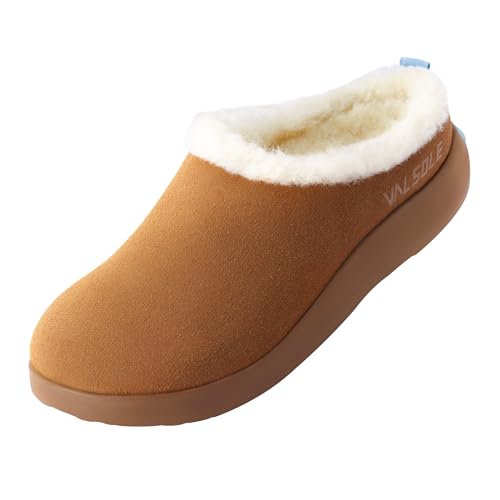
VALSOLE Orthopedic Slippers for Women and Men — Best Unisex Support
VALSOLE’s slipper is the unisex entry: arch support house shoes for women and men, positioned as comfort slippers for indoor and outdoor use. For households that buy one supportive style for everyone — or for buyers who find gendered slipper ranges limiting — a unisex design with support as its stated headline is a genuinely useful option.
One piece of wording discipline is applied to this pick in particular. The listing positions the design for heavier users with a weight line in its title. That is a positioning statement, not a tested capacity rating, so this guide notes it in the spec box as positioning and prints no number as a rating. Buyers for whom a tested figure matters should treat the listing’s own detail page as the authority.
Within those honest bounds, the VALSOLE is a sensible comfort pick: stated arch support, a house-shoe format that works indoors and for doorstep moments, and a unisex fit.
Strengths
- Unisex positioning makes it the household pick — one style for everyone, in a category usually split by gender
- Arch support is stated as the headline feature, in a comfort slipper format
- Indoor-outdoor positioning covers the doorstep trips house slippers actually make
Trade-offs
- The listing’s weight positioning is a marketing line, not a tested capacity — this guide does not print it as a rating
- Unisex fits are compromises by nature; very narrow or very wide feet should check the listing’s sizing carefully
| Support | Arch support house shoes (as listed) |
| Fit | For women and men (as listed) |
| Use | Comfort slippers for indoor outdoor (as listed) |
| Weight note | Listing positions the design for users of 220+ lbs; no capacity rating is printed in this guide |
| Style | House shoes |
Best for: Households wanting one unisex supportive house slipper style for everyone / Not suited for: Buyers needing a tested capacity figure or a precisely gender-specific fit
Check on Amazon to see the current listing, size and color options, and delivery details for this pick.

ONCAI Men’s Slippers with Arch Support — Best Men’s Warm Support
The ONCAI closes the guide with the men’s warm-support combination: a bedroom house shoe whose listing states arch support and memory foam in a warm, cozy design for indoor and outdoor use. Like the COFACE on the women’s side, it refuses to choose between cushioning and support, and for men in cold homes that combination is the hardest to find in this category.
The format is deliberately simple — a slip-on house shoe in black, warm-lined, with the support features stated rather than dramatized. For the man who wants his winter slippers to feel structured rather than shapeless, without moving to a full orthopedic-style shoe, this is the middle path the guide was looking for.
On stated comfort construction, the ONCAI completes a list that covers the category’s realistic options.
Strengths
- Pairs stated arch support with memory foam — the support-plus-cushion combination in a men’s winter slipper
- Warm, cozy positioning suits cold floors and cold seasons, where men’s supportive options are scarcest
- A bedroom house shoe format keeps it simple: slip on, supported, warm
Trade-offs
- Warmth-first design is the wrong tool for summer or heated homes
- Memory foam’s lifespan caveat applies, as across this guide
| Support | Arch support bedroom house shoes (as listed) |
| Cushioning | Memory foam (as listed) |
| Style | Warm, cozy indoor outdoor (as listed) |
| Fit | Men’s slipper sizing as listed |
| Color | Black |
Best for: Men in cold homes wanting warmth plus stated arch support and memory foam cushioning / Not suited for: Summer use, hot feet, and buyers wanting a minimalist flat slipper
Check on Amazon to see the current listing, size and color options, and delivery details for this pick.
Comparison Table
The table compares stated comfort construction only: arch support as listed, cushioning as listed, fit features as listed. It contains no health claims, because the listings’ construction descriptions are what a buyer can actually verify.
| Pick | Badge | Key spec | Best for |
|---|---|---|---|
| Vionic Women’s Indulge Carlin Flannel Mule Slipper | Best Structured Insole | Three-Zone Comfort with orthotic insole arch support (as listed); flannel mule | Women who want a shaped, arch-supporting insole inside a soft house mule for everyday home comfort |
| Orthofeet Charlotte Women’s Slippers (Taupe) | Best Adjustable Fit | Adjustable slip-on; arch support; wide toe box (as listed) | Women who want an adjustable, wide-toe-box fit with stated arch support for all-day home wear |
| Orthofeet Asheville Men’s House Slippers (Brown) | Best Men’s Structured Fit | Adjustable slip-on; arch support; wide toe box (as listed) | Men who want stated arch support, an adjustable fit and toe room in an all-day house slipper |
| COFACE Women’s Memory Foam Slippers with Arch Support | Best Warm Support Combo | Memory foam plus arch support (as listed); hard rubber sole; faux fur collar | Women wanting warm, cushioned slippers with stated arch support and a hard sole for hard floors |
| VALSOLE Orthopedic Slippers for Women and Men | Best Unisex Support | Arch support house shoes (as listed); unisex; indoor outdoor comfort | Households wanting one unisex supportive house slipper style for everyone |
| ONCAI Men’s Slippers with Arch Support | Best Men’s Warm Support | Arch support (as listed); memory foam; warm cozy house shoes | Men in cold homes wanting warmth plus stated arch support and memory foam cushioning |
How to Read Support Claims on a Slipper Listing
A supportive slipper listing can be read in layers, and only the bottom layer is evidence. The top layer is adjectives — soothing, therapeutic, doctor-inspired — which describe intentions. The middle layer is condition language, which this guide treats as marketing and does not repeat. The bottom layer is construction: arch support named, an insole system named, cushioning described, a toe box width stated, an adjustable closure specified. Construction can be checked against the product when it arrives; adjectives cannot.
All six picks in this guide were chosen from that bottom layer, and their reviews quote it. When you shop beyond this list, perform the same reduction: cross out the adjectives mentally, find the construction sentences, and compare those. A listing with no construction sentences has told you it is a soft slipper with ambitious copy, which may still be a fine slipper — but it is not a supportive one.
Supportive Slippers and the Rest of Your Foot Care
House slippers are one input among several in how feet feel at home, and usually not the largest. Time spent barefoot or in socks on hard floors, the shoes worn outside the house, activity levels and individual anatomy all matter more than any single product category. That perspective is worth keeping when a listing implies a pair of slippers will transform a condition: the honest claim for the picks here is narrower and more useful — they are the supportive end of house footwear, chosen on stated construction, for comfort during time at home.
If foot discomfort is part of your life, the genuinely helpful sequence is professional advice first and product choices second, made with that advice in hand. This guide’s role is to make the second step well-informed: what the features are, which listings state them, and where the marketing ends and the construction begins.
What ‘Arch Support’ Actually Means in a Slipper
The phrase covers a range of constructions, and knowing the range helps you read listings — including the six here — accurately. At the structured end, a slipper is built around a shaped insole: a footbed molded with a defined arch contour, sometimes named as a comfort system, as the Vionic listing does. In the middle, a foam footbed is cut or padded to create an arch rise, which is the construction behind most ‘arch support’ house shoes. At the light end, the phrase describes a firmer midfoot section in an otherwise soft slipper.
None of these is a medical device, and the differences between them are comfort differences, not treatment grades. What a buyer can verify is which construction a listing describes — named insole system, contoured footbed, or a bare claim with no construction behind it. This guide selected from the first two kinds and treated the third as insufficient evidence, which is the same standard you can apply to any listing in the category.
Firmer is not automatically better, either. A pronounced contour in the wrong place, or in the wrong size, is worse than a gentle one that matches your foot. That is why the fitting guide in this article emphasizes locating the support with your own arch before judging — construction quality and personal fit are separate questions, and both have to pass.
Hard Floors at Home: The Context Behind This Search
Most people who type this query share an environment: homes with hard floors and long hours spent on them, often barefoot or in flat slippers. Whatever the state of anyone’s feet, a flat, worn-out slipper on tile or hardwood offers the foot nothing — no cushioning, no shape, no grip. Replacing that with a cushioned, contoured, well-fitting house slipper is a straightforward comfort upgrade to the hours spent at home, and framing it that way keeps expectations where the evidence is.
It is also worth auditing the rest of the home environment with the same plain eyes. The shoes worn outdoors, time spent standing on hard kitchen floors, and worn-out everyday footwear all shape daily comfort at least as much as house slippers do. Supportive slippers are the easiest single change — they are comparatively inexpensive and they cover the hours at home — but they are one change among several, and any source telling you otherwise is selling something.
If discomfort is significant or persistent, that audit is a complement to professional advice, never a substitute for it. A clinician can identify causes that no product comparison can see, and can advise on footwear with your specific feet in mind.
How the Picks Divide: Structured Brands Versus Comfort-Led Designs
This guide’s six picks fall into two families, and choosing between the families is the real decision. The structured family — Vionic and the two Orthofeet designs — builds the slipper around support: named insole systems, stated arch support, fit engineering like adjustable closures and wide toe boxes. These feel more like supportive shoes that happen to be slippers, and they suit buyers who want maximum structure at home.
The comfort-led family — COFACE, VALSOLE and ONCAI — starts from the house slipper and adds stated arch support to memory foam, warmth and plush formats. These feel like slippers first, with support as a genuine but secondary character. They suit buyers who found structured designs too firm or too shoe-like, or whose priority is warmth and softness with more shape than a basic slipper offers.
Neither family is the correct one in the abstract. The structured family asks for an adjustment period and rewards it with shape that lasts; the comfort-led family is immediately familiar and asks less. Your history with footwear — whether firm footbeds have felt good or intrusive — is the best predictor, and the graduated fitting routine in this guide will confirm the choice within the returns window.
Setting Expectations: A Plain-Language Summary
Everything in this guide reduces to a few plain sentences, and they are worth gathering in one place. These six slippers were chosen because their listings state arch support and cushioning as construction. Structured models — the Vionic’s named insole system, the Orthofeet pair’s adjustable fits and wide toe boxes — offer the most shape; comfort-led models — COFACE, VALSOLE, ONCAI — offer support inside softer, warmer slipper formats. All of them are house footwear for comfort during time at home.
Readers with foot pain deserve both halves of that honesty: real information about what these products are, and a clear statement of what they are not.
If you take one action beyond buying a pair, make it the fitting routine: right size, arch located under your own arch, graduated wear over the first days, and an exchange rather than endurance if the fit is wrong. And if pain is part of the picture, make the clinician appointment the first action of all. Comfort at home is a legitimate goal; it is simply not the same goal as treatment, and keeping the two separate is what makes this guide trustworthy.
A Final Word on Sources and Transparency
That record exists so that the line this guide drew can be audited: the titles say what they say, the article claims only comfort and construction, and the difference between the two is visible to anyone who wants to check. In a category where marketing and medicine are routinely blurred, that auditability is not bureaucratic; it is the substance of the guide’s trustworthiness.
If you arrived here in pain, the kindest accurate closing is this: supportive, well-fitting house slippers are a reasonable comfort purchase, the six above are the verified shortlist, and a clinician is the right address for the pain itself. Both things can be true at once, and a guide that respects its readers will say both.
Key Takeaways, in Comfort Terms Only
Chosen on construction, these six slippers state arch support and cushioning in their listings; the structured brands add named insole systems, adjustable fits and wide toe boxes, while the comfort-led designs add support to memory foam and warmth. Fit decides whether any of it works: right size, the support located under your own arch, graduated wear, and an exchange when the match is wrong. That is the complete, honest summary of what house slippers can offer — comfort, chosen carefully, for the hours you spend at home.
How to Get the Fit Right in Supportive House Slippers
Support features only work when the slipper fits — an arch support in the wrong place is just a lump. This fitting routine applies to every pick in this guide and takes one evening.
- Order using the listing’s own sizing information, and if you are between sizes, follow the listing’s guidance rather than a generic rule — structured footbeds are less forgiving of a wrong size than soft foam slippers.
- Try them on in the evening, when feet are at their largest, wearing the socks you will normally wear at home.
- Stand still and locate the arch support with your foot: it should meet the arch of your foot, not sit under the heel or the ball. If it feels misplaced, the size is wrong, however comfortable the length seems.
- Walk your hardest floors and your stairs. The footbed should feel present but not intrusive, and the heel should stay in the slipper without gripping with your toes.
- Wear them for short periods over the first days — an hour, then a morning, then a day. Structured footbeds feel different from flat slippers, and a gradual introduction tells you whether the difference is adjustment or a genuine mismatch.
- If you use prescribed orthotics or have a diagnosed foot condition, take the slipper question to your clinician, who knows your feet; this guide compares retail comfort features and does not substitute for that advice.
Keep the returns window in mind while you test. A supportive slipper that does not fit your arch is the wrong slipper for you, whatever its listing says, and the honest outcome is an exchange — not perseverance.
Common Buying Mistakes
Expecting slippers to treat a foot condition. The most important mistake to avoid, so it comes first: slippers are comfort footwear. They do not treat plantar fasciitis or any other condition, and any listing or article implying a cure is overpromising. See a clinician for pain; choose slippers for comfort.
Believing medical wording in a product title. Some listings in this category load their titles with condition language. Read titles as marketing and specifications as information.
Buying flat fashion slippers and hoping for support. A flat foam pad has no arch to support anything. If support is the brief, the listing must state arch support or a structured insole — as all six picks here do.
Judging a structured footbed in the first minute. Contoured insoles feel firmer and stranger than plush foam at first touch. Judge over days of graduated wear, as the fitting guide above describes, before concluding.
Ignoring the toe box. Support that squeezes the toes trades one discomfort for another. Two picks here state a wide toe box; if your feet need room, that stated feature should rank high in your choice.
Wearing supportive slippers outdoors as shoes. These are house slippers, some with soles positioned for doorstep moments. They are not walking shoes, and treating them as such wears them out and misuses their design.
Final Recommendation
Choose by construction. The most structured insole story belongs to the Vionic Carlin, whose listing names its comfort system and arch support outright. The best fit engineering belongs to the Orthofeet pair — the Charlotte for women and the Asheville for men — with adjustable, hands-free designs and stated wide toe boxes. The best combinations of cushioning plus support are the COFACE for women and the ONCAI for men, both warm winter formats, and the VALSOLE covers households that want one unisex style.
And hold the frame this guide opened with: these are comfort choices for time at home, compared on features their listings state. They are not treatments, and no honest guide will present them as such. For pain, see a clinician. For supportive, cushioned house footwear chosen with open eyes, the six above are the verified shortlist.
Keep exploring the same cluster: Best Arch Support Slippers Mens Best Arch Support Womens Slippers Best Arch Support Indoor Slippers Best Anti Fatigue Slippers Best Comfy Womens Slippers With Support Best Slippers Not Leather
Frequently Asked Questions
Do these slippers treat plantar fasciitis?
No. Slippers are comfort footwear, not medical devices, and they do not treat plantar fasciitis or any other condition. This guide compares stated comfort features — arch support, cushioning, fit — for people who want supportive house slippers. If you have foot pain or a diagnosis, consult a clinician about treatment and about footwear choices for your situation.
What comfort features should I look for in house slippers?
Arch support stated on the listing, real cushioning, a footbed with some structure rather than a flat pad, a fit that holds the heel, room in the toe box, and a sole with grip for hard floors. All six picks here state arch support; the reviews detail each one’s construction in the listing’s own terms.
Why does this guide not repeat some words from the product titles?
Some listings include medical wording in their titles. That wording is marketing language aimed at conditions, and this site does not make medical claims about footwear.
Are structured insoles supposed to feel firm?
Generally, yes — a contoured insole with arch support feels firmer than a plush foam pad, and that firmness is how it holds its shape. Most wearers adjust over several days of graduated wear. Pain or worsening discomfort is different from adjustment: stop and, if it persists, talk to a clinician.
Can I wear these slippers outside the house?
They are house slippers. Some listings position their soles for indoor and outdoor moments like doorsteps and patios, but none of these picks is a walking shoe, and regular outdoor use will wear them quickly and void the assumptions behind their comfort design.
How long will the cushioning and support last?
Memory foam elements compress gradually under daily use, while structured insoles generally hold their shape longer. Either way, supportive slippers are wear items: when the footbed feels flat and the support is gone, replacement — not perseverance — is the right response.
Can I use my own insoles inside these slippers?
That depends on the slipper’s internal volume and the insole’s thickness, and combining products changes how both fit. If a clinician has prescribed or recommended specific insoles for you, ask them which footwear they should be used in rather than improvising combinations — and never stack an insole on top of a strongly contoured footbed without checking the fit carefully, since the result can crowd the foot and defeat both designs.
