Disclosure: airfryerkitchensupply.com is reader-supported. When you buy through links on our site, we may earn an affiliate commission at no extra cost to you.
Where to buy
This best slippers not leather guide links only to listings verified for this site. Proving a negative — that a slipper is not leather — takes more care than most buying, because listings love leather-adjacent words. Every pick below was cross-checked, and each one qualifies the same way: its verified listing states a non-leather material outright, such as cotton knit, cotton linen, linen and cotton fabric, faux suede, microsuede, or ragg wool. Listings that named no material at all were not treated as not-leather — absence of evidence is not evidence — and they were excluded or left unlinked. Use the links to check the current price on Amazon and to re-read the material wording on the listing before you buy.
- EverFoams Men’s Slippers, Cotton Knit with Memory Foam — check price on Amazon
- COCOMUSE Ultralight Open Toe Cotton Linen Women’s Slippers — check price on Amazon
- EitCaton Unisex Linen House Slippers — check price on Amazon
- HomeTop Men’s Moccasin Slippers, Faux Suede — check price on Amazon
- isotoner Men’s Microsuede Devin Clog Slippers — check price on Amazon
- Acorn Women’s Moc Slipper, Ragg Wool — check price on Amazon
The best slippers not leather should be easy to find and are not, because ‘not leather’ is a claim about what a product is not — and listings prefer to talk about what things are. This guide therefore works by positive evidence: a slipper qualifies only when its verified listing states a non-leather material in so many words. Cotton knit qualifies. Cotton linen qualifies. Faux suede and microsuede qualify, because ‘faux’ and ‘micro’ state the synthetic nature outright. Ragg wool qualifies. A listing that simply never mentions material does not qualify, however inexpensive it is, because cheap does not mean leather-free — some of the cheapest slippers on the market are leather, and some expensive ones are cloth. Price is not evidence, and this guide does not use it as evidence.
That rule shaped the six picks. There is a cotton knit memory foam slipper for men, an open-toe cotton linen slipper for women, a unisex linen and cotton fabric slipper, a men’s moccasin in explicitly faux suede, a men’s microsuede clog from isotoner, and a women’s moccasin in ragg wool. Between them they also make the positive case for non-leather materials: cotton and linen breathe, knits and wool blends warm without overheating, faux suede and microsuede deliver the suede look with wash-day simplicity, and several of these are machine washable in ways leather never tolerates.
One more honesty note that runs through every review: where a listing states a material for the upper but is silent about trims, linings or soles, the review says exactly that. The qualification in this guide is ‘the listing states a non-leather material for the slipper’ — and where total certainty about every component matters to you, the product page’s full material breakdown is the final check, as the buying guide explains.
In this guide
Quick Picks
Six slippers whose listings state a non-leather material outright — cotton knit, cotton linen, linen-cotton fabric, faux suede, microsuede and ragg wool — with the evidence quoted per pick.
- Best Cotton Knit for Men: EverFoams Men’s Slippers, Cotton Knit with Memory Foam — The listing states cotton knit outright — a breathable, machine washable men’s slipper with memory foam. Check the current price on Amazon.
- Best Cotton Linen for Women: COCOMUSE Ultralight Open Toe Cotton Linen Women’s Slippers — The listing states cotton linen — an ultralight open-toe indoor slipper with a cloth bottom for warm-weather house wear. Check the current price on Amazon.
- Best Linen-Cotton Unisex: EitCaton Unisex Linen House Slippers — The listing states linen and cotton fabric — a breathable open-toe unisex slipper with memory foam and a non-slip sole. Check the current price on Amazon.
- Best Faux Suede for Men: HomeTop Men’s Moccasin Slippers, Faux Suede — The listing states faux suede — a men’s memory foam moccasin with the suede look and none of the leather. Check the current price on Amazon.
- Best Microsuede Clog: isotoner Men’s Microsuede Devin Clog Slippers — The listing states microsuede — a men’s slip-on clog with memory foam comfort, for indoor and outdoor use. Check the current price on Amazon.
- Best Wool for Women: Acorn Women’s Moc Slipper, Ragg Wool — The listing states ragg wool — a women’s moccasin slipper with memory foam and an indoor-outdoor sole. Check the current price on Amazon.
How These Picks Were Chosen
Verification used Amazon listing data for airfryerkitchensupply.com: brand-and-model searches, titles matched to API responses, ASINs taken from those responses, and size or color variants of one slipper counted as a single product.
The test: the verified listing title must state a material that is not leather. Accepted evidence included named plant and textile materials (cotton knit, cotton linen, linen, cotton fabric, ragg wool) and explicitly synthetic suede alternatives (faux suede, microsuede). Rejected: listings with no material stated, listings whose material was ambiguous, and — importantly — genuine suede and genuine leather listings, which this category contains in surprising numbers and which look identical in thumbnails to their faux counterparts.
We also refused two common shortcuts. First, price: a low price was never treated as proof of a non-leather material, because inexpensive genuine suede slippers exist in this market. Second, brand assumptions: no maker was assumed leather-free across its range, because most slipper brands sell leather and non-leather lines side by side. Each pick stands on its own listing’s words, quoted in its review.
The 6 Best Slippers Not Leather — Verified by Material
Each review quotes the material evidence from the verified listing before discussing comfort, because in this category the material is the brief. Comfort features are credited only where the listing states them, as everywhere in this guide.

EverFoams Men’s Slippers, Cotton Knit with Memory Foam — Best Cotton Knit for Men
Start with the evidence, because that is this guide’s method: the listing names these ‘Cotton Knit’ slippers. Cotton is a plant textile, not leather, and the claim needs no inference, no price reasoning and no brand assumption. For a man who wants a not-leather slipper with zero ambiguity, this is the cleanest qualification in the guide.
The slipper behind the evidence is well matched to the material. Cotton knit is breathable and soft, the memory foam supplies the cushioning, and the listing states machine washability and a non-slip sole in a lightweight house slipper. Leather’s traditional selling points — structure and patina — are traded for airflow and laundry, which for house footwear is usually the right trade.
Know the knit compromise: it wraps rather than holds, and it will not warm a cold floor in January the way the wool pick below will. As the breathable, washable, unambiguously cotton answer for men, it leads this list on the strength of the clearest evidence and the most practical care story.
Strengths
- The material evidence is unambiguous: ‘cotton knit’ is in the product’s own name on the listing, not inferred
- Cotton knit breathes better than leather or suede uppers, suiting warm feet and warm rooms
- Machine washable — a care option leather uppers do not offer
Trade-offs
- Knit uppers are less structured than leather; the fit is a soft wrap, not a shoe-like hold
- Cotton knit is a warm-weather-to-mild material; deep-winter warmth seekers should look at the ragg wool pick
- As with all picks here, the listing’s material statement covers the slipper as described; check the product page for a full component breakdown if you need one
| Material evidence | Cotton knit — stated in the listing title |
| Cushioning | Memory foam (as listed) |
| Care | Machine washable (as listed) |
| Sole | Non-slip (as listed) |
| Use | House use; lightweight (as listed) |
Best for: Men who want an unambiguous cotton, not-leather slipper that breathes and washes / Not suited for: Men who want a structured leather-like hold or deep-winter warmth
Check on Amazon to see the current listing, size and color options, and delivery details for this pick.

COCOMUSE Ultralight Open Toe Cotton Linen Women’s Slippers — Best Cotton Linen for Women
The evidence first: these are ‘Cotton linen’ slippers by name on the verified listing. Linen and cotton are both plant textiles, so the not-leather qualification is direct. The design that follows from those materials is a warm-weather specialist: an ultralight, open-toe indoor slipper with a cloth bottom, described as sweat-absorbing — the slipper equivalent of a linen shirt, built for air.
That specialization defines its best use. In a warm home, a hot climate or a summer season, closed foam slippers become unbearable by mid-morning, and an open cotton-linen slipper is what feet actually want. The cloth bottom keeps it silent and floor-friendly, suited to apartments and delicate wood.
The limits are the mirror of the virtues: cloth bottoms wear faster and grip less than rubber soles, open toes warm nothing, and natural absorbent fibers ask for regular washing. Bought as the warm-weather, plant-fiber answer — with the evidence printed in its name — it is exactly right.
Strengths
- Cotton linen is stated in the name — plant-fiber evidence with no interpretation required
- The open-toe, ultralight design is the coolest-wearing option in this guide, for warm homes and warm seasons
- A cloth-bottom indoor slipper is quiet and gentle on delicate floors
Trade-offs
- A cloth bottom is an indoor-only, low-mileage sole — it is not the pick for stairs-heavy or high-traffic homes
- Open toes mean minimal warmth and minimal coverage
- Absorbent natural fibers need regular washing to stay fresh
| Material evidence | Cotton linen — stated in the listing title |
| Design | Open toe; ultralight soft indoor slipper (as listed) |
| Sole | Cloth bottom (as listed) |
| Use | Indoor house slippers (as listed) |
| Feature | Absorb sweat (as listed) |
Best for: Women in warm homes or seasons who want a plant-fiber, open-toe house slipper / Not suited for: Cold floors, high-traffic homes, and anyone needing a durable rubber sole
Check on Amazon to see the current listing, size and color options, and delivery details for this pick.

EitCaton Unisex Linen House Slippers — Best Linen-Cotton Unisex
EitCaton’s slipper states its materials twice over: ‘Linen’ in the name and ‘Cotton Fabric’ in the listing’s own description. Both are plant textiles, so the not-leather evidence is as explicit as this category offers. What distinguishes this pick from the COCOMUSE above is the underfoot story: memory foam cushioning and a non-slip sole, in a breathable open-toe design that is also machine washable.
That combination makes it the natural-fiber all-rounder of this guide. The COCOMUSE is lighter and more minimal; this one adds the cushioning and grip that a full day of house wear asks for, while keeping the breathability that is the whole point of choosing linen and cotton over leather or synthetics.
It remains a warm-leaning design — open toes are open toes — and natural fibers will soften with washing, which most wearers read as comfort rather than decline. For a unisex, plant-fiber, cushioned house slipper with the materials printed on the listing, this is the guide’s most complete package.
Strengths
- Two plant materials are stated — linen in the name and cotton fabric in the description — making the evidence doubly explicit
- Unlike the cloth-bottom pick above, this one pairs natural fibers with memory foam and a non-slip sole
- Unisex sizing suits households buying one style for everyone
Trade-offs
- Open-toe design limits warmth and coverage, as with any summer-leaning slipper
- The listing also positions it for casual outdoor moments; treat it as a house slipper first, per this guide’s standard
- Natural-fiber uppers soften and fade with washing over time
| Material evidence | Linen; cotton fabric — stated in the listing title |
| Cushioning | Memory foam (as listed) |
| Design | Open-toe; breathable (as listed) |
| Sole | Non-slip (as listed) |
| Care | Machine washable (as listed) |
Best for: Households wanting one unisex plant-fiber slipper with real cushioning and grip / Not suited for: Cold-season warmth and closed-toe coverage
Check on Amazon to see the current listing, size and color options, and delivery details for this pick.

HomeTop Men’s Moccasin Slippers, Faux Suede — Best Faux Suede for Men
Suede is where not-leather shopping gets treacherous, because genuine suede and faux suede are visually identical in listing photos and this market sells both at similar tiers. The HomeTop moccasin resolves the question in its own words: the listing states ‘Faux Suede’. Faux means synthetic by definition, so the qualification is explicit — the suede look, with the material honestly named as the alternative it is.
The slipper itself is a complete men’s moccasin: memory foam, a warm plush lining, a non-slip rubber sole and machine washability. That last feature underlines the practical case for faux materials — a genuine suede moccasin fears water; this one goes in the wash. For many buyers the not-leather choice is not a compromise at all, and this pick is the evidence.
One precision note, in keeping with this guide’s method: the faux suede statement sits in the listing’s description of the shoe, and a buyer who needs every component certified should read the product page’s full materials section. What the listing states is clear, and it is what this recommendation rests on.
Strengths
- ‘Faux suede’ states the synthetic nature in plain words — the suede appearance without animal leather
- A rubber sole and plush lining make it a complete winter-capable moccasin, not a token alternative
- Machine-washable per the listing, which genuine suede moccasins generally are not
Trade-offs
- The faux suede wording appears in the listing’s description of the upper and sole package; buyers wanting a component-by-component breakdown should confirm on the product page
- Faux suede will not age or patina like genuine suede — it stays uniform, which some buyers prefer and some miss
- A plush-lined moccasin is a cool-season design
| Material evidence | Faux suede — stated in the listing description |
| Cushioning | Memory foam (as listed) |
| Style | Moccasin slippers (as listed) |
| Sole | Non-slip rubber sole (as listed) |
| Lining | Warm plush lining (as listed) |
Best for: Men who want the suede moccasin look with the material stated as faux, plus washable practicality / Not suited for: Buyers who specifically value genuine suede’s aging and feel — who should not be shopping this search
Check on Amazon to see the current listing, size and color options, and delivery details for this pick.
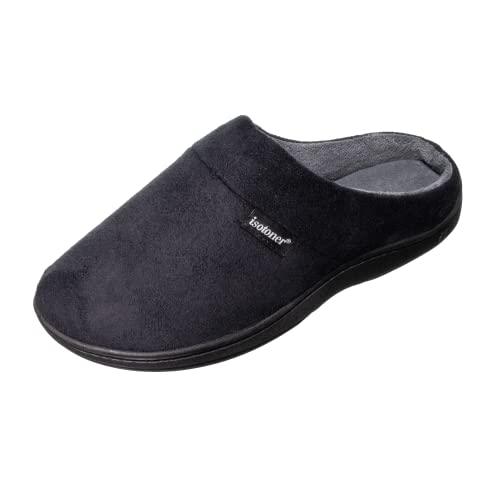
isotoner Men’s Microsuede Devin Clog Slippers — Best Microsuede Clog
Microsuede makes the evidence easy: it is a synthetic microfiber material, and isotoner names it in the product’s title — ‘Microsuede Devin Clog’. There is no leather reading of the word microsuede, which is precisely why it belongs in this guide. Buyers who find ‘faux’ wording ambiguous can treat this pick as the category’s most self-explanatory material claim.
As a slipper, the Devin is the convenience pick: a slip-on clog with memory foam comfort, positioned for indoor and outdoor use. It is the pair that lives by the desk or the door, on in a second for every household trip, off just as fast. isotoner’s long history in slippers shows in that focus — nothing extraneous, the brief executed plainly.
The clog caveats apply: open backs and stairs are a cautious combination, and microsuede’s nap wants occasional attention to look its best. For the man whose priority is an unambiguous material in the easiest format, those are small prices.
Strengths
- Microsuede is a synthetic microfiber by definition, and it is named in the product title itself — top-tier evidence
- The clog format is the easiest on-and-off in this guide, for men who slip footwear off at the desk
- isotoner is a long-standing slipper specialist, and memory foam comfort is stated on the listing
Trade-offs
- An open clog is less secure on stairs than closed-back designs
- Microsuede’s fine nap shows dust and needs a brush or wash to stay smart
- Less warm than the lined moccasin picks — a mild-weather and warm-foot design
| Material evidence | Microsuede — stated in the listing title |
| Cushioning | Memory foam comfort (as listed) |
| Design | Slip-on clog (as listed) |
| Use | Indoor/outdoor (as listed) |
| Brand | isotoner |
Best for: Men who want the material claim in the product name itself, in an easy slip-on clog / Not suited for: Stair-heavy homes and deep-winter warmth needs
Check on Amazon to see the current listing, size and color options, and delivery details for this pick.

Acorn Women’s Moc Slipper, Ragg Wool — Best Wool for Women
The final material in this guide’s evidence set is wool: Acorn’s women’s moc is listed in ‘Dark Charcoal Heather Ragg Wool’, with the material carried in the colorway name itself. Ragg wool is a textile — traditionally a wool blend yarn used in cold-weather socks and mittens — and it gives this slipper the warmest natural-fiber profile in the guide, with memory foam underfoot and an indoor-outdoor sole.
Wool earns its place on properties, not just on the not-leather technicality. It warms without the clamminess synthetics can produce, regulates temperature across a day, and suits the cold-floor season that cotton and linen picks cannot serve. Paired with a moccasin fit that stays on, this is the winter answer in a guide whose other materials lean warm-weather.
Two honest notes: ragg wool is generally a blend, and the listing’s exact fiber percentages live on the product page for buyers who need them; and wool’s warmth is a liability for hot feet in heated rooms. Within its season, it completes the material range this search asks for — cotton, linen, faux suede, microsuede and wool, each stated on its own listing.
Strengths
- Ragg wool is stated in the colorway name itself — a wool-blend textile with a long history in socks and cold-weather wear
- Wool’s natural warmth regulation makes this the cold-season pick of the guide
- Memory foam and an indoor-outdoor sole complete a specification most wool slippers do not match
Trade-offs
- Wool blends can feel warm to hot-footed wearers and in heated homes
- Ragg wool is typically a blend; buyers needing the full fiber breakdown should read the product page
- The moc style is a closer fit than clogs — check the listing’s sizing guidance
| Material evidence | Ragg Wool — stated in the listing title (Dark Charcoal Heather Ragg Wool) |
| Cushioning | Memory foam (as listed) |
| Sole | Indoor outdoor sole (as listed) |
| Style | Women’s moc slipper (as listed) |
| Color | Dark Charcoal Heather |
Best for: Women wanting a warm, natural-textile slipper for the cold season with memory foam comfort / Not suited for: Hot-footed wearers, warm climates, and buyers needing an exact fiber breakdown before purchase
Check on Amazon to see the current listing, size and color options, and delivery details for this pick.
Comparison Table
The material column quotes each listing’s own words — that wording is the qualification for this guide. Where a listing qualifies a material (for example, faux suede in the sole-and-upper description), the review notes the scope honestly.
| Pick | Badge | Key spec | Best for |
|---|---|---|---|
| EverFoams Men’s Slippers, Cotton Knit with Memory Foam | Best Cotton Knit for Men | Material stated: cotton knit (as listed); memory foam | Men who want an unambiguous cotton, not-leather slipper that breathes and washes |
| COCOMUSE Ultralight Open Toe Cotton Linen Women’s Slippers | Best Cotton Linen for Women | Material stated: cotton linen (as listed); open toe; cloth bottom | Women in warm homes or seasons who want a plant-fiber, open-toe house slipper |
| EitCaton Unisex Linen House Slippers | Best Linen-Cotton Unisex | Material stated: linen, cotton fabric (as listed); memory foam; open-toe | Households wanting one unisex plant-fiber slipper with real cushioning and grip |
| HomeTop Men’s Moccasin Slippers, Faux Suede | Best Faux Suede for Men | Material stated: faux suede (as listed); memory foam moccasin | Men who want the suede moccasin look with the material stated as faux, plus washable practicality |
| isotoner Men’s Microsuede Devin Clog Slippers | Best Microsuede Clog | Material stated: microsuede (as listed); memory foam clog | Men who want the material claim in the product name itself, in an easy slip-on clog |
| Acorn Women’s Moc Slipper, Ragg Wool | Best Wool for Women | Material stated: ragg wool (as listed); memory foam moc | Women wanting a warm, natural-textile slipper for the cold season with memory foam comfort |
The Materials, Compared: Cotton, Linen, Wool, Faux Suede and Microsuede
Each qualifying material in this guide has a distinct job. Cotton knit is the breathable all-rounder: soft, washable, mild-season. Cotton linen and linen-cotton blends are the warm-weather specialists — the lightest, coolest options, in open-toe designs that treat heat as the enemy. Ragg wool is the cold-season textile, warming and temperature-regulating in a way plant fibers do not. Faux suede replicates suede’s look and soft nap in a synthetic that tolerates washing. Microsuede, its finer microfiber cousin, gives the smoothest finish and the easiest care of the suede family.
Notice what none of them does: none asks you to accept a compromise story. Leather’s real advantages — structure, longevity, patina — matter in shoes and boots worn outdoors for years. In house slippers, which live indoors, get washed, and are replaced on a foam-driven cycle anyway, the textile and synthetic materials in this guide are frequently the more rational engineering choice, independent of any preference about leather itself.
Why This Guide Rejected Listings Other Guides Would Include
Three kinds of listings were excluded, and naming them is useful because they fill the rest of the internet’s versions of this list. First, genuine suede and leather slippers with soft-focus photography that makes them look like fabric — excluded on material fact. Second, slippers with no material stated anywhere in the listing — excluded on evidence, however likely their cloth construction seemed. Third, slippers whose only ‘evidence’ was a low price — excluded on principle, because the reasoning is false and would mislead exactly the buyers this search serves.
The result is a shorter, stricter list than the category usually produces: six slippers, six quoted material statements, zero inferences.
Why People Choose Not-Leather Slippers: The Practical Cases
Buyers arrive at this search from several directions, and the practical cases are worth naming because they shape which material to choose. Some avoid leather on principle and want the evidence airtight — for them, the named textiles and the explicit ‘faux’ and ‘micro’ wordings in this guide are the point of the exercise. Some are buying for someone else and cannot risk ambiguity. Some have simply learned that leather and suede house slippers are high-maintenance indoors: they dislike water, resist washing, and show every kitchen splash.
There is also a fit-and-feel case that rarely gets stated. Textile uppers — knits especially — accommodate feet that vary: swelling through the day, bandages, thick socks in winter. A leather upper holds its shape against the foot; a knit yields to it. For house footwear worn in long, unstructured hours, yielding is often the comfort feature that matters most, and it is free with the materials in this guide.
Whatever the reason, the method stays the same: the material must be stated. A principled purchase deserves evidence, a gift deserves certainty, and a practical purchase deserves a listing honest enough to name what it is selling. The six picks meet that bar in their own words.
Care Guide: Washing and Keeping Textile Slippers
Textile slippers repay a simple care routine that leather never tolerates. Most picks in this guide state machine washability; use a gentle cycle, cold water and a wash bag if you have one, then air-dry fully away from direct heat, which warps foam and crisps fibers. Cotton and linen picks benefit from a shake and brush between washes to lift dust from the weave. Faux suede and microsuede want a soft brush to keep the nap even, and they forgive spot-cleaning better than any material here.
Rotation is care, too. A pair rested a day between wears dries fully — including the foam, which holds moisture invisibly — and lasts measurably longer than a pair worn damp into the next day. Two pairs of textile slippers in rotation will outlast two pairs worn in sequence, which is the value argument for owning more than one qualifying pair.
Store them dry, aired and out of sustained sunlight, which fades natural fibers unevenly. And retire them on cushioning, not appearance: textile uppers often look fine long after the foam beneath has finished its work.
Reading Material Labels Like an Auditor
Listings reward readers who parse precisely. ‘Cotton knit’ names a fiber and a construction. ‘Wool-like’ names an aspiration. ‘Suede’ names a leather; ‘faux suede’ names its synthetic imitation; ‘microsuede’ names a microfiber. ‘Leather’ with any softening adjective — genuine, premium, soft — is still leather. ‘Vegan leather’, where it appears in the wider market, is a synthetic by definition, but this guide preferred listings whose material words needed no glossary at all.
Scope is the second audit skill. A title may state the upper’s material while the lining, trim and sole go unmentioned. Decide in advance whether your requirement covers the whole product or the upper principally, and read the product page’s materials section with that decision in hand. If the page is silent on a component that matters to you, the correct action is to ask the seller or choose a fuller disclosure — not to round silence up to compliance.
Keep the receipts of your reasoning when the purchase matters: save the listing text at purchase time. Listings change, and the wording you relied on is the wording you may one day need to point to.
Building a Full Not-Leather Rotation From This Guide
The six picks assemble into a complete year without a single leather component claim left unverified. Warm season: the EverFoams cotton knit for men, the COCOMUSE cotton linen for women, and the EitCaton linen-cotton as the shared household pair — three plant-fiber options covering closed, open and unisex formats. Cool season: the HomeTop faux suede moccasin and isotoner microsuede clog for men, the Acorn ragg wool moc for women — warmth and the suede look, each with its material named in its listing.
Notice that the rotation logic and the evidence logic reinforce each other. Because every pick’s material is stated, a household can standardize — one style per person per season, bought in multiples, washed on the same routine — without a single purchase resting on an assumption. Standardization is where the not-leather brief stops being a per-purchase research project and becomes a settled household default.
If you extend the rotation beyond this list, extend the method with it: new candidate, material stated in the listing’s own words, scope of the statement understood, price ignored as evidence. Six picks were enough to prove the category can be shopped this way; the method scales to any listing you meet next.
A Note on Scope: What This Guide’s Evidence Covers
Precision about scope protects both buyer and guide, so it gets its own section. The material statements quoted here come from the verified listing titles and headline descriptions — the words a seller puts first. They establish the slipper’s stated material, principally its upper, in the seller’s own terms. They do not constitute a laboratory analysis, a certification, or a guarantee about components a listing never mentions, and this guide has flagged those silences wherever a pick’s statement has a visible boundary.
That is not a weakness of the list; it is the honest maximum that listing-based buying can achieve, and it is considerably more than most versions of this list attempt. Buyers whose requirement is absolute — every thread, trim and glue — should treat the product page’s full materials disclosure and, where needed, direct seller confirmation as the final step, as the verification routine in this guide advises. Everyone else can buy from these six with the evidence in front of them, which is the standard this search deserves.
Key Takeaways for Not-Leather Buyers
Evidence first, always. A slipper belongs on this list only when its own listing states a non-leather material — cotton knit, cotton linen, linen with cotton fabric, faux suede, microsuede, ragg wool — and each of the six reviews quotes that statement before discussing anything else. Price proves nothing, brand proves nothing, and silence proves nothing; three kinds of listings were excluded from this guide for exactly those failures, and the verification routine in the how-to section lets you apply the same exclusions anywhere.
Then choose the material as a material, not as an absence: cotton and linen for breathability, wool for cold-season warmth, faux suede and microsuede for the suede look with washable practicality. Bought that way — evidence for the brief, properties for the choice — not-leather slippers stop being a restriction and become what they are in this guide: a well-specified category with better answers for indoor life than leather usually offers.
How to Verify a Slipper Is Really Not Leather Before You Buy
This guide did the verification for its six picks; this routine lets you apply the same standard to any other listing in minutes, and it is worth learning because the category’s wording traps are systematic.
- Find the material in the listing’s own words. Accept named textiles — cotton, linen, wool, canvas — and explicitly synthetic terms: faux suede, faux leather, microsuede, microfiber, synthetic. If no material is stated, treat the slipper as unverified, not as leather-free.
- Watch the suede trap specifically. ‘Suede’ alone means genuine suede, which is leather. Only ‘faux suede’ or ‘microsuede’ clears this search — the difference is one word, and it is the whole decision.
- Never infer from price. Inexpensive genuine suede and leather slippers exist in this market, and premium-priced cloth slippers exist too. Price is evidence of nothing about material.
- Never infer from brand. Most slipper brands sell leather and non-leather lines side by side; a brand’s other products tell you nothing about the listing in front of you.
- Check what the material statement covers. A title may name the upper material while trims or linings go unmentioned. If every component matters to you, read the product page’s full materials section and, if it is silent, ask the seller rather than assuming.
- Be wary of leather vocabulary used loosely: ‘leather-like’, ‘leather feel’ and ‘premium leather texture’ describe imitations in some listings and are ambiguous in others. Ambiguous means unverified — move on to a listing that states its material plainly.
When in doubt, choose the listing that states more. In this category, a seller who names the material precisely has done the work for you; a seller who hides behind adjectives has told you something too.
Common Buying Mistakes
Assuming cheap means leather-free. The most persistent error in this category. Genuine suede slippers are sold at value tiers in this market; price cannot certify a material, and this guide rejected that reasoning for every pick.
Reading ‘suede’ as a style word. Suede is a leather. Only the explicit alternatives — faux suede, microsuede — qualify as not leather, which is why two picks here carry those exact words in their listings.
Trusting a brand’s whole range. A maker’s cotton slipper does not make its suede slipper cotton. Verify per listing, per product, every time — the method used for all six picks above.
Accepting silence as consent. A listing that never mentions material has not told you the slipper is leather-free; it has told you nothing. Silence excluded several candidates from this guide.
Ignoring trims and linings. An upper can be cotton while a trim is not stated. If your requirement covers the whole product, the full materials section on the product page is the final authority, not the title.
Overlooking the positive case. Not-leather is not a lesser category: cotton and linen breathe, knits and wool regulate warmth, faux suede and microsuede wash and wear evenly. Buy the material for its properties, not as a reluctant substitute.
Final Recommendation
Choose by material first, because that is the keyword, then by season. Warm weather and warm homes: the EverFoams cotton knit for men, the COCOMUSE cotton linen for women, or the EitCaton linen-cotton unisex with the strongest underfoot specification of the three. The suede look without the leather: the HomeTop faux suede moccasin for men, or the isotoner microsuede clog where the material is named in the title itself. Cold season: the Acorn ragg wool moc for women, the warmest natural textile here.
Shop beyond this list with the verification routine in this guide, and the not-leather brief stays exactly as honest as it should be.
Keep exploring the same cluster: Best Slippers Inexpensive Best Slippers For Working From Home Best Allday Comfort Slippers Best Comfy Womens Slippers Best Breathable Slippers Women Best Slippers Shoes For Plantar Fasciitis
Frequently Asked Questions
How can I be sure a slipper is not leather?
By positive evidence: the listing states a non-leather material — cotton, linen, wool, faux suede, microsuede or another named textile or synthetic. Every pick in this guide qualifies that way. A listing that states no material is unverified, and price or brand reputation cannot substitute for the statement.
Is suede leather?
Yes — genuine suede is a form of leather. That is why this guide only includes suede-look picks whose listings say ‘faux suede’ or ‘microsuede’, which are synthetic materials. The single word ‘faux’ or the prefix ‘micro’ is the entire difference, and it is why the verification section of this guide dwells on it.
Is faux leather acceptable for this search?
Faux leather is not leather — it is a synthetic — so it satisfies the literal brief. This guide’s six picks happen to be textiles and synthetic suedes rather than faux leather, because those were the strongest verified matches; a listing that states ‘faux leather’ plainly would qualify on the same evidence rule.
Are non-leather slippers less durable than leather ones?
Not categorically. Cotton and linen uppers wear differently from leather — they soften rather than patina — and faux suede and microsuede are notably easy to maintain and wash. The picks here pair their materials with memory foam and real soles, and several are machine washable, which leather uppers generally cannot claim.
Does ‘wool-like’ mean the slipper is wool?
No — ‘wool-like’ describes appearance and feel, and this guide does not treat it as a material claim. The wool pick here, the Acorn moc, states ‘Ragg Wool’ on its listing; that is the standard of evidence to look for, and fiber percentages, where they matter, are on the product page.
What about the soles and linings — are they covered by the material claims?
The claims quoted here are the listings’ material statements for the slippers as described, centered on the uppers. Soles on these picks are rubber, cloth or indoor-outdoor compounds as noted per review. If your requirement covers every component, read the full materials breakdown on the product page before ordering — the verification routine in this guide walks through it.
Are these slippers suitable for people avoiding all animal products?
The uppers’ materials are stated as textiles or synthetics on each listing, which is the evidence this guide verified. A strict requirement can extend to components listings rarely detail — adhesives, trims, dyes — and no listing-based guide can certify those. Buyers with an absolute standard should confirm the full composition with the seller for the specific listing, using the material statement quoted here as the starting point.
Can textile slippers handle a household with pets?
Generally better than leather does. Textiles tolerate the washing that pet households need more often, pet hair brushes off knits and microsuede more readily than it releases from some leathers, and a claw snag in a knit is a cosmetic event rather than a tear in a hide. Choose the machine-washable picks here, keep a brush by the door for the nap fabrics, and the not-leather brief and the pet household turn out to be natural allies.


