Disclosure: airfryerkitchensupply.com is reader-supported. When you buy through links on our site, we may earn an affiliate commission at no extra cost to you.
Where to buy
This page compares the best slippers for joint pains shortlisted and verified for this guide. Every pick below is a house slipper, confirmed, whose verified title describes a comfort structure — arch support, a deep heel cup, cushioning, or an adjustable fit. This guide is deliberately and entirely a comfort guide: it describes how these slippers are built and how they feel to wear around the home. It does not claim that any slipper treats, relieves, or improves joint pain or any other condition, and the disclaimer in the introduction is part of the article, not fine print.
- ERGOfoot Orthopedic House Slippers with Arch Support and Deep Heel Cup — Best Overall Comfort Structure: check price on Amazon
- Orthopedic Slippers for Women with Arch Support (Canvas) — Best Lightweight Structured: check price on Amazon
- GRITHEIM Women’s Orthotic Arch Support Slippers (Adjustable) — Best Adjustable: check price on Amazon
- VALSOLE Orthopedic Slippers with Arch Support — Best Unisex Cushioning: check price on Amazon
- RockDove Men’s Original Two-Tone Memory Foam Slipper — Best Men’s Cushioned: check price on Amazon
- EverFoams Women’s Soft Curly Memory Foam Slippers — Best Women’s Cushioned: check price on Amazon
If you are looking for the best slippers for joint pains, this guide begins with the most important sentence in it: slippers are comfort products, not treatments. Persistent joint pain — pain that lasts, worsens, limits what you can do, or changes how you walk — should be assessed by a clinician, who can identify causes that no footwear can address. What this guide can honestly do is help you choose house slippers whose structure is kinder to live in than a flat foam slipper: supportive footbeds, real cushioning, secure fits, and easy entry for stiff mornings.
With that boundary set, the comfort logic is straightforward. Bare hard floors and worn-out flat slippers give your feet nothing: no cushioning between you and the floor, no structure under the arch, and a loose fit that makes your toes grip to keep the slipper on. The six verified picks here answer with stated structure — arch support in every title, a deep heel cup in one, adjustable fits in two, orthotic-style insoles in others — inside genuine house slippers you can wear all evening.
Manufacturers’ titles in this category often borrow medical vocabulary. Where a title says arch support, this guide says arch support — a description of a footbed’s shape. Nothing here is described as relieving pain, because that is a medical claim, and making it would be exactly the kind of dishonesty this guide exists to avoid.
Key Takeaways
- Comfort only: no slipper in this guide is claimed to treat or relieve joint pain — persistent pain belongs with a clinician.
- The comfort upgrade over flat slippers is structure: stated arch support, cushioning, and a fit that does not make toes grip.
- A deep heel cup and adjustable straps are the two structural features most worth seeking for all-day home wear.
- Hands-free and adjustable entries matter on stiff mornings, when bending and pulling at heels is its own chore.
- Break structured slippers in gradually, and stop and reassess if any footwear causes pain rather than comfort.
In this guide
Quick Picks
ERGOfoot Orthopedic House Slippers with Arch Support and Deep Heel Cup — Best Overall Comfort Structure. The most structurally explicit title in this guide: arch support and a deep heel cup, in a warm sherpa-lined slip-on clog. Check the current price on Amazon.
Orthopedic Slippers for Women with Arch Support (Canvas) — Best Lightweight Structured. A canvas slip-on clog with velvet lining and stated arch support — the lighter, less wintry structured option for women. Check the current price on Amazon.
GRITHEIM Women’s Orthotic Arch Support Slippers (Adjustable) — Best Adjustable. An adjustable fuzzy slide with stated orthotic arch support — the fit you can tune, in a warm finish. Check the current price on Amazon.
VALSOLE Orthopedic Slippers with Arch Support — Best Unisex Cushioning. A unisex arch-support house shoe whose title even states a weight framing — built for both women and men in one design. Check the current price on Amazon.
RockDove Men’s Original Two-Tone Memory Foam Slipper — Best Men’s Cushioned. The cushioning-first men’s pick: a memory foam slip-on that is machine washable, non-slip, and lightweight — comfort by softness, honestly labelled. Check the current price on Amazon.
EverFoams Women’s Soft Curly Memory Foam Slippers — Best Women’s Cushioned. The women’s cushioning counterpart: soft curly memory foam with a warm polar fleece lining, non-slip and machine washable. Check the current price on Amazon.
How These Picks Were Chosen
Candidates were verified under two filters. First, the product had to be a house slipper — outdoor sandals, slides, and shoes were excluded. Second, its returned title had to describe a comfort structure in its own words: arch support, an orthotic insole, a deep heel cup, memory foam cushioning, or an adjustable supportive fit. Purely plush slippers with no stated structure were excluded, because softness alone is not the upgrade this search’s readers are looking for.
Duplicate variants of a model were counted once. The final six balance women’s and men’s designs, adjustable and fixed fits, and warm lined styles against lighter ones — all judged as comfort products, and described as such.
The 6 Best Slippers for Joint Pains (Comfort-Focused Picks)

ERGOfoot Orthopedic House Slippers with Arch Support and Deep Heel Cup — Best Overall Comfort Structure
The ERGOfoot slipper leads this guide because its verified title names two structures instead of one feeling: arch support and a deep heel cup. The heel cup is the detail experienced wearers look for — a cupped heel seat holds the foot centred on the cushioning instead of letting it wander off the edge of a flat sole. Add a warm sherpa lining and an easy slip-on clog format, and this is the most completely described comfort design here.
Strengths
- Arch support and deep heel cup both stated in the verified title
- Warm sherpa lining for cold floors
- Easy slip-on clog with a non-slip rubber sole per the title
Trade-offs
- Clog format has an open back — less secure on stairs
- Sherpa warmth is too much for hot homes
- Structured footbed feels firm at first compared with plush slippers
| Support | Arch support (per Amazon title) |
| Heel | Deep heel cup (per Amazon title) |
| Lining | Sherpa |
| Sole | Non-slip rubber sole |
Structure is a system: the arch support raises the middle of the footbed, the heel cup cradles the back of it, and together they keep the foot positioned on the cushioning the clog provides. That positioning is the honest comfort claim — a foot that stays centred on its padding feels the padding. Judge this pick as the guide’s template for what to look for in any supportive slipper, and expect the usual short adjustment period while your feet get used to a footbed with a shape.
Best for: readers wanting the most explicitly structured comfort slipper for home wear / Not suited for: readers who need a closed heel or a cool, unlined slipper
Check on Amazon — check price on Amazon before ordering, since listings and configurations change.

Orthopedic Slippers for Women with Arch Support (Canvas) — Best Lightweight Structured
Not every home needs a sherpa-lined winter clog, and this canvas design is the temperate-weather member of the structured family. Its verified title describes women’s canvas slippers with a velvet lining, arch support, a slip-on clog format, and an anti-slip rubber sole. The canvas upper breathes where faux fur insulates, which makes this the pick for heated homes and warm climates.
Strengths
- Arch support stated in the verified title
- Canvas upper with velvet lining — lighter than faux fur designs
- Anti-slip rubber sole per the title
Trade-offs
- Canvas offers less warmth on genuinely cold floors
- Slip-on clog format only
- Structured footbed needs the usual gradual break-in
| Support | Arch support (per Amazon title) |
| Upper | Canvas |
| Lining | Velvet lining |
| Sole | Anti-slip rubber sole |
This pick demonstrates that support is a footbed property, not a winter property: the same structural idea — a shaped, arch-supporting base — inside a light canvas house shoe. For readers whose homes are warm year-round, the lined winter picks would be abandoned by March, and an abandoned supportive slipper supports nothing. Choose the upper for your climate and the footbed for your feet, in that order, and this is the warm-climate answer in this guide.
Best for: women in warm homes wanting stated arch support without winter lining / Not suited for: readers wanting maximum warmth and insulation
Check on Amazon — check price on Amazon before ordering, since listings and configurations change.

GRITHEIM Women’s Orthotic Arch Support Slippers (Adjustable) — Best Adjustable
Adjustability is the GRITHEIM’s argument: its verified title describes fuzzy, adjustable slippers with orthotic arch support. A strap you can set means the slipper can hold a foot securely without squeezing it — the fit problem that makes many people abandon structured slippers, whose footbeds only work when the foot stays placed on them. The slide format keeps entry effortless. As elsewhere in this guide, the condition named in the manufacturer’s title is recorded in the sources and not repeated as a claim.
Strengths
- Adjustable fit stated in the verified title — tune the hold to your foot
- Orthotic arch support per the title
- Fuzzy slide format: warm and effortless to put on
Trade-offs
- Slide format is the least secure heel design here — mind stairs
- Leopard finish is a bold style choice
- Size-specific listing (title shows US 9) — verify your size
| Support | Orthotic arch support (per Amazon title) |
| Fit | Adjustable |
| Style | Fuzzy slide |
| Lining | Fuzzy / furry finish |
A supportive footbed under a foot that slides around is a map in the wrong hands. The adjustable strap is what makes the support usable hour after hour: set it standing, snug enough that the foot stays centred, loose enough that nothing pinches. For feet whose size drifts through the day — a common, ordinary experience — that tunability is the difference between a morning slipper and an all-day one. The slide’s open heel is the honest trade: unbeatable entry, minimal security.
Best for: readers whose feet change through the day and who want to tune the fit / Not suited for: readers who need a secure closed heel for stairs
Check on Amazon — check price on Amazon before ordering, since listings and configurations change.
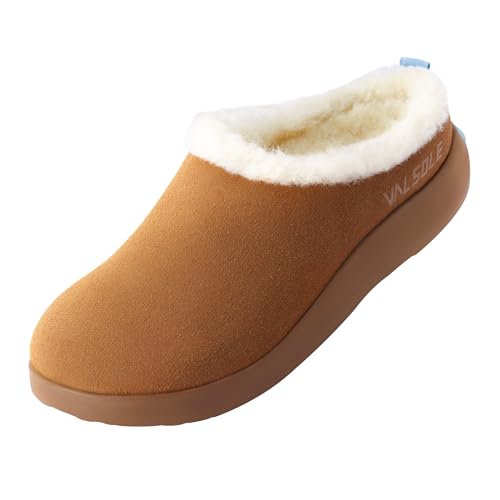
VALSOLE Orthopedic Slippers with Arch Support — Best Unisex Cushioning
The VALSOLE pick serves the households the gendered picks miss: its verified title describes orthopedic slippers for women and men with arch support, and includes a stated weight framing of 220+ lbs — a reminder that cushioning must be judged against the load it carries. A shared design also simplifies a household’s buying: one model, two wearers, no translation between ranges.
Strengths
- Arch support stated for a unisex design — women and men
- Title states a 220+ lbs framing for the cushioning
- House shoe format for indoor and outdoor trips per the title
Trade-offs
- One shared design means a less tailored fit than gendered models
- Support detail beyond the title’s wording is not stated
- Structured feel needs gradual break-in like all picks here
| Support | Arch support (per Amazon title) |
| Fit | Unisex — women and men |
| Framing | 220+ lbs (per Amazon title) |
| Style | House shoes |
The weight framing in this title is worth pausing on, because it is the kind of honesty this guide rewards: cushioning is load-bearing, and a slipper that states the load it was framed for lets heavier readers self-select instead of discovering compression the hard way. Combined with stated arch support in a unisex house shoe, the VALSOLE is the practical household pick — the pair by the door that serves whoever is standing on the cold floor.
Best for: households wanting one supportive model for different wearers / Not suited for: readers wanting a closely tailored, gender-specific fit
Check on Amazon — check price on Amazon before ordering, since listings and configurations change.

RockDove Men’s Original Two-Tone Memory Foam Slipper — Best Men’s Cushioned
RockDove’s two-tone slipper is this guide’s representative for the cushioning school: its verified title describes a memory foam slipper that is slip-on, non-slip, machine washable, and lightweight. It makes no arch support claim in its title, and this review does not invent one — its comfort offer is a thick foam footbed between your foot and the floor, in the easiest-care package in the guide. For men whose priority is straightforward cushioning and a slipper that goes in the wash, that is a legitimate and clearly labelled choice.
Strengths
- Memory foam cushioning per the verified title
- Machine washable — the easiest care in this guide
- Non-slip and lightweight per the title
Trade-offs
- No arch support stated — cushioning only, not structure
- Memory foam compresses over time and will need replacing
- Slip-on mule format; open heel
| Cushioning | Memory foam (per Amazon title) |
| Care | Machine washable |
| Sole | Non-slip |
| Support | Not stated |
Including a cushioning-only pick in a structure-led guide is a matter of honesty about preferences: some wearers try structured footbeds and simply prefer deep foam. The RockDove delivers that preference without pretending to be something else, and its washability is a real quality-of-life feature — slippers live hard lives and most cannot be cleaned properly at all. Know which school you are buying from, replace it when the foam packs down, and it will serve exactly as described.
Best for: men who prefer deep foam cushioning and washable easy care / Not suited for: readers specifically seeking stated arch support structure
Check on Amazon — check price on Amazon before ordering, since listings and configurations change.

EverFoams Women’s Soft Curly Memory Foam Slippers — Best Women’s Cushioned
EverFoams closes the guide with the women’s version of the cushioning choice: a soft curly memory foam slipper with a warm polar fleece lining, described in its verified title as a non-slip, machine washable indoor loafer for fall and winter. Like the RockDove, it claims cushioning rather than arch structure, and it is labelled that way here. Its loafer shape gives more foot coverage than a mule, and the fleece lining makes it the cosiest purely-cushioned option in the guide.
Strengths
- Memory foam cushioning with warm polar fleece lining
- Machine washable and non-slip per the verified title
- Loafer shape — more coverage than an open mule
Trade-offs
- No arch support stated in the title — cushioning only
- Fall-winter weight lining is warm for summer
- Foam will compress with daily wear and need eventual replacement
| Cushioning | Memory foam (per Amazon title) |
| Lining | Polar fleece, wool-like |
| Care | Machine washable |
| Support | Not stated |
Paired with the RockDove, this pick completes the guide’s honest map: four structured designs whose titles state their support, and two cushioning designs whose titles state their foam. Neither school is a fraud; they are different comforts. The EverFoams is for the reader who has weighed that choice and wants warmth, softness, and a washable loafer for winter evenings — bought with open eyes about what memory foam does and does not do.
Best for: women wanting warm, washable, deeply cushioned winter slippers / Not suited for: readers seeking stated arch support structure
Check on Amazon — check price on Amazon before ordering, since listings and configurations change.
Comparison Table
| Pick | Badge | Key spec | Best for |
|---|---|---|---|
| ERGOfoot Orthopedic House Slippers with Arch Support and Deep Heel Cup | Best Overall Comfort Structure | Arch support with deep heel cup | readers wanting the most explicitly structured comfort slipper for home wear |
| Orthopedic Slippers for Women with Arch Support (Canvas) | Best Lightweight Structured | Canvas clog with arch support | women in warm homes wanting stated arch support without winter lining |
| GRITHEIM Women’s Orthotic Arch Support Slippers (Adjustable) | Best Adjustable | Adjustable slide with arch support | readers whose feet change through the day and who want to tune the fit |
| VALSOLE Orthopedic Slippers with Arch Support | Best Unisex Cushioning | Unisex arch support house shoes | households wanting one supportive model for different wearers |
| RockDove Men’s Original Two-Tone Memory Foam Slipper | Best Men’s Cushioned | Memory foam cushioning, washable | men who prefer deep foam cushioning and washable easy care |
| EverFoams Women’s Soft Curly Memory Foam Slippers | Best Women’s Cushioned | Memory foam loafer, fleece lined | women wanting warm, washable, deeply cushioned winter slippers |
How to Choose Comfortable Slippers When Your Joints Ache
Begin with the boundary this guide opened with, because it protects you as a shopper: no slipper treats joint pain. Marketing in this category leans on medical vocabulary precisely because aching joints make people hopeful, and hope is easy to sell. Buy structure and comfort, which are real and checkable, and take persistent pain to a clinician, who can offer things no product page can. That division — clinician for causes, slippers for comfort — is the healthiest frame for every decision below.
For comfort itself, three properties matter. Cushioning decides how much floor you feel: memory foam and padded footbeds soften every step on hard surfaces. Structure decides how your foot is held: stated arch support and a deep heel cup keep the foot positioned on that cushioning instead of sliding off it. Fit decides whether you keep them on: adjustable straps, hands-free entries, and room through the instep matter most on stiff mornings and for feet that change through the day. The strongest picks state several of these in their titles; the honest cushioning-only picks state their foam and nothing more, and are labelled accordingly.
Then match the slipper to your home’s reality. Cold hard floors argue for lining and a rubber sole; warm homes argue for canvas and lighter builds. Stairs argue for a secure heel; single-floor living forgives a slide. A slipper that suits your house gets worn, and a worn slipper is the only kind that can comfort anyone.
Support vs Cushioning: Reading Slipper Titles Honestly
Titles in this category mix two different comforts, and separating them is the core shopping skill. Cushioning words — memory foam, plush, padded, soft — describe what is under your foot: a layer that compresses. Support words — arch support, orthotic insole, deep heel cup — describe the shape of that layer: a structure that holds the foot in a position. A slipper can offer either or both, and the titles in this guide were graded on exactly which they state.
The practical difference shows up over a day’s wear. Pure cushioning feels wonderful for the first hour and gradually less distinct as foam compresses under load; structure keeps its geometry and keeps the foot centred, which many wearers experience as comfort that lasts into the evening. Neither sensation is imaginary, and preference between them is legitimate — the RockDove and EverFoams picks exist for the cushioning preference, labelled as what they are.
What is not legitimate is vocabulary borrowed to blur the two, or to imply medical effects. Copy that habit: buy the shape and the foam that a title actually describes, and let clinicians make medical claims, because they are the ones qualified to stand behind them.
A Note on Pain, From a Shopping Guide That Refuses to Play Doctor
It would be easy — and wrong — for this guide to end its advice at the checkout. Joint pain has many causes, some minor and some that reward early attention, and a shopping guide cannot tell them apart. Pain that persists beyond a few weeks, pain that swells, locks, gives way, wakes you at night, or changes how you walk deserves a clinician’s assessment regardless of what any slipper does for your evenings at home.
What comfortable slippers can legitimately do is smaller and still worthwhile: make hard floors kinder, make evenings at home more pleasant, and remove the small daily discomfort of standing barefoot on tile while dinner cooks. That is a real quality-of-life purchase. It is simply not a medical one, and any guide — or listing — that blurs that line is asking for trust it has not earned.
Hard Floors, Long Evenings: The Comfort Case in Detail
Consider where home discomfort actually accumulates. It is rarely one dramatic moment; it is the tile floor during a long cook, the bathroom’s cold ceramic at night, the standing desk’s mat-less floor, the hundred trips between sofa, kitchen, and door. Bare feet and worn-out slippers put the full hardness of those floors into every one of those moments. A cushioned, structured slipper does not change your joints — this guide has been careful about that line throughout — but it changes the surface you meet, thousands of times a week, and that is a real and honest comfort difference.
The details that decide whether that difference lasts past the first week are unglamorous. Cushioning that rebounds instead of packing flat. A footbed shape that keeps the foot where the cushioning is. A sole that grips wet-adjacent floors without squeaking you awake at night. An entry that does not require bending, tugging, and balancing on one foot at the exact hour your body is stiffest. The picks in this guide were chosen on those details, stated in their own titles, rather than on any promise about what they would do for a diagnosis.
There is also a dignity point worth making plainly. Wanting your evenings at home to feel comfortable is a sufficient reason to buy good slippers; it does not need a medical justification, and dressing a comfort purchase in medical language — as listings often do — sells the purchase short. Buy them the way you would buy a good chair: because you will live in them, and living in them should feel good.
When Slippers Are Not the Answer: A Shopper’s Safety Net
This guide sells nothing — it recommends products — and part of recommending responsibly is naming the exits. If your reason for reading is pain that is new, worsening, or accompanied by swelling, stiffness that dominates your mornings, locking, giving way, numbness, or any change in how you walk, the correct next step is a clinician’s appointment, not a checkout. Those are assessment-worthy signs by any ordinary standard, and footwear is not an assessment.
Likewise, if a particular slipper hurts, the answer is not to push through a break-in. Structured footwear should feel unfamiliar before it feels natural; it should never hurt. Stop, reassess the fit, and if the pain is yours rather than the slipper’s, return to the paragraph above. A guide that tells you when not to buy is a guide whose buying advice you can trust the rest of the time.
Finally, treat any product — in this category above all — that promises to fix, cure, or reverse a joint problem as disqualifying itself. Honest products describe their construction. The six picks here were chosen because their titles describe shapes, foams, and fits that can be checked. Hold every future purchase to the same standard, and your comfort shopping will stay honest long after this guide is closed.
Building a Comfortable Home Routine Around Your Feet
A pair of slippers is one element in a wider home environment, and the readers who get the most comfort from this guide’s picks tend to arrange the rest of that environment with the same practicality. A washable mat where you stand longest — at the sink, at the stove — softens the two places hard floors tax you most. A chair with a footstool in the room where you spend evenings changes how long standing tasks feel by the time you sit down. None of this is treatment, and none of it is presented as such; it is furnishing your home for the body you have, which is an ordinary and sensible project.
Routine matters as much as objects. Slippers kept where you get out of bed get worn from the first step; slippers kept in a distant cupboard get worn from the third hour. A second, lighter pair for warm months keeps the habit alive when the lined winter pair becomes unthinkable — the canvas pick in this guide exists for exactly that rotation. Small environmental decisions like these are why two households can buy the same slipper and report different evenings.
Keep the guide’s boundary as the routine’s foundation: comfort at home is a legitimate goal in itself, pursued with good objects and sensible habits. Pain is a medical subject, pursued with a clinician. Households that keep those two projects separate tend to do both of them better — the slippers get judged as slippers, and the pain gets the professional attention it deserves.
What Good Looks Like After a Month: Judging Your Purchase
A month is the honest trial period for a comfort purchase, because it outlasts novelty and break-in alike. Judge your slippers on three pieces of evidence. The first is wear pattern: a footbed that has taken a gentle impression of your foot while keeping its shape is doing its job; a footbed flattened to the sole is telling you its cushioning has already retired, and that pair was a month-long rental, not a purchase. The second is habit: the pair you have worn thirty evenings running has passed the only market test that matters, and the pair migrated to the cupboard has failed it, whatever its title promised.
The third evidence is the evening itself. The claim this guide has allowed itself — the only one — is that structured, cushioned slippers make home hours on hard floors more comfortable than bare feet or dead slippers. A month in, you know whether that modest claim held in your house: whether cooking feels different, whether the cold-floor trips are still dreaded, whether you bother putting them on. Modest claims, honestly tested, are how comfort purchases should be judged, and a pair that passes deserves the same loyalty as a good chair.
If the verdict is failure, spend the information well. A structure that felt wrong teaches you to buy cushioning; a cushioning that flattened teaches you to buy structure; a fit that pinched teaches you adjustability. Every pick in this guide was labelled by school precisely so a failed first choice converts into a correct second one. And through all of it, the guide’s boundary stands: comfort is the slippers’ department, pain is a clinician’s, and a household that keeps that straight will shop this category well for life.
Gift-Buying for Someone With Aching Joints: A Delicate Note
These slippers are frequently bought as gifts, and the gift version of this guide’s honesty matters. Give comfort, not implications: a structured, cushioned pair presented as ‘these looked incredibly comfortable’ lands warmly, while the same pair presented as a remedy for someone’s joints lands as a diagnosis from a relative. The picks here make good gifts precisely because their virtues are describable without medical language — warmth, structure, easy entry, a fit that adjusts.
Practical gift details: adjustable models forgive size uncertainty better than fixed ones; exchange-friendly sellers forgive the rest. And if the person you are buying for has mentioned pain that sounds persistent or worsening, the genuinely caring gift may be encouragement toward a clinician, offered once and kindly — with the slippers as the comfort that accompanies it, not the substitute for it.
Slippers and Standing Desks, Kitchens and Cold Mornings: A Practical Round-Up
The standing desk has quietly become a slippers location: hours of standing at home, on floors chosen for looks, in whatever was on your feet. A structured, cushioned pair — several picks here qualify — is the home worker’s equivalent of a desk mat, with the advantage of following you to the kettle. Kitchens make the same demand with added water, which is why the rubber-soled picks matter: a non-slip sole on a wet-adjacent tile floor is a comfort feature and a steadiness feature in one.
Cold mornings are the third location, and the one where entry design earns its keep. Hands-free and slip-on formats exist in this guide because the first steps of the day are when bending, tugging, and balancing are least welcome. A warm, structured pair waiting at the bedside is a small piece of domestic engineering with an outsized effect on how the day starts. None of these observations requires a medical claim, and that is the point of ending here: ordinary life, made more comfortable by honestly described objects, was the whole brief.
Sizing Structured Slippers: The Fit Decisions That Decide Comfort
Structured slippers are sized products in a way plush ones are not: the arch section, the heel cup, and the cushioning zones all have intended positions, and a size too large lets the foot swim off them while a size too small crowds the toes and shifts the heel out of its cup. Order your true shoe size first. Judge the fit standing, in the evening, with the straps — where fitted — set under load. The heel should sit in its cup without effort, the arch should meet the footbed’s rise, and the toes should have room to lie flat rather than grip.
Between sizes, prefer the size that keeps the heel seated; a foot that stays positioned receives the comfort the structure was built to give, while a loose slipper makes the toes work to keep it on — the exact habit a comfort purchase exists to retire. Keep packaging through the first evenings, use the maker’s exchange route if the geometry is wrong for your foot, and remember that a different model is a more promising correction than a different size of a shape that does not suit you.
Closing Note: Comfort, Honestly Bought
This guide asked more of its readers than most shopping articles do: to hold two ideas at once — that comfortable slippers are genuinely worth buying, and that no slipper is a treatment for joint pain. Readers who hold both ideas shop this category better than anyone: they choose structure and cushioning on evidence, they break slippers in patiently, they replace them when their comfort retires, and they give their joints the professional attention that only a clinician can provide. The six pairs here were chosen to reward exactly that reader. Wear them well, on the hardest floors of the house, for the ordinary pleasure of evenings that feel a little kinder.
How to Break In and Look After Structured House Slippers
Structured slippers reward a gentle introduction and simple care. These steps are about comfort and longevity only.
- Wear new structured slippers for short periods at first — an hour or two indoors — and build up over several days, rather than switching to them for a whole day at once.
- Set adjustable straps while standing, so the fit accounts for your foot under load; the hold should centre the foot on the footbed without pinching.
- Check the contact on a hard floor: you should feel cushioning under the whole foot and, on structured models, the footbed meeting your arch and cupping your heel.
- Keep slippers for indoor wear as much as their soles allow you to judge sensible — grit ground into a footbed shortens its life and dulls its cushioning.
- Air slippers after wear, wash the washable models on the maker’s instructions, and let lined pairs dry away from direct heat.
- Replace slippers when the cushioning stays compressed or the structure you felt at first has flattened away — a worn-out slipper is a flat slipper, whatever it once was.
If any footwear causes pain rather than comfort during break-in, stop wearing it and reassess. Footwear should never need to be endured, and ongoing pain is a clinician’s subject, not a break-in stage.
Common Buying Mistakes
Believing a listing’s medical language. Titles in this category borrow condition names freely. This guide logs that wording in its sources and claims none of it. Buy described structure and cushioning; let clinicians handle conditions.
Delaying a clinician because a slipper feels nice. Comfort at home and medical assessment are not alternatives. Pain that persists, swells, or changes your walking needs professional eyes, however good your evenings feel.
Choosing pure plush when you wanted structure. The softest slipper is usually the flattest. If you want support, the title must say so — arch support, heel cup, orthotic insole — before the fur lining seduces you.
Enduring a painful break-in. New structure should feel unfamiliar, not painful. Pain is a stop signal: reassess the fit, and if pain is the underlying reason you are shopping, see the first two mistakes.
Wearing dead slippers. Foam that no longer rebounds and footbeds worn flat give you the floor with extra steps. Replace slippers when their comfort features have visibly retired.
Final Recommendation
For the most completely described comfort structure, start with the ERGOfoot — arch support and a deep heel cup in one warm clog. The canvas design is its warm-climate counterpart, the GRITHEIM adds tunability, and the VALSOLE serves mixed households with a stated load framing. Readers who simply prefer deep foam, honestly labelled, have the RockDove for men and the EverFoams for women.
And the guide’s opening sentence is also its closing one: choose these slippers for comfort, break them in gently, check the current listing and check price on Amazon before ordering — and take joint pain that persists to a clinician, because that conversation matters more than any purchase in this article.
Related guides in this series: Best Arch Support Slippers Mens Best Arch Support Womens Slippers Best Arch Support Indoor Slippers Best Allday Comfort Slippers Best Anti Fatigue Slippers Best Affordable House Slippers For Women
Frequently Asked Questions
Can slippers help with joint pain?
This guide does not claim that any slipper treats or relieves joint pain, and you should be suspicious of any listing that does. What supportive, cushioned slippers can do is make standing and walking on hard floors at home more comfortable than bare feet or worn flat slippers. Joint pain itself — especially pain that persists — should be assessed by a clinician.
What should I look for in a comfortable slipper for aching feet?
Stated structure and honest cushioning: arch support or a deep heel cup in the title if you want support, memory foam if you want softness, an adjustable or easy-entry fit for stiff mornings, and a non-slip sole for hard floors. Every pick here was chosen because its title states its comfort features in checkable words.
Is arch support or memory foam better?
They are different comforts. Arch support is a shape that holds the foot positioned; memory foam is a cushion that compresses. Structured designs tend to keep their feel through a long evening; foam feels plushest at first. This guide labels which each pick offers — four state support, two state cushioning only — so you can choose knowingly.
Why do some titles mention medical conditions?
Because manufacturers market that way. A condition named in a title is advertising language, not evidence, and not a substitute for medical advice.
How long should I break in structured slippers?
A few days of short wear, building up gradually. The footbed’s shape should feel increasingly natural. If a slipper causes pain at any point, stop — break-in is for unfamiliarity, not for enduring pain, and persistent pain belongs in a clinician’s assessment.
When should I replace my house slippers?
When the comfort you bought is gone: foam that stays flattened, a footbed whose shape you can no longer feel, a sole worn smooth. At that point the slipper is offering your feet nothing but a layer of fabric, and a fresh pair — structured or cushioned, by your preference — restores the point of wearing them.


