Disclosure: airfryerkitchensupply.com is reader-supported. When you buy through links on our site, we may earn an affiliate commission at no extra cost to you.
Where to buy
All six cushions below were verified against Amazon’s catalogue data and are sold through Amazon, where you can confirm the current size and colour options before ordering:
- ComfiLife Gel & Memory Foam Seat Cushion — check price on Amazon
- Everlasting Comfort Memory Foam Seat Cushion — check price on Amazon
- Cushion Lab Pressure Relief Seat Cushion — check price on Amazon
- Purple Royal Seat Cushion — check price on Amazon
- TushGuard Seat Cushion — check price on Amazon
- SofterCharm Seat Cushion — check price on Amazon
Introduction
People searching for the best seat pillows for support for sciatica are usually looking for one thing: a way to sit down — at a desk, in a car, at the kitchen table — without the sitting itself becoming the worst part of the day. This guide needs to be precise about what a seat cushion is. Sciatica is a medical condition involving nerve pain, and a cushion cannot treat it, cure it or resolve its causes. What a well-chosen cushion can do is change the mechanics of sitting: it can soften a hard seat, spread pressure more evenly under you, support a more neutral sitting posture, and make a chair’s height and angle work better — in other words, sitting comfort, which is a legitimate thing to shop for carefully.
Two ground rules follow from that. First, if you have persistent leg pain, numbness, weakness, or symptoms that are getting worse, the right next step is a doctor or physiotherapist, not a purchase — and nothing in this guide should delay that. Second, this guide evaluates cushions only on verifiable sitting-comfort criteria: materials, shape, density, size and the pressure-distribution design stated in each product’s own listing, all verified.
In this guide
Quick Picks
- Best Overall — ComfiLife Seat Cushion: a gel-and-memory-foam cushion that also lifts the sitter slightly, for office chairs, car seats and desk setups. Check on Amazon
- Best for Office and Car — Everlasting Comfort Seat Cushion: a large memory foam cushion shaped for office chairs and car seats, from a long-running cushion specialist. Check on Amazon
- Best Dense Support — Cushion Lab Seat Cushion: an extra-dense memory foam cushion with a patented pressure-relief design, built for long sitting hours. Check on Amazon
- Best Gel Grid — Purple Royal Seat Cushion: a 2 inch gel grid cushion with handles, for pressure distribution that never packs down like foam. Check on Amazon
- Best Value — TushGuard Seat Cushion: a large memory foam cushion in grey for car seats, aeroplanes and desk chairs. Check on Amazon
- Best Large Size — SofterCharm Seat Cushion: a large-format memory foam cushion for long sitting at home, in the car or on a plane. Check on Amazon
How These Picks Were Chosen
Selection used sitting-mechanics criteria that any buyer can apply. Pressure distribution came first: cushions that spread load across a wider area — through contoured memory foam, gel layers or grid structures — reduce the peak pressure under the sit bones and tailbone area compared with a flat hard seat. Shape came second: most picks use a contoured profile, and several designs in this category include a rear cut-out or a shaped back edge intended to reduce direct pressure on the tailbone when seated; we describe shapes as shapes, without converting them into medical promises. Density and thickness came third, because a cushion that bottoms out under your weight is decoration, and a cushion that is too firm or too tall creates new problems — including changing your chair’s ergonomics, which the buying guide covers in detail.
Equally important is what we excluded and why. We excluded heated and vibrating cushions whose listings lean on therapy language, rigid medical devices sold as everyday cushions, and any product whose listing we could not verify. We also applied a language rule across the whole guide: comfort claims are stated as comfort claims. A cushion can make a long drive or a workday at a hard chair more comfortable for someone whose back and legs are sensitive to sitting; whether it changes a medical condition is a question for clinicians and evidence, not for a shopping guide, and you should be suspicious of any guide that blurs that line.
The 6 Best Seat Pillows for Support for Sciatica

1. ComfiLife Seat Cushion — Best Overall
The ComfiLife combines the two cushion technologies most buyers end up choosing between: its listing describes a premium gel and memory foam construction for office chairs and car seats, designed also as a lifting cushion — it raises the sitter slightly, which matters more than it sounds, because a few centimetres of height changes hip and knee angles at a desk or behind a wheel. The contoured memory foam spreads pressure, the gel layer moderates the foam’s warmth and adds a different, cooler kind of support, and the whole design is aimed squarely at long daily sitting.
Strengths
- Gel plus memory foam: two pressure-distribution mechanisms in one cushion.
- Lifting effect improves sitting geometry on low chairs and car seats.
- Versatile across office chair, car and desk use — one cushion for the whole day.
Trade-offs
- Added height can be a problem in cars with low headroom or under low desks — measure before relying on it.
- Gel-and-foam hybrids feel different from pure foam; committed foam fans should note the change in character.
- As with all picks here, it is a comfort aid for sitting, not a treatment for any condition.
| Mini spec box | |
|---|---|
| Construction | Gel & memory foam (per listing) |
| Use | Office chair, car seat, desk |
| Height effect | Lifting cushion (per listing) |
| Colour (listing) | Black |
| Exact dimensions | Not stated in listing title |
The ComfiLife is the best overall because it addresses the three things that make sitting uncomfortable on a hard chair — peak pressure, a seat that is too low, and heat build-up — in a single, portable product. For a reader whose sitting day spans a car commute and a desk, it is the one cushion that travels between both without compromise. Check your headroom and desk clearance first; if the lift fits your setups, this is the most complete comfort package in the guide.
Best for: desk workers and drivers who want pressure distribution plus a useful lift. / Not suited for: low-headroom cars or anyone whose chair is already at maximum comfortable height. Check on Amazon

2. Everlasting Comfort Seat Cushion — Best for Office and Car
Everlasting Comfort built its name on this cushion, and its listing describes a memory foam seat cushion for office chairs and cars in a large size, with an ergonomic design. The appeal is focus: a single, well-shaped block of memory foam, contoured for the seated body, that has been refined over a long production run. For sensitive sitters, that refinement shows in the details that matter — a contour that spreads load instead of concentrating it, and foam dense enough to support rather than collapse.
Strengths
- Purpose-shaped memory foam contour from a cushion specialist brand.
- Large size suits bigger chairs and bigger sitters better than compact cushions.
- Equally at home in an office chair and a car seat — the classic two-location day.
Trade-offs
- Pure memory foam sleeps warmer than the gel-layered ComfiLife or the Purple grid.
- Large footprint may overwhelm small task chairs and narrow car seats — check your seat width.
- Foam softens gradually over years; heavy daily users will feel it age sooner.
| Mini spec box | |
|---|---|
| Construction | Memory foam |
| Size (per listing) | Large |
| Use | Office chairs and car |
| Colour (listing) | Black |
| Gel layer | Not stated |
Choose the Everlasting Comfort if you want the category’s classic answer in its classic form: one cushion, well shaped, that makes an office chair or a car seat a more comfortable place to spend hours. It is particularly well matched to readers who found thin foam pads useless — the difference between a pad and a proper contoured cushion is exactly the difference between decoration and pressure distribution. As ever in this guide, treat it as sitting comfort equipment: valuable on a long day, and no substitute for assessment if symptoms persist.
Best for: office and car sitters wanting the proven contoured memory foam design in a large size. / Not suited for: hot climates without the gel option, or very narrow seats. Check on Amazon
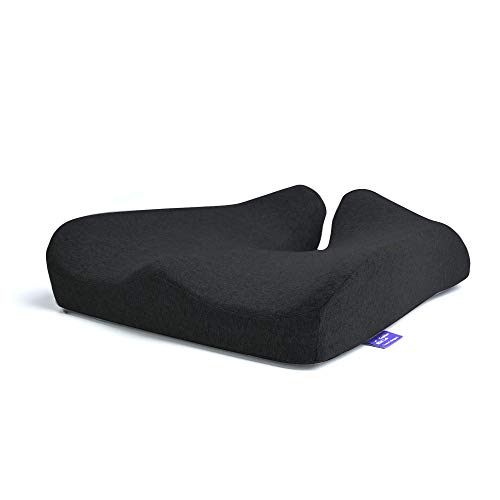
3. Cushion Lab Seat Cushion — Best Dense Support
Cushion Lab’s entry is built around density: its listing describes a patented pressure relief seat cushion in extra-dense memory foam, designed for long sitting hours on office and home chairs, and as a car pad for hip and tailbone comfort. Extra-dense foam is the right call for heavier sitters and for anyone whose previous cushion “bottomed out” — the sensation of the foam compressing completely so you end up sitting on the hard chair through a thin layer of defeated padding.
Strengths
- Extra-dense memory foam resists bottoming out under heavier loads and longer hours.
- Patented pressure-relief shaping, designed specifically around seated pressure distribution.
- Firm, supportive character suits sitters who dislike the sink-in feel of soft cushions.
Trade-offs
- Firmness is polarising: light sitters may find extra-dense foam unyielding at first.
- Dense foam is heavier to carry between locations than the lighter picks.
- Support-focused design prioritises pressure distribution over plushness.
| Mini spec box | |
|---|---|
| Construction | Extra-dense memory foam |
| Design | Patented pressure relief design (per listing) |
| Use | Office and home chairs, car pad |
| Target use | Long sitting hours |
| Exact dimensions | Not stated in listing title |
The Cushion Lab is the engineer’s pick: it treats the cushion as a load-bearing component and specifies density accordingly. If you are a heavier sitter, if your workdays are genuinely long, or if softer cushions have disappointed you, its firmer support is the most likely in this guide to still feel like support at hour six. Give it a few days — dense foam plus a new sitting posture is an adjustment, and the first evening is not the verdict.
Best for: heavier sitters, long workdays, and anyone whose previous cushion bottomed out. / Not suited for: light sitters wanting a soft, plush feel from day one. Check on Amazon

4. Purple Royal Seat Cushion — Best Gel Grid
Purple’s Royal cushion replaces foam with structure: its listing describes a portable 2 inch gel seat cushion with a GelFlex grid and handles, for car, office chair and stadium use, designed to reduce pressure on hard seats while staying temperature-neutral. The grid works by buckling under concentrated load — the columns under your sit bones flex more than the surrounding grid — which spreads pressure by geometry rather than by softness, and it never takes a permanent set the way foam eventually does.
Strengths
- GelFlex grid distributes pressure by structure and does not pack down over time.
- Temperature-neutral feel — the coolest-sitting pick in this guide.
- Handles and portability suit stadium seats, travel and chair-hopping.
Trade-offs
- The grid feel is distinctly different from foam — springy and structured, not plush.
- At 2 inches thick it adds noticeable height; check desk and car clearances.
- Grid cushions are heavier than they look, despite the handles.
| Mini spec box | |
|---|---|
| Construction | GelFlex grid (per listing) |
| Thickness (per listing) | 2 inch |
| Portability | Handles, portable |
| Use | Car, office chair, stadium |
| Foam content | Grid design (not a foam cushion) |
Choose the Purple Royal if foam has failed you twice — once by warmth, once by flattening — and you want a mechanically different answer. It is also the pick for hard, unyielding seats specifically: stadium benches, wooden kitchen chairs, older car seats whose own padding has died. The temperature neutrality is a genuine comfort advantage on long summer drives, where foam cushions can turn a car seat into a warm, soft trap that encourages slumping.
Best for: hard seats, warm climates, and sitters who want support that never flattens. / Not suited for: anyone who wants a plush foam feel or cannot spare 2 inches of seat height. Check on Amazon
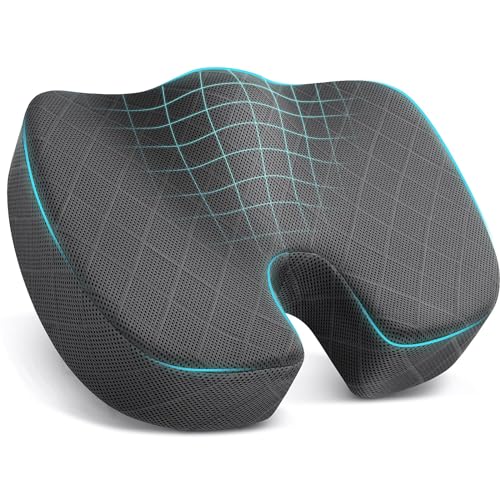
5. TushGuard Seat Cushion — Best Value
The TushGuard is the value route into proper cushion support: its listing describes a memory foam office chair cushion in grey, large size, for car seats, aeroplanes and desk chairs, designed for long sitting. It covers the category’s essentials — contoured memory foam, a generous footprint, multi-location use — at the accessible end of the guide’s range, which makes it the sensible first experiment for a reader who is not yet sure a cushion will change their sitting day.
Strengths
- Full-size memory foam contour at the value end of the category.
- Multi-use across car, plane and desk — good for commuters and travellers.
- Grey colourway hides travel and car wear better than black or bright colours.
Trade-offs
- Value-tier foam will age faster than the dense Cushion Lab under daily heavy use.
- No gel layer or grid — pure foam warmth and compression behaviour.
- Fewer design refinements than the premium picks; the essentials are covered, the extras are not.
| Mini spec box | |
|---|---|
| Construction | Memory foam |
| Size (per listing) | Large |
| Use | Car seat, aeroplane, desk chair |
| Colour (listing) | Grey |
| Gel layer | Not stated |
Buy the TushGuard to learn what a real cushion does for your sitting, at a price that makes the experiment painless. Many readers will find it sufficient full stop — the essentials of pressure distribution do not require premium pricing. Readers who discover they sit ten hours a day and wear cushions hard can treat it as the audition for the denser picks above, with the TushGuard retiring to the car or the spare chair where its second life is still useful.
Best for: first-time cushion buyers, commuters and travellers wanting full-size support at a value tier. / Not suited for: the heaviest daily use over many years. Check on Amazon
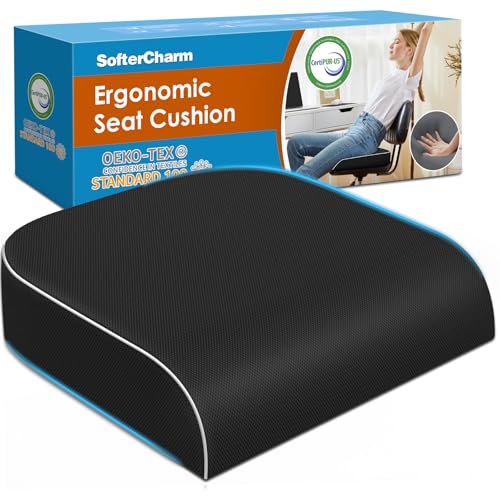
6. SofterCharm Seat Cushion — Best Large Size
The SofterCharm closes the list with scale: its listing describes a large memory foam office chair cushion in black, a butt pillow format intended for long sitting at home, in the car or on a plane. A large-format cushion covers more of the seat and more of the sitter — valuable for bigger chairs, bigger sitters, and anyone who found standard cushions felt like a small island in the middle of a wide seat.
Strengths
- Large format covers wide seats and larger sitters properly.
- Memory foam contouring for even pressure distribution across the larger area.
- One cushion serves home, car and travel — simple to move between them.
Trade-offs
- Size cuts both ways: it can crowd narrow car seats and small task chairs.
- Pure memory foam warmth, as with the other foam picks.
- Large cushions are bulkier to store and carry than compact models.
| Mini spec box | |
|---|---|
| Construction | Memory foam |
| Size (per listing) | Large |
| Use | Home, car, aeroplane |
| Colour (listing) | Black |
| Exact dimensions | Not stated in listing title |
The SofterCharm is the fit-first pick of the value tier: if your chair is generous, your frame is generous, or standard cushions left pressure exactly where they were supposed to remove it — at the edges, where the cushion ended — the larger format fixes the geometry. Measure your seat before ordering any large cushion, this one included; the right cushion should cover the sitting area without folding against armrests or seat edges, which would create the very pressure ridges you are trying to avoid.
Best for: wide seats, larger sitters, and anyone under-served by standard-size cushions. / Not suited for: narrow car seats or compact task chairs. Check on Amazon
Key Takeaways
- A seat cushion is sitting-comfort equipment: it distributes pressure, softens hard seats and improves sitting geometry. It does not treat sciatica or any other medical condition.
- Persistent leg pain, numbness, weakness or worsening symptoms need a doctor or physiotherapist — do not let any purchase delay that.
- Density decides durability: extra-dense foam (Cushion Lab) for heavy use, gel layers (ComfiLife) for cooler support, grid structure (Purple) for support that never packs down.
- Cushions add height — check desk clearance, chair ergonomics and car headroom before choosing a thick or lifting model.
- Judge any cushion after several full sitting days, and change one variable at a time.
Comparison Table
| Pick | Badge | Key spec | Best for |
|---|---|---|---|
| ComfiLife | Best Overall | Gel + memory foam, lifting | Desk and car, all-round comfort |
| Everlasting Comfort | Best for Office and Car | Large contoured memory foam | Classic two-location days |
| Cushion Lab | Best Dense Support | Extra-dense foam, patented design | Heavy use, long hours |
| Purple Royal | Best Gel Grid | 2 inch GelFlex grid, handles | Hard seats, warm climates |
| TushGuard | Best Value | Large memory foam, grey | First experiment, travel |
| SofterCharm | Best Large Size | Large-format memory foam | Wide seats, larger sitters |
How to Choose a Seat Cushion When Sitting Is Uncomfortable
Start by diagnosing your seat, not yourself. Sit in your usual chair and notice the mechanics: is the seat hard, so pressure concentrates under your sit bones? Is it too low, so your hips sit below your knees and your pelvis rolls backward? Is it too deep, so you perch on the edge or slump against the backrest? Each problem has a cushion answer — pressure distribution for hardness, a lifting cushion for lowness, a cushion that effectively shortens the seat for depth — and buying the wrong answer for your actual problem is the most common failure in this category.
Then choose the material by your sitting pattern. Long static hours favour density and structure (Cushion Lab, Purple) that hold geometry all day; mixed car-and-desk days favour versatile foam or gel-foam hybrids (ComfiLife, Everlasting Comfort); travel and experimentation favour the value tier (TushGuard). Thickness is a genuine trade-off, not a bigger-is-better scale: every centimetre of cushion raises you, changing desk reach, steering wheel position and headroom, so the correct cushion is the thinnest one that fully supports you without bottoming out. Finally, keep the medical framing straight while you shop: you are buying sitting comfort and better sitting mechanics, which are worthwhile in themselves — and any seller who promises more than that is telling you something about the seller, not the cushion.
How to Use a Seat Cushion Correctly
- Place the cushion fully on the seat, contoured side up, with the shaped or cut-out edge at the back where the design intends it.
- Sit back so your weight is centred on the cushion, not perched on its front edge.
- Re-adjust the chair after adding the cushion: raise or lower the seat so feet rest flat, and check desk and armrest height against the new sitting height.
- In a car, re-set the seat position, steering wheel and mirrors after fitting the cushion — your eye line has moved.
- Start with shorter sittings and build up over the first week; a new sitting geometry is an adjustment, even a good one.
- Stand and move regularly regardless of cushion quality — no cushion makes unbroken sitting healthy.
- Rotate or rest foam cushions between heavy days where possible, and keep them out of prolonged heat in parked cars.
Common Buying Mistakes
- Believing a cushion will treat a medical condition. Cushions improve sitting comfort and mechanics. Ongoing nerve symptoms need professional assessment.
- Buying the thickest cushion available. Excess height wrecks desk ergonomics and car headroom; the right thickness is the one that supports without bottoming out.
- Ignoring the chair underneath. A cushion cannot rescue a collapsed, wrong-sized chair — sometimes the chair is the purchase to make.
- Judging after twenty minutes. Sitting comfort is an hours-long property; assess across several full days.
- Sitting still for longer because the cushion feels better. Comfort should fund movement breaks, not replace them.
Final Recommendation
For most readers, the ComfiLife is the place to start: gel-and-foam pressure distribution plus a useful lift covers the widest range of uncomfortable seats. The Everlasting Comfort is the classic alternative for office-and-car days, the Cushion Lab is the heavy-duty answer for long hours and heavier sitters, and the Purple Royal is the structurally different option for hard seats and warm climates. The TushGuard makes the experiment affordable, and the SofterCharm fixes the fit for wide seats and larger frames. Whichever you choose, keep the framing from the introduction: you are buying more comfortable sitting, honestly specified — and if your symptoms persist, worsen, or involve numbness or weakness, a clinician’s appointment matters more than any cushion in this guide. Related reading for the rest of the sitting and sleeping comfort system: Best Butt Pillows, Best Body Pillows For Sacroiliac Joint, Best Chairs For Back And Neck, Best Chairs For Butt Pain and Best Affordable Pillows.
Cushion or New Chair: Which Purchase Comes First?
Readers with uncomfortable sitting often face this fork, and the honest answer is diagnostic. A cushion is the right first purchase when the chair itself is sound — right size, working adjustments, intact padding — but the seat is hard, a little low, or your needs have changed. It is portable, reversible and inexpensive relative to furniture, so it is also the right experiment when you are unsure what your body is asking for. A new chair is the right purchase when the chair is the problem: a collapsed seat that no cushion can level, a backrest that forces a slump, a size that never fitted. Stacking a premium cushion on a failed chair produces a comfortable layer on a bad foundation, and the sitting still feels wrong in ways buyers then blame on the cushion.
The middle path is sequencing: cushion first when the chair passes inspection, because the cushion remains useful — in the car, on a dining chair, at a stadium — even if a chair purchase follows later. Nothing in this guide’s list is wasted by a later furniture upgrade, which cannot be said of most comfort purchases. Inspect honestly, in this order: chair structure, chair fit, seat surface, then cushion. The cheapest correct purchase is the one aimed at the layer that is actually failing.
Driving With a Seat Cushion: Setup and Safety
The car is where cushions earn their keep for many readers — and where setup matters most, because a cushion changes your relationship to the controls. After fitting one, re-set the seat position, the steering wheel reach and all mirrors before driving; your eye line sits higher, and your distance to the pedals has effectively changed. Check headroom honestly: a thick or lifting cushion in a low car can put your head uncomfortably close to the roof, which is both uncomfortable and a reason to choose a thinner model for the car even if a thicker one suits your desk.
Two safety notes deserve plain language. A cushion should sit flat and stable on the car seat, never folded or doubled, and it should not interfere with the seatbelt’s position across your hips — if it does, it does not belong in that car. And on long drives, the cushion is not the strategy; the breaks are. Stop, walk and stretch at sensible intervals, because hours of unbroken driving posture load the body in ways no cushion can offset. Used with those disciplines, a cushion turns the car from the worst seat of your day into a manageable one — which, for readers whose symptoms flare after drives, is a meaningful quality-of-life change bought honestly as comfort.
Desk Setup With a Cushion: Rebuilding the Geometry
Adding a cushion to a desk chair without re-setting the workstation is the most common way buyers waste a good cushion. The cushion raises you, so: re-set chair height until your feet are flat again (a footrest if the chair cannot go low enough at your desk), re-check that your forearms rest level at the keyboard, and re-check screen height, because your eye line has risen by the cushion’s compressed thickness. Armrests that were perfect before may now sit relatively lower; raise them to meet your forearms rather than letting your shoulders climb.
Give the new geometry a fair trial — several full workdays — and change one variable at a time if something feels off. A frequent pattern is that the cushion feels wonderful but the neck complains by Friday; that is usually the unraised screen announcing itself, not the cushion failing. Treat the cushion as one component in a sitting system whose other components are the chair, the desk, the screen and your break habit, and the system — not any single product — is what makes sitting comfortable for someone whose back and legs are sensitive to it.
Materials Compared: Foam, Gel-Foam and Grid
The three constructions in this guide behave differently across a long day, and the differences are mechanical rather than mysterious. Memory foam moulds to your shape and spreads pressure by conforming; it is warm, it softens slightly with body heat, and it slowly compresses over years. Its comfort is immediate and familiar, which is why most picks use it. Gel-layered foam, as in the ComfiLife, adds a cooler, more fluid kind of support on top of the foam’s conformity — the gel moderates temperature and changes the pressure feel from “sinking” to “floating”, a distinction sitters tend to have strong preferences about once they have tried both.
The gel grid, represented by the Purple Royal, abandons conformity for structure: the grid’s columns buckle selectively under load, so pressure distribution is engineered rather than moulded, and there is nothing to pack down — the support in year three is the support from day one, and air flows through the grid, making it the temperature-neutral choice. Its trade-off is feel: structured and springy rather than plush, and some sitters never convert. None of the three is medically superior — this guide makes no such claim for any of them — they are three honest engineering answers to the same comfort problem, and the right one is the one your body prefers after full days, not first minutes.
Who Each Pick Suits: A Quick Matching Guide
If your day is car-then-desk and your seats are hard and low, start with the ComfiLife’s lift and gel-foam comfort. If your day is one long desk stretch and you want the classic solution, the Everlasting Comfort. If you are a heavier sitter or your cushions die young, the Cushion Lab’s density is built for you. If your seats are brutally hard — stadium, wooden chairs, an old car — or heat is your enemy, the Purple Royal’s grid. If you are experimenting on a budget or equipping a travel kit, the TushGuard. If every standard cushion felt too small, the SofterCharm. Matching the pick to the pattern of your sitting, rather than to the loudest claim on a listing, is the whole method of this guide — and it works precisely because the claims here are limited to what cushions can verifiably do for sitting comfort.
Cushion Care and Lifespan
A cushion’s working life is the life of its support geometry. Foam cushions should be aired regularly, kept out of prolonged heat — a parked summer car is the fastest way to age memory foam — and rested between heavy-use days where possible, because foam recovers loft when unloaded. Covers, where removable, should be washed on the schedule of anything you sit on daily; a clean cover also protects the foam core, which should never be soaked. Expect a quality foam cushion in daily service to give a few years before its support noticeably softens; denser foams sit at the long end of that range. The grid cushion asks less: shake out debris, wash according to the maker’s instructions, and its structure persists.
Judge replacement by performance, not appearance: if you can feel the hard seat through the cushion at your sit bones by midday, if the cushion has taken a permanent tilt or hollow, or if your sitting comfort has quietly returned to its pre-cushion state, the geometry is spent. Replacing a spent cushion matters more than replacing a spent pillow or pad, because the cushion’s entire value is the pressure distribution that worn material no longer provides.
A Realistic First Week With a New Cushion
Set expectations the way this guide has set its claims: modestly and mechanically. Day one usually brings an obvious change — a hard seat feels civilised, your sitting height feels different, and your posture sits a little more naturally because the surface invites it. Days two to four are the adjustment: muscles that braced against a bad seat renegotiate, and minor unfamiliarity is normal as your sitting geometry changes. By the end of the first week you should be able to answer the only question that matters — is sitting, across a whole ordinary day, more comfortable than it was? Keep the comparison honest by not changing anything else that week: same chair, same desk settings (re-adjusted once for the cushion’s height), same routine.
If the answer is clearly yes, you have bought what this category can sell, and the cushion earns its place. If the answer is no, work the variables in order — placement, chair height, cushion orientation, then a different construction from this guide — before concluding cushions do not help you. And if sitting remains a significant problem whatever you place under you, read that as information, not failure: it is exactly the situation the introduction described, where professional assessment is the productive next step and products take a supporting role at most.
Sitting at Work All Day: A Cushion Is One Layer of the Answer
For desk workers, it is worth placing the cushion inside the full set of things that decide how sitting feels by 5 p.m. The chair’s own fit comes first, then the cushion’s pressure distribution, then desk and screen geometry, then — outweighing all of them across a week — how often you stand and move. Readers sometimes buy a cushion as a licence to sit longer; the evidence of ordinary experience points the other way: the people who fare best with sensitive backs and legs are the ones who treat comfort equipment as a way to make a varied day pleasant, alternating sitting with standing, walking and brief stretches. A standing-desk converter, a walk to make tea, a phone call taken on your feet — each is worth more than any single product, and each is free.
That perspective should not discourage the purchase; it should aim it. Buy the cushion that fixes your seat’s specific failing — hardness, pressure peaks, a tired car seat on the commute — and let the rest of the system do its share. The guides linked in the final recommendation cover the neighbouring layers: chairs that support the back and neck, and pillows for other sitting and sleeping positions, so the whole day, not just the desk hours, can be arranged for comfort.
Frequently Asked Questions
Can a seat cushion cure sciatica?
No. Sciatica is a medical condition, and no cushion can cure it or treat its causes. A cushion can make sitting more comfortable — by distributing pressure, softening a hard seat and improving sitting posture — which is a real benefit worth shopping for carefully. Persistent or worsening symptoms, numbness or weakness need assessment by a doctor or physiotherapist. Anyone who tells you a cushion will resolve a nerve condition is selling you the cushion, not the truth, and this guide would rather lose the sale than blur that line.
What cushion shape is most comfortable for long sitting?
For most people, a contoured cushion that spreads pressure across a wide area beats a flat pad, and designs that reduce direct pressure under the tailbone area suit many sitters. Density matters as much as shape: the cushion must support your weight without bottoming out. The picks in this guide cover foam contours, a gel-foam hybrid and a grid, because the best shape is the one your body and your chair agree on over full days. If you sit on several different chairs in a day, favour the pick whose shape is least chair-specific — the versatile mid-size foams and the gel-foam hybrid travel best between seats.
How thick should a seat cushion be?
Thick enough to support you fully without compressing to the hard seat, and no thicker — because every cushion raises your sitting height and changes your desk, chair and car geometry. The only stated thickness in this guide is the Purple Royal’s 2 inches. If you are between chairs and cars with different clearances, a moderate cushion plus re-adjusting each seat beats a maximum-thickness cushion that fits nowhere properly. When in doubt, measure the compressed thickness under your own weight — sit on the cushion on a hard chair and have someone check the remaining height — because that working figure, not the shelf figure, is what your desk and car will actually experience.
Can I use one cushion for both my car and my office chair?
Yes — most picks here are explicitly multi-location, and the ComfiLife, Everlasting Comfort and TushGuard all span car and desk use. Just re-adjust each seat after moving the cushion: seat height in the car, chair height and desk relationship in the office. Your eye line and reach change with the cushion in place, and a cushion moved three times a day without re-adjustment teaches its owner to blame the product for geometry that was never re-set.
Why does sitting still hurt more than moving around?
Sitting holds one posture and one pressure pattern for a long time, while movement varies both. That is general mechanics, not medical advice: it is why this guide pairs every cushion recommendation with regular standing and movement breaks, and why a cushion that makes sitting more comfortable should be used to make your day more varied, not more static. Even the best-supported sitter in this guide’s audience should treat the hourly stand-and-move as non-negotiable equipment — the only item in the whole sitting system that costs nothing and outperforms everything else in it.
Do seat cushions help on aeroplanes and trains?
They are one of the most appreciated travel uses: vehicle and aircraft seats are thin, hard and shaped for someone else, and a portable cushion — the TushGuard and SofterCharm both list aeroplane use, and the Purple Royal has handles for carrying — restores pressure distribution for the journey’s length. On aircraft, remember the cushion raises you slightly and takes seat depth; on a long flight that trade is usually worth it, and the cushion doubles as a lumbar roll or headrest improvisation in a pinch, though its designed job is under you.
Can I use a seat cushion on a dining chair or at the kitchen table?
Yes — hard dining and kitchen chairs are one of the best use cases, because their flat wooden or moulded seats concentrate pressure exactly where a cushion distributes it. The Purple Royal was designed with hard seats in mind, and any foam pick here will transform a long family dinner or a laptop session at the table. Just re-check your height at the table: a thick cushion raises you relative to the table surface, which most people find fine and some find worth a thinner pick.
When should I stop trying cushions and see a professional?
Promptly, if you have numbness, weakness, pain that travels and persists, symptoms following an injury, or anything that is getting worse rather than better — and in general, if sitting pain is a recurring part of your life rather than an occasional discomfort, a professional assessment is the right purchase before another product. A cushion can then be chosen with that professional’s guidance for your specific situation, which is the one route by which a cushion recommendation becomes genuinely personal rather than generic.

