Disclosure: airfryerkitchensupply.com is reader-supported. When you buy through links on our site, we may earn an affiliate commission at no extra cost to you.
Where to buy
Shopping for the best no sweat slippers? All six slippers below are house slippers sold on Amazon, and each pick links to its listing so you can check the current price on Amazon, confirm your size, and read the materials and care details before ordering. Breathability lives in the details — upper material, toe coverage, perforations — so the listing’s own wording is quoted carefully in these reviews: if a slipper is called breathable, open-toe, linen, cotton, or bamboo here, it is because its listing says so. Where a listing does not state a material, we say so rather than guessing at what touches your skin.
- Dearfoams Men’s Brendan Breathable Clog — Best Cushioned No-Sweat Pick: Check the current price on Amazon
- VeraCosy Men’s Open-Toe Slippers — Best Open-Toe for Men: Check the current price on Amazon
- Japanese Style Linen House Slippers (Open Toe) — Best Linen Design: Check the current price on Amazon
- COCOMUSE Open Toe Cotton Linen Slippers — Best Sweat-Absorbing Cloth Design: Check the current price on Amazon
- Japanese Bamboo House Slippers — Best for Dry, Cool Feet in Summer: Check the current price on Amazon
- RockDove Men’s Axis Arch Support Slide Slipper — Best Open-Toe with Support: Check the current price on Amazon
The best no sweat slippers solve a problem that has nothing to do with winter: feet that run hot, in houses that run warm, in slippers designed by people who apparently believe every home is a ski lodge. The standard house slipper — plush fleece, faux fur lining, memory foam that seals around the foot — is a heating system with a sole attached, and for a large population of wearers it is unwearable for ten months of the year. If your feet sweat in ordinary slippers, the issue is not your feet; it is that the category’s default construction traps heat and moisture against the skin with no exit route, and your body responds the only way it can.
The exit routes are what this guide is about. Breathability in a house slipper comes from four honest mechanisms, and every pick here uses at least one of them as stated in its listing: an open toe that ventilates the front of the foot, where much of the heat collects; natural-fiber uppers like linen and cotton that absorb moisture and let it evaporate instead of sealing it in; perforations that give air a path through a closed upper; and bamboo-based construction, which one listing here explicitly describes as keeping feet dry and cool. We describe only what the listings state — no invented ‘moisture-wicking technology,’ no upgrading a breathable claim into a guarantee. Feet differ, houses differ, and the honest promise is narrower and better: these are the slippers engineered to trap the least heat.
All six picks are house slippers — indoor scuffs, clogs, and open-toe designs for the home, not outdoor sandals or slides — spanning a perforated memory foam clog for people who still want cushion, linen and cotton-linen open-toe designs, a bamboo summer slipper, and an open-toe cushioned slide with arch support. The buying guide after the reviews explains the material science in plain terms — why foam runs hot, why natural fibers feel drier, and how to build a two-season slipper rotation — so you can judge the next pair yourself, in any shop, without this list in your hand.
In this guide
Quick Picks
In a hurry? Every pick here attacks foot heat by a stated mechanism — open toes, linen, cotton, bamboo, or perforations. If you want cushion with your airflow, start with the Dearfoams clog or the RockDove slide; if you want maximum ventilation, go straight to the open-toe natural-fiber picks.
Dearfoams Men’s Brendan Breathable Clog — Best Cushioned No-Sweat Pick. A men’s memory foam clog house shoe whose listing leads with ‘breathable’ and describes a perforated upper, offered in wide widths — the pick for hot feet that still want real cushioning and a closed toe. Check the current price on Amazon
VeraCosy Men’s Open-Toe Slippers — Best Open-Toe for Men. A men’s slip-on open-toe house slipper in Ultimate Gray whose listing describes it as a summer, breathable design for bedroom and home wear — ventilation by the simplest mechanism there is: no roof over the toes. Check the current price on Amazon
Japanese Style Linen House Slippers (Open Toe) — Best Linen Design. Unisex open-toe house slippers in linen whose listing describes them as breathable, lightweight, and anti-skid — natural fiber plus open architecture, in a minimalist Japanese style for women and men. Check the current price on Amazon
COCOMUSE Open Toe Cotton Linen Slippers — Best Sweat-Absorbing Cloth Design. Women’s open-toe slippers in cotton linen whose listing states they absorb sweat, with a cloth bottom, in an ultralight indoor design — the pick that names the problem in its own description. Check the current price on Amazon
Japanese Bamboo House Slippers — Best for Dry, Cool Feet in Summer. Bamboo house slippers whose listing describes them as odor-resistant and made to keep feet dry and cool for summer, with a non-slip soft sole — the pick that pairs moisture control with odor control. Check the current price on Amazon
RockDove Men’s Axis Arch Support Slide Slipper — Best Open-Toe with Support. A men’s open-toe slide slipper with arch support and memory foam, an indoor/outdoor sole, and a listing that states breathability — the engineered option for hot feet that also need structure. Check the current price on Amazon
How These Picks Were Chosen
We filtered the house-slipper field by one question: what does the listing itself say that would let heat and moisture escape? Acceptable evidence was explicit — the words breathable or open-toe in the listing, natural-fiber uppers named as linen, cotton, or bamboo, perforated construction, or a stated dry-and-cool design purpose. Slippers that were merely ‘lightweight’ or summer-marketed without a stated mechanism were set aside, because light and cool are different properties and this search deserves the difference respected. We kept the category discipline of the whole program: house slippers only, no outdoor sandals, no shower slides, no massage or novelty footwear.
Every candidate was verified against its live Amazon listing, and the reviews record the exact basis of each pick’s breathability claim. Two useful tensions shaped the final six. First, cushion versus airflow: memory foam is the comfort baseline of modern slippers but also a heat holder, so the list includes foam picks only where the design compensates with perforations or an open toe. Second, coverage versus ventilation: some wearers need a closed toe for warmth in air conditioning or for protection around the house, so one pick keeps the toe closed and breathes through perforation instead. The result is a list organized by mechanism, so you can shop your own priority rather than our ranking.
The 6 Best No Sweat Slippers
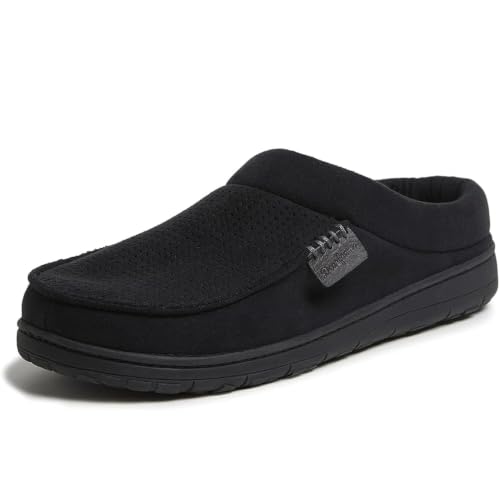
Dearfoams Men’s Brendan Breathable Clog — Best Cushioned No-Sweat Pick
The Brendan answers the hardest version of the no-sweat brief: a closed-toe slipper, with a genuine memory foam footbed, that does not cook the foot. Its listing describes an indoor/outdoor breathable memory foam clog in a black perforated finish — the perforations are the mechanism, a field of small vents across the upper that gives air a route in and heat a route out while the toe stays covered. For wearers who stub toes on furniture, who keep a cold air-conditioned house, or who simply dislike open-toe styles, this is the design that refuses to make them choose between protection and ventilation. The clog format adds a defined heel cup that scuffs lack, so the foot stays seated instead of sliding and gripping — and a relaxed foot sweats less than a gripping one.
The wide-widths availability stated in the listing is a breathability feature in disguise: a slipper that is too narrow compresses the foot, reduces air circulation around it, and feels hotter than the same slipper in the right width. If your feet run both hot and wide, this is the only pick here designed for you by name. The honest trade-offs: a perforated foam clog still insulates more than an open linen slipper — it is the coolest cushioned clog, not the coolest slipper on the page — and the indoor/outdoor sole, while practical, is more shoe-like than minimalists may want at home. Within the cushioned category, though, nothing else here breathes by design this deliberately.
Strengths
- Perforated, breathable upper stated in the listing — vents a closed toe
- Memory foam footbed keeps real cushioning in a no-sweat design
- Wide widths available — proper width is itself a cooling feature
Trade-offs
- Still warmer than open-toe natural-fiber picks
- Clog format is more structured than a soft scuff
- Foam footbed holds more heat than linen or cotton constructions
Key specs (from the manufacturer listing)
- Style: Clog house shoe, perforated black, stated
- Breathability: Breathable, perforated, stated
- Footbed: Memory foam, stated
- Widths: Wide widths offered, stated
- Sole: Indoor/outdoor, stated
Buy the Brendan if your feet are hot but your floors are hard and your toes are accident-prone — the classic profile of a man who has given up on slippers entirely and taken to socks on tile. It is also the winter-acceptable face of this list: in a heated house in January, its perforated foam is the warmest you should go, and for genuinely cold floors you can pair it with the rotation strategy in the guide below rather than returning to a fleece furnace.
Best for: Hot feet that need cushion, closed toes, or wide widths / Not suited for: Anyone wanting maximum ventilation above all else

VeraCosy Men’s Open-Toe Slippers — Best Open-Toe for Men
Sometimes the advanced technology is a hole where the heat was. The VeraCosy open-toe slipper takes the direct route: its listing describes a slip-on men’s house slipper for summer and bedroom wear, breathable and comfortable, in a gray colorway — with the entire front of the foot open to the room’s air. Toe-box heat is where slipper sweat concentrates, because the toes are enclosed, active, and far from any opening; removing the roof over them changes the microclimate of the whole foot, not just the toes. For the man whose feet are fine in sandals all summer and miserable in any closed slipper, this is the house-slipper translation of the footwear that already works for him.
The design stays a house slipper in every other respect — a cushioned slip-on for indoor floors, in a neutral gray that does not announce itself — and its listing mentions outdoor and bathroom among its contexts, which we report as the maker’s framing while recommending the usual care: an open-toe slipper’s grip should be tested on your own bathroom tile before it is trusted there. What the listing does not state in its title is the upper material, so we will not name one; the breathability claim here rests on the open architecture and the maker’s own breathable designation, both of which are stated. Simple, direct, and honest — the open toe is the oldest no-sweat technology and still the benchmark the others are measured against.
Strengths
- Open toe ventilates where slipper heat concentrates most
- Listing states breathable, summer-ready design
- Neutral gray slip-on suits any household’s look
Trade-offs
- Open toe means no protection from stubs or dropped objects
- Upper material is not stated in the listing title
- Minimal coverage will feel cool in cold houses — a summer weight
Key specs (from the manufacturer listing)
- Style: Open-toe slip-on, Ultimate Gray, stated
- Breathability: Breathable, stated; open-toe design
- Season: Summer, per listing
- Footbed: Not stated in listing title
- Material: Not stated in listing title
Choose the VeraCosy if your reference point is ‘I am happy in sandals and unhappy in slippers’ — it imports the sandal’s one essential feature into a house slipper’s body. It is the natural summer half of a two-pair rotation for men, and the natural full-time answer in warm climates and warm houses. If you also want arch structure with your open toe, the RockDove Axis below is the same idea on a more engineered platform.
Best for: Men in warm homes and climates who live in sandals outdoors / Not suited for: Cold houses, or anyone needing toe protection

Japanese Style Linen House Slippers (Open Toe) — Best Linen Design
Linen is the connoisseur’s answer to hot feet, and this Japanese-style slipper combines it with the open-toe architecture: its listing describes linen house slippers for women and men, open-toe, breathable, lightweight, with an anti-skid sole, in a soft, minimalist design for bedrooms and living rooms. Linen’s virtues at the foot are physical, not mystical — the flax fiber absorbs moisture readily and releases it to the air, and its relatively open weave lets heat move instead of pooling. A linen slipper feels dry in the way a linen shirt feels dry: not cold, not clammy, just unbothered. For wearers whose complaint is less ‘my feet are hot’ than ‘my feet feel damp and sealed,’ linen is the material that addresses the actual sensation.
The Japanese styling is functional minimalism: a low, light slipper that disappears into a calm home, easy to keep by the door or the bed, and — as the listing notes — suitable as guest slippers, which is a real household category in homes that ask guests to change footwear. The trade-offs are the natural-fiber ones: linen constructions are lighter in cushioning than memory foam platforms, so hard-floor marathon standing (long cooking sessions) may want the Dearfoams or RockDove instead; and natural fibers ask for gentler washing than synthetics, with the listing’s care guidance as the authority. For pure cool, dry, light comfort in warm rooms, this is the most elegant mechanism on the list.
Strengths
- Linen upper absorbs and releases moisture — feels dry, not sealed
- Open toe plus breathable weave stacks two cooling mechanisms
- Lightweight, anti-skid, minimalist design suits guests and daily wear
Trade-offs
- Lighter cushioning than memory foam platforms
- Natural fiber needs gentler care than synthetics
- Minimal structure — not for wearers wanting arch support
Key specs (from the manufacturer listing)
- Material: Linen, stated
- Style: Open-toe, Japanese style, unisex, stated
- Breathability: Breathable, stated
- Sole: Anti-skid, stated
- Weight: Lightweight, stated
Buy the linen slippers if your home runs warm, your floors are kind, and your complaint is dampness rather than impact. They are also the connoisseur’s guest slipper — a small stack of these by the door is a hospitality upgrade that costs less than one pair of prestige slippers — and the natural summer partner to any winter pair in a two-season rotation. Treat them gently in the wash and they will keep the dry, airy feel that made you choose linen in the first place.
Best for: Warm homes, damp-feeling feet, and guest-ready households / Not suited for: Long standing on hard floors or support seekers

COCOMUSE Open Toe Cotton Linen Slippers — Best Sweat-Absorbing Cloth Design
The COCOMUSE listing does something rare in this category: it says the quiet part in its own title, describing open-toe cotton linen women’s slippers that absorb sweat, with a cloth bottom, in an ultralight indoor design. That directness earns it a place and defines its mechanism — where other picks ventilate, this one absorbs. Cotton-linen cloth against the foot takes up moisture as it forms and holds it away from the skin in the fabric, which is why cloth-bottomed house slippers have been the warm-climate standard in much of the world for generations: the foot feels dry because the slipper is doing the dampness management, quietly, all evening.
The cloth bottom is the design’s character and its boundary in one: it makes the slipper silent and feather-light — the listing’s ‘ultralight’ is believable — and it confines the slipper to dry indoor floors, where cloth soles belong. This is a bedroom-and-living-room slipper, not a bathroom or door-yard one, and it will not cushion like foam because it is not trying to. For the woman whose feet sweat in every foam and fleece slipper she has tried, the COCOMUSE represents the opposite philosophy in its purest form: no foam, no fur, no seal — cloth, air, and an open toe. Sometimes the low-technology answer is the one that was right all along.
Strengths
- Listing states sweat-absorbing cotton linen construction
- Cloth bottom — silent and ultralight on indoor floors
- Open toe adds ventilation to the absorption mechanism
Trade-offs
- Cloth sole is for dry indoor floors only
- Minimal cushioning — not a standing-all-day slipper
- Absorbent cloth needs regular washing to stay fresh
Key specs (from the manufacturer listing)
- Material: Cotton linen, stated
- Moisture: Absorb sweat, stated in listing
- Style: Open-toe, women’s, stated
- Sole: Cloth bottom, stated
- Weight: Ultralight, stated
Choose the COCOMUSE if your history is a drawer of abandoned foam slippers — the evidence says your feet want cloth, not cushion. It is the evening-and-bedroom slipper of this list, the one that feels like almost nothing while quietly handling the moisture that made every previous pair unbearable. Wash it regularly, keep it on dry floors, and let its simplicity make the argument that the no-sweat problem was never asking for more technology, only for the right material.
Best for: Women whose feet sweat in foam or fleece slippers / Not suited for: Wet floors, hard-floor standing, or cushion seekers

Japanese Bamboo House Slippers — Best for Dry, Cool Feet in Summer
Sweat’s least charming consequence is odor, and this bamboo slipper is the only pick whose listing addresses both halves of the problem: it describes odor-resistant Japanese bamboo house slippers that keep feet dry and cool for summer, with a non-slip soft sole, easy to clean, sized here for women in a blue colorway. Bamboo-based textiles are marketed across the clothing world for moisture handling, and this listing makes the dry-and-cool claim in its own words, which is the basis we report it on. The easy-clean note matters as much as the fiber: in the no-sweat category, the winning slipper is the one that can be freshened completely and often, because a slipper that manages moisture but cannot be cleaned eventually becomes the odor problem it was bought to solve.
The soft sole and indoor, tatami-friendly framing place this slipper in the light indoor category alongside the linen and cotton picks — a warm-season, dry-floor design rather than a cushioned platform. That is the correct company for it: summer slippers should be judged on how little they add to the foot, and a soft-soled bamboo slipper adds almost nothing but a clean, dry interface between foot and floor. Households with tatami or delicate flooring get a bonus from the soft sole’s gentleness. If your no-sweat problem peaks in summer and travels with an odor complaint, this listing was quite literally written for you.
Strengths
- Listing states dry-and-cool summer design with odor resistance
- Easy to clean — freshness is maintainable, not just initial
- Soft non-slip sole is gentle on tatami and delicate floors
Trade-offs
- Soft sole means minimal cushioning and support
- Summer-weight design will not serve cold floors
- This listing is a women’s size run — check the page for options
Key specs (from the manufacturer listing)
- Material: Bamboo, stated
- Moisture/odor: Dry and cool, odor-resistant, stated
- Sole: Non-slip soft sole, stated
- Care: Easy to clean, stated
- Season: Summer, per listing
Buy the bamboo slippers as your summer pair — the warm-season half of a rotation, or the year-round answer in a genuinely hot climate — especially if odor has been the deal-breaker that ended previous slippers’ careers early. Keep them clean on the rhythm the listing’s easy care invites, and they will stay the fresh pair by the bed long after a fleece slipper would have been quietly thrown away.
Best for: Summer wear, odor-prone feet, and delicate floors / Not suited for: Cold floors or wearers needing cushioned support

RockDove Men’s Axis Arch Support Slide Slipper — Best Open-Toe with Support
The Axis closes the list by refusing the category’s usual trade: it pairs an open toe with actual structure. Its listing describes a men’s slide slipper with arch support and memory foam cushioning, an indoor/outdoor sole, machine washability, a skin-friendly build — and breathability, stated outright. The slide format is the ventilation maximalist’s closed-shoe alternative: the entire top of the foot is open to the air, not just the toes, while the footbed underneath does the support work that linen and cloth slippers leave undone. For the man whose feet are hot and whose arches complain — a common pairing, since the foam slippers that support arches are usually the ones sealing in heat — this is the pick designed at the intersection.
The machine washability deserves emphasis in this category above all others: a breathable slipper worn by sweaty feet needs washing more than any other footwear you own, and a support slipper that can go in the machine is one that will actually get washed. The indoor/outdoor sole extends its territory to the door and deck. The trade-offs are format physics: a slide is held by its strap, so fit at the strap decides security, and an open slide offers no heel or toe protection. But as the list’s synthesis — open where heat escapes, structured where support matters, washable where hygiene demands — the Axis is the most complete answer here for feet that need more than air alone.
Strengths
- Open slide design maximizes airflow over the whole foot
- Arch support and memory foam — structure the other airy picks lack
- Machine washable, with an indoor/outdoor sole
Trade-offs
- Slide strap fit decides security — check sizing carefully
- No toe or heel protection
- More engineered feel than a soft house slipper
Key specs (from the manufacturer listing)
- Style: Open-toe slide slipper, stated
- Support: Arch support, stated
- Footbed: Memory foam, cushioned, stated
- Breathability: Breathable, stated
- Care: Machine washable, stated
Choose the Axis if you have been choosing between your supportive slippers (hot) and your sandals (unsupported) every evening — it exists to end that negotiation. It is the strongest single-pair answer on this list for warm houses, and the natural recommendation for men who stand a lot at home, where the arch support earns its keep while the open top keeps the peace with their feet.
Best for: Hot feet that also need arch support and cushioning / Not suited for: Anyone needing a secured heel or toe coverage
Comparison Table
Organize this table by mechanism, because mechanism is what you are buying: ventilation (open toe and slide designs), absorption (cotton linen), fiber behavior (linen, bamboo), and perforation (the Dearfoams clog). The cushioned picks cluster where foam appears; the lightest, driest-feeling picks cluster where cloth and natural fibers do. Your feet’s complaint — heat, dampness, or odor — points at its row.
| Pick | Badge | Key spec | Best for |
|---|---|---|---|
| Dearfoams Men’s Brendan Breathable Clog | Best Cushioned No-Sweat Pick | Perforated breathable clog, memory foam, wide widths | Hot feet that need cushion, closed toes, or wide widths |
| VeraCosy Men’s Open-Toe Slippers | Best Open-Toe for Men | Open-toe slip-on, breathable summer design | Men in warm homes and climates who live in sandals outdoors |
| Japanese Style Linen House Slippers (Open Toe) | Best Linen Design | Linen open-toe, breathable, anti-skid, lightweight | Warm homes, damp-feeling feet, and guest-ready households |
| COCOMUSE Open Toe Cotton Linen Slippers | Best Sweat-Absorbing Cloth Design | Cotton linen open-toe, sweat-absorbing, cloth sole | Women whose feet sweat in foam or fleece slippers |
| Japanese Bamboo House Slippers | Best for Dry, Cool Feet in Summer | Bamboo, dry & cool, odor-resistant, soft sole | Summer wear, odor-prone feet, and delicate floors |
| RockDove Men’s Axis Arch Support Slide Slipper | Best Open-Toe with Support | Open slide, arch support, memory foam, breathable | Hot feet that also need arch support and cushioning |
How to Choose Slippers That Don’t Make Your Feet Sweat
Diagnose your complaint first, because ‘sweaty feet in slippers’ is three different problems wearing one name. If your feet feel hot — a temperature complaint — you need airflow: open toes, slides, perforations. If your feet feel damp or clammy without feeling especially hot, you need absorption: cotton, linen, and bamboo constructions that take moisture into the fiber and release it. If the problem announces itself when you take the slippers off, you need the third thing: washability and odor management, because the freshest material in the world loses to a month of accumulated wear. Most wearers have a primary complaint and a secondary one; the picks here are organized so you can match both — the bamboo for damp-plus-odor, the COCOMUSE for damp above all, the open-toe designs for heat above all.
Then audit the construction of any slipper you consider, in this order. Upper coverage: the more of the foot enclosed, the more heat retained — a closed fleece slipper is the maximum, a slide the minimum. Upper material: natural fibers (linen, cotton, bamboo) absorb and release moisture; synthetics and foam seal it in unless perforated or genuinely breathable by design, as the Dearfoams clog’s listing states. Footbed: memory foam cushions and insulates in equal measure, so foam picks must compensate with openness — the Axis’s open slide over foam is the template. Lining: any plush or fleece lining is a heating layer, whatever the upper does; in this category, an unlined or cloth-lined slipper beats a lined one by default.
Finally, be honest about season and house. A no-sweat slipper is the right tool for warm rooms, warm climates, and warm-blooded people — and the wrong tool for a drafty house in January, where the correct system is a rotation: a breathable pair for most of the year and a warmer pair for the cold weeks, each resting while the other works. Rotation also doubles as hygiene, since a slipper rested and aired for a day dries fully in a way a daily-worn slipper never does. Build the system your climate actually has, not the one the slipper industry’s winter catalog imagines.
Why Feet Sweat in Slippers: The Material Story
A foot in a slipper is a foot in a microclimate. Skin continuously releases moisture, and in open air it evaporates unnoticed; enclose the foot in foam and fleece and the moisture has nowhere to go, the air inside the slipper saturates, evaporation stops, and the foot responds to the rising temperature by sweating more. That feedback loop — not any defect in your feet — is why ordinary slippers feel fine for ten minutes and unbearable by an hour. Every mechanism in this guide breaks the loop at a different point: ventilation removes the saturated air, absorption moves moisture into a fiber where it can evaporate from a larger surface, and perforation lets a closed design breathe in miniature.
Material reputations in this category are mostly earned. Memory foam is a closed-cell insulator by nature — superb cushioning, poor breathing — which is why both foam picks here compensate structurally, with perforations or a fully open top. Fleece and faux fur are lofted insulators, the warmest choice a designer can make. Linen and cotton are the traditional warm-climate fibers precisely because they absorb moisture into the fiber and dry fast in air; bamboo textiles are marketed on similar moisture behavior, and the bamboo pick’s listing states the dry-and-cool outcome directly. None of this makes one material ‘best’ in the abstract — it makes each material honest about its physics, and your job is to match the physics to your complaint.
One more factor wearers overlook: fit. A slipper that is too tight compresses the foot, restricts the air layer around it, and forces the toes to grip — and gripping feet sweat. A slipper that is too loose makes the foot work to keep it on, with the same result. The coolest slipper is a correctly fitted one, which is why this guide keeps repeating the unglamorous advice: measure, use the listing’s size chart, and let a relaxed foot be the goal. Relaxed feet in moving air is the entire science of this category, stated in one line.
Building a Two-Season Slipper Rotation
The households that solve hot feet permanently rarely do it with one perfect pair; they do it with a small system. The core is a breathable pair from this guide matched to your complaint — open-toe or slide for heat, natural fiber for dampness. The satellite is a warmer pair for the cold weeks, which our new-design slippers guide covers in its winter-weight directions (the recycled boot, the plush designs). Alternating between them rests each pair’s materials, lets each dry and air fully between wears, and extends both pairs’ service lives well beyond what either would manage alone.
Add the hygiene rhythm and the system maintains itself: wash the washable pairs (Axis, and any machine-washable design) on a regular cycle rather than waiting for visible need; air the natural-fiber pairs by a window between wears; and keep a dedicated light pair by the bed if your main pair lives by the door, because the trip across a cold or dirty floor in the wrong slipper is how rotations quietly collapse back into one overworked pair. Retire pairs when soles smooth out or cloth soles wear thin — in this category, a worn slipper is not just uncomfortable, it is unhygienic, and replacement is maintenance, not indulgence.
How to Keep No-Sweat Slippers Fresh and Working
A breathable slipper is a system that needs light maintenance to stay breathable — sweat salts, skin oils, and dust slowly clog the very fibers and vents you bought. This routine keeps all six picks performing as designed.
- Air every pair after every wear: stand them where air moves — not sealed in a closet or a shoe bin — so the day’s moisture fully evaporates. This single habit does more for freshness than any spray.
- Wash on the maker’s terms and on a rhythm: machine-washable designs (the RockDove Axis states it) go in on a gentle cycle every week or two in heavy use; natural-fiber pairs (linen, cotton linen, bamboo) get the gentle wash or hand wash their listings advise. Air-dry everything — heat degrades foam, adhesives, and natural fibers alike.
- Rotate if you possibly can: a rest day lets foam recover and fibers dry completely. Two modest pairs alternated will out-fresh and outlast one premium pair worn daily, in this category above all others.
- Keep vents and weaves clear: brush perforations (Dearfoams) and open weaves (linen) free of lint and dust monthly, because a clogged vent is a closed slipper wearing a costume.
- Manage the feet as well as the footwear: slippers worn on clean, dry feet stay fresh far longer, and a pair of light socks on the coldest evenings extends a breathable slipper’s season without returning to the fleece furnace.
- Replace on evidence, not sentiment: cloth soles worn thin, foam that stays flat, odor that survives a proper wash — each means the mechanism you bought has expired. In the no-sweat category, a fresh pair is a functional purchase, and the old pair’s retirement is part of the system working.
Keep each listing’s care instructions as the final authority for its materials — this routine is the shared rhythm, but linen, bamboo, foam, and cloth each have their maker’s specifics, and the maker’s word on its own construction outranks any general guide.
Common Buying Mistakes
Buying ‘lightweight’ and expecting ‘cool.’ Weight and breathability are different properties: a feather-light fleece slipper still seals the foot in insulation. Shop by stated mechanism — open toe, named natural fibers, perforations, a breathable designation in the listing — the way this guide filtered its picks, not by how little the parcel weighs.
Assuming memory foam can be breathable by itself. Foam insulates; that is its physics. Foam slippers earn a place in this category only when the design compensates — the Dearfoams’ perforated upper, the Axis’s fully open slide top. A closed, lined memory foam slipper marketed as ‘cooling’ deserves your skepticism and a close read of what, exactly, is supposed to let the heat out.
Wearing one pair daily, all year. A slipper never rested never fully dries, and a never-dry slipper becomes the odor problem it was bought to escape. Rotation is the category’s master habit: two pairs, alternated, aired between wears, washed on rhythm. It costs less than the premium single pair it replaces.
Ignoring fit as a sweat factor. Tight slippers compress and heat the foot; loose ones make it grip and work. Both sweat more than a relaxed, correctly sized foot. Measure and use the listing’s chart — in this category, fit is a cooling feature, not a comfort footnote.
Taking house slippers into wet duty. Most picks here are dry-indoor designs — cloth soles, soft soles, and natural fibers are not bathroom-and-dew gear, and soaking a breathable slipper destroys the dry microclimate that is its whole purpose. Keep a separate, washable solution for wet floors and let the no-sweat pair stay dry.
Expecting a slipper to fix a medical issue. Ordinary foot sweat in warm slippers is a materials problem, and this guide solves it as one. But excessive sweating in all footwear and conditions, skin problems between the toes, or persistent odor despite clean footwear and clean feet are worth a clinician’s or pharmacist’s attention — the right purchase there is advice, not another pair.
Key Takeaways
- Match the mechanism to the complaint: open designs for heat, cotton/linen/bamboo absorption for dampness, washability for odor.
- Memory foam only belongs here with compensation — perforations (Dearfoams) or a fully open top (RockDove Axis).
- Natural fibers feel dry because they absorb moisture and release it to the air; fleece and foam feel hot because they seal it in.
- Fit is a cooling feature: a relaxed, correctly sized foot sweats less than a compressed or gripping one.
- Rotation and airing beat any single pair: rest every pair a day between wears and wash on a rhythm.
Final Recommendation
Act on your complaint. Heat first: the VeraCosy open-toe for men, or the RockDove Axis if you also want arch support and a washable, structured platform. Dampness first: the COCOMUSE cotton linen for women, the linen Japanese-style slippers for anyone, or the bamboo pair if odor travels with the damp. Cushion non-negotiable: the Dearfoams Brendan, whose perforated closed toe is the one design here that protects the toes and vents them too. Every one of those choices replaces a sealed fleece furnace with a stated mechanism, and that replacement — not any single product — is the actual solution to sweaty feet in slippers.
Then keep the system alive with the boring magic: air after wear, wash on rhythm, rotate if you can, and retire pairs when their mechanism wears out. Do that, and the phrase ‘no sweat slippers’ stops being a search term you revisit every summer and becomes simply the slippers by your bed — which is where this guide has been trying to get you all along.
Start with the shortlist: Dearfoams Men’s Brendan Breathable Clog (Best Cushioned No-Sweat Pick), RockDove Men’s Axis Arch Support Slide Slipper (Best Open-Toe with Support), Japanese Style Linen House Slippers (Open Toe) (Best Linen Design).
Related guides on this site: Best Slippers For People With Sweaty Feet Best Clog Slippers That Dont Make Feet Sweat Best Breathable Slippers Women Best Slippers That Won T Smell Best Slippers For Warm Weather
Related guides
Frequently Asked Questions
What type of slipper is best for feet that sweat?
One with a stated escape route for heat and moisture. For hot feet, open designs — open-toe slippers like the VeraCosy or an open slide like the RockDove Axis — ventilate most aggressively. For feet that feel damp rather than hot, natural-fiber uppers (the linen Japanese-style slippers, the cotton-linen COCOMUSE, the bamboo pair) absorb moisture and release it to the air. If you need a closed toe and cushion, the perforated Dearfoams Brendan is the design that breathes through vents. Avoid plush linings and sealed foam constructions, whatever their marketing says.
Are open-toe slippers the best for sweaty feet?
They are the most ventilated, which makes them the strongest answer to heat — the toe box is where slipper heat concentrates. They are not automatically the best answer to dampness, where absorbent natural fibers can feel drier, and they sacrifice toe protection and warmth. Many wearers land on a combination: an open-toe pair for warm months and a perforated closed-toe pair, like the Dearfoams clog, for cooler rooms. Your complaint — heat, damp, or both — should make the call.
Do bamboo slippers really keep feet dry?
The bamboo pick in this guide is recommended on its listing’s own statement: it describes odor-resistant bamboo slippers made to keep feet dry and cool for summer, with easy cleaning. Bamboo-based textiles are widely used for moisture-handling clothing, and the listing makes the claim directly, which is the standard this guide reports. What keeps any such slipper performing is the maintenance rhythm — airing after wear and regular cleaning — because absorbed moisture and odor must actually leave the slipper between wears for the mechanism to reset.
Can memory foam slippers work for hot feet?
Only when the design compensates for foam’s insulating nature. Foam itself traps heat; the two foam picks here earn their place structurally — the Dearfoams Brendan vents through a perforated upper, and the RockDove Axis puts its foam footbed under a fully open slide top. A closed, lined, all-foam slipper will run hot no matter what its product name promises, and if your feet are seriously heat-prone, the natural-fiber picks will serve you better than any foam compromise.
How do I stop my slippers from smelling?
Break the moisture cycle: air the pair after every wear in moving air, wash washable designs regularly (the Axis is machine washable per its listing; the bamboo pair is stated easy to clean), rotate two pairs so each dries fully between wears, and wear slippers on clean feet. Odor is bacteria enjoying a permanently damp home; deny the dampness and the odor loses its lease. If a pair smells again immediately after a proper wash and full dry, its materials are saturated past recovery — retire it.
Should I wear socks with no-sweat slippers?
Light socks are a legitimate tool, not a defeat: a thin cotton or moisture-handling sock absorbs sweat before the slipper does, extends the slipper’s fresh life, and stretches a breathable pair’s usefulness into cooler evenings. Barefoot in an open or natural-fiber slipper maximizes airflow, so in peak summer most wearers go sockless. Let temperature decide — the goal is a dry, relaxed foot, and both configurations can deliver it in the right week of the year.

