Disclosure: airfryerkitchensupply.com is reader-supported. When you buy through links on our site, we may earn an affiliate commission at no extra cost to you.
Where to buy
These are the verified options for best wooden reclining chairs: Every chair below was checked against the Amazon listing data returned by Amazon listing data before it earned a link. Where the listing title itself confirms real wood — wooden arms, a wooden base, solid wood legs or a bamboo frame — we say so; where a chair is an upholstered recliner with no wood in the listing at all, it did not make this list, however comfortable it might be.
Wooden Arms Push-Back Recliner: check price on Amazon · MCombo 9019 Swivel Recliner: check price on Amazon · HULALA HOME Farmhouse Recliner: check price on Amazon · IOMOR Push Back Recliner: check price on Amazon · GUEAPY Wingback Recliner: check price on Amazon · Eapmic Bamboo Folding Lounger: check price on Amazon
Finding the best wooden reclining chairs takes more filtering than most recliner shopping, because the word “wooden” gets used loosely. Plenty of recliners have a plywood frame hidden under the upholstery, and plenty of listings lead with a lifestyle photo of a chair on a wooden floor. Neither makes a chair a wooden recliner in any sense a buyer can see or maintain. For this roundup we applied a stricter test: the wood has to be part of the product as the manufacturer describes it — visible arms, a swivel base, spindle or straight solid wood legs, or a folding bamboo frame — and that description has to come from the verified listing title, not from a photograph.
That test shrinks the field fast, and it is worth knowing why before you spend anything. The genuine wooden reclining chairs on the market fall into four families. Push-back recliners with solid wood legs borrow their looks from mid-century armchairs and hide the mechanism in the seat. Swivel recliners on wooden bases pair the recliner with a separate ottoman. Chairs with exposed wooden arms put the timber where your hands rest. And folding wooden or bamboo loungers trade deep cushioning for portability. Each family suits a different room and a different sitter, and the six picks below cover all four, with the trade-offs of each stated plainly.
One more reality check: a wooden recliner is still mostly an upholstered chair. The wood is the structure you see and touch — legs, arms, base — while the comfort comes from foam, springs and fabric or faux leather. Judge both halves. A beautiful solid wood leg set does not rescue a thin seat cushion, and a plush seat does not excuse wobbly legs. The reviews below separate the two questions for every pick, and the buying guide further down explains how to check leg joinery, recline mechanisms and clearance before a chair ever reaches your living room.
In this guide
Quick Picks
Short on time? These are the six chairs that passed the wood test, in the order most buyers should consider them.
Manual Push-Back Recliner with Wooden Arms (Light Grey Chenille) — Best Overall
The most literal answer to the search: a mid-century style push-back recliner whose wooden arms are the design, not a footnote. The high back, adjustable backrest and footrest, and chenille upholstery make it an easy chair to live with in a living room or bedroom, and the listing promises easy assembly. — Check the current price on Amazon
MCombo Manual Swivel Recliner with Ottoman 9019 — Best Swivel Recliner with Ottoman
A swivel recliner and ottoman pair that turns a full 360 degrees on a wooden base, with an adjustable backrest and a stated 330 lb capacity. The listing specifically pitches it at small spaces and RVs, which matches its compact two-piece footprint. — Check the current price on Amazon
HULALA HOME Farmhouse Curved Recliner with Solid Wood Spindle Legs — Best Farmhouse Style
A farmhouse-styled push-back recliner standing on solid wood spindle legs, upholstered in linen with a curved, high back. The turned-leg profile is the point: from across the room this reads as a traditional armchair, and the recline stays a secret until you lean back. — Check the current price on Amazon
IOMOR Push Back Recliner Chair with Solid Wood Legs — Best Cushioned Seat
An overstuffed fabric push-back recliner on solid wood legs, described by its listing as a heavy duty single sofa chair with a padded seat. If your priority is a soft, sink-in seat and the wood is there to ground the design, this is the balance point of the list. — Check the current price on Amazon
GUEAPY Mid-Century Modern Wingback Recliner with Solid Wood Legs — Best Wingback Design
A wingback accent recliner with a floral upholstery option and solid wood legs. The wings give you somewhere to rest your head sideways for a nap, and the push-back manual recline keeps the traditional profile intact. This is the statement piece of the six. — Check the current price on Amazon
Eapmic Folding Wooden Lounge Chair with Footrest (Bamboo) — Best Portable / Bamboo
A folding wooden lounge chair in bamboo with an adjustable reclining backrest and a footrest, made to move between indoors and outdoors and to store flat. It is the only pick here you can put away in a cupboard — and the only one built for the patio as much as the lounge. — Check the current price on Amazon
How These Picks Were Chosen
We started from recliner listings across Amazon and applied the wood test first: the verified listing title had to name wood as a visible, structural part of the chair — wooden arms, a wooden or wood swivel base, solid wood legs, or a wooden/bamboo folding frame. Chairs described only as having an internal frame, and cover-only accessories that appeared in the search results, were excluded. Every surviving candidate then had to be a complete, working reclining chair sold as a single product, not a slipcover, a replacement part or a chair-and-ottoman photo where the ottoman is sold separately without disclosure in the title.
From that shortlist we picked for range rather than repetition: one chair per design family where the market allowed it, spread across push-back, swivel-with-ottoman, exposed-arm and folding designs, and across fabric, chenille, linen and faux leather upholstery. Within each family we favoured the listing whose title gave buyers the most checkable facts — a stated weight capacity, a stated recline action, a stated assembly position — because a listing that tells you more up front is usually the safer buy. Specifications in the mini spec boxes below are taken only from the verified listing titles; anything the title does not state is marked “Not stated” rather than guessed.
A note on honesty about materials: “solid wood legs” in a title tells you the legs are solid wood; it does not tell you the species, the finish chemistry or the frame material inside the upholstery, and we have not invented any of those details. Where a chair uses bamboo, we call it bamboo. Where the wood element is only a base or only the arms, the review says exactly that, so you can decide whether that is enough wood for what you had in mind.
The 6 Best Wooden Reclining Chairs

Manual Push-Back Recliner with Wooden Arms (Light Grey Chenille) — Best Overall
This is the chair for the buyer who typed “wooden” and meant it visually. The wooden arms give you timber exactly where you see and touch it every day, framing a high-back chenille seat in a mid-century modern silhouette that sits comfortably next to other wood furniture. It suits readers, TV watchers and anyone furnishing a living room or bedroom corner who wants a recliner that does not look like a piece of cinema seating.
Strengths
- Wooden arms are named in the listing title — real, visible wood, not a hidden frame claim
- Push-back recline with adjustable backrest and footrest needs no lever or motor to maintain
- High back and chenille upholstery suit long reading or viewing sessions
Trade-offs
- Push-back mechanisms need body weight and a firm push; lighter sitters may find the recline effortful
- Chenille shows wear and pet hair more readily than faux leather
- The listing title does not state a weight capacity, so heavier buyers should confirm before ordering
| At a glance | |
|---|---|
| Wood element | Wooden arms |
| Recline type | Manual push-back, adjustable backrest & footrest |
| Upholstery | Chenille |
| Back height | High back |
| Assembly | Easy assembly (per listing) |
| Weight capacity | Not stated |
The push-back action is the defining experience here. Instead of a handle or a power button, you lean and push, and the backrest and footrest move together. In daily use that simplicity is a genuine strength: there is no motor to fail, no cable to trip over, and the chair can sit anywhere in the room rather than within reach of a socket. The flip side is control. A push-back gives you the positions the mechanism geometry allows, and finding the middle position — upright enough to talk, reclined enough to relax — takes a little practice in the first week.
On the wood question, the arms do more than decorate. Wooden armrests stay cooler and firmer than padded ones, give you a solid push-off point when standing up, and age by developing a patina rather than by cracking the way faux leather arm tops eventually do. Check the arm height against your side table before ordering, and remember that a high back like this one needs wall clearance when fully reclined — the buying guide below covers how to measure that gap properly.
Best for: Buyers who want visible wood, a mid-century look and a simple manual recline / Not suited for: Anyone who needs a powered lift assist or a stated high weight capacity
Check the current price on Amazon

MCombo Manual Swivel Recliner with Ottoman 9019 — Best Swivel Recliner with Ottoman
Choose this one if your recliner needs to face more than one direction — a TV on one wall, a conversation area on another, a window view on a third. The wooden base is the structural heart of the chair: it carries the swivel, so the wood here is doing engineering work, not decoration. The separate ottoman means your legs are supported without a fold-out footrest mechanism, which keeps the recline action simple and the chair easy to move.
Strengths
- 360° swivel on a wooden base — the wood is structural and visible from every angle
- Stated 330 lb capacity in the listing title, clearer than most rivals
- Separate ottoman supports legs without a mechanical footrest to maintain
Trade-offs
- Faux leather is not real leather; expect it to age faster than hide upholstery
- A separate ottoman takes floor space and can drift out of position on smooth floors
- Swivel bases need a level floor to turn without rocking
| At a glance | |
|---|---|
| Wood element | Wooden swivel base |
| Recline type | Manual, adjustable backrest |
| Upholstery | Faux leather |
| Weight capacity | 330 lbs (per listing) |
| Ottoman | Included |
| Swivel | 360° |
The two-piece layout changes how a room works. A conventional recliner points one way; this chair turns to the conversation, then to the screen, then back again, and the ottoman follows your feet rather than dictating where the chair must stand. In an RV or a small flat — both named in the listing — that flexibility earns its floor space. The adjustable backrest leans you back while the ottoman carries your calves, a combination many people find easier on the lower back than a footrest that lifts from under the knees.
Practical checks before buying: measure the full circle the chair sweeps as it swivels, not just its static footprint, and confirm the ottoman height roughly matches the seat height so your legs rest level rather than dangling or jack-knifed. The wooden base should be inspected on arrival for finish consistency, since it is the most visible wooden surface in the set and the part that takes knocks from vacuum cleaners and shoes.
Best for: Small living rooms, RVs and anyone who wants a swivel-plus-ottoman layout / Not suited for: Buyers who want genuine leather or a one-piece chair with no separate ottoman
Check the current price on Amazon
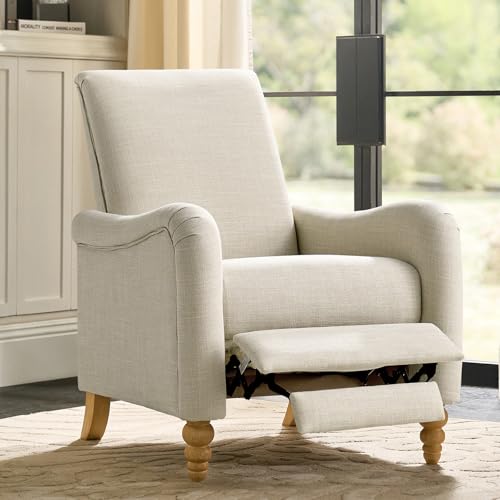
HULALA HOME Farmhouse Curved Recliner with Solid Wood Spindle Legs — Best Farmhouse Style
This pick is for decorated rooms — farmhouse, cottage and transitional spaces where a typical recliner silhouette would clash with everything else you own. Spindle legs are turned on a lathe, so each leg carries the rounded profile of traditional wooden furniture, and the listing confirms they are solid wood. The linen upholstery keeps the palette light and textured rather than glossy.
Strengths
- Solid wood spindle legs named in the title — traditional turned-wood looks
- Push-back recline with adjustable backrest and footrest hides inside an armchair shape
- Linen upholstery suits light, natural farmhouse colour schemes
Trade-offs
- Linen is the least forgiving upholstery here for spills and stains
- Legs raise the chair; the seat height will feel taller than low-slung recliners
- Spindle legs concentrate weight on small feet — use pads on delicate floors
| At a glance | |
|---|---|
| Wood element | Solid wood spindle legs |
| Recline type | Push-back, adjustable backrest & footrest |
| Upholstery | Linen |
| Back height | High back |
| Style | Farmhouse / curved back |
| Weight capacity | Not stated |
Legs change the whole maintenance picture of a recliner. A chair standing on turned wooden legs lets you vacuum underneath, lets air circulate, and lets the chair be lifted and carried by two people without dragging a mechanism base across the floor. It also means the recline hardware lives entirely in the seat box, so what you see from the side is furniture, not machinery. If your room already has turned legs on a coffee table or dining chairs, this is the recliner that will match them.
The honest cautions are about fabric and stance. Linen wrinkles, marks with water rings if a spill is left, and wants a throw or a quick blot rather than a scrub. And because the chair stands taller, shorter sitters should check that their feet still rest comfortably when seated upright; a small footstool or cushion solves it, but it is better to know before the box arrives. Neither point is a flaw — both are the normal price of a chair designed to look like an armchair first.
Best for: Farmhouse and cottage rooms that need a recliner in disguise / Not suited for: Homes with heavy spill risk or anyone wanting a low, lounge-style seat height
Check the current price on Amazon

IOMOR Push Back Recliner Chair with Solid Wood Legs — Best Cushioned Seat
Some buyers want the wood to be the whole story; others want comfort first and honest wooden legs underneath. This IOMOR is the second kind of chair. The overstuffed, padded seat is the headline, the push-back action keeps the mechanism invisible, and the solid wood legs keep it visually lighter than a skirted or pedestal recliner. It suits everyday living-room use where the chair will be sat in for hours, not admired from the doorway.
Strengths
- Overstuffed padded seat is the comfort focus, per the listing
- Solid wood legs confirmed in the title
- Push-back design keeps the armchair profile clean from every side
Trade-offs
- Deep, soft cushioning is harder to get out of for anyone with weak knees
- Fabric upholstery needs vacuuming and spot care to stay fresh
- The title does not state dimensions or capacity — measure and confirm before ordering
| At a glance | |
|---|---|
| Wood element | Solid wood legs |
| Recline type | Push-back |
| Upholstery | Fabric |
| Seat | Overstuffed, padded |
| Weight capacity | Not stated |
| Dimensions | Not stated |
Overstuffed seating divides people, so think about how you actually sit. If you curl up, sit sideways or spend whole evenings in one chair, generous padding is a daily pleasure. If you prefer firm support that holds your posture, a softer seat can feel like hard work by the end of a film. The push-back mechanism pairs naturally with this much cushion: as you lean, the back gives way and the seat keeps its shape, rather than a footrest lever dictating the position.
Because the listing is sparing with numbers, do the homework the title leaves undone: find the seat width between the arms, the seat height from the floor, and the fully reclined length in the full product details, and compare all three with a chair you already find comfortable. That five-minute check is the difference between a chair that fits your body and a chair that merely fits your room — and it matters more for an overstuffed model, where the usable seat is narrower than the outside width suggests.
Best for: Comfort-first buyers who still want real solid wood legs / Not suited for: Anyone who prefers a firm, upright seat or needs published dimensions up front
Check the current price on Amazon

GUEAPY Mid-Century Modern Wingback Recliner with Solid Wood Legs — Best Wingback Design
Wingbacks earn their keep in two ways: the wings block draughts and give a sideways headrest, and the tall, formal silhouette anchors a room corner like no low recliner can. Choose this GUEAPY if the chair will be seen — a living room focal point, a reading corner by a window — and if a floral accent pattern fits your scheme. The solid wood legs keep the base honest and traditional.
Strengths
- Wingback shape adds a sideways headrest and a formal, room-anchoring profile
- Solid wood legs stated in the listing title
- Manual push-back recline — no motor, no cables, place it anywhere
Trade-offs
- Floral upholstery is a strong look that will not suit every room
- Wingback sides narrow the usable shoulder space for broader sitters
- Accent chairs like this prioritise looks; check seat depth if you are tall
| At a glance | |
|---|---|
| Wood element | Solid wood legs |
| Recline type | Manual push-back |
| Style | Mid-century modern wingback |
| Upholstery | Upholstered (floral accent option) |
| Weight capacity | Not stated |
| Assembly | Not stated |
A wingback recliner solves a problem most recliners ignore: what your head does when you doze. Flat-back recliners let your head roll; wings catch it. For afternoon readers and nappers that is a real, nightly difference, and it is why the wingback form has survived for centuries. The push-back mechanism suits the style, too — a lever or side handle would spoil the line of the chair, and this design keeps every surface clean.
Treat it as an accent piece when planning the room. A floral pattern wants plain neighbours: a solid-colour sofa, a simple rug, curtains that pick out one colour from the pattern rather than competing with it. And because accent chairs are often bought by photograph, confirm the seat dimensions in the full listing before ordering — wingbacks can be narrower between the arms than they look, which matters if the chair is for a broad-shouldered sitter rather than purely for show.
Best for: Reading corners and living rooms that need a recliner with presence / Not suited for: Minimalist rooms, or broad sitters who need maximum seat width
Check the current price on Amazon

Eapmic Folding Wooden Lounge Chair with Footrest (Bamboo) — Best Portable / Bamboo
Not every wooden reclining chair needs to be a permanent piece of furniture. This Eapmic folds, so it suits renters, small flats, balconies and gardens where seating appears when guests or sunshine arrive and disappears afterwards. Bamboo is the honest material here: light for its strength, naturally at home outdoors, and visibly wood-like in grain and colour in a way no metal folding chair matches.
Strengths
- Folds flat for storage — the only pick that does
- Bamboo wooden frame is light to carry between house and garden
- Adjustable reclining backrest plus a footrest for a proper lounging position
Trade-offs
- A folding lounger will never match the cushioning of an upholstered recliner
- Bamboo left outdoors year-round will weather; store it dry between seasons
- Hinges and joints need a periodic check and tighten — normal for folding furniture
| At a glance | |
|---|---|
| Wood element | Bamboo wooden folding frame |
| Recline type | Adjustable backrest |
| Footrest | Included |
| Folding | Yes — portable, foldable |
| Use | Indoor / outdoor (per listing) |
| Weight capacity | Not stated |
Judge this chair by lounger rules, not armchair rules. The recline comes from an adjustable backrest with set positions rather than a continuous mechanism, and the footrest completes a laid-back line that works for sunbathing, garden reading and balcony mornings. What you give up in padding you gain in placement: the chair goes where the light is, follows the shade, and folds against a wall when the day is done.
Care is simple but not optional. Wipe bamboo down when it comes in wet, store it somewhere dry over winter, and run a hand over the joints at the start of each season to check for looseness — folding frames work their fixings over time, and a two-minute check keeps the chair feeling solid. Used that way, a bamboo lounger is one of the longest-lived pieces of garden furniture you can own, and it doubles as spare indoor seating whenever the house fills up.
Best for: Balconies, patios, renters and anyone short on storage space / Not suited for: Anyone wanting a deeply cushioned, permanent living-room recliner
Check the current price on Amazon
Comparison Table
| Pick | Badge | Key spec | Best for |
|---|---|---|---|
| Manual Push-Back Recliner with Wooden Arms (Light Grey Chenille) | Best Overall | Wooden arms; push-back recline; chenille | Buyers who want visible wood, a mid-century look and a simple manual recline |
| MCombo Manual Swivel Recliner with Ottoman 9019 | Best Swivel Recliner with Ottoman | Wooden base; 360° swivel; 330 lb capacity | Small living rooms, RVs and anyone who wants a swivel-plus-ottoman layout |
| HULALA HOME Farmhouse Curved Recliner with Solid Wood Spindle Legs | Best Farmhouse Style | Solid wood spindle legs; linen; push-back | Farmhouse and cottage rooms that need a recliner in disguise |
| IOMOR Push Back Recliner Chair with Solid Wood Legs | Best Cushioned Seat | Solid wood legs; overstuffed padded seat | Comfort-first buyers who still want real solid wood legs |
| GUEAPY Mid-Century Modern Wingback Recliner with Solid Wood Legs | Best Wingback Design | Solid wood legs; wingback; push-back | Reading corners and living rooms that need a recliner with presence |
| Eapmic Folding Wooden Lounge Chair with Footrest (Bamboo) | Best Portable / Bamboo | Bamboo frame; folds flat; adjustable backrest | Balconies, patios, renters and anyone short on storage space |
Read the wood column first — it is the whole point of this roundup. Arms, bases, legs and a bamboo frame distribute the wood very differently: legs and arms show constantly, a swivel base shows from across the room, and the folding lounger is wood throughout. Then compare recline types: four of the six lean back with a push, one swivels to an ottoman, and one adjusts in steps.
How to Choose Wooden Reclining Chairs
Start by deciding how much wood you actually want, because the market uses the word at every strength. At one end are chairs where wood is the visible structure — arms, legs, a swivel base. At the other are chairs where wood exists only as an internal frame you will never see. Neither is dishonest, but they are different products at different prices, and the listing title is your evidence: if the wood is a selling point, the manufacturer names it there. If the title is silent about wood, assume the wood is hidden and shop accordingly.
Next, match the recline mechanism to the sitter. Push-back chairs (four of our six) are simple and reliable but need a confident lean and work best for average-weight adults. Swivel-and-ottoman designs separate the leg support from the chair, which suits people who shift position often. Stepped adjustable loungers suit outdoor and occasional use. Powered recliners barely exist in genuinely wooden designs — if a listing claims both real wood throughout and a power mechanism, read it very carefully before believing either claim.
Finally, check the three dimensions that decide comfort: seat height (your feet should rest flat when upright), seat width between the arms (the honest width, not the outside measurement), and full reclined length plus the wall clearance behind it. Push-back and wingback designs typically need a clear gap behind the chair to reach full recline. Measure your space with the chair in its reclined footprint, not its upright one — the single most common wooden recliner disappointment is a beautiful chair that can only recline halfway because a wall is in the way.
Wood Types, Legs and Joinery: What to Look For
Listing titles in this category confirm “solid wood” far more often than they name a species, and that is the honest limit of what you can know before buying. What you can assess is form. Turned spindle legs signal traditional furniture-making and pair with farmhouse rooms. Straight tapered legs read mid-century. A full swivel base in wood is the boldest statement and the most visible. Bamboo is a grass rather than a timber, but it behaves like a light hardwood in furniture and is the right choice when the chair must be carried or live partly outdoors.
Whatever the form, legs and bases live or die by their fixings. On arrival, check that every leg sits flat with no rock, that bolts are tightened evenly rather than forced, and that the chair does not creak under a gentle side-to-side load. Felt or rubber pads under wooden feet protect both the leg ends and your floor, and they silence the scrape that makes a heavy chair feel cheap. Re-check tightness after the first month of use; new wooden furniture settles, and a quarter-turn on each bolt is normal maintenance, not a defect.
Finish care is equally simple. Dust wooden arms, legs and bases with a dry or barely damp cloth; standing water and harsh sprays dull finishes and can lift them over time. Keep wooden recliners out of direct, all-day sun where you can — not because the chair will fail, but because finishes fade unevenly where light falls on one arm and not the other.
Budget Tiers for Wooden Reclining Chairs
Prices in this niche move with upholstery more than with wood. As a framing guide rather than a price list: the budget tier is folding wooden and bamboo loungers and simple leg-based push-back chairs in fabric — honest, functional, and light on cushioning. The mid tier is where most of this roundup sits: solid wood legs or arms, better fabrics and chenilles, and mechanisms that feel engineered rather than improvised. The premium tier buys genuine leather, larger hardwood components and heavier frames — and is also where vague “wood” claims multiply, so the title test matters more, not less, as you spend more.
Spend first on the mechanism and the seat, because those decide whether you use the chair daily; spend second on the wood form you will enjoy looking at. A chair with modest legs and a seat you love will be used for a decade. A chair with beautiful legs and a seat you tolerate becomes the room’s most expensive clothes stand within a year.
Wooden Recliners vs Upholstered Recliners: Which Ages Better?
The honest comparison favours wood in exactly the places a chair gets touched. Armrests, leg tops and base edges are impact and friction zones: padded vinyl there eventually cracks, fabric there eventually shines and thins, but wood there develops a patina and can be wiped, waxed or in the worst case refinished. That is why the wooden-armed and wooden-based picks in this list are likely to look respectable for longer than a fully upholstered equivalent at the same price, even if the upholstery on both ages at the same rate.
Where upholstered recliners win is initial softness and choice. A padded arm is kinder to an elbow during a three-hour film, and the fully upholstered market is ten times the size, so sizes, fabrics and mechanisms multiply. The wooden niche asks you to accept a smaller catalogue in exchange for structure you can see and maintain. Most buyers who search this exact term have already made that trade in their heads; the job of this guide is simply to make sure the chair they pick delivers real wood in return.
One ageing factor is shared by every recliner regardless of material: the mechanism and the seat foam decide the chair’s working life. Foam softens, push-back pivots develop play, and no quantity of beautiful timber changes that. Buy the seat and the action first, the wood second — which is the same order we used to rank the six picks above.
Where a Wooden Reclining Chair Works Best in the Home
Reading corners are the natural habitat: a wooden recliner, a side table at arm height and a lamp behind the shoulder make a self-contained station that looks deliberate rather than parked. The wingback and spindle-leg picks were chosen with exactly this spot in mind. In open-plan rooms, a chair with real legs also beats a pedestal recliner visually, because sight lines pass underneath it and the room feels less full.
Bedrooms suit the quieter designs — the chenille wooden-arm chair and the MCombo with its ottoman both work as a dressing-and-reading seat that never needs to shout. For media rooms, be honest that a wooden recliner is a compromise: it will not swallow you like a theatre recliner, and that is precisely why some households prefer it. The room keeps its furniture character, and the recline is there when the film starts.
Avoid placing any recliner — wooden or not — where its reclined back will strike a radiator, a shelf edge or a door swing. And in homes with toddlers, remember that push-back chairs move when leaned on; position them so a climbing child cannot tip the chair backward into its recline arc.
How to Set Up and Position a Wooden Reclining Chair
Assembly on these chairs is usually legs, base and back rather than full construction, but the order you do it in — and where you put the finished chair — decides how solid it feels.
- Unpack on a soft surface and lay out every part before touching a bolt; confirm the legs, base or arms match the listing photographs.
- Fit wooden legs or the base loosely first, then tighten each fixing a little at a time in rotation, so the chair pulls down level instead of twisting toward the first tight bolt.
- Stand the chair on its hardest, flattest floor area and sit down slowly; rock gently side to side. Any wobble now is a fixing to adjust, not a fault to live with.
- Add felt or rubber pads under every wooden foot before the chair goes to its final position.
- Position the chair with full recline clearance: recline it completely, measure the gap the headrest needs behind, and leave at least that much space to the wall.
- Test the recline through its full travel ten times. Push-back chairs should move smoothly without a grinding point; swivel chairs should turn a full circle without catching.
- After two weeks of use, re-check every leg and base fixing once — new wood furniture settles, and a single tightening round keeps it silent for years.
For daily care, vacuum upholstery weekly, wipe wooden parts with a dry cloth, and keep a throw over the headrest area if hair products or oils are a factor in your household. That small routine protects both halves of the chair — the fabric you sit on and the wood you bought it for.
Common Buying Mistakes
Believing the photograph instead of the title. A chair photographed on a wooden floor, or beside a wooden table, is not a wooden chair. The listing title is where manufacturers state materials; if wood is not named there, do not pay a wooden-chair price for it.
Forgetting recline clearance. Upright footprints lie. A push-back or wingback recliner needs clear space behind it to open fully, and a chair that can only half-recline is a daily irritation.
Judging seat width by the outside measurement. Arms, wings and overstuffing all eat into the sitting space. The width between the arms is the number your body experiences.
Dragging the chair by its arms or back. Wooden legs and bases are strong vertically and weaker sideways. Lift with two people, or slide the chair on its pads — never haul it across the room by one arm.
Skipping the one-month re-tighten. New wooden furniture settles into its fixings. Five minutes with the supplied key after a few weeks prevents the creaks and wobbles people wrongly blame on build quality.
Key Takeaways
- Only buy “wooden” when the listing title names the wood — arms, base, solid wood legs or a bamboo frame.
- Push-back mechanisms dominate this niche: simple, motor-free, but they need wall clearance and a confident lean.
- Measure seat height, width between the arms, and full reclined length before ordering.
- Re-tighten leg and base fixings after the first month; it is normal wooden-furniture maintenance.
Final Recommendation
If you buy one chair from this list, make it the Manual Push-Back Recliner with Wooden Arms — it is the most complete answer to the search, with wood where your hands rest, a high back for long sits, and no motor to maintain. For a farmhouse room, the HULALA HOME spindle-leg chair disappears into the décor until you lean back; for a small space or an RV, the MCombo swivel on its wooden base is the flexible choice. Comfort-first buyers should take the IOMOR, design-led buyers the GUEAPY wingback, and anyone short on space the folding Eapmic bamboo lounger.
Whichever you choose, apply the title test one last time at checkout, measure your recline clearance, and check the current price on Amazon from the links above — prices and stock in this niche move often, and the right chair at the wrong size helps no one.
Quick re-check links: Wooden Arms Push-Back Recliner · MCombo 9019 · HULALA HOME Farmhouse Recliner · IOMOR Push Back Recliner · GUEAPY Wingback Recliner · Eapmic Bamboo Lounger
Best Reclining Chairs For Sleeping Best Reclining Leather Living Room Chairs Best High Leg Recliner Chairs Best Reclining Chairs For Nursery Best Temperature Controlled Reclining Chairs
Frequently Asked Questions
What makes a recliner a “wooden” reclining chair?
In this roundup, the wood has to be a visible, structural part named in the listing: wooden arms, a wooden swivel base, solid wood legs, or a wooden/bamboo folding frame. Almost all recliners contain some wood inside the frame; that alone does not make a chair a wooden recliner in any sense you can see or care for.
Are push-back recliners reliable?
Yes — they are the simplest recline mechanism in common use, with no motor, cable or battery to fail. The trade-off is effort and control: you recline by leaning and pushing, and the positions available are set by the mechanism rather than by a button. Most owners adapt within a few days.
How much space does a wooden recliner need behind it?
Enough for the headrest to travel back through its full arc — measure with the chair fully reclined rather than trusting the upright footprint. Wall-hugger mechanisms exist but are rare in wooden designs, so assume you need a genuine gap and plan the room around the reclined size.
Can wooden recliner legs damage floors?
Wooden feet are kinder than metal ones, but any hard foot can mark a soft floor finish over time. Fit felt or rubber pads under every leg — they protect the floor, protect the leg ends, and stop the chair creeping when you push back to recline.
Is bamboo a good material for a reclining lounger?
For a folding lounger, yes: bamboo is light for its strength, looks unmistakably natural, and handles indoor-outdoor life well if it is stored dry and wiped down after wet weather. It will not match the cushioning of an upholstered recliner, but that is a difference of category, not quality.
How do I care for the wooden parts of a recliner?
Dust with a dry or barely damp cloth, keep standing water and harsh sprays off the finish, and avoid all-day direct sun on one side of the chair where you can. Re-check leg and base fixings after the first month of use, then once or twice a year.


