Disclosure: airfryerkitchensupply.com is reader-supported. When you buy through links on our site, we may earn an affiliate commission at no extra cost to you.
Where to buy
The verified picks in this guide are sold on Amazon. Use the links below to check price on Amazon for each model; listings, sizes and colour options change over time, so confirm the exact configuration on the product page before ordering.
- BEQHAUSE Kitchen Runner Rug 24″x60″ — check price on Amazon
- Hazo Haus Navy Blue Runner Rug 2×6 for Kitchen — check price on Amazon
- Ileading Kitchen Rugs Set 3 Piece — check price on Amazon
- YDKGL Kitchen Rugs Kitchen Mats for Floor Non Slip Washable Blue 17″x3 — check price on Amazon
- eqivei Kitchen Rugs Non Slip Washable 2-Piece Kitchen Mats for Floor — check price on Amazon
- COSY HOMEER Soft Kitchen Floor Mats and Rugs Non Slip 20″x59″ — check price on Amazon
Introduction: Finding the non skid kitchen rugs
The best non skid kitchen rugs solve a problem every other kitchen rug creates: a loose rug in front of a sink or stove is a sliding hazard exactly where you stand holding hot pans and wet dishes. Non-skid performance comes from the backing — usually rubber or a rubberised weave — gripping the floor, and it is the first thing to verify, because a beautiful rug with a smooth backing is a beautiful accident waiting to happen. Every pick in this guide has its non-slip or non-skid backing confirmed in its verified listing title, in runner and mat sizes that suit real kitchen layouts.
Kitchen rugs live a harder life than any other rug in the house. They absorb sink splashes, catch cooking oil mist, endure daily vacuuming and, in busy homes, weekly washing. That is why this shortlist favours washable, low-pile, absorbent designs with stain resistance stated in their listings, and why we treat size honestly: a 17-by-30-inch mat covers a sink station, a 24-by-60 runner covers a galley run, and a multi-piece set covers a working triangle. Measure your floor first; the guide explains how below.
A terminology note for honest shopping: listings use non-slip, non-skid and anti-slip interchangeably, and all three describe backing grip rather than a certified standard. What you can verify is the backing type and the care instructions — and those, not the adjectives, decide whether a rug stays put and survives your washing machine.
In this guide
Quick Picks
Short on time? These are the six selections that survived verification, grouped by the job each one does best. Every linked model below was confirmed against the Amazon catalogue data available to this site; any slot that could not be verified is marked honestly instead of being filled with a guessed product.
BEQHAUSE Kitchen Runner Rug 24″x60″ — Best Overall Runner — check price on Amazon
BEQHAUSE’s 24-by-60 runner is non-slip, washable, absorbent and stain resistant — the complete checklist in the most useful kitchen size.
Hazo Haus Navy Blue Runner Rug 2×6 for Kitchen — Best Rubber Backing — check price on Amazon
Hazo Haus builds its 2-by-6 runner on a rubber backing and says so plainly — the most direct grip construction in this list.
Ileading Kitchen Rugs Set 3 Piece — Best Set for a Working Triangle — check price on Amazon
Ileading’s three-piece non-slip washable set covers sink, stove and prep zones in one coordinated purchase.
YDKGL Kitchen Rugs Kitchen Mats for Floor Non Slip Washable Blue 17″x3 — Best Compact Sink Mat — check price on Amazon
YDKGL’s 17-by-30 woven mat with rubber backing is the right-sized, super-absorbent answer for a single sink station.
eqivei Kitchen Rugs Non Slip Washable 2-Piece Kitchen Mats for Floor — Best Cushioned Two-Piece — check price on Amazon
eqivei’s two-piece set adds cushioned rubber backing for standing comfort at the two stations where cooks stand longest.
COSY HOMEER Soft Kitchen Floor Mats and Rugs Non Slip 20″x59″ — Best Soft Standing Runner — check price on Amazon
COSY HOMEER’s 20-by-59 soft runner is explicitly a non-skid standing mat — super absorbent, washable and sized for long counters.
Key Takeaways
- Backing grip is the product: verify rubber or rubberised backing in the listing before falling for a pattern.
- Low pile plus washable construction is the practical combination for a working kitchen.
- Size by station: single mats for the sink, runners for galley runs, sets for a working triangle.
- Absorbency matters at the sink; cushion matters at the stove; many kitchens need both in different spots.
- Non-slip, non-skid and anti-slip are marketing synonyms — judge the backing material and care label instead.
How These Picks Were Chosen
We searched catalogue data for kitchen rugs and runners with grip backing, then filtered out area rugs that merely mention a kitchen among many rooms — a living-room rug photographed near a counter is not a kitchen rug. Survivors had to confirm three things in their verified titles: kitchen intent, a non-slip or non-skid backing claim tied to a backing material or construction, and practical care such as washability or stain resistance. Decorative-only rugs with no stated grip were excluded regardless of appearance.
The six picks span the layouts kitchens actually have: a 24-by-60-inch runner for galley kitchens, a 2-by-6-foot rubber-backed runner that also serves halls and laundry rooms, a three-piece set for sink-stove-fridge triangles, a compact woven sink mat, a two-piece cushioned set for standing zones, and a soft absorbent runner with explicit non-skid standing-mat positioning. Colour variants of the same model were counted once — where a brand sells one rug in five colours, that is one pick, not five.
Standing rules apply as always: no static prices, no fixed ratings, and spec boxes that print only what the verified titles state — sizes, backing types and care features. Where a title does not state a pile height or material blend, we say so rather than filling the gap with a guess.
The 6 Best Non Skid Kitchen Rugs Reviewed

1. BEQHAUSE Kitchen Runner Rug 24″x60″ — Best Overall Runner
Check the current price on Amazon
The BEQHAUSE kitchen runner covers the classic galley run at 24 by 60 inches, and its verified listing confirms the full practical stack: non-slip backing, machine washable construction, extra absorbency and stain resistance. It suits the long sink-and-stove wall found in most apartments and family kitchens.
Strengths
- Stated 24×60 size covers a full sink-to-stove run in one piece
- Washable and stain resistant — the two care features kitchens actually need
- Absorbent surface handles the sink splash zone
Trade-offs
- One long runner cannot cover an L-shaped layout alone
- Blue colourway in this listing will not suit every kitchen scheme
- Low-profile kitchen rugs offer grip and coverage, not deep cushioning
| Specification (from the verified listing title) | Detail |
|---|---|
| Size | 24″ x 60″ (from listing title) |
| Backing | Non-slip |
| Care | Washable, stain resistant |
A single runner beats two small mats in a galley kitchen for one simple reason: there is no gap in the middle to catch a toe or a dropped utensil. The 24-inch width suits standard cabinet runs without creeping under the kick plates. Absorbency is the feature to weight most here — the zone in front of a sink receives more water in a week than the rest of the kitchen floor receives in a month, and a rug that spreads that water across an absorbent pile, then goes in the wash, is doing real work. Shake it outside weekly, wash it when the pile starts to hold cooking smells, and let it dry fully before relaying it so the backing grips a dry floor. On very smooth tile, even good backing benefits from a clean, dry floor underneath; mop first, rug second.
Best for: galley kitchens and long sink runs / Not suited for: L-shaped kitchens needing corner coverage
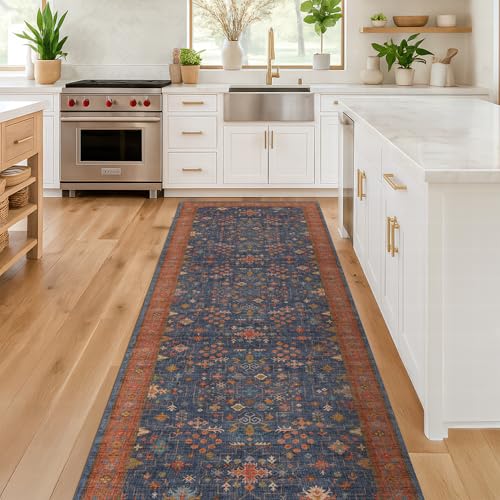
2. Hazo Haus Navy Blue Runner Rug 2×6 for Kitchen — Best Rubber Backing
Check the current price on Amazon
The Hazo Haus runner is a 2-by-6-foot low-pile rug with a washable, non-slip, non-skid rubber backing, positioned for kitchens, hallways, mudrooms and laundry rooms. If your first question is what physically stops the rug moving, this listing answers it in the most concrete terms available: rubber.
Strengths
- Rubber backing stated explicitly in the listing
- Low pile stays clear of door swings and chair casters
- One rug serves kitchen, hall or laundry — useful for open-plan homes
Trade-offs
- Multi-room positioning means a generalist pattern rather than a kitchen-specific design
- Rubber-backed rugs should be air-dried, not tumble-dried hot, to protect the backing
- Navy colourway shows flour and light dust readily
| Specification (from the verified listing title) | Detail |
|---|---|
| Size | 2 x 6 ft (from listing title) |
| Backing | Rubber, non-slip / non-skid |
| Pile | Low pile, stain resistant (per listing) |
Rubber backing is the oldest and most honest grip technology in rugs: it works by friction, it works on tile, vinyl and sealed wood, and its failure mode is gradual and visible — cracking after years of hot washing — rather than sudden. Protect it by washing cool and drying in air, and this class of runner lasts. The low pile is a deliberate trade: you give up plushness and gain a rug that doors clear, vacuums glide over, and dropped crumbs leave easily. In the kitchen, place the runner’s centreline where your feet actually stand at the stove, not where it looks centred in the room; grip matters most under working feet. The 2-by-6 footprint also fits the laundry and mudroom roles the listing claims, making this the natural buy for a home standardising on one runner everywhere.
Best for: buyers who want explicit rubber-backed grip / Not suited for: buyers wanting a plush, cushioned standing feel

3. Ileading Kitchen Rugs Set 3 Piece — Best Set for a Working Triangle
Check the current price on Amazon
The Ileading kitchen rug set provides three coordinated non-slip, washable pieces with stain-resistant, farmhouse-styled designs for the three stations of a working kitchen. It suits buyers furnishing a kitchen from scratch who want matched coverage rather than a patchwork of single mats bought over years.
Strengths
- Three pieces cover the sink-stove-prep triangle in one purchase
- Non-slip and washable across the set
- Coordinated styling keeps a busy kitchen looking intentional
Trade-offs
- Set sizes are fixed — one piece may not match your station spacing
- Farmhouse styling is a specific look that will not suit modernist kitchens
- Three pieces mean three items to wash and relay
| Specification (from the verified listing title) | Detail |
|---|---|
| Configuration | 3-piece set |
| Backing | Non-slip |
| Care | Washable, stain resistant |
Sets succeed or fail on layout fit, so measure before ordering: pace out your sink, stove and main prep counter, and compare the distances with the set’s piece sizes on the product page. When the geometry matches, a set is the most economical way to cover a kitchen and the most visually coherent. The washable, stain-resistant construction matters more in a set than in a single mat, because the stove piece will collect oil mist while the sink piece collects water — expect to wash the stove piece most often, and rotate pieces between stations if sizes allow, to equalise wear. Grip on sets is only as good as the smallest piece: small mats move more readily than long runners, so place the smallest piece where feet are most stationary, typically at the sink.
Best for: new kitchens needing full coordinated coverage / Not suited for: kitchens whose station spacing is unusual

4. YDKGL Kitchen Rugs Kitchen Mats for Floor Non Slip Washable Blue 17″x3 — Best Compact Sink Mat
Check the current price on Amazon
The YDKGL kitchen mat is a compact 17-by-30-inch woven rug with rubber backing, positioned as a super-absorbent, washable floor mat for the sink zone. It is the pick for small kitchens, single-station coverage and buyers who want one excellent mat rather than a room of rugs.
Strengths
- Compact stated size fits apartment sinks and small kitchens precisely
- Woven construction with rubber backing balances grip and absorbency
- Washable — essential for a mat that lives at the splash zone
Trade-offs
- Covers one station only
- Woven surfaces hold crumbs more than flat low-pile rivals
- Blue colourway in this listing limits scheme matching
| Specification (from the verified listing title) | Detail |
|---|---|
| Size | 17″ x 30″ (from listing title) |
| Backing | Woven rubber backing |
| Care | Washable, super absorbent (per listing) |
Small mats are where non-skid backing matters most, because a short mat has less weight and less friction area holding it in place — and this is exactly the mat that gets stepped on with wet hands and wet feet. The woven construction earns its place at the sink: woven pile absorbs and spreads splash water instead of letting it pool on a flat surface, and the rubber backing supplies the grip. Wash it more often than you think necessary; sink mats quietly accumulate a remarkable load of soap residue and food splash, and a mat that smells faintly of old dishwater is telling you its wash is overdue. Dry it fully before putting it back — rubber backing on a damp floor grips noticeably worse.
Best for: small kitchens and single sink stations / Not suited for: large kitchens needing run coverage

5. eqivei Kitchen Rugs Non Slip Washable 2-Piece Kitchen Mats for Floor — Best Cushioned Two-Piece
Check the current price on Amazon
The eqivei kitchen rug set pairs two non-slip washable mats with a cushioned rubber backing, absorbent woven surfaces and runner sizing for sink and stove zones. It suits cooks who stand for long stretches — bakers, batch cookers and holiday hosts — and feel it in their legs by evening.
Strengths
- Cushioned backing adds standing comfort plain rugs cannot offer
- Two pieces cover the two main standing stations
- Absorbent woven surface with washable care
Trade-offs
- Cushion layer adds thickness — check door clearance
- Two fixed sizes may not match every kitchen’s spacing
- Cushioned mats should not be placed where stools or carts roll
| Specification (from the verified listing title) | Detail |
|---|---|
| Configuration | 2-piece set |
| Backing | Cushioned rubber backing, non-slip |
| Care | Washable, absorbent woven |
Cushion is the one upgrade in kitchen flooring you feel within a single cooking session: a few millimetres of resilient backing under the heel changes an hour of stirring and chopping from a leg workout into a non-event. The eqivei set builds that cushion into the backing itself, so grip and comfort arrive together rather than as a mat stacked on a pad — a stack that would defeat the non-skid purpose entirely. Keep cushioned pieces at standing stations and out of traffic lanes and rolling zones, where their thickness becomes a trip edge. Wash gently and dry flat; cushion layers last longest when they are not wrung, folded or baked in a hot dryer.
Best for: cooks who stand for long sessions / Not suited for: traffic lanes or rolling-cart zones

6. COSY HOMEER Soft Kitchen Floor Mats and Rugs Non Slip 20″x59″ — Best Soft Standing Runner
Check the current price on Amazon
The COSY HOMEER kitchen runner is a soft 20-by-59-inch floor mat whose listing calls it a non-skid standing mat outright, with super-absorbent performance and washable care. It suits long counter runs in family kitchens where one continuous soft surface beats several small mats.
Strengths
- Standing-mat positioning with explicit non-skid claim
- Super absorbent surface for busy family sink zones
- Long single-piece coverage with no mid-run gaps
Trade-offs
- Soft construction trades some firmness of footing for comfort
- This model is sold in several colours — they are variants of one pick, not different rugs
- Long runners need a long wash cycle and drying space
| Specification (from the verified listing title) | Detail |
|---|---|
| Size | 20″ x 59″ (from listing title) |
| Backing | Non-skid standing mat |
| Care | Washable, super absorbent (per listing) |
Note the honesty point in this pick’s trade-offs, because it applies across the whole category: this brand sells the same runner in multiple colours under separate listings, and a guide that counted each colour as a different recommendation would be padding its list. It is one design — a soft, absorbent, non-skid runner — and judged as one design it is strong: the length covers a family sink-and-dishwasher run, the soft surface suits bare feet on cold mornings, and washability keeps it hygienic. Soft runners grip best on clean, dry, smooth floors; on textured tile, press the edges down after washing and relaying. If your kitchen floor is heated, check the product page for backing heat guidance before ordering any rubberised rug.
Best for: family kitchens with long counter runs / Not suited for: buyers wanting a firm, thin rug feel
Comparison Table
| Pick | Badge | Key spec | Best for |
|---|---|---|---|
| BEQHAUSE Kitchen Runner Rug 24″x60″ | Best Overall Runner | 24″x60″ runner, non-slip, washable | galley kitchens and long sink runs |
| Hazo Haus Navy Blue Runner Rug 2×6 for Kitchen | Best Rubber Backing | 2×6 ft, rubber backing, non-skid | buyers who want explicit rubber-backed grip |
| Ileading Kitchen Rugs Set 3 Piece | Best Set for a Working Triangle | 3-piece set, non-slip, washable | new kitchens needing full coordinated coverage |
| YDKGL Kitchen Rugs Kitchen Mats for Floor Non Slip Washable Blue 17″x3 | Best Compact Sink Mat | 17″x30″, woven rubber backing, absorbent | small kitchens and single sink stations |
| eqivei Kitchen Rugs Non Slip Washable 2-Piece Kitchen Mats for Floor | Best Cushioned Two-Piece | 2-piece set, cushioned rubber backing | cooks who stand for long sessions |
| COSY HOMEER Soft Kitchen Floor Mats and Rugs Non Slip 20″x59″ | Best Soft Standing Runner | 20″x59″, non-skid standing mat, absorbent | family kitchens with long counter runs |
How to Choose the Best Non Skid Kitchen Rugs
Start at the back of the rug, not the front. Grip comes from backing material: natural or synthetic rubber backings grip by friction and are the most reliable on tile, vinyl and sealed wood; woven rubber-backed constructions combine grip with absorbency; thin latex coatings grip when new but wear fastest. The listings in this guide state their backing approach in their titles, and that statement — not the words non-slip, non-skid or anti-slip, which are used interchangeably — is what you are actually buying.
Next, size the rug to the work, not the room. Stand at your sink and stove in your normal stance and note where your feet land: that footprint, plus a margin, is your mat. Kitchens with a single work wall suit one runner; L-shaped and island kitchens suit sets or a runner plus a mat. Leave a border of bare floor around the rug — a rug that reaches wall to wall traps moisture at its edges and is harder to lift for washing.
Then weigh the care reality. A kitchen rug that cannot be machine washed will, in practice, not be washed, and an unwashed kitchen rug becomes the least hygienic textile in the house. Low pile washes and dries fastest and vacuums cleanest. Absorbency matters at the sink; cushion matters at the stove; stain resistance matters everywhere in a working kitchen. Choose the two properties your cooking style stresses most, and let the third go — no single rug maximises all three.
Keeping Non-Skid Backing Working for Years
Non-skid performance is a maintenance state, not a permanent property. Rubber and rubberised backings lose grip when they are dirty, damp underneath, or heat-damaged. The routine that preserves them is simple: lift the rug weekly and clean the floor beneath it, because the dust and cooking-oil film that accumulate under a kitchen rug are a lubricant layer working against the backing. Wash the rug itself on a cool cycle, and dry it in air rather than high heat — repeated hot tumble drying is the fastest way to crack a rubber backing and end a rug’s gripping life.
Know the warning signs. A rug that has started travelling across the floor, edges that curl upward, or a backing that feels powdery or shows fine cracks is a rug whose grip is failing. Curling edges are a trip hazard in their own right and should not be tolerated in front of a stove. When backing fails, replace the rug; rug pads and tapes underneath a kitchen rug create a stacked, sliding sandwich and are not a safe repair in a wet, hot work zone.
Floor type matters too. Freshly sealed or waxed floors can interact with rubber backings, and delicate finishes deserve a check of the product page guidance before a rubber-backed rug is laid for months at a time. On heated floors, confirm the backing tolerates warmth. None of this is complicated — it is simply the difference between a rug that grips for years and one that grips for a season.
Kitchen Rug Placement: A Station-by-Station Plan
Place rugs where feet stand still, not where feet travel. The sink station takes the highest priority: it is the wet zone, the standing zone and the dropped-glass zone in one. A mat or runner section centred on your standing position — not centred on the cabinet — does the work. The stove station is second: you stand there longest during active cooking, which is where cushioned backing pays for itself, but keep rug edges well clear of the oven door’s swing and never let a rug sit where a hot pan might be set down in an emergency.
Traffic lanes between stations should stay bare. Rugs in lanes add trip edges exactly where you move fastest carrying heavy, hot or sharp things. The fridge and prep counter usually need coverage only in large kitchens; in small ones, a runner that spans sink and stove covers both stations and the step between them, which is why the runner format dominates this guide’s picks.
Finally, think in seasons. Winter adds meltwater at the door end of many kitchens; summer adds bare feet that feel cold floors and appreciate a soft runner. A washable rug you can lift, wash and relay in an hour adapts to both. The best non skid kitchen rug is ultimately the one whose backing still grips in year two — buy the backing, maintain the backing, and let the pattern be the bonus.
Non Skid Rugs in Rental Kitchens and Open-Plan Homes
Rental kitchens add a constraint this category rarely discusses: the floor is not yours. Rubber backings are generally kind to sealed floors, but long contact on some finishes — freshly waxed wood, certain vinyls — can leave marks, and a renter’s deposit rides on the difference. The precautions are cheap: lift the rug weekly (which good grip maintenance requires anyway), never leave a damp rug sitting on wood for weeks, and let a washed rug dry fully before it goes back down. Follow those rules and a non-skid rug protects the floor it covers rather than threatening it — most landlords would rather see a clean rug than the traffic wear of an uncovered work zone.
Open-plan homes raise the opposite issue: the kitchen rug is visible from the living room, so it gets chosen as décor and demoted as equipment. Resist the demotion. The runner that spans your sink and stove will be the hardest-working textile in the open space, and its backing, pile height and washability matter more than whether it flatters the sofa. Choose the pattern last, from among the constructions that pass the equipment test — as this guide’s picks were chosen — and an open-plan kitchen can have both.
One more open-plan reality: sound. A rug in the work zone measurably softens the acoustic of a hard-floored open space, absorbing the clatter frequencies that make kitchens feel harsh. It is a side benefit rather than a reason to buy, but households that add a runner often report the room feels calmer — a reminder that the best kitchen equipment sometimes pays twice.
Kitchen Rug Fibres: What Survives a Working Kitchen
Fibre choice decides how a kitchen rug ages, and the kitchen is an unusually honest testing ground: water, oil, heat, grit and bleach-based cleaners all arrive weekly. Synthetic piles — polyester and polypropylene families — dominate this category for sound reasons. They absorb water into the pile structure without weakening, resist staining, tolerate machine washing and dry quickly. Their weakness is heat: a synthetic rug should never sit where a hot pan might land, and tumble-dryer heat is their slow enemy, which is another argument for air drying.
Woven constructions, like the sink mat pick in this guide, trade a little softness for structure: the weave itself creates texture that traps splash water and hides the crumb-level evidence of a working kitchen between washes. Flat, low piles vacuum cleanest and are the right choice under rolling stools and carts. Deep, plush piles feel wonderful at 7 a.m. and hold the most soil by Friday; in a kitchen, that trade usually resolves against plushness except at a single standing station.
Natural fibres have their place in kitchens — cotton washes well and feels honest — but they dry slowly and fade, and a slow-drying rug in a wet zone spends part of its life as a damp rug, which serves neither grip nor hygiene. The practical synthesis, and the one this guide’s picks reflect, is synthetic or woven construction for the wet and working zones, with natural fibres reserved for the calmer corners of the room.
A Seasonal Calendar for Kitchen Rug Care
Kitchen rugs live by the calendar more than owners expect, because the kitchen itself changes with the seasons. Winter brings the heaviest load: meltwater and grit tracked to the door end, longer cooking days, and rugs that dry slowly in cold, closed-up houses. Winter discipline is frequency — shake and lift more often, wash before the rug looks dirty, and never let a damp rug sit sealed against a wood floor for weeks. The backing you protect in winter is the grip you rely on all year.
Spring is inspection season. Flip every kitchen rug and read its backing like a report: flexible and intact means another year; cracking, powdering or smooth-worn patches mean the rug’s gripping life is ending, and the honest move is to replace it while the failure is still a choice rather than an incident. Spring is also when a household should re-audit placement — stations move as habits change, and the rug should follow the feet, not last year’s floor plan.
Summer lightens the load but adds bare feet, which feel backing failure and pile wear more honestly than shoes do; if a rug feels tired in July, believe your feet. Autumn is the deep-clean: the full wash, the floor beneath scrubbed and dried, the rug relaid on a pristine surface before the heavy cooking season begins. Four small rituals a year — that is the entire calendar. Households that keep it find their non-skid rugs still gripping in year three; households that skip it buy the same rug twice and blame the rug both times.
Rug Layering, Borders and the Look of a Finished Kitchen
Once the equipment questions are settled, a kitchen rug still has to live in a designed room, and a few composition rules keep function and appearance from fighting. Leave a border of bare floor visible around the rug on all sides: the border is what makes the rug read as intentional rather than as carpet that lost its way, and it keeps edges away from the kick plates and door swings where they would curl and fray. Align a runner’s long edges with the cabinetry lines it parallels; a runner a few degrees off-axis nags at the eye every single day in a way no pattern can compensate for.
Colour and pattern scale follow workload, not fashion. Busy, mid-tone patterns forgive the daily evidence of cooking between washes, which is why they dominate real kitchens; pale, plain rugs are beautiful for exactly one day after each wash. In open-plan spaces, let the kitchen rug borrow one colour from the living area rather than matching it — coordination reads as calm, duplication reads as indecision. None of these rules outrank the backing, the sizing or the care label. They simply ensure that the rug you chose as equipment can also be lived with as furniture, which is the difference between a purchase that satisfies for years and one that satisfies until the novelty fades.
What to Do When a Kitchen Rug Still Slides
Occasionally a rug with a sound backing still travels on a particular floor, and the troubleshooting order matters. First, clean both interfaces properly — the floor beneath and the backing itself — because the majority of sliding cases are contamination, not construction. Second, confirm the floor is fully dry and, if it was recently sealed, waxed or polished, allow that finish to cure; fresh surface treatments defeat backings that will grip the same floor perfectly a month later. Third, check the rug’s size against its traffic: a small mat in a turning zone, where feet pivot rather than stand, lives the hardest life in the category, and the honest fix is a larger rug or a runner that removes the pivot from the mat entirely.
What not to do is stack fixes. Tape, pads and liners layered under a kitchen rug create multiple slip planes in the wettest, hottest work zone in the house, and each layer’s failure mode compounds the others. If a clean floor, a dry start and a correctly sized rug still slide, the backing itself has failed or was never adequate — replace the rug and let the failed one retire to a dry, low-stakes floor. In a kitchen, persistence with a sliding rug is not thrift; it is risk with a familiar face.
One Final Note
One last habit separates satisfied owners from disappointed ones in this category: they treat the first wash as part of the purchase. A new rug’s backing often grips better after its first cool wash removes factory residues, its pile stands up properly, and any loose fibres leave before they can track through the house. Wash it before its first week of service, dry it fully, relay it on a clean floor, and the rug you then judge is the rug as it will actually live — which, for every pick in this guide, is a rug that stays exactly where you put it.
How to Install and Care for Non Skid Kitchen Rugs
Installation is five minutes of care that decides whether the backing ever gets to work. First, clean the floor where the rug will sit — mop it, and let it dry completely, because backing grips a clean dry surface and skates on a dusty or damp one. Second, unroll the rug and let it relax flat for several hours; rugs shipped rolled hold a curl memory, and edges that start curled rarely flatten fully underfoot. Books on the corners overnight solve stubborn cases. Third, position the rug by standing in your working stance and centring it under your feet, then press down along its full length, especially the edges, to seat the backing.
Test the installation honestly before you cook: stand on the rug and push sideways with one foot as if reaching across a counter. A well-seated rubber backing on a clean floor should not travel. If it does, lift, re-clean the floor, check for moisture, and relay. On exceptionally smooth floors, the first wash often improves grip by removing factory surface residues from the backing.
For care, shake the rug outside several times a week — daily in homes with pets — vacuum it on a hard-floor setting without a beater bar grinding the backing edges, and machine wash it cool when it holds cooking smells or visible soil. Air-dry flat or on a line, never in high heat. Rotate long runners end-for-end monthly so the sink end and stove end share wear. Follow that routine and the non-skid performance you bought on day one is still there in year three.
Common Buying Mistakes
The most common mistake is buying the pattern and ignoring the backing, then discovering at the first sink session that the rug surfs. Read listings for the backing construction, not the adjectives. The second mistake is sizing by room instead of by station: a rug centred beautifully on the kitchen that leaves your feet half off its edge at the stove is decoration, not equipment. Third, buyers stack solutions — a rug on a pad on a mat — creating layered slip planes that are more dangerous than any single layer.
Fourth, people tumble-dry rubber-backed rugs on hot cycles and crack the backing within a year, then blame the rug. Air drying is part of the product’s real cost; if you cannot air-dry, choose a fully woven washable construction and accept its different grip character. Fifth, rugs get left down for months without lifting, while the floor beneath grows a film of dust and oil that silently defeats the grip. Lift weekly, clean beneath, relay. And finally, shoppers tolerate curling edges and travelling rugs long past the point of safety because the rug still looks fine from above. In a kitchen, grip is the product — when the grip goes, the rug goes, however pretty the pattern remains.
Final Recommendation
For most kitchens, the BEQHAUSE runner is the complete answer: right size, washable, absorbent and non-slip in one piece. If explicit rubber backing reassures you — it should — the Hazo Haus runner states its construction plainest. Furnishing a whole kitchen at once points to the Ileading three-piece set; standing for hours points to the cushioned eqivei pair; a single small sink points to the YDKGL mat; and long family counter runs suit the soft COSY HOMEER runner. Buy the backing first, size it to your stance, and maintain it — that is the whole discipline of a kitchen rug that never slides.
Related guides on this site: Best Blue Kitchen Rugs · Best Kitchen Rugs For Standing · Best Kitchen Rugs For Wood Floors · Best Kitchen Rugs Washable Hook And Loom · Best Rug Pad For Small Kitchen Rugs
Related guides
Frequently Asked Questions
What is the difference between non-slip, non-skid and anti-slip rugs?
In practice, nothing — the terms are used interchangeably in listings and none denotes a certified standard. What differs is the backing construction behind the words: rubber backings, rubberised woven backings and latex coatings grip differently and age differently. Judge the stated backing material and the care instructions, not the adjective.
Do non skid kitchen rugs work on tile floors?
Yes — tile is one of the best surfaces for rubber-backed rugs, provided both the tile and the backing are clean and dry. Dust, mop residue and moisture under the rug are the usual causes when a rug that should grip does not. On very glossy tile, relay the rug after its first wash, which removes factory residues from the backing.
How often should a kitchen rug be washed?
Shake it outside several times a week and wash it whenever it holds cooking smells, looks soiled or feels stiff with residue — typically every one to three weeks in a working kitchen. The sink-station rug needs washing most often. Always let it dry fully before relaying it.
Can I put a rubber-backed rug on hardwood?
Generally yes on sealed hardwood, but check the product page guidance: some finishes and waxes interact with rubber over long contact, and freshly refinished floors should cure fully first. Lift the rug weekly — which you should do anyway for cleaning — and inspect the finish beneath during the first month.
Are cushioned kitchen mats better than rugs?
They solve a different problem. Cushion relieves leg and back fatigue during long standing, while rugs cover more floor and absorb more water. Many cooks use both in different stations — cushion at the stove, absorbent rug at the sink. Never stack a cushioned mat on top of a rug; the stack defeats the non-skid purpose.
When should a non skid rug be replaced?
When the backing cracks, powders or stops gripping after the floor and rug are both clean and dry, or when edges curl persistently upward. At that point the rug has become the hazard it was bought to prevent, and no cleaning routine will restore it.


