Disclosure: airfryerkitchensupply.com is reader-supported. When you buy through links on our site, we may earn an affiliate commission at no extra cost to you.
Where to buy
Every chair below was confirmed against Amazon listing data held in our verified product cache before it earned a link. Where a chair appears with an Amazon link, that link goes to the exact listing whose title we checked. Use the links in this box for a fast shortlist, then read the full reviews before you commit — the right kind of spring for a focused writer is not the same as the right kind for someone who leans, rocks and fidgets through calls all day.
- DUMOS Home Office Chair (Rocking Mode, Black) — check price on Amazon
- Steelcase Leap Office Chair (Onyx) — check price on Amazon
- Herman Miller Embody Ergonomic Office Chair (Charcoal Rhythm) — check price on Amazon
- SIHOO M18 Ergonomic Office Chair (Black) — check price on Amazon
- Furmax Office Chair (Black) — check price on Amazon
- Sweetcrispy Ergonomic Computer Desk Chair (Gray) — check price on Amazon
If you are shopping for the best springy office chairs, you are probably tired of seats that feel like a plank: you sit down, nothing gives, and two hours later your lower back and hips are doing all the complaining. A springy chair answers with movement — a seat and back that yield when you sit, rebound when you shift, and let you rock, tilt or lean without fighting the furniture. That give is not a gimmick. Small, constant movement keeps you changing posture through the day instead of locking into one position, and it is the single biggest comfort difference between a chair you tolerate and a chair you actually like sitting in for a full shift.
One honesty note before the picks: no mainstream office-chair listing actually uses the word springy in its title, so we judged springiness only by mechanisms the listings themselves state — rocking modes, tilt and recline ranges, flexible live-back designs and breathable mesh that flexes under you. Where a listing states a mechanism, we say so. Where it does not, we do not invent one. Every chair below is a complete chair (never a cushion, mat or accessory), each model appears once even when it sells in several colours, and none of the six is a gaming chair or a kids’ chair dressed up for adults.
Key Takeaways
- Springiness comes from stated mechanisms — rocking modes, tilt ranges and flexible backs — not from marketing adjectives.
- Mesh backs flex and breathe; padded executive seats cushion but move less. Pick the kind of give you actually want.
- A chair that holds a stated weight capacity above your weight will keep its spring longer than one at its limit.
- Lock the tilt when you need focus; a springy chair should let you switch the movement off, not force it on you.
- No listing below claims the word springy — each pick earned its place from a mechanism named in its own title.
In this guide
Quick Picks
Best Overall: DUMOS Home Office Chair (Rocking Mode, Black) — Check on Amazon
The only chair here whose listing literally names a rocking mode, paired with a flexing mesh mid-back and named lumbar support — the clearest spring-per-dollar answer in the group.
Best Premium Spring: Steelcase Leap Office Chair (Onyx) — Check on Amazon
The Leap’s LiveBack backrest changes shape as you move and its Natural Glide System lets the seat travel as you recline — engineered spring, at an engineered price tier.
Best Flexible Back: Herman Miller Embody Ergonomic Office Chair (Charcoal Rhythm) — Check on Amazon
The Embody’s fame rests on a back built to flex point by point with your spine; the verified listing is the Charcoal Rhythm configuration with fully adjustable arms and carpet casters.
Best for Heavier Sitters: SIHOO M18 Ergonomic Office Chair (Black) — Check on Amazon
A stated 330 lb capacity, tilt lock, adjustable lumbar support, 2D armrests and a wide cushion — spring that stays controlled under bigger bodies.
Best Budget: Furmax Office Chair (Black) — Check on Amazon
The value anchor: a breathable mesh mid-back that flexes as you lean, lumbar support, adjustable height and easy assembly, at the budget end of the market.
Best Small-Space Spring: Sweetcrispy Ergonomic Computer Desk Chair (Gray) — Check on Amazon
Flip-up arms let this mesh mid-back slide fully under a desk — the springy pick for bedrooms, study nooks and small apartments.
How These Picks Were Chosen
We started from office chairs whose Amazon listings we had already verified, then filtered hard. Out went chair mats, seat cushions, footrests and every other accessory — this list is chairs only. Out went kids’ study chairs and racing-style gaming chairs, which promise bounce but are built for different bodies and different rooms. What remained were adult ergonomic chairs whose titles state a movement or support mechanism we could point to.
From that pool we ranked by how directly the stated mechanism produces give: an explicit rocking mode first, then tilt and recline ranges, then flexible back technologies, then the natural flex of a mesh back over a frame. We also required the basics a springy chair still has to get right — lumbar support named in the title, adjustable height, and a swivel base — because a bouncy chair that wrecks your posture is worse than a firm one that supports it.
Finally, we deduplicated by model. Several of these chairs sell in multiple colours and arm configurations; each model appears once, and where a listing is one specific configuration we say exactly which one it is, so you are never misled into thinking a linked variant is a different chair.
The 6 Best Springy Office Chairs

DUMOS Home Office Chair (Rocking Mode, Black) — Best Overall
The DUMOS earns the top badge on the simplest evidence in this roundup: its listing states a rocking mode outright. Rocking is the purest form of office-chair spring — you lean back, the chair gives smoothly, you come forward, it returns you — and most budget chairs fake it with a loose tilt knob or skip it entirely. Here it is a named feature, sitting alongside an ergonomic mid-back in breathable mesh, fixed armrests, height adjustment and a full 360-degree swivel. The mesh matters to the springy brief too: a mesh back flexes against your shoulders as you move, so the give comes from both the base mechanism and the backrest itself.
Strengths
- Rocking mode stated in the listing — real, switchable-feeling give
- Mesh mid-back flexes as you lean and stays breathable
- Lumbar support and height adjustment both named in the title
Trade-offs
- Fixed armrests — no width or height tuning for your elbows
- Mid-back height will not support taller users’ shoulders
- Black is the configuration verified here; other colours are separate listings
| Spec (from listing title) | Detail |
|---|---|
| Back | Ergonomic mid-back mesh |
| Mechanism | Rocking mode, 360° swivel |
| Support | Lumbar support (as titled) |
| Armrests | Fixed |
| Colour verified | Black |
In daily use this is the chair for the restless sitter on a sensible budget: someone who rocks while reading, leans back to think, and swivels between a desk and a side table. The combination of a rocking base and a mesh back means movement is available in two directions, which is exactly what keeps a long session from stiffening up. The honest limits are fit-related rather than quality-related. Fixed armrests either land at your elbow height or they do not, and a mid-back design deliberately trades head and shoulder support for a lighter, airier chair. If you are tall, or you know you want to nap-recline at lunch, look further down this list; if you want genuine spring in a compact home-office footprint, start here.
One more practical note on the DUMOS: because its armrests are fixed, check your desk height before ordering — if your desktop is unusually high or low, fixed arms are the one dimension you cannot negotiate with. The rocking mechanism also rewards a clear floor area behind the chair; a rocking chair against a wall is a chair whose best feature has been cancelled by furniture placement. Give it the space its listing promises it can use.
Assembly, briefly: the DUMOS class of chair is a one-person, one-evening build, and the rocking mechanism rewards careful bolt-tightening — a loosely seated mechanism bolt is the most common cause of a rock that feels vague rather than smooth. Tighten in the maker’s sequence, sit, then re-check the main pivot bolts after the first week. Warranty thinking, in one line: at this tier the paperwork is basic, so your protection is the return window — spend the first fortnight sitting in the DUMOS through real workdays, not weekend trials, and let that honest test make the keep-or-return decision.
Best for: Budget-minded fidgeters who rock while they work / Not suited for: Tall users who need head and shoulder support
Check on Amazon — check the current price on Amazon before you buy, and confirm the exact configuration on the listing page.

Steelcase Leap Office Chair (Onyx) — Best Premium Spring
The Steelcase Leap is what springiness looks like when an engineering team designs for it deliberately. Its listing names two technologies that both exist to keep the chair moving with you: LiveBack, a backrest built to change shape as your spine changes position, and a Natural Glide System, which lets the seat move forward as you recline so your eyes and arms stay in the right relationship to your desk instead of being dragged away from it. Most chairs that recline pull you out of your working position; the Leap’s whole point is that it does not. It is the premium-priced anchor of this list, and it is here because the mechanism is real, named and central to the design.
Strengths
- LiveBack backrest flexes and reshapes as you shift posture
- Natural Glide keeps you positioned at your desk while reclining
- A long-established ergonomic design with carpet casters fitted
Trade-offs
- Premium tier — the most expensive route to spring on this list
- Heavier, more complex chair than a simple mesh task chair
- Onyx is the verified configuration; finishes vary by listing
| Spec (from listing title) | Detail |
|---|---|
| Back technology | LiveBack (as titled) |
| Mechanism | Natural Glide System |
| Casters | For carpet (as titled) |
| Colour verified | Onyx |
Choose the Leap if sitting is genuinely your job — eight-plus hours, five days a week, year after year — and you have learned the hard way that cheap spring wears out into sloppy spring. A designed flex system holds its behaviour far longer than a budget tilt mechanism, and the glide-while-reclining behaviour is something you feel every single time you lean back to read a long document. The trade is money and mass: this is a serious piece of office furniture, not a flat-pack weekend project. If your budget is mid-range, the chairs around it on this list deliver most of the movement for a fraction of the commitment; if you buy chairs once a decade, this is the one built for that habit.
Ownership is where premium chairs quietly justify themselves. A Leap-class chair is built to be kept: components are designed as a system rather than as a disposable assembly, and the chair’s behaviour in year eight resembles its behaviour in year one far more closely than a budget mechanism’s does. If you are the kind of buyer who maintains things — who would rather service a good object than replace a cheap one — the Leap’s economics and its spring both run on your side.
Resale and longevity, briefly: Steelcase chairs hold value in a way flat-pack chairs do not, because offices buy them used by the pallet. If your life involves moves and changes, that second-hand depth is a practical asset — the chair can leave your home as easily as it entered, which cannot be said of most furniture at any tier. If you buy one premium chair in your life, insure it with placement: away from radiators and direct sun, which age every material a chair contains, and on the carpet its casters were named for. Environment is the silent half of every longevity claim.
Best for: Full-time desk workers buying a decade-long chair / Not suited for: Anyone furnishing a temporary or spare-room setup
Check on Amazon — check the current price on Amazon before you buy, and confirm the exact configuration on the listing page.
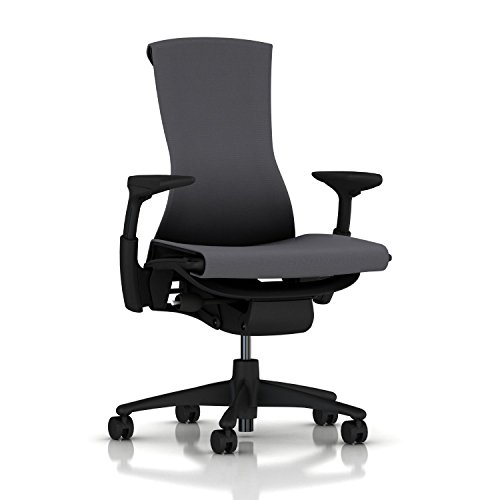
Herman Miller Embody Ergonomic Office Chair (Charcoal Rhythm) — Best Flexible Back
The Embody approaches spring from the backrest rather than the base. Its design is famous in the ergonomic world for a back structure that flexes in many small zones instead of bending as one stiff shell, so when you twist to reach a shelf or shift your weight to one side, the back follows instead of resisting. The verified listing states fully adjustable arms and carpet casters, in the Charcoal Rhythm finish. We are careful here: the listing title itself does not describe the flexible back, so we present that reputation as design context, not as a listing claim — what the listing guarantees is the model, the arms and the casters, and the model is what carries the flex design.
Strengths
- A back design built to flex zonally with your movements
- Fully adjustable arms stated in the listing
- Carpet casters fitted as standard on this configuration
Trade-offs
- Premium tier, comparable to the Leap
- The listing title is brief — confirm fabric and configuration details on the page
- Its distinctive look divides opinion in formal offices
| Spec (from listing title) | Detail |
|---|---|
| Armrests | Fully adjustable (as titled) |
| Casters | Carpet casters |
| Finish verified | Charcoal Rhythm |
The Embody suits the mover more than the rocker: if your springiness craving is really about a chair that never fights you when you twist, lean sideways or perch at an angle, a zonally flexible back answers it better than a strong tilt spring does. Pair that with genuinely adjustable arms and you have a chair that adapts in almost every direction a body moves. The cautions are practical. It sits in the same premium tier as the Leap, so the Leap-versus-Embody choice comes down to which movement you value — glide-supported recline or a back that flexes everywhere. And because this listing’s title is unusually terse for the price, read the product page carefully and confirm you are getting the exact configuration named here before paying premium money.
A word on casters, since the listing specifies carpet casters: on hard floors, carpet casters roll less freely and can mark softer surfaces, so hard-floor households should budget for a chair mat or a caster swap as part of the true purchase. It is a small, solvable detail, but it is exactly the kind of detail that decides whether a premium chair feels premium in your specific room rather than in a showroom.
A fitting session for the Embody should be unhurried: its adjustments interact, so set the seat and arms first, live with them for a day, and only then judge the back’s behaviour. Premium chairs punish the five-minute verdict more than any other kind, because their whole design assumes an owner who tunes. A last Embody note for shared households: its adjustments are personal enough that a second regular user effectively needs their own fitting session. Households that share one premium chair should expect a minute of re-tuning at every handover — a small ritual, honestly priced in.
Best for: Twisters and leaners who want a back that follows them / Not suited for: Shoppers who want every spec spelled out in the title
Check on Amazon — check the current price on Amazon before you buy, and confirm the exact configuration on the listing page.

SIHOO M18 Ergonomic Office Chair (Black) — Best for Heavier Sitters
Springiness means nothing if the chair feels like it is straining under you, which is why the M18 matters: its listing states a 330 lb capacity outright, a number we can print because it comes from the title itself. Around that capacity it builds the controlled version of spring — a tilt mechanism with a tilt lock, so you decide when the chair moves and when it holds still — plus adjustable lumbar support, 2D armrests, a wide cushion and a headrest, all behind a breathable mesh back. For a larger sitter, that lock is not a minor detail: it is the difference between a chair that gives supportively and one that tips you back further than you meant to go.
Strengths
- 330 lb capacity stated in the listing title
- Tilt lock lets you switch the spring off for focused work
- Adjustable lumbar support, 2D arms, headrest and wide cushion
Trade-offs
- Bigger footprint than the compact mesh chairs here
- Mesh-and-cushion mix breathes less than full mesh
- Black verified; other colours are separate listings
| Spec (from listing title) | Detail |
|---|---|
| Capacity | 330 lbs (as titled) |
| Mechanism | Tilt with tilt lock |
| Support | Adjustable lumbar support |
| Armrests | 2D adjustable |
| Seat | Wide cushion |
If you are a bigger or taller sitter who has watched budget chairs go loose and creaky within a year, the M18’s stated capacity and lockable tilt are aimed at you. The wide cushion spreads load, the headrest gives the recline somewhere to land, and the mesh back still flexes enough to count as give rather than a wall. It is less airy than the all-mesh chairs and it takes more floor space, so measure your desk nook before ordering. But as the controlled-spring option — movement when you want it, a firm hold when you do not — it is the most complete package in the middle of this list.
The M18’s headrest deserves its own sentence, because headrests are where budget chairs most often cheat: a fixed, badly placed headrest is worse than none. The M18 pairs its headrest with adjustable lumbar support, so the two ends of the spine can be set independently — the arrangement heavier sitters need, since their recline angle and lumbar curve rarely match a factory’s single guess. Set the lumbar first, then the headrest, in that order.
For shared and hot-desking use, the M18’s adjustments are all reachable from the seated position, which matters more than it sounds: a chair whose lumbar and tilt can be reset in ten seconds gets reset; a chair that needs tools and a manual becomes whoever sat in it last, permanently. The M18 in a small room: its wider seat and headrest claim visual space as well as floor space, so measure the recline arc against the wall behind your desk. A chair that cannot use its tilt because furniture forbids it is a chair bought at half value.
Best for: Heavier sitters who want lockable, controlled tilt / Not suited for: Very small desks or petite users who may swim in the seat
Check on Amazon — check the current price on Amazon before you buy, and confirm the exact configuration on the listing page.
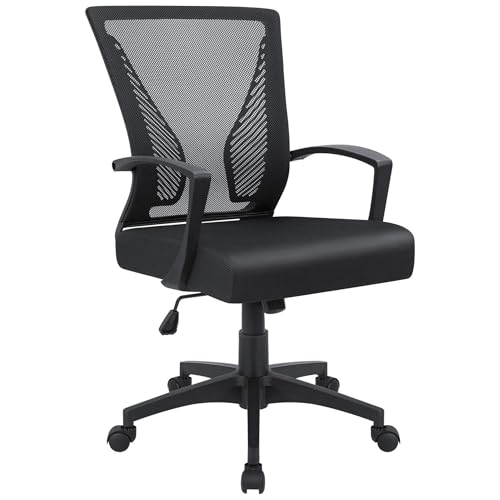
Furmax Office Chair (Black) — Best Budget
Not everyone needs engineered spring; some people need a chair that is simply less dead than the dining chair they have been using, at a price that does not require a committee. The Furmax is the budget staple of the mesh-chair world: an ergonomic mid-back in breathable mesh with lumbar support, adjustable height, armrests, a 360-degree swivel and a listing that promises easy assembly. Its springiness is the modest, honest kind — the mesh back gives against your back as you lean and shift, rather than a mechanical rocking system — and we rank it accordingly: real flex, entry-level mechanism.
Strengths
- Mesh back flexes with your movement and breathes in warm rooms
- Lumbar support and height adjustment at a budget tier
- Easy assembly stated — a realistic one-person setup
Trade-offs
- No rocking mode or tilt lock named in the listing
- Mid-back support only; no headrest
- Budget mechanisms loosen sooner under heavy daily use
| Spec (from listing title) | Detail |
|---|---|
| Back | Breathable mesh mid-back |
| Support | Lumbar support (as titled) |
| Base | 360° swivel |
| Assembly | Easy assembly (as titled) |
Buy the Furmax for a first home office, a student desk, a spare room or a rental you will leave behind — the places where a good-enough chair that arrives cheap and assembles fast beats a perfect chair that never gets bought. Its mesh flex will feel like a revelation if you are coming from a wooden chair, and its limits only show up under the heaviest use: eight-hour days, every day, for years, will ask more of its mechanism than it was priced to give. Treat it as the honest floor of this list. Everything above it adds a stronger or smarter kind of spring; nothing below its tier is worth your money at all.
For the Furmax, manage expectations about armrests and seat foam and it will not disappoint you: at this tier those are comfort basics, not engineered components. Its real job in a home is to be sat in for study sessions, gaming evenings and part-time workdays, and at those duties its mesh flex is genuinely pleasant. The moment your work becomes full-time and permanent, promote it to the spare room and let a mid-tier chair take the desk — that is a lifecycle, not a failure.
One honest Furmax upgrade path: keep it, and when the budget allows, spend the next money on the desk and screen position rather than a second chair. Seat height relative to screen height decides more backs than any mechanism in this guide, and the Furmax is good enough to let the rest of the setup be the bottleneck for a while. Furmax owners, one comfort trick: a folded throw over the mesh back on cold mornings takes the chill off the first sit without changing the chair’s flex. Small adaptations like that are how a budget chair serves for years — the owner meets it halfway.
Best for: First home offices, students and spare rooms / Not suited for: Heavy all-day use over many years
Check on Amazon — check the current price on Amazon before you buy, and confirm the exact configuration on the listing page.

Sweetcrispy Ergonomic Computer Desk Chair (Gray) — Best Small-Space Spring
Small rooms punish big chairs, and they punish fixed armrests most of all: the chair cannot tuck under the desk, so it lives in the middle of the floor forever. The Sweetcrispy answers with flip-up arms on a mesh mid-back frame, with lumbar support, a rolling swivel base and a footprint aimed at home offices, bedrooms and study corners. Its spring is the mesh-flex kind, like the Furmax, but the flip-up arms change how you use it — perch, swivel and tuck away — which makes it the natural pick where the chair shares space with a bed, a wardrobe or a walking route through the room.
Strengths
- Flip-up arms let the chair tuck completely under the desk
- Mesh mid-back flexes and breathes; lumbar support named
- Rolling swivel base suits multi-use small rooms
Trade-offs
- No rocking mode or stated capacity in the listing
- Mid-back only — no headrest for reclining
- Gray is the verified configuration
| Spec (from listing title) | Detail |
|---|---|
| Armrests | Flip-up |
| Back | Mesh mid-back |
| Support | Lumbar support (as titled) |
| Base | Rolling swivel |
| Colour verified | Gray |
Choose this one when the room decides for you. In a bedroom-office or a studio corner, the ability to flip the arms and push the chair fully home under the desk is worth more than a fancier tilt mechanism, and the mesh back still gives you the flex-and-breathe basics that make a chair feel alive rather than inert. What you give up is specification depth: the listing states no weight capacity and no rocking mode, so heavy users and dedicated rockers should take the DUMOS or the M18 instead. For a student, a teen’s study desk or a compact work-from-home corner, it is the right-sized spring.
The Sweetcrispy’s flip-up arms also make it the easiest chair here to clean around and the kindest to small-room traffic flow: arms down for work, arms up and the chair vanishes under the desk, restoring the room to a bedroom by evening. For students in halls and anyone whose office is also their sleeping space, that daily transformation is worth more than a specification sheet can express.
Finally, the Sweetcrispy in Gray deserves a colour note: grey mesh shows dust and wear more honestly than black, which in a bedroom-study is arguably a virtue — the chair tells you when to clean it. A soft brush and a vacuum crevice tool, monthly, keep a grey mesh chair looking like the listing photograph. Sweetcrispy longevity is mostly hinge hygiene: the flip-up arms are its moving gift, so keep their pivots free of dust and do not use a flipped arm as a push-off handle when standing. Treat the mechanism gently and it will keep performing the chair’s best trick daily.
Best for: Small rooms and desks the chair must tuck under / Not suited for: Rockers or heavier users needing a stated capacity
Check on Amazon — check the current price on Amazon before you buy, and confirm the exact configuration on the listing page.
Comparison Table
| Pick | Badge | Key spec | Best for |
|---|---|---|---|
| DUMOS Home Office Chair (Rocking Mode, Black) | Best Overall | Rocking mode + mesh mid-back | Budget-minded fidgeters who rock while they work |
| Steelcase Leap Office Chair (Onyx) | Best Premium Spring | LiveBack + Natural Glide System | Full-time desk workers buying a decade-long chair |
| Herman Miller Embody Ergonomic Office Chair (Charcoal Rhythm) | Best Flexible Back | Flexible-back design; fully adjustable arms | Twisters and leaners who want a back that follows them |
| SIHOO M18 Ergonomic Office Chair (Black) | Best for Heavier Sitters | 330 lb capacity; tilt lock | Heavier sitters who want lockable, controlled tilt |
| Furmax Office Chair (Black) | Best Budget | Flexing mesh mid-back; easy assembly | First home offices, students and spare rooms |
| Sweetcrispy Ergonomic Computer Desk Chair (Gray) | Best Small-Space Spring | Flip-up arms; mesh mid-back | Small rooms and desks the chair must tuck under |
How to Choose the Best Springy Office Chairs for Your Sitting Style
Start by naming the movement you actually miss. If you rock while you think, you need a rocking mode or a free tilt — a mechanism in the base. If you twist, reach and lean sideways, you need a flexible back. If you simply hate the dead, board-like feel of a cheap seat, the flex of a mesh back may be all the spring you require, and it is the cheapest kind to buy. Matching the mechanism to the habit matters more than any other decision in this category, because a chair with the wrong kind of give will annoy you every day in a way a firm chair never does.
Next, insist on control. Spring you cannot switch off becomes a distraction in focused work and video calls, so a tilt lock or a tension adjustment is worth real money. Then check the unglamorous basics the listings state plainly: lumbar support, height adjustment and — if you are a larger sitter — a stated weight capacity with headroom above your own weight. A mechanism run permanently at its limit loses its spring first and its structure second.
Mesh, Cushion and Flexible Shells: Three Different Kinds of Give
A mesh back gives by flexing: the woven surface stretches slightly against your back, spreads pressure and lets air through, which is why mesh chairs feel alive and cool. A padded seat gives by compressing: comfortable and quiet, but the give is downward only and foam tired after years of use stays compressed. A flexible shell or engineered back — the Leap’s LiveBack and the Embody’s zonal design are the famous examples — gives by changing shape, following your spine as it moves. That is the most sophisticated spring and the most expensive, and it is the only kind that keeps supporting you while it moves.
None of the three is simply best. Hot rooms and restless sitters favour mesh. People who sit very still and upright often prefer a good cushion. People whose backs complain despite decent chairs are the ones who report the biggest difference from an engineered flexible back. Read the picks above with your own habit in mind rather than by badge order alone.
Setting the Budget Tiers for a Springy Chair
At the budget tier, expect mesh flex, basic lumbar shaping and height adjustment — the Furmax and Sweetcrispy end of the market. Chairs here transform a bad setup but are not built for a decade of daily punishment. The mid tier adds the mechanisms that define this category: rocking modes, tilt locks, adjustable lumbar systems, headrests and stated capacities, as on the DUMOS and the SIHOO M18. That is the value sweet spot for most full-time home workers. The premium tier — Steelcase and Herman Miller — buys engineered flex, longer design lives and chairs built to be serviced rather than replaced. Spread over ten years of daily sitting, the premium tier can be the cheapest per year; over two years in a rented flat, it cannot. Match the tier to your horizon, not to your enthusiasm on shopping day.
Seat Depth, Arm Height and the Other Dimensions of Spring
Spring gets the headlines, but fit decides whether you enjoy it. Seat depth matters first: if the seat’s front edge presses the back of your knees, you will perch forward and never use the backrest’s flex at all. You want a small gap between the seat edge and your calves when your back is against the backrest. Arm height matters second, because arms set too high shrug your shoulders all day, quietly undoing every ergonomic claim the chair makes, while arms set too low might as well not exist. None of the listings in this guide states every dimension, which is normal for the category — so treat the product page’s dimension table as required reading, and measure your current chair’s good points before you shop, so you know which numbers you are trying to keep.
Desk geometry is the third fit factor and the one most often forgotten. A springy chair travels: rocking and tilting move your body through a small arc, and your knees, elbows and the desk’s underside all share that space. Check that your knees clear the desk apron at full recline, that your armrests pass under or clear the desktop at working height, and that the chair’s base does not strike a desk leg at full swivel. Five minutes with a tape measure prevents the specific disappointment of a wonderful chair that cannot be sat in at the desk it was bought for.
How Long Does Spring Last? Mechanisms Across the Years
A tilt mechanism ages in a predictable way: the tension range narrows, small clicks and creaks arrive, and the smooth centre of the motion develops a favourite spot. Budget mechanisms reach that stage in a few years of daily use; engineered chairs resist it far longer because their moving parts are designed as a system with tolerances, not assembled to a price. You can slow the ageing in any chair: keep the mechanism’s underside free of dust and pet hair, resist the urge to use the chair as a step, and stay within the stated capacity, since every sit above it spends the mechanism’s life at a higher rate.
Mesh ages differently: it relaxes. A new mesh back is taut and springy; over years it takes a set, holding a gentle impression of its owner’s back. Quality mesh relaxes slowly and evenly and stays supportive; cheap mesh sags in the lumbar zone first, which is why an adjustable lumbar support matters more in year three than in week one. When a mesh chair starts to feel dead, check the lumbar setting before condemning the chair — half the time, the spring is fine and the support has simply drifted out of position.
What Springy Chairs Do for Focus, Mood and the Long Afternoon
There is a reason restless sitters describe a dead chair as maddening rather than merely uncomfortable: the body asks for micro-movement all day, and a chair that refuses it forces that movement into fidgeting, perching and standing up for no reason. A chair with give absorbs the request. Rocking while reading, tilting while thinking, leaning while listening — these are not distractions from work; for many people they are how attention sustains itself across an afternoon. The springy chair’s productivity claim is modest and real: it removes a friction, it does not add a talent.
That is also why the lock matters psychologically as well as mechanically. Movement you can stop is a tool; movement you cannot stop is a symptom. Every pick in this guide either states a control — a rocking mode you engage, a tilt lock, a tension you set — or offers the gentle, self-limiting flex of mesh, which never moves unless you do. Choose the chair whose movement obeys you, and the long afternoon gets measurably quieter, in the chair and in the mind sitting in it.
How to Set Up and Dial In a Springy Office Chair
A springy chair only works when it is adjusted to you; out of the box, most are set for nobody in particular. Work through these steps in order on your first sit, then revisit them after a week, when the chair and your body have introduced themselves properly.
- Set seat height first: feet flat on the floor, knees at roughly a right angle, thighs level or sloping very slightly down.
- Raise or position the lumbar support so its firmest point meets the natural inward curve of your lower back, not your waist or your shoulder blades.
- Set the tilt tension so the chair gives when you lean with intent but holds you upright when you sit normally — this knob is the spring control, and it is usually under the front of the seat.
- If your chair has a tilt lock, practise finding it without looking; you will want it locked for calls and free for reading.
- Position armrests so your elbows rest with shoulders relaxed, or flip and lower them out of the way if they push your shoulders up.
- Sit for a full work session, then adjust one thing at a time over the next few days instead of changing everything at once.
After a month, re-check the tension: mechanisms settle, and a chair that felt perfectly springy in week one can feel loose by week six. A quarter-turn back toward firm usually restores it.
Common Buying Mistakes
Buying bounce without a lock. A chair that moves when you do not want it to is as bad as one that never moves. If the listing names no tilt lock or tension control, expect to fight the spring during focused work.
Confusing a cushion with a chair. Seat cushions, lumbar pillows and chair mats fill search results for office chairs and add a little give to a bad chair, but they are not chairs. Every pick in this article is a complete chair.
Ignoring the stated capacity. Spring mechanisms wear fastest at their limit. If a listing states a capacity, keep comfortable headroom above your weight; if it states none, heavier sitters should choose a model that does.
Assuming every colour is the same chair. Colours and arm options are often separate listings with different configurations. Confirm the exact variant on the product page matches the one reviewed here.
Judging spring in the first five minutes. New mechanisms feel stiff and new mesh feels taut. Give a chair a week of real work before deciding its give is wrong — and use that week to adjust it properly first.
Final Recommendation
If you want one answer: the DUMOS is the clearest expression of this category, because its rocking mode is stated in its own listing and its mesh back adds a second kind of give. If your budget stretches to buying once for a decade, the Steelcase Leap’s LiveBack and Natural Glide are the engineered version of the same idea, and the Herman Miller Embody is the flexible-back alternative. Heavier sitters should take the SIHOO M18’s stated capacity and tilt lock seriously, small rooms should take the Sweetcrispy’s flip-up arms, and tight budgets should take the Furmax without embarrassment — honest mesh flex beats a dead chair at any price.
Whichever you choose, adjust it properly in the first week and re-check the tilt tension after a month. Spring is a feature you maintain, not just a feature you buy.
Related reading on this site: Best Office Chairs For Long Sitting And Comfort Best Petite Ergonomic Office Chairs Best Relaxing Office Chairs Best Ranked Executive Office Chairs Best Rug Under Rolling Office Chairs
Frequently Asked Questions
What makes an office chair springy?
A mechanism or material that gives and rebounds as you move: a rocking or tilting base, a flexible back that changes shape, or a mesh back that flexes against you. In this article every claim of spring traces to a mechanism or material named in the chair’s own listing.
Is a springy chair good for long hours?
It can be, because small movements stop you locking into one posture all day. The conditions are proper adjustment — seat height, lumbar position and tilt tension set for your body — and a lock for the times you need stillness.
What is the difference between tilt and rocking?
Tilt usually means the backrest reclines, sometimes with the seat. Rocking means the whole seat-and-back unit pivots smoothly back and forth. Rocking feels more like a rocking chair; tilt feels more like leaning back in place.
Mesh or padded seat for springiness?
They give differently. Mesh flexes and breathes; padding compresses and insulates. Restless, warm sitters usually prefer mesh, while people who sit very still often prefer a good cushion under them and flex in the back instead.
How long should a springy mechanism last?
Budget tilt mechanisms can loosen within a couple of years of heavy daily use, while premium engineered chairs are designed for a decade or more. Staying within the stated weight capacity is the biggest factor you control.
Can I add spring to my current chair?
A cushion can add softness but not movement. Real spring lives in the base mechanism and the back structure, so if movement is what you miss, it has to come from a different chair.


