Disclosure: airfryerkitchensupply.com is reader-supported. When you buy through links on our site, we may earn an affiliate commission at no extra cost to you.
Where to buy
The best recliner type chairs below are sold on Amazon, and every linked chair was verified cache before earning its link — the listing title is the only source used for the specs quoted here. Prices move constantly, so each pick says check price on Amazon instead of printing a number that would go stale.
Homall Recliner Chair (PU Leather, Black) — Check the current price on Amazon
CANMOV Leather Recliner Chair (Nut Brown) — Check the current price on Amazon
Yaheetech Recliner Chair (3 Adjustable Angles, Black) — Check the current price on Amazon
MCombo Manual Swivel Recliner with Ottoman (9019) — Check the current price on Amazon
CANMOV Pushback Recliner Chair (Reddish Brown) — Check the current price on Amazon
EBELLO Pushback Recliner Chair (Fabric Wingback, Beige) — Check the current price on Amazon
Introduction: Finding the best recliner type chairs Without Guesswork
Shoppers searching for the best recliner type chairs usually discover the same problem within ten minutes: the word recliner covers at least six different mechanisms, and a chair that is perfect for one room fails in another for reasons that have nothing to do with comfort. A push-back recliner needs no lever and no motor, but it also gives you no locked positions. A swivel recliner with an ottoman turns beautifully in a reading corner and wastes floor space in a narrow living room. This guide is organised by type first, because the type decision is the one you cannot change after delivery.
The six picks below were chosen to represent the main recliner types a home buyer actually meets: a classic manual recliner for home-theater seating, a traditional leather armchair recliner, a compact three-angle recliner for small rooms, a swivel recliner with a separate ottoman, and two push-back designs in faux leather and fabric. Every linked model was cross-checked against Amazon listing data cache for this site, and only the words in the verified listing title are used as specifications. Where a listing title does not state a capacity, a recline angle, or a material grade, this guide says so instead of guessing.
A final word before the picks: recliner type chairs are heavy, arrive in large boxes, and are miserable to return. Measuring your doorway, your wall clearance, and the fully reclined footprint before ordering is worth more than any single feature discussed below. The buying-guide sections after the reviews walk through each measurement in the order you should take it.
Consider, too, who else will use the chair. Recliners are shared furniture in most homes — partners, parents, guests, and eventually children conducting physics experiments on the footrest — and a chair fitted to one body and one habit should still tolerate the others. The type framework in this guide is built to survive that sharing: mechanisms and clearances first, personal preference second, upholstery last.
Key Takeaways
- Choose the mechanism first: push-back, swivel, rocker, and traditional handle or lever recliners behave very differently in daily use.
- Wall clearance decides more purchases than upholstery does — measure the fully reclined footprint before ordering.
- Only specifications printed in the verified listing title are quoted here; anything unstated is marked as not stated.
- Compact recliners trade recline depth for floor space, and that trade is worth making deliberately, not by accident.
- A separate ottoman gives a deeper leg rest than most built-in footrests at the same footprint.
In this guide
Quick Picks
Six chairs, six mechanisms or formats, each with a distinct job. Badges are repeated at the head of each full review so you can jump straight to the type you are considering.
Best Overall: Homall Recliner Chair (PU Leather, Black) — Check price on Amazon
Best Classic Look: CANMOV Leather Recliner Chair (Nut Brown) — Check price on Amazon
Best Compact: Yaheetech Recliner Chair (3 Adjustable Angles, Black) — Check price on Amazon
Best Swivel Type: MCombo Manual Swivel Recliner with Ottoman (9019) — Check price on Amazon
Best Push-Back Type: CANMOV Pushback Recliner Chair (Reddish Brown) — Check price on Amazon
Best Fabric Wingback: EBELLO Pushback Recliner Chair (Fabric Wingback, Beige) — Check price on Amazon
How These Picks Were Chosen
The method was mechanical before it was editorial. First, every candidate had to be a complete recliner chair — no headrest pillows, no slipcovers, no replacement parts — because a roundup of recliner types that quietly includes accessories helps nobody. Second, each candidate had to be verified: the listing title returned by the listing is the product’s identity here, and its ASIN is the only ASIN used in links. Third, duplicates of the same model in different colours were collapsed into one pick, because a colour variant is not a different type of chair.
Within those rules, the six slots were assigned to cover the mechanism map rather than to repeat the best-selling format six times. Two push-back chairs appear because push-back is the fastest-growing type for apartments, and they differ in upholstery and styling enough to serve different rooms. Comfort judgements in the reviews are framed as fit judgements — who the chair suits, who it will frustrate — rather than as universal scores, and no fixed popularity figures appear anywhere in this guide, because such numbers change constantly and help no one plan a room.
The 6 Best Recliner Type Chairs, Reviewed by Mechanism
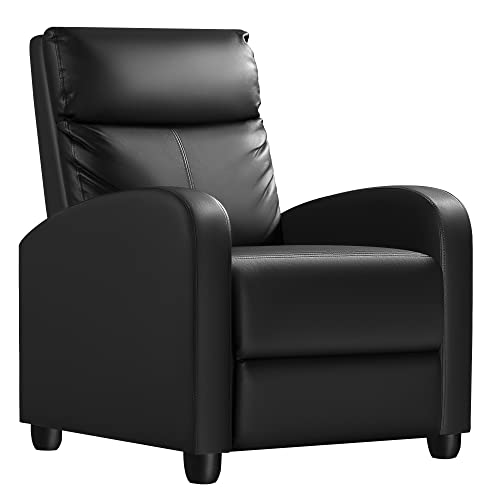
Homall Recliner Chair (PU Leather, Black) — Best Overall
The Homall is the reference point for this roundup: a single-seat manual recliner in PU leather, positioned by its own listing as home theater seating with lumbar support. It suits the reader who wants the familiar living-room recliner experience — sit down, recline, watch something — without moving into powered or oversized territory. The black PU leather finish fits media rooms and dens where a fabric chair would show every spill, and the single-sofa format keeps it usable as an ordinary armchair when it is not reclined.
Read the listing title the way this guide does and you will notice what it does not claim: no weight capacity is stated in the title, no recline angle is stated, and no frame material is stated. That does not make the chair a bad buy; it means those checks belong on the listing page before you order, and the review refuses to invent numbers the listing did not return. In daily use, PU leather’s bargain is simple — it wipes clean and shrugs off drink spills, and in exchange it does not breathe like fabric and will not age like genuine leather. For a theater seat used a few hours at a time, that is usually the right trade.
Strengths
- Verified listing positions it explicitly for home theater seating
- PU leather surface wipes clean after spills
- Lumbar support is named in the verified title, not assumed
Trade-offs
- Capacity and recline angle are not stated in the listing title — check the listing page
- PU leather does not breathe like fabric on long sits
- Single fixed colour in the verified listing (black)
Spec box (from the verified listing title only):
- Upholstery stated in listing title: PU leather
- Positioning stated in listing title: home theater seating
- Support feature stated in listing title: lumbar support
Best for: movie-room and den seating in a wipe-clean finish / Not suited for: buyers who need a stated high weight capacity confirmed before ordering
Check on Amazon — check price on Amazon before ordering, and confirm the size and configuration on the listing page.
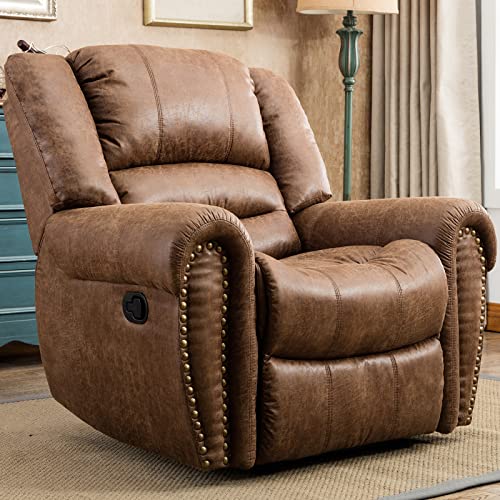
CANMOV Leather Recliner Chair (Nut Brown) — Best Classic Look
Where the Homall is a media-room chair, the CANMOV leather recliner is a living-room chair in the traditional sense: a manual single sofa with padded arms and back, finished in nut brown. The listing describes it as classic and traditional, and that styling is the reason to buy it — it sits comfortably next to wood furniture and older décor where a black theater recliner would look like equipment. Manual operation means no motor to fail and no cord to route, at the cost of the effort a manual mechanism always asks for.
The honest limits are the usual ones for this class. The verified title does not state a weight capacity, a recline angle, or whether the word leather in the title refers to genuine or bonded material — the title simply says Leather Recliner Chair, and this guide repeats exactly that and no more. If the material grade matters to you, the listing page’s materials section is where that answer lives. As a type specimen it earns its slot: this is the handle-era recliner format updated with contemporary padding, and for a formal living room it is the most natural fit of the six.
Strengths
- Traditional styling suits formal living rooms
- Manual mechanism — nothing electrical to fail
- Nut brown finish pairs with wood furniture
Trade-offs
- Material grade beyond the word leather is not stated in the title
- No capacity or recline angle stated in the verified title
- Manual recline needs more user effort than a powered chair
Spec box (from the verified listing title only):
- Mechanism stated in listing title: manual recliner
- Style stated in listing title: classic and traditional
- Colour stated in listing title: nut brown
Best for: traditional living rooms that need a recliner to look like furniture / Not suited for: buyers who want powered recline or a stated material grade up front
Check on Amazon — check price on Amazon before ordering, and confirm the size and configuration on the listing page.

Yaheetech Recliner Chair (3 Adjustable Angles, Black) — Best Compact
Small rooms are where recliner shopping usually collapses, and the Yaheetech is the pick built for that problem. Its verified title leads with the two facts that matter in a small space: it is compact, and it offers three adjustable angles rather than a single deep recline. Three set positions sound like a limitation next to an infinite-position powered chair, but in practice most people live in two positions — upright with feet up, and leaned back — and a compact chair that does those without swallowing the room is the honest winner for apartments and spare rooms.
The title also confirms pocket springs and lumbar support, which separates it from the flat-foam budget chairs that feel fine in a showroom and tired in a month. Faux leather keeps the price class and the cleaning routine simple. What the title does not state is a weight capacity or the chair’s exact dimensions, and for a compact purchase dimensions are the whole game: measure your space, then confirm the listing’s dimension figures on the product page before ordering. Treat this as the small-room default and the larger chairs as the upgrade path.
Strengths
- Compact format stated in the title — built for small rooms
- Three defined angles instead of a vague recline claim
- Pocket springs stated in the verified title
Trade-offs
- Three positions only — no infinite adjustment
- Dimensions and capacity are not stated in the title
- Faux leather rather than genuine leather
Spec box (from the verified listing title only):
- Positions stated in listing title: 3 adjustable angles
- Upholstery stated in listing title: faux leather
- Construction stated in listing title: pocket springs
- Format stated in listing title: compact
Best for: apartments, spare rooms, and small living rooms / Not suited for: tall readers who need a deep, long recline
Check on Amazon — check price on Amazon before ordering, and confirm the size and configuration on the listing page.

MCombo Manual Swivel Recliner with Ottoman (9019) — Best Swivel Type
The swivel-and-ottoman format is the oldest recliner type in this guide and still the best answer for a reading corner. The MCombo 9019 pairs a manual recliner on a wooden swivel base with a separate ottoman, and its verified title is unusually informative: 360-degree swivel, adjustable backrest, and a stated capacity of 330 lbs. A separate ottoman matters more than it looks — your legs rest at the height you choose by moving the ottoman, not the height a built-in footrest dictates, and the chair itself stays compact enough for the small spaces and RV use the listing names.
The trade-offs belong to the type, not just this model. An ottoman is a second piece of furniture competing for floor space, and a swivel base wants a level, firm floor to feel stable. The faux leather keeps the pairing affordable and easy to clean. Of the six picks, this is the one whose type most changes how a room works: it turns a corner into a destination. If your recliner will live in a bedroom corner or beside a bookshelf rather than facing a television, start here.
Strengths
- Stated 330 lbs capacity in the verified title
- Separate ottoman allows independent leg-rest height
- 360° swivel suits reading corners and conversation areas
Trade-offs
- Ottoman is a second footprint in the room
- Swivel bases feel best on firm, level floors
- Faux leather rather than genuine leather
Spec box (from the verified listing title only):
- Rotation stated in listing title: 360° swivel on wooden base
- Capacity stated in listing title: 330 lbs
- Format stated in listing title: separate ottoman included
Best for: reading corners, bedrooms, and RV or small-space seating / Not suited for: rooms where a second ottoman footprint will not fit
Check on Amazon — check price on Amazon before ordering, and confirm the size and configuration on the listing page.

CANMOV Pushback Recliner Chair (Reddish Brown) — Best Push-Back Type
Push-back is the recliner type for people who do not want their chair to look like a recliner. There is no handle, no lever, and no motor: you lean back and body weight works the mechanism. The CANMOV pushback pairs that clean format with faux leather and rivet decoration in reddish brown, which makes it an accent chair first and a recliner second — the right priority for a living room that hosts guests more often than it hosts naps.
Understand the type’s honest compromise before choosing it. Push-back mechanisms typically offer a shallower recline than handle or powered chairs, and the position is held by your posture rather than locked by a ratchet. The verified title states no capacity and no recline angle, so both belong on your listing-page checklist. Within those limits, this is the most furniture-like chair in the roundup, and for many living rooms that is exactly the point: reclining comfort that disappears into the décor when upright.
Strengths
- No visible handle or lever — reads as an accent chair
- Push-back operation is simple and silent
- Rivet detailing suits classic and transitional décor
Trade-offs
- Push-back recline is shallower than powered formats
- Position is held by posture, not locked
- Capacity and angle not stated in the verified title
Spec box (from the verified listing title only):
- Mechanism stated in listing title: push back
- Upholstery stated in listing title: faux leather
- Detail stated in listing title: rivet decoration
Best for: living rooms where the recliner must pass as an accent chair / Not suited for: buyers who want a deep, locked recline for sleeping
Check on Amazon — check price on Amazon before ordering, and confirm the size and configuration on the listing page.

EBELLO Pushback Recliner Chair (Fabric Wingback, Beige) — Best Fabric Wingback
The EBELLO takes the same push-back idea as the CANMOV above and moves it into fabric and a wingback silhouette, and the difference is not cosmetic only. Fabric breathes where faux leather does not, which matters in warm rooms and on long sits, and a wingback’s high, wrapped back suits readers and anyone who likes a sense of enclosure when they sit. The listing places it in living rooms and bedrooms, in beige, with rivet decoration echoing the classic accent-chair pattern.
Fabric’s cost is maintenance: spills soak rather than wipe, and light beige shows life honestly. The verified title states no capacity, no recline angle, and no fabric composition beyond the word fabric, so performance fabrics and stain treatments should not be assumed — check the listing page if those matter. As a type specimen, this is the push-back recliner for traditional and mid-century rooms, and the softest-edged design of the six.
Strengths
- Breathable fabric upholstery for warm rooms
- Wingback shape suits reading and bedrooms
- Push-back format keeps the silhouette clean
Trade-offs
- Fabric absorbs spills that faux leather would shed
- Beige shows wear and marks more readily
- Capacity and angle not stated in the verified title
Spec box (from the verified listing title only):
- Mechanism stated in listing title: push back
- Upholstery stated in listing title: fabric
- Style stated in listing title: mid century wingback
Best for: traditional bedrooms and reading spots in warm rooms / Not suited for: homes with spill-prone kids or pets on the furniture
Check on Amazon — check price on Amazon before ordering, and confirm the size and configuration on the listing page.
Comparison Table
The table below puts the picks side by side using only the key specification confirmed in each verified listing title, so the comparison never claims more than the listings themselves state.
| Pick | Badge | Key spec (listing title) | Best for |
|---|---|---|---|
| Homall Recliner Chair (PU Leather, Black) | Best Overall | Upholstery stated in listing title: PU leather | movie-room and den seating in a wipe-clean finish |
| CANMOV Leather Recliner Chair (Nut Brown) | Best Classic Look | Mechanism stated in listing title: manual recliner | traditional living rooms that need a recliner to look like furniture |
| Yaheetech Recliner Chair (3 Adjustable Angles, Black) | Best Compact | Positions stated in listing title: 3 adjustable angles | apartments, spare rooms, and small living rooms |
| MCombo Manual Swivel Recliner with Ottoman (9019) | Best Swivel Type | Rotation stated in listing title: 360° swivel on wooden base | reading corners, bedrooms, and RV or small-space seating |
| CANMOV Pushback Recliner Chair (Reddish Brown) | Best Push-Back Type | Mechanism stated in listing title: push back | living rooms where the recliner must pass as an accent chair |
| EBELLO Pushback Recliner Chair (Fabric Wingback, Beige) | Best Fabric Wingback | Mechanism stated in listing title: push back | traditional bedrooms and reading spots in warm rooms |
How to Choose the Right Recliner Type for Your Room
Start with the mechanism, because it decides everything downstream. Traditional manual recliners use a handle or lever and a ratcheting footrest; they are proven, repairable, and usually the deepest recliners in their price class. Push-back chairs trade depth for a clean silhouette. Swivel recliners with ottomans trade the built-in footrest for freedom of placement. Rocker and glider recliners add motion that suits nurseries and anyone who finds stillness uncomfortable. Powered chairs — absent from this roundup’s verified picks — trade simplicity for infinite positions and lift assistance, and they deserve their own dedicated guide rather than a token slot here.
Next, measure three things in order. First, the doorway and the path to the room, because a chair that cannot enter is a return, not a purchase. Second, the wall clearance: most recliners need the back to travel rearward as they open, so the distance from wall to chair back in the fully reclined position is the number that decides placement. Third, the fully reclined footprint — length from wall to extended footrest — because that is the space the chair truly occupies in use, not the tidy upright footprint in the listing photograph.
Finally, match upholstery to the household rather than to the photograph. Faux and PU leathers forgive spills and pets’ claws better than fabric and clean in seconds; fabric breathes better and feels warmer in winter; genuine leather, where a listing actually states it, ages rather than wears. None of these is best in the abstract. The right answer is the one that matches how the room is actually used on an ordinary Tuesday.
Recliner Types Compared: Manual, Push-Back, Swivel, and Rocker
Manual handle recliners are the benchmark type: a three-position ratchet, a footrest that takes real weight, and a mechanism any upholsterer can service. Their weakness is visual — they look like recliners from across the room — and physical, since the handle asks for hand strength that not every user has. Push-back chairs solve the visual problem and remove the handle entirely, but the recline is shallower and the hold is postural. If you regularly fall asleep in your chair, a push-back is the wrong type no matter how pretty it is.
Swivel recliners with ottomans are the conversational type: they turn toward a speaker, a window, or a fire, and the ottoman doubles as a footrest, a side seat, or a tray table in a pinch. Their weakness is footprint arithmetic — chair plus ottoman plus turning clearance can exceed a wall recliner’s needs. Rocker and glider recliners, represented in nurseries everywhere, add soothing motion and are the type to choose when the chair’s job includes settling a baby or simply a restless sitter. Each type is a legitimate answer; the mistake is buying one type while imagining another.
Sizing a Recliner: Seat Height, Depth, and Who Actually Fits
A recliner fits when three measurements agree with the sitter. Seat height should let the feet rest flat with the footrest down; a seat that leaves feet dangling will make the recline feel like a relief for the wrong reason. Seat depth should support the thigh without pressing behind the knee. And the reclined length should let a tall sitter’s head stay on the headrest rather than above it — the most common tall-buyer disappointment, and one no listing photograph reveals.
Where a verified title states a capacity, as the MCombo swivel does at 330 lbs, treat it as a hard boundary with margin, not a target. Where no capacity is stated — true of several picks here — the listing page’s specification section is the only honest source, and ordering without reading it is gambling on the one number that affects safety. When two household members of very different sizes will share the chair, fit the larger sitter first; a smaller person can add a cushion, but a larger person cannot subtract chair.
Recliner Mechanisms in Daily Life: Noise, Effort, and Wear
Mechanisms announce themselves over time. A traditional ratchet recliner develops a familiar click through its positions and asks for a firm pull to close the footrest — a sound and effort profile that suits a media room and may annoy in a quiet nursery-adjacent living room. Push-back mechanisms are the quietest in this roundup because there is nothing to click: the trade is that the recline depth depends on the sitter’s weight and intent, so a lighter person may find the chair reluctant while a heavier person finds it eager. Neither behaviour is a defect; both are physics, and matching the mechanism to the household’s actual sitters prevents the commonest disappointment in this category.
Wear follows the mechanism too. Ratchets wear at their teeth, swivel bases wear at their bearing ring, and push-back pivots wear at their bushings — all slowly, all over years, and all announced early by new noises or new play in the motion. A monthly habit of operating the chair slowly through its full range, listening, catches those announcements while they are still curiosities. Keep the tracks and pivots free of the household’s debris — pet hair, blanket fringe, and children’s small toys are the unholy trinity of recliner mechanisms — and vacuum the footrest’s path as part of ordinary cleaning. The chairs in this guide are furniture-grade objects; treated as such, their mechanisms should outlast their upholstery.
Effort deserves a final word for households with older users. A manual handle that a strong adult finds trivial can be a genuine barrier to someone with limited hand strength, and a push-back that needs body weight to engage can strand a slight person upright. If the chair’s main user is older or smaller, test the mechanism type — in a showroom or through a generous return window — before committing to the specific model. The type decision, once again, is the purchase.
Upholstery Care by Material: PU Leather, Faux Leather, and Fabric
PU and faux leather surfaces, used by four of this guide’s six picks, ask for the simplest routine in furniture care: wipe with a damp cloth, dry, and keep them out of prolonged direct sun, which dries and cracks synthetic skins faster than use does. Avoid solvent cleaners and abrasive pads, which strip the surface finish that makes these materials wipeable in the first place. A small tear repaired early with a vinyl repair kit stays small; ignored at a flex point, it becomes the chair’s defining feature within a season.
Fabric upholstery, like the EBELLO wingback’s, trades the wipe for the vacuum: a weekly pass with an upholstery attachment lifts the grit that abrades fibres at seat and armrest, and spills should be blotted — never rubbed — with a clean cloth before they set. Where a listing states a fabric treatment, follow its care label; where it does not, assume no treatment and behave accordingly around red wine and toddlers with juice. Genuine leather, where a future listing states it, wants conditioning on a schedule and distance from radiators. None of these routines is burdensome; all of them are cheaper than reupholstery, and the chair you maintain is the chair that still looks chosen in five years.
Budget Tiers for Recliner Types, in Words Rather Than Numbers
This guide prints no product prices, by standing rule, but tier thinking still helps a buyer sort the field. In the budget tier of any recliner type, what you are buying is the mechanism in its simplest form and upholstery chosen for cost: expect thinner padding, simpler stitching, and a shorter warranty conversation. The mid tier — where most of this roundup’s verified picks sit — buys better foam or spring systems, cleaner upholstery work, and mechanisms that feel engineered rather than assembled. The premium tier buys materials with names and papers: genuine leathers, hardwood frames, branded mechanisms, and the kind of weight that announces itself at delivery.
The useful question is not which tier is best but which tier’s compromises you will never notice. A guest-room recliner used monthly lives happily at budget tier for a decade. The chair you will sit in every evening for five years should be bought at the tier where its padding system — pocket springs, layered foam, or both — is a stated feature rather than a hope, because padding fatigue is the failure mode you will actually experience, long before any mechanism gives up.
One tier trap deserves naming: paying premium money for a budget mechanism because the upholstery photographs beautifully. Stitching can be upgraded by a product line overnight; a ratchet’s steel cannot. When a listing’s confirmed facts describe springs, mechanisms, and capacities, the tier is real. When they describe only colours and lifestyle scenes, the tier is a photograph, and your money deserves better evidence.
Recliners for Specific Rooms: Media Room, Nursery Corner, and the Guest Room
Room-by-room, the type map resolves quickly. A media room wants the traditional manual format — deep recline, a footrest that takes weight, upholstery that survives snacks — which is the Homall pick’s home turf, arranged facing the screen with the reclined footprint measured against the row behind. A nursery or bedroom corner wants motion and a small footprint: the swivel-and-ottoman format, whose ottoman doubles as a feeding mother’s footrest and later as a toddler’s first climbing frame, with the rocker and glider types as its close cousins in the wider market.
The guest room wants the chair that disappears: a push-back in a furniture finish, which reads as an accent chair to every guest and reclines only for the one who knows. The reading room or study wants the wingback’s enclosure and fabric quiet. And the main living room — the contested room, shared by television watchers, conversationalists, and nappers — wants the household’s honest majority use to win: if most evenings are screens, buy the theater format; if most are talk, buy the swivel; if most are books, buy the wingback. Rooms do not need the best recliner type in the abstract. They need their own.
The Shortlist by Household: Who Should Buy Which Type
If your household is a couple furnishing a first living room, the decision narrows to the Homall and the CANMOV push-back: the Homall if evenings mean films, the push-back if the room must host and converse. Both are verified, both are manual and uncomplicated, and the choice between them is a lifestyle question wearing a furniture question’s clothes. Answer how the room spends its evenings and the chair chooses itself.
If your household includes an older parent or grandparent as a primary user, weight the mechanism’s effort honestly: handles need hand strength, push-backs need body weight, and the swivel’s turning motion needs a stable floor and a confident sitter. The MCombo’s stated 330 lbs capacity and ottoman format suit a reader’s corner beautifully, but test any mechanism type against the actual user’s strength before the box is opened — returns in this category are freight events, not errands.
If your household is a small apartment with one multipurpose room, the Yaheetech’s compact three-angle format is the disciplined buy, with the EBELLO wingback as the alternative where the chair doubles as the room’s reading seat and its fabric softness matters more than recline depth. Measure the reclined footprint against the room’s walking lines, choose once, and let the chair be the room’s anchor rather than its apology.
How to Set Up a New Recliner and Break It In Safely
Unbox in the room where the chair will live if the box fits through the door; recliners are far easier to move as parts than as a finished chair. Most manual and push-back recliners ship with the back detached. Slide the back onto the base brackets until both sides click or sit flush — a back that rocks independently was not seated, and forcing the mechanism with a half-seated back is how brackets bend. Keep the packaging until the mechanism has been tested through its full range at least a dozen times.
Place the chair, then test clearance empirically rather than trusting your tape work: recline fully with nobody in the chair, and check the wall behind and the floor or rug in front of the footrest. Move the chair forward in small increments until the headrest clears the wall at full recline with a margin for the wall’s baseboard. On hard floors, felt pads under a swivel base prevent both noise and floor marks; on carpet, expect any recliner to feel slightly softer in its mechanism, which is normal.
Break-in is real for padded recliners. Foam and pocket springs settle over the first few weeks, and a chair that feels firm on day one is usually the chair that feels right on day thirty — judge it then, not at unboxing. Operate manual mechanisms with smooth pressure rather than yanks, keep the mechanism’s moving joints free of blankets and pet toys, and vacuum under the footrest path weekly if pets shed, because grit in a recline track is the most common cause of a mechanism that suddenly feels rough.
One more setup habit separates satisfied owners from returners: live with the chair in its intended spot for a full week before deciding its final position to the inch. Recliners reveal their true space needs through use — the side table that the swivel arc clips, the lamp the headrest shadows, the walkway the extended footrest narrows. Small shifts after a week of real evenings are normal furniture settling, not indecision, and they are far easier before the room’s other pieces have been arranged around a guessed position.
Common Buying Mistakes
The most expensive mistake is measuring the chair upright and discovering the reclined footprint at delivery. A recliner is two pieces of furniture — the one in the photograph and the longer one it becomes — and only the second one’s measurements matter. The second mistake is choosing a type by photograph: push-back chairs photograph like accent chairs because they are accent chairs, and buyers who wanted a sleeping-depth recline feel misled by a product that never promised it.
The third mistake is treating unstated specifications as standard ones. If a listing title does not state a capacity, an angle, or a material grade, the correct assumption is not that the figure is typical — it is that you do not know it yet. The fourth mistake is ignoring the return reality: recliners are bulky freight, and return shipping on a change of mind can rival the chair’s value, which makes the pre-order measurements in this guide worth more than any discount. Finally, do not place a swivel or rocker recliner where its motion can strike a side table or a floor lamp; motion types need a clear arc, not just a clear footprint.
A further mistake is arranging the whole room around the chair before living with it — side tables, lamps, and rugs committed to positions the recliner’s real arc and reclined length have not yet approved. Chairs move through space in ways photographs never show; give the mechanism a week of evenings to draw its true map of the room, and only then let the rest of the furniture sign the treaty.
Final Recommendation
If you remember one thing, make it this: buy the mechanism, then the upholstery, then the colour. For most living rooms, the Homall is the safest all-round start — a verified home-theater manual recliner in a wipe-clean finish. For a formal room, the CANMOV leather chair looks like it belongs there. Small rooms should start with the Yaheetech’s compact three-angle format, reading corners with the MCombo swivel and ottoman, and style-first rooms with either push-back — faux leather for easy care, the EBELLO’s fabric wingback for breathability and a softer silhouette.
Before any order, do the three measurements — doorway, wall clearance, reclined footprint — and read the listing page for the specifications its title does not state, especially capacity. That ten minutes is the difference between a chair that serves for years and a very large return.
Related guides on this site: Best Blue Bedroom Chairs, Best Booster Chairs For Toddlers, Best Bouncer Chairs For Babies, Best Boys Dorm Chairs, Best Breakfast Chairs.
Frequently Asked Questions
What are the main types of recliner chairs?
The main home types are traditional manual recliners with a handle or lever, push-back recliners worked by body weight, swivel recliners usually paired with an ottoman, rocker and glider recliners that add motion, and powered recliners with motors. This guide’s verified picks cover the manual, push-back, and swivel types in depth.
How much wall clearance does a recliner need?
It depends on the mechanism, and the honest method is empirical: place the chair, recline it fully while empty, and measure the gap. Push-back and compact chairs generally need less rear travel than deep traditional recliners, but no universal figure exists — which is why this guide refuses to print one.
Is a push-back recliner as comfortable as a handle recliner?
It is comfortable for sitting and leaning, and typically shallower for sleeping. Push-back positions are held by posture rather than locked, so readers and television watchers are usually happy, while committed chair-nappers should choose a traditional or powered format.
What does a stated weight capacity actually mean?
It is the maximum user weight the manufacturer states for the chair, and it should be treated as a boundary with margin. Only one pick in this roundup states a capacity in its verified title — the MCombo swivel at 330 lbs — so for the others, check the specification section on the listing page before ordering.
Are faux leather recliners a bad choice?
No — they are a deliberate trade. Faux and PU leathers wipe clean, resist spills, and cost less; they breathe less than fabric and will not develop the patina of genuine leather. For media rooms and homes with kids or pets, the trade often favours faux leather.
Can a recliner work in a small apartment?
Yes, if the type is chosen for it. Compact three-angle chairs like the Yaheetech pick and swivel chairs with ottomans were both positioned by their listings for small spaces. Measure the reclined footprint, not the upright one, and the apartment question answers itself.


