Disclosure: airfryerkitchensupply.com is reader-supported. When you buy through links on our site, we may earn an affiliate commission at no extra cost to you.
Where to buy
Every chair below was confirmed through Amazon’s own product data, and each is described in this guide by the exact material term its listing uses — PU leather where the listing says PU leather, faux leather where it says faux leather. None is genuine leather, and none is described as such anywhere in this article. Check the current price on Amazon for each: VASAGLE PU Leather Armchair, Black Faux Leather Wingback Accent Chair, Mid-Century Wingback PU Leather Accent Chair, Faux Leather Wingback Accent Chairs, Set of 2, CANMOV Pushback Recliner Chair, and Homall Recliner Chair PU Leather.
Introduction
The best PU leather living room chairs earn their popularity honestly: they deliver the tailored, wipe-clean look people want from leather at a fraction of the cost, in the accent, wingback, and recliner shapes living rooms actually use. PU leather is a synthetic material — a polyurethane-coated fabric — and this guide treats it as exactly that. It is not hide, it will not develop a patina, and it should not be bought under any illusion otherwise; what it does offer is a smooth, consistent surface that shrugs off spills, needs no conditioning, and looks convincingly tailored in photographs and in person. A note on vocabulary, because listings mix terms freely: some of the chairs below are sold as “PU leather” and some as “faux leather.” Faux leather is the umbrella term for leather alternatives, and PU leather is one member of that family; where a listing says only “faux leather,” we call the chair faux leather in this guide and do not upgrade its label to PU. Six verified chairs follow — three armchair and wingback designs in the classic accent role, a matched set of two, and two recliners for readers whose “living room chair” means a place to fully unwind — each described strictly from its listing data. If you are furnishing a whole room rather than a single seat, read the layout section before the reviews — the best chair in this guide placed in the wrong pattern will satisfy you less than a lesser chair placed well, and living rooms are systems, not collections of individual purchases.
In this guide
Quick Picks
- Best Overall: VASAGLE PU Leather Armchair — a button-tufted PU leather armchair with a thick cushion, from the brand’s MARY collection, in tan, for living room, bedroom, reading nook, or home office. Check the current price on Amazon
- Best Wingback: Black Faux Leather Wingback Accent Chair — a button-tufted wingback with solid wood legs and PU leather upholstery per the listing, in black. Check the current price on Amazon
- Best Mid-Century Style: Mid-Century Wingback PU Leather Accent Chair — a PU leather wingback armchair with buttons and rivet decoration, in PU brown per the listing. Check the current price on Amazon
- Best Pair: Faux Leather Wingback Accent Chairs, Set of 2 — two brown wingback reading armchairs with wood legs, a solid wood frame, and nailhead trim. Check the current price on Amazon
- Best Pushback Recliner: CANMOV Pushback Recliner Chair — a faux leather push-back recliner armchair with rivet decoration, in reddish brown, sized as a single accent recliner. Check the current price on Amazon
- Best Home Theater Recliner: Homall Recliner Chair — a PU leather recliner with lumbar support, positioned by the listing for home theater seating in the living room, in black. Check the current price on Amazon
How These Picks Were Chosen
Screening started with the room: every pick is a living-room chair — accent chair, armchair, wingback, or recliner — not a dining chair, office chair, or gaming chair, all of which appear in this search’s results wearing similar materials. Next, the material label had to be verifiable from the listing itself: each pick’s title states PU leather or faux leather outright, and this guide mirrors that wording product by product. We deliberately included both labels rather than pretending they are interchangeable, because shoppers comparing listings deserve to see which chair claims which material. Construction details were taken only where listings state them — wood legs, solid wood frames, nailhead or rivet trim, tufting, cushion descriptions — and where a listing is silent, the review below is silent too. Finally, we balanced the six across the real use cases: single accent chairs in three styles and colors, one matched pair for symmetrical rooms, and two recliner mechanisms (pushback and home-theater style) for readers whose living-room chair is primarily a seat to relax in rather than a design object.
Recliners in an accent-chair guide deserve a word of justification, because some readers will wonder. Search behavior settles it: a large share of people shopping this search mean “a leather-look chair I will actually sit in every evening,” and for them a guide of upright accent chairs alone would answer a question they did not ask. The recliners included here were held to the same label discipline — the CANMOV as faux leather because that is its listing’s term, the Homall as PU leather because that is its listing’s term — and to the same living-room test, which is why gaming recliners and office recliners from the same catalogs were excluded despite similar upholstery.
The 6 Best PU Leather Living Room Chairs

VASAGLE PU Leather Armchair — Best Overall
VASAGLE is one of the most established names in flat-pack living-room furniture, and this armchair shows its formula: PU leather upholstery with button tufting, a thick cushion, and mid-century modern lounge styling, in tan, from the brand’s MARY collection. The listing positions it across living room, bedroom, reading nook, and home office — a true accent chair rather than a single-purpose piece. It suits readers furnishing a first apartment, adding a reading corner, or warming up a room whose sofa is a cool-toned fabric; the tan colorway does particular work against grey and white palettes.
Strengths
- Listing states PU leather outright — no label guessing
- Button tufting and thick cushion give it a tailored, finished look
- Versatile accent sizing suits living rooms, nooks, and bedrooms alike
Trade-offs
- Synthetic upholstery — no leather aging or patina, ever
- Accent-chair scale is a single-person occasional seat, not a sprawling lounger
- Light tan shows scuffs and denim dye transfer more readily than dark colors
Spec snapshot (from the listing): PU leather; button tufted; thick cushion; mid-century modern; tan; MARY collection; model ULYY200KZ02S.
The overall badge goes to the chair that fits the most rooms with the least debate. Tufting matters on PU leather specifically: because the material is uniform, large flat panels can read as plain, and button tufting breaks the surface into tailored segments that catch light like a much more expensive chair. The thick cushion addresses the other PU stereotype — thin padding over a hard frame — at least by the maker’s design intent. As with every synthetic-upholstered chair in this guide, judge it as a well-made faux leather chair, and it will satisfy; judge it as discount leather, and no product in this category can pass that test.
Best for: most living rooms, reading corners, first apartments / Not suited for: buyers wanting genuine leather or oversized lounging
Check the current price on Amazon

Black Faux Leather Wingback Accent Chair — Best Wingback
The wingback is the most architectural shape in this guide — high back, enveloping wings, button tufting — and this version pairs it with solid wood legs and upholstery the listing describes as PU leather on a chair it titles as faux leather; we keep both terms visible because the listing uses both. In black, it reads formal and graphic: a chair for a study corner, a fireplace flank, or a living room that needs one strong dark anchor. It suits traditional and transitional rooms, readers who sit upright, and anyone furnishing a home office corner that must pass as living-room furniture.
Strengths
- Wingback silhouette gives genuine visual structure to a room
- Solid wood legs per the listing — a construction step above all-plywood frames
- Button tufting suits the formal shape
Trade-offs
- Black shows dust and pet hair more than mid-tones
- Upright wingback posture is not a recline-and-nap shape
- The listing’s dual PU/faux terminology requires the careful reading this guide models
Spec snapshot (from the listing): faux leather accent chair; PU leather upholstery; button-tufted; wingback; solid wood legs; black; for living room, bedroom, study, or home.
Wingbacks earn their floor space by doing two jobs: they are the most supportive upright reading shape in the accent-chair family — the wings and high back create a sense of enclosure that readers love — and they are instant architecture in rooms that otherwise hold only low, soft shapes. This chair’s black colorway leans into the second job. Place it at an angle to a fireplace or as the counterpoint to a light sofa, and it organizes the room around itself. Buyers wanting the same shape in a warmer tone should look at the brown wingbacks that follow in this guide.
Best for: studies, fireplace flanks, formal living rooms / Not suited for: casual lounging or low-contrast light rooms wanting warmth
Check the current price on Amazon

Mid-Century Wingback PU Leather Accent Chair — Best Mid-Century Style
This chair takes the wingback in a retro direction: a PU leather accent armchair with buttons and rivet decoration, described by the listing as a leisure single sofa chair for bedroom, club, or home reception settings, in PU brown. The rivet (nailhead-style) trim is the stylistic signature — it traces the chair’s edges the way tailoring piping would, and it is what separates this design from the cleaner VASAGLE. It suits mid-century and eclectic rooms, brown-leather-look palettes without leather prices, and small-space singles who want one chair with genuine presence.
Strengths
- Listing states PU leather directly
- Rivet decoration adds crafted detail at a synthetic-chair price
- Brown colorway warms rooms that black would chill
Trade-offs
- Trim style is distinctive — it will date a room toward its chosen era, by design
- Single accent scale, like its peers
- PU brown is its own shade; matching it to existing “brown leather” pieces exactly is unrealistic
Spec snapshot (from the listing): PU leather; wingback; buttons; rivet decoration; PU brown; single accent armchair.
Mid-century styling and PU leather are natural partners: the era’s chairs prized smooth surfaces, sculptural silhouettes, and honest manufactured materials, so a synthetic upholstery on this shape reads as period-appropriate rather than as an apology. The rivet trim pushes the look toward club-chair territory — the listing itself suggests club and reception settings — which makes this the pick for a home bar corner, a den, or a living room with vintage company. Pair it with wood tones and brass lighting and the whole arrangement coheres.
Best for: mid-century and eclectic rooms, dens, warm palettes / Not suited for: minimalists or exact color-matching projects
Check the current price on Amazon

Faux Leather Wingback Accent Chairs, Set of 2 — Best Pair
Symmetrical rooms need pairs, and pairs are where accent-chair budgets usually break — this set of two brown faux leather wingback chairs, with wood legs, a solid wood frame, and nailhead trim per the listing, exists to solve that arithmetic. The listing calls them comfy reading armchairs with high backs, for living room, bedroom, and even small spa settings. Note the label discipline: this set is sold as faux leather without a PU specification in its title, so this guide calls it faux leather throughout. It suits formal living rooms arranged around a fireplace or coffee table, primary bedrooms with a sitting area, and anyone who has priced two single chairs and done the math.
Strengths
- Matched pair in one purchase — guaranteed color and finish consistency
- Solid wood frame and wood legs per the listing
- High-back wingback shape reads formal and composed in pairs
Trade-offs
- Faux leather label without PU specification in the title
- Two chairs need real floor space and a symmetrical layout to shine
- Nailhead trim style is traditional; ultra-modern rooms may clash
Spec snapshot (from the listing): faux leather; wingback; set of 2; brown; wood legs; solid wood frame; nailhead trim; high back.
The hidden virtue of a factory pair is consistency: two chairs bought separately months apart can differ in dye lot and sheen, while a set is upholstered as siblings. For the classic arrangement — two wingbacks flanking a fireplace or facing a sofa across a rug — that consistency is the difference between “matched set” and “similar chairs.” The solid wood frame claim also matters more in a pair, because pairs tend to become the room’s primary guest seating and take daily use rather than occasional use. If your room has the symmetry to use them, this set is the most economical route in the guide to a genuinely formal living room.
Best for: symmetrical living rooms, fireplace pairs, guest seating / Not suited for: small or asymmetrical rooms
Check the current price on Amazon

CANMOV Pushback Recliner Chair — Best Pushback Recliner
The CANMOV splits the difference between accent chair and recliner: a faux leather armchair with a push-back reclining mechanism and rivet decoration, in reddish brown, sized as a single accent recliner for the living room. Pushback designs recline by body pressure rather than a side handle or motor, which keeps the silhouette clean — at rest, it reads as a tailored accent chair; leaned into, it becomes a recliner. It suits smaller living rooms, readers who recline occasionally, and anyone whose household includes a skeptic of the oversized recliner aesthetic.
Strengths
- Reclining function hidden inside an accent-chair silhouette
- Pushback mechanism has no handle or motor to service
- Rivet decoration and reddish brown colorway give it tailored presence
Trade-offs
- Pushback recline requires body pressure and floor grip to operate smoothly
- Accent-scale recliner is not a wide, plush movie-day lounger
- Faux leather label — the listing does not specify PU for this model
Spec snapshot (from the listing): faux leather; pushback recliner; rivet decoration; single accent recliner; reddish brown; brand CANMOV.
Every household with a design-conscious member and a comfort-conscious member should study this chair, because it is the negotiated settlement between them. By day it holds the room’s tailored line; by evening it gives back the reclined reading position that makes a living-room chair a favorite seat rather than a decorative one. The reddish brown tone is the warmest in this guide and pairs naturally with wood floors and traditional rugs. If your reclining is occasional and your room is not large, this is the recliner pattern to buy.
Best for: small living rooms, occasional recliners, design-first households / Not suited for: dedicated home theater or plus-size lounging
Check the current price on Amazon
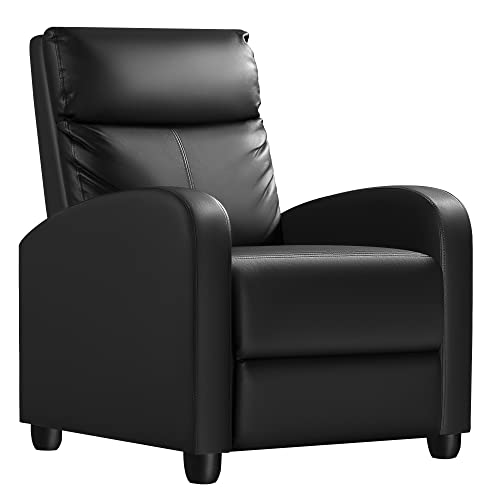
Homall Recliner Chair — Best Home Theater Recliner
The Homall is the unapologetic recliner of the group: a PU leather reclining sofa chair for adults, in black, with lumbar support, positioned by its listing for home theater seating in the living room. Homall sells enormous volumes of seating in this pattern, and the design intent is comfort-first — wide, padded, and built around the reclined position rather than the upright one. It suits movie rooms, gaming-adjacent living rooms, and anyone whose living-room chair is where evenings actually happen.
Strengths
- Listing states PU leather directly
- Purpose-built recliner comfort with lumbar support
- Black home-theater styling suits media rooms
Trade-offs
- Large footprint and visual weight — it will dominate a small room
- Recliner-first design is not a tailored accent piece
- Heavily padded PU surfaces need the care routine in this guide to age well
Spec snapshot (from the listing): PU leather; recliner sofa chair; lumbar support; home theater positioning; black; for adults.
There is no point pretending this chair is anything other than what it is, and that is its charm: it is the seat people fight over on movie night. The PU leather surface is a practical match for the role — popcorn butter and drink condensation wipe off a synthetic surface in seconds, where they would be an incident on fabric or a conditioning event on genuine leather. Place it where the screen is, give it the wall clearance a recliner needs, and let the accent chairs in this guide handle the looking-good duties elsewhere in the room.
Best for: media rooms, movie nights, comfort-first buyers / Not suited for: small formal living rooms
Check the current price on Amazon
Comparison Table
| Pick | Badge | Key spec | Best for |
|---|---|---|---|
| VASAGLE Armchair | Best Overall | PU leather, button tufted, tan | Most living rooms |
| Black Wingback Accent Chair | Best Wingback | PU leather upholstery, solid wood legs, black | Studies and formal rooms |
| Mid-Century Wingback | Best Mid-Century Style | PU leather, rivet trim, PU brown | Retro and eclectic rooms |
| Wingback Chairs Set of 2 | Best Pair | Faux leather, solid wood frame, nailhead trim | Symmetrical layouts |
| CANMOV Pushback Recliner | Best Pushback Recliner | Faux leather, pushback recline, reddish brown | Small rooms, occasional recline |
| Homall Recliner | Best Home Theater Recliner | PU leather, lumbar support, black | Movie rooms |
Key Takeaways
- PU leather is a synthetic, polyurethane-coated material — this guide never calls it leather, and neither should any listing you trust.
- Listings mix “PU leather” and “faux leather”; each pick here is labeled with its own listing’s exact term.
- Wingbacks give upright support and architecture; recliners give relaxation; accent chairs give flexibility — buy the job, not just the look.
- Wood legs and solid wood frames, where listings state them, are the construction details worth paying for in this tier.
- PU leather’s superpower is care: spills wipe clean and no conditioning is needed — but heat and harsh cleaners are its enemies.
- Decide the silhouette before the product: accent chairs serve rooms and conversation, recliners serve one person’s evening.
- Tape the footprint — and a recliner’s full extension — on the floor before ordering; layout regrets are the most preventable in furniture.
How to Choose a PU Leather Living Room Chair
Start with the chair’s job in your room’s seating plan. If the sofa carries daily lounging, the new chair is an accent: prioritize silhouette and color, and the wingbacks and the VASAGLE are your field. If the chair will be someone’s primary evening seat, prioritize the recliners and cushion depth. If the room is formal and symmetrical, the set of 2 solves it in one order. Next, measure with recliners’ honesty: a recliner needs wall clearance behind and legroom in front, and a wingback pair needs a room width that lets both chairs breathe — tape the footprints on the floor before ordering and live with the tape for a day.
Then interrogate the material like a skeptic, because this category rewards it. Confirm the listing’s own material term; be wary of listings that say “leather” unqualified at synthetic prices, since genuine leather at these tiers is not a thing and the word is doing dishonest work. Check what the frame and legs are stated to be — solid wood claims appear on two picks in this guide and are worth more than any styling adjective. Consider color against your household: black hides wear but shows dust and hair; tan and brown hide dust but show dye transfer and scuffs; reddish brown is the forgiving middle. Seat geometry deserves its own check, because living-room chairs fail comfort quietly: a seat height around the mid-teens of inches suits most adults for easy standing, deeper seats suit loungers and taller users, and shallower seats suit upright conversation and smaller rooms. If the chair is destined for an older household member, prioritize a firmer cushion and a seat height that lets feet rest flat — the difference between a chair that gets used daily and one that gets admired is often whether standing up from it feels effortless. The wingbacks’ upright patterns and the VASAGLE’s accent scale are the friendliest in this guide on that measure; deep recliners are the least, by design.
Finally, set the expectation that defines satisfaction with this entire category: you are buying a handsome, practical, wipe-clean chair for years of service — not an heirloom, and not leather. Buyers who hold that frame consistently report the highest satisfaction with PU leather furniture.
How to Care for PU Leather Upholstery
PU leather care is simple, but it is not “no care,” and the failure mode of neglected PU — surface peeling years in — is usually traceable to heat, harsh chemicals, or both. Dust weekly with a dry or barely damp soft cloth; the material’s smooth surface releases dust easily, which is half its appeal. Wipe spills promptly with a damp cloth and mild soap, then dry the spot — liquids left standing can work into seams and stitching even when the surface itself resists them. Keep the chair out of prolonged direct sunlight and away from radiators and heat vents; sustained heat dries the polyurethane coating and shortens its life more than any other household factor. Never use solvent cleaners, bleach, or abrasive pads, and be skeptical of “leather conditioners” — a synthetic coating does not absorb conditioner the way hide does, and the wrong product leaves residue or damages the finish; a clean damp cloth is the entire routine for most situations. For recliners, vacuum the crevice between seat and back monthly, since grit ground into the fold is where surfaces abrade first. Handled this way, a PU leather chair should look presentable for years of daily use.
Common Buying Mistakes
The defining mistake of this category is believing you bought leather — every disappointment downstream flows from it. PU leather will not patina, will not last decades like quality hide, and should not be priced or judged as if it would. Second: trusting listings that blur material terms; if a chair’s title says “leather” at a synthetic price with no PU or faux qualifier, assume synthetic and sloppy labeling. Third: buying a recliner without measuring wall clearance and then parking it mid-room in frustration. Fourth: choosing black for a pet-haired household or tan for a raw-denim household — color regret is the most preventable regret in furniture. Fifth: ignoring frame and leg materials in favor of styling words; the listings that state solid wood are telling you where the money went. Sixth: using leather-care products or harsh cleaners on a synthetic surface and damaging the coating in the name of maintenance.
PU Leather vs. Genuine Leather vs. Fabric: The Honest Three-Way Comparison
Buyers in this category are usually choosing among three upholstery families, and each wins somewhere. Genuine leather wins on longevity and aging: a quality hide chair can serve for decades, develops patina, and can be conditioned and repaired by specialists. It loses on price — typically several times the cost of the chairs in this guide — on care obligations, and on vulnerability to spills left standing and to pet claws in the short term. PU leather wins on price, on wipe-clean practicality, and on consistency: every panel matches, every chair in a set matches, and no animal product is involved. It loses on lifespan and on aging character; it stays the same until it wears, rather than growing more beautiful. Fabric wins on breathability, on texture variety, and on hiding minor scratches within a weave. It loses on spill absorption and hair retention, and it asks for deeper cleaning.
The decision usually resolves by household rather than by taste. Homes with young children, frequent entertaining, or pets that shed favor PU leather’s surface logic — which is why it dominates the accent-chair tier specifically, where pieces are bought in pairs, moved often, and expected to look crisp in photographs. Homes furnishing once for decades favor leather’s economics over time. Homes in hot climates with no air conditioning should weigh fabric or PU carefully, since both synthetics and leather feel warmer against skin than a breathable weave in August. None of these is the “premium” answer in the abstract; each is the right answer to a different set of facts, and this guide’s six chairs are the PU family’s best current representatives for the living room.
Arranging Living Room Chairs: Layout Patterns That Work
Where chairs sit matters as much as which chairs they are. The conversation cluster — sofa facing two accent chairs across a coffee table — is the pattern the set of 2 in this guide was born for; keep the chairs’ front legs on the rug to visually anchor the group, and angle them a few degrees inward, because perfectly parallel chairs read as a waiting room. The reading corner pattern takes one chair — a wingback ideally, for its enclosure — placed at 45 degrees in a corner with a floor lamp behind the shoulder and a small side table within reach; it converts dead square footage into the room’s most contested seat. The fireplace flank is the formal classic: matched chairs on either side, symmetry doing the decorative work. The media pattern gives the recliner the throne position facing the screen, with accent chairs angled at the room’s edges for overflow seating that can swivel into the conversation after the film. Two universal rules: leave walking lanes of roughly a meter where people actually pass, and let every seat reach a surface for a drink — a chair without a table beside it is a chair people migrate out of. Tape the layout on the floor before the chairs arrive, and you will learn more in ten minutes than a month of rearranging furniture teaches.
Assembly, Delivery, and First-Week Checks
Chairs in this tier typically arrive flat-packed or partially assembled — legs, backs, and cushions as separate components — and assembly is usually a one-person, sub-hour job with the tool included. Work on a rug or blanket to protect both the floor and the upholstery, and resist fully tightening every bolt until all are started; frames align better loose and true up when snugged in sequence. With recliners, operate the mechanism several times before loading it with a person, and confirm the floor clearance through the full recline arc. In the first week, run three checks: re-tighten leg bolts after a few days of settling, confirm the chair sits level (adjustable glide feet or a felt pad fix most wobbles), and inspect seams and tufting buttons while the return window is unquestionably open. Keep the packaging until those checks pass. None of this is difficult, but the buyers who do it are the ones whose chairs feel solid in year three, because frame tightness in week one is destiny for flat-pack furniture.
Color and Finish: Choosing Among Black, Tan, Brown, and Reddish Brown
This guide’s six chairs span the classic synthetic-leather palette, and each color has a personality beyond taste. Black — the wingback and the Homall — is the graphic choice: it anchors pale rooms, suits media spaces, and hides wear and spills best, while showing every speck of dust and light pet hair. Tan — the VASAGLE — is the warm neutral: it brightens rooms, pairs with both grey and wood palettes, and shows scuffs and dye transfer soonest, which makes it the color for adult, low-chaos households. Brown — the mid-century wingback and the set of 2 — is the traditional middle: forgiving of dust, warm with wood floors, and the easiest to coordinate with existing furniture, with the caveat that matching a specific existing brown exactly is a fool’s errand; aim for harmony of tone, not identity. Reddish brown — the CANMOV — is the richest and most specific: beautiful with traditional rugs and warm lighting, and the hardest to add to later, since its undertone must be respected by neighboring pieces. A practical rule for pairs and sets: buy them together, as the set of 2 in this guide allows, because dye lots in synthetic materials vary enough between production runs to make a later “matching” purchase visibly approximate. Photograph your room in daylight before ordering; phone screens flatter warm tones, and the chair will live in your light, not the listing’s.
Reading a PU Leather Chair Listing Like a Skeptic
Five checks separate an informed purchase in this category from a hopeful one. First, find the material term and hold the listing to it: “PU leather” and “faux leather” are honest labels; an unqualified “leather” at this tier’s prices is a red flag, and “leather-like” is a confession. Second, look for frame and leg specifics — the picks in this guide that state solid wood legs or a solid wood frame are spending money where it matters, while listings heavy on lifestyle adjectives and silent on construction are telling you where the money did not go. Third, treat lifestyle photos as styling, not scale: check stated dimensions against your taped floor plan, because accent chairs photograph larger than they sit. Fourth, note the mechanism on recliners — pushback, handle, or power — since it determines both the silhouette and the servicing future; the CANMOV’s pushback simplicity and the Homall’s theater-first design are different ownership propositions wearing similar upholstery. Fifth, read the care guidance in the listing if present and compare it with the routine in this guide; a maker who tells you to keep their chair away from heat and solvents is a maker who understands their own material, which correlates with the material being decent in the first place.
Accent Chair or Recliner? Deciding the Silhouette First
Half the returns in this category are silhouette regrets, not quality complaints, so decide the shape before the product. An accent chair — the VASAGLE and the two single wingbacks — is a social object: upright enough for conversation, compact enough to move for cleaning or company, and honest about being sat in for an hour rather than an evening. A wingback adds enclosure and formality to that brief, which is why readers and conversationalists love it and nappers do not. A recliner — the CANMOV in tailored form, the Homall in full form — is a personal object: it serves one person’s evening completely and a dinner party barely at all. The pushback pattern exists precisely for households torn between the two briefs, and its compromise is real in both directions: less tailored than a true accent chair at rest, less enveloping than a true recliner at full lean. Ask the deciding question out loud — “who sits here, doing what, for how long, most evenings?” — and the silhouette usually chooses itself. Then let the six reviews above choose the specific chair, because within a silhouette, construction and color are what separate a good purchase from a merely adequate one.
A Note on Longevity and Honest Expectations
It is worth stating plainly what ownership of these chairs looks like across years, because the category’s worst reviews are expectation failures rather than product failures. In year one, a well-kept PU leather chair looks essentially new — the surface is uniform and the cushions hold their shape. Across years two to five of daily use, the changes are gradual: high-contact areas soften in sheen, seat cushions settle into their owners’ shapes, and the chair reads as comfortably lived-in rather than showroom-crisp. The failure to avoid is the sudden one — coating damage from a heat source, a solvent cleaner, or a pet’s determined scratching — which is why the care section of this guide is written as prevention rather than repair. Set beside genuine leather’s decades, this is a shorter arc; set beside its price, it is a fair one, and the households happiest with these chairs are the ones who bought the arc knowingly. When the chair eventually retires from the living room, sound frames often give it a second life in a bedroom or study — one more reason the solid-wood construction claims in two of this guide’s listings matter.
Secondhand and Hand-Me-Down Notes
Because these chairs are affordable and durable enough to circulate, a brief word on the secondhand life of PU leather furniture: it is a good category to buy used and a good category to pass on, with two checks. Inspect the coating at the high-contact zones — seat front edge, armrest tops, headrest area — where peeling, if it is coming, announces itself first as a change in sheen or fine cracking; a chair clean at those three points is usually sound throughout. Then sit in it properly: frame integrity announces itself through creaks and flex that a photograph cannot convey, and the solid-wood construction claimed by two of this guide’s listings is exactly what survives to be worth buying twice. Sellers should photograph those same zones honestly; buyers should price in the material’s arc rather than its first-year looks. A PU leather chair on its second owner, in a bedroom or study, is this category’s quiet sustainability story.
Final Recommendation
For most living rooms, buy the VASAGLE PU Leather Armchair — the most versatile tailored accent in the guide. Formal and traditional rooms should take the black wingback or the matched set of 2; retro rooms the mid-century wingback; small rooms that still want recline the CANMOV pushback; and movie-first rooms the Homall recliner. For neighboring questions in this seating cluster, see Best Cloth Living Room Chairs, Best Chairs Accent Chair, Best Leather Chairs For Reading, Best Leather Wingback Chairs Great Colors, and Best Made Small Living Room Chairs.
Whichever chair you choose, do the two things this guide keeps returning to: read its material label with clear eyes — PU leather and faux leather are good materials with honest jobs, and they disappoint only when sold or bought as something else — and give the chair its first-week checks while the return window is open. A chair chosen that way, in the right silhouette, color, and construction for your room, will be the seat your household gravitates to, which is the only review that ultimately counts.
Frequently Asked Questions
Is PU leather real leather?
No. PU leather is a synthetic material — fabric coated with polyurethane. It looks and cleans like leather’s tailored surface, but it is not hide, does not develop patina, and should be bought and priced as a synthetic. This guide labels every chair with the exact term its listing uses.
What is the difference between PU leather and faux leather?
Faux leather is the umbrella category for all leather alternatives. PU leather is one specific type — the polyurethane-coated kind. Some listings in this guide state PU leather directly; others state only faux leather, and we preserve that distinction chair by chair rather than treating the terms as interchangeable.
How long does a PU leather chair last?
With the care routine in this guide — shade from direct sun and heat, damp-cloth cleaning, no solvents — expect years of presentable daily service. The coating’s enemies are heat, harsh chemicals, and abrasion in creases; the material’s lifespan is shorter than quality genuine leather and longer than its bargain reputation suggests when it is kept well.
Does PU leather peel?
Low-quality or heat-damaged PU coatings can eventually crack or peel, which is why this guide favors established makers, states frame materials where listings provide them, and gives a care routine aimed at the coating’s real enemies. Peeling is a quality-and-care outcome, not an inevitability on day one.
PU leather or fabric for a living room with kids and pets?
PU leather’s wipe-clean surface is a genuine advantage for spills and muddy paws, and it does not trap hair the way fabric weaves do. Fabric wins on breathability in hot rooms and on hiding scratches — pet claws can mark a PU surface. Many households split the difference: PU leather on the accent chairs, fabric on the main sofa, or the reverse.
Are these chairs comfortable for long reading sessions?
The wingbacks are the reading chairs of this guide — upright support, enclosure, and in the set of 2’s case a high back designed for the purpose; the CANMOV adds recline for readers who shift positions, and the Homall serves readers who effectively live in one seat. For multi-hour reading, pair any of them with a footstool and a lamp at shoulder height; the chair supplies the posture, but the accessories finish the job, and a cushion behind the lower back personalizes any of these seats further.
Can I repair a scratch or tear in PU leather?
Small surface scuffs often fade with gentle cleaning. Tears and peeling are harder — vinyl and PU repair kits exist with mixed, color-dependent results, and they are a cosmetic patch rather than a restoration. Prevention through the care routine is worth more than any repair product in this category.


