Disclosure: airfryerkitchensupply.com is reader-supported. When you buy through links on our site, we may earn an affiliate commission at no extra cost to you.
Where to buy
Every vacuum below is a complete cordless machine — motor, floor head, and battery in the box as a working system, not a bare tool or a replacement part — confirmed through Amazon’s own product data. Check the current price on Amazon for each: Shark Pet Cordless Stick Vacuum IX141, Dyson V8 Plus Cordless Vacuum, Tineco A30S Cordless Vacuum Cleaner, Levoit Cordless Vacuum Cleaner LVAC-200, BISSELL PowerClean FurGuard Pet Cordless Stick Vacuum, and Hoover ONEPWR WindTunnel Emerge Complete.
Introduction
The best battery vacuum for hardwood rugs has a harder job than either surface alone suggests. Hardwood wants a gentle touch — no aggressive stiff bristles grinding grit across a finish — plus suction strong enough to pull debris out of plank seams and bevels. Rugs want the opposite personality: agitation that works pile loose of embedded hair and grit, and enough sustained power to matter on more than a doormat. A cordless stick vacuum that serves a mixed-floor home has to switch between those personalities several times in a single session, keep its runtime honest across both, and do it all on one battery. This guide compares six complete cordless machines verified through Amazon’s product data, spanning the value tier to the premium tier, with runtimes, suction figures, and floor-head designs taken from their listings. We excluded tool-only machines sold without batteries, handheld car vacuums, pool and robot vacuums, and every replacement battery, filter, and attachment — because a battery vacuum guide should contain vacuums that arrive ready to clean, battery included. If you read only one section beyond the picks, make it the technique sections: on mixed floors, how you run a mid-priced machine matters more than the price gap between it and the premium model beside it.
In this guide
Quick Picks
- Best Overall: Shark Pet Cordless Stick Vacuum IX141 — up to 40 minutes of runtime, an XL dust cup, LED headlights, and a removable handheld mode, built for carpet and hard floors. Check the current price on Amazon
- Best Premium: Dyson V8 Plus Cordless Vacuum — 115AW of suction in the listing, two power modes, up to 40 minutes, a detangling cleaner head, and conversion to handheld. Check the current price on Amazon
- Best Runtime: Tineco A30S Cordless Vacuum Cleaner — 200AW suction and up to 60 minutes per the listing, a 1L dustbin, and a ZeroTangle brush for pet hair on carpet and hard floor. Check the current price on Amazon
- Best Lightweight: Levoit Cordless Vacuum Cleaner LVAC-200 — anti-tangle design for pet hair, up to 50 minutes, and a 180-degree lay-flat design for reaching under furniture. Check the current price on Amazon
- Best for Pet Homes: BISSELL PowerClean FurGuard — a 280W pet-focused stick with up to 50 minutes of runtime, LED headlights, a fur remover tool, HEPA filtration as the listing states it, and a removable battery. Check the current price on Amazon
- Best Self-Standing: Hoover ONEPWR WindTunnel Emerge Complete — a lightweight, self-standing cordless stick on Hoover’s ONEPWR battery system, positioned for quiet cleaning. Check the current price on Amazon
How These Picks Were Chosen
The screening rules were mechanical. First, completeness: the listing had to describe a full cordless vacuum system — several otherwise interesting machines in Amazon’s catalog are sold as “tool only” for workshop battery platforms and were excluded, because a homeowner following this guide should open one box and start cleaning. Second, dual-surface intent: each pick’s listing had to address both hard floors and carpet or rugs, since that pairing is the search’s whole point. Third, no parts: replacement batteries, filters, chargers, and brush rolls are accessories, not vacuums, and none appears as a pick. Within those rules we balanced the factors that decide mixed-floor ownership — runtime against real homes’ square footage, dust-cup capacity, whether the battery is removable (which determines whether a second battery can double your runtime later), floor-head behavior on pile, and weight. Suction figures and runtimes are quoted from listings as manufacturers state them; maximum runtimes in this category are typically measured on the lowest setting, and we flag that where it matters rather than repeating headline numbers as promises.
One more screening note, because readers will meet these products in search results and wonder: the catalog for this search is unusually polluted. Alongside genuine machines sit pool cleaners that share the word “vacuum,” sewing-table mini vacuums, air dusters, wet-dry workshop tools sold without batteries, and a thicket of replacement batteries whose listings borrow vacuum photography. A guide that simply ranked the first ten results would recommend at least three products that cannot clean a floor. Our six picks survived a dumber, more reliable test — each is unambiguously a complete cordless floor vacuum whose own listing says it cleans both hard floors and carpet or rugs — and the exclusions are documented in this article’s companion notes rather than silently skipped.
The 6 Best Battery Vacuums for Hardwood and Rugs

Shark Pet Cordless Stick Vacuum IX141 — Best Overall
The Shark IX141 is the balanced default for a mixed-floor home: a lightweight grey stick vacuum with up to 40 minutes of runtime, an XL dust cup, LED headlights on the floor head, and a removable handheld vacuum mode, with crevice and pet tools included per the listing. Its positioning covers carpet and hard floors in one machine, which is precisely the brief. It suits apartments and mid-size homes, pet owners who vacuum frequently in short sessions, and anyone who wants one machine to live in a closet rather than a fleet of specialists.
Strengths
- XL dust cup means fewer mid-session emptying trips on pet-hair days
- LED headlights reveal dust and grit on hardwood that ceiling light hides
- Removable handheld mode handles stairs, upholstery, and car interiors
Trade-offs
- 40-minute maximum runtime is measured gently — max-power rug work shortens it
- Single floor head design must serve both surfaces rather than swapping to a dedicated soft roller
- Stick format still needs a wall or closet corner to lean in
Spec snapshot (from the listing): up to 40-min runtime; XL dust cup; LED headlights; removable handheld; crevice and pet tools; for carpet and hard floors.
What makes the IX141 the overall pick is the absence of a weak point for its tier. The dust cup size matters more in pet homes than spec sheets suggest, because a cup that fills in four minutes turns vacuuming into an emptying ritual; the XL cup keeps sessions continuous. The headlights sound like a gimmick until you watch them rake light across hardwood at floor level and reveal the grit line along baseboards you have been missing for months. And the handheld conversion means the same battery and motor serve the sofa and the stairs. For a first cordless purchase in a home with both hardwood and rugs, this is the machine against which the rest of the guide is measured.
Best for: most mixed-floor homes and pet owners / Not suited for: very large homes needing hour-plus continuous runtime
Check the current price on Amazon

Dyson V8 Plus Cordless Vacuum — Best Premium
The V8 Plus is the established premium pattern in this category: a Dyson cordless rated in the listing at 115AW with two power modes and up to 40 minutes of runtime, a cleaner head designed to detangle hair as it cleans, and instant conversion to a handheld. It addresses hard floors and carpets in one system. It suits buyers who want refined engineering, strong suction in a compact body, and a machine whose accessory ecosystem and parts availability are the most mature in the category.
Strengths
- 115AW suction figure and two power modes let you trade runtime for rug power deliberately
- Detangling cleaner head reduces the hair-wrap maintenance that plagues brush rolls
- Handheld conversion and Dyson’s accessory range extend it beyond floors
Trade-offs
- Premium tier pricing
- Runtime matches rather than beats cheaper rivals, especially on the higher power mode
- Dust bin is compact beside the Shark’s XL cup
Spec snapshot (from the listing): 115AW; 2 power modes; up to 40 minutes; detangles; converts to handheld; hard floors and carpets.
The honest way to frame the V8 Plus is that you are paying for suction density and design maturity, not for headline runtime. Its two-mode system maps neatly onto the hardwood-and-rug brief: the lower mode for daily hardwood passes where finesse matters, the higher mode for rug agitation where embedded grit needs persuading. The detangling head deserves its reputation in homes with long hair, human or pet, because every minute not spent cutting hair off a brush roll is a minute the vacuum stays in service. If your budget reaches the premium tier and your home is apartment-to-mid-size, this remains the reference cordless experience.
Best for: premium buyers, smaller homes, long-hair households / Not suited for: budget shoppers or very large homes
Check the current price on Amazon

Tineco A30S Cordless Vacuum Cleaner — Best Runtime
The A30S leads this guide on both headline numbers in its listing: 200AW of suction and up to 60 minutes of runtime, with a 1L larger dustbin, a ZeroTangle brush, and PureCyclone filtration technology, positioned for pet hair on carpet and hard floor. Numbers aside, the configuration tells a coherent story — a big bin, a long runtime, and an anti-tangle brush are the three features a large, pet-owning, mixed-floor home actually consumes. It suits bigger homes, multi-pet households, and anyone whose current cordless dies in the last bedroom.
Strengths
- Up to 60 minutes of runtime — the longest in this guide as listed
- 200AW suction figure is the highest in this guide as listed
- 1L dustbin and ZeroTangle brush target pet-hair volume directly
Trade-offs
- Maximum runtime is achieved on gentle settings; max-power rug cleaning draws it down faster
- Larger bin and battery make it a fuller handful than the lightest sticks
- Premium-adjacent pricing within the cordless field
Spec snapshot (from the listing): 200AW suction; up to 60-min runtime; 1L dustbin; ZeroTangle brush; PureCyclone tech; pet hair, carpet and hard floor.
Runtime is the specification that decides whether a cordless vacuum becomes a whole-home tool or a spot-cleaning accessory, and the A30S is built to be the former. Sixty minutes at low-to-mid settings covers a large home’s hardwood in one pass, with enough reserve to give the rugs real attention rather than a courtesy swipe. The ZeroTangle brush addresses the other large-home tax — brush-roll maintenance scales with the hair volume of the household. For the reader whose hardwood is measured in rooms rather than feet and whose rugs are genuinely trafficked, this is the pick engineered around your floor plan.
Best for: large homes, multi-pet households, long sessions / Not suited for: buyers prioritizing the lightest possible stick
Check the current price on Amazon
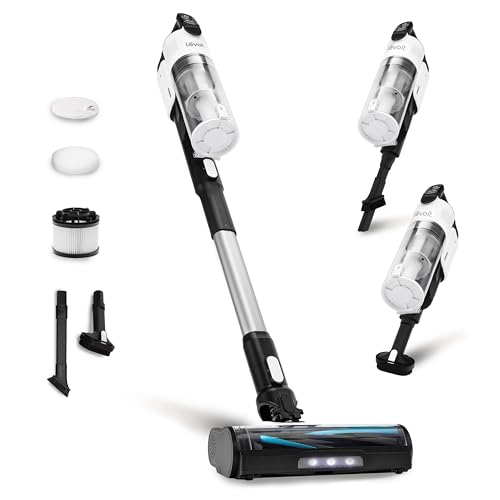
Levoit Cordless Vacuum Cleaner LVAC-200 — Best Lightweight
The LVAC-200’s signature is in its listing: an anti-tangle design for pet hair, up to 50 minutes of runtime, a lightweight rechargeable build for carpets and hard floors — and a 180-degree lay-flat design. That last feature is the one owners end up mentioning most, because the dirtiest hardwood in most homes is the hardwood under sofas, beds, and media consoles, and a stick that folds flat reaches it without moving furniture. It suits smaller homes, users who find full-size sticks fatiguing, and anyone whose cleaning style is frequent and quick rather than weekly and monumental.
Strengths
- 180° lay-flat design cleans under low furniture without moving it
- Up to 50 minutes of runtime is strong for its weight class
- Anti-tangle brush design reduces pet-hair maintenance
Trade-offs
- Lightweight builds trade dust capacity — expect more frequent emptying
- Deep-pile rug agitation is not its specialty compared with the pet-flagship picks
- Fewer included tools than some rivals per its positioning
Spec snapshot (from the listing): anti-tangle for pet hair; up to 50 minutes; lightweight; rechargeable; carpets and hard floors; 180° lay-flat; model LVAC-200.
There is a real philosophy difference between this and the Tineco: the A30S assumes you vacuum your whole home in planned sessions; the Levoit assumes you vacuum often, briefly, and opportunistically — the visible grit by the door today, under the sofa tomorrow. For hardwood-dominant homes with a few rugs, that philosophy fits the actual dirt, which accumulates at edges and under furniture rather than evenly across open floor. A light machine you enjoy grabbing will keep hardwood cleaner than a powerful machine that feels like an event, and the lay-flat trick covers the square footage other sticks skip entirely.
Best for: hardwood-dominant homes, under-furniture cleaning, frequent quick passes / Not suited for: deep-pile rug specialists
Check the current price on Amazon

BISSELL PowerClean FurGuard Pet Cordless Stick Vacuum — Best for Pet Homes
BISSELL builds pet-first, and the FurGuard’s listing reads like a checklist written by a dog owner: a 280W motor, up to 50 minutes of runtime, LED headlights, a fur remover tool, a 2-in-1 handheld conversion, HEPA filtration as the listing states it, and — the feature with the longest shadow — a removable battery. A removable battery changes ownership math: a second battery doubles runtime, and a worn battery is a replaceable part rather than the end of the machine. It suits committed pet homes, shedding breeds, and buyers who plan to keep a vacuum for many years.
Strengths
- Removable battery enables runtime doubling and long-term battery replacement
- Pet-specific toolkit including a fur remover tool, plus LED headlights
- HEPA filtration as stated in the listing; up to 50 minutes of runtime
Trade-offs
- Pet-first design is more machine than pet-free homes need
- A second battery is a separate purchase if you want the doubled runtime
- 280W-class power rewards mid settings for battery management
Spec snapshot (from the listing): 280W; up to 50-min runtime; 2-in-1 handheld; LED headlights; fur remover tool; HEPA per listing; removable battery.
On hardwood-and-rug pet duty specifically, the FurGuard’s combination is well aimed. Headlights expose the hair-and-grit mix along baseboards; the handheld mode with the fur tool handles the sofa, which is where rug-adjacent pet hair migrates; and the filtration claim matters in homes where vacuuming itself stirs the air. But the removable battery is the strategic feature. Every cordless vacuum in this guide will eventually face battery aging; on most, that is a product replacement, and on this one it is a part replacement. For a pet home that vacuums daily, that difference compounds into the best long-term value in the guide.
Best for: daily pet-hair homes, long-term ownership planners / Not suited for: pet-free homes wanting the simplest stick
Check the current price on Amazon

Hoover ONEPWR WindTunnel Emerge Complete — Best Self-Standing
The Emerge Complete solves the two annoyances that make people abandon stick vacuums: storage and batteries. It is a lightweight cordless stick that stands on its own — no leaning, no wall mount required — and it belongs to Hoover’s ONEPWR system, in which batteries are shared across a family of products; the “Complete” kit designation indicates a full working package rather than a bare tool. The listing positions it for powerful, quiet cleaning in home use. It suits apartment dwellers without a utility closet, renters who cannot drill for a wall dock, and households already owning ONEPWR batteries.
Strengths
- Self-standing design stores anywhere without a mount or a lean
- ONEPWR battery ecosystem — batteries can be shared and swapped across the system
- Lightweight build with quiet-cleaning positioning
Trade-offs
- The listing gives less headline specification detail than spec-forward rivals
- Ecosystem value only materializes if you use ONEPWR batteries elsewhere
- Not the pet-specialist tool that the BISSELL and Shark are
Spec snapshot (from the listing): ONEPWR battery system; Complete kit; lightweight; self-standing; WindTunnel design; home use, quiet cleaning positioning.
WindTunnel is Hoover’s long-running suction-channel design language, and its presence here signals a mainstream, floor-first machine rather than a gadget. The self-standing frame deserves more respect than it gets in spec comparisons: a vacuum that parks upright in a corner gets used for the two-minute grit emergency, while a vacuum that must be retrieved from a mount in another room gets used on Saturday. For hardwood homes, where the winning strategy is frequent light passes rather than heroic weekly sessions, that accessibility is a performance feature in disguise.
Best for: apartments, renters, ONEPWR households, grab-and-go cleaning / Not suited for: buyers wanting maximum published specs or pet specialization
Check the current price on Amazon
Comparison Table
| Pick | Badge | Key spec | Best for |
|---|---|---|---|
| Shark IX141 | Best Overall | 40-min runtime, XL cup, LED headlights | Most mixed-floor homes |
| Dyson V8 Plus | Best Premium | 115AW, 2 modes, detangling head | Premium smaller homes |
| Tineco A30S | Best Runtime | 200AW, 60-min runtime, 1L bin | Large and multi-pet homes |
| Levoit LVAC-200 | Best Lightweight | 50-min runtime, 180° lay-flat | Under-furniture cleaning |
| BISSELL FurGuard | Best for Pet Homes | 280W, removable battery, fur tool | Daily pet-hair duty |
| Hoover Emerge Complete | Best Self-Standing | Self-standing, ONEPWR system | Apartments and renters |
Key Takeaways
- Only complete machines with batteries are picks here — tool-only listings, car vacuums, and replacement parts were excluded on purpose.
- Maximum runtimes are measured on gentle settings; plan your real runtime around mid-power mixed-floor work.
- Removable batteries (BISSELL, and Hoover’s ONEPWR system) change long-term ownership: runtime can double and batteries can be replaced.
- Hardwood rewards headlights, finesse, and frequent light passes; rugs reward suction headroom and anti-tangle brushes.
- Dust-cup size is a pet-home specification, not a footnote — the Shark’s XL cup and Tineco’s 1L bin exist for hair volume.
- Technique is a free upgrade: perimeters first, slow passes over seams and rug centers, and a clean floor head protect both the floor and the machine.
- Park the vacuum where dirt enters the home; a machine stored near the mess gets used for the two-minute cleanups that keep hardwood looking freshly done.
How to Choose the Best Battery Vacuum for Hardwood Rugs
Start with your floor ratio. A hardwood-dominant home with a few low-pile rugs should weight the Levoit and Hoover end of this guide — light, quick, kind to finishes, and good under furniture. A genuinely mixed home should default to the Shark or Dyson. A rug-heavy or large home should start with the Tineco’s runtime and bin, or the BISSELL with a second battery on the shopping list. Then check the two numbers that quietly decide satisfaction: real runtime at the power level your rugs need, and dust capacity against your household’s hair and grit production. A vacuum that dies or fills two rooms from the end teaches its owner to vacuum less, and every other specification becomes trivia.
Then think about the battery as a system. Is it removable? Can it be replaced in three years, or shared with other tools you own, as with Hoover’s ONEPWR? Is the runtime figure quoted at a setting you will actually use on rugs? Finally, consider the floor head’s personality on each surface: anti-tangle and detangling designs (Tineco, Levoit, Dyson in this guide) reduce maintenance in hair-heavy homes, while LED headlights (Shark, BISSELL) change what you can see on hardwood more than any suction figure changes what you can pick up. Suction matters, but on sealed hardwood most debris sits on the surface waiting to be collected; on rugs, suction plus agitation is what extracts the embedded fraction. Buy for the surface that challenges the machine — the rug — and confirm the machine stays gentle and convenient on the surface that fills most of your week — the hardwood.
Hardwood Technique: Getting the Most From a Cordless Stick
Technique multiplies whatever machine you buy. Vacuum hardwood in overlapping lanes at walking pace, not the brisk shove used on carpet — the head needs a moment over plank seams, where grit collects. Run the room’s perimeter first with lights on the head if your model has them, because baseboard edges hold the densest debris line in the room. Slow down further over the high-grit zones: entryways, under kitchen stools, and the rug-to-hardwood borders where tracked-in sand transfers. Empty the cup before it passes roughly two-thirds full; cyclonic systems lose efficiency as the cup crowds, and hardwood dust is fine enough to show the loss quickly. Between deep sessions, use the handheld mode for the daily grit spots — thirty seconds at the door beats a weekly archaeological dig. And keep the floor head’s brush and wheels clean: a pebble or hair wad trapped under a wheel is how a gentle machine becomes a scratch risk, which is a maintenance fact, not a design flaw.
Rug Technique: Pile, Direction, and Battery Budgeting
Rugs repay a different technique. Raise the power for rug passes and budget battery for it — if your home is large, clean rugs first while the battery is full, then drop to a gentler mode for the hardwood majority. Work rugs in two directions, with the pile and then across it; the second direction lifts what the first loosened, especially along traffic lanes. Slow down on the rug’s center, where embedded grit concentrates, and give edges a dedicated pass, since rug borders trap debris against the hardwood line. For low-pile and flatweave rugs — the kind most common over hardwood — moderate suction with agitation is the sweet spot; excessive suction can seal the head to a light rug and drag it, which is your cue to vent or lower the setting. Shake small rugs outdoors when you can instead of vacuuming them at maximum — some cleaning jobs are still best done by gravity. Finally, match expectations to pile: no stick vacuum fully substitutes for a deep extraction clean once or twice a year on high-pile rugs, and the honest role of every machine in this guide is excellent maintenance between those events.
Common Buying Mistakes
The most expensive mistake in this category is buying a tool-only machine by accident — the listing price looks like a bargain until you price the battery and charger the box does not contain; every pick in this guide is a complete system precisely to avoid that trap. Second: shopping by maximum runtime without asking at what power setting it was measured. Third: ignoring dust capacity in a pet home, then blaming suction for what is really a full cup. Fourth: buying a replacement battery or a parts listing thinking it is a vacuum — it happens constantly in this category’s search results. Fifth: assuming the strongest suction is automatically best for hardwood, when technique, headlights, and frequency matter more on sealed floors. Sixth: forgetting storage — a vacuum without a parking plan becomes a vacuum behind a door that nobody opens.
Matching the Vacuum to Your Rug Types
“Rugs” in a hardwood home usually means three different textiles, and they do not want the same cleaning. Low-pile and flatweave rugs — kilims, dhurries, most modern synthetics — are the cordless stick’s home ground: moderate suction plus brush agitation lifts surface grit and hair without fighting the rug itself. If a light rug bunches or seals to the head, that is excess suction for its weight; step the power down or open a vent if your model provides one. Medium-pile area rugs, the common living-room case, want the full treatment described in the technique section: higher power, two directions, slow center passes. This is where the guide’s stronger machines — the Tineco’s 200AW listing figure, the Dyson’s higher mode, the BISSELL’s 280W motor — earn their keep. High-pile and shag rugs are the honest limit of the format: sticks can maintain them, fluff the surface, and collect hair, but deep grit extraction from a long pile is a periodic job for a full-size machine or a professional clean. Wool rugs deserve one extra note: be gentle with beater aggression on looped wool constructions, and prefer suction-led passes, because loops can fuzz or pull under enthusiastic agitation. A vacuum guide that pretends one setting serves a kilim and a shag alike is not being straight with you; the picks above were chosen because their power ranges let you move between those textiles deliberately.
Battery Care: Making the Pack Last
The battery is the consumable heart of every machine in this guide, and a few habits decide whether it serves for years or fades early. Avoid storing the vacuum fully depleted for long stretches; lithium packs prefer to rest partially charged, and a vacuum that lives on its charger between uses — as most of these are designed to do — manages this itself. Keep the machine out of temperature extremes: a freezing garage or a sun-baked porch ages a pack faster than daily use does. Notice the difference between runtime loss from a clogged filter or a full cup — which mimics battery failure — and genuine capacity fade; clean the filter and empty the cup before concluding the battery is tired. Where the design allows it, the removable-battery machines (the BISSELL directly, the Hoover through ONEPWR) let you rotate two packs, which halves each pack’s cycle count and gives you a graceful path when one eventually fades: replace the pack, keep the machine. Tool-only shoppers in this category sometimes imagine they will save money building a system piecemeal; for a first cordless, the complete-kit picks here remain the simpler and usually cheaper route to a working vacuum.
Filtration and Emptying: The Unglamorous Details That Decide Satisfaction
Filtration claims need the same label discipline as everything else in this guide. The BISSELL’s listing states HEPA filtration, and we report it in the listing’s own terms; other picks describe proprietary cyclone systems, like Tineco’s PureCyclone, whose job is to keep suction steady by separating dust before the filter. What matters practically is twofold: how much fine dust the system exhausts back into the room — a real consideration for the person pushing the vacuum — and how much maintenance the filter demands. Washable filters need complete drying before reinstallation; a damp filter is a clogged filter. Emptying design matters just as much. A cup that releases from the bottom, away from your face, over a bin, is the difference between a ten-second task and a dust event. In pet homes, empty outside when you can, and wipe the cup’s interior occasionally — fine hardwood dust films plastic and quietly shrinks usable capacity. These are small behaviors, but cordless ownership is a long series of small behaviors, and the machines in this guide were partly chosen for making them easy ones.
Storage and Charging: Setting Up the Vacuum’s Home Base
Where a cordless vacuum lives determines how often it works. The ideal home base is on the floor where the dirt is — a kitchen corner, a laundry room edge, a hallway closet with an outlet — not in a distant utility space. Wall docks keep sticks tidy but require drilling and a nearby outlet; renters and the drill-averse should note that the Hoover in this guide stands on its own, and several other picks lean acceptably in a closet corner. Charging habits are simple: return the machine to its base after sessions so the battery is ready for the two-minute emergency, which is the moment cordless design exists for. Keep the handheld attachments at the base rather than in a drawer across the house; the crevice tool you have to fetch is the crevice tool you stop using. If two people share the machine, agree on the emptying rule — whoever fills the cup past the line empties it — because shared tools fail socially before they fail mechanically.
A Realistic Ownership Rhythm for Mixed Floors
Here is the schedule these machines are quietly designed around. Daily or near-daily: a two-to-five-minute pass over the kitchen, entryway, and the rug by the door — the zones that generate most of a home’s mobile grit — using whatever power the surface asks for. Twice a week: the full hardwood circuit with headlights or a low sun angle if you can arrange it, perimeters included, plus handheld duty on stairs and the sofa. Weekly: rugs get the two-direction, full-battery treatment, cups get emptied and checked, and the floor head gets a thirty-second inspection for wrapped hair and trapped debris. Monthly: wash or tap out filters as the maker directs, wipe the cup, and check wheels and brush ends. Twice a year: if your home has high-pile rugs, schedule the deep extraction clean that no stick pretends to replace. Followed loosely, this rhythm keeps a mixed-floor home at a standard that makes the weekly session feel easy — which is the entire point of owning a battery vacuum rather than a corded machine you dread.
Cordless vs. Corded for This Exact Job
Since the keyword specifies battery power, a fair question is what you give up versus a corded machine — and the honest answer is: sustained maximum power and unlimited runtime, in exchange for everything else. A corded upright will out-muscle any stick in this guide on a deep-pile rug at minute forty-five, because it never thinks about a battery. It will also live in a closet, require an outlet hunt in every room, and lose the two-minute emergency entirely. The mixed-floor reality of most homes — mostly hard surface, a few rugs, dirt that arrives daily in small amounts at doors and kitchens — plays to the cordless pattern: frequent, brief, unplanned cleaning. The households that genuinely need both are easy to identify: large homes with extensive medium-or-high-pile rug coverage, where a corded machine does the weekly deep work and a stick from this guide does everything else. Everyone else is choosing a primary tool, and for hardwood with rugs, the battery tool’s convenience compounds daily while the corded tool’s power advantage matters monthly. That asymmetry is why this category has become the default recommendation for mixed floors, and why the runtime and battery-system questions in this guide matter more than any single suction figure.
Reading Cordless Vacuum Listings Like an Engineer
A short literacy section, because this category’s listings reward careful reading. When a runtime is printed, find the condition attached to it — “up to” figures in this guide’s picks (40, 50, and 60 minutes) describe the gentlest mode with a standard head, and your rug mode will be shorter; a listing that quotes runtime without conditions is telling you less, not more. When suction is printed in air watts, note whose figure it is and resist ranking machines across brands by that number alone, for the reasons covered in the FAQ. When a machine is described as “for pet hair,” look for the mechanism behind the phrase — anti-tangle brush geometry, a fur tool, a bigger cup — because the picks in this guide each implement it differently and the mechanism is what you are buying. When filtration is claimed, keep the claim at the level the listing states it; the BISSELL’s listing says HEPA, and this guide repeats exactly that, no more and no less. And when a price looks impossibly low for the category, check the two traps this guide screened out at the start: “tool only,” meaning no battery in the box, and accessory listings for batteries or filters dressed in vacuum language. Reading listings this way takes an extra minute per product and saves the most common returns in the category — which is why our screening rules were built from exactly these checks.
Two-Home and Second-Floor Strategies
A closing ownership pattern worth copying: households with two floors, or a main home and a frequently used second space, increasingly keep the cordless question simple by standardizing. One machine per floor — even a modest one — gets used more than one excellent machine carried between floors, because stairs are where good cleaning intentions go to die. Where budgets force a single machine, park it on the floor with the rugs and the entryway, since that is where the heavy soil lives, and let the handheld mode commute. Battery-system households have a third option: a second body sharing the same packs, which is the Hoover ONEPWR logic extended across a whole home. None of this changes which pick tops this guide for a single-machine household — the Shark’s balance still leads — but it reframes the purchase from “a vacuum” to “a floor-care system,” which is how the households happiest with cordless cleaning actually think about it.
Final Recommendation
Most mixed-floor homes should buy the Shark IX141 and stop deliberating: balanced runtime, a big cup, headlights, and handheld conversion. Premium buyers in smaller homes get the Dyson V8 Plus; large and multi-pet homes get the Tineco A30S; hardwood-dominant homes that live under furniture get the Levoit LVAC-200; daily pet homes get the BISSELL FurGuard and its replaceable battery; renters and apartment dwellers get the self-standing Hoover Emerge Complete. For related reading across this floor-care cluster, see Best Battery Powered Vacuums, Best Battery Carpet Vacuums, Best All Around Vacuums, Best Area Rug That Vacuums Easily, and Best Bagged Vacuums For Carpet And Hardwood.
Whichever machine you choose, the first week sets the pattern: mount or park it where the dirt actually enters your home, run the perimeter of your main room once with fresh eyes for where grit gathers, and learn your rug’s preferred power setting before you need it in a hurry. A battery vacuum rewards owners who build the small habits early — cup emptied before it crowds, filter kept clean, head checked for wrapped hair — and every pick in this guide was chosen to make those habits easy rather than to win a specification contest you would forget by the second month of ownership.
Frequently Asked Questions
How much runtime do I actually need?
As a planning rule, a studio or apartment is served by 40 minutes of listed runtime; a mid-size home wants 50 to 60; a large home wants 60, a removable battery, or a two-battery plan. Remember listed maxima are gentle-setting figures, so treat them as ceilings and your mid-power reality as somewhat less.
Will a stick vacuum scratch hardwood?
A maintained floor head in good condition is designed for hard floors. The realistic scratch risks are debris trapped under wheels or a damaged brush — both maintenance issues. Keep the head and wheels clean, and any pick in this guide is appropriate for sealed hardwood.
What does AW mean, and should I compare it across brands?
AW stands for air watts, a measure of suction power at the cleaner head. Figures quoted here — 115AW for the Dyson, 200AW for the Tineco — are the manufacturers’ own listing figures. Cross-brand comparisons should be made cautiously, since test conditions vary; treat AW as a within-brand guide and one signal among several.
Is a removable battery worth prioritizing?
For daily-use and pet homes, yes: it is the only route to doubling runtime without a second machine, and it converts battery aging from a product failure into a part replacement. The BISSELL builds it in directly; the Hoover’s ONEPWR system shares batteries across tools.
Can one of these replace a full-size vacuum entirely?
For apartments and most mid-size homes with low-to-medium pile rugs, yes — that is the use case these machines are designed around. Homes with extensive high-pile carpet may still want a corded deep-cleaner for periodic extraction, with the cordless handling the frequent maintenance that keeps floors presentable between those sessions.
How do I stop a light rug from bunching under the vacuum?
Lower the power setting first — bunching is usually excess suction gripping a rug lighter than the force moving it. A rug pad underneath helps doubly: it anchors the rug and protects the hardwood beneath. If your model has a vent or suction release, opening it slightly achieves the same effect. Very small rugs are often faster to shake outside and spot-clean.
When should I replace the filter or battery?
Filters follow the maker’s schedule — many are washable and should be fully dry before reuse; a filter that stays musty or visibly damaged after cleaning is due for replacement. Batteries announce themselves through steadily shrinking runtime that cleaning the filter and emptying the cup does not restore. On removable-battery models like the BISSELL, or system batteries like Hoover’s ONEPWR, that is a part swap; on sealed models it weighs toward machine replacement, which is worth knowing before you buy.
Why were robot and handheld vacuums excluded?
The search asks for a battery vacuum you steer across hardwood and rugs. Robot vacuums are a different ownership model with different strengths, and handheld-only units cannot do whole floors. Both appear in Amazon’s results for this search, and both would dilute a guide meant to answer one question well.


