Disclosure: airfryerkitchensupply.com is reader-supported. When you buy through links on our site, we may earn an affiliate commission at no extra cost to you.
Where to buy
This guide to the best area yarn rugs for living room spaces is built around verified listings whose own titles state their fibre and construction. A yarn rug is a rug you can read: braided, knitted, knotted or hand-woven from visible strands of wool, cotton or jute, instead of a printed surface pretending to have texture. Every pick below was confirmed against Amazon listing data held for this site, and each listing describes its own construction — handwoven, braided, chunky knit, knotted — in its title, so what you see described here is what the maker claims on the listing itself. Each pick links to its live listing so you can check the current price on Amazon and confirm the size and colourway before ordering.
One honesty note that shapes this whole guide: true yarn rugs are handmade or hand-finished, so they vary slightly from piece to piece and shed a little at first. That is the nature of the product, and the listings below were chosen because their construction claims are specific enough to trust.
- FRELISH DECOR Wool Cotton 6×9 Area Rug, Ivory — Handwoven Braided Chunky Knit Cable — Check the current price on Amazon
- SAFAVIEH Braided Wool Oval Rug 8×10, Farmhouse Ivory & Blue — Check the current price on Amazon
- SAFAVIEH Natural Fiber Area Rug 5×8, Jute Knotted NF447A — Check the current price on Amazon
- LIANLAM Handwoven Wool Rug 8×10, Beige — 80% Merino Wool, 20% Cotton — Check the current price on Amazon
- Chardin Home 6×9 Jute Cotton Area Rug, Natural Jute Ivory, Reversible — Check the current price on Amazon
- SAFAVIEH Natura Shag Area Rug 8×10, Dark Green & Ivory NAT102Y — Check the current price on Amazon
The best area yarn rugs for a living room bring something no printed rug can fake: real, physical texture built strand by strand. A braided wool rug has ridges your feet can feel. A chunky knit rug has loops you can see from across the room. A knotted jute rug has a dry, architectural grain that makes a modern sofa look deliberate. In a living room — the room where a rug is touched, sat on and looked at more than any other — that honesty of construction is the difference between a floor covering and a piece of furnishing.
‘Yarn rug’ is a shopper’s phrase rather than a trade category, so this guide defines it by construction: rugs whose surface is visibly formed from yarn or fibre strands — braided, hand-woven, knitted or knotted — in natural materials. The six picks span wool-and-cotton braids, a chunky knit cable design, knotted jute, a hand-woven shag, a reversible jute-cotton flatweave, and a merino-blend handwoven rug. Each listing states its construction and materials in its own title, and we report them exactly as stated.
Living-room duty shaped the selection. These are rugs sized for real seating areas — 5×8 up to 8×10 and 6×9 — in palettes that work under sofas rather than only in photographs. We favoured constructions that tolerate daily traffic, and we flag the care each material demands, because natural yarn rugs reward owners who vacuum them properly and punish owners who treat them like washable synthetics.
In this guide
Quick Picks
Short version: braided wool for all-round living-room duty, chunky knit for maximum texture, knotted jute for structure and durability, merino handweave for the premium end. Badges mark each rug’s home ground.
Best Overall — FRELISH DECOR Wool Cotton 6×9 Area Rug, Ivory — Handwoven Braided Chunky Knit Cable: A 6×9 ivory rug combining braiding with a chunky knit cable design, handwoven from wool and cotton per the listing — maximum yarn texture in a living-room size. Check price on Amazon
Best Braided Classic — SAFAVIEH Braided Wool Oval Rug 8×10, Farmhouse Ivory & Blue: An 8×10 oval braided rug in ivory and blue, hand-woven from wool and cotton with a stated 3/8-inch low pile, made in India per the listing. Check price on Amazon
Best Jute Texture — SAFAVIEH Natural Fiber Area Rug 5×8, Jute Knotted NF447A: A 5×8 knotted jute rug with a chunky 3/4-inch pile, listed as durable and easy care — the architectural, natural-fibre option. Check price on Amazon
Best Premium Fibre — LIANLAM Handwoven Wool Rug 8×10, Beige — 80% Merino Wool, 20% Cotton: An 8×10 handwoven rug stating an 80% merino wool and 20% cotton blend, with OEKO-TEX named in the listing — the premium natural-fibre pick. Check price on Amazon
Best Reversible Flatweave — Chardin Home 6×9 Jute Cotton Area Rug, Natural Jute Ivory, Reversible: A handwoven jute-and-cotton flatweave in natural and ivory, reversible by design — two looks and double the surface life in one 6×9 rug. Check price on Amazon
Best Plush Yarn — SAFAVIEH Natura Shag Area Rug 8×10, Dark Green & Ivory NAT102Y: A hand-woven wool-and-cotton shag with a stated 1-inch high pile in dark green and ivory — the plush, boho end of the yarn spectrum. Check price on Amazon
How These Picks Were Chosen
Every rug here was matched against Amazon listing data verified cache for this site. Eligibility required the listing itself to describe a yarn construction — handwoven, braided, knitted or knotted — and a natural fibre content such as wool, cotton or jute. Printed rugs with yarn-look patterns were excluded: a photograph of texture is not texture. Sizes had to suit a living room, which excluded runners, mats and small accent rugs.
We read each listing for its stated materials and dimensions and reported only those facts: where a listing says ‘hand-woven wool & cotton’ or ‘80% Merino wool + 20% cotton’, the article repeats exactly that, including the percentages.
The final six balance texture against practicality. Pure jute is the toughest and the roughest; wool blends are softer and warmer; chunky knits are the most dramatic and the most delicate. A living room usually wants the middle of that triangle, which is why braided wool-and-cotton takes two of the six slots in different forms. Prices for handmade-look rugs vary sharply by size, so check the current price on Amazon for your exact dimensions.
The 6 Best Area Yarn Rugs for Living Room

FRELISH DECOR Wool Cotton 6×9 Area Rug, Ivory — Handwoven Braided Chunky Knit Cable — Best Overall
The FRELISH DECOR is the rug that best explains this whole keyword: a 6×9 ivory rug whose listing describes it as handwoven, braided and chunky knit in a cable pattern, from wool and cotton. The cable knit is the same structure as a heavy sweater, scaled to a rug — rows of interlocked loops with real depth that catch light differently through the day. Under a sofa grouping, it reads as warmth made visible, which is precisely the farmhouse living-room effect most buyers of yarn rugs are chasing.
Strengths
- Chunky knit cable is the most visibly yarn-made surface in this guide
- Wool-cotton blend balances warmth, softness and structure
- 6×9 is a versatile living-room size for sofa groupings
Trade-offs
- Chunky loops can snag — keep pet claws and heels in mind
- Ivory shows soil; best in adult living rooms
- Handwoven pieces vary slightly from the listing photo
Key specs from the listing
- Size: 6 x 9 ft
- Materials: Wool and cotton, per the listing
- Construction: Handwoven, braided, chunky knit cable
- Colour: Ivory
The wool-cotton blend is a sensible engineering compromise. Wool brings resilience and warmth; cotton brings softness and a steadier, less springy hand. Braided-and-knit construction gives the surface its sculptural quality, and the 6×9 footprint suits the common arrangement of a three-seat sofa with two chairs, front legs on the rug.
Treat the chunky loops with respect: they are the beauty and the vulnerability. Vacuum with suction only, keep sharp pet claws trimmed, and do not drag furniture across it. In a household with a large, enthusiastic dog, the flatter braided Safavieh below is the wiser buy. In an adult living room, this is the texture centrepiece of the guide.
Best for: farmhouse living rooms wanting maximum visible yarn texture / Not suited for: homes with clawed pets or heavy furniture dragging

SAFAVIEH Braided Wool Oval Rug 8×10, Farmhouse Ivory & Blue — Best Braided Classic
Braiding is the oldest yarn-rug construction, and the Safavieh BRD903M shows why it endures: wool and cotton yarns braided and stitched into a flat, dense, reversible-feeling surface that takes traffic without flinching. The oval format is its special contribution — living rooms are full of rectangles, and an oval rug under a coffee table softens the whole geometry of the seating area while the ivory-and-blue farmhouse palette keeps it light.
Strengths
- Oval shape softens rooms full of rectangular furniture
- Braided construction is flat, tough and traffic-friendly
- Stated pile height and materials — an honestly specified listing
Trade-offs
- Oval rugs need centred placement to look intentional
- Low pile braid is firm rather than cushioned
- Braids can separate if a loop is pulled — repair, don’t pull
Key specs from the listing
- Size: 8×10 ft, oval
- Materials: Wool & cotton, hand-woven
- Pile: 3/8 in low pile
- Origin stated in listing: Made in India
The listing’s stated 3/8-inch pile tells you the experience honestly: this is a firm, flat rug that furniture sits on stably and doors swing over easily, not a cushion. In return you get the braided virtues — no pile to crush into traffic lanes, easy vacuuming, and a surface that hides the evidence of daily life in its own texture. It is the yarn rug for households that actually live in the living room.
Placement is the one discipline: an oval must be centred on something — the coffee table, the seating group, the room axis — or it looks adrift. Centre it, anchor it with the table, and the shape becomes the room’s calm centre. The same design exists in other shapes in the maker’s line, but this guide verified the oval 8×10 listing specifically.
Best for: busy living rooms wanting flat, tough yarn texture / Not suited for: buyers wanting a plush underfoot feel

SAFAVIEH Natural Fiber Area Rug 5×8, Jute Knotted NF447A — Best Jute Texture
Jute is the yarn rug for minimalists: a golden, dry, plant-fibre strand knotted into a thick, architectural surface. The NF447A’s listing states a 3/4-inch pile, which in knotted jute means a chunky, nubby texture that reads almost like sculpture under a low modern sofa. The listing describes it as durable and easy care, and positions it for living rooms and offices — dry, indoor, high-design spaces are exactly jute’s home ground.
Strengths
- Knotted jute has a dry, sculptural texture no synthetic imitates
- Thick 3/4-inch pile gives real presence underfoot
- Jute is hard-wearing in dry living-room conditions
Trade-offs
- Jute dislikes moisture — never steam clean or place in damp rooms
- Texture is firm and rustic, not soft
- Natural fibre sheds and varies in tone from rug to rug
Key specs from the listing
- Size: 5×8 ft
- Material: Jute fibres, knotted
- Pile: 3/4 in
- Listing claims: Durable, kid & pet friendly, easy care
Jute’s virtues are structure and tone. It holds a room’s palette down to earth, pairs with leather, linen and pale wood beautifully, and shrugs off dry dirt, which vacuums straight out of the open knot structure. Its limits are equally clear: water is the enemy, staining it and weakening the fibre, so jute belongs away from plant-watering accidents, pet water bowls and damp floors.
The 5×8 size suits a compact seating group or a sofa-and-coffee-table arrangement in a smaller living room. If your room is large, use it as the textured layer under the main seating and let flooring frame it. Expect natural variation — jute is a plant, and slight tone differences across the rug are the signature of the real material, not a defect.
Best for: modern and Scandinavian living rooms wanting natural structure / Not suited for: damp rooms or households with frequent liquid spills
LIANLAM Handwoven Wool Rug 8×10, Beige — 80% Merino Wool, 20% Cotton — Best Premium Fibre
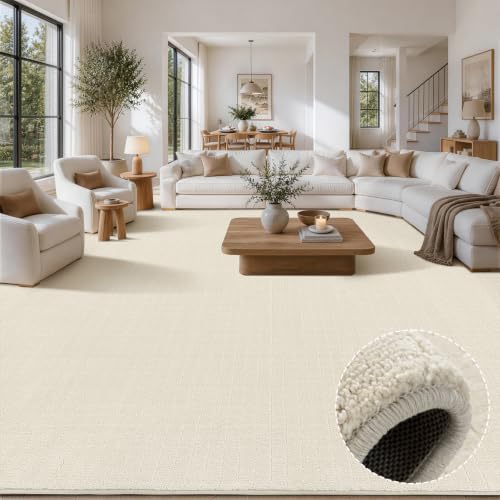
The LIANLAM states its recipe outright: 80% merino wool and 20% cotton, handwoven, in an 8×10 beige rug whose listing also names OEKO-TEX. Merino matters — its fibres are finer than standard rug wool, so a merino-rich rug feels noticeably softer under bare feet while keeping wool’s resilience and natural warmth. For a living room where the rug is the main textural event and the palette is calm, this is the premium expression of the yarn idea: visible handwork, honest materials, full anchor size.
Strengths
- Listing states exact fibre percentages — rare transparency
- Merino wool is finer and softer than standard rug wool
- Full 8×10 living-room anchor size in a calm beige
Trade-offs
- Premium natural fibre at a premium tier
- Listing also claims washable — follow its care label exactly, as wool and washing need care
- Beige palette is quiet; rooms wanting drama should look elsewhere
Key specs from the listing
- Size: 8 x 10 ft
- Materials: 80% merino wool + 20% cotton, per the listing
- Construction: Handwoven
- Named in listing: OEKO-TEX
- Colour: Beige
The listing describes the rug as washable and non-slip; treat both as care instructions to follow precisely rather than assumptions, because wool-rich rugs and water require the maker’s exact method. Read the care label on arrival and keep it. A rug of this composition, cared for as directed, should hold its surface for years, and wool’s natural resilience means the pile recovers from furniture marks better than most fibres.
The beige calm is either the point or the problem. In a room of linen, oak and white walls, this rug completes the sentence. In a room needing a focal point, the FRELISH’s chunky cable texture or the Chardin’s two-tone weave will speak louder. Choose the LIANLAM when softness and fibre quality outrank pattern in your priorities.
Best for: calm, premium living rooms prioritising fibre quality and softness / Not suited for: buyers wanting bold pattern or the lowest price

Chardin Home 6×9 Jute Cotton Area Rug, Natural Jute Ivory, Reversible — Best Reversible Flatweave
The Chardin home rug blends the two great natural yarn fibres — jute for structure, cotton for softness — into a handwoven flatweave in natural and ivory, and then adds the flatweave’s party trick: it is reversible. Two faces mean two looks and, in practical terms, a second life: when one face fades or marks, flip the rug and the room looks newly furnished. In a 6×9, it suits the standard sofa grouping in most living rooms.
Strengths
- Reversible — flip for a fresh face or a fault covered
- Cotton softens jute’s roughness for bare feet
- Flatweave sits flat under furniture and doors
Trade-offs
- Flatweave offers no cushioning — pair with a pad
- Jute content still dislikes soaking moisture
- Reversible designs need a pad that grips on both faces
Key specs from the listing
- Size: 6×9 ft
- Materials: Jute and cotton, handwoven
- Construction: Flatweave, reversible
- Colours: Natural jute and ivory
Flatweave is the construction for people who like their rugs architectural rather than plush. It lies dead flat, so coffee tables sit steady, doors clear it, and the woven pattern reads crisply. The jute-cotton mix threads the needle between the NF447A’s rustic chunk and a pure cotton rug’s softness: textured enough to be interesting, smooth enough for bare feet and children’s knees.
Use a rug pad designed for reversible rugs — grip on both sides — and rotate as well as flip: a flip plus a 180-degree turn distributes sun and traffic across four orientations over the years. That kind of care is how a natural flatweave becomes a decade-long furnishing instead of a season’s experiment.
Best for: living rooms wanting texture with flexibility and easy furniture placement / Not suited for: buyers wanting cushion underfoot

SAFAVIEH Natura Shag Area Rug 8×10, Dark Green & Ivory NAT102Y — Best Plush Yarn
At the far end of the yarn spectrum from the flatweaves sits the Natura shag: hand-woven wool and cotton with a full inch of pile, in a dark green and ivory boho tribal pattern. This is the yarn rug as comfort object — the one children lie on, feet disappear into, and the whole seating area gathers around. The listing states the fibre, the construction, the pile height and the country of manufacture, which is the specification honesty this guide rewards.
Strengths
- One-inch pile is the deepest, cosiest surface in this guide
- Hand-woven wool and cotton — real yarn construction, not print
- Green and ivory tribal pattern anchors boho living rooms
Trade-offs
- High pile traps crumbs and needs deeper vacuuming
- Shag shows footprints and furniture compression
- Too much texture for minimalist rooms
Key specs from the listing
- Size: 8 x 10 ft
- Materials: Wool & cotton, hand-woven
- Pile: 1 in high pile
- Origin stated in listing: Made in India
- Pattern: Boho tribal, dark green & ivory
A one-inch wool-cotton pile behaves differently from synthetic shag: the natural fibres have body, so the pile stands and recovers rather than lying in greasy-looking strands, and wool’s resilience handles the coffee-table zone well. The green-and-ivory palette is the boldest in this guide and earns it — against pale sofas and wood floors it gives a living room a confident, collected centre.
Commit to the upkeep honestly. High pile needs a vacuum with adjustable height, crumbs migrate downward, and dining chairs should stay off it. As a living-room-only rug in a household that vacuums properly, the Natura delivers the deepest version of what yarn-rug buyers actually want: texture you can feel from the sofa.
Best for: boho living rooms wanting maximum plush yarn texture / Not suited for: dining areas and low-maintenance households
Comparison Table
| Pick | Badge | Key spec | Best for |
|---|---|---|---|
| FRELISH DECOR Wool Cotton 6×9 Area Rug, Ivory — Handwoven Braided Chunky Knit Cable | Best Overall | 6×9 handwoven wool-cotton, chunky knit cable, ivory | farmhouse living rooms wanting maximum visible yarn texture |
| SAFAVIEH Braided Wool Oval Rug 8×10, Farmhouse Ivory & Blue | Best Braided Classic | 8×10 oval braid, wool & cotton, 3/8 in pile | busy living rooms wanting flat, tough yarn texture |
| SAFAVIEH Natural Fiber Area Rug 5×8, Jute Knotted NF447A | Best Jute Texture | 5×8 knotted jute, 3/4 in pile, natural tone | modern and Scandinavian living rooms wanting natural structure |
| LIANLAM Handwoven Wool Rug 8×10, Beige — 80% Merino Wool, 20% Cotton | Best Premium Fibre | 8×10 handwoven, 80% merino wool / 20% cotton | calm, premium living rooms prioritising fibre quality and softness |
| Chardin Home 6×9 Jute Cotton Area Rug, Natural Jute Ivory, Reversible | Best Reversible Flatweave | 6×9 jute-cotton flatweave, reversible, natural/ivory | living rooms wanting texture with flexibility and easy furniture placement |
| SAFAVIEH Natura Shag Area Rug 8×10, Dark Green & Ivory NAT102Y | Best Plush Yarn | 8×10 hand-woven shag, wool & cotton, 1 in pile | boho living rooms wanting maximum plush yarn texture |
Key Takeaways
- Yarn rugs are defined by construction — braided, woven, knitted, knotted — not by printed texture.
- Wool blends are the all-rounders; jute is toughest but must stay dry; chunky knits are the most delicate.
- Listings here state their fibres plainly, including one exact 80% merino / 20% cotton split — trust stated percentages over photos.
- A pad is structural for yarn rugs: grip, protection and longer life.
- Snip loose strands, never pull — and judge shedding at week six, not day two.
How to Choose a Yarn Rug for a Living Room
Define your texture tolerance first, because yarn rugs span a wider range than any other rug family. At one end, flatweaves and braids are firm, flat and architectural; at the other, chunky knits and shags are deep, soft and dramatic. Living rooms that host floor-sitting, children playing and bare feet all winter usually want the middle-to-deep end. Rooms where the rug is mostly looked at, or where furniture must glide, belong at the flat end. There is no best texture — only the texture your household will still enjoy in month six.
Choose fibre by lifestyle. Wool is the premium all-rounder: resilient, warm, naturally soil-hiding, and it recovers from furniture dents. Cotton softens blends and suits casual rooms but flattens faster alone. Jute is the toughest and driest-feeling, and it must be kept away from moisture. Blends — wool-cotton, jute-cotton — exist because each fibre covers another’s weakness, and the listings here state their blends plainly, including one exact 80/20 merino-cotton split. Read the percentages when a listing offers them; they predict the feel better than any photograph.
Size and shape follow the seating. Front legs of the sofa and chairs on the rug is the rule; 8×10 anchors most living rooms, 6×9 suits compact groupings, and 5×8 works as a defined layer under a sofa-and-table set in a small room. Consider an oval if your room is a sea of rectangles — a braided oval softens the geometry in a way guests notice without knowing why. Tape the outline on the floor before ordering, as with any rug, but doubly so for handmade pieces whose slight size variation is part of their nature.
Finally, buy the care you will actually perform. Yarn rugs are vacuumed with suction or a raised beater bar, never steam-cleaned if they contain jute, and spot-cleaned promptly. A pad underneath is close to mandatory: it stops flatweaves creeping, cushions braids, and extends every natural fibre’s life. Check the current price on Amazon for your exact size — handmade-style rugs price steeply by dimension — and expect slight variation from the photo. That variation is the receipt proving a person, not a printer, made your rug.
Living With Natural Yarn: Shedding, Variation and Ageing Well
New natural yarn rugs shed. Loose fibres worked free during weaving rise to the surface in the first weeks, and a wool or jute rug can fill a vacuum canister with alarming enthusiasm at first. This is normal, finite, and not a defect: the shedding curve falls steeply after the first month of regular vacuuming. Judge a natural rug’s shedding at week six, not day two, and never pull a loose strand — snip it level with the surface, because pulling unravels braids and knots in a way scissors never will.
Variation is the other adjustment. Handwoven and hand-finished rugs differ slightly in tension, tone and edge straightness from piece to piece and even across a single rug. In a printed rug that would be a fault; in a yarn rug it is the evidence of construction. The practical approach is to embrace variation within a calm palette — natural, ivory, beige and undyed tones vary gracefully — and to be more cautious with saturated colours in handmade pieces, where dye-lot differences show more boldly.
Ageing, finally, is where natural yarn wins its premium back. Wool develops a soft patina and keeps its body; braids can be re-stitched if a section ever loosens; flatweaves can be flipped and rotated into a second decade. A yarn rug is one of the few furnishings that can look better at year five than at month one, provided it is vacuumed, padded and kept dry. Buy it as a long-term piece, care for it as one, and it will behave as one.
Yarn Rug Constructions Compared: Braided, Woven, Knitted, Knotted
Braided rugs are built by plaiting yarns into ropes and stitching the ropes into a flat mat. The result is dense, reversible-feeling, and nearly indestructible in domestic terms — the construction of choice where chairs slide and feet pass all day. Their texture is ridged and regular, their profile flat, and their one vulnerability is a pulled stitch, which is why the snip-don’t-pull rule matters.
Hand-woven flatweaves interlace warp and weft on a loom, producing the thinnest, crispest yarn rugs — the dhurrie and kilim family. They show pattern most sharply, lie flattest under furniture, and offer the least cushioning. Knotted rugs tie each tuft individually, building the deep, nubby surfaces of the jute pick in this guide; they are the most labour-intensive construction and feel it — substantial, textured, and unmistakably handmade.
Knitted and crocheted constructions loop yarn through itself, sweater-fashion, giving the softest, most elastic surfaces — the chunky cable knit in our top pick. They are also the most delicate: loops snag, stretch and dislike dragging. Shaggy hand-woven rugs like the Natura split the difference, anchoring long yarns in a woven base for depth with more resilience than a true knit. Read the construction word in any listing first; it predicts the rug’s next ten years better than the photograph does.
Natural Fibres in Depth: Wool, Cotton and Jute Personalities
Wool is the aristocrat of rug fibres for mechanical reasons: its crimped fibres act like springs, recovering from compression that flattens other materials into traffic lanes, and its scaly surface hides dry soil within the pile rather than displaying it. Wool also holds dye with a depth synthetics envy and feels warm in winter and neutral in summer. Its costs are price, a month of early shedding, and a dislike of harsh alkaline cleaners. For a living room’s main rug, wool or a wool-rich blend is the default recommendation of this guide for a reason.
Cotton is wool’s friendly lieutenant: soft, matte, inexpensive and washable in small formats, but quicker to flatten and slower to recover. Alone, cotton makes a pleasant casual rug for low-traffic rooms; blended with wool or jute it contributes softness and stability to constructions that would otherwise be too springy or too rough. The blends in our picks — wool-cotton, jute-cotton — are not compromises but deliberate engineering.
Jute is the structural minimalist: a bast plant fibre with a dry, architectural hand, exceptional toughness in dry conditions, and a golden tone that grounds a room’s palette. Its rules are absolute — keep it dry, never steam it, expect texture rather than softness. Households that respect those rules get a rug of remarkable presence for the price; households that cannot should choose wool and never look back.
Styling a Living Room Around a Textured Rug
A textured rug is a design commitment, and the room should be arranged to honour it. Start with the rug’s own palette: pull one colour from it for cushions or a throw, and let everything else quieten down. Chunky and shaggy textures pair with smooth surfaces — leather, glass, pale wood — because contrast is what makes texture legible; a room where everything is textured reads as noise, while one strong texture against calm surfaces reads as design.
Scale the furniture to the construction. Heavy, low furniture anchors flatweaves and braids beautifully and can crush a chunky knit’s loops at the contact points, so knits belong under lighter pieces or in the open centre of the seating group. Shags love a coffee table with legs rather than a solid base, letting the pile show around it. In every case, the front-legs rule still governs placement — texture does not exempt a rug from geometry.
Lighting finishes the effect. Textured rugs come alive under raking light — a low sun through a side window, or lamps at seating height — which models every ridge and loop in shadow. Flat overhead light flattens them. If your living room’s main light is a ceiling panel, a textured rug will still feel wonderful underfoot, but for the full visual return, place a lamp where its light can rake across the rug in the evening.
Yarn Rugs in Homes With Pets and Children
Natural yarn rugs and family life coexist better than their delicate reputation suggests, provided the construction is matched to the household. Braided and flatweave rugs are the family-proof end: flat surfaces release crumbs and pet hair to the vacuum, tolerate chair legs and toy traffic, and hide the evidence of both in their texture. The Safavieh braid and the Chardin flatweave in this guide are the picks we would put under a family sofa without a second thought.
Chunky knits and deep shags ask for a truce: claws trimmed, heels off, and an understanding that a pulled loop is an accident to snip, not a catastrophe. In return they give children the best floor in the house — warm, soft, and quiet under play. Many households run both: a flat, tough yarn rug in the traffic zone and a deep one in the reading corner, which is not indecision but zoning.
Accidents follow the fibre rules already given: blot fast, keep jute dry, vacuum wool gently and often. A natural rug that survives a family usually does so because its owners treated spills as laundry rather than tragedy — quickly, calmly, and with the right cloth. Choose the construction for the household you have, and a yarn rug will repay you in the currency this category trades in: years of texture under daily life.
Second-Hand and Vintage Yarn Rugs: A Worthy Detour
Yarn rugs are among the best second-hand buys in home furnishing, because their construction ages visibly and honestly — you can read a used braided or hand-woven rug’s remaining life in its surface in a way printed rugs never allow. Wool braids and flatweaves from earlier decades surface regularly in estate sales and vintage shops, often at prices below new budget rugs, and a sound one needs only a thorough vacuum, a day of airing and a fresh pad to return to service. Inspect a second-hand yarn rug the way this guide taught you to inspect a listing: check for pulled sections in braids, thin patches in flatweaves, and any smell of damp, which in natural fibre is the one flaw that cleaning may not forgive. Check the edges, where wear concentrates, and turn the rug over — the back of a handwoven rug shows its construction truthfully. If it passes, you gain a rug with the patina new rugs spend years acquiring. If the new market is your preference, the six verified picks above remain the controlled route; but a shopper who understands yarn construction, as this guide has tried to make you, is exactly the shopper who can spot the vintage bargain everyone else walks past.
How to Place and Care for a Yarn Rug
Natural yarn rugs ask for a specific care rhythm: the right pad, the right vacuum settings, prompt spot care and seasonal rotation. Follow it and these rugs outlast most of the furniture on top of them.
- Pad it first. Lay a rug pad cut slightly smaller than the rug. For reversible flatweaves, choose a pad with grip on both faces. The pad prevents creep, adds comfort and stops grit grinding through the weave into the floor.
- Vacuum with the right setting. Use suction-only or the highest beater-bar setting for shags and chunky knits; never let a spinning brush tear at loops and braids. Vacuum slowly in overlapping passes, in the direction of the weave where there is one.
- Snip, never pull. Loose strands and sprouts are trimmed level with scissors. Pulling a strand in a braided, knotted or woven rug can unzip a whole section.
- Spot clean by fibre. Blot spills immediately with a clean cloth. Wool tolerates mild wool-safe cleaners; jute must be kept as dry as possible — blot, then dry with airflow, and never steam clean a jute rug.
- Rotate and flip seasonally. Turn the rug 180 degrees twice a year to even sun and traffic; flip reversible flatweaves for a fresh face. Furniture dents in wool usually lift with a damp cloth and time.
- Rest it from heavy dragging. Lift furniture to move it, or use glides. Dragging a sofa leg across a chunky knit or braid is the fastest way to snag the surface you bought the rug for.
Keep pets’ claws trimmed if you own looped or chunky constructions, and shake smaller yarn rugs outdoors when you can — a good shake removes the grit vacuums miss and refreshes the pile in a way no machine matches.
Common Buying Mistakes
Steam cleaning a jute rug
Jute and water are enemies: soaking or steam weakens the fibre and can stain it permanently. Keep jute rugs dry, blot spills fast, and choose a different fibre for any room with moisture risk.
Pulling loose strands
A pulled strand can unravel a braid or open a knot row. Every loose end on a yarn rug gets scissors, never fingers.
Judging shedding in the first week
Natural rugs shed loose weaving fibres early and settle down. Returning a wool rug for week-one shedding is returning it for being real — give it a month of vacuuming first.
Skipping the pad
Unpadded flatweaves creep, braids wear from beneath, and grit grinds through weaves into floor finishes. The pad is structural for yarn rugs, not optional comfort.
Expecting a handmade rug to be pixel-perfect
Slight variations in tone, tension and edge are the nature of handwoven goods. If you need machine uniformity, buy a power-loomed rug — several in our online rugs guide — and enjoy yarn texture in a smaller accent instead.
Final Recommendation
For most living rooms, the FRELISH DECOR chunky knit and the Safavieh braided oval cover the two great yarn experiences — dramatic texture and tough, flat practicality — between them. Fibre purists should take the LIANLAM’s stated merino blend, minimalists the knotted jute, flippers the Chardin reversible flatweave, and comfort seekers the Natura’s inch-deep shag.
Whichever construction you choose, buy the size with tape on the floor, pad it properly, and give it a month to settle before judging. A yarn rug is a handmade object joining a lived-in room; the small imperfections are not the price of the texture — they are the proof of it.
To recap the top of the list: FRELISH DECOR Wool Cotton 6×9 Area Rug, Ivory — Handwoven Braided Chunky Knit Cable, SAFAVIEH Braided Wool Oval Rug 8×10, Farmhouse Ivory & Blue, SAFAVIEH Natural Fiber Area Rug 5×8, Jute Knotted NF447A. Check the current price on Amazon for each before you decide.
Related reading from our other guides: Best Area Rugs Online Best 8 X 10 Wool Area Rugs Best Affordable Jute Rugs Best Area Rugs For Family Rooms Best Area Rugs For Homes With Dogs
Frequently Asked Questions
What exactly is a yarn rug?
A rug whose surface is visibly built from strands — braided, hand-woven, knitted or knotted yarn or fibre — rather than a printed or machine-tufted surface. In practice that means natural materials like wool, cotton and jute, real texture you can feel, and slight handmade variation from piece to piece.
Are yarn rugs practical for a living room?
Yes, with the right construction for your household. Braids and flatweaves handle heavy traffic and furniture well; chunky knits and shags are softer but more delicate and belong in lower-traffic, adult living rooms. A rug pad and correct vacuuming make any of them a long-term furnishing.
Do wool yarn rugs shed?
At first, yes — loose fibres from weaving rise and vacuum away over the first several weeks, then shedding settles to very little. Snip any sprouting strand level rather than pulling it. Persistent heavy shedding after a couple of months of vacuuming is not normal and is worth raising with the seller.
Can I put a jute rug in a living room with pets?
Jute handles dry dirt and claw-free traffic well and vacuums clean easily. Its weakness is liquid: water bowls, accidents and wet paws work against it. If spills are a daily reality, a braided wool-cotton rug will forgive more. Keep any jute rug away from moisture and never steam clean it.
What size yarn rug do I need?
Follow the front-legs rule: the rug should sit under the front legs of your sofa and chairs. That means 8×10 for most living rooms, 6×9 for compact groupings, and 5×8 as a defined layer in small rooms. Tape the outline first — handmade rugs reward measured buyers.
How do I stop a flatweave yarn rug from sliding?
With the right pad: a grippy pad cut just smaller than the rug, double-sided grip for reversible designs. Furniture weight on the edges helps too. A sliding flatweave is almost never a rug fault — it is a missing pad.

