Disclosure: airfryerkitchensupply.com is reader-supported. When you buy through links on our site, we may earn an affiliate commission at no extra cost to you.
Where to buy
The fastest way to put the best towels for cleaning spills to work is to order a working set, not a single towel. Every pick below was confirmed against Amazon’s own catalog data before it earned a link, and each one is sold as a multi-pack, because spill duty destroys the economics of buying towels one at a time. Start with the Utopia Towels Kitchen Bar Mops (check price on Amazon) if you want the classic cotton answer, the MR.SIGA Microfiber Cleaning Cloths (check price on Amazon) if you want one cloth that handles spills and glass, or the ZUPERIA Bar Mop Towels (check price on Amazon) if your kitchen goes through towels the way a restaurant does. Prices move, pack counts change, and colors rotate, so confirm the current pack size on the listing before you check out.
Introduction
The best towels for cleaning spills are not the prettiest towels in your kitchen, and they are not the ones folded for guests. They are the workhorses that live within arm’s reach of the stove, the sink, and the coffee maker, ready to absorb a knocked-over glass of milk, a boil-over of pasta water, or the slow leak under a dish rack before it reaches the floor. A towel that is genuinely good at spills does three things well: it takes up liquid fast on first contact instead of pushing it around, it holds enough water that one towel finishes the job, and it survives hundreds of hot washes without going stiff, thin, or sour. Decorative tea towels fail at least two of those three tests, which is why so many kitchens end up burning through paper towels instead.
This guide separates spill towels into the two families that actually work: thirsty cotton bar mops and terry towels built for volume, and microfiber cleaning cloths built for speed, streak-free wiping, and color-coded rotation. Both families have a place. Cotton wins on raw capacity per towel and on heat tolerance near the stove. Microfiber wins on how fast it grabs a thin film of liquid, how well it wrings out, and how compactly a big stack stores. The six picks below cover both families at several pack sizes, from a 3-pack of dual-purpose All-Clad towels for a small, tidy kitchen to a 50-pack of AIDEA microfiber for households that treat towels as a consumable utility. Every product name, size, and pack count in this article comes straight from the manufacturer’s Amazon listing title as verified, and where a listing does not confirm a detail, we simply do not claim it.
In this guide
Quick Picks
- Best Overall — Utopia Towels Kitchen Bar Mops, Pack of 12, 16×19 in, 100% Cotton: the classic restaurant bar mop format sized for home kitchens, with enough towels in the pack to keep a clean one in rotation all week. Check the current price on Amazon
- Best for Big Households — ZUPERIA Bar Mop Towels, 24 Pack, 16×19 in: the same bar mop idea doubled, in 100% cotton with a blue stripe that makes kitchen duty easy to separate from other laundry. Check the current price on Amazon
- Best Microfiber — MR.SIGA Microfiber Cleaning Cloths, 12 Pack: ultra absorbent, high density microfiber that is color coded, so you can dedicate colors to counters, spills, and glass. Check the current price on Amazon
- Best for Heavy-Duty Messes — USANOOKS Microfiber Cleaning Cloth, 12 Pcs, 12.5×12.5 in: a denser, grime-focused weave built to take up liquid and residue together, sized for two-handed mopping of stove-top and counter spills. Check the current price on Amazon
- Best Bulk Value — AIDEA Microfiber Cleaning Cloth, 50 Pack, 12×12 in: fifty lint-free, streak-free cloths that make it painless to grab a fresh one for every spill and retire tired ones to garage duty. Check the current price on Amazon
- Best Dual-Purpose — All-Clad Professional Cotton Dual Purpose Kitchen Towels, 3 pc: one side is a lint-free flat weave for glassware, the other is absorbent terry loops made for spills, so one towel covers both jobs on a small counter. Check the current price on Amazon
How These Picks Were Chosen
We chose these towels the way a short-order cook would: by what survives a Saturday. First, every candidate had to be a real, currently listed product whose name, size, material, and pack count could be confirmed; anything we could not verify was cut, no matter how familiar the brand. Second, we weighted absorbency mechanics over marketing language. For cotton, that means terry loops or a bar mop rib with enough yarn mass to hold water; a flat, fashion-first weave was disqualified even when it was sold as a kitchen towel. For microfiber, it means a dense split-fiber cloth marketed for absorbency rather than a thin dusting cloth. Third, we required multi-packs, because spill cleanup is a rotation game: a towel that is in the wash cannot catch tonight’s spill, and single decorative towels never build a rotation. Fourth, we checked size honestly. A 12×12 inch cloth and a 16×19 inch bar mop are different tools, and the reviews below say plainly which jobs each size suits. Finally, we excluded anything with a fixed price claim, a star-rating claim, or a durability claim we could not ground in the listing itself; where a listing states a wash count or a capacity, we attribute it to the listing rather than presenting it as our own test result.
The 6 Best Towels for Cleaning Spills

Utopia Towels Kitchen Bar Mops, Pack of 12 — Best Overall
The bar mop is the towel professional kitchens settled on decades ago, and the Utopia Towels Kitchen Bar Mops bring that exact format home: 100% cotton, 16×19 inches, sold as a pack of 12 in white. That size is the sweet spot for spills. It is large enough to fold into quarters and present a thick, thirsty pad to a puddle, large enough to lay flat under a dish rack, and small enough to wring out fully over the sink with two hands. The pack of 12 is the real feature: with a dozen in rotation, you can use three or four on a heavy cooking day and still have clean towels while the rest are in the laundry. White cotton also tolerates the hot washes and the occasional bleach cycle that spill towels eventually need, without a color to fade unevenly.
Strengths
- True bar mop dimensions (16×19 in) give enough cloth to fold for thickness or spread for coverage.
- 100% cotton terry-style absorbency takes up standing liquid on contact instead of skating over it.
- A 12-pack builds a real rotation, so a clean towel is always within reach.
Trade-offs
- White shows stains from coffee, turmeric, and tomato even after washing; they are clean, just not pristine.
- Cotton dries more slowly than microfiber when draped over a faucet between uses.
- No color coding, so separating spill towels from other kitchen laundry is on you.
Spec box: Material: 100% cotton (per listing) · Size: 16 x 19 in · Pack: 12 · Color: White · Format: bar mop
Who this suits: home cooks who spill like they mean it — batch cooking, kids at the counter, a coffee station that overflows weekly. The bar mop format also doubles as a trivet substitute for setting down a hot pan briefly and as the towel you drape over a shoulder during a long cook, because the size sits well and the cotton tolerates heat that would melt a synthetic cloth. If your spills are mostly small drips and glass-polishing, a microfiber pick below is the better tool; if your spills arrive by the cupful, start here and check the current price on Amazon for the 12-pack before you look anywhere else.
Best for: everyday high-volume kitchen spills and cooks who want the professional format / Not suited for: anyone who wants lint-free glass finishing from the same towel
Check the current price on Amazon

ZUPERIA Bar Mop Towels, 24 Pack — Best for Big Households
The ZUPERIA Bar Mop Towels take the same 16×19 inch, 100% cotton bar mop blueprint and double the count to 24, adding a blue stripe that does more work than it first appears to. In a household where towels migrate — one ends up in the bathroom, one in the garage, one under a plant — a 24-pack keeps the kitchen supplied, and the stripe lets everyone learn the rule in a day: striped towels are kitchen spill towels, full stop. ZUPERIA positions these for restaurants, cooks, and bartenders as well as homes, and the pack economics follow that positioning: this is the buy for people who would rather own too many spill towels than run out during a dinner party. The listing describes the cotton as high absorbency and quick-dry for a cotton towel, and calls them reusable dish cloths as well as bar mops, which matches how most households actually use them.
Strengths
- 24 towels at bar mop size is the deepest rotation on this list.
- Blue stripe creates instant visual sorting between kitchen duty and everything else.
- 100% cotton tolerates hot washing and heavy use without synthetic melt concerns near the stove.
Trade-offs
- You need drawer or shelf space for 24 towels; small kitchens may prefer the 12-pack above.
- Like all white cotton, the body of the towel will stain over time even though it stays functional.
- Bar mop weave is a working texture, not a display texture, if your towels live on the oven handle for looks.
Spec box: Material: 100% cotton (per listing) · Size: 16 x 19 in · Pack: 24 · Marking: blue stripe · Positioning: home and restaurant use
The honest way to think about the ZUPERIA pack is cost per spill over years, not the sticker on the box — and since we do not print prices, the practical advice is to compare the per-towel math on the listing against the 12-pack above at the moment you buy. Households with a second kitchen, a bar area, or a rental property to stock get the most from this size of pack. So do families who do one big laundry run a week: 24 towels is roughly two weeks of heavy use in reserve. If that sounds like your house, check the current price on Amazon and consider buying once instead of repeatedly.
Best for: large families, frequent entertainers, and anyone stocking more than one wet zone / Not suited for: tiny kitchens with a single small towel drawer
Check the current price on Amazon

MR.SIGA Microfiber Cleaning Cloths, 12 Pack — Best Microfiber
MR.SIGA’s Microfiber Cleaning Cloths are the pick when your spills are frequent, thin, and spread out: the film of water around a sink, the coffee ring trail to the desk, the condensation puddle under a water pitcher. The listing describes them as ultra absorbent and high density, and — the detail that earns them this slot — color coded. Color coding is the difference between a microfiber system and a microfiber pile. Dedicate one color to food-zone counters, one to floor spills, one to glass and stainless, and you stop cross-contaminating surfaces or ruining a good finishing cloth on a greasy stove spill. Microfiber’s split fibers grab liquid by capillary action, so a cloth this dense picks up a thin spill in one pass where a flat cotton weave sometimes needs two, and it wrings out drier, which means it is ready again sooner during a long cleanup.
Strengths
- Color-coded pack supports a hygienic rotation by zone.
- High-density microfiber excels at thin films and wide, shallow spills.
- Wrings out nearly dry, so one cloth can work through several small spills in a session.
Trade-offs
- Smaller cloth format than a bar mop; a full quart of milk still wants cotton volume or several passes.
- Microfiber must be kept away from high heat and should not be used as a potholder, ever.
- Performance depends on washing without fabric softener, which coats the fibers.
Spec box: Material: microfiber (per listing) · Pack: 12 · Feature: color coded · Positioning: kitchen, car, glass, and household surfaces
MR.SIGA also lists these for car, glass, and household surfaces, and that versatility is genuine for spill duty: the same cloth that mops a counter spill buffs a water-spotted faucet afterward. The discipline is in the laundry. Wash microfiber separately from cotton, because cotton lint loads the fibers and dulls exactly the absorbency you bought them for. Households willing to keep that one rule get the fastest spill response on this list. Check the current price on Amazon and note the color assortment in the pack before ordering, since assortments can rotate.
Best for: quick daily spills, sink and counter films, and anyone who likes a color-coded system / Not suited for: very large-volume spills as the only towel in the house
Check the current price on Amazon
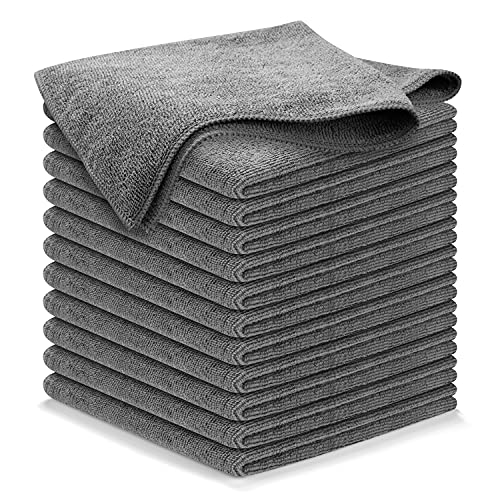
USANOOKS Microfiber Cleaning Cloth, 12 Pcs — Best for Heavy-Duty Messes
Some spills are not just liquid. They are liquid plus: pasta water with starch, a smoothie with seeds and pulp, the greasy ring a stockpot leaves on the counter. The USANOOKS Microfiber Cleaning Cloth is built for that category. The listing describes a high-performance weave aimed at grime and liquid together, at 12.5×12.5 inches in grey, in a pack of 12. Grey is a deliberate, practical color for this job — it hides the evidence of a working life far better than white microfiber. The size is a two-hand cloth: big enough to fold into a pad and lean on, small enough to control around stove burners and faucet bases where a large towel bunches and misses. USANOOKS states a wash lifespan figure in its listing title; we treat that as the maker’s own claim rather than a tested number, but the underlying point stands: this is a cloth meant to be laundered hard and often.
Strengths
- Grime-focused weave lifts residue and liquid in the same pass.
- Grey color stays presentable through a long working life.
- 12.5 in square format gives controlled, two-handed pressure on stuck spills.
Trade-offs
- Not the cloth for final glass polishing; keep a lint-free finisher separate.
- Square cleaning-cloth size covers less area per pass than a bar mop on a floor spill.
- Like all microfiber, it needs softener-free washing to stay absorbent.
Spec box: Material: microfiber (per listing) · Size: 12.5 x 12.5 in · Pack: 12 · Color: Grey · Focus: grime plus liquid
Put USANOOKS on the jobs you currently sacrifice paper towels to: the stove after a fry-up, the counter under the cutting board after watermelon, the floor where the dog’s water bowl sloshes. Because the pack is a dozen, you can stage them — a few by the stove, a few under the sink, a few in the laundry basket pipeline — and always have one where the mess happens. If your spills are mostly clean water and coffee, MR.SIGA above is the lighter, faster system; if your spills have texture, this is the cloth. Check the current price on Amazon for the 12-pack.
Best for: greasy, starchy, and textured spills around the stove and prep zone / Not suited for: delicate glassware finishing
Check the current price on Amazon

AIDEA Microfiber Cleaning Cloth, 50 Pack — Best Bulk Value
The AIDEA Microfiber Cleaning Cloth pack changes the psychology of spill cleanup: with 50 cloths at 12×12 inches, you stop rationing. A fresh cloth for every spill stops being wasteful and starts being the system. The listing describes them as soft absorbent cleaning rags, lint-free and streak-free, in multicolor, for house, kitchen, and window use. That lint-free quality matters more than it sounds — it means the cloth you grabbed for a counter spill can finish a stainless fridge door or a glass cooktop without leaving fiber behind, so the bulk pack genuinely serves the whole kitchen rather than one corner of it. Fifty cloths also solve the laundry-interval problem completely: even a household that washes towels weekly will not run dry, and when individual cloths eventually thin out after long service, retiring them to the garage or the car costs nothing emotionally because the stack behind them is deep.
Strengths
- 50-pack depth means a fresh cloth is always available, even between laundry days.
- Lint-free, streak-free finish lets one cloth type serve counters, glass, and appliances.
- Multicolor assortment allows rough zone coding by color.
Trade-offs
- 12×12 in is a small format; floor-scale spills take several cloths or a bar mop partner.
- Bulk utility cloths are thinner per cloth than premium microfiber; they win on numbers, not plushness.
- You need a storage spot for a tall stack — a basket under the sink works well.
Spec box: Material: microfiber (per listing) · Size: 12 x 12 in · Pack: 50 · Colors: multicolor assortment · Finish: lint-free, streak-free
The AIDEA pack is also the right answer for households with kids, pets, and plants — the three great spill generators — and for anyone setting up a kitchen from zero who needs the towel drawer solved in one order. Pair it with one cotton bar mop pack for volume work and your spill system is complete at both ends. As always with bulk packs, confirm the count and size on the listing at checkout, since bulk assortments are the listings most likely to be revised. Check the current price on Amazon.
Best for: busy households, first-kitchen setups, and anyone who wants to stop rationing towels / Not suited for: buyers who want one thick premium cloth rather than a deep bench
Check the current price on Amazon

All-Clad Professional Cotton Dual Purpose Kitchen Towels, 3 pc — Best Dual-Purpose
The All-Clad Professional Cotton Dual Purpose Kitchen Towels solve a different problem: the small kitchen, the bar cart, the one-towel-out-at-a-time household. Each towel is genuinely two tools — the listing describes a lint-free flat weave on one side for glassware and absorbent terry loops on the other side for spills, with a hanging loop, in a 3-piece set (the verified listing is the Chili colorway). That construction means the towel hanging by your sink can mop the counter spill with its terry face, then dry a wine glass with its flat face, without a second towel entering the story. For households that hate clutter and wash small loads often, three excellent towels beat twelve mediocre ones. The trade is obvious and we will state it plainly: three towels is not a rotation for a heavy cooking household, and these are positioned as a premium, deliberate purchase rather than bulk utility.
Strengths
- Two verified faces in one towel: terry loops for spills, flat lint-free weave for glassware.
- Hanging loop keeps the towel drying properly instead of balled on the counter.
- Cotton construction handles hot washing and stove-adjacent duty.
Trade-offs
- Only 3 towels per set; heavy spill days will outrun them without a backup pack.
- Premium positioning means a higher per-towel cost than bulk cotton or microfiber.
- The flat glassware side is a finishing surface, not a second spill surface.
Spec box: Material: cotton (per listing) · Pack: 3 · Design: dual-sided, flat weave / terry loops · Feature: hanging loop · Color of verified listing: Chili
Buy the All-Clad set as the front-of-house towel — the one that lives on the oven handle, handles the spill in front of guests, and dries the glasses afterward — and back it with any bulk pick above for the invisible heavy work. That two-tier system is how tidy kitchens actually operate. If you want only one purchase and your kitchen is small and your cooking is light-to-moderate, this set alone is defensible. Check the current price on Amazon, and note the colorway, since this line is sold in more than one color and the listing you land on should match the set you want.
Best for: small kitchens, bar areas, and tidy cooks who want one towel to do both jobs / Not suited for: high-volume family kitchens as the only towel supply
Check the current price on Amazon
Comparison Table
| Pick | Badge | Key spec | Best for |
|---|---|---|---|
| Utopia Towels Kitchen Bar Mops (check price) | Best Overall | 100% cotton, 16×19 in, 12-pack | Everyday high-volume spills |
| ZUPERIA Bar Mop Towels (check price) | Best for Big Households | 100% cotton, 16×19 in, 24-pack, blue stripe | Deep rotation, multi-zone homes |
| MR.SIGA Microfiber Cleaning Cloths (check price) | Best Microfiber | High-density microfiber, 12-pack, color coded | Thin films and daily quick spills |
| USANOOKS Microfiber Cleaning Cloth (check price) | Best for Heavy-Duty Messes | Microfiber, 12.5×12.5 in, 12-pack, grey | Greasy and textured spills |
| AIDEA Microfiber Cleaning Cloth (check price) | Best Bulk Value | Microfiber, 12×12 in, 50-pack, lint-free | Fresh cloth for every spill |
| All-Clad Dual Purpose Kitchen Towels (check price) | Best Dual-Purpose | Cotton, dual-sided, 3-pack, hanging loop | Spills plus glassware in small kitchens |
Key Takeaways
- Spill performance comes from structure — terry loops and yarn mass in cotton, dense split fibers in microfiber — not from the word “kitchen” on the label.
- Rotation beats quality alone: a 12- to 24-pack of good towels outperforms three excellent towels in a busy kitchen, because a towel in the wash catches nothing.
- Match the tool to the spill: cotton bar mops for volume, microfiber for films and speed, dual-purpose cotton when counter space allows only one towel out.
- Wash discipline decides lifespan: hot water for cotton, no fabric softener for microfiber, and fully dry storage between uses.
- Every pick here was verified against its Amazon listing for material, size, and pack count before it earned a link.
How to Choose the Best Towels for Cleaning Spills
Start by auditing your own spills for one honest week. Most households discover their spills fall into two piles: frequent small events (water around the sink, coffee drips, condensation) and occasional big events (a dropped pot, a tipped pitcher, a dishwasher leak). If your week is mostly small events, microfiber is your primary system, because speed and wring-out matter more than capacity. If your week includes big events, cotton bar mops are non-negotiable, because capacity per towel is what keeps a quart of liquid off the floorboards. Most kitchens need both, in roughly a 70/30 split toward whichever pile dominates.
Next, think in terms of stations, not drawers. A spill towel system works when towels live where spills happen: two folded by the stove, two at the sink, one at the coffee or drinks station, one near the pet bowls or the kids’ table if those exist. Count your stations, multiply by two (one in use, one in laundry), and that is your minimum pack size. This arithmetic is why the packs in this guide run from 12 to 50: a three-station kitchen needs at least a dozen towels to function without daily laundry.
Material choice has one more dimension: heat. Cotton towels can grab a hot handle in a pinch and shrug off a hot wash; microfiber must never touch a hot pan or burner and can be damaged by high dryer heat. If your household will not reliably keep that rule — teenagers, distracted cooks, shared kitchens — weight your system toward cotton and keep microfiber for the sink and glass zones where heat never enters the picture. Finally, consider your laundry reality. Cotton bar mops forgive any wash routine. Microfiber demands separation from cotton loads and no softener. Choose the system your household will actually maintain, because a theoretically better towel washed wrong performs worse than a simpler towel washed right.
What Makes a Towel Absorbent, Really
Absorbency is three separate properties that marketing folds into one word. The first is rate: how fast the towel takes up liquid on contact. Rate comes from surface structure — loops, ribs, and split fibers present thousands of tiny capillary channels that pull water in. The second is capacity: how much the towel holds before it is saturated and starts leaving liquid behind. Capacity comes from mass — more yarn, more fiber, more water held. The third is release: how completely the towel gives the water back when wrung. Release is where microfiber quietly wins, because its fibers hold water in surface channels rather than deep in a yarn core, so a hard wring returns most of its capacity instantly.
This is why a thick cotton bar mop and a thin microfiber cloth can both honestly be called absorbent while behaving completely differently at the sink. The bar mop drinks a puddle and holds it; the microfiber drinks a film, releases it into the sink with a twist, and drinks again. Neither is lying. Your job as a buyer is to match the property to the spill: capacity for volume, rate and release for repetition. It is also why the first touch matters in technique — press a folded towel into a spill and give the capillaries two or three seconds to work before you start wiping. Wiping immediately with any towel mostly moves liquid sideways; pressing first, then wiping, removes it.
How to Set Up a Spill-Towel Rotation That Actually Works
A rotation is a small system with four parts: staged clean towels, a defined in-use life, a collection point, and a wash routine. Set it up once and spills stop being events. First, stage folded towels at each wet station — stove, sink, drinks area — in stacks of two or three, stored somewhere they stay dry, because a towel stored damp starts the day already compromised. Second, define the in-use rule in one sentence everyone can repeat: a spill towel handles spills only, never hands, never dishes, and it retires to the laundry after any spill involving grease, raw meat juice, or chemicals, and at the end of every day regardless. Third, place a small open bin or a hook inside the sink cabinet as the collection point, so retiring a towel is easier than reusing a dirty one. Fourth, wash on a fixed rhythm — cotton hot with the regular towel load, microfiber in its own softener-free load — and return towels to stations in the same folding session, so the system refills itself.
Two refinements separate kitchens where this lasts from kitchens where it collapses by week two. Color or stripe coding, like the ZUPERIA stripe or MR.SIGA’s color-coded pack, removes the daily decision about which towel is which; make the code visible and boring. And keep one sealed emergency reserve — four towels that only come out for the dishwasher-leak class of disaster — so a bad day never empties the stations. Rebuild the reserve the same week you break into it.
The Spill Playbook: Matching the Towel to the Mess
Different liquids behave differently, and the right towel-plus-technique pairing saves both the surface and the towel. Water and other thin, clean liquids are the easy case: press a folded bar mop or a microfiber cloth flat, wait two seconds, lift, and the spill is mostly gone; a second pass with the dry side finishes it. Work from the outside of the puddle inward so you do not spread the perimeter. For coffee, tea, and wine — the staining trio — speed matters more than pressure. Blot with a cotton towel you have already mentally assigned to the stain-tolerant pile (this is where white bar mops earn their keep, because they can be bleached), and never scrub a colored spill on a light counter or rug, which drives pigment sideways and down. Rinse the towel cold afterward; hot water sets many food stains.
Grease and oil invert the rules. Oil does not absorb into water-loving fibers the way water does, and a wet towel just skates it around. Start with a dry towel — microfiber is particularly good here, because its fibers are oleophilic enough to grab oil films — and wipe in one direction, folding to a clean face as each face loads. Follow with a hot, lightly soapy pass using a second towel, then a dry finish. Keep these towels segregated in the wash if you can; oil-loaded towels washed cool come out still loaded, and they will perfume the whole load. Starchy and sugary spills — pasta water, syrup, juice, soda — are a two-stage job: absorb the volume with cotton first, then re-wet the sticky residue with a damp microfiber cloth and lift it, because dried sugar re-dissolves faster than it scrapes. Protein spills like milk and egg need the retirement rule from the rotation section: absorb, then that towel goes straight to the laundry, and the surface gets a fresh cloth, because protein residue is what turns a stored towel sour by morning.
Finally, the floor spill — the one that has already escaped the counter. Resist the bath towel. A bar mop folded in quarters under your palm, or two AIDEA-style cloths overlapped, gives you control at the edges where liquid creeps under appliances. For the under-fridge and under-oven creep zone, slide a flat-folded bar mop on the end of a broom handle rather than kneeling into the spill. When the visible liquid is up, do one deliberate pass with a barely damp cloth over the whole area: floors that feel dry but carry a sugar or grease film are tomorrow’s sticky surprise, and the damp pass is what actually closes the incident.
Where Each Towel Type Earns Its Place: A Room-by-Room View
The kitchen is the headquarters of spill duty, but it is not the whole territory, and assigning the right towel type to each room prevents the quiet failure mode where one perfect kitchen system serves a whole house badly. At the kitchen’s own stations, the split from this guide holds: bar mops at the stove and prep counter, microfiber at the sink and drinks station. In the dining room, the towel that matters is the one that can arrive during a meal without embarrassing anyone — this is the All-Clad dual-purpose set’s second career, and a folded white bar mop’s first, because a spill at the table is a performance as much as a cleanup. In bathrooms, microfiber wins outright: it handles the daily water ring around sinks, dries faster between uses in a humid room, and its lint-free finish suits mirrors; keep a dedicated color there so bathroom cloths never rotate back to the kitchen. For the laundry room and mudroom — the spill zones nobody plans — the bulk AIDEA logic applies: a basket of inexpensive cloths where boots, detergent drips, and wet umbrellas actually happen beats a rule that towels live only in the kitchen.
The garage and car deserve the retirees. Every towel system produces graduates: cotton towels that have gone thin, microfiber that has lost its finish. Demoting them deliberately — a labeled bin in the garage — keeps them out of the kitchen rotation while extracting their remaining value on oil-adjacent jobs where a good towel should never go. This lifecycle, from glass-adjacent microfiber to counter duty to garage exile, is how a household extracts full value from every pack in this guide, and it only works when packs are deep enough that demotion never leaves a station empty. That is the final argument for the pack sizes chosen here: depth is not hoarding, it is what makes the whole system — rotation, dedication, retirement — possible at once.
Common Buying Mistakes
The most common mistake is buying decorative towels for a working job. Flat-weave, printed, seasonal towels are made to be looked at; their smooth surfaces push liquid around and their dyes dislike hot washes. Buy them for the oven handle if you love them, but never count them in your spill capacity. The second mistake is buying too few. A 3-pack is a garnish, not a system, unless your kitchen is genuinely tiny and your laundry is genuinely frequent — under-buying is why paper towels creep back. The third mistake is mixing microfiber into the cotton wash with softener and then concluding microfiber does not work; the fibers were coated, not defective. The fourth is using one towel for everything: the towel that wiped raw chicken juice must not dry the salad bowl an hour later, which is why rotation and retirement rules matter more than brand. The fifth is judging by hand-feel in the store or by a photo online — plushness correlates weakly with spill performance, while structure, size, and pack depth, the things this guide is built on, correlate strongly.
Final Recommendation
If you buy one thing from this guide, buy the Utopia Towels Kitchen Bar Mops (check price on Amazon): the format is proven, the size is right, and the 12-pack builds a working rotation in a single order. Scale up to the ZUPERIA 24-pack if your household is large or your laundry is weekly. Build a microfiber lane alongside with MR.SIGA for daily films and glass-adjacent spills, or go all-in on volume with the AIDEA 50-pack if fresh-cloth-every-time is the habit you want. Keep USANOOKS at the stove for the spills with texture, and let the All-Clad set be the polished front-of-house towel in a small kitchen. Readers setting up the rest of the towel drawer should also see our guides to Best Towels For Drying Glasses, Best Bar Towels For Drying Glassware, Best Bang For Buck Dish Towels, and Best Bargain Towels, which cover the finishing and budget sides of the same drawer.
Frequently Asked Questions
Are cotton or microfiber towels better for cleaning spills?
Each wins a different spill. Cotton bar mops hold more liquid per towel, tolerate heat, and forgive any laundry routine, so they are better for large-volume spills. Microfiber absorbs thin films faster, wrings out drier, and can finish glass and stainless without lint, so it is better for frequent small spills. Most kitchens do best with cotton as the base system and microfiber as the fast lane.
How many spill towels does a household actually need?
Count your wet stations — stove, sink, drinks area — and own at least four towels per station: two staged, one in use across the day, one in the laundry pipeline. That works out to a 12-pack minimum for most kitchens, which is why every primary pick in this guide starts at 12.
Why does my microfiber cloth push water around instead of absorbing it?
Almost always because the fibers are coated. Fabric softener and dryer sheets leave a film that blocks the capillary channels, and washing with cotton loads the fibers with lint. Wash microfiber separately in warm water without softener, and absorbency usually returns within a wash or two.
Can I use the same towel for spills and for drying dishes?
You can, but you should not make it the system. A spill towel contacts floors, grease, and whatever was in the liquid; a dish towel contacts clean dishes. Keep the roles separate — the All-Clad dual-purpose pick is the exception that proves the rule, because its two faces are designed for two distinct jobs and it should still be washed before it rotates back to glassware after heavy spill duty.
How should spill towels be washed to keep them absorbent and fresh?
Wash cotton towels hot with a thorough rinse, and dry them fully before storing; damp storage is what makes towels smell sour. Wash microfiber separately, warm, with no fabric softener or dryer sheets, and dry on low-to-medium heat. Retire any towel that stays stiff or smells off after a proper hot wash — its fibers are done, and a deep pack means retiring it costs little.
What size towel is best for kitchen spills?
For cotton, 16×19 inches is the proven bar mop format: foldable into a thick pad, spreadable under a dish rack, and wringable with two hands. For microfiber, 12 to 12.5 inches square is the controllable two-hand size. Oversized bath-format towels are clumsy at counters, and small washcloth sizes saturate before a real spill is gone.


