Disclosure: airfryerkitchensupply.com is reader-supported. When you buy through links on our site, we may earn an affiliate commission at no extra cost to you.
Where to buy
Every pick below is sold on Amazon, and each verified listing links directly from this guide so you can check the current price on Amazon and confirm the floorhead type, bag or bagless format, and included tools on the listing page before ordering. Floorhead details matter more than brand badges for this job: a vacuum that is perfect for hardwood and shallow rugs can be wrong for the same floors if it ships with a different head in your region’s variant, so verify the exact configuration on the listing rather than assuming it from the model name alone.
- Miele Classic C1 Pure Suction — check price on Amazon
- Miele Classic C1 Turbo Team — check price on Amazon
- Bissell Hard Floor Expert Multi-Cyclonic Canister (1547) — check price on Amazon
- Eureka Whirlwind Bagless Canister (NEN110A) — check price on Amazon
- Dyson V8 Cordless Vacuum — check price on Amazon
- Shark Cordless Vacuum IZ363HT — check price on Amazon
The best vacuum for hardwood floors and shallow rugs has to do two opposite jobs without changing its personality. On bare hardwood it must glide without scattering debris, scratching the finish, or grinding grit under hard wheels; on a shallow rug — low-pile, flatweave, or a thin area rug over the same hardwood — it must lift embedded dust from fibers it can barely sink into, without sealing itself to the rug, bunching it up, or chewing the edges. Most vacuums are tuned for one surface and tolerate the other. The six below were chosen because their verified listings speak to both halves of the job.
It also helps to name what ‘shallow’ means before shopping, because sellers use pile language loosely. For this guide, shallow means low-pile and flatweave rugs: fibers short enough that you can feel the backing’s structure through them, rug pads and all, typically the rugs chosen precisely because chairs roll over them and doors swing clear above them. If your rug is thick enough to hide your fingertips when you press into it, it has left this category, and several recommendations here — pure suction especially — stop being the right answer for it.
The market reality is that ‘shallow rug’ is the hardest common surface in a home. Deep carpet forgives a stiff brush roll; bare floors forgive weak suction. A low-pile rug forgives nothing: too much agitation frays it, too much suction glues the vacuum to it, and a heavy machine drags it across the hardwood underneath. That is why this guide leans toward canisters with dedicated hard-floor and low-pile heads, plus two carefully chosen cordless sticks, and why raw suction numbers — which sellers love and this guide does not print as a ranking — matter less here than head design and control.
Key Takeaways
- Head design beats suction numbers for this job: a soft or parquet hard-floor head plus a low-pile setting is the winning combination.
- Canister vacuums dominate this category because their heads swap and their weight stays off your wrist and off the rug.
- Spinning brush rolls should be switchable or gentle; on shallow rugs an aggressive beater bar frays edges and can scatter debris on the hardwood beside it.
- Miele’s two Classic C1 models split the brief cleanly: Pure Suction for mostly bare floors, Turbo Team when rugs cover more of the home — and choosing between them by your real floor ratio beats buying the stronger-sounding one by default.
- Check wheels and underside materials — hard plastic wheels are how vacuums scratch the hardwood they were bought to protect.
- Vacuum shallow rugs from the center outward, at half your usual pace, with suction set for the rug rather than for your ambitions.
- Keep an inexpensive rug pad under shallow rugs on hardwood: it anchors the rug against vacuum drag and protects the finish beneath it at the same time.
In this guide
Quick Picks
Six verified picks, spanning bagged and bagless canisters plus two cordless sticks, because this floor mix rewards head design and suction control more than any single format. The Miele Classic C1 Pure Suction is Best Overall for homes that are mostly hardwood with a few low-pile rugs; the Miele Classic C1 Turbo Team adds a turbobrush for rug-heavier homes; the Bissell Hard Floor Expert is the bagless canister pick; the Eureka Whirlwind NEN110A is the budget workhorse; and the Dyson V8 and Shark IZ363HT cover cordless duty from two different philosophies.
- Miele Classic C1 Pure Suction — Best Overall — Check the current price on Amazon
- Miele Classic C1 Turbo Team — Best for Rug-Heavier Homes — Check the current price on Amazon
- Bissell Hard Floor Expert Multi-Cyclonic Canister (1547) — Best Bagless Canister — Check the current price on Amazon
- Eureka Whirlwind Bagless Canister (NEN110A) — Best Budget Workhorse — Check the current price on Amazon
- Dyson V8 Cordless Vacuum — Best Premium Cordless — Check the current price on Amazon
- Shark Cordless Vacuum IZ363HT — Best Cordless with HEPA Filtration — Check the current price on Amazon
How These Picks Were Chosen
Candidates came from the program’s verified Amazon listing data cache for airfryerkitchensupply.com, cross-checked against the vacuum and rug categories, and every pick’s claims in this guide trace to its listed listing title. Where a title states a surface pairing — hard floors and low-pile carpet, in Miele’s wording — that pairing is quoted as the seller states it. Where a title does not break out a shallow-rug claim, the review says so and judges the machine on the design features the title does confirm: head type, format, filtration wording and tools.
One category was deliberately excluded and deserves a sentence: full-size uprights. A few upright listings claim hard-floor competence, but the format’s weight distribution, fixed heads and beater-first design work against shallow rugs in ways no setting fully cures, and every upright we examined for this guide asked the rug to tolerate the machine rather than the other way around. Readers with a mixed home that includes one deep-carpet room are better served by a canister from this list plus acceptance of slower passes in that room, or by a separate carpet machine, than by an upright that compromises the floors this search actually names.
We filtered out machines whose listings aim them at deep carpet, pet-specialist uprights whose brush rolls cannot calm down for low pile, and duplicate variants of the same model in different colors. What survived had to plausibly cross from hardwood to a shallow rug and back in one pass around a room, because that transition — repeated a dozen times per cleaning session — is the actual user experience this search describes. Filtration claims are reported at exactly the level the listing states them, no stronger.
The 6 Best Vacuum for Hardwood Floors and Shallow Rugs

Miele Classic C1 Pure Suction — Best Overall
The Miele Classic C1 Pure Suction earns Best Overall because its listing states this guide’s exact brief in plain words: a vacuum for hard floors and low-pile carpet. Pure Suction is the important part of the name. This configuration cleans with suction and a combination floorhead rather than a powered beater bar, which is precisely the gentle mechanism shallow rugs want — embedded dust gets lifted by airflow instead of being whipped by bristles, and rug edges and fringes survive the encounter. On hardwood, the same head glides without the scattering a spinning brush causes.
The bagged canister format suits this mixed-surface job in ways uprights struggle to match. The weight rides on the canister’s own wheels behind you, so the head stays light in your hand and light on the rug — no heavy motor housing pressing a shallow rug into the floor or dragging it sideways. Miele’s bagged system also means the dust you pull out of rug fibers leaves the house sealed in a bag rather than in a cloud over the hardwood you just cleaned when you empty a bin.
A word about how it behaves in a real session, since that is where this machine quietly wins converts. The canister follows without the tugging negotiation upright owners know, the head turns into the gaps between chair legs without lifting, and the whole system is quiet enough in character — a low, even note rather than a shriek — that early-morning cleaning before the household wakes is a realistic habit. Habits matter here more than heroics: the vacuum that gets used three calm times a week protects hardwood better than the theoretically stronger machine that stays in the closet because using it feels like an event.
The honest costs are the format’s costs. Bags are a running purchase, the cord keeps you planning a route between outlets, and a pure-suction head asks you to work a heavily soiled rug with slower, overlapping passes rather than one aggressive sweep. For a home that is mostly hardwood with shallow rugs — the exact home in this search — those are small prices for the gentlest, most controlled clean in this guide. Check the current price on Amazon and confirm the floorhead in the box on the listing before ordering.
Strengths
- Listing states the exact brief: hard floors and low-pile carpet
- Pure-suction cleaning is gentle on shallow rug fibers, edges and fringe
- Light in-hand head weight keeps thin rugs from dragging or bunching
Trade-offs
- Bags are an ongoing running cost
- Corded canister needs outlet planning in large homes
- Heavy rug soil needs slow, repeated passes rather than one sweep
| Format | Bagged canister |
| Surfaces (per listing) | Hard floors & low-pile carpet |
| Maker | Miele |
Best for: Homes that are mostly hardwood with low-pile or flatweave rugs / Not suited for: Homes with mostly medium- or deep-pile carpet
Check the current price on Amazon

Miele Classic C1 Turbo Team — Best for Rug-Heavier Homes
The Turbo Team is the Classic C1’s answer when the balance of the home tips toward rugs. Its listing extends the surface range to low-medium pile carpet alongside hard floors, and the Turbo Team configuration adds an air-driven turbobrush head for the rug work: the vacuum’s own airflow spins the brush, so the rug gets real agitation without a separate electric motor in the head. On shallow rugs that air-driven action is a sweet spot — enough agitation to shake grit loose from low fibers, self-limiting enough that it does not savage the rug the way a motor-driven beater can.
Owning both heads is the deeper point. The hard-floor head handles the hardwood with a soft, gliding touch; the turbo head comes out for rug passes. That two-head discipline is what canisters do better than any other format, and it is why two Mieles open this guide without apology: between the Pure Suction and the Turbo Team, the entire hardwood-and-shallow-rug spectrum is covered by machines designed around head-swapping rather than around one compromised universal head.
Choose between the siblings by floor ratio, honestly assessed. If rugs cover a third or more of your floor, or your low-pile rugs are thick enough to be called low-medium, the Turbo Team is your Miele. If rugs are accents on a sea of hardwood, the Pure Suction is simpler and gentler. Either way you accept the bagged, corded canister trade-offs from the first review; what you get back is the most surface-appropriate cleaning in this category.
Strengths
- Air-driven turbobrush agitates low-pile rugs without a harsh motor-driven bar
- Stated range extends to low-medium pile for rug-heavier homes
- Two-head system treats hardwood and rugs with dedicated tools
Trade-offs
- Turbobrush loses spin on very dense or high rugs as airflow drops
- Same bag and cord running considerations as the Pure Suction
- Head swapping mid-session is a small but real interruption
| Format | Bagged canister |
| Surfaces (per listing) | Hard floors & low-med pile carpet |
| Head | Turbo Team configuration |
Best for: Homes where low-pile rugs cover a large share of the floor / Not suited for: Homes with only one or two thin accent rugs on hardwood
Check the current price on Amazon
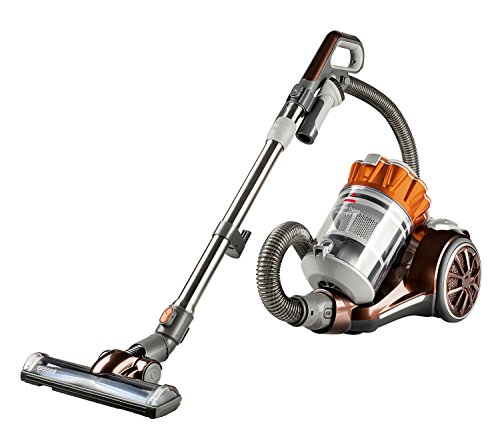
Bissell Hard Floor Expert Multi-Cyclonic Canister (1547) — Best Bagless Canister
Not everyone wants bags, and the Bissell Hard Floor Expert is the bagless canister built for this brief — its very name states the hard-floor specialization, and the verified listing describes a multi-cyclonic bagless canister vacuum, model 1547, corded. Multi-cyclonic separation spins dust out of the airstream before the filter, which keeps suction steadier as the bin fills with the fine, heavy dust that hardwood and rug fibers produce in surprising quantity.
The canister layout brings the same in-hand lightness as the Mieles, which is half the battle on shallow rugs: the head can be worked slowly across a low-pile rug without the machine’s full weight bearing down and pinning the rug to the floor. For renters and first-home buyers, the bagless format also removes the ‘which bags does it take’ question from the purchase entirely, and the running cost becomes filter care rather than bag purchases.
There is also a size argument in its favor. Full-size canisters can feel like towing luggage through a furnished room; a mid-size bagless canister threads between chair legs and under low tables with less negotiation, which matters in the dining rooms and living rooms where shallow rugs actually live. Storage follows the same logic — this is a machine that fits the closet a real apartment has, not the utility room a brochure imagines.
Bagless honesty applies, though. Emptying a bin of fine floor dust is a dustier job than swapping a sealed bag, however carefully the marketing describes it, and cyclonic systems still rely on filters that need regular cleaning to hold their performance. The Bissell also lacks the Mieles’ explicit low-pile pairing in its listing title, so rug performance rests on technique — suction control and slow passes — more than on a stated surface claim. For bagless loyalists, it remains the most on-brief canister here.
Strengths
- Hard-floor specialist line in a bagless canister format
- Multi-cyclonic separation holds suction as the bin fills
- No bag purchases; running cost is filter maintenance
Trade-offs
- Bin emptying releases more dust than a sealed bag swap
- Listing title does not state a low-pile carpet pairing, so rug technique matters
- Filters need regular cleaning to keep cyclones working as designed
| Format | Bagless canister, multi-cyclonic |
| Line | Hard Floor Expert |
| Model | 1547, corded |
Best for: Bagless loyalists with mostly hard floors and some shallow rugs / Not suited for: Dust-sensitive households that prefer sealed bag disposal
Check the current price on Amazon

Eureka Whirlwind Bagless Canister (NEN110A) — Best Budget Workhorse
The Eureka Whirlwind NEN110A is the value anchor of this guide: a lightweight, corded, bagless canister whose listing states it covers carpets and hard floors. It is the machine for the apartment, the rental and the second floor — light enough to carry up stairs without a plan, simple enough that every housemate will actually use it, and cheap to run because there are no bags and the format is as basic as canisters get.
On this guide’s specific brief it performs better than its tier suggests, for a structural reason: a lightweight canister head is naturally kind to shallow rugs. There is little weight to drag a thin rug across the hardwood, and the straightforward suction-first cleaning that budget canisters rely on is inherently gentler than an aggressive powered brush. On hardwood it does the essential job — picking up grit before it can be ground into the finish — without hard, heavy housings banging into baseboards.
Apartments deserve one more sentence, because this is the apartment vacuum of the guide in everything but name. It stores in a closet corner, its cord is long enough for a one-bedroom without outlet gymnastics, and its simplicity means a partner or roommate will use it the same way you do. In shared housing, the best vacuum is reliably the one everyone is willing to run, and the Whirlwind’s lack of ceremony is a feature that fancier machines genuinely cannot copy.
The compromises are the expected ones. Fit, finish and filtration refinement are a class below the Miele and Bissell picks, the accessory set is basic, and fine dust control at bin-emptying time is the bagless tax in its least filtered form. None of that matters much if the alternative at this budget is an upright with a beater bar that would be actively wrong for your floors. As a first vacuum for a hardwood-and-rugs home, the Whirlwind is the honest buy.
Strengths
- Lightweight canister is gentle on shallow rugs and easy on stairs
- List covers carpets and hard floors in one simple machine
- Bagless with minimal running costs
Trade-offs
- Basic fit, finish and filtration compared with pricier canisters
- Small accessory set for above-floor cleaning
- Bin emptying is the dustiest in this guide
| Format | Bagless canister, lightweight, corded |
| Surfaces (per listing) | Carpets and hard floors |
| Model | NEN110A, blue |
Best for: Apartments, rentals and budget-first hardwood homes / Not suited for: Buyers wanting premium filtration, finish or accessories
Check the current price on Amazon

Dyson V8 Cordless Vacuum — Best Premium Cordless
The Dyson V8 is the cordless pick for homes that clean in short, frequent passes — which, honestly, is how hardwood homes should clean, since grit tracked in today scratches the finish tomorrow. Its verified listing states it cleans hard floors and carpets, detangles, converts to a handheld, and runs up to 40 minutes across 2 power modes at 115AW. Those are the seller’s stated figures, quoted as stated, and the two-mode part matters for this brief: the gentler mode is the shallow-rug mode, keeping suction from sealing the machine onto a thin rug while still lifting surface dust.
The detangling cleaner head design is the V8’s other relevant feature, because shallow rugs in real homes collect hair along their edges, and a head that resists hair wrap saves the scissor-and-tweezers maintenance session that older stick vacuums demand. As a handheld it also handles the grit that collects on stairs and entry mats, the two places hardwood homes actually wear.
In a hardwood home the V8’s real rival is not another vacuum; it is the broom. A broom is instant and silent, but it flicks grit into baseboard gaps and raises the fine dust that settles back onto the floor within the hour. The cordless stick answers with the same grab-and-go speed and actually removes the dust from the house. That is the honest case for the format, and the V8 makes it with the most refined execution of the two cordless picks here: balanced in the hand, easy to steer flat under low furniture where grit hides, and finished to a standard that makes leaving it mounted on a wall charger feel normal rather than like storing a tool in the living room.
Cordless trade-offs are structural. Forty minutes of stated runtime is plenty for an apartment and tight for a large house done in one pass, and a stick vacuum’s brush head, however well designed, is a compromise head: it will never treat a shallow rug with the tailored gentleness of the Miele’s dedicated floorhead. Buy the V8 as the daily driver in a smaller hardwood home, or as the quick-pass partner to a canister in a bigger one — both are legitimate, common setups.
Strengths
- Two power modes let you soften suction for shallow rugs
- Detangling head reduces hair-wrap maintenance
- Converts to handheld for stairs, entry mats and edges
Trade-offs
- Stated 40-minute runtime limits large one-pass cleans
- Universal stick head is a compromise versus dedicated canister heads
- Premium tier pricing within the cordless class
| Format | Cordless stick, converts to handheld |
| Power (per listing) | 115AW, 2 power modes |
| Runtime (per listing) | Up to 40 minutes |
| Surfaces (per listing) | Hard floors and carpets |
Best for: Smaller hardwood homes and daily quick-pass cleaning / Not suited for: Large homes needing one long corded session
Check the current price on Amazon

Shark Cordless Vacuum IZ363HT — Best Cordless with HEPA Filtration
The Shark IZ363HT is the cordless alternative for buyers who put filtration first: its verified listing states a HEPA filter, a 50-minute runtime, and a lightweight stick design for pet hair on carpet and hardwood floors, converting to a handheld. Note the filtration wording carefully, because this guide reports it exactly as listed: the listing says HEPA filter. That is the claim, neither upgraded nor downgraded here, and buyers comparing filtration should compare listings at that same literal level.
The stated 50 minutes is the longest runtime claim among this guide’s cordless picks, which changes how the machine fits a hardwood home: a full floor of a medium house becomes a realistic single session rather than a race against the battery light. Pet-hair positioning also matters on shallow rugs specifically, because pet hair weaves itself into low-pile fibers more stubbornly than into bare floor dust, and a head tuned for hair pickup earns its keep on exactly the rugs this search is about.
Like the Dyson, it remains a universal-head stick: powerful and convenient, but a compromise next to a canister’s swappable heads, and its brush roll needs the same shallow-rug awareness — if a rug starts traveling with the vacuum, suction is set too high for that rug’s weight. Within the cordless class, though, the combination of stated HEPA filtration, the longer stated runtime and pet-hair tuning makes the Shark the most complete cordless answer to this brief.
Strengths
- HEPA filter stated on the listing, for buyers who filter-first
- Longest stated cordless runtime in this guide at 50 minutes
- Pet-hair tuning suits hair woven into low-pile rugs
Trade-offs
- Universal stick head still compromises versus canister floorheads
- High suction settings can drag lightweight rugs
- Cache record for this listing does not note a verification date
| Format | Cordless stick, handheld conversion |
| Filtration (per listing) | HEPA filter |
| Runtime (per listing) | 50-minute runtime |
| Surfaces (per listing) | Carpet and hardwood floor, pet hair |
Best for: Pet-owning hardwood homes wanting cordless freedom with stated HEPA filtration / Not suited for: Purists wanting dedicated hard-floor and rug heads
Check the current price on Amazon
Comparison Table
| Pick | Badge | Key spec | Best for |
|---|---|---|---|
| Miele Classic C1 Pure Suction | Best Overall | Bagged canister | Homes that are mostly hardwood with low-pile or flatweave rugs |
| Miele Classic C1 Turbo Team | Best for Rug-Heavier Homes | Bagged canister | Homes where low-pile rugs cover a large share of the floor |
| Bissell Hard Floor Expert Multi-Cyclonic Canister (1547) | Best Bagless Canister | Bagless canister, multi-cyclonic | Bagless loyalists with mostly hard floors and some shallow rugs |
| Eureka Whirlwind Bagless Canister (NEN110A) | Best Budget Workhorse | Bagless canister, lightweight, corded | Apartments, rentals and budget-first hardwood homes |
| Dyson V8 Cordless Vacuum | Best Premium Cordless | Cordless stick, converts to handheld | Smaller hardwood homes and daily quick-pass cleaning |
| Shark Cordless Vacuum IZ363HT | Best Cordless with HEPA Filtration | Cordless stick, handheld conversion | Pet-owning hardwood homes wanting cordless freedom with stated HEPA filtration |
How to Choose a Vacuum for Hardwood Floors and Shallow Rugs
Begin by weighing your floors, literally by area. Count the rooms that are bare hardwood, the rooms with shallow rugs, and any room with deeper carpet. If deeper carpet is more than a guest-room exception, you are shopping a different guide. For the hardwood-plus-shallow mix, the deciding features in order are: a head that treats bare floors gently, a way to calm suction or agitation for low-pile rugs, wheels and undersides that cannot scratch, and only then power, capacity and extras. Most buying regret in this category comes from reversing that order.
Suction control: the shallow-rug skill nobody advertises
A shallow rug weighs almost nothing, so a vacuum with strong, unadjustable suction seals itself onto the rug and then drags it. The defenses are a suction-relief slider on the head or hose, a lower power mode on a cordless, or a head design that bleeds a little air by design, as parquet and combination floorheads do. When you test a vacuum — in a store or during a return window — the shallow-rug test is simple: if the rug travels with the machine or the machine becomes hard to push, that pairing will annoy you weekly. Good matches glide with a slight, steady resistance and leave the rug exactly where it lay.
Agitation needs the same moderation. Low-pile fibers are short, so the dirt sits near the surface and yields to airflow plus light brushing; a stiff, fast beater bar mostly frays rug edges and can flick grit onto the surrounding hardwood. Air-driven turbo brushes and switchable brush rolls exist precisely for this middle ground, and pure-suction heads skip the problem entirely on the lightest rugs. Deep-clean fantasies belong to deep carpet; on shallow rugs, gentle and thorough beats aggressive every time.
Protecting the hardwood itself
The vacuum bought to care for hardwood can be the thing that scars it. Check three contact points on any candidate: the wheels (soft rubber or felt-friendly materials over hard plastic), the underside of the head (no protruding screws or cracked plates), and the canister body’s wheels if it is a canister that will roll across the floor all session. Keep heads and wheels grit-free, because trapped grit under a wheel is sandpaper with a motor. Finally, vacuum before you mop and before furniture gets dragged; most hardwood scratch stories are really grit stories.
What About Robot Vacuums on Hardwood and Shallow Rugs?
Readers ask about robots for this floor mix often enough that the honest answer belongs in the guide. A robot is genuinely good at the daily-grit half of the hardwood job: frequent light passes keep abrasive dust from accumulating, and most robots cross onto low-pile rugs without drama because their brushes and suction are modest by design. The shallow-rug caveats are edges and fringe, which robots love to climb, chew and drag, and the deep-clean half of the job, where a robot’s small bin and gentle agitation leave the embedded dust that a canister’s slow pass removes. Treat a robot as a maintenance layer between real vacuuming sessions, not as the machine this search is asking for, and if you want one, the dedicated robot guide linked at the end of this article covers models chosen for exactly these floors.
The same logic answers the wet-dry question before it is asked: mop-vacuum hybrids are tempting in hardwood homes, but shallow rugs complicate them further, since the machine must detect and avoid or lift off the rug while carrying water. For a home whose defining mix is hardwood plus shallow rugs, the dry, head-swapping discipline in this guide remains the reliable core, with any wet or robotic help added as a supplement rather than a replacement.
Bagged, Bagless, Corded, Cordless: Format Choices for This Brief
Bagged canisters, represented by the two Mieles, offer the cleanest disposal and the most tailored heads, at the price of bags and a cord. Bagless canisters, the Bissell and Eureka here, trade a dustier emptying ritual for zero bag costs and simpler ownership. Cordless sticks, the Dyson and Shark, trade head specialization for the freedom that makes daily grit control actually happen in real households. None of these formats is wrong for hardwood and shallow rugs; the wrongness lives in specific models whose heads or wheels ignore the floors. A household that cleans a little every day often does best with a cordless as the daily tool and any canister as the weekly deep tool, and this guide’s six picks were chosen so that any two of them pair sensibly in that arrangement.
How to Vacuum Hardwood and Shallow Rugs Without Damaging Either
Work in the right order: rugs last in each room is wrong — do the bare hardwood first with the hard-floor head or setting, moving slowly enough that grit is captured rather than pushed, and always with the grain of foot traffic rather than against the room’s layout. Shake or beat shallow rugs outdoors when you can; a rug that arrives at vacuuming pre-shaken needs only a gentle pass, which is the kindest pass there is. Then vacuum the rug itself from the center outward, which pushes edges flat instead of curling them, and finish with one slow pass along each edge where grit concentrates.
A weekly rhythm that suits these floors
Hardwood rewards frequency over intensity. A realistic rhythm for this floor mix: quick grit passes over traffic lanes and entry zones two or three times a week with whatever machine is fastest to deploy, one full session weekly with the good head discipline described here, and a monthly slow pass over the shallow rugs with the rug head, including lifting each rug occasionally to vacuum the grit that migrates underneath it — that hidden grit is the layer that grinds against both the rug backing and the floor finish every time someone walks across. Entry mats inside and outside each door cut the whole workload measurably, because most of what you vacuum was carried in on shoes during the first three steps inside.
Technique details that protect both surfaces
Set suction for the rug, not for your ambitions: open the relief valve or drop the power mode until the rug stays put while the head still picks up test grit. Slow down. On shallow pile, a slow pass at moderate suction removes more than a fast pass at maximum, because the fibers get time to release what they hold. Lift the head over fringe rather than vacuuming through it, and never let a spinning brush sit stationary on one spot of rug or floor while you move furniture — a parked brush is a wear spot and, on hardwood, a potential scuff.
After cleaning, empty or check the bag before it overfills, since an overfull vacuum loses exactly the gentle, controlled suction this whole technique depends on, and wipe the head’s underside and wheels with a cloth. That thirty-second habit removes the trapped grit that would otherwise be ground across your hardwood at the start of the next session, undoing the care you just took.
Common Buying Mistakes
Using a deep-carpet upright on shallow rugs
A beater bar tuned for plush carpet frays low-pile edges, overheats against the resistance of a sealed-on rug, and can throw grit across the hardwood. If your current vacuum cannot calm its brush or suction, it is the wrong tool for this floor mix however powerful it is.
Judging by suction numbers alone
This guide deliberately does not rank by suction figures, because on shallow rugs excess suction is a defect, not a feature. Head design, suction control and wheel materials decide results on this brief; a spec-sheet arms race decides nothing.
Dragging the rug around and calling it clean
If the rug bunches, travels or curls, the vacuum-rug pairing is wrong in that moment: lower the suction, change the head, or hold a rug corner with your foot as a last resort. A rug that gets dragged weekly wears at its backing and edges and scratches at the floor beneath.
Skipping the wheel and underside check
Hard plastic wheels and gritty head undersides are the quiet cause of ‘mystery’ hardwood scratches. Check them when you buy and wipe them after every few sessions; it is the cheapest floor protection in this entire guide.
Vacuuming a shallow rug like it owes you money
Speed is the enemy on low pile. Fast, scrubbing passes mostly skate over the surface while the brush flicks debris sideways, and they curl rug edges that then get run over and frayed. The fix costs nothing: half your usual pace, overlap each pass by a third, and let suction do the work it is designed to do. A shallow rug cleaned slowly at moderate settings comes up cleaner than one attacked at maximum power, and it survives the year in visibly better condition — a difference guests notice even if they cannot name it.
Final Recommendation
A note on tiers, since this guide prints no prices: the six picks span budget to premium, and the ladder buys refinement rather than a different outcome. The Eureka cleans these floors respectably for the least money and the least ceremony. The middle tier — the Bissell and the two cordless picks — buys filtration, convenience and finish. The Miele tier buys the most tailored heads and the calmest, most controlled cleaning experience, which on delicate floors is a real functional difference and not just polish. Buy the tier your floor value justifies: irreplaceable vintage hardwood argues upward; a rental’s laminate argues for the Whirlwind and a clear conscience.
Most hardwood-and-shallow-rug homes should start with the Miele Classic C1 Pure Suction: its listing states this exact brief, and its gentle, controlled clean is what these floors ask for. Step to the Turbo Team when rugs cover more of the home. Bagless households are honestly served by the Bissell Hard Floor Expert, tight budgets by the Eureka Whirlwind, and cordless households by the Dyson V8 for daily passes or the Shark IZ363HT when stated HEPA filtration and longer stated runtime lead. Whichever you choose, check the current price on Amazon, confirm the floorhead configuration on the listing, and run the shallow-rug glide test in your first session while returns are easy. Keep exploring with Best Canister Vacuum For Hardwood Floors And Rugs, Best Robot Vacuum For Hardwood Floors And Area Rugs, Best Vacuum For Hardwood Floors Area Rugs Pets and Best Stick Vacuum For Area Rugs And Hardwood Floors.
The three picks most readers should start with are Miele Classic C1 Pure Suction, Miele Classic C1 Turbo Team, Bissell Hard Floor Expert Multi-Cyclonic Canister (1547) — each links to its verified Amazon listing, where you can check the current price on Amazon and confirm the exact variant before ordering.
Frequently Asked Questions
What type of vacuum is best for hardwood and low-pile rugs?
A canister with a dedicated hard-floor head and a gentle or turbo rug head is the most tailored answer, which is why Miele’s Classic C1 models lead this guide. A cordless stick with adjustable power is the practical alternative for daily cleaning in smaller homes.
Will a vacuum scratch my hardwood floors?
It can, through hard plastic wheels, damaged head undersides, or grit trapped under either. Choose soft-wheeled models, keep undersides clean, and vacuum up grit promptly rather than letting it be ground in by foot traffic — the vacuum is usually the solution, not the problem, when it is maintained.
Should the brush roll be on or off for shallow rugs?
Gentle or air-driven agitation helps lift dust from low fibers; a stiff motor-driven beater at full aggression is what frays edges. If your vacuum’s brush cannot be switched off or calmed, use slower passes and lower suction, and consider a pure-suction or turbo head for the rug work.
How do I stop the vacuum from dragging my thin rug?
Lower the suction with the relief valve or power mode, switch to the hard-floor or combination head, and vacuum from the center of the rug outward. If the rug still travels, it is very light: a rug pad underneath both anchors it and protects the hardwood beneath it.
Can one vacuum really do both hardwood and rugs well?
Yes, when ‘well’ is defined by head design rather than raw power. The canisters here do it by swapping heads; the cordless picks do it with adjustable power and compromise heads. What one vacuum cannot do is excel at deep-pile carpet at the same time — that is a different brief with a different guide, and any listing claiming mastery of all three surfaces equally should be read with suspicion.
Is HEPA filtration important for floors like these?
It matters most to dust-sensitive households, since hardwood homes resuspend fine dust easily. Where filtration matters to you, compare listings at the literal level of their claims — the Shark IZ363HT’s listing states a HEPA filter, and this guide reports filtration claims exactly as each listing states them.


