Disclosure: airfryerkitchensupply.com is reader-supported. When you buy through links on our site, we may earn an affiliate commission at no extra cost to you.
Where to buy
Every chair below was confirmed, and each one’s weight capacity — 400, 500 or 600 lb — is stated in its verified listing title. Capacity is the one specification this category cannot fudge, so this guide quotes it exactly as listed and builds every recommendation around it. Check the current price on Amazon, and confirm seat dimensions on the listing before ordering.
- Flash Furniture HERCULES Series Big and Tall 500 lb Rated Mesh/LeatherSoft Executive Chair — Check the current price on Amazon
- Flash Furniture HERCULES Series 24/7 Intensive Use Big and Tall 500 lb Rated Mesh Executive Chair — Check the current price on Amazon
- Flash Furniture Hercules 24/7 Big & Tall Fabric Office Chair, 400 LB Capacity — Check the current price on Amazon
- Zonelucky Big and Tall Office Chair, 600 lbs Weight Capacity, Extra Wide Seat — Check the current price on Amazon
- Cloomey 500lbs Big and Tall Office Chair with Adjustable Lumbar Support — Check the current price on Amazon
- HESL 400lbs Executive Office Chair with Flip-Up Armrests — Check the current price on Amazon
The best office chairs for heavy people start with a number, and the number has to be honest. A chair rated well above the sitter’s weight is not over-engineering; it is the difference between a chair that feels solid in year three and one that develops a tilt, a wobble and a sinking cylinder by spring. Every pick in this guide carries its capacity in the verified listing title itself — 400, 500 and 600 lb ratings all appear — so the central claim of each review can be checked against the listing-confirmed title rather than taken on this guide’s word.
Capacity is necessary but not sufficient. A heavy-duty chair also needs a seat wide enough to sit in rather than on, a base and cylinder built for the load, armrests that do not flex away, and cushioning dense enough not to bottom out by lunch. The verified titles here speak to several of those directly — extra-wide seats, heavy-duty bases, upgraded wheels, thick armrest pads — and the reviews distinguish what is stated from what you should confirm on the listing, such as exact seat width in inches, before buying.
The six picks span three capacity classes and three styles: executive leather-look chairs, mesh ergonomic chairs, and one gaming-format chair with a footrest. That spread is deliberate. Heavier sitters are not a niche with one taste; they are a large share of office workers who have simply been underserved by standard chairs rated far below them. The correct response is a real selection, honestly labeled.
Key Takeaways
- Every capacity in this guide (400, 500, 600 lb) is stated in the verified listing title — check it there yourself.
- Buy capacity with headroom: a rating comfortably above body weight is what survives years of daily sitting.
- Seat width matters as much as capacity; several titles confirm extra-wide seats, and exact inches should be confirmed on the listing.
- Heavy-duty bases and upgraded wheels, named in some titles, are structural features — not trim.
- Mesh backs suit warm offices; padded executive styles suit long, still, focused work.
In this guide
Quick Picks
Best Overall: Flash Furniture HERCULES Series Big and Tall 500 lb Rated Mesh/LeatherSoft Executive Chair — a 500 lb rated executive chair mixing a mesh back with a LeatherSoft seat and adjustable lumbar support. — Check price on Amazon
Best for Long Shifts: Flash Furniture HERCULES Series 24/7 Intensive Use Big and Tall 500 lb Rated Mesh Executive Chair — the intensive-use sibling: 500 lb rated, mesh executive build, with a ratchet back for dialled-in fit. — Check price on Amazon
Best Fabric Option: Flash Furniture Hercules 24/7 Big & Tall Fabric Office Chair, 400 LB Capacity — a fabric-upholstered 24/7 chair at the 400 lb class with a lumbar adjustment knob and adjustable arms. — Check price on Amazon
Highest Capacity, Padded: Zonelucky Big and Tall Office Chair, 600 lbs Weight Capacity, Extra Wide Seat — the guide’s joint-highest rating at 600 lbs, with an extra-wide seat, adjustable headrest and air lumbar support per the title. — Check price on Amazon
Best 500 lb Value Format: Cloomey 500lbs Big and Tall Office Chair with Adjustable Lumbar Support — a 500 lb executive with an extra-wide seat, thick armrest pads and a heavy-duty base with upgraded wheels, per the title. — Check price on Amazon
Best with Flip-Up Arms: HESL 400lbs Executive Office Chair with Flip-Up Armrests — a 400 lb executive in breathable PU leather whose flip-up arms let it tuck fully under the desk. — Check price on Amazon
How These Picks Were Chosen
Chairs were found by searching Amazon listing data for big-and-tall and heavy-duty office chairs, then screened on one hard rule: the capacity had to appear in the listing title itself. Chairs that were probably adequate but did not state a rating were excluded, because in this category an unstated rating is an unmade promise. Stacking chairs, reception chairs and other non-task seating that surfaced in results were excluded as wrong products entirely — this guide is about chairs you work in for hours.
The survivors were balanced across capacity classes so the guide serves the whole audience: two chairs at the 600 lb class for maximum headroom, 500 lb chairs including a value-positioned adjustable model and two long-trusted Hercules-series designs, and 400 lb chairs for buyers whose needs sit at that class and who want flip-up arms or a lower-commitment purchase. Styles were varied deliberately across leather-look executive, mesh and one footrest gaming format.
A restraint note: seat dimensions in inches, warranty terms and cylinder class are not stated in most verified titles, so this guide does not invent them. Where a title states a feature — an adjustable headrest, air lumbar support, a 24/7 intensive-use rating — the review uses it; where it does not, the buying guide tells you exactly what to confirm on the listing before ordering.
The 6 Best Office Chairs for Heavy People

Flash Furniture HERCULES Series Big and Tall 500 lb Rated Mesh/LeatherSoft Executive Chair — Best Overall
The Hercules name is the long-running big-and-tall line in this category, and this model’s verified title combines the things most heavy sitters ask for: a 500 lb rating, a breathable mesh back so long sessions do not overheat, a padded LeatherSoft seat, and adjustable lumbar support. It is the guide’s default recommendation for a full-time home office or a workplace chair that must simply work, every day, for years.
Strengths
- 500 lb capacity stated in the verified title
- Mesh back for airflow with a padded seat — the hybrid most long-session sitters prefer
- Adjustable lumbar support named in the title
- Executive format suits offices and client-facing home workspaces
Trade-offs
- LeatherSoft is a coated upholstery, not full-grain leather — expect it to age accordingly
- Assembly is a two-person job at this size and weight class
- Executive styling is bulky in small rooms
| Detail | Verified from listing title |
|---|---|
| Capacity | 500 lb (per listing title) |
| Back | Mesh |
| Seat | LeatherSoft upholstery |
| Support | Adjustable lumbar (per title) |
| Series | HERCULES Big and Tall |
The mesh-back, padded-seat hybrid exists because heavy sitters generate the two complaints separately: a fully padded executive chair gets hot by hour three, while a fully mesh chair can feel unforgiving by hour five. Splitting the difference — airflow where the back sweats, cushion where the weight sits — is the configuration that survives a full work week, and it is why this model sits at the top of the guide rather than a more dramatic-looking alternative.
The 500 lb rating deserves a word about headroom. A sitter well under the rating still benefits: every component — cylinder, base, mechanism — is specified for the higher load, so at lower loads it operates with margin, which is precisely what prevents the slow tilt-and-sink failures that plague standard chairs used beyond their design. Buy the rating above your need and the chair stops being a consumable.
Best for: full-time desk work; buyers who want one proven chair and no experiments / Not suited for: small rooms or buyers who want a footrest format
Check the current price on Amazon
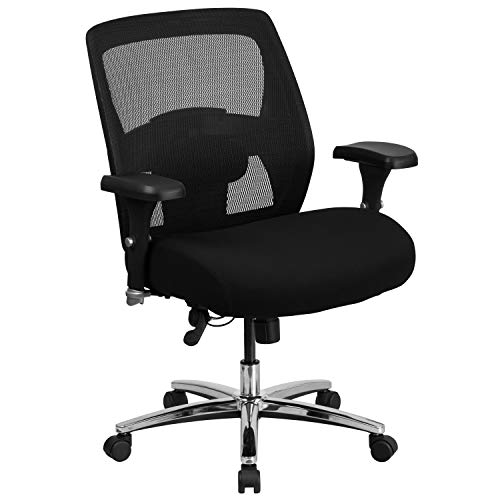
Flash Furniture HERCULES Series 24/7 Intensive Use Big and Tall 500 lb Rated Mesh Executive Chair — Best for Long Shifts
The ’24/7 Intensive Use’ in this verified title is a duty rating, not a slogan: it positions the chair for shift work, dispatch desks, security stations and anyone whose chair is occupied around the clock by one or several heavy sitters. The ratchet back — a height-adjustable backrest mechanism — lets different users set the lumbar curve where their own back needs it, which is what makes a shared heavy-duty chair actually shareable.
Strengths
- 24/7 intensive-use positioning with a 500 lb rating, both in the title
- Ratchet back adjusts backrest height for different sitters
- Full mesh executive build for shift-long airflow
Trade-offs
- Priced and built as equipment, not as furniture — overkill for occasional use
- Mesh seat feel divides opinion; cushion loyalists should choose the LeatherSoft sibling
- Shared-chair duty demands a cleaning routine the household chairs do not
| Detail | Verified from listing title |
|---|---|
| Capacity | 500 lb (per listing title) |
| Duty | 24/7 intensive use (per title) |
| Back | Mesh, ratchet height adjustment |
| Format | Executive ergonomic |
Multi-shift seating is where standard chairs go to die, because a chair used twenty hours a day ages four times faster than a home-office chair — and when several sitters share it, none of them owns the adjustment. The ratchet back is the answer to the second problem: each user can raise or lower the backrest in seconds to put its curve at their own lumbar, instead of enduring a predecessor’s setting. If your chair will be shared, this feature alone justifies the model.
For a single heavy sitter working genuinely long days — the twelve-hour desk is more common than ergonomics articles admit — the same logic applies at one remove: the intensive-use build is specified for a duty cycle beyond yours, and that margin is durability you will feel in year two as absence of wobble. Choose it when hours, not features, are your extreme variable.
Best for: shift work, shared desks and very long single-user days / Not suited for: occasional or part-time desk use
Check the current price on Amazon

Flash Furniture Hercules 24/7 Big & Tall Fabric Office Chair, 400 LB Capacity — Best Fabric Option
Not every heavy sitter wants mesh or leather-look. This Hercules model’s verified title specifies fabric upholstery — the warm, matte, grippy surface that suits cooler offices and anyone who slides on smooth seats — with a 400 lb capacity, a lumbar adjustment knob and adjustable arms, in the same 24/7 duty family as its mesh sibling. It is the traditional-office choice in the guide.
Strengths
- Fabric upholstery: no stickiness in summer, no chill in winter
- Lumbar adjustment knob lets you set support pressure, not just position
- Adjustable arms, 400 lb capacity and 24/7 positioning all stated in the title
Trade-offs
- 400 lb class is the guide’s lowest — buy it only if it gives you real headroom
- Fabric needs more spill care than mesh or coated upholstery
- Traditional styling will not satisfy buyers after a modern mesh look
| Detail | Verified from listing title |
|---|---|
| Capacity | 400 lb (per listing title) |
| Upholstery | Fabric |
| Lumbar | Adjustment knob (per title) |
| Arms | Adjustable (per title) |
| Duty | 24/7 big & tall |
Fabric is the unfashionable correct answer for a certain kind of sitter: it does not creak, does not feel cold at 8 a.m., does not stick at 4 p.m., and its slight grip keeps posture honest in a way slippery surfaces do not. In a home office that doubles as a guest room, a fabric chair also looks like furniture rather than equipment, which matters to some households more than any mechanism.
The lumbar knob is the feature to notice. Most chairs offer lumbar position; a knob implies pressure adjustment — how firmly the support presses — which is the variable heavier sitters most need to control, since the same curve that supports one back bruises another. Paired with adjustable arms, this is the most tailorable chair at its capacity class in the guide, provided 400 lb gives you the headroom your situation requires.
Best for: traditional offices, fabric loyalists and pressure-sensitive backs / Not suited for: anyone needing a rating above the 400 lb class
Check the current price on Amazon

Zonelucky Big and Tall Office Chair, 600 lbs Weight Capacity, Extra Wide Seat — Highest Capacity, Padded
This chair’s verified title leads with the maximum: a 600 lbs weight capacity and an extra-wide seat, plus a 4-inch adjustable headrest and air lumbar support, in a PU leather executive format. It is the pick for the heaviest sitters in the audience and for anyone who has broken a standard chair before and intends never to repeat the experience. The air lumbar — an inflatable support — lets the sitter set lower-back pressure by feel rather than by fixed curve.
Strengths
- 600 lbs capacity — the highest class in this guide, stated in the title
- Extra-wide seat confirmed in the title
- Air lumbar support adjusts pressure to the individual back
- Adjustable headrest supports taller sitters and reclined breaks
Trade-offs
- PU leather is a synthetic upholstery; it will not age like hide
- Newer brand in this category — judge it by its stated specifications and the listing’s terms
- Large footprint; measure your desk space
| Detail | Verified from listing title |
|---|---|
| Capacity | 600 lbs (per listing title) |
| Seat | Extra wide (per title) |
| Headrest | 4-inch adjustable (per title) |
| Lumbar | Air lumbar support (per title) |
| Upholstery | PU leather |
At the top capacity class, the conversation changes from comfort features to trust. A 600 lb rating means the cylinder, base, mechanism and frame were all specified for loads that destroy ordinary chairs, and for a sitter near standard chairs’ limits, that specification is the product. The extra-wide seat matters just as much in practice: capacity without width gives you a strong chair you sit on rather than in, while width lets hips and thighs settle inside the chair’s support instead of on its edges.
The air lumbar is a thoughtful inclusion at this class, because fixed lumbar curves are designed around average backs and heavy sitters are not average in the relevant dimensions. An inflatable support conforms and adjusts, and it can be softened for a reclined call or firmed for focused typing. Combined with the adjustable headrest — valuable for taller frames — this is the most accommodation-focused design in the guide, in a conventional executive skin that will not embarrass a professional office.
Best for: the heaviest sitters; anyone who has broken a standard chair / Not suited for: small workspaces or hide-leather purists
Check the current price on Amazon

Cloomey 500lbs Big and Tall Office Chair with Adjustable Lumbar Support — Best 500 lb Value Format
The Cloomey’s verified title reads like a checklist written by someone who has read heavy sitters’ complaints: 500 lb capacity, adjustable lumbar support, an extra-wide seat, thick armrest pads, and a heavy-duty base with upgraded wheels. The armrest and wheel details are the tell — armrests that flex and casters that crack are the first failures on overloaded chairs, and this listing names both as addressed.
Strengths
- 500 lb capacity with extra-wide seat, both stated in the title
- Thick armrest pads — arm comfort is a real all-day variable
- Heavy-duty base and upgraded wheels named as structural features
Trade-offs
- Value positioning means upholstery and finish should be judged as practical, not luxurious
- Exact seat dimensions are a listing-page confirmation, as with most picks here
- Executive bulk needs a measured desk bay
| Detail | Verified from listing title |
|---|---|
| Capacity | 500 lbs (per listing title) |
| Seat | Extra wide (per title) |
| Armrests | Thick armrest pad (per title) |
| Base | Heavy duty base, upgraded wheels (per title) |
| Lumbar | Adjustable lumbar support (per title) |
Wheels are the most underrated structural component in this category. A standard caster under a heavy sitter on carpet lives at the edge of its design load with every roll, and the failure — a cracked wheel, a chair that drags — arrives as a daily annoyance long before it arrives as a collapse. A listing that specifies upgraded wheels and a heavy-duty base is telling you the load path was thought through from the floor up, which is exactly the thinking this category requires.
The thick armrest pads continue the theme: arms bear real weight during the sit-down and stand-up that bracket every work session, dozens of times a week. Padded, sturdy armrests make those transitions comfortable and give forearms a genuine rest during calls. For a buyer who wants the 500 lb class with the practical details covered and no interest in paying for brand heritage, this is the guide’s straightforward recommendation.
Best for: value-focused buyers who still want the 500 lb class done properly / Not suited for: buyers who prioritize premium upholstery feel
Check the current price on Amazon

HESL 400lbs Executive Office Chair with Flip-Up Armrests — Best with Flip-Up Arms
The HESL’s verified title pairs a 400 lb capacity with the feature small offices actually need: flip-up armrests. Fixed arms are the reason big chairs cannot tuck under desks and cannot pull close enough for proper typing posture in tight bays. Flip them up and this executive chair slides home, saving the floor space a big-and-tall chair usually costs — and lets the sitter choose, moment by moment, between arm support and freedom.
Strengths
- Flip-up armrests: tucks under desks, pulls close for typing
- 400 lb capacity stated in the title
- Breathable PU leather finish in a clean executive profile
Trade-offs
- 400 lb class — confirm it gives you genuine headroom before choosing it over the 500 lb picks
- Flip-up arms are inherently less rigid than fixed arms under full leaning weight
- Synthetic upholstery, as with the other leather-look picks
| Detail | Verified from listing title |
|---|---|
| Capacity | 400 lbs (per listing title) |
| Armrests | Flip-up (per title) |
| Upholstery | Breathable PU leather (per title) |
| Format | Executive, big and tall |
Desk geometry is the silent ergonomic variable. A chair that cannot pull close forces a reach; a reach held for six hours becomes shoulder and back fatigue that no lumbar feature can fix. Flip-up arms solve the geometry at the source, and for heavy sitters in compact home offices — the spare-room desk, the closet conversion — that solution can matter more than an extra hundred pounds of rating they do not need.
The honest boundary is the capacity class. At 400 lb, this chair serves sitters for whom that rating is comfortable headroom; for anyone near it, the guide’s 500 and 600 lb picks are the responsible recommendation, flip-up arms or not. Within its class, though, the HESL is the most space-literate design here, and its breathable-finish PU addresses the summer stickiness that is the usual complaint against leather-look chairs.
Best for: compact home offices and desk bays where the chair must tuck away / Not suited for: sitters who need a rating above 400 lb
Check the current price on Amazon
Comparison Table
| Pick | Badge | Key spec | Best for |
|---|---|---|---|
| Flash Furniture HERCULES Series Big and Tall 500 lb Rated Mesh/LeatherSoft Executive Chair | Best Overall | 500 lb rated, mesh back, LeatherSoft seat | full-time desk work; buyers who want one proven chair and no experiments |
| Flash Furniture HERCULES Series 24/7 Intensive Use Big and Tall 500 lb Rated Mesh Executive Chair | Best for Long Shifts | 500 lb, 24/7 intensive use, ratchet back | shift work, shared desks and very long single-user days |
| Flash Furniture Hercules 24/7 Big & Tall Fabric Office Chair, 400 LB Capacity | Best Fabric Option | 400 lb, fabric, lumbar knob | traditional offices, fabric loyalists and pressure-sensitive backs |
| Zonelucky Big and Tall Office Chair, 600 lbs Weight Capacity, Extra Wide Seat | Highest Capacity, Padded | 600 lbs, extra-wide seat, air lumbar | the heaviest sitters; anyone who has broken a standard chair |
| Cloomey 500lbs Big and Tall Office Chair with Adjustable Lumbar Support | Best 500 lb Value Format | 500 lbs, extra-wide, upgraded wheels | value-focused buyers who still want the 500 lb class done properly |
| HESL 400lbs Executive Office Chair with Flip-Up Armrests | Best with Flip-Up Arms | 400 lbs, flip-up arms, PU leather | compact home offices and desk bays where the chair must tuck away |
How to Choose an Office Chair When You Are Heavy
Begin with headroom arithmetic. Find your weight, add the reality that you will sometimes sit down with momentum, hold a laptop, or lean hard on one arm — then choose a rating with clear margin above the total. The ratings in this guide (400, 500, 600 lb) are stated in the verified titles; treat any chair without a stated rating as unrated, whatever its marketing says. A chair working at half its rating feels solid and stays solid; a chair working at its limit feels fine in the showroom and tired by month six.
Next, measure the seat you need rather than the seat you hope for. Sit in your current chair and measure the width your body actually occupies, then add room to shift — an extra-wide seat, confirmed in several titles here, is not vanity sizing but working space. Seat depth matters too: you should be able to sit fully back with a small gap behind the knees. Exact dimensions are a listing-page check for most models, and it is the most important check you will make — a strong chair in the wrong size is still the wrong chair.
Finally, audit the load path: base, cylinder, casters, armrests. Metal bases outlast nylon at heavy loads; upgraded wheels, named in one title here, address the most common first failure; armrests should be padded and rated for the push-down load of standing up, because that is how they are actually used. Read listings for these structural words the way you would read a bridge’s specification — in this category, structure is comfort, because structure is what remains comfortable in year three.
- Choose a rating with clear headroom above body weight — margin is durability
- Measure your seated width and add shifting room; confirm seat inches on the listing
- Metal base, quality cylinder and upgraded casters are the load path that matters
- Armrests are standing-up equipment: padded and sturdy beats decorative
- Mesh for heat, fabric for neutrality, coated upholstery for easy wiping — all legitimate
Setup and Adjustment for Heavier Sitters
A heavy-duty chair delivers its value only when adjusted, and heavier sitters should be more systematic about it than most. Set seat height so feet rest flat with knees at roughly ninety degrees — a too-low seat concentrates load on the seat edge and the sitter’s thighs, a common and misdiagnosed source of discomfort. Set lumbar support — knob, ratchet or air — to fill the small of the back without pushing; you should feel accompanied, not prodded. Set armrest height so shoulders hang naturally with forearms resting; shoulders that shrug to meet the arms will ache by noon.
Then live in the settings for a week before judging. Bodies adapt to a new chair over days, and the correct response to day-one strangeness is small adjustments, not rejection. The one sensation that should not be waited out is bottoming out — the feeling of sitting through the cushion onto the seat pan. That is a specification failure, not an adjustment failure, and it means the chair’s cushion or rating is wrong for you. Return it within the window and move up a class; this guide is organized by class precisely to make that step easy.
Making a Heavy-Duty Chair Last
The enemies of a hard-working chair are grit in the casters, a dry cylinder and one-sided wear. Monthly, turn the chair over — with help at this size — and clear hair and grit from the wheels; a caster that cannot roll becomes a drag anchor that twists the base with every move. Keep the chair on a chair mat on carpet, both to roll freely and to spread load, and on hard floors choose the floor-appropriate wheel type the listing offers if it offers one.
Rotate your sitting habits slightly: use the recline and lock at different angles across the day rather than spending months in one bolted position, because mechanisms wear where they are used. And keep the purchase paperwork and the rating in mind as the chair ages — a quality heavy-duty chair should give years of service, and a premature wobble or sink is a warranty conversation, not an accepted decline. The brands in this category expect to be judged on durability; hold them to it.
How to Assemble and Set Up a Big and Tall Office Chair
Assembly of a heavy-duty chair is a two-person, thirty-minute job done well — and a frustrating one done solo on a carpet. The sequence below prevents the usual mistakes.
- Unpack on a clear floor, lay out all parts and hardware, and confirm every piece against the listing’s parts diagram before discarding any packaging.
- Attach the casters to the base first, pressing or tapping each fully home — a half-seated caster is a future wobble.
- Fit the gas cylinder into the base, then build the seat: mechanism to seat underside, arms loosely first, fully tightened only when all bolts are started.
- With a second person, lower the seat assembly onto the cylinder and attach the backrest; sit gently to seat the cylinder connection before final tightening.
- Tighten all bolts in a cross pattern, then re-check every bolt after the first week of use — new chairs settle, and a one-time re-torque prevents creaks.
- Adjust in order: seat height, lumbar support, armrest height, then tilt tension set firm enough that reclining feels supported rather than sudden.
Place the chair on a mat if your floor is carpeted, confirm it rolls in a straight line without dragging, and spend the first week making small adjustments rather than one grand setting. Keep the hex key that came in the box taped under the seat — the week-two re-torque and every future tweak will thank you.
The Cylinder, the Base and the Tilt: Anatomy of a Rating
A weight rating is not a sticker; it is the sum of three components, and understanding them tells you where a chair will fail if it ever does. The gas cylinder carries the seated load dynamically — every sit-down is a small impact — and heavy-duty chairs use cylinders specified for the class, which is why a sinking seat is the classic symptom of an under-rated chair. The base spreads the load to the floor through its feet; metal bases handle heavy loads and hard floors with a margin that nylon cannot match at the top classes, and the wider the base’s footprint, the more stable the chair feels in a recline. The tilt mechanism is the hinge between seat and back, and its play — felt as a sideways wobble — is the failure that makes a chair feel cheap long before anything breaks.
When you read any chair listing in this category, translate its features into those three components and ask what is actually specified. The picks in this guide state their ratings in their titles, and several name their structural answers directly — heavy-duty bases, upgraded wheels, intensive-use duty. A listing that talks only about comfort foam and color, at a suspiciously high claimed rating, is asking you to trust the one number it did not engineer. Trust the chairs whose structure is described, and let the rating be the summary of that structure rather than a substitute for it.
Desk Height, Flooring and the Room Around the Chair
A big and tall chair changes the room it enters, and planning for that prevents the two classic disappointments. The first is desk clearance: a taller, wider chair with a thick seat raises the sitter, so check that your thighs clear the desk’s underside and any keyboard tray with the seat at its correct ergonomic height — correct for your legs, not lowered to fit the furniture. If the desk is the constraint, the flip-up-arm pick in this guide exists for exactly that negotiation, and a desk riser is a cheaper fix than a wrong chair. The second is flooring: heavy loads concentrate through five small wheels, which will dent soft wood, wander on thick carpet and scar delicate finishes. A chair mat is not an accessory in this category; it is the interface that makes the chair’s weight a non-event for the floor.
Leave the chair its turning circle, too. A wide chair in a bay sized for a standard chair will knock the desk, the wall and the sitter’s patience in rotation. Measure the bay, compare it with the chair’s footprint from the listing, and if the room truly cannot give the space, that is information — a slightly narrower model at the right capacity class will serve you better than the widest chair wedged into a corner it resents. Ergonomics is geometry before it is upholstery, and the room is half the geometry.
Trying, Returning and the First Thirty Days
A heavy-duty chair cannot be judged in a showroom minute, and online it cannot be judged at all until it is assembled — which makes the return terms part of the product. Before ordering any chair in this guide, read the listing’s return conditions with the same care as its capacity: who pays return freight on a sixty-pound chair is a material fact, and a seller confident in this category usually makes returns survivable. Keep all packaging until day thirty, photograph the assembly hardware layout before you begin, and note the date the chair entered service; if a cylinder or mechanism is going to disappoint, it usually announces itself inside that first month of honest use.
Use those thirty days as a structured trial rather than a vague impression. Week one is adjustment: height, lumbar, arms, tilt, in small daily changes. Week two is the verdict on cushion — bottoming out will not improve, and if it is present, begin the exchange conversation while the window is wide. Weeks three and four are for the sounds and the wobble: a chair that is quiet and true at day thirty, under your real working weight, has passed the only examination that matters. This guide has given you the classes and the candidates; the calendar, faithfully kept, gives you the certainty.
Common Buying Mistakes
Buying exactly your weight in rating. A rating equal to body weight leaves no margin for momentum, laptops or leaning. Headroom is what separates a five-year chair from a one-year chair.
Ignoring seat width while chasing capacity. A 500 lb chair with a standard-width seat is strong and uncomfortable. Extra-wide seats are named in several titles here for a reason — confirm the inches on the listing.
Judging the chair in the first hour. New cushions and new posture both need a week. Adjust daily in small steps; only bottoming out — feeling the seat pan through the cushion — is an immediate verdict.
Skipping the week-one bolt check. Heavy-duty chairs settle under load in their first days. Ten minutes with the hex key at week one prevents the creaks and wobbles people later blame on the chair.
Rolling standard casters on the wrong floor. Grit-filled or floor-mismatched casters drag, twist the base and scar hard floors. A mat on carpet and clean wheels everywhere are part of the chair’s real specification.
Final Recommendation
If you want the proven all-rounder, take the Hercules 500 lb mesh-and-LeatherSoft executive — it is the category’s reference chair for a reason. Shift workers and sharers should choose its 24/7 ratchet-back sibling; fabric loyalists, the 400 lb Hercules with the lumbar knob. Buyers who need maximum rating should go straight to the 600 lb Zonelucky with its extra-wide seat and air lumbar, value hunters at the 500 lb class to the Cloomey with its upgraded wheels, and compact offices to the HESL whose flip-up arms let a big chair live in a small bay.
Whichever class you choose, assemble it with help, adjust it over a week, and re-torque the bolts once. A heavy-duty chair is equipment; treated like equipment, it will repay you for years.
- Flash Furniture HERCULES Series Big and Tall 500 lb Rated Mesh/LeatherSoft Executive Chair — Check price on Amazon
- Flash Furniture HERCULES Series 24/7 Intensive Use Big and Tall 500 lb Rated Mesh Executive Chair — Check price on Amazon
- Flash Furniture Hercules 24/7 Big & Tall Fabric Office Chair, 400 LB Capacity — Check price on Amazon
- Zonelucky Big and Tall Office Chair, 600 lbs Weight Capacity, Extra Wide Seat — Check price on Amazon
- Cloomey 500lbs Big and Tall Office Chair with Adjustable Lumbar Support — Check price on Amazon
- HESL 400lbs Executive Office Chair with Flip-Up Armrests — Check price on Amazon
Best Ergonomic Office Chairs Back Pain Best Customizable Office Chairs Best Chairs For 8 Hours Best Easy Rolling Office Chairs Best Office Chairs
One more audience deserves direct address: the buyer purchasing for someone else — an employer for an employee, a spouse for a partner, an office manager for a team. Buy the rating and the adjustability, and let the sitter choose the style where possible, because the person in the chair is the only authority on its second year. For shared or hot-desking environments, the intensive-use pick in this guide exists precisely for that anonymous duty, and its ratchet back is the feature that respects a succession of different bodies. Providing a properly rated chair is not a perk; for a heavy employee it is the difference between equipment that fits and equipment that merely exists, and it is noticed, and remembered, accordingly.
And a final practical mercy: keep the old chair for one week after the new one arrives. Assembly day enthusiasm is a poor judge, floors and desks reveal their objections slowly, and a household with a spare chair for that week can make its decision in calm rather than in the shadow of a return deadline. If the new chair wins — as a properly rated, properly adjusted chair should — the old one can go to its next life with the household’s blessing and a clear conscience. Decisions about the object you will sit in for thousands of hours deserve that unhurried week, and it costs nothing but a corner of floor space.
Frequently Asked Questions
How much capacity headroom do I actually need?
Enough that your full, clothed, seated-with-momentum weight sits comfortably below the rating. In practice, most buyers should choose at least one class above their bare body weight — which is why this guide stocks 400, 500 and 600 lb classes and labels each chair’s class in its title and review.
Is a gaming chair a good office chair for heavy sitters?
It can be, when its rating is genuinely stated — one footrest gaming format appears in this category’s wider listings. The test is the same as for any chair here: stated capacity, seat width, and a base built for the load. Style is the last criterion, never the first.
Mesh or padded seat for long days?
Mesh breathes and suits warm rooms and restless sitters; dense padding cushions and suits still, focused work. The guide’s top pick splits the difference — mesh back, padded seat — which is the combination most full-time sitters settle on.
Why do standard chairs fail under heavier sitters?
Usually the cylinder sinks, a caster cracks, or the tilt mechanism develops play — each component was specified near its limit and aged at that limit. Heavy-duty chairs specify every component for the higher load, which is what the rating actually certifies.
What if I feel the seat pan through the cushion?
That is bottoming out, and it means the cushion density or the chair’s class is wrong for you. Do not wait for it to improve; exchange within the return window and move up a capacity class.
Are flip-up armrests strong enough?
They are engineered for their chair’s rating, but a fixed arm will always feel more rigid under a full lean. Choose flip-up arms when desk geometry demands them — a chair that tucks in and pulls close prevents more strain than rigid arms ever cause.


