Disclosure: airfryerkitchensupply.com is reader-supported. When you buy through links on our site, we may earn an affiliate commission at no extra cost to you.
Where to buy
The fastest way to compare the current listings for these picks is on Amazon, where each product page shows the live configuration, size and colour options for that model. Use the links below to check price on Amazon for the verified picks; any pick marked as a pick slot is described without a link until its listing is re-verified, so treat it as a specification to search for rather than a link to follow.
- Shark Pet Cordless Stick Vacuum IX141 — Check the current price on Amazon
- Dyson V8 Plus Cordless Vacuum — Check the current price on Amazon
- Tineco A30S Cordless Vacuum Cleaner — Check the current price on Amazon
- Levoit Cordless Vacuum Cleaner LVAC-200 — Check the current price on Amazon
- Shark Rocket Corded Stick Vacuum HV301 — Check the current price on Amazon
- Bissell Featherweight Stick Vacuum 2033M — Check the current price on Amazon
Vinyl flooring is forgiving about almost everything except two things: grit that gets ground underfoot, and vacuum cleaner heads that scratch or scuff it. The best lightweight stick vacuums for vinyl floors are therefore a specific breed — light enough to grab for a two-minute sweep, gentle enough in the head and wheels for a floor whose wear layer is thinner than wood, and strong enough to lift grit before your shoes grind it in. The best lightweight stick vacuums for vinyl floors in this guide were all confirmed against live listings, from the programme’s verified cache and a fresh verification run for this batch.
One honesty note before the picks: very few listings state a dedicated soft-roller or vinyl-specific head, so this guide does not pretend otherwise. Instead, each review works from what the listing does state — weight class, runtime, suction figures where given, dust cup size and conversion to handheld — and the buying-guide sections explain how to check a head for vinyl safety on any model, including these.
Key Takeaways
- Grit is vinyl’s enemy: frequent light vacuuming protects the wear layer better than occasional deep cleaning.
- Lightweight is the feature you will feel daily — a stick you can lift one-handed gets used; a heavy one stays in the cupboard.
- Check the head before the motor: hard scratchy wheels and stiff bristles are the vinyl risk, not suction power.
- Stated runtimes range from 40 to 60 minutes across these picks; stated suction figures are quoted per listing and are not comparable across brands.
- Corded picks never run flat mid-clean; cordless picks trade that certainty for grab-and-go freedom.
In this guide
Quick Picks
Best Overall for Vinyl Homes: Shark Pet Cordless Stick Vacuum IX141 — Check price on Amazon. A lightweight cordless stick with a stated 40-minute runtime, XL dust cup, LED headlights and a removable handheld.
Best Premium Pick: Dyson V8 Plus Cordless Vacuum — Check price on Amazon. A premium cordless stating 115AW of suction, two power modes and up to 40 minutes, with detangling and handheld conversion.
Best Runtime and Capacity: Tineco A30S Cordless Vacuum Cleaner — Check price on Amazon. A cordless stick stating 200AW suction, 60 minutes of runtime and a larger 1L dustbin, with an anti-tangle brush.
Best Lay-Flat Reach: Levoit Cordless Vacuum Cleaner LVAC-200 — Check price on Amazon. A lightweight cordless stating up to 50 minutes, anti-tangle design for pet hair and a 180° lay-flat body.
Best Corded — Never Runs Flat: Shark Rocket Corded Stick Vacuum HV301 — Check price on Amazon. A corded stick stating under 9 lbs, with handheld conversion, swivel steering and tools for pet hair and low-profile reach.
Best Budget Stick: Bissell Featherweight Stick Vacuum 2033M — Check price on Amazon. A featherweight corded stick and electric broom with a crevice tool, for hard floors and carpets, at a budget tier.
How These Picks Were Chosen
We shortlisted complete stick vacuums whose verified listings position them for hard floors as well as carpet, in genuinely lightweight formats. Replacement batteries, pool vacuums and wet-dry shop machines that surfaced in the same searches were excluded, as were heavy uprights wearing a stick-vacuum costume. Each model appears once, and where the same vacuum appeared in both the cache and the fresh run under one ASIN, it is one pick, not two.
Specifications are quoted only where the listing states them — the Dyson’s 115AW and 40 minutes, the Tineco’s 200AW, 60 minutes and 1L cup, the Shark Rocket’s under-9-lb weight — and where a listing is silent, the review says the job the vacuum does rather than inventing a number.
The 6 Best Lightweight Stick Vacuums for Vinyl Floors in Detail

Shark Pet Cordless Stick Vacuum IX141 — Best Overall for Vinyl Homes
The Shark IX141 is the balanced answer for most vinyl-floored homes. The verified listing states a 40-minute runtime, an XL dust cup, LED headlights and a removable handheld conversion, in a lightweight cordless stick positioned for pet hair and hard floors as well as carpet. On vinyl, the headlights are a genuinely practical feature: they rake light across the surface and show the grit line along skirting boards that overhead lighting hides — exactly the grit that damages vinyl when it is walked on.
Strengths
- 40-minute stated runtime covers most flats and houses in one pass
- Headlights reveal grit on smooth vinyl before it is ground in
- Handheld conversion handles stairs, cars and upholstery
Trade-offs
- Cordless means a battery to charge and eventually replace
- Brush head should be checked and kept grit-free to protect the wear layer
- XL cup still fills fast in shedding season
| Brand / model | Shark IX141 |
| Runtime (listing) | 40 minutes |
| Dust cup (listing) | XL dust cup |
| Extras (listing) | LED headlights, removable handheld |
Use this Shark the way vinyl wants to be vacuumed: often, briefly, and before the grit builds up. A five-minute pass every couple of days with a light cordless stick does more for a vinyl floor’s lifespan than a monthly deep clean, because the damage mechanism is grit under shoes, and frequent removal interrupts it. The handheld conversion earns its keep around the places grit collects — door thresholds, under radiators, the kick space under kitchen units. Keep the brush roll inspected: a stone lodged in any vacuum head can score a line in vinyl, and the two-minute check before a session is the cheapest floor insurance in this guide.
Best for: most vinyl-floored homes wanting one cordless stick for everything / Not suited for: very large homes needing longer than the stated runtime in one session
Check on Amazon — check the current price on Amazon before you decide, because sizes and configurations change.

Dyson V8 Plus Cordless Vacuum — Best Premium Pick
The Dyson V8 Plus is the premium expression of the lightweight stick idea. The verified listing states 115AW, two power modes, up to 40 minutes of runtime, detangling technology and conversion to a handheld, for hard floors and carpets. Suction figures like AW are brand-measured and not directly comparable across makers — we quote it because the listing states it, and the practical translation is simpler: this is a strong, well-engineered stick whose lower mode is the right setting for daily vinyl passes and whose higher mode is for carpet and rugs.
Strengths
- Two power modes let you match the clean to the floor
- Detangling head suits homes with long hair
- Premium build and filtration reputation
Trade-offs
- Premium tier pricing
- Maximum runtime is mode-dependent — the strongest mode drains faster
- Attachments and parts are brand-specific
| Brand / model | Dyson V8 Plus |
| Suction (listing) | 115AW |
| Runtime (listing) | Up to 40 minutes, 2 power modes |
| Extras (listing) | Detangles, converts to handheld |
On vinyl, the V8’s virtue is control. Daily passes on the gentler mode lift grit without drama; the stronger mode is there for the rug by the door and the carpeted stairs. The detangling design addresses the reality of most homes — hair wrapping a brush roll until the head drags — and a head that is kept clean is a head that treats vinyl kindly. As with every pick here, inspect the head’s wheels and underside periodically: premium engineering does not exempt a trapped stone from scratching. If your home is mostly vinyl with a few rugs, this is the stick that makes the frequent-light-clean habit feel effortless rather than like a chore you are rationing.
Best for: buyers wanting a premium, versatile cordless for mixed vinyl and carpet / Not suited for: budget tiers, or homes needing very long single-session runtimes
Check on Amazon — check the current price on Amazon before you decide, because sizes and configurations change.

Tineco A30S Cordless Vacuum Cleaner — Best Runtime and Capacity
If your vinyl floors come with square metres attached, the Tineco A30S is the stamina pick. The verified listing states 200AW of suction, a 60-minute runtime and a larger 1L dustbin, with a zero-tangle brush and cyclone technology, positioned for pet hair, carpet and hard floors. The 1L cup is a practical specification for pet homes: fewer mid-clean emptying trips, and a cup that can handle a full shedding-season pass of a house without being emptied over the bin twice.
Strengths
- Longest stated runtime in this guide at 60 minutes
- 1L cup suits large homes and pet hair volume
- Anti-tangle brush reduces head maintenance
Trade-offs
- Brand-measured suction figures are not cross-brand comparable
- Larger capacity usually means a slightly larger stick to store
- Pet-hair positioning means filters need regular attention
| Brand / model | Tineco A30S |
| Suction (listing) | 200AW |
| Runtime (listing) | 60 minutes |
| Dustbin (listing) | 1L, zero-tangle brush |
Choose the A30S when the floor plan is the argument: open-plan vinyl through a kitchen, hall and living space is one long cleaning run, and a 60-minute stated runtime with a 1L cup finishes it in one session instead of two. The anti-tangle brush matters on vinyl specifically because a hair-wrapped roll stops rotating evenly and starts dragging debris — keep it checked anyway, as with all picks. For vinyl care, work in straight, unhurried passes and let the head do the lifting; pressing down hard on any stick vacuum adds wheel pressure without adding cleanliness, and your wear layer prefers a light touch used often.
Best for: larger vinyl-floored homes and pet households / Not suited for: small flats where the runtime and capacity are more than the job needs
Check on Amazon — check the current price on Amazon before you decide, because sizes and configurations change.
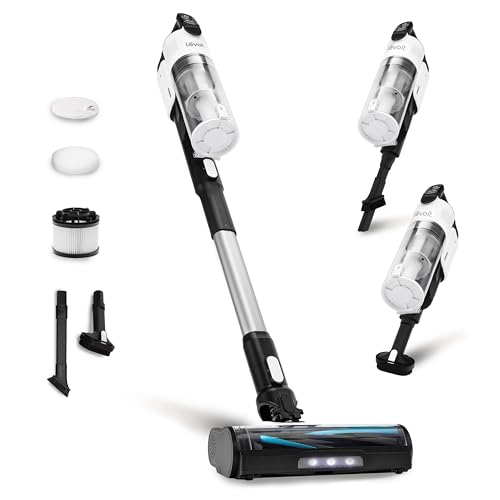
Levoit Cordless Vacuum Cleaner LVAC-200 — Best Lay-Flat Reach
The Levoit LVAC-200’s signature is in its verified listing: a 180° lay-flat design, up to 50 minutes of runtime, anti-tangle construction for pet hair, and a lightweight rechargeable format for carpets and hard floors. Lay-flat reach is a vinyl feature in disguise — the grit that damages vinyl migrates under sofas, beds and sideboards, and a stick that folds flat retrieves it without moving furniture, which means it actually gets retrieved instead of being left to grind.
Strengths
- Lay-flat body cleans under furniture where grit hides
- 50-minute stated runtime is generous for the class
- Anti-tangle design suits pet homes
Trade-offs
- Lay-flat reach still needs the head checked for trapped grit
- Runtime is an “up to” figure — strongest settings shorten it
- Less established in vacuums than the biggest brands
| Brand / model | Levoit LVAC-200 |
| Runtime (listing) | Up to 50 minutes |
| Design (listing) | 180° lay-flat |
| Focus (listing) | Anti-tangle, pet hair, hard floors and carpets |
Most vinyl wear does not happen in the middle of the room, where everyone vacuums; it happens in the traffic lanes and under the edges of furniture, where grit accumulates undisturbed and shoes pivot on it. The LVAC-200 is built for exactly those zones. Run it flat under the sofa weekly, keep the anti-tangle head inspected, and use the long stated runtime for unhurried full-home passes. For a vinyl-floored flat with low furniture — platform beds, low sofas, sideboards — this design detail is worth more than a suction headline, and it is why the Levoit holds its own against bigger names in this guide.
Best for: homes with low furniture and lots of under-furniture floor / Not suited for: buyers who prefer the biggest-brand service networks
Check on Amazon — check the current price on Amazon before you decide, because sizes and configurations change.

Shark Rocket Corded Stick Vacuum HV301 — Best Corded — Never Runs Flat
Corded sticks are unfashionable and permanently ready. The verified Shark Rocket HV301 listing states a weight under 9 lbs, conversion to a handheld, swivel steering, low-profile reach and crevice and upholstery tools, for carpet and hard floors. Under 9 lbs is a real, stated number in a category full of the vague word “lightweight”, and the cord means the vacuum you grab for a gritty doorway at 8 a.m. is always at full power — no battery gauge, no wall dock discipline, no mid-clean fade.
Strengths
- Stated under-9-lb weight — genuinely light
- Corded power never fades or runs flat
- Swivel steering and low-profile head suit furnished rooms
Trade-offs
- The cord limits range and needs socket planning
- Older platform — check the live listing for current configuration
- No battery freedom for stairs without sockets
| Brand / model | Shark Rocket HV301 |
| Weight (listing) | Under 9 lbs |
| Power | Corded |
| Extras (listing) | Handheld conversion, swivel steering, crevice and upholstery tools |
The Rocket is the pick for households that have been betrayed by batteries — or that simply prefer a tool that works at full strength every single time. On vinyl, its swivel steering and low-profile head make short work of the skirting-line grit and the under-cabinet strip where vinyl kitchens accumulate crumbs. Manage the cord like a system: start at the far end of the room and work toward the socket, and the cord never crosses your cleaned path. For a rental flat, a first home, or a vinyl-floored house where the stick lives in one cupboard and serves two floors via landing sockets, the HV301’s simplicity is its specification.
Best for: buyers who want guaranteed power and a stated light weight / Not suited for: homes where sockets are scarce or stairs dominate the cleaning
Check on Amazon — check the current price on Amazon before you decide, because sizes and configurations change.

Bissell Featherweight Stick Vacuum 2033M — Best Budget Stick
The Bissell Featherweight is the budget anchor and, for small vinyl flats, possibly the smartest buy in the guide. The verified listing describes a lightweight bagless stick vacuum and electric broom with a crevice tool, for hard floors and carpets. It makes no premium claims and needs none: its job is the two-minute daily pass that keeps grit off vinyl, and a featherweight corded stick that lives behind a door will do that job more faithfully than an expensive machine that lives in a box.
Strengths
- Genuinely featherweight — effortless for daily passes
- Budget tier makes it a low-regret purchase
- Crevice tool handles edges and thresholds
Trade-offs
- Corded, with a modest cleaning path
- Not the tool for deep carpet cleaning
- Bagless cup is small — empty it often
| Brand / model | Bissell Featherweight 2033M |
| Format | Corded stick / electric broom |
| Tool (listing) | Crevice tool included |
| Tier | Budget |
Judge the Featherweight by the metric that matters for vinyl: cleans per week. A vacuum this light and this cheap gets used daily without negotiation, and daily grit removal is the whole vinyl-protection strategy in one habit. Keep it assembled and plugged near the kitchen or hall if you can; a vacuum that is visible is a vacuum that is used. Its limits are real — it is not a deep-clean machine for thick carpet, and nobody should ask it to be — but as the vinyl floor’s daily defender, with the crevice tool for the edges where grit queues up, it earns the final slot in this guide on merit.
Best for: small vinyl flats, first homes and daily-pass households / Not suited for: large homes or deep-carpet cleaning briefs
Check on Amazon — check the current price on Amazon before you decide, because sizes and configurations change.
Comparison Table
| Pick | Badge | Key spec | Best for |
|---|---|---|---|
| Shark Pet Cordless Stick Vacuum IX141 | Best Overall for Vinyl Homes | Shark IX141 | most vinyl-floored homes wanting one cordless stick for everything |
| Dyson V8 Plus Cordless Vacuum | Best Premium Pick | Dyson V8 Plus | buyers wanting a premium, versatile cordless for mixed vinyl and carpet |
| Tineco A30S Cordless Vacuum Cleaner | Best Runtime and Capacity | Tineco A30S | larger vinyl-floored homes and pet households |
| Levoit Cordless Vacuum Cleaner LVAC-200 | Best Lay-Flat Reach | Levoit LVAC-200 | homes with low furniture and lots of under-furniture floor |
| Shark Rocket Corded Stick Vacuum HV301 | Best Corded — Never Runs Flat | Shark Rocket HV301 | buyers who want guaranteed power and a stated light weight |
| Bissell Featherweight Stick Vacuum 2033M | Best Budget Stick | Bissell Featherweight 2033M | small vinyl flats, first homes and daily-pass households |
How to Choose the Best Lightweight Stick Vacuums for Vinyl Floors
Vinyl — whether sheet, tile or luxury vinyl plank — has a wear layer that grit destroys by abrasion. Your vacuum’s first job is therefore frequency: choose the stick you will actually lift daily, which is why stated weight and grab-and-go format outrank headline suction in this guide. The second job is head kindness. Before buying any stick for vinyl, examine the head design: wheels should be smooth and free-spinning, the underside free of sharp moulding edges, and the brush suited to hard floors — and whatever head you choose, keep it inspected, because one trapped stone out-scratches a year of careful vacuuming.
Then match power source to home. Cordless sticks — Shark, Dyson, Tineco, Levoit here — trade runtime limits for freedom; read stated runtimes as best-case figures that shrink on maximum settings. Corded sticks — the Shark Rocket and Bissell Featherweight — trade range for certainty. Suction numbers (AW, Pa, watts) are measured differently by every brand and cannot be compared across the table; treat them as within-brand information only, which is how the reviews above use them. Finally, value the handheld conversion: vinyl homes accumulate grit on stairs, in cars and around thresholds, and a stick that becomes a handheld covers the whole grit map with one tool.
Protecting Vinyl’s Wear Layer: A Cleaning Rhythm That Works
Doormats first: a mat at each exterior door strips more grit than any vacuum feature, and the vacuum’s job shrinks accordingly. Then vacuum in the direction of traffic, briefly and often — high-traffic lanes every couple of days, whole floors weekly — using straight passes at walking pace. Rushing makes any head skip and bounce; bouncing heads are the ones that scuff. Empty the cup before it is packed, because a full cup reduces airflow and tempts you to press down, and pressing down adds wheel pressure without adding clean.
Between vacuums, protect the floor from its other enemies: felt pads under chair and table legs, no dragging of furniture, and shoes-off or indoor-shoes habits in gritty seasons. When you wash vinyl, use a damp — not soaking — mop with a vinyl-appropriate cleaner, because standing water finds seams. None of this requires the premium pick; it requires the rhythm, and the rhythm is exactly what a lightweight stick makes sustainable for years.
Cordless vs Corded for Vinyl: An Honest Decision
Cordless wins the daily-pass argument in most homes: no cord to trail through doorways, no socket hunt, and a machine that lives on a dock looking ready. Its costs are battery management — charging discipline, eventual battery replacement — and runtime ceilings that matter in big houses. The stated figures in this guide run from 40 to 60 minutes, which covers the great majority of homes for a vinyl pass, especially since vinyl passes are quick by nature.
Corded wins the certainty argument: full power at the first pass and the fiftieth, a lighter body because there is no battery to carry, and a lower price for the same cleaning ability — the Featherweight’s whole proposition. Its cost is choreography around sockets. The deciding question is embarrassingly practical: which failure mode will annoy you more in year two — a flat battery, or a cord? Answer that honestly and the category chooses itself; the picks above give you strong options on both sides of the line.
Reading Vacuum Listings Without Being Fooled
Vacuum listings are a dialect of their own, and three translations will protect you. First, suction units are not a common currency: AW, Pa and watts measure different things under different conditions, and a bigger number from one brand does not beat a smaller number from another — this guide quotes them per listing and compares none across brands. Second, runtime is always “up to”: the figure assumes the gentlest mode on hard floors, and maximum modes typically cut it dramatically. Third, “lightweight” is an adjective until a number appears — which is why the Shark Rocket’s stated under-9-lb figure is highlighted in its review, and why you should hunt for the stated weight on any listing you consider beyond this guide.
What can be compared honestly is format and stated features: runtime class, dust cup size in litres, conversion to handheld, head design you can inspect, and the tools in the box. Buy on those, verify the ASIN against a live listing as every pick here was verified, and the dialect loses its power to mislead.
How to Vacuum Vinyl Floors Without Scratching Them
Step 1: Inspect the head. Before each session, turn the head over: remove trapped stones, hair and grit from the brush and wheels. This thirty-second check prevents most vacuum-caused vinyl scratches.
Step 2: Choose the gentle setting. Use the lower power mode for daily vinyl passes; reserve maximum power for rugs and carpet.
Step 3: Work from far to near. Start at the far end of the room and move toward the door (or the socket, for corded models), so you never walk back over cleaned floor in outdoor shoes.
Step 4: Slow, straight passes. Walk at half your normal pace in overlapping straight lines. Let the head lift the grit; do not press down.
Step 5: Detail the edges. Use the crevice tool or handheld conversion along skirting boards, thresholds and under cabinet kick spaces, where grit queues up.
Step 6: Go under furniture weekly. Use the lay-flat reach or move light furniture to clear the grit reservoirs underneath.
Step 7: Empty and wipe. Empty the cup, and wipe the head’s underside and wheels with a dry cloth before storing, so the next session starts clean.
Common Buying Mistakes
Vacuuming monthly with a heavy machine instead of daily with a light one. Vinyl damage happens between cleans, under shoes. Frequency beats force.
Comparing suction numbers across brands. AW, Pa and watts are not interchangeable. Buy on format, runtime, cup size and head design.
Never inspecting the vacuum head. A lodged stone in any head can score vinyl in one pass. Thirty seconds of checking is the whole insurance policy.
Pressing down for “deeper” cleaning. Pressure adds wheel load, not suction. Slow passes clean; force only risks the wear layer.
Ignoring the edges. Grit migrates to skirting lines and thresholds, then walks back into the room on socks. Detail the edges every session.
Leaving the cup packed full. A full cup strangles airflow and makes every subsequent pass worse. Empty early, empty often.
Final Recommendation
For most vinyl homes, the Shark IX141 is the balanced buy — runtime, headlights, handheld conversion, no drama. The Dyson V8 Plus is the premium upgrade; the Tineco A30S is the big-home stamina pick; the Levoit LVAC-200 wins under furniture. Corded loyalists get the Shark Rocket’s stated under-9-lb certainty, and small flats get the Featherweight’s daily-pass economics.
Companion guides in this batch and programme: Best Lightweight Vacuums For Kitty Litter for the pet version of this problem, Best Throw Rugs For Vinyl Plank Flooring to protect the same floors at the door, plus Best Vacuum Cleaner Hardwood And Throw Rugs and Best Area Rug That Vacuums Easily from the wider allocation list.
Vinyl Plank, Sheet Vinyl and Vinyl Tile: Does the Vacuum Care?
The three vinyl formats behave slightly differently under a vacuum, and the differences are worth a paragraph each. Luxury vinyl plank has seams and a textured grain that can hold grit in the bevels between planks; it rewards slower passes along the plank direction and regular edge detailing, because grit sitting in a bevel is grit positioned exactly where shoes pivot. Sheet vinyl has no seams to hide in and is the easiest surface in this guide to keep clean — its risk is instead a single long scratch, which is why the head-inspection habit matters most here. Vinyl tile sits between the two: many seams, each one a small grit shelf, best handled by passes in two directions on the weekly clean.
None of this changes the shortlist — all six picks serve all three formats — but it changes the routine you wrap around the machine, and routine is where vinyl floors are actually saved or lost. If you take one refinement from this section, take the two-direction weekly pass for tiled and planked floors: the second direction lifts what the first direction pushed into the seams, and it costs four extra minutes.
Where the Stick Lives: Storage as a Cleaning Feature
A vacuum’s storage place decides its usage statistics more honestly than its specifications do. A cordless stick on a wall dock in the hall gets grabbed for the two-minute grit emergency; the same stick in its box in a loft gets used on Saturdays. If you buy cordless, mount the dock where the grit is — near the kitchen or the front door — not where the drill happened to be. If you buy corded, keep the machine assembled, cord loosely looped, in the cupboard nearest the largest vinyl area; assembly friction is usage friction.
Small flats make this vivid: the Featherweight behind the kitchen door is, in measured cleans per week, the most effective vacuum in this entire guide for its owner, whatever the flagship models promise. Buy the machine your storage supports, store it like you mean to use it daily, and the vinyl will show the difference within a season — in the traffic lanes first, which is where your future self walks.
Batteries, Filters and the True Cost of a Cordless Stick
Cordless ownership has a maintenance ledger that corded ownership does not, and honest budgeting includes it. Batteries lose capacity over years and are replaceable on some models and effectively not on others — check the live listing and the brand’s parts support before buying if you intend to keep the machine a long time. Filters need washing or replacing on schedule; a clogged filter is the commonest cause of a cordless stick “losing suction” that it never actually lost. Dust cups and cyclones want a monthly wipe-down beyond emptying, because the fine dust vinyl homes generate coats everything.
None of this is an argument against cordless — the four cordless picks here are recommended with open eyes — it is an argument for reading the whole cost. The corded picks invert the ledger: no battery, simpler upkeep, and a machine that will likely outlast two cordless generations for the price of managing a cable. Choose your ledger, keep the small maintenance appointments either way, and any of the six will serve the floor faithfully.
Kitchens, Hallways and Bathrooms: Vinyl’s Three Working Zones
Most vinyl lives in three zones, and each asks something slightly different of a stick vacuum. The kitchen is the grit-and-crumb zone: food debris migrates to the kick space under units and the strip in front of the hob, so the crevice tool and handheld conversion matter as much as the main head — the Shark IX141 and the Rocket both answer this directly. The hallway is the traffic zone, where outdoor grit enters and distributes itself; it rewards the fastest possible daily pass, which is the Featherweight’s and the cordless picks’ shared argument. The bathroom is the small, damp, hair-collecting zone, where a compact stick that stores nearby and a head that does not tangle — Dyson and Tineco both state detangling or zero-tangle designs — keeps a fiddly room effortless.
Map your own home’s zones before choosing and the shortlist sorts itself: the household whose vinyl is ninety percent kitchen and hall should buy for speed and edges; the household with vinyl throughout, including bedrooms, should buy for runtime and reach. Either way, the vacuum that lives nearest the busiest zone will do the most work — a truth no specification table captures and every honest cleaner knows.
When to Replace a Stick Vacuum — and What to Do With the Old One
Replace a stick vacuum on evidence, not age. For cordless models, the evidence is a battery that no longer holds a useful fraction of its stated runtime despite clean filters, or suction that does not return after the cup, cyclone and filters have been properly cleaned — the two failures that maintenance cannot reverse. For corded models, it is a damaged cable, a cracked head housing, or wheels worn to the point of marking floors, which on vinyl is a retirement offence in itself. Brushes and filters are consumables, not verdicts: replace those first, at a fraction of a new machine’s cost, before concluding anything about the vacuum.
A retired stick with life left in it demotes well — to a garage, a workshop, a student’s first flat — while a truly finished one should go to small-appliance recycling rather than landfill, batteries included through the proper channel. And when the replacement arrives, repeat this guide’s first ritual before its first pass: inspect the head, charge or plug in, and take the slow first walk down the grittiest hallway in the house. The floor will not notice the brand change; it will notice, within weeks, whether the frequency changed.
A Two-Week Vinyl Routine, Written Out in Full
Monday: a five-minute cordless pass of the hall and kitchen lanes, edges included, cup emptied. Wednesday: the same pass, plus the bathroom with the handheld conversion for corners. Friday: the weekly full clean — every room, two directions on plank or tile, under the sofa with the lay-flat or the moved furniture, skirting lines detailed with the crevice tool. The following week repeats the rhythm with one addition: a damp mop after Friday’s vacuum, while the floor is genuinely grit-free, which is the only moment mopping polishes instead of merely relocating abrasive dust.
Total active time across the fortnight is under ninety minutes, and the floor that receives it keeps its sheen and its wear layer years longer than the floor that receives a heroic monthly clean. That is the entire thesis of this guide expressed as a calendar: lightweight machines, used briefly and often, inspected honestly, chosen by format rather than by headline numbers. Pick the one of the six that fits your rooms, your sockets and your storage, and let the routine do what routines do.
One Final Check Before You Order Any Stick Vacuum
Read the live listing for the exact model one more time and confirm four things in the seller’s own current words: the stated runtime or the corded format, the stated weight if it is given, the tools actually in the box, and the return terms. Listings evolve between production runs — a head changes, a tool drops out of the bundle — and the verification behind this guide, whether from the dated cache or this batch’s fresh run, describes the listing as checked. Your order deserves the same thirty-second discipline. Confirm those four, and the vacuum that arrives will be the vacuum this guide reviewed, ready to start the only job that matters: showing up, lightly and often, between your shoes and your vinyl.
Light in the hand, kind to the wear layer, honest in its numbers — hold every candidate, including the six verified above, to those three tests, and your vinyl floors will repay the discipline with years of unmarked, unsanded, quietly shining service.
And a Word for Renters With Vinyl You Do Not Own
If the vinyl is your landlord’s, the argument for a lightweight stick doubles: deposit disputes are won and lost on floors, and a floor whose wear layer you protected for two years photographs like a floor that was respected. Keep the vacuum small, keep the routine documented by nothing more than its visible results, and photograph the floors at move-in and move-out with the vacuum’s work in between. The cheapest pick in this guide costs less than the smallest plausible deduction from a deposit — arithmetic that makes the Featherweight, for renters specifically, less a budget compromise and more an insurance policy with a crevice tool.
Whether the floor is yours for thirty years or yours until the lease ends, it deserves the same light, frequent, inspected care — and now you have six verified ways to give it exactly that.
Grab it daily, empty it often, check the head every time — the smallest habits in this guide protect the largest surface in your home.
That is the whole method, and it works.
Start today, before the next gritty footprint.
Frequently Asked Questions
Will a stick vacuum scratch vinyl flooring?
A well-maintained head should not: the scratch risk comes from grit or stones trapped in the brush or wheels, and from dragging a dirty head. Inspect and wipe the head before sessions, use the gentler power mode, and let slow passes do the work. No vacuum is safe with a stone lodged in it, which is why the check matters more than the brand.
Is cordless or corded better for vinyl floors?
Both work; the trade is freedom against certainty. Cordless sticks make daily passes effortless and cover most homes within their stated 40–60 minute runtimes. Corded sticks like the Shark Rocket and Bissell Featherweight are lighter, cheaper and always at full power. Choose by which inconvenience you mind less.
What suction do I need for vinyl?
Less than marketing suggests. Vinyl is smooth, so grit lifts easily; the challenge is frequency and edges, not raw power. Suction figures (AW, Pa) are brand-specific and not comparable across makers — this guide quotes them per listing for completeness and bases its rankings on format and stated features instead.
How often should I vacuum vinyl floors?
High-traffic lanes every couple of days, whole floors weekly — more often in gritty seasons or with pets. Frequent light passes are the actual protection for the wear layer, which is why lightweight sticks suit vinyl better than heavy machines used rarely.
Can I use the same stick vacuum on vinyl and carpet?
Yes — every pick here is positioned for hard floors and carpets. Use the gentler mode and passes on vinyl, and the stronger mode on carpet and rugs. If a model offers a hard-floor head or setting, use it on vinyl; whatever the head, keep it inspected and clean.
Why does my vinyl floor look dull even though I vacuum?
Usually embedded grit in traffic lanes plus residue from over-wet mopping. Increase vacuum frequency in the lanes, detail the edges where grit hides, and damp-mop with a vinyl-appropriate cleaner rather than soaking. Felt pads under furniture legs stop new scratches appearing in the same places.


