Disclosure: airfryerkitchensupply.com is reader-supported. When you buy through links on our site, we may earn an affiliate commission at no extra cost to you.
Where to buy
The best slippers with foot support are comfort products, and this guide treats them as exactly that: every pick below is a genuine house slipper — no sandals, slides or shoes — with a shaped, supportive footbed, confirmed through the airfry site’s Amazon listing data before being linked.
- COFACE Women’s Memory Foam Slippers with Arch Support, Beige, Size 7 — Check on Amazon
- EverFoams Women’s Bootie Slippers with Memory Foam — Check on Amazon
- isotoner Women’s Microsuede Moccasin Slippers with Memory Foam and Arch Support — Check on Amazon
- VLLy Men’s Moccasin Slippers with Memory Foam Arch Support — Check on Amazon
- AWFI Men’s Slippers with Arch Support, Memory Foam — Check on Amazon
- SaDuck Men’s Slippers with Arch Support, Memory Foam — Check on Amazon
Check the current price on Amazon from any link; no prices are printed here because they change — and order your exact size from the listing’s size run, because support only works when the arch contour lands under your arch.
Introduction: what “foot support” in a slipper really means
The best slippers with foot support solve a problem most people misdiagnose as a flooring problem. Hours on hard home floors — cooking, tidying, working from a standing desk, carrying children — leave feet tired in a way a soft slipper does not fix, because softness is not support. The best slippers with foot support put a shaped insole under the foot: a contoured arch, a defined heel cup and a real sole, so the foot is held in position instead of collapsing into a flat foam pad by the end of the first hour.
Every pick in this roundup is a house slipper first — moccasins, booties and slip-on house shoes meant for indoor wear with brief outdoor tolerance — and a support product second. That ordering matters, because the category is polluted in both directions: plush novelty slippers with no structure calling themselves supportive, and aggressively medical-looking footwear that nobody wants to wear at home. The six below are the middle that actually gets worn: verified listings, stated arch support, memory foam or structured footbeds, and styles for both cold and warm homes. Comfort claims are kept honest throughout — these are comfort products, and this guide makes no medical promises for them. One more scoping note: this guide covers adult house slippers for general home wear. It does not cover post-surgical footwear, diabetic-specific designs or children’s slippers, each of which has its own requirements and its own guides elsewhere on this site; mixing those needs into a general roundup would serve none of them well.
In this guide
Quick Picks
Best for Women — COFACE Women’s Memory Foam Slippers with Arch Support, Beige, Size 7. The COFACE women’s slipper is the archetype of the supportive house slipper: a warm moccasin-style upper with a faux fur collar, a memory foam insole built around an arch support contour, and a hard rubber sole that does not care whether you step onto the porch. Check on Amazon
Best Bootie for Winter Support — EverFoams Women’s Bootie Slippers with Memory Foam. The EverFoams bootie wraps the supportive-slipper formula in ankle coverage: a fleece-lined bootie with a memory foam footbed the listing describes as a foot support cushion, and a non-slip sole for indoor and outdoor use. Check on Amazon
Best Classic Moccasin — isotoner Women’s Microsuede Moccasin Slippers with Memory Foam and Arch Support. Isotoner is the heritage name in this roundup, and its microsuede moccasin is the classic execution: memory foam comfort with stated arch support in a low-profile moccasin that reads as a shoe rather than a novelty slipper. Check on Amazon
Best Men’s Moccasin — VLLy Men’s Moccasin Slippers with Memory Foam Arch Support. The VLLy men’s moccasin pairs the two features men actually ask for: memory foam with arch support, and the ability to machine wash the result. Check on Amazon
Best Men’s All-Rounder — AWFI Men’s Slippers with Arch Support, Memory Foam. The AWFI entry is the men’s comfort all-rounder: arch support and memory foam in a breathable build whose listing name-checks Coolmax material — a moisture-management fabric — alongside the usual rubber sole. Check on Amazon
Best Breathable for Men — SaDuck Men’s Slippers with Arch Support, Memory Foam. The SaDuck closes the roundup with the same recipe in its most breathable men’s form: a two-tone slip-on house shoe with memory foam arch support, positioned by its listing as breathable indoor-outdoor wear. Check on Amazon
How These Picks Were Chosen
Every slipper was cross-checked against the airfry site’s Amazon listing data: the Amazon listing title is the source for each support, material, sole and care claim, and only listing-confirmed listings received Amazon links. Two honesty rules governed selection. First, category discipline: only house slippers qualified — ballet and dance slippers, sandals, slides, flip-flops, massage footwear and baby booties were all excluded, however supportive their listings claimed to be.
Beyond verification, picks were balanced deliberately: women’s and men’s designs, cold-weather and breathable builds, moccasin, bootie and slip-on formats, and a range of support firmness from the isotoner’s gentle contour to firmer shaped footbeds. Duplicate listings of the same slipper in other colors or adjacent sizes were counted once. Sizes named in spec boxes are the sizes in the verified listings; every brand’s full size run should be confirmed on the listing page before ordering.
The 6 Best Slippers With Foot Support

COFACE Women’s Memory Foam Slippers with Arch Support, Beige, Size 7 — Best for Women
The COFACE women’s slipper is the archetype of the supportive house slipper: a warm moccasin-style upper with a faux fur collar, a memory foam insole built around an arch support contour, and a hard rubber sole that does not care whether you step onto the porch. It is the pick for women who are on their feet at home — cooking, tidying, chasing children — and want the slipper to work like footwear, not like a sock with ambitions.
Strengths
- Memory foam insole with a defined arch contour rather than a flat foam pad
- Hard rubber sole handles indoor floors and quick outdoor steps equally
- Warm moccasin styling with faux fur collar suits cold floors and winter evenings
Trade-offs
- Sized listings mean ordering your exact size — check the listing’s size run before buying
- Warmth is a liability in summer or heated homes; this is a cold-season slipper
- Support language in the listing title goes further than this guide repeats — treat it as a comfort product
| Style | Moccasin-style house slipper with faux fur collar (per listing title) |
| Insole | Memory foam with arch support (per listing title) |
| Sole | Hard rubber sole, indoor/outdoor (per listing title) |
| Size in listing | Women’s size 7, Beige |
What separates a supportive slipper from a soft one is what happens at minute thirty, not minute one. Flat memory foam feels wonderful initially and compresses to nothing by the end of a cooking session; a contoured insole keeps a shaped surface under the arch, which is the difference between cushion and support. The COFACE is built on the contoured side of that line, and its rubber sole adds the second half of support — a stable platform that does not roll or squish sideways on hard floors. Note the honesty point in its trade-offs: the listing’s own title uses stronger therapeutic wording than this guide will. Buy it for structured comfort on hard home floors, which it delivers, not for any promise beyond that.
Best for: Women on their feet at home on hard floors, especially in colder months / Not suited for: Warm-climate wearers wanting a light summer house slipper.
Check on Amazon — check the current price on Amazon.

EverFoams Women’s Bootie Slippers with Memory Foam — Best Bootie for Winter Support
The EverFoams bootie wraps the supportive-slipper formula in ankle coverage: a fleece-lined bootie with a memory foam footbed the listing describes as a foot support cushion, and a non-slip sole for indoor and outdoor use. For cold houses — tile kitchens, drafty hallways, basement laundry runs — the bootie format keeps the whole foot warm instead of just the part a mule covers.
Strengths
- Bootie coverage keeps ankles and heels warm on cold floors
- Memory foam footbed with stated foot-support cushioning
- Non-slip sole rated by the listing for indoor and outdoor wear
Trade-offs
- Ankle coverage makes it the warmest pick here — too warm for many in summer
- Bootie style is slower to slip on and off than a mule or clog
- Color and size in the verified listing are specific; confirm your size run on the listing
| Style | Bootie slipper with warm collar (per listing title) |
| Insole | Memory foam (per listing title) |
| Traits | Non-slip sole; indoor/outdoor; foot support cushion (per listing title) |
| Size in listing | Women’s 8 M US, Purple |
The bootie is the support pick for a specific environment: the genuinely cold home. Cold feet change how people stand and walk indoors — shorter steps, tenser posture — and full coverage removes that variable while the foam footbed does the support work. EverFoams’ listing emphasizes cozy materials, but the structure underneath is the same recipe as the roundup’s best: cushioned shaped footbed, real sole, secure fit that does not let the foot slide and negate the support. If your home is warm year-round, this is the wrong pick wearing the right features; choose the SaDuck or AWFI openness instead.
Best for: Cold homes and winter wear on tile, stone or unheated floors / Not suited for: Warm climates or anyone who overheats in socks.
Check on Amazon — check the current price on Amazon.

isotoner Women’s Microsuede Moccasin Slippers with Memory Foam and Arch Support — Best Classic Moccasin
Isotoner is the heritage name in this roundup, and its microsuede moccasin is the classic execution: memory foam comfort with stated arch support in a low-profile moccasin that reads as a shoe rather than a novelty slipper. For buyers who want support without the orthopedic-store look — a slipper that can answer the door without embarrassment — this is the established answer.
Strengths
- Arch support and memory foam in a discreet, shoe-like moccasin
- Microsuede upper looks tidy enough for guests and door-answering
- A long-running brand with consistent sizing across reorders
Trade-offs
- Low-profile moccasin warmth is moderate — not a deep-winter bootie
- Support is gentler than the firmest contoured insoles here
- Microsuede needs a brush and care to keep its finish
| Style | Microsuede moccasin slipper (per listing title) |
| Insole | Memory foam comfort with arch support (per listing title) |
| Use | Indoor/outdoor (per listing title) |
| Brand | isotoner |
The isotoner’s virtue is balance. Its support is real but not aggressive, its warmth is adequate but not sweltering, its styling is neutral in a way that survives trends, and its foam is the comfortable, familiar kind. In a category that splits into extremes — maximal orthotic designs at one end, novelty plush at the other — the classic moccasin is what most people, asked honestly, want to wear for the sixteen waking hours at home. It is also the safest gift pick in the roundup, precisely because it offends no preference strongly. Support purists who want the firmest arch should take the COFACE or AWFI; everyone else can stop here.
Best for: Everyday wearers wanting balanced support in a classic style / Not suited for: Those needing the firmest possible arch contour.
Check on Amazon — check the current price on Amazon.

VLLy Men’s Moccasin Slippers with Memory Foam Arch Support — Best Men’s Moccasin
The VLLy men’s moccasin pairs the two features men actually ask for: memory foam with arch support, and the ability to machine wash the result. Its fleece lining and non-slip rubber sole make it an indoor-outdoor workhorse, and the listing’s washable claim is rarer than it should be in a category worn barefoot daily.
Strengths
- Machine washable — the hygiene feature most supportive slippers lack
- Memory foam arch support in a traditional moccasin format
- Non-slip rubber sole for garage, porch and driveway steps
Trade-offs
- Fleece lining runs warm outside winter
- Moccasin fit is relaxed; narrow feet may feel play in the heel
- Washable per the listing — follow its care instructions to protect the foam
| Style | Men’s moccasin slipper, fleece lined (per listing title) |
| Insole | Memory foam with arch support (per listing title) |
| Sole | Non-slip rubber sole (per listing title) |
| Care | Machine washable (per listing title) |
| Size in listing | Men’s 10 US, Brown |
Washability changes the ownership math of a supportive slipper. A contoured insole you cannot wash accumulates a season of barefoot wear and starts to feel like a compromise; the VLLy can be reset. That, plus the moccasin’s easy fit and the sole’s outdoor tolerance, makes it the roundup’s best men’s all-rounder for houses with hard floors and cold mornings. Its support sits in the middle of this group — present and shaped, not maximal — which suits the majority of wearers who want their arches acknowledged rather than engineered. Size from the listing’s own guidance; moccasins stretch slightly with wear, so a snug start is the right start.
Best for: Men wanting supportive, washable everyday house slippers / Not suited for: Narrow feet or anyone wanting a firm, high arch.
Check on Amazon — check the current price on Amazon.
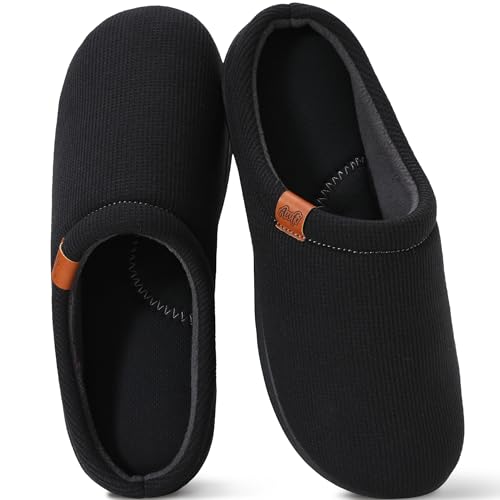
AWFI Men’s Slippers with Arch Support, Memory Foam — Best Men’s All-Rounder
The AWFI entry is the men’s comfort all-rounder: arch support and memory foam in a breathable build whose listing name-checks Coolmax material — a moisture-management fabric — alongside the usual rubber sole. Where the VLLy leans warm and fleece-lined, the AWFI leans breathable, which makes it the men’s pick for homes and seasons where warmth is already handled.
Strengths
- Arch support with memory foam in a breathable, moisture-managing build
- Rubber sole suits indoor floors and brief outdoor use
- Closed and open-toe variants in the listing family let you pick your ventilation
Trade-offs
- Breathable build gives up the deep-winter warmth of fleece-lined picks
- Brand is less established than isotoner; sizing should be checked against the listing’s chart
- Support contour is moderate rather than maximal
| Style | Men’s house slippers, closed/open-toe options in listing (per listing title) |
| Insole | Memory foam with arch support (per listing title) |
| Traits | Coolmax material mentioned in listing title; rubber sole |
| Brand | AWFI (per API brand field) |
Men’s supportive slippers skew heavily toward winter designs, which leaves warm-footed wearers choosing between support and comfort for half the year. The AWFI’s listing is notable for treating breathability as a headline rather than an apology — Coolmax in the title signals a slipper designed to be worn for long indoor days without the swampy feel fleece produces by noon. Its support recipe matches the group: shaped foam under the arch, real sole underneath. If you run warm, this is your men’s pick; if your floors are cold, it is your summer pair beside a fleece moccasin.
Best for: Men who run warm and want year-round supportive house slippers / Not suited for: Cold-floor homes in winter.
Check on Amazon — check the current price on Amazon.

SaDuck Men’s Slippers with Arch Support, Memory Foam — Best Breathable for Men
The SaDuck closes the roundup with the same recipe in its most breathable men’s form: a two-tone slip-on house shoe with memory foam arch support, positioned by its listing as breathable indoor-outdoor wear. It is the warm-weather and warm-house counterpart to the fleece picks — support without insulation.
Strengths
- Breathable build for warm homes and summer wear
- Slip-on ease with a house-shoe structure that stays on the foot
- Memory foam arch support consistent with the roundup’s standard
Trade-offs
- Minimal insulation — cold floors will be felt
- Two-tone casual styling is informal even by slipper standards
- Size runs in ranges (11-12 in the listing); fit precision is looser than single sizes
| Style | Men’s two-tone slip-on house shoes (per listing title) |
| Insole | Memory foam with arch support (per listing title) |
| Traits | Breathable; indoor/outdoor (per listing title) |
| Size in listing | Navy, men’s 11-12 |
Breathability in a supportive slipper is not a minor variant — it decides whether the slipper is worn in July at all, and an unworn supportive slipper supports nothing. The SaDuck’s open, breathable design keeps the shaped footbed in service year-round for warm-footed men, and its house-shoe structure — a defined heel and sole rather than a sock-like mule — keeps the foot positioned over the arch contour instead of sliding off it, which is the silent failure of floppy summer slippers. Pair it conceptually with the VLLy: one for the cold half of the year, one for the warm half, and the support habit never takes a season off.
Best for: Warm-weather and warm-home wear for men / Not suited for: Winter wear on unheated floors.
Check on Amazon — check the current price on Amazon.
Comparison Table
| Pick | Badge | Key spec | Best for |
|---|---|---|---|
| COFACE Women’s Arch Support Slippers — Check on Amazon | Best for Women | Memory foam arch contour, hard rubber sole, warm moccasin | Women on their feet at home on hard floors, especially in colder months |
| EverFoams Women’s Bootie Slippers — Check on Amazon | Best Bootie for Winter Support | Bootie, fleece lined, memory foam footbed | Cold homes and winter wear on tile, stone or unheated floors |
| isotoner Microsuede Moccasin — Check on Amazon | Best Classic Moccasin | Microsuede moccasin, gentle arch support | Everyday wearers wanting balanced support in a classic style |
| VLLy Men’s Moccasin Slippers — Check on Amazon | Best Men’s Moccasin | Men’s moccasin, washable, fleece lined | Men wanting supportive, washable everyday house slippers |
| AWFI Men’s Arch Support Slippers — Check on Amazon | Best Men’s All-Rounder | Men’s breathable build, Coolmax in listing | Men who run warm and want year-round supportive house slippers |
| SaDuck Men’s Arch Support Slippers — Check on Amazon | Best Breathable for Men | Men’s two-tone slip-on, breathable | Warm-weather and warm-home wear for men |
Key Takeaways
- Support means shape: a contoured arch and heel cup that still exist at the end of the day, not a flat foam pad that starts soft.
- Buy for your home’s temperature as much as your feet — fleece booties and breathable slip-ons serve opposite houses.
- Fit is functional: the arch contour must land under your arch, so order true size and expect a snug first fit in moccasins.
- Washability is a support feature over time — a washable slipper stays pleasant enough to keep wearing daily.
- These are comfort products. This guide repeats no listing’s therapeutic promises, and neither should your expectations.
- Judge support standing still, on your hardest floor, hands busy — a contour you forget while cooking is a contour in the right place.
- Two seasonal pairs — one fleece, one breathable — keep the support habit alive all year and make each pair last longer, because foam given a full rest day between wearings rebounds more completely and holds its contour through far more evenings of real use.
How to Choose Slippers With Foot Support
Start with your floor and your hours. Hard floors — tile, stone, hardwood, laminate — are where support earns its keep, and the longer you stand on them, the firmer and more structured the footbed you should choose from this roundup. Carpeted homes forgive almost anything; a gentle contour like the isotoner’s is plenty there. Then choose by temperature: fleece-lined moccasins and booties (COFACE, EverFoams, VLLy) for cold floors and winter; breathable builds (AWFI, SaDuck) for warm homes and summer. A supportive slipper that makes your feet overheat will be kicked off by noon, and an unworn slipper supports nothing.
Fit deserves more care than slipper shopping usually gets. The arch contour is a shaped feature at a fixed position; a slipper a size too large puts that contour under the wrong part of the foot, converting support into a lump. Order your true size, expect moccasins to start snug and relax, and prefer defined heel structure — a house-shoe back or bootie — if your feet slide in open mules, because a foot that migrates off the footbed gets cushion, not support.
Cushion versus support: reading an insole honestly
Press the insole with your thumb. Pure cushion compresses uniformly and stays down briefly; a supportive footbed has zones — softer under the heel and forefoot, firmer and raised through the arch. Memory foam complicates the read because it contours to any pressure, which is why the picks here pair it with a stated arch structure rather than selling foam alone as support. Over weeks, judge by the end of the day: a slipper whose arch you can still feel, gently, at hour ten is supportive; one that feels like a flat mat by then was only ever cushioned.
Soles: the platform underneath
A supportive insole on a flimsy sole is a house on sand. The hard rubber soles on the COFACE and the non-slip soles across this roundup provide the stable base that lets the footbed’s shape mean something, plus the practical freedom of porch, garage and mailbox steps without a shoe change. If you have polished or wet-prone floors, weight the sole’s grip as heavily as the insole’s shape; the two are one system.
When a slipper is not the answer
Honesty requires the boundary: slippers are comfort products for ordinary tired feet on hard floors. Persistent foot pain, pain that changes how you walk, or any diagnosed condition belongs to a clinician and possibly to prescribed footwear — not to a roundup. This guide has deliberately excluded listings that pitch themselves primarily as medical devices, and it repeats none of their language. Buy these slippers to be comfortable at home, and let that be the whole promise.
There is a middle case worth naming: discomfort that appears only during long standing at home and vanishes in supportive shoes is exactly the pattern this category serves well, and it is reasonable to try a structured slipper before escalating. The signal to escalate is change — new pain, one-sided pain, pain at rest, or anything that alters your stride. Comfort products address comfort problems; the moment the problem stops sounding like comfort, it stops being a shopping problem.
Hard Floors, Standing Desks and the Modern Home
The supportive slipper is having a moment for a structural reason: homes have changed. Open-plan living concentrates life on one large hard surface; kitchens have become standing workplaces; working from home moved eight hours of daily standing from office carpet to domestic tile and hardwood. The slipper that evolved for bedroom-to-bathroom trips is being asked to serve as all-day footwear, and most of the category has not caught up — which is precisely the gap the six picks here were chosen to fill, each with a real sole and a footbed designed for hours rather than minutes.
Standing-desk users should think of the slipper as part of the desk setup, alongside the mat and the monitor height: alternate supportive slippers with bare feet across the day if you like variety, but do the long standing blocks in the structured pair. Home cooks should weight washability and sole grip — the VLLy’s washable claim and the roundup’s rubber soles are kitchen features as much as comfort ones. And households with stairs should insist on a heel that stays on: a supportive mule left at the stair’s bottom because it cannot be trusted on the steps is a support system that abandons you at the exact place stability matters most.
How to Wear and Care for Supportive Slippers
Break them in at home over a few days — a contoured footbed feels different from flat slippers for the first evenings, and your feet should meet it in short sessions before a full day of cooking or cleaning. Keep the support where it belongs: wear the slipper fully on, heel seated, rather than crushing the back down as a mule, which destroys both the heel cup’s function and the slipper’s structure. On care: wash the washable (the VLLy states machine washable — follow its instructions), air foam insoles regularly, and keep fleece linings dry between wears. Replace supportive slippers when the arch contour flattens or the sole smooths out; unlike decorative slippers, these have a functional lifespan, and wearing a collapsed pair is worse than wearing an honest flat one, because your feet trust support that is no longer there.
Rotation extends that lifespan materially. Two pairs worn on alternate days give foam a full day to rebound between wearings, and foam that rebounds fully keeps its contour months longer than foam compressed daily without rest — the same reason runners rotate shoes. Rotation also solves the washing problem: one pair can be laundered or aired thoroughly while the other serves. If you find a model that fits your arch exactly, buying the second pair while it is certainly available is not indulgence; in a category where models are revised quietly and often, it is how a proven fit is secured against next year’s lineup.
Supportive Slippers by Wearer: A Quick Tour
The home cook and the standing-desk worker are the same customer: long static hours on hard floors, where the firmer contours (COFACE for women; a structured men’s pick) justify themselves. The parent of small children adds motion — stairs, carries, quick outdoor steps — and should weight sole grip and a secure heel: bootie and house-shoe formats over loose mules. The older wearer, or anyone unsteady on polished floors, should read the sole column of the comparison table first and the insole second; stability is the primary support at that point, and every pick here offers a real sole rather than a fabric bottom. The warm-footed wearer in a heated home should start at the AWFI and SaDuck and not be talked into fleece by a winter-biased category. And the gift buyer should take the isotoner: the most forgiving fit, the most neutral style, and support gentle enough to suit a foot they have never measured.
The Anatomy of a Supportive Slipper, Part by Part
It helps to know which part of the slipper does which job, because marketing blurs them together. The arch contour — the raised, firmer zone through the midfoot — is the support feature proper: it gives the arch something to rest against instead of flattening fully with every step, distributing the work of standing across more of the foot’s surface. The heel cup is the positioning feature: a dished seat that keeps the heel centered over the footbed, so the arch contour stays where it was designed to be. Without the cup, feet drift inward or outward and the contour misses its target within the hour.
The cushioning layer — memory foam in most of this roundup — is the comfort feature, and it is the one most often mistaken for support. Its job is pressure relief at the heel and forefoot, the two strike points. Foam quality decides how long that job lasts: good foam rebounds for seasons; poor foam takes a permanent set shaped like your foot’s pressure points and then offers neither cushion nor contour. The upper is the retention feature: moccasin lacing, bootie height and house-shoe backs all exist to keep the foot on the footbed, because support only acts on a foot that stays in position. And the outsole is the foundation: it sets the platform’s stability, protects the footbed from floor moisture and grit, and determines whether the slipper can leave the house for thirty seconds without a costume change.
Reading a listing with this anatomy in mind cuts through the category’s language. “Memory foam” names only the comfort layer. “Arch support” names the contour — ask whether a sole and heel structure back it up. “Indoor/outdoor” names the outsole’s ambition. The picks in this roundup were chosen because their listings describe a complete anatomy, not a single impressive layer; that completeness, more than any one feature, is what separates the supportive slipper from the soft one over a year of evenings.
Sizing and Fit in Practice
Slipper sizing is sloppier than shoe sizing — ranges instead of sizes, unisex conversions, brands that run small — and in a supportive slipper the sloppiness costs more, because fit is function. Practical rules: order your usual shoe size first, not a size up for coziness; a supportive slipper should feel snug across the midfoot when new, since uppers and fleece relax measurably in the first weeks. If you are between sizes, the tie-breaker is the arch: stand in both, and choose the size where the contour meets the middle of your arch rather than your heel or forefoot. Ranged sizing, like the SaDuck’s 11-12, trades that precision for convenience — acceptable for moderate contours, a compromise for anyone seeking the firmest support.
Width matters quietly. A wide foot in a regular moccasin splays over the footbed’s edges and never meets the contour at all; a narrow foot in a wide slipper swims and slides. Several listings in this category offer wide variants — if your shoes are wide, your slippers should be too, and the listing’s size chart, not the headline size, is the document to trust. Socks change fit as well: a slipper fitted barefoot in summer will feel different over winter socks, which is one more argument for the two-pair household — a fleece pair sized for socks, a breathable pair sized for bare feet — over one compromised pair stretched across both seasons.
Finally, test fit the way you will use it: not with a few steps on carpet, but with ten minutes of standing on your hardest floor, ideally while doing something with your hands — cooking, dishes — that keeps your attention off your feet. Support that you stop noticing while occupied is support working; a contour you keep noticing is a contour in the wrong place, whatever the size chart said.
Common Buying Mistakes
Buying soft when you need shaped is the first mistake — the two feel identical for five minutes in a shop. Second is sizing up for comfort, which misplaces the arch. Third is choosing a winter bootie for a warm house, or a breathable slip-on for stone floors in January. Fourth is crushing the heel and wearing a structured slipper as a mule. Fifth is believing therapeutic title language at face value; this guide filtered such listings deliberately, and you should read all support claims as comfort claims. Sixth is keeping a collapsed pair in service long past its functional life because the upper still looks fine. Seventh is testing fit with a thirty-second carpet stroll instead of real standing time on a hard floor — support reveals itself over minutes of load, not seconds of walking, and the wearers who test properly are the ones whose first purchase is usually their last for the season, which is the quiet economic argument for taking ten unglamorous minutes over a quick guess that gets repeated twice in a row by most buyers.
Final Recommendation
For women, start with the COFACE for structured support on hard floors, the EverFoams bootie if your home is cold, and the isotoner moccasin for balanced everyday wear. For men, the VLLy moccasin is the washable all-rounder, with the AWFI and SaDuck covering warm homes and summer. Whichever you choose, order true to size, give the contour a few evenings to make its case, and judge it at the end of your longest day at home — that is the only review that matters.
A word about expectations to close. A supportive slipper will not transform standing into sitting, and it will not undo a day of poor footwear worn outside the house. What it does — measurably, by the evening — is remove the slow accumulation of foot fatigue that hard floors and flat slippers conspire to produce, so that home feels like the recovery half of the day rather than a continuation of its demands. Buyers who judge these six picks by that standard, in the right size and the right build for their home’s temperature, are rarely disappointed; buyers who judge them by the therapeutic language this guide declined to repeat were never really shopping for slippers at all.
For related comfort-at-home reading, see Best Arch Support Slippers Mens and Best Arch Support Womens Slippers for the gender-specific deep dives, Best Cushioned Slippers With Arch Support for the cushion-forward angle, and Best Anti Fatigue Slippers if standing time, rather than arch shape, is your main complaint.
Frequently Asked Questions
What makes a slipper “supportive” rather than just soft?
Structure that survives the day: a contoured arch, a heel cup that positions the foot, and a sole firm enough to hold the shape. Softness alone compresses flat within the hour. The test is at the end of your longest day at home — if you can still feel a gentle arch underfoot, the slipper is supportive; if it feels like a mat, it was only cushioned.
Should supportive slippers feel firm at first?
Different, rather than firm. A contour your feet are not used to announces itself for the first few evenings. Break in with short sessions; if the arch feels like a misplaced lump after a week, the size is wrong — the contour is not landing under your arch — rather than the concept being wrong.
Can I wear supportive slippers outdoors?
The picks here carry rubber or non-slip soles their listings rate for indoor/outdoor use, which means porch, garage, garden and mailbox trips — not walks. Treat outdoor tolerance as convenience for brief steps, and keep a structured slipper’s outdoor exposure short if you want its insole environment to stay clean and dry.
How do I wash supportive slippers?
Only as the listing allows. The VLLy states machine washable; foam-insole slippers generally are not machine washable and should be aired, spot-cleaned and kept dry. Fleece linings benefit from a full dry between wears. When in doubt, the listing’s care wording governs — washing a non-washable contoured insole can collapse the very structure you bought.
How long do supportive slippers last?
Functionally, until the arch contour flattens or the sole wears smooth — commonly a season or two of daily wear for foam-based designs. Uppers often outlast footbeds, which tempts people to keep wearing a collapsed pair; resist that, because the support you are counting on is the part that wore out.
Should I buy one pair or two?
If your home spans seasons — cold floors in winter, warm rooms in summer — two pairs in opposite builds (a fleece moccasin and a breathable slip-on) will each be worn in the conditions they suit, and both will last longer for the rotation. Single-pair households in mild climates can ignore this; two-pair households consistently report the supportive habit actually sticking, which is the outcome that matters.
Do supportive slippers work on carpet?
They work, but carpet forgives so much that the difference between a supportive slipper and a basic one shrinks. If your home is wall-to-wall carpet, prioritize fit, warmth and sole safety on the hard-floor islands — kitchen and bathroom — and feel free to choose the gentler contours in this roundup.
Are these slippers a treatment for foot pain?
No. They are comfort products for ordinary tired feet on hard floors, and this guide has deliberately excluded listings pitched primarily in medical terms and repeated none of their claims. Ongoing or significant foot pain deserves a clinician’s assessment and, if needed, footwear chosen for that purpose.


