Disclosure: airfryerkitchensupply.com is reader-supported. When you buy through links on our site, we may earn an affiliate commission at no extra cost to you.
Where to buy
Every entry in this guide to the best mid century modern rattan chairs is sold on Amazon and was confirmed in Amazon’s catalog data as a rattan chair, with the mid-century connection stated in the listing or built into the chair’s form. Start with the NoeBanJe Mid Century Accent Chair with vintage rattan detailing if you want a single reading chair, or the JIRAIN Rattan Cantilever Dining Chairs, Set of 4 if you are furnishing a dining table with the era’s most recognizable chair form. No prices are printed in this guide; check the current price on the exact listing through the links.
Why rattan and mid-century design belong together
The best mid century modern rattan chairs are not a marketing mashup; they are a genuine historical pairing. Postwar designers embraced cane webbing and rattan because the materials did what the era asked of furniture: they were light, breathable, honest about their construction, and they softened the new geometry of bent plywood and tubular steel with a natural, hand-worked texture. The cantilever frame, the molded shell with a cane back, the low lounge profile with woven panels: these are the forms that still read as mid-century today. Modern production chairs in this style divide into two families, and this guide covers both honestly. The first uses rattan or cane as a woven back or panel inside a wood or metal frame, which is the closest to the original designs. The second uses rattan as an accent, an armrest, a hollow-out detail, on an upholstered modern chair. Both can be good furniture; they are not the same product, and the reviews below say which is which for every pick.
One more piece of framing matters for rattan specifically: most “rattan” in modern listings is a woven natural or synthetic cane panel, while the structural frame is wood, bamboo, or steel. That is true of the era’s originals as well, where rattan poles and cane webbing played different roles. We report each listing’s own description of its materials, flag where the title is silent, and never upgrade a chair’s materials beyond what its verified listing states.
In this guide
Quick Picks
- Best True Mid-Century Accent — NoeBanJe Mid Century Accent Chair: a curved-back armchair with vintage rattan hollow-out detailing, made for living rooms and reading corners. Check the current price on Amazon
- Best Dining Set — JIRAIN Rattan Cantilever Dining Chairs, Set of 4: rattan backs on curved steel cantilever bases, the iconic mid-century dining form, sold as a set of four. Check the current price on Amazon
- Best Modern Rattan Armchair — DUHOME Rattan Accent Chair: natural rattan back and armrests with black solid wood legs and an inset cushion. Check the current price on Amazon
- Best Fully Assembled Club Chair — SAFAVIEH Zane Club Rattan Accent Chair: a woven rattan club chair with a stated 275 lb capacity that arrives fully assembled. Check the current price on Amazon
- Best Handwoven Dining Pair — Furlide Rattan Dining Chairs, Set of 2: handwoven rattan on a bamboo frame in walnut, with armrests, for dining and reading areas. Check the current price on Amazon
- Best Upholstered Pair — Yaheetech Rattan Accent Chairs, Set of 2: boucle-upholstered armchairs with wood armrests and legs and rattan detailing, sold as a pair. Check the current price on Amazon
How These Picks Were Chosen
Three filters built this list. First, verified rattan: every pick’s catalog listing names rattan in the product itself, as a woven back, panel, armrest, or frame element; chairs with a rattan keyword and no rattan in the product description were excluded. Second, the mid-century connection had to be real: either the listing presents the chair as mid-century, or the chair’s form is one of the era’s signatures, the cantilever dining chair being the clearest case. Third, role coverage: a single accent chair, a dining set of four, a dining pair, a club chair, a modern armchair, and an upholstered pair, because “rattan chair” searches come from dining rooms and reading corners in roughly equal measure.
As always in this program, the reviews claim only what the verified titles support: stated capacities are reported as stated (the Safavieh’s 275 lb), stated materials are reported as stated (the DUHOME’s natural rattan and solid wood legs, the Furlide’s handwoven rattan and bamboo frame), and where a title does not specify a material or a weight limit, we say the specification is not stated rather than guessing. No prices and no fixed ratings appear anywhere in this guide.
The 6 Best Mid Century Modern Rattan Chairs

NoeBanJe Mid Century Accent Chair — Best True Mid-Century Accent
The NoeBanJe is the most literally on-brief chair in this guide: the listing names it a mid-century accent chair, with a curved backrest, upholstery, and a vintage rattan hollow-out panel, in Beige on this listing. The curved back is the detail to appreciate; it follows the arc that mid-century designers used to make a small chair feel embracing rather than upright, and the rattan panel keeps the back visually light, which is why this style works in bedrooms and smaller living rooms where a solid-back chair would loom.
Strengths
- Explicit mid-century design with the curved back the era is known for
- Rattan hollow-out panel lightens the silhouette and adds texture
- Upholstered seat keeps it comfortable for reading-length sits
Trade-offs
- Accent-chair scale; not a dining chair and not a lounge recliner
- Rattan panel is a design element, not the chair’s structure; treat it as you would cane webbing, without leaning heavy objects against it
- Beige upholstery needs the usual light-fabric care
Key specs (from the verified listing): brand NoeBanJe; mid-century accent armchair; curved backrest; upholstered; vintage rattan hollow-out detail; Beige on this listing.
Place this chair where mid-century rooms put their accent chairs: angled in a corner with a small side table, at a bedroom’s reading spot, or as the single chair that keeps a sofa arrangement from feeling like a showroom set. It is the pick for the buyer who typed the exact keyword of this guide and wants the chair that matches it most directly.
Best for: living-room and bedroom accent seating in true mid-century style. / Not suited for: dining sets or heavy daily lounge use.
Check the current price on Amazon

JIRAIN Rattan Cantilever Dining Chairs, Set of 4 — Best Dining Set
The cantilever chair, a seat carried on a continuous curved frame with no back legs, is one of the defining inventions of modern furniture design, and its cane-backed versions are mid-century dining icons. The JIRAIN set brings that form to a modern listing: rattan backs, curved steel bases, sold as a set of four in a natural finish, positioned for kitchen and dining use. The cantilever frame has a practical virtue beyond looks: it has a gentle flex that makes long dinners more comfortable than a rigid four-legged chair, and the sled base slides on floors without the leg-by-leg dragging of conventional chairs.
Strengths
- Iconic cantilever form with rattan backs, the mid-century dining look in one purchase
- Set of four outfits a standard dining table immediately
- Curved steel base gives a slight, comfortable flex when seated
Trade-offs
- Dining-height, dining-purpose chairs; not lounge seating
- Steel bases on hard floors want felt protection to avoid marks and noise
- A set of four is a commitment; measure your table’s width per seat before ordering
Key specs (from the verified listing): brand JIRAIN; rattan back; cantilever curved steel base; set of 4; Natural finish; dining positioning.
This set is the fastest way to give a dining room a coherent mid-century identity, because four matching cantilever chairs change a room more than any single accent piece can. Pair them with a simple wood table, walnut if you can, and the room is done. Check the listing’s stated dimensions against your table height and the width available per place setting; cantilever chairs sit slightly differently from four-legged chairs, and elbow room is the measurement that decides comfort.
Best for: dining rooms and kitchens wanting the iconic cane-back cantilever set. / Not suited for: lounge or desk use.
Check the current price on Amazon

DUHOME Rattan Accent Chair — Best Modern Rattan Armchair
The DUHOME takes the modern route: a natural rattan back and natural rattan armrests on black solid wood legs, with an inset beige cushion. The contrast is the design, pale woven rattan against black wood, and it suits contemporary rooms that want one organic texture rather than a full period scheme. Because the listing states natural rattan for the back and arms and solid wood for the legs, this is also one of the clearer material stories in the roundup.
Strengths
- Natural rattan back and armrests stated in the listing
- Solid wood legs stated, with a high-contrast black finish
- Inset cushion adds seat comfort without hiding the rattan work
Trade-offs
- Rattan armrests are textured; sensitive forearms may prefer padded arms for long sits
- Modern-contrast styling is less period-pure than the NoeBanJe
- Single chair; pairs must be bought as two singles
Key specs (from the verified listing): brand DUHOME; natural rattan back and armrests; black solid wood legs; inset beige cushion; leisure positioning for balcony and living room.
Choose the DUHOME for a living room that is modern first and mid-century in its accents. It also works as a desk-adjacent occasional chair and in a sunroom, where the breathable rattan back is a functional advantage in warm light. Keep it indoors as the listing positions it; natural rattan and weather are poor companions.
Best for: modern rooms wanting a natural-rattan statement chair. / Not suited for: period-pure mid-century schemes or outdoor use.
Check the current price on Amazon

SAFAVIEH Zane Club Rattan Accent Chair — Best Fully Assembled Club Chair
The Zane is the substantial, sit-in-it chair of this guide: a club profile in woven rattan cotton, in Coastal Grey, with a stated capacity of 275 lb and, a detail many buyers will value above all others, it arrives fully assembled. Safavieh is a long-established home furnishings brand, and the Zane’s 24-inch overall width makes it a real reading chair rather than a decorative perch. The grey finish steers it coastal, which blends naturally with mid-century rooms built on pale woods and white walls.
Strengths
- Fully assembled on arrival; no hardware, no afternoon lost
- Stated 275 lb capacity, clearly specified where many listings are silent
- Club profile with woven rattan cotton construction for genuine sit-in comfort
Trade-offs
- Coastal grey palette is a specific look; it will not warm up a walnut-heavy room the way natural cane does
- Club scale needs floor space; measure small rooms carefully
- Premium brand positioning within this roundup
Key specs (from the verified listing): brand SAFAVIEH; Zane Club model SEA7006A; woven rattan cotton; 24″ overall; stated capacity 275 lb; fully assembled; Coastal Grey.
The Zane is the recommendation for buyers who have been burned by flat-pack furniture and by chairs that look bigger online. A stated capacity, a stated width, an established brand, and no assembly: it is the low-risk, high-comfort purchase of this guide, and the natural anchor chair for a reading nook.
Best for: reading nooks and buyers wanting an assembled, clearly specified club chair. / Not suited for: small rooms or warm walnut palettes.
Check the current price on Amazon

Furlide Rattan Dining Chairs, Set of 2 — Best Handwoven Dining Pair
The Furlide pair is the craft pick: handwoven rattan on a bamboo frame in a walnut tone, with armrests, sold as a set of two for dining rooms, kitchens, living rooms, and reading areas. Handwoven work has a subtle irregularity that machine production irons out, and in rattan that irregularity is the point; it is what makes the chairs feel made rather than extruded. Armrests on dining chairs are a genuine comfort upgrade for long meals, and they also make these chairs credible as occasional chairs beyond the table.
Strengths
- Handwoven rattan stated in the listing, with the texture that implies
- Bamboo frame in walnut tone pairs naturally with mid-century woods
- Armrests elevate them above standard dining side chairs
Trade-offs
- Sold as a pair; a table of six needs three sets and a bigger budget
- Armrests must clear the table apron; measure before ordering
- Natural woven materials vary slightly piece to piece
Key specs (from the verified listing): brand Furlide; handwoven rattan; bamboo frame; walnut tone; armrests; set of 2; dining and reading positioning.
Buy the Furlide pair as host chairs at the ends of a dining table, where armchairs belong, and flank them with simpler side chairs; that is the classic arrangement and it lets a pair do the work of a set. They are equally at home as a conversational pair in a living room with a small table between them.
Best for: host-end dining chairs and craft-minded buyers wanting handwoven rattan. / Not suited for: buyers needing a matched set of six in one box.
Check the current price on Amazon
Yaheetech Rattan Accent Chairs, Set of 2 — Best Upholstered Pair
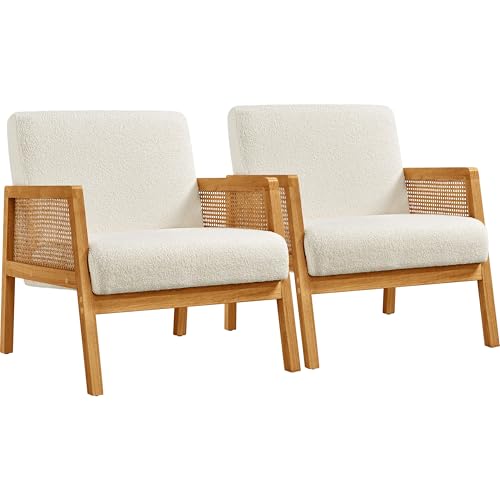
The Yaheetech pair leads with upholstery: boucle fabric armchairs in Ivory, with wood armrests and legs and rattan detailing in the design, sold as a set of two for living rooms, bedrooms, and reception-style spaces. Boucle is the most tactile of modern upholstery fabrics, and paired with wood and rattan accents it gives a soft, layered take on the mid-century palette. As a pair, they solve the two-matching-accent-chairs problem in one order, which anyone who has tried to buy two singles months apart, and met a dye-lot difference, will appreciate.
Strengths
- Matched pair in one purchase, boucle upholstery with wood and rattan accents
- Upholstered comfort for longer sits than a bare woven chair
- Ivory palette brightens rooms and layers with most mid-century woods
Trade-offs
- Rattan is an accent here, not the main structure; purists should choose the DUHOME or Furlide
- Boucle in ivory is the highest-maintenance upholstery in this guide
- Accent scale; not dining chairs
Key specs (from the verified listing): brand Yaheetech; boucle fabric upholstery; wood armrest and legs; rattan accent detailing; set of 2; Ivory.
We include the Yaheetech with its role stated plainly: it is the upholstered, rattan-accented end of this category, and for many living rooms that is the right end, because comfort and a matched pair matter more than woven purity. Place them facing a sofa or angled at a fireplace, and let the rattan details tie them to the era.
Best for: living rooms wanting a matched, comfortable pair with rattan accents. / Not suited for: rattan purists or dining use.
Check the current price on Amazon
Comparison Table
| Pick | Badge | Key spec | Best for |
|---|---|---|---|
| NoeBanJe Mid Century Accent Chair | Best True Mid-Century Accent | Curved back, rattan hollow-out panel | Accent and reading corners |
| JIRAIN Cantilever Dining Set of 4 | Best Dining Set | Rattan back, curved steel cantilever | Dining rooms |
| DUHOME Rattan Accent Chair | Best Modern Rattan Armchair | Natural rattan, solid wood legs | Modern rooms, sunrooms |
| SAFAVIEH Zane Club Chair | Best Fully Assembled | Woven rattan cotton, stated 275 lb | Reading nooks |
| Furlide Dining Chairs, Set of 2 | Best Handwoven Pair | Handwoven rattan, bamboo frame | Host chairs, pairs |
| Yaheetech Accent Chairs, Set of 2 | Best Upholstered Pair | Boucle, wood and rattan accents | Matched living-room pairs |
How to Choose a Mid Century Rattan Chair That Lasts
Decide first how much rattan you actually want. Woven cane and rattan panels (JIRAIN, DUHOME, Furlide) give the authentic texture, breathability, and lightness of the era, and they ask for reasonable care in return. Rattan-accented upholstered chairs (Yaheetech, and the NoeBanJe’s panel) give comfort and softness with a nod to the material. Neither is the “real” choice in the abstract; the real choice is the one matched to how the chair will be used. Dining chairs get dragged, bumped, and sat in daily, so frame construction and floor protection matter most there. Accent chairs get looked at as much as sat in, so silhouette and finish carry more weight.
Then inspect what the listing actually states. A stated capacity (the Safavieh’s 275 lb) is a sign of a maker willing to be specific; silence is not a disqualification but should lower your confidence for heavy daily use. Note whether the rattan is described as natural or left unspecified, and whether the frame is wood, bamboo, or steel, because those facts decide care and longevity more than the styling does. Check dimensions against your space and, for dining chairs, against your table: seat height near the standard dining range, arm height under the table apron if the chairs have arms, and width per place setting. Finally, plan the floor interface: cantilever and sled bases want felt or a rug beneath them on hard floors, and four-legged woven chairs want glides that keep the legs from wicking up moisture when floors are mopped.
How to Care for Rattan and Cane Chairs
Rattan and cane are durable indoors and fussy about exactly two things: moisture extremes and neglect. Dust woven panels regularly with a soft brush or the vacuum’s brush attachment, working with the weave, because ground-in dust is what dulls cane and makes it brittle over years. Keep the chairs out of prolonged direct sunlight, which dries and fades natural fibers, and away from heating vents for the same reason. If a woven panel starts to feel dry, a very light wipe with a barely damp cloth is the traditional remedy; soaking is never right, because cane that is repeatedly wetted and dried sags and cracks. Tighten frame fasteners seasonally, since wood and bamboo joints move with household humidity. Never stand on a cane seat, never use a woven panel as a step or a shelf, and teach children that the beautiful woven back is not a climbing surface. Treated this way, quality woven chairs serve for many years; the cane panels in mid-century originals have lasted half a century, which is the best evidence of what the material can do when it is kept dry, shaded, and dusted.
Common Buying Mistakes
The first mistake is assuming “rattan” in a title means a rattan chair; some listings use the word for a color or a printed pattern, which is why every pick here was verified against its product description. The second is buying dining chairs by the set without measuring width per place setting and arm clearance under the table apron. The third is putting natural woven chairs on a porch because they look like outdoor furniture; indoor rattan and weather do not mix unless the listing explicitly rates the chair for outdoor use, and none of these picks claims that. The fourth is leaning chairs back on two legs, which woven backs and cantilever frames alike punish. The fifth is skipping floor protection under steel bases. The sixth is expecting upholstered boucle in ivory to survive a household with toddlers and red wine without a care plan; choose the woven picks if your life is messier than your taste.
Final Recommendation
For the chair that matches this search most directly, buy the NoeBanJe. For a dining room transformation, buy the JIRAIN cantilever set. For natural materials with modern contrast, the DUHOME; for zero assembly and a specified build, the Safavieh Zane; for handwoven craft, the Furlide pair; for upholstered comfort as a matched pair, the Yaheetech. The desk-side of the same design era is covered in our companion guide to the Best Mid Century Modern Office Chairs, and wider seating options appear in Best Breakfast Chairs and Best Blue Bedroom Chairs.
A Short, Useful History of Cane in Modern Chairs
Cane webbing entered modern furniture through the bentwood cafes of the nineteenth century, where woven seats proved light, strong, and replaceable, and it never really left. The early modernists carried it into tubular steel: the cantilever chairs of the late 1920s paired chrome frames with cane seats and backs, creating the exact silhouette, curved steel below, woven panel above, that the JIRAIN set in this guide still follows. Mid-century designers then married cane to molded plywood and solid wood, using the woven panel to keep chairs visually light in the smaller postwar home, and that is the tradition the NoeBanJe’s curved back and rattan panel and the Furlide’s handwoven dining chairs descend from. The lesson for today’s shopper is not nostalgia; it is that cane and rattan have a century-long track record as structural, everyday materials when they are kept indoors and dry. When you buy a woven chair, you are buying into one of the most proven constructions in furniture, and the care section of this guide is simply the accumulated knowledge of that century, written down. If the price of the era’s look is your concern, our Best Chairs Around 100 coverage maps the friendlier tiers of the wider chair market.
Rattan Chairs Room by Room: Dining, Living, Bedroom, Sunroom
In the dining room, rattan’s virtues are practical: woven backs are breathable through long meals, the chairs are light enough to move for cleaning, and a matched set instantly gives the room a designed center. Choose by the table: cantilever sets like the JIRAIN for a modern table, handwoven pairs like the Furlide as host chairs with simpler sides, and always confirm arm clearance if the chairs have arms. In the living room, a single rattan chair is a texture instrument; it breaks up upholstery monotony, which is why the DUHOME’s contrast of pale rattan and black wood works so well against a fabric sofa, and why a matched upholstered pair like the Yaheetech should still carry its rattan accents visibly. In the bedroom, think bare feet and morning light: a club chair like the Safavieh Zane in a corner with a lamp becomes the room’s second destination, and woven materials keep the corner from feeling heavy in a room meant for rest. In the sunroom, rattan is at home visually, but respect the material limits from the care section: bright indirect light is fine, hours of direct sun and any rain exposure are not, and a sunroom that bakes in summer will dry natural fibers faster than any other room in the house, so rotate the chairs and keep them out of the window’s direct line. Across all four rooms, the same rule holds: rattan indoors, treated as furniture rather than decoration, gives decades of service; rattan treated as indestructible patio gear gives a season.
Natural vs Synthetic Woven Materials: Reading Between the Lines
Listings in this category use several material vocabularies, and reading them precisely protects you. “Natural rattan,” as the DUHOME states for its back and armrests, means the genuine vine material, with its warmth, slight irregularity, and indoor-only care needs. “Handwoven rattan,” as the Furlide states, adds the craft dimension: a person wove it, and small variations are evidence, not defects. “Woven rattan cotton,” the Safavieh Zane’s stated construction, describes a woven material in the rattan family of constructions; we report it exactly as the listing states it. Where a listing says only “rattan” without a qualifier, as with the JIRAIN’s rattan backs, the honest reading is that the product uses rattan as stated and the full material specification lives on the product page, which you should read before ordering, especially if the chair will sit in strong sunlight. Synthetic woven materials, often called PE rattan in outdoor furniture, are a different product for a different purpose; none of the picks in this guide is an outdoor PE-rattan chair, and this guide does not borrow outdoor listings to fill an indoor brief. The discipline is simple: buy the material the listing states, for the use the listing positions, and let the product page’s full specification confirm the details the title leaves out.
What to Verify on the Product Page Before Ordering a Rattan Chair
The reviews in this guide claim exactly what the verified titles support, which leaves a short, important checklist for your final visit to the product page of the exact chair you intend to order. Confirm the full dimensions, seat height above all for dining chairs, because a beautiful chair that sits an inch too low for your table will annoy you at every meal; confirm the stated weight capacity where published, and treat its absence as a reason to choose a chair that publishes one if the chair will carry heavy daily use; confirm the material specification in full, including whether woven elements are natural or synthetic and what the frame is made of, since titles compress these facts; confirm assembly requirements, which range from the Safavieh’s fully assembled delivery to flat-pack sets, and confirm whether cushions shown are included. For sets, confirm the count in the box and whether the price shown is for the set or per chair, the single most common source of checkout surprise in this category. Finally, check the return terms with the chair’s size in mind: returning one accent chair is simple, returning a set of four dining chairs is a project, and it is better priced into the decision beforehand. This diligence is not a lack of confidence in the six picks; it is the standard closing routine for furniture, applied with the specifics this category demands.
Pairing Rattan Chairs With Tables, Woods, and Rooms
Rattan chairs succeed or fail on their partnerships. With tables, the classic mid-century pairing is a simple walnut or teak-toned wood table, because the woven chair brings the texture and the table should bring the calm; a glass top is the modern alternative, letting the chairs’ forms show through, and the JIRAIN cantilever set was in fact verified in this program’s work alongside glass-table dining arrangements. Avoid pairing woven chairs with a heavily carved or rustic table, where two busy textures compete and both lose. With woods elsewhere in the room, aim for family resemblance rather than matches: rattan’s honey tones sit comfortably with walnut, oak, and pale ash, and the DUHOME’s black legs give you a bridge into rooms with black metal or dark accents. With upholstery, let the woven chair be the room’s one organic texture where possible; a boucle pair like the Yaheetech softens that rule by carrying rattan as an accent, which is precisely its design intent. With light, rattan rewards placement near windows without sitting in direct sun: the weave throws beautiful shadow patterns in indirect light, which is free decoration no other chair material provides. And with rugs, a low-pile or flat-weave rug under dining chairs lets bases slide and legs sit level, while a plush rug under an accent chair is pure comfort; match the floor layer to the chair’s job as carefully as the chair itself.
Rattan Chairs for Households With Children and Pets
Woven furniture and family life coexist well when the chair is matched to the household honestly. The virtues are real: rattan chairs are light enough that a child bumping one moves the chair rather than getting hurt by it, woven backs have no sharp corners, and the materials shrug off the casual contact that chips lacquered furniture. The cautions are equally real. Woven panels should not be climbed, stood on, or used as a ladder to the bookshelf, and that rule needs to be a household rule rather than a hope, because cane’s strength is in sitting loads, not point loads from small feet. Cat owners should know that woven textures can read as scratching invitations; placing a dedicated scratching post nearer the cat’s favorite route than the chair is, and choosing the upholstered Yaheetech or the smooth-panel designs for a cat-heavy room, prevents the conflict entirely. Dog households fare easiest of all: hair does not embed in cane the way it does in upholstery, and a brush attachment returns a woven chair to clean in a minute. For sticky fingers and spills, woven panels wipe down more forgivingly than boucle or chenille, which is one more reason the dining picks in this guide, JIRAIN and Furlide, suit family tables: the chairs at a family table should be the ones that can be cleaned at the speed of family life. Choose with the household you have, enforce the one climbing rule, and rattan will serve a family as faithfully as it serves a design magazine.
For households furnishing a nursery-adjacent space or a grandparent’s reading corner, the club-chair end of this guide deserves a second look: the Safavieh Zane’s stated capacity, assembled delivery, and stable club profile make it the chair least likely to tip, rock unexpectedly, or demand maintenance from its owner, and its woven construction keeps it light enough to move for cleaning behind. Stability, specification, and zero assembly are unglamorous virtues, and in family households they are the ones that matter at year three.
How Long Rattan Chairs Last, and What Renewal Looks Like
A quality indoor rattan chair is a long-lived piece of furniture, and its aging pattern is different from upholstered furniture’s, which is worth understanding before you buy. The frame, wood, bamboo, or steel in these picks, ages slowest and usually outlasts everything else. The woven elements age by environment rather than by use: kept dry, shaded, and dusted, cane and rattan panels remain sound for many years, as the survival of mid-century originals proves; kept in sun and damp, they dry, fade, and eventually crack, and no purchase price protects against a bad environment. Upholstered elements, the NoeBanJe’s seat and the Yaheetech’s boucle, age by contact and will show wear before the woven work does, which is the normal order of things and not a defect. Renewal follows the same order: a woven chair can be re-caned by a specialist when a panel finally fails, a service that exists in most cities precisely because these chairs are worth renewing; cushions can be re-covered; frames can be re-glued and re-tightened. That renewability is a genuine part of the mid-century value proposition, and it is why buying the better-made chair in this category, the stated materials, the handwoven work, the established brand, pays back across a longer horizon than the checkout difference suggests. Treat the chair as a maintainable object rather than a disposable one, and the set you buy for this year’s dining room can plausibly serve the next home’s as well.
Styling a Room Around a Rattan Chair: Three Compositions That Work
Because rattan chairs are texture-forward, they reward deliberate composition and punish accidental placement, so here are three room compositions built from this guide’s picks that reliably work. The first is the reading corner: a Safavieh Zane or NoeBanJe angled at forty-five degrees to the room’s corner, a small round side table at elbow height, a floor lamp arcing from behind the chair’s shoulder, and a low-pile rug defining the territory. The angle is the trick; a chair squared to the wall looks stored, while the same chair angled looks inhabited, and the lamp’s position means the light falls on the page rather than in the reader’s eyes. The second composition is the dining set with a center of gravity: the JIRAIN cantilevers around a plain wood table, a pendant light centered over the table’s middle rather than the room’s, and nothing else in the room competing in woven texture, so the chairs’ cane backs become the room’s single pattern. The third is the conversation pair: two Yaheetech or Furlide chairs facing a sofa across a low table, or facing each other across a small one, with a shared textile, a throw or cushions in one of the room’s existing tones, tying them to the scheme. In each composition the rattan chair is doing the job this category does best: supplying the organic, hand-worked note that keeps modern rooms from feeling machined. Compose first on paper, measure the footprints, and only then order, because rattan’s lightness makes it tempting to buy on impulse and place on hope, and hope is not a floor plan.
A Note on Colors, Counts, and Variant Listings
Several chairs in this guide are listed in more than one color or configuration, and the picks here are no exception: finishes and upholstery colors vary across each listing’s options. The reviews describe the verified variant, named in each heading and spec box, and other variants of the same chair are reasonable choices when you confirm two things on the product page: that the construction and materials match the reviewed variant, since some listings change materials between colors, and that the count in the box matches your plan, especially for the sets, where a pair and a set of four can share one listing page. When the variant details are ambiguous, the verified configuration is the safe purchase, and it is the one this guide’s badges and verdicts were written about.
Whichever chair you choose, place it with the intention its design deserves: measured against its table or its corner, protected at the floor, and kept in the dry, shaded indoor life these materials are built for. Do that, and a rattan chair stops being a purchase and becomes what it has been in homes for a century, a piece of furniture so easy to live with that it quietly outlasts the trends that surrounded its arrival. That longevity, more than any single style claim, is the real mid-century inheritance, and it is available at every tier in this guide to any buyer willing to measure first and care lightly.
Measure the space, choose the chair whose verified construction matches the job, and let the weave do what it has done for a hundred years: make a room feel made by hands, for people, one ordinary day at a time, in the corner where the light is good and the book is waiting.
That is the standard to buy by, and every chair in this guide was chosen because it can meet it in the right room, at the right scale, for the right household.
Buy it once, place it well, and enjoy it daily.
Frequently Asked Questions
Is rattan the same as cane and wicker?
Not exactly. Rattan is the vine material itself, used as poles and frames; cane is the woven skin of the rattan vine, used for the classic webbing panels; wicker is a weaving technique that can use rattan, cane, or synthetics. Listings use the words loosely, which is why this guide reports each chair’s stated construction individually.
Can rattan chairs be used outdoors?
Only if the specific listing rates them for outdoor use. The picks in this guide are indoor chairs; natural rattan and cane degrade in rain and strong sun. Keep them inside, or on a covered, dry porch at most, and bring them in for winter.
How much weight can a rattan chair hold?
It varies by construction, which is why stated figures matter. The Safavieh Zane in this guide states 275 lb. Where a listing does not state a capacity, do not assume one; check the product page’s full specification or choose a chair that publishes its figure.
Why is the cantilever design considered mid-century?
The cantilever, a chair carried on a continuous curved frame without rear legs, was a landmark of early modern furniture design, and its cane-backed versions became dining-room icons carried through the mid-century period. The JIRAIN set in this guide follows that exact form: rattan back, curved steel base.
How do I stop a cane or rattan panel from sagging?
Keep it dry, shaded, and unloaded: no standing, sitting on backs, or storing heavy objects against panels. Dust regularly so fibers stay supple, and avoid repeated wetting. A panel that has already sagged from moisture damage is a repair-shop job, not a home fix.
Are rattan dining chairs practical for everyday family use?
Yes, with the right expectations. Woven backs are breathable and comfortable, frames are light to move for cleaning, and the JIRAIN’s steel cantilever base is built for daily sliding. Protect hard floors under metal bases, keep the chairs indoors, and they will handle family duty well.


