Disclosure: airfryerkitchensupply.com is reader-supported. When you buy through links on our site, we may earn an affiliate commission at no extra cost to you.
Where to buy
All six of the best mid century modern office chairs below are sold on Amazon, and each was confirmed in Amazon’s catalog data with a listing that explicitly presents it as a mid-century modern office or desk chair. If you want the most complete package of arms, lumbar support, and leather upholstery, start with the Furniliving Leather Office Chair. If you want the authentic bentwood silhouette the style is famous for, start with the VINGLI Mid Century Walnut Bentwood Swivel Chair. Prices are never printed in this guide because they change constantly; use the links to check the current price on the color you want.
The mid-century office chair problem: style first, but you still have to sit in it
Shopping for the best mid century modern office chairs means negotiating between two legitimate demands. The first is the look: walnut-toned wood, bentwood shells, tapered forms, channel or diamond stitching, and the warm, low-slung silhouette that defined postwar design and still anchors home offices that double as living spaces. The second is the reality that an office chair is sat in for six to ten hours a day, and a chair that only photographs well becomes an expensive sculpture you avoid. The good news is that the current generation of mid-century-styled desk chairs has largely solved the old trade-off by putting modern hardware — gas-lift height adjustment, swivel bases, casters, tilt — underneath period-correct shapes. The six picks below were chosen at that intersection: every one is verified in Amazon’s catalog as a mid-century modern desk or office chair, and they are separated by the things that actually differ between them, upholstery, arms, wood treatment, and budget tier.
One framing note before the picks. True vintage mid-century office chairs and licensed design classics exist in a completely different price universe and are not sold as ordinary Amazon listings; what this guide covers is the modern production market, chairs designed in the mid-century language for today’s home offices. Within that honest scope, there is real quality variation, and the reviews below are specific about where each chair spends its money and where it saves.
In this guide
Quick Picks
- Best Overall — Furniliving Leather Office Chair: leather upholstery, arms, and stated lumbar support in a mid-back mid-century profile, the most complete feature set in this roundup. Check the current price on Amazon
- Best Bentwood Silhouette — VINGLI Mid Century Walnut Bentwood Swivel Chair: the classic walnut bentwood shell with chenille upholstery and fixed arms, in Olive Green on this listing. Check the current price on Amazon
- Best Premium Build — HULALA HOME Solid Wood Office Chair: a solid wood and bentwood frame with tilt function and a metal base, for buyers who want materials first. Check the current price on Amazon
- Best Armless Walnut — BERYTH Home Office Chair, Walnut Style: an armless mid-back chair in black PU leather with a walnut-style finish and a stated 300 lb capacity. Check the current price on Amazon
- Best Stitched Faux Leather — FIDOM Ergonomic Armless Office Desk Chair: black faux leather with diamond stitching and a walnut accent, armless and height-adjustable. Check the current price on Amazon
- Best Budget — COMHOMA Home Office Desk Chair: a chenille-upholstered mid-century modern chair with a curved backrest and wheels, at the friendliest tier in this guide. Check the current price on Amazon
How These Picks Were Chosen
The first filter was stylistic honesty: the listing itself had to present the chair as mid-century modern, and the design had to show the language, walnut tones, bentwood, period stitching, or the low mid-back profile, rather than being a generic mesh task chair with a retro keyword attached. Several high-volume generic chairs were excluded on that basis. The second filter was office function: every pick is a swivel desk chair with height adjustment and casters (the listings state these features), because a dining chair with a vintage look is not an office chair however pretty it is. The third filter was spread: with arms and armless, leather, faux leather, and chenille, bentwood shells and upholstered frames, and budget through premium tiers, so the six slots answer different buyers rather than repeating one chair six times.
Specification discipline applies as always in this program. Claims in the reviews are drawn from the verified listing titles: where a listing states a capacity (the BERYTH’s 300 lb figure) or a material (the HULALA’s solid wood), it is reported as stated; where a listing does not state a detail, this guide does not invent it, and you should confirm the full specification on the product page before ordering. No prices and no fixed ratings appear anywhere in this guide.
The 6 Best Mid Century Modern Office Chairs

Furniliving Leather Office Chair — Best Overall
The Furniliving is the chair we would point to first because it checks the boxes the others trade away: leather upholstery, arms, stated lumbar support, a mid-back adjustable swivel design, and wheels, all inside a mid-century modern profile in Brown on this listing. For a full-time home office, that combination matters. Arms change how a chair feels across an eight-hour day, lumbar support is the feature budget retro chairs most often skip, and leather is the upholstery that ages most gracefully in this style.
Strengths
- Most complete feature set here: arms, lumbar support, swivel, height adjustment, wheels
- Leather upholstery suits the mid-century language and wears in rather than wearing out
- Mid-back profile keeps the period silhouette without a gamer-chair bulk
Trade-offs
- Leather needs basic care and is warmer to sit on than fabric in summer
- Mid-back means no headrest; tall users who lean back to think should note that
- Sits above the budget tier
Key specs (from the verified listing): brand Furniliving; leather upholstery; lumbar support stated; mid-back; adjustable swivel; wheels and arms; Brown on this listing.
Choose the Furniliving if your home office is a real workplace that also has to look like a designed room when the laptop closes. It is the least compromised chair in this guide, and in a category where most models sacrifice one feature for the silhouette, that completeness is the story.
Best for: full-time home workers who want arms, lumbar support, and leather in a mid-century profile. / Not suited for: buyers who need a headrest or the lowest possible price.
Check the current price on Amazon

VINGLI Mid Century Walnut Bentwood Swivel Chair — Best Bentwood Silhouette
If one material defines mid-century furniture, it is bentwood, plywood molded into curves that solid wood cannot achieve, and the VINGLI is built around exactly that: a walnut bentwood shell with chenille upholstery, a fixed arm, height adjustment, and rolling casters, in Olive Green on this listing. It is the chair in this roundup that a design-literate guest will identify as mid-century from across the room.
Strengths
- Authentic bentwood shell in walnut, the signature construction of the era
- Chenille upholstery is soft, breathable, and quieter than leather in warm rooms
- Fixed arms integrated into the silhouette rather than bolted on as an afterthought
Trade-offs
- Fixed arms do not adjust and will not suit every desk height or body
- Chenille shows wear paths sooner than leather under daily full-time use
- The listing describes the chair across office and bedroom use; it is a lighter-duty proposition than the Furniliving
Key specs (from the verified listing): brand VINGLI; walnut bentwood shell; chenille upholstery; fixed arm; adjustable height; rolling casters; Olive Green on this listing.
The VINGLI is the style-led pick, and it knows it. Buy it for a home office that is also a reading room, a bedroom desk, or any space where the chair is part of the room’s composition. If your day is ten hours of spreadsheets, the Furniliving’s support set is the wiser spend; if your day mixes work, calls, and a room you love looking at, the bentwood shell earns its place.
Best for: design-led home offices and mixed-use rooms wanting the true bentwood look. / Not suited for: users who need adjustable arms or maximum daily support features.
Check the current price on Amazon

HULALA HOME Solid Wood Office Chair — Best Premium Build
The HULALA HOME entry distinguishes itself with materials: a solid wood and bentwood frame, a tilt function, a metal base, 360-degree swivel, and height adjustment, upholstered in fabric in Green on this listing. In a category full of engineered shells and plastic understructures wearing a walnut photograph, a listing that states solid wood is making a claim worth rewarding, and the tilt function adds the recline that the other retro chairs here mostly lack.
Strengths
- Solid wood frame stated in the listing, the premium material story in this roundup
- Tilt function for leaning back, rare among mid-century-styled chairs
- Metal base and full swivel/height hardware for daily office use
Trade-offs
- Premium tier pricing, the top of this guide
- Fabric upholstery needs more spill care than leather or PU
- Wood tones vary; the delivered shade may differ slightly from listing photos
Key specs (from the verified listing): brand HULALA HOME; solid wood with bentwood frame; tilt function; metal base; 360° swivel; height adjustable; fabric upholstery; Green on this listing.
This is the buy-it-for-years pick. Solid wood can be refinished, fabric can be cleaned or eventually re-covered, and the metal base is the component most likely to outlast the upholstery. If your instinct is to buy once and maintain, rather than replace a budget chair every few years, the HULALA is where this guide points you.
Best for: buyers prioritizing materials and longevity, who want tilt in a mid-century chair. / Not suited for: budget shoppers or anyone wanting leather.
Check the current price on Amazon
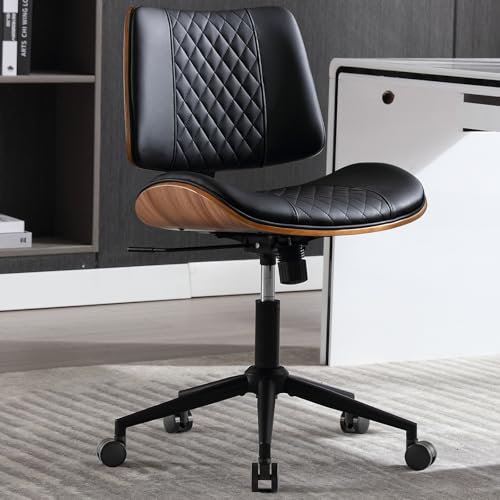
BERYTH Home Office Chair, Walnut Style — Best Armless Walnut
The BERYTH is the compact, armless answer: a mid-back chair in black PU leather with a walnut-style finish, height adjustment, 360-degree swivel, and a stated capacity of 300 lb, which is the highest figure stated by any listing in this roundup and worth noting for larger users whom retro chairs often underserve. Armless is a feature, not an omission, for desks with low clearance, for musicians and makers who need their arms free, and for small rooms where chair arms dictate the layout.
Strengths
- Stated 300 lb capacity, the strongest figure in this guide
- Armless profile slides fully under desks and suits compact rooms
- Walnut-style finish delivers the mid-century cue at a mid-tier position
Trade-offs
- PU leather is not genuine leather; expect a shorter upholstery life than the Furniliving
- No arms means no arm support during long calls or reading
- Walnut “style” is a finish, not solid walnut; the HULALA is the real-wood pick
Key specs (from the verified listing): brand BERYTH; PU leather upholstery; walnut-style finish; armless; mid-back; adjustable height; 360 swivel; stated capacity 300 lb.
We flag the finish honestly because this guide’s credibility depends on it: the BERYTH gives you the look and a sturdy stated capacity at a mid-tier price, and that is a fair trade as long as you know the walnut is a finish. For a guest-room desk, a teen’s study space, or a compact apartment office, it is a smart, space-disciplined buy.
Best for: compact offices, armless-preference users, and larger users wanting a stated higher capacity. / Not suited for: buyers wanting genuine leather or solid wood.
Check the current price on Amazon

FIDOM Ergonomic Armless Office Desk Chair — Best Stitched Faux Leather
The FIDOM’s signature is its diamond-stitched black faux leather, a period detail borrowed from classic upholstery, set against a walnut accent that warms the black. It is armless, height-adjustable, and built as a swivel rolling task chair, aimed at study and home-office use. The stitching is not decoration for its own sake: quilted upholstery holds its padding distribution better than a smooth skin, which helps the seat feel consistent across months of use.
Strengths
- Diamond stitch detailing is authentically period and helps padding stay distributed
- Walnut accent keeps the black upholstery from reading as generic office furniture
- Armless, compact task format suits studies and smaller desks
Trade-offs
- Faux leather will not age like genuine leather and can peel years sooner if abused
- No arms and no stated lumbar feature; a lighter support package than the Furniliving
- Black shows dust and lint readily
Key specs (from the verified listing): brand FIDOM; faux leather with diamond stitch; walnut accent; armless; adjustable height; swivel rolling task chair.
Choose the FIDOM when the desk is as much a styling exercise as a workplace: a study corner, a writing desk, a bedroom workspace that must look intentional in photographs and in person. It is the fashion-forward pick of the six, priced in the accessible middle, and honest about being faux leather rather than pretending otherwise.
Best for: style-led studies and compact desks wanting stitched upholstery detail. / Not suited for: full-time users needing arms and lumbar features.
Check the current price on Amazon

COMHOMA Home Office Desk Chair — Best Budget
The COMHOMA brings the mid-century modern brief in at the budget tier: an ergonomically curved backrest, chenille upholstery, wheels, and a design the listing itself frames for home office and vanity use, in Green on this listing. Budget retro chairs usually fail by looking like costumes; the COMHOMA’s curved back and fabric finish keep it credible as furniture, and chenille is a genuinely pleasant upholstery to sit on in both warm and cool rooms.
Strengths
- Lowest tier in this guide while keeping the mid-century silhouette
- Chenille upholstery is soft, breathable, and forgiving of casual use
- Curved backrest gives more shape than flat budget chair backs
Trade-offs
- Budget construction throughout; not the ten-year chair the HULALA aims to be
- Lighter support package, suited to part-time and mixed use more than ten-hour days
- Fabric needs prompt spill attention
Key specs (from the verified listing): brand COMHOMA; chenille upholstery; curved backrest; wheels; mid-century modern vanity/office positioning; Green on this listing.
The COMHOMA is the right chair for the spare room that became an office, the student desk, and the renter who wants the look without the investment. It is also the sensible way to test whether the mid-century silhouette suits your room before committing to the premium builds above it in this guide.
Best for: budget shoppers, part-time desks, and first mid-century purchases. / Not suited for: full-time heavy daily use over many years.
Check the current price on Amazon
Comparison Table
| Pick | Badge | Key spec | Best for |
|---|---|---|---|
| Furniliving Leather Office Chair | Best Overall | Leather, arms, lumbar support stated | Full-time home office |
| VINGLI Walnut Bentwood Chair | Best Bentwood Silhouette | Bentwood shell, chenille, fixed arms | Design-led rooms |
| HULALA HOME Solid Wood Chair | Best Premium Build | Solid wood, tilt, metal base | Buy-once longevity |
| BERYTH Walnut Style Chair | Best Armless Walnut | PU leather, stated 300 lb capacity | Compact desks, larger users |
| FIDOM Diamond Stitch Chair | Best Stitched Faux Leather | Quilted faux leather, walnut accent | Style-led studies |
| COMHOMA Desk Chair | Best Budget | Chenille, curved back, wheels | Budget and part-time desks |
How to Choose a Mid Century Modern Office Chair You Can Work In
Start with your hours. Under three hours a day, almost any chair in this guide will serve, and you can let style lead. Over six hours, the support features must lead: arms you can rest on, a back shape that meets your lumbar curve, and a seat you do not slide around on, which is why the Furniliving tops this guide. Next, measure the desk, not the room. Chair arms must clear the desk’s underside or the chair will live pushed back at an angle that ruins your posture; if clearance is tight, the armless BERYTH and FIDOM exist precisely for you. Check the desk height against the chair’s adjustable range on the product page, and remember that a chair mat or rug changes effective heights slightly.
Then choose upholstery by climate and household. Leather and PU wipe clean and suit homes with children, pets, and coffee; leather ages better and costs more, PU is the honest budget substitute and should be bought with a shorter expected life in mind. Chenille and fabric breathe better in warm rooms and feel cozier in cold ones, at the cost of spill care. Finally, interrogate the wood claim. “Solid wood” (HULALA) is a material; “walnut style” or “walnut finish” (BERYTH) is a surface; “bentwood” (VINGLI) is a construction of molded plywood that is authentic to the era and strong for its weight. None of these is a scam when labeled honestly, and this guide labels them; just pay solid-wood prices only for solid wood.
How to Set Up a Mid Century Desk Chair for All-Day Comfort
Assembly and adjustment decide whether a good chair feels good. Assemble on a soft surface to protect the wood finishes, tighten fasteners in a cross pattern, and re-check them after the first week, because new chairs settle. Set seat height so your feet rest flat and your thighs are roughly level, with the desk’s edge near elbow height when your arms hang relaxed. If the chair has arms, set your working position so the arms support your forearms without lifting your shoulders; if it is armless, bring the chair close enough that the desk itself supports your arms. Position the monitor so the top of the screen is near eye level, which usually means a stand or a stack of books under it, because no chair can fix a screen that is six inches too low. On hard floors, confirm the casters roll without marking; on carpet, consider a chair mat so the swivel base is not fighting pile all day. Then give the setup a week before judging: your body adapts to a new chair’s geometry, and day-one impressions, good or bad, are unreliable.
Common Buying Mistakes
The first mistake is buying the photograph: a chair styled in a sunlit loft with no desk in sight, chosen without checking arm clearance, seat height range, or support features. The second is paying genuine-materials prices for finishes; read whether the listing says solid wood, bentwood, or walnut style, and price accordingly. The third is choosing a vanity-weight chair for a full-time job; if the listing frames the chair for bedroom and vanity use, believe it and match it to part-time duty. The fourth is ignoring capacity figures when they are stated, or assuming them when they are not. The fifth is forgetting the floor: hard casters on soft wood floors, or any casters on deep carpet without a mat, will annoy you daily. The sixth is skipping the re-tightening step after assembly week, then blaming the chair for a wobble that a wrench would have fixed.
Final Recommendation
Most full-time home workers should buy the Furniliving for its complete support set. Design purists should buy the VINGLI bentwood, and buy-once shoppers the HULALA solid wood. Compact and armless needs split between the BERYTH (capacity, walnut finish) and the FIDOM (stitched detail), and the budget belongs to the COMHOMA. If your taste runs to natural woven materials at the desk, our companion guide to the Best Mid Century Modern Rattan Chairs covers the cane-and-rattan side of the same era, and for the wider seating landscape see Best Chairs Affordable and Best Breakfast Chairs.
The Mid-Century Design Language, Decoded for Chair Shoppers
Knowing the vocabulary helps you see past listing photography. Bentwood, the VINGLI’s construction, is plywood steamed or pressed into curves, the technique that let postwar designers make shells that cradle the back instead of merely propping it. Walnut became the era’s signature wood tone because it is warm without being orange, and modern listings reproduce it three ways: real walnut or other solid wood (the HULALA’s stated solid wood frame), molded plywood with a walnut veneer, and printed or stained finishes (the BERYTH’s honestly labeled walnut style). Channel stitching and diamond quilting, the FIDOM’s detail, come from the era’s upholstery, where tufting and stitching were how a plain material gained architecture. The low, wide mid-back profile shared by all six picks is itself a period marker: mid-century chairs were designed for rooms, not cubicles, so they stay below the sightline of a sofa and read as furniture. When a listing’s chair shows a tall mesh back, a headrest tower, and racing stripes, it may be a fine chair, but it is not speaking this language, and it will not give a room the effect you searched for. Judge listings by these elements, wood honesty, stitch detail, profile height, and you will sort the category faster than any filter sidebar. For the floor under the chair, our guide to the Best Carpet For Under Desk Chairs covers the pairing that protects both the chair’s casters and your flooring.
Matching the Chair to the Worker: Four Common Scenarios
The full-time remote worker should buy support first and silhouette second, which in this guide means the Furniliving, or the HULALA if tilt matters to your afternoons. Set the chair up as the setup section describes and judge it after a week of real days, not an evening. The hybrid worker, two or three desk days a week, can let style lead further: the VINGLI’s bentwood or the FIDOM’s stitching will carry those hours comfortably and earn their keep as room furniture on the other days. The compact-apartment worker is solving a geometry problem before a comfort one: armless chairs that slide fully under the desk, the BERYTH or FIDOM, return floor space to the room every evening, and that daily reclaiming is worth more than an armrest. The shared-desk household, two people, one chair, should prioritize the widest adjustment ranges and the sturdiest stated construction, and should re-set the chair’s height each time rather than compromising on one setting that fits nobody; in this guide that points again to the Furniliving or HULALA. Notice that three of four scenarios converge on the top of the range: office chairs are among the most-used objects in a home, and the cost-per-hour math of a better chair is kinder than it looks at checkout.
Assembly and Long-Term Care, by Material
Most chairs in this category arrive flat-packed, and the first hour decides years of behavior. Lay parts out, confirm every fastener against the instructions before tightening anything, and assemble on carpet or a blanket to protect walnut finishes. Tighten in stages, snug everything first, then fully tighten in a cross pattern, and re-check all fasteners after the first week and again after the first month; a chair that develops a wobble at month two is almost always a fastener story, not a frame story. For care: leather wants a dry or barely damp cloth and distance from radiators, which dry it to cracking; PU and faux leather want the same gentle wiping and no solvents, which attack the surface; chenille and fabric want vacuuming with an upholstery tool and immediate blotting of spills, with any cleaning product tested on a hidden patch first. Wood frames and bentwood shells should be dusted dry and kept out of prolonged direct sun, which fades walnut tones unevenly, one side of the chair at a time. Casters deserve a quarterly clean, because hair and grit wound around the axles are the hidden cause of chairs that stop rolling smoothly and start marking floors. None of this is specialized; it is the ordinary maintenance that separates a chair that looks designed at year five from one that looks tired at year two.
Ergonomics Without the Ugly: Fitting a Retro Chair to a Real Body
The fear that a stylish chair cannot be ergonomic is outdated, but it contains a kernel of truth worth managing: mid-century chairs offer fewer adjustment levers than a modern ergonomic chair, so the adjustments you do have must be set deliberately. Work through the fit in order. Seat height first, as the setup section described, because it anchors everything else. Seat depth second: you should be able to sit with your back against the chair’s back and a small gap, roughly two or three fingers, between the seat edge and the back of your knees; a chair that is too deep will push you into a slouch no backrest can fix, and a cushion behind the lumbar is the honest field remedy. Back angle third: mid-century mid-backs support the shoulder blades’ lower half, which suits upright task work and encourages the posture changes that matter more than any single perfect position. Arms fourth, where fitted: they should meet your forearms with your shoulders down and relaxed, and if fixed arms fight your desk height, a desk riser or a different chair from this guide’s armless pair is the correct answer, not a hunched compromise. Finally, movement: the healthiest feature of any of these chairs is the swivel and the casters, because the evidence-informed advice for desk workers is to change position often, stand between tasks, and let the chair support a working posture rather than freeze one. A retro chair set up with this much care will serve a full-time worker well; a top-tier ergonomic chair left at factory settings will not, which is the real lesson the style-versus-comfort debate keeps missing.
What to Verify on the Product Page Before Ordering
This guide verified each chair’s identity, style, and stated headline features from catalog data, and it deliberately did not print specifications the titles leave out. Your final check, two minutes on the product page of the exact chair and color you are ordering, should confirm: the full dimension set, especially seat height range and seat depth, against your body and desk; the stated weight capacity, which only some listings publish, the BERYTH’s 300 lb figure being the example in this guide; the caster type and whether it suits your floor; the assembly requirement and whether arms are fixed, adjustable, or absent, in case the listing’s photos show a different variant; and the return terms, because a chair is a body-fit purchase and even a well-chosen one deserves an exit if your particular frame disagrees with it. Check also that the colorway in your cart matches the one reviewed, since several picks here are listed in a specific color, green chenille, olive bentwood, chestnut-toned browns, and other colors in the same listing may carry different upholstery or pricing. None of this diligence is a warning against these six chairs; it is the standard closing routine for furniture bought online, and it is what separates the buyers who love their chairs at month six from the ones writing frustrated reviews about a number they never checked.
Mid-Century Office Chairs in Small and Shared Spaces
Two living situations deserve their own advice because they dominate modern home working. The first is the studio or one-bedroom where the office is also the living room and the bedroom. There, the chair is never off duty visually, which argues for the picks whose design holds up from every angle: the VINGLI’s bentwood shell looks finished from behind, where many chairs show their worst side to the room, and the armless BERYTH and FIDOM disappear under the desk at night, returning the room to living. A chair mat in a clear or low-contrast finish protects the floor without drawing a rectangle of office across the space, and choosing the chair in a tone that already exists in the room’s palette, olive, walnut, black, makes the workstation read as furniture that belongs rather than equipment that landed. The second situation is the shared family desk, homework by evening, work by day, two or three users of different sizes. There, durability and fast adjustment outrank everything: the chair will be raised, lowered, spun, and occasionally ridden, and the honest picks are the sturdier builds in this guide, with fasteners re-checked more often than the care section’s schedule, because shared chairs live harder lives. Set a household rule that whoever finishes resets the chair to a neutral height, and the next user starts from a known position instead of yesterday’s compromise.
Both situations share one more consideration: noise. Casters on hard floors, swivel squeaks, and the scrape of a chair pushed back are amplified in small and shared homes, and they are manageable. Felt or soft-wheel casters, where the product page offers them, quiet the rolling; a rug or mat under the workstation absorbs the rest; and the quarterly caster cleaning from the care section prevents the gritty grinding that develops when wheels are neglected. A mid-century chair’s promise is that work furniture can be beautiful; keeping it quiet is how that promise survives in a real apartment.
How Long Should a Mid-Century Office Chair Last, and What Fails First
Setting lifespan expectations honestly helps you price the tiers in this guide. On a well-built chair used full-time, the usual order of aging is: casters and the gas lift first, because they are the moving, load-cycling parts; upholstery second, with PU and faux leather showing surface wear years before genuine leather or a quality chenille gives up; fasteners loosening throughout, which is maintenance rather than failure; and the frame last, which is why the HULALA’s stated solid wood and the VINGLI’s bentwood shell are long-game purchases, since a sound frame can outlive two rounds of upholstery and hardware. Budget chairs compress that timeline: the COMHOMA is a fair purchase for part-time duty measured in a few good years, and it becomes an unfair one only when asked to be a decade of full-time service. Two habits extend every tier’s life disproportionately: re-tightening fasteners on schedule, and keeping the chair out of the two environments that age furniture fastest, direct sun and radiator heat, which fade walnut, dry leather, and embrittle plastics alike. When a chair does reach the end, judge it by the frame: a chair with a sound frame and tired upholstery is a re-covering candidate, not rubbish, and mid-century designs, built around separable shells and pads, are often easier to refresh than the sealed construction of cheap modern chairs. Buy the tier that matches your intended years, maintain the moving parts, and the chair you chose for its looks will still be earning its place when the trend cycle has moved on twice.
A Final Walk Around the Six Chairs: Which One Is on Your Floor in a Year
Imagine each chair a year from now, in a real room, with real habits formed around it, because that is the purchase you are actually making. The Furniliving, a year in, is the chair nobody thinks about anymore, which is the highest praise office furniture earns: its leather has taken a soft sheen where hands and backs meet it, its arms are where your arms expect them, and it has quietly become the room’s default seat for work, calls, and the occasional evening read. The VINGLI, a year in, is still the chair guests ask about, its bentwood shell catching the light the way it did on day one, and its owner has learned its fixed arms’ geometry so completely that the desk, the chair, and the body have negotiated a permanent peace. The HULALA, a year in, feels less like a purchase and more like a possession: the solid wood has the beginnings of the patina that makes owners sentimental, the tilt has become a thinking ritual at four in the afternoon, and the chair has already outlasted the cheap chair it replaced in the owner’s previous home, which is the entire argument for its tier.
The BERYTH, a year in, has justified itself in square footage: it slides under the desk every night, the room breathes, and its stated capacity has been a non-event, which is what capacity should be. The FIDOM, a year in, still photographs like a design decision, its diamond stitching holding the upholstery’s shape in a way smooth budget chairs do not, and it has made a study corner feel intentional out of all proportion to its price. The COMHOMA, a year in, has done exactly what it promised: given a spare room a real desk chair with a real silhouette at a friendly tier, hosted a year of part-time work and homework, and asked for nothing but an occasional tightening and a prompt blot when coffee happened. None of these futures requires luck. Each follows from matching the chair to the hours, the room, and the body using the checks in this guide, and then doing the small maintenance that furniture has always asked in exchange for years of service. That is the whole method: verify the product, fit it honestly, maintain it lightly, and let a well-chosen chair disappear into a well-run working life.
A Note on Color and Finish Across the Six Picks
Several picks in this guide are listed in specific colorways, the COMHOMA and HULALA in green, the VINGLI in olive green chenille over walnut, the Furniliving in brown leather, the BERYTH and FIDOM in black, and those colors are part of why each chair was chosen: green and walnut are the current mid-century palette at its most livable, brown leather is the classic, and black with walnut accents is the graphic option. Most of these listings offer other colors, and you are free to choose them, but verify two things when you stray from the reviewed variant: that the upholstery material stays the same, since some listings swap fabric types between colors, and that the price tier you saw discussed here still applies, since colors are priced independently. When in doubt, the reviewed colorway is the one whose exact listing this guide verified, and it is rarely a mistake to buy the version of a product that was actually checked.
One last practical thought applies to every chair in this guide equally: buy the chair for the desk and the body you have this year, not for the office you plan to renovate someday. A chair that fits today’s desk height, today’s floor, and today’s working hours will be loved daily, while a chair bought for a hypothetical future room tends to be wrong twice, once now and once when the future arrives in a different shape from the plan. The six chairs above were verified, compared, and fitted against present-tense questions for exactly that reason, and whichever one you choose, set it up on the day it arrives, run the one-week judgment this guide describes, and then let it get on with the unglamorous, essential work of holding you up while you do yours.
Frequently Asked Questions
Are mid century modern office chairs comfortable for full-time work?
The modern production ones in this guide can be, provided you choose by support features rather than silhouette alone. For full-time use, prioritize arms, a shaped back, and the support claims the listing actually states, as with the Furniliving; reserve the lighter vanity-style chairs for part-time desks.
What is the difference between bentwood, solid wood, and walnut finish?
Bentwood is molded plywood, the era’s signature construction, strong and light. Solid wood is exactly that, the premium material. A walnut finish or walnut style is a surface treatment that delivers the look at a lower tier. All three are legitimate when labeled honestly; they should not be priced the same.
Should I choose an armless mid-century chair?
Choose armless if your desk has low underside clearance, if you play an instrument or work with your hands at the desk, or if the room is small. Choose arms if you take long calls, read at the desk, or work full days, since arm support meaningfully reduces shoulder fatigue.
Leather, faux leather, or fabric for a retro office chair?
Genuine leather lasts longest and ages best but costs most and feels warm in summer. Faux leather and PU give the look and easy cleaning at mid tiers with a shorter expected life. Chenille and fabric breathe best and feel coziest, with more spill care required.
How do I know a “mid-century” listing is really in that style?
Look for the design vocabulary in the chair itself: walnut tones, bentwood or tapered forms, a low mid-back profile, and period upholstery details like channel or diamond stitching. Every pick in this guide was verified as a mid-century modern listing; a generic mesh task chair with a retro keyword is not the same thing.
Do these chairs need a chair mat?
On carpet, usually yes, so the casters roll freely and the base does not strain. On hard floors, a mat is optional and depends on the floor’s softness and the caster type; check the product page for the caster description and test-roll in your own space during the return window.


