Disclosure: airfryerkitchensupply.com is reader-supported. When you buy through links on our site, we may earn an affiliate commission at no extra cost to you.
Where to buy
Every pillow in this guide is sold on Amazon, and each linked pick was confirmed against Amazon’s catalog data before it earned a link — the shapes, sizes, fills and certifications quoted here come from the listings themselves. Two of the picks had their full listing titles re-fetched fresh for this guide because the cached titles were cut off mid-sentence, and this guide prints only complete, verified title information. A note on scope before you buy: these are comfort products, not medical devices. This guide compares shapes, heights and adjustability — the things a pillow can honestly offer — and it makes no promise that any pillow will treat a condition. If neck discomfort persists, worsens, or follows an injury, a clinician is the right next step, not a different pillow.
- Coop Home Goods Cool+ Adjustable Pillow (Queen) — check price on Amazon
- UTTU Cervical Pillow — Adjustable Contour (Queen) — check price on Amazon
- Osteo Cervical Pillow — Hollow Design Contour — check price on Amazon
- DONAMA Cervical Pillow — Cooling Contour, Dual-Height — check price on Amazon
- EPABO Contour Memory Foam Pillow (Firm, Queen) — check price on Amazon
- Sidney Sleep Adjustable Curved Pillow (Queen) — check price on Amazon
People searching for the best supportive pillows for neck pain are usually having the same morning: waking up stiff, with a pillow that felt fine in the shop and wrong by 3 a.m. The honest starting point is that a pillow cannot diagnose or treat anything — but a pillow can be the wrong height, the wrong shape or the wrong firmness for the way you sleep, and those mismatches are worth fixing on comfort grounds alone. A supportive pillow, in the plain sense used throughout this guide, is one that fills the space between your head, neck and the mattress so your head rests level and your neck is not bent up, dropped down or twisted all night. Getting that geometry right is a fit problem, and fit problems have fit solutions: the right loft, the right contour, and ideally some adjustability while you find them.
The six verified picks here represent the main design answers. Two are adjustable — one shredded-fill pillow you can add to or thin out, and one contour design with removable layers. Three are shaped memory-foam contours of different philosophies: a hollow-center design, a dual-height cooling contour, and the classic firm contour that defined the category. The sixth is a curved, adjustable-fill pillow for people who move between back and side sleeping. Every pick was verified. Where a listing’s own title uses medical marketing language, this guide names the product by its shape and design instead, records the full title in the sourcing notes, and keeps the article itself in comfort language — support, height, alignment, feel — because that is what a pillow can truthfully be judged on.
After the reviews, the buying guide explains loft by sleep position, contour shapes and who they suit, foam certifications stated precisely, and the adjustment period every shaped pillow demands. A how-to section walks through fitting a pillow to your mattress and shoulders, and the mistakes section covers the classics: buying the tallest contour on the page, judging a shaped pillow on night one, and stacking two pillows to fix a height problem that one right pillow solves.
Key Takeaways
- Support is geometry: the right pillow keeps your head level with your spine in your actual sleep position — height matters more than any other feature.
- Adjustable pillows (removable fill or layers) forgive buying mistakes; fixed contours reward buyers who already know their height.
- Side sleepers need the most loft, back sleepers a medium height with neck support, stomach sleepers the thinnest pillow of all — or none.
- Give a shaped pillow a real adjustment period of one to two weeks before judging it; night one is not a verdict.
- CertiPUR-US speaks to foam content and emissions standards; GREENGUARD Gold speaks to low chemical emissions — neither is a medical endorsement.
- A pillow is a comfort product. Persistent, worsening or injury-related neck pain belongs to a clinician, not a shopping cart.
- Refit when the mattress changes: the gap your pillow fills is created by your body sinking into your bed, so a new mattress quietly changes the right pillow height.
In this guide
Quick Picks
Best Adjustable — Coop Home Goods Cool+ Adjustable Pillow (Queen). A plus-shaped, adjustable-fill memory foam pillow with cooling gel, certified foam and low-emission credentials — the pick that lets you dial the height instead of guessing it.
Best Adjustable Contour — UTTU Cervical Pillow — Adjustable Contour (Queen). A sandwich-layer contour pillow whose height adjusts between the two stated profiles — 5.2 and 4.5 inches — in a 23.6 x 13.8 inch queen footprint, for back, side and stomach sleepers.
Best Hollow-Design Contour — Osteo Cervical Pillow — Hollow Design Contour. A hollow-center contour in odorless memory foam with a cooling case and an adjustable design — the sculpted option for back sleepers who want their head cradled, not perched.
Best for Side Sleepers — DONAMA Cervical Pillow — Cooling Contour, Dual-Height. A dual-height cooling contour with a removable pillowcase — two neck heights on one pillow, so side and back sleepers each get an edge built for them.
Best Classic Contour — EPABO Contour Memory Foam Pillow (Firm, Queen). The classic firm contour in queen size, with a pillowcase included — the traditional shaped pillow, bought by people who know they like the shape.
Best Curved Design — Sidney Sleep Adjustable Curved Pillow (Queen). A curved, adjustable shredded-fill pillow at a stated 19 x 29 inches with extra fill included and CertiPUR-US foam — the contour idea with the tuning forgiveness of loose fill.
How These Picks Were Chosen
Candidates were adult bed pillows in the verified catalog data with a support-oriented design: contours, cervical shapes, adjustable fills and curved profiles. Travel pillows, recliner headrest cushions, bath and hot-tub pillows, wedge and body pillows, and children’s pillows were excluded — they appear in the same catalog searches and solve different problems. What remained was checked pick by pick against its listing: shape, size where stated, fill type, adjustability mechanism and certifications, with anything unstated reported as not stated in the spec box.
Two picks needed repair before they could be used honestly. The cached titles for the EPABO and DONAMA pillows were truncated mid-sentence, and this program does not print or paraphrase cut-off titles — so both ASINs were re-fetched in this batch’s fresh verification run, and the reviews use only the complete titles that came back. The Coop and UTTU cache entries carry no recorded verify date, and the sourcing notes say ‘not recorded’ for them rather than inventing one.
Language discipline was applied as a selection filter, not just a writing style. Listings lead with all kinds of claims in this category; the picks are presented by their verifiable design facts — shape, dimensions, fill, adjustability, certifications — and the article evaluates those. No pillow here is promised to relieve, treat or cure anything, no fixed ratings or prices are printed, and the guide’s recommendation logic is fit: match the height and shape to your position, mattress and shoulders, then use the adjustment period honestly.
The 6 Best Supportive Pillows for Neck Pain

Coop Home Goods Cool+ Adjustable Pillow (Queen) — Best Adjustable
The Coop Cool+ leads this guide because adjustability is the most honest feature a support pillow can offer: instead of betting your neck on a stranger’s idea of the right height, you add or remove fill until your own head sits level. The verified listing describes a queen-size, plus-shaped memory foam pillow with cooling gel, positioned for back, stomach and side sleepers, with CertiPUR-US and GREENGUARD Gold certifications. Those two marks are reported precisely here: CertiPUR-US certifies aspects of the foam’s content and emissions performance, and GREENGUARD Gold certifies low chemical emissions — both are materials credentials, and neither is a medical claim, which is exactly the kind of verified fact this guide trades in.
Strengths
- Adjustable fill — tune the loft to your position and mattress instead of accepting a fixed height
- Plus-shaped profile suits position-switchers
- CertiPUR-US foam and GREENGUARD Gold low-emission certifications stated in the listing
Trade-offs
- Dialing in the fill takes a few nights of experimenting
- Shredded fill feels different from a solid contour — less sculpted, more moldable
- Cooling gel is a surface comfort feature, not a climate system
| Size (listing) | Queen |
| Fill (listing) | Adjustable memory foam with cooling gel |
| Shape (listing) | Plus shaped |
| Certifications | CertiPUR-US, GREENGUARD Gold (per listing) |
| Verify date | Not recorded in cache |
The method with this pillow is a small ritual worth doing properly. Start with the fill as shipped and sleep three nights, noting one thing only: whether your head feels tipped up, dropped down, or level when you wake. Adjust in handfuls, not fistfuls — a little fill changes loft more than you expect — and give each change two nights. Side sleepers will land higher, back sleepers lower, and the plus shape gives position-switchers room to find a different height on the same pillow by rotating it. What the Coop cannot do is provide the sculpted cradle of a fixed contour; if you already know you love a shaped pillow’s neck roll, the contours below serve you better. If you are buying your first support pillow and do not yet know your height, this is the lowest-risk place in the guide to learn it.
Best for: First-time support-pillow buyers and position-switchers who need to tune height at home / Not suited for: Anyone who already knows they want a fixed, sculpted contour shape
Check on Amazon — check the current price on Amazon before you decide, and confirm the size and colorway on the listing page.

UTTU Cervical Pillow — Adjustable Contour (Queen) — Best Adjustable Contour
The UTTU answers the contour pillow’s classic dilemma — what if the height is wrong? — with layers. Its verified listing describes an adjustable sandwich construction in a contour memory-foam pillow, sized 23.6 by 13.8 inches, with two working heights of 5.2 and 4.5 inches depending on configuration, positioned for side, back and stomach sleepers with a cooling cover angle. Two heights in one pillow does not sound like much until you have owned a fixed contour that missed your height by exactly that margin; the half-inch-plus difference between the two profiles is roughly the difference between a neck held level and a chin tipped toward your chest.
Strengths
- Two stated heights (5.2 / 4.5 in) via the adjustable sandwich layers
- Full dimensions stated in the listing — no guessing the footprint
- Contour shape with a cooling positioning for warm sleepers
Trade-offs
- Contour footprint (23.6 in wide) is narrower than a standard queen pillow
- Layer-swapping is less granular than shredded-fill adjustment
- Shaped pillows demand an adjustment period — budget one to two weeks
| Size (listing) | 23.6 x 13.8 in (Queen) |
| Heights (listing) | 5.2 in / 4.5 in |
| Fill (listing) | Memory foam, sandwich layers |
| Shape (listing) | Contour |
| Verify date | Not recorded in cache |
Use the UTTU methodically. Start on the lower profile if you sleep mostly on your back or your mattress is soft — a soft mattress lets your shoulders sink, which lowers the height your pillow must supply — and on the higher profile if you are a side sleeper on a firm mattress, where the shoulder gap the pillow must fill is at its largest. The stated dimensions make this pillow unusually easy to pre-judge: lay a tape on your current pillow and compare the 23.6-inch width before ordering, because contour pillows are deliberately narrower than standard pillows and the change surprises people. As with every shaped pick here, judge it at the end of week two, not on night two; the sandwich adjustability exists precisely so that the fortnight of tuning ends at a height that is yours.
Best for: Contour-curious sleepers who want a height safety net, and side sleepers on firm mattresses / Not suited for: Anyone who wants a full-width standard pillow shape
Check on Amazon — check the current price on Amazon before you decide, and confirm the size and colorway on the listing page.
Osteo Cervical Pillow — Hollow Design Contour — Best Hollow-Design Contour
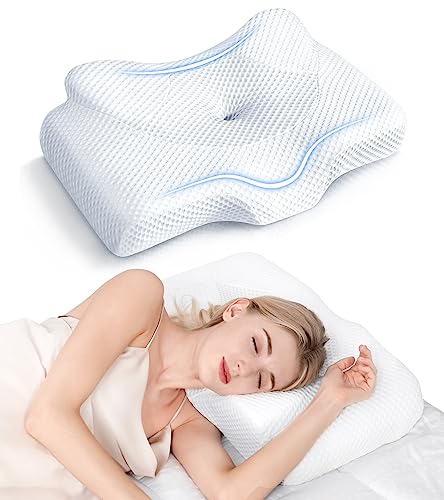
The Osteo’s distinguishing idea is in its name: a hollow design. Where a classic contour raises two ridges and asks your neck to pick one, a hollow-center pillow cradles the head in a shallow bowl while the surrounding foam supports the neck’s curve — a shape back sleepers tend to settle into with less of the ‘lying on a speed bump’ feeling that puts people off contours entirely. The verified listing adds odorless memory foam, a cooling case and an adjustable design to that shape. The product’s full listing title uses stronger marketing language than this guide does; the review sticks to the design facts, which are interesting enough on their own.
Strengths
- Hollow center cradles the head — a gentler introduction to contour shapes
- Odorless memory foam positioning suits sensitive noses
- Cooling case and adjustable design stated in the listing
Trade-offs
- The cradle shape centers you — restless position-changers may fight it
- Adjustment mechanism details are not specified in the listing title
- Side sleepers need to check the edge height suits their shoulder width
| Shape (listing) | Hollow-design contour |
| Fill (listing) | Memory foam, odorless |
| Cover (listing) | Cooling case |
| Adjustability | Adjustable design (mechanism not stated) |
| Size | Not stated in listing title |
Who settles best into a hollow design? The back sleeper who has tried a classic double-ridge contour and found the ridge under the neck too assertive, and the back sleeper who wakes with their head rolled off a flat pillow entirely. The bowl keeps the head centered and the neck supported in a way that feels like being held rather than propped. Side sleepers are the question mark: turning onto your side in a centered bowl means sleeping on the pillow’s raised edge, and whether that edge height matches your shoulder is a fit question only your frame can answer — broad shoulders want more edge than this class of pillow usually gives. If you are primarily a back sleeper, this is the contour to try first. If you are primarily a side sleeper, the dual-height DONAMA below is shaped for you.
Best for: Back sleepers who want a cradled, centered head position / Not suited for: Restless combination sleepers and broad-shouldered side sleepers
Check on Amazon — check the current price on Amazon before you decide, and confirm the size and colorway on the listing page.

DONAMA Cervical Pillow — Cooling Contour, Dual-Height — Best for Side Sleepers
The DONAMA’s dual-height design is the contour category’s neatest trick: the pillow’s two long edges are built to different heights, so you rotate the pillow — not your expectations — when you change position. The higher edge serves side sleeping, where the pillow must fill the full shoulder-to-ear gap; the lower edge serves back sleeping, where too much height tips the chin forward. Its full verified title — re-fetched fresh for this guide after the cached copy was found truncated — confirms the cooling contour memory foam build, the dual-height design and a removable pillowcase, a small feature with outsized value on a pillow you will use for years, because the case is the part that needs washing.
Strengths
- Dual-height edges — one pillow fitted to both side and back positions
- Removable pillowcase for real washing
- Cooling contour positioning for warm sleepers
Trade-offs
- You must learn which edge is which — a week of habit-building
- Exact heights are not stated in the listing title
- Fixed foam heights cannot be fine-tuned like the adjustable picks
| Shape (listing) | Contour, dual-height |
| Fill (listing) | Memory foam |
| Cover (listing) | Removable pillowcase |
| Surface (listing) | Cooling |
| Heights | Dual-height (figures not stated in title) |
The side-sleeper case for this pillow is worth making carefully, because side sleeping is where pillow height does the most work. On your side, the gap between mattress and head is the width of your shoulder, and a pillow that fills it exactly keeps your head level; too low and your head drops toward the mattress all night, too high and it is propped at an angle. A dual-height contour lets you test both edges across the adjustment fortnight and keep the winner, and the contour’s neck roll supports the curve while the higher loft does the filling. Pair it with the right mattress logic: the firmer your mattress, the more of the gap the pillow alone must fill, and the more likely the high edge is your answer. Warm sleepers get the cooling surface as a bonus, with the usual honesty that cooling covers feel cool to first touch rather than refrigerating the night.
Best for: Side sleepers, and back-and-side combination sleepers who want one pillow for both / Not suited for: Anyone who wants to fine-tune height in small increments
Check on Amazon — check the current price on Amazon before you decide, and confirm the size and colorway on the listing page.
EPABO Contour Memory Foam Pillow (Firm, Queen) — Best Classic Contour
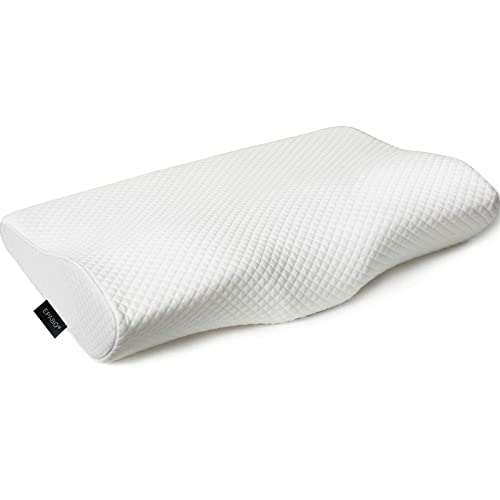
The EPABO is the category’s classic: a firm contour memory-foam pillow in queen size, its full title — also re-fetched fresh for this guide, because the cached version ended mid-sentence — confirming the contour shape, the firm feel, the queen size and an included pillowcase, positioned for side, back and stomach sleepers. There is no adjustability story here and no cooling headline; the offer is the original one. A shaped ridge supports the neck, a valley receives the head, and the firmness holds that geometry all night instead of collapsing by 2 a.m. For sleepers who have used a contour before and know the shape suits them, that simplicity is the point.
Strengths
- Classic contour geometry in a firm feel that holds its shape overnight
- Queen size with a pillowcase included
- No mechanisms, layers or fill to manage — the simplest ownership in the guide
Trade-offs
- Fixed height and firmness — if the geometry misses your frame, there is no adjustment to save it
- Firm is genuinely firm; plush-pillow lovers should look at the Coop instead
- Exact dimensions are not stated in the listing title
| Shape (listing) | Contour |
| Feel (listing) | Firm |
| Size (listing) | Queen |
| Cover (listing) | Pillowcase included |
| Dimensions | Not stated in listing title |
The firm contour is a commitment device, and it rewards the buyers who treat it as one. If your history says shaped pillows work for you — you have slept on a hotel contour, a partner’s contour, an old contour you wore out — the EPABO is the straightforward replacement: same geometry, honest firmness, nothing to configure. If you have never slept on a contour, this is the riskiest first purchase in the guide despite its classic status, because a fixed shape at a fixed height either fits your neck or spends its life in the guest room; the adjustable UTTU and Coop exist precisely to de-risk that first experiment. One more honest note: firm memory foam feels firmer in a cold bedroom and softer in a warm one, so judge this pillow in the room and season you will actually sleep in.
Best for: Experienced contour sleepers replacing a worn-out shaped pillow / Not suited for: First-time contour buyers, who should start with an adjustable pick
Check on Amazon — check the current price on Amazon before you decide, and confirm the size and colorway on the listing page.

Sidney Sleep Adjustable Curved Pillow (Queen) — Best Curved Design
The Sidney Sleep tries to end the guide’s central argument — fixed contour versus adjustable fill — by being both. Its verified listing describes a curved pillow shape for neck and shoulder support, adjustable shredded fill with extra fill included in the box, a queen size stated precisely at 19 by 29 inches, and CertiPUR-US certified foam. The curve gives the shoulder-side of the pillow a cutaway that solid rectangles lack, letting side sleepers pull the pillow in close without bunching it against the shoulder, while the shredded fill lets you set the height the curve alone cannot decide.
Strengths
- Curved shape plus adjustable fill — geometry and tuning in one pillow
- Extra fill included, so raising the loft needs no second purchase
- Full dimensions (19 x 29 in) and CertiPUR-US certification stated
Trade-offs
- Shredded fill can shift and needs a morning fluff to redistribute
- The curve is oriented — it takes a night or two to learn which way is up
- White cover shows wear honestly and needs the washable-case habit
| Size (listing) | 19 x 29 in (Queen) |
| Fill (listing) | Adjustable shredded fill, extra included |
| Shape (listing) | Curved |
| Certification | CertiPUR-US (per listing) |
| Color (listing) | White |
The curved cut deserves its moment, because it solves a specific side-sleeper annoyance that loft discussions miss. On a rectangular pillow, a side sleeper’s shoulder collides with the pillow’s near edge, so the pillow gets pushed away or scrunched, and the carefully chosen height collapses at exactly the point of contact. The curve removes material where the shoulder arrives, so the pillow stays where you put it and its height stays where you set it. Combined with the adjustable fill — and the rare honesty of extra fill in the box rather than sold separately — the Sidney is the most configurable shaped option here. Its cost is the shredded-fill tax: a daily fluff, and a loft that can migrate if you sleep restlessly. For a methodical sleeper who wants shape and tuning in one purchase, it is the guide’s most complete single answer.
Best for: Side and back sleepers who want a shaped pillow they can still fine-tune / Not suited for: Anyone who hates fluffing a pillow or wants a set-and-forget solid contour
Check on Amazon — check the current price on Amazon before you decide, and confirm the size and colorway on the listing page.
Comparison Table
| Pick | Badge | Key spec | Best for |
|---|---|---|---|
| Coop Home Goods Cool+ Adjustable Pillow (Queen) | Best Adjustable | Adjustable fill, queen, certified foam | First-time support-pillow buyers and position-switchers who need to tune height at home |
| UTTU Cervical Pillow — Adjustable Contour (Queen) | Best Adjustable Contour | Adjustable contour, 5.2/4.5 in heights | Contour-curious sleepers who want a height safety net, and side sleepers on firm mattresses |
| Osteo Cervical Pillow — Hollow Design Contour | Best Hollow-Design Contour | Hollow-center contour, cooling case | Back sleepers who want a cradled, centered head position |
| DONAMA Cervical Pillow — Cooling Contour, Dual-Height | Best for Side Sleepers | Dual-height cooling contour | Side sleepers, and back-and-side combination sleepers who want one pillow for both |
| EPABO Contour Memory Foam Pillow (Firm, Queen) | Best Classic Contour | Firm classic contour, queen | Experienced contour sleepers replacing a worn-out shaped pillow |
| Sidney Sleep Adjustable Curved Pillow (Queen) | Best Curved Design | Curved adjustable, 19×29, extra fill | Side and back sleepers who want a shaped pillow they can still fine-tune |
How to Choose a Supportive Pillow: Loft by Sleep Position
Everything in this category reduces to one measurement: the distance your pillow must fill to keep your head level with your spine in the position you actually sleep in. Side sleepers have the largest gap — roughly the width of a shoulder — and need the highest loft, with the firmness to hold it; that is why the dual-height DONAMA and the curved Sidney aim at them. Back sleepers need a medium height with support under the neck’s curve and a lower resting place for the head itself, which is the contour’s home turf and the hollow design’s specialty. Stomach sleepers need the least of all — a thin, soft pillow or none — because a high pillow bends a stomach sleeper’s neck backward and twists it; notably, several listings claim suitability for stomach sleepers, and this guide’s advice is to take the thinnest configuration of any adjustable pick if that is your position.
Mattress firmness quietly changes every one of those answers. On a soft mattress your body sinks, your shoulder burrows, and the gap your pillow must fill shrinks — sometimes by an inch or more. On a firm mattress the gap is at its full width. This is why the same pillow can feel perfect in a hotel and wrong at home, and why adjustable picks are the rational first purchase: they let the pillow adapt to the mattress you own instead of the mattress the product photo assumed. When you assess a new pillow, assess it on your own bed, in your own position, over two weeks — the adjustment protocol in the how-to section — and let the geometry, not the first night, decide.
- Side sleeping: highest loft, firm enough to hold it, contour edge or curve helps
- Back sleeping: medium height, neck support with a lower head rest — contour territory
- Stomach sleeping: thinnest option available, or no pillow; height is the enemy
- Soft mattress = less pillow needed; firm mattress = more
- Adjustable first, fixed once you know your number
Contour Shapes Decoded: Ridges, Hollows, Curves and Dual Heights
The classic contour — the EPABO’s shape — is a ridge-and-valley profile: the ridge supports the neck, the valley receives the head. It is the oldest design in the guide and the most polarizing, because its fixed geometry is either your geometry or it is not. The hollow design — the Osteo — softens the idea into a cradle, centering the head with gentler transitions, and tends to convert back sleepers who found the classic ridge too much. The dual-height contour — the DONAMA — puts two ridge heights on one pillow and lets position decide. The curved pillow — the Sidney — attacks the problem from the shoulder side, cutting away the corner that collides with a side sleeper’s shoulder. And the adjustable designs — Coop’s fill, UTTU’s layers, Sidney’s shredded fill — admit the deepest truth in the category, which is that no maker can know your shoulder width, and the best pillow is the one that lets you finish fitting it at home.
Firmness interacts with every shape. A contour’s support comes from the foam holding its sculpted geometry under load, so contour pillows run firm by design; a firm rating on a contour is not a macho upsell, it is the shape’s structural requirement. Shredded-fill pillows feel softer and mold rather than sculpt, which some necks prefer and some find unsupportive. Neither family is superior — they are different theories of the same night’s sleep, and the adjustment period is how you find out which theory your body votes for.
Foam Certifications and Materials, Stated Precisely
Two certifications recur in these listings, and this guide uses them exactly. CertiPUR-US is a certification program for flexible polyurethane foam covering aspects of content, emissions and durability testing — the Coop and Sidney listings claim it. GREENGUARD Gold, claimed by the Coop, certifies that a product meets low chemical-emission limits, with the Gold tier applying stricter limits intended for sensitive environments. Both are legitimate materials credentials. Neither certifies that a pillow will do anything for your neck, and any listing that lets a foam certification blur into a health promise is telling you something about its marketing rather than its foam.
Beyond certifications, the material questions that matter are simpler. Memory foam softens with warmth and firms in the cold, so a pillow’s feel is partly a bedroom-temperature fact. New foam can carry an odor that fades over days — the Osteo’s listing makes odorlessness a headline, which tells you the category’s baseline — and airing a new pillow before its first night is always wise. Covers matter more than they get credit for: a removable, washable case (the DONAMA) or an included pillowcase (the EPABO) is the difference between a pillow you can keep fresh for years and one you replace for hygiene rather than wear.
How to Fit a Supportive Pillow: A Two-Week Protocol
A supportive pillow is fitted, not just bought. This protocol turns the first fortnight into a fitting process instead of a coin flip, and it works for every pick in this guide.
- Night zero: air the new pillow out for several hours before bed — new foam odor fades fastest with ventilation — and put on its case.
- Set the starting configuration by your position: side sleepers start high (the DONAMA’s tall edge, the UTTU’s 5.2-inch profile, generous fill in the adjustable picks); back sleepers start medium; stomach sleepers start at the thinnest setting available.
- Do the mirror check before the first night: lie in your sleep position and have someone look, or use a phone on a timer — your head should sit level, nose roughly in line with the center of your chest, not tipped toward the ceiling or the mattress.
- Sleep three nights on the starting configuration before changing anything. Night one measures novelty, not fit.
- Adjust one variable at a time — a handful of fill, one layer, the other edge — and give each change two nights. Small changes move loft more than you expect.
- Track one signal only: how your neck and shoulders feel in the first ten minutes after waking, compared with your old pillow’s baseline. Ignore midnight impressions; everyone wakes at 3 a.m. on a new pillow.
- By the end of week two, keep the configuration that wins the morning test. If no configuration of a fixed contour wins it, that shape is not your shape — the adjustable picks exist for exactly this outcome.
- Once fitted, maintain the fit: fluff shredded fill daily, keep solid contours out of prolonged compression, and re-run this protocol if you change mattresses — the gap your pillow fills will have changed with it.
One boundary deserves repeating at the end of a fitting guide: this protocol optimizes comfort and sleep position. If you have persistent pain, numbness or tingling in the arms or hands, pain after an injury, or symptoms that are getting worse, stop shopping and see a clinician. A well-fitted pillow is a good night’s sleep aid, and this guide recommends it as exactly that — nothing more, and nothing less.
Common Buying Mistakes
Mistake 1: Buying the tallest, firmest contour on the page. More height and more firmness are not more support. Support is your head held level, and an overbuilt pillow tips a back sleeper’s chin down and cranks a smaller side sleeper’s head up. Match the height to your frame and mattress, or buy adjustable and find it.
Mistake 2: Judging a shaped pillow on night one. Your neck has years of habit in your old pillow’s shape, and any new geometry feels wrong at first. The two-week protocol exists because night one measures novelty. Sleepers who return contours after one night often return the right pillow for the wrong reason.
Mistake 3: Stacking two pillows to fix height. Two pillows create a hinge, not a height — the top one slides, the angle lands mid-neck, and the geometry is worse than either pillow alone. One pillow of the right height, or an adjustable pillow raised properly, solves the problem the stack pretends to.
Mistake 4: Ignoring the mattress in the pillow decision. The gap a pillow fills is created by your body sinking into your mattress. Change the mattress — or sleep in a hotel — and the same pillow is a different height. Refit when the mattress changes, and be suspicious of any pillow verdict formed on someone else’s bed.
Mistake 5: Expecting a pillow to treat a condition. Listings in this category use medical language freely; this guide does not. A pillow can improve your sleep position and comfort. Persistent, worsening or injury-related neck pain needs a clinician’s assessment, and no purchase in this guide is a substitute for one.
Final Recommendation
Start where your certainty is. If you have never owned a support pillow, begin with the Coop Cool+ Adjustable or the UTTU adjustable contour and fit yourself over two weeks — the adjustability is the insurance. Side sleepers should look first at the DONAMA dual-height contour and the curved, tunable Sidney Sleep. Back sleepers who want to be cradled should try the Osteo hollow design, and experienced contour sleepers replacing a worn favorite can go straight to the firm classic, the EPABO contour.
Whichever pick you choose, run the two-week fitting protocol honestly, judge by the mornings, and keep the boundary clear in your mind: these are well-verified comfort tools for better sleep geometry. Used that way, they earn their place on the bed.
Related guides on this site: Best Contour Neck Pillows For Sleeping Best Cool Gel Memory Foam Pillows Best Cold Pillows For Side Sleepers Best Affordable Firm Pillows Best Bamboo Memory Foam Pillows
Frequently Asked Questions
What makes a pillow ‘supportive’?
Geometry, held overnight. A supportive pillow fills the space between your head, neck and mattress so your head rests level with your spine in your sleep position — and its fill or foam holds that shape until morning instead of collapsing. Height matched to your position and mattress is the biggest factor; contour shapes, dual heights and adjustable fills are three different strategies for landing that height and keeping it.
How high should a pillow be for side sleeping?
High enough to fill your shoulder gap exactly — head level, not propped or dropped. That is the largest gap of any position, which is why side-sleeper designs like the dual-height DONAMA and the curved Sidney run tall on their working edge. Your mattress matters: a firm mattress leaves the full gap to the pillow, a soft one absorbs part of it. The mirror check in this guide’s fitting protocol is the reliable way to judge, because shoulder widths vary too much for a universal number.
Are contour pillows better than regular pillows?
For some sleepers, clearly; for others, not at all. A contour’s sculpted ridge supports the neck’s curve in a way a flat pillow cannot, and back and side sleepers who match its geometry often prefer it strongly. But a fixed contour that misses your height has no adjustment to save it, which is why this guide puts adjustable designs first for newcomers and reserves the firm classic contour for sleepers who already know the shape suits them.
How long does it take to get used to a supportive pillow?
Plan on one to two weeks. Your neck and shoulders have adapted to your old pillow’s shape over years, and a new geometry — even the right one — feels foreign for the first several nights. Use the protocol in this guide: three nights before the first adjustment, one variable at a time, judged by how you feel in the morning. A pillow that still loses that morning test after two honest weeks of fitting is the wrong pillow for you.
What do CertiPUR-US and GREENGUARD Gold mean on a pillow?
They are materials certifications, stated precisely in this guide’s materials section. CertiPUR-US covers aspects of the foam’s content, emissions and durability. GREENGUARD Gold certifies low chemical emissions under a strict tier of limits. Both are good reasons to prefer one foam over another. Neither is evidence that a pillow treats or prevents any condition, and this guide does not present them that way.
When should I see a doctor instead of buying a pillow?
When symptoms go beyond morning stiffness that a better sleep position plausibly explains: pain that persists or worsens over weeks, pain following an injury, numbness or tingling in the arms or hands, weakness, or pain that disrupts sleep despite a well-fitted pillow. Those are clinical questions. This guide’s pillows are comfort products for sleep geometry, and the honest recommendation for anything more is a professional assessment.

