Disclosure: airfryerkitchensupply.com is reader-supported. When you buy through links on our site, we may earn an affiliate commission at no extra cost to you.
Where to buy
Every rug in this guide is sold through Amazon, and each linked pick below was confirmed against Amazon’s own catalog data before it earned a link. Wood floors punish the wrong rug twice — once when a rough or gritty backing grinds the finish, and again when a thick pile traps grit and works like sandpaper underfoot — so the safest place to buy is the listing page itself, where you can confirm the exact size, backing description and care instructions for the specific rug you are about to put on a finished floor. Prices move constantly, so each pick says check price on Amazon rather than printing a number that would be stale within weeks.
- Moynesa Ultra-Thin Washable Vintage Area Rug (5×7) — check price on Amazon
- AMADA Washable Area Rug (8×10, Blue) — check price on Amazon
- RELEANY Washable Area Rug (5×7) — check price on Amazon
- RUGSURE Washable Area Rug (5×7, Green) — check price on Amazon
- nuLOOM Elfriede Natural Solid Flatweave Area Rug (6×9) — check price on Amazon
- Tumble Amara Washable Area Rug (8×10) — check price on Amazon
If you are shopping for the best rugs wood floor owners can live with, the real question is not which pattern looks good in a photo. It is which rug protects the finish under it, stays flat under chairs and foot traffic, and does not turn into a grit trap that slowly dulls the boards it was meant to decorate. Hardwood is a hard, smooth, finished surface. Anything rough, rubbery in the wrong way, or heavy with trapped sand will mark it over time, and the damage usually appears exactly where the rug sat, discovered months later when the rug is lifted for cleaning.
This guide narrows the field to low-profile, washable and flatweave rugs whose listings describe non-slip or low-profile constructions that suit hard floors, plus clear guidance on the one accessory that matters more than the rug itself: a proper rug pad. Every linked pick was verified against its Amazon listing, so the sizes and construction details quoted here come from the listing, not from guesswork. Where a listing is silent about a detail — backing material, exact fiber — this guide says so instead of filling the gap with an invented spec.
You will find six picks below: thin washable vintage-style rugs that slide into a laundry cycle instead of trapping dirt, a large low-profile option for open living rooms, a pet-friendly washable design, a stain-resistant tribal pattern, a true flatweave for a natural look, and a premium washable rug for bigger rooms. After the reviews, the buying-guide sections explain pile height, backing safety, pad choice and sizing for wood floors specifically, followed by a practical setup and care routine and the mistakes that most often cost people a refinishing bill.
Key Takeaways
- Low profile beats plush on wood: thin washable rugs and flatweaves trap less grit and let doors and chairs move freely.
- The pad matters as much as the rug — a felt or felt-and-rubber pad cushions the finish; bare latex and rough jute-style backings go straight against boards at your risk.
- Washable rugs solve the grit problem at the source, because the dirt leaves in the wash instead of grinding into the finish.
- Size the rug to the furniture, not the room: front legs of seating on the rug, with a border of bare wood showing.
- Lift and vacuum under any rug on wood at least monthly; trapped grit, not the rug itself, does most of the damage.
In this guide
Quick Picks
Best Overall — Moynesa Ultra-Thin Washable Vintage Area Rug (5×7). The thinnest washable pick in the guide, with a non-slip, non-shedding build and a vintage medallion pattern that hides everyday dust between washes — the lowest-risk profile you can put on a finished floor.
Best for Large Rooms — AMADA Washable Area Rug (8×10, Blue). A full 8×10 washable rug with a low-profile build and non-slip backing, sized to sit under a complete living-room furniture grouping without the door-clearance and chair-wobble problems of a thick rug.
Best for Pet Households — RELEANY Washable Area Rug (5×7). A water-repellent, pet-friendly washable rug in a busy vintage floral pattern — the combination that survives muddy paws, spilled water bowls and the occasional accident on a wood floor.
Best Stain Resistance — RUGSURE Washable Area Rug (5×7, Green). Stain- and water-resistant, non-slip and washable, in a vintage tribal pattern — built for the rooms where spills are a weekly event rather than a rare disaster.
Best Flatweave — nuLOOM Elfriede Natural Solid Flatweave Area Rug (6×9). A true flatweave in a solid natural tone at 6×9 — zero pile means zero grit storage, the cleanest possible profile for a wood floor, in a minimalist look the washable vintage prints cannot offer.
Best Premium Washable — Tumble Amara Washable Area Rug (8×10). A room-size 8×10 washable rug from a brand built entirely around washable rugs — the premium route to whole-room coverage on wood without giving up the ability to launder the rug.
How These Picks Were Chosen
The shortlist started from rugs whose Amazon listings, verified, describe constructions that make sense on a finished wood floor: low pile or low profile, machine-washable builds, flatweaves, and non-slip designs intended to stay put without adhesive. Thick shag, high-pile plush and rugs whose listings position them mainly as soft bedroom carpeting were set aside, because height and loft are liabilities on hardwood — they catch door swings, wobble under chair legs and hold more abrasive grit against the finish.
Each surviving pick had to earn its place on a specific job: the thinnest practical washable rug, the big-room washable, the pet-household washable, the stain-hiding pattern, the flatweave, and the premium large washable. Listings were checked for the details that matter here — stated size, pile or profile language, washability, non-slip claims — and anything the listing did not state is reported as not stated in the spec box rather than assumed. No prices and no fixed ratings are printed anywhere in this guide, because both change constantly; the listings carry the live numbers.
One more filter was applied that most roundups skip: honesty about backings. Several popular rugs use backings that are fine on tile but questionable on polyurethane finishes. Rather than pretend every non-slip backing is wood-safe, the reviews and the buying guide separate what the listing claims from what a cautious owner should do — which, in most cases, is to put a quality pad between rug and floor and treat the rug’s own backing as a bonus, not the protection plan.
The 6 Best Rugs Wood Floor Owners Can Live With

Moynesa Ultra-Thin Washable Vintage Area Rug (5×7) — Best Overall
The Moynesa earns the top spot because its design attacks the wood-floor problem from the right direction: it is ultra-thin, so there is almost no pile depth in which grit can lodge, and it is machine washable, so whatever dirt does collect leaves in the wash rather than grinding against the finish. The listing describes a non-slip, non-shedding construction in a 5×7 size with an oriental medallion pattern in a boho vintage style, a combination that suits living rooms and bedrooms where the rug needs to look deliberate rather than utilitarian.
Strengths
- Ultra-thin profile keeps doors swinging freely and chair legs stable
- Machine washable, so trapped grit is removed instead of accumulating
- Non-shedding build means fewer loose fibers migrating across the boards
Trade-offs
- Thin means minimal cushion — pair it with a felt pad if you want softness
- 5×7 is a seating-zone size, not a whole-room solution
- Vintage distressed patterning is a specific look that will not suit every room
| Size (listing) | 5×7 |
| Profile | Ultra-thin, low profile |
| Care | Machine washable |
| Backing detail | Non-slip (material not stated in listing title) |
On wood, thickness is a trade, not a virtue. Every extra millimeter of pile is storage space for the sand and grit that shoes carry in, and that grit is what actually scratches finishes — the rug is just the vehicle. An ultra-thin washable rug breaks that cycle twice over: there is little depth for grit to hide in, and the whole rug goes into the wash, resetting the clock. The non-shedding claim matters for the same reason; shed fibers themselves are soft, but a rug that constantly releases material is usually a rug whose construction is loosening, and loose construction lets more debris reach the floor interface. Put a felt pad under this Moynesa and you get the cushion the thin build lacks, plus a soft, finish-safe layer between the rug’s non-slip backing and your boards. The medallion pattern is doing quiet work too — its mottled vintage shading camouflages the light dust that shows instantly on a solid dark rug over pale wood.
Best for: Most living rooms and bedrooms on hardwood that need a low-risk, easy-care anchor rug / Not suited for: Anyone who wants a plush, underfoot-luxury feel from the rug itself rather than from a pad
Check on Amazon — check the current price on Amazon before you decide, and confirm the size and colorway on the listing page.

AMADA Washable Area Rug (8×10, Blue) — Best for Large Rooms
Scaling up is where wood-floor rugs usually go wrong: big rugs are heavy, heavy rugs are hard to lift for cleaning, and a big rug that never gets lifted becomes a big grit reservoir. The AMADA’s listing answers with an 8×10 washable build described as low-profile and non-slip, with a soft texture and a vintage look in blue. It is positioned for living rooms, bedrooms and dining rooms, and the low profile is the detail that makes an 8×10 practical over boards — dining chairs slide instead of catching, and doors clear it.
Strengths
- True 8×10 coverage for full furniture groupings
- Low-profile build suits dining chairs and door swings
- Washable at a size where most rugs are spot-clean only
Trade-offs
- Washing an 8×10 needs a large-capacity machine or a laundromat trip
- Soft texture is a surface feel, not cushion — a pad still helps
- Blue vintage colorway limits palette matching
| Size (listing) | 8×10 |
| Profile | Low-profile |
| Care | Washable (per listing) |
| Backing detail | Non-slip (material not stated in listing title) |
The honest caveat with any 8×10 washable rug is logistics: confirm your machine’s capacity before you count on home laundering, and treat the washable label as ‘can be washed when needed’ rather than a weekly routine. Even so, the ability to fully wash a room-size rug once or twice a year is a genuine advantage over a comparable non-washable rug, which can only be surface-cleaned while its underside grit load grows. For dining rooms on wood, this AMADA’s low profile is the headline feature — chairs on casters or glides move across it without the lip-catching you get at the edge of a medium-pile rug, and the non-slip positioning keeps the rug from creeping under table traffic. As with every pick here, a felt pad underneath is recommended on finished wood, both for cushion and as a sacrificial layer between backing and boards.
Best for: Open living rooms and dining rooms on wood that need one large, low, washable rug / Not suited for: Small rooms where an 8×10 overwhelms the floor and leaves no wood border
Check on Amazon — check the current price on Amazon before you decide, and confirm the size and colorway on the listing page.

RELEANY Washable Area Rug (5×7) — Best for Pet Households
Pets and hardwood are a stressful pairing: claws, water bowls, muddy paws and the occasional accident all threaten the finish. The RELEANY’s listing leans directly into that reality with a water-repellent, pet-friendly, easy-to-clean washable build in a 5×7 size. The brick, brown and green vintage floral pattern is not just decoration — a busy, multi-tonal print is the most forgiving possible surface for the tracked-in evidence of animal life between cleanings.
Strengths
- Water-repellent surface buys time when bowls spill or accidents happen
- Washable build handles the deep cleans pet rugs inevitably need
- Busy vintage floral pattern hides paw prints and shedding between washes
Trade-offs
- Water repellent is not waterproof — standing liquid still needs prompt cleanup
- Floral boho styling is a strong look that dominates a quiet room
- 5×7 covers a seating zone, not a whole open-plan space
| Size (listing) | 5′ x 7′ |
| Surface | Water repellent (per listing) |
| Care | Washable, easy to clean |
| Backing detail | Non-slip (material not stated in listing title) |
The water-repellent surface deserves a precise explanation, because it is the feature pet owners most often misunderstand. Repellency makes liquid bead and slows its soak-through, which gives you a realistic window to blot a spill before it reaches the rug’s underside and sits against the wood. It does not make the rug a tray; a tipped water bowl left for hours will still get through. Used with that understanding — and with a waterproof-feel pad strategy discussed in the buying guide — this RELEANY is the most forgiving pick in the guide for animal households. The washable build closes the loop: pet rugs accumulate odor and dander that surface cleaning cannot reach, and a rug you can fully launder is a rug you will actually keep clean, which is what protects the floor beneath it in the long run.
Best for: Dog and cat households with wood floors in living rooms, bedrooms or offices / Not suited for: Anyone expecting a waterproof barrier that makes spill cleanup optional
Check on Amazon — check the current price on Amazon before you decide, and confirm the size and colorway on the listing page.
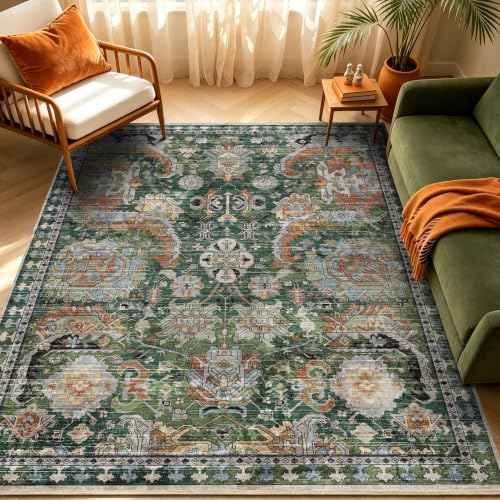
RUGSURE Washable Area Rug (5×7, Green) — Best Stain Resistance
The RUGSURE listing stacks the practical claims in one place: stain and water resistant, non-slip, washable, and described as pet and child friendly, in a 5×7 vintage tribal design in green. For a wood floor under a kids’ room, nursery or family living space, that stack translates to a rug that resists the spill at the surface, stays where it was placed, and can be laundered when resistance is not enough. It earns the stain-resistance slot in this guide on the strength of that listing profile.
Strengths
- Stain and water resistance stated in the listing
- Washable when surface resistance is eventually overwhelmed
- Tribal pattern and green palette hide marks well in family rooms
Trade-offs
- Resistant finishes wear with repeated washing — care instructions matter
- Nursery and kids’ positioning means a busier, more casual style
- One size and colorway verified here; other variants were not separately checked
| Size (listing) | 5′ x 7′ |
| Surface | Stain & water resistant (per listing) |
| Care | Washable |
| Backing detail | Non-slip (material not stated in listing title) |
Stain resistance on a rug over wood does double duty. The obvious benefit is cosmetic — juice, coffee and craft paint are less likely to set. The less obvious benefit is behavioral: owners clean a resistant rug sooner and more casually, because spills sit on the surface where they are visible, instead of soaking in and being forgotten against the floor. That said, resistance is a coating-level property, and coatings fade with harsh detergents and hot washes, so follow the care label exactly if you want the feature to last. In the nursery and kids’-room roles the listing suggests, pair this RUGSURE with a pad and a standing rule that any spill reaching the rug’s edge gets checked underneath the same day; wood swells quietly, and the time to catch moisture is before the boards cup, not after.
Best for: Kids’ rooms, nurseries and family rooms on wood where spills are routine / Not suited for: Formal living rooms that need a quiet, solid or traditional pattern
Check on Amazon — check the current price on Amazon before you decide, and confirm the size and colorway on the listing page.

nuLOOM Elfriede Natural Solid Flatweave Area Rug (6×9) — Best Flatweave
The nuLOOM Elfriede is the minimalist’s answer in this guide: a flatweave with a solid natural color and no pile at all. The listing title is short — it confirms the flatweave construction, the solid natural colorway and the 6×9 size, and does not state a fiber, so this guide does not invent one. What a flatweave guarantees by construction is the lowest possible profile: chairs glide, doors clear, robot vacuums climb on without drama, and there is no pile depth in which abrasive grit can hide against the floor.
Strengths
- Flatweave construction — no pile to trap grit against the finish
- Solid natural tone works with almost any wood stain color
- 6×9 is a versatile mid-large size for living and dining spaces
Trade-offs
- Fiber is not stated in the listing title — check the listing page before buying if fiber matters to you
- Flatweaves feel firm underfoot; cushion must come from a pad
- Flatweaves can curl at corners without a pad or corner weights
| Size (listing) | 6′ x 9′ |
| Profile | Flatweave (no pile) |
| Fiber | Not stated in listing title |
| Care | Not stated in listing title — confirm on listing page |
Flatweaves ask for one specific accessory and reward you for using it: a pad. Without pile to grip, a flatweave on smooth wood can skate and its corners can lift, and both problems disappear with a felt or felt-and-rubber pad cut slightly smaller than the rug. With the pad in place, the Elfriede becomes arguably the safest rug in this entire guide for the floor itself — nothing traps grit, nothing thick edges a doorway, and the whole assembly is light enough to lift for the monthly under-rug vacuum that keeps finishes safe. The solid natural colorway is the aesthetic counterpoint to the busy vintage prints elsewhere in the guide: on mid-tone oak or walnut it reads calm and architectural, and it shows dust honestly, which on wood is a feature — you clean what you can see.
Best for: Minimalist rooms, dining spaces and anyone who wants the lowest-risk profile on wood / Not suited for: Anyone who wants softness or pattern from the rug itself
Check on Amazon — check the current price on Amazon before you decide, and confirm the size and colorway on the listing page.

Tumble Amara Washable Area Rug (8×10) — Best Premium Washable
Tumble built its name on washable rugs, and the Amara in 8×10 is the premium expression of the idea in this guide: full living-room or bedroom coverage with a washable build. The listing title is brief — it confirms the Amara model, washability and the 8×10 size, and does not state pile height or backing material, so those details are flagged as not stated rather than guessed. What justifies the premium slot is the combination itself: at 8×10, most rugs are permanent installations you clean around; a washable one stays a maintainable object.
Strengths
- 8×10 coverage with a genuinely washable build
- From a washable-rug specialist brand rather than a generalist line
- Room-size format suits living rooms and primary bedrooms on wood
Trade-offs
- Pile and backing details are not stated in the listing title — verify on the listing page
- Premium positioning within the washable category
- 8×10 laundering needs a large-capacity machine
| Size (listing) | 8×10 |
| Care | Washable (per listing) |
| Pile height | Not stated in listing title |
| Backing detail | Not stated in listing title |
The case for paying premium money for a washable 8×10 is a total-cost argument. A non-washable room-size rug on wood eventually needs professional cleaning to deal with what accumulates in and under it, and professional rug cleaning for an 8×10, repeated over the rug’s life, closes much of the gap with a washable rug’s higher purchase price — while the washable rug also gets cleaned more often, because the barrier is a laundry cycle rather than a service appointment. On wood specifically, that cleaning frequency is the finish-protection story again: grit load under and inside the rug stays low across the rug’s whole life. Before buying, use the listing page to confirm the backing description and any pad the maker recommends, and plan the pad purchase at the same time; an 8×10 that arrives without a pad tends to live without one, and on finished wood the pad is half the system.
Best for: Larger living rooms and primary bedrooms where washable coverage is worth a premium / Not suited for: Budget-first shoppers, or rooms smaller than a true 8×10 footprint
Check on Amazon — check the current price on Amazon before you decide, and confirm the size and colorway on the listing page.
Comparison Table
| Pick | Badge | Key spec | Best for |
|---|---|---|---|
| Moynesa Ultra-Thin Washable Vintage Area Rug (5×7) | Best Overall | Ultra-thin washable, 5×7 | Most living rooms and bedrooms on hardwood that need a low-risk, easy-care anchor rug |
| AMADA Washable Area Rug (8×10, Blue) | Best for Large Rooms | 8×10 low-profile washable | Open living rooms and dining rooms on wood that need one large, low, washable rug |
| RELEANY Washable Area Rug (5×7) | Best for Pet Households | Water-repellent washable, 5×7 | Dog and cat households with wood floors in living rooms, bedrooms or offices |
| RUGSURE Washable Area Rug (5×7, Green) | Best Stain Resistance | Stain-resistant washable, 5×7 | Kids’ rooms, nurseries and family rooms on wood where spills are routine |
| nuLOOM Elfriede Natural Solid Flatweave Area Rug (6×9) | Best Flatweave | Flatweave, 6×9, solid natural | Minimalist rooms, dining spaces and anyone who wants the lowest-risk profile on wood |
| Tumble Amara Washable Area Rug (8×10) | Best Premium Washable | 8×10 washable, premium | Larger living rooms and primary bedrooms where washable coverage is worth a premium |
How to Choose a Rug That Will Not Ruin a Wood Floor
Start with the finish, not the rug. Most modern hardwood is sealed with polyurethane or a similar film finish, and what damages it is rarely the rug’s face — it is abrasion at the interface: grit trapped under or inside the rug, ground in by foot traffic. That is why this guide favors low-profile and flatweave constructions and washable builds. Pile height is the first spec to check: the lower the pile, the less debris the rug can store and the less it can move against the floor. The second spec is cleanability. A rug you can fully wash is a rug whose grit load resets to zero; a rug you can only vacuum carries an accumulating load that vacuuming reduces but never eliminates.
Backing is the second decision, and it is where honest uncertainty belongs. Non-slip backings keep rugs planted, which is good — a rug that creeps gets walked into wrinkles, and wrinkles concentrate wear. But some backing compounds can react with or stick to certain finishes over long periods, and listings rarely disclose backing chemistry. The cautious, standard solution is a pad: a dense felt pad, or a felt-and-rubber pad, between rug and floor. The pad provides the grip, the cushion and a known, finish-friendly contact layer, and it turns the rug’s own backing into a non-issue. If you take one idea from this guide, take that one: on finished wood, the pad is not an accessory, it is the protection system, and the rug is the decoration on top of it.
- Choose low pile, low profile or flatweave over plush on any finished wood
- Treat washability as a floor-protection feature, not just a convenience
- Always budget for a felt or felt-and-rubber pad cut 1–2 inches smaller than the rug
- Avoid adhesive tapes and sprays directly on finished wood unless the finish maker approves them
- In sunny rooms, remember rugs block UV — the covered wood will age differently from the exposed border
Sizing and Placement on Hardwood
The classic arrangement still works because it is functional, not just decorative: in a living room, the rug should run under the front legs of sofas and chairs, tying the grouping together while leaving a border of bare wood visible around it — roughly a hand’s breadth to a foot and a half of floor showing reads intentional in most rooms. A rug that floats entirely in front of the furniture looks undersized and, on wood, slides more, because no furniture weight anchors it. In dining rooms, the rug must extend far enough that chairs stay on it when pulled out — about two feet beyond the table on all sides is the working rule — or chair legs will catch the rug’s edge on every use, worrying both the rug and the floor at the edge line.
Traffic lanes deserve their own thought. The path from door to sofa to kitchen is where grit concentrates, and a washable rug placed across that lane is doing protective work for the highest-wear boards in the house. Entryways on wood are the extreme case: a washable low-profile rug or runner inside the door catches the outdoor grit before it distributes. Whatever size you choose, measure the room and the furniture before ordering, and check the listing’s stated size carefully — the picks in this guide list their sizes exactly as the listings state them, and a 5×7 and an 8×10 solve very different rooms.
Rug Pads, Backings and Finish Safety in Detail
Felt pads are the conservative default for wood: dense needle-punched felt cushions, protects against backing abrasion, and adds no chemistry to the floor interface. Their weakness is grip — felt on smooth wood can let a light rug wander — which is why felt-and-rubber combination pads exist: felt against the floor, a thin natural-rubber layer against the rug. Natural rubber is the traditional finish-safe grip material; cheap PVC and vinyl pads are the ones with a reputation for reacting with finishes and leaving ghost patterns, and they are worth avoiding on good floors. Whichever pad you choose, cut or order it slightly smaller than the rug so it stays invisible and the rug’s edge lies flat on the floor rather than tenting over the pad’s edge.
One more material note belongs here, because it decides many purchases: natural-fiber rugs such as jute and seagrass look made for wood floors, and their flat, firm weaves do behave well on top of a pad. Their undersides, however, can be coarse, and coarse fibers in direct contact with a finish, shifting slightly under traffic for years, are exactly the abrasion scenario this guide is built to avoid. The rule is simple — natural-fiber rugs on wood always ride on a felt pad, never bare. The seagrass guide linked at the end of this article covers that category in depth if the look appeals to you.
Rotation and inspection complete the system. Rotate rugs a quarter or half turn every few months so traffic wear and sun exposure even out, and lift the rug fully at least monthly to vacuum the floor beneath — that five-minute habit removes the grit reservoir that causes most rug-related finish damage. When you lift it, look at the floor: early dulling in the rug’s outline is a warning you can act on with a pad change and better grit control, long before it becomes a refinishing conversation.
Entryways and High-Traffic Lanes: Where Wood Needs a Rug Most
If you only put one rug on your wood floors, put it inside the front door. The entryway is where outdoor grit — the sand, fine gravel and road dust that does the actual scratching — enters the house, and a low-profile washable rug or runner there intercepts most of it before shoes distribute it down the hallway and across the living room. Every pick in this guide is washable or flatweave for a reason, and the entry is the placement where that pays off fastest: the rug will get dirty quickly precisely because it is doing its job, and being able to launder it rather than shake it and hope is what keeps the interception working month after month.
Hallways and the lanes between kitchen, sofa and stairs follow the same logic at lower intensity. A runner or a 5×7 washable rug laid fully across a lane protects the boards that would otherwise take every pass. What matters is commitment: the rug must cover the whole lane, edge to edge of the traffic pattern, because a partial rug creates a step-on, step-off rhythm that concentrates grit transfer exactly at its borders. In open-plan spaces, one large washable rug under the main grouping plus a washable entry rug covers the great majority of the wear a wood floor will ever see, and both can be maintained with the routine in the next section.
How to Set Up and Care for a Rug on a Wood Floor
A careful first setup takes twenty minutes and decides how the rug treats your floor for years. Work through these steps in order, and repeat the maintenance steps on the rhythm described — the routine is short, and it is the difference between a rug that protects a floor and a rug that quietly damages one.
- Clean the floor first: sweep, then damp-mop the exact footprint and let it dry completely. Any grit sealed under a new rug starts grinding on day one.
- Roll out the pad, trimmed 1–2 inches smaller than the rug on every side, felt side down against the wood.
- Unroll the rug over the pad and let it relax for a day; corners that curl can be weighted overnight with books rather than taped.
- Walk the edges down and check every door swing that crosses the rug — low-profile picks should clear easily; adjust placement now, not after a door has planed the edge for a month.
- Vacuum the rug with suction only or a gentle brush roll setting; aggressive beater bars are hard on both rug fibers and, at the edges, on the floor.
- Weekly: vacuum the rug’s surface, concentrating on traffic lanes. Monthly: lift the rug and pad, vacuum and inspect the floor beneath, and check for moisture after any spill week.
- Wash washable rugs per their care label when traffic lanes look dull despite vacuuming — that dullness is embedded grit announcing itself.
- Rotate the rug every season, and move it fully during any plumbing or pet incident to check the floor the same day.
Spills get a specific protocol on wood: blot from the surface, then lift the nearest rug edge and check underneath. Liquid that reaches the boards and sits will swell and stain them, and the check takes thirty seconds. If the underside is wet, prop the rug up to dry with air moving over the floor, and do not relay it until the boards are fully dry to the touch.
Finally, keep a simple rhythm in your head of what lives where: which rug sits on which pad, when each was last washed, and when the floor beneath was last checked. It sounds fussy, but wood floors are maintained in years, not weeks, and the owners who keep them beautiful are simply the ones whose small habits — pad, lift, wash, rotate — never lapse long enough for grit or moisture to do quiet, cumulative work. A rug on wood is a system, and systems reward rhythm.
Common Buying Mistakes
Mistake 1: Buying plush for a hard floor. Thick, soft rugs feel like the generous choice, but on wood their depth stores grit, their edges catch chairs and doors, and their weight discourages the lifting that cleaning requires. Low profile is not a compromise on wood — it is the correct engineering.
Mistake 2: Skipping the pad to save money. The pad is the finish-protection layer, the cushion and the grip in one purchase. A rug laid bare on polyurethane is a slow experiment in backing abrasion that you will grade when you finally lift it.
Mistake 3: Assuming non-slip means floor-safe. Non-slip describes grip, not chemistry. Listings rarely state backing materials, which is why this guide reports them as not stated and routes the contact through a felt pad instead.
Mistake 4: Never lifting the rug. The floor under a rug is invisible, so it gets forgotten — until the outline of dullness or a moisture stain announces itself. A monthly lift-and-vacuum is the cheapest insurance in this entire guide.
Mistake 5: Sizing to the room instead of the furniture. A rug that ends mid-traffic-lane creates an edge that feet, chairs and vacuum cleaners worry constantly, and on wood that edge line is where finish wear concentrates. Anchor the rug under furniture legs or place it fully across the lane.
Final Recommendation
For most wood-floor rooms, start with the Moynesa Ultra-Thin Washable 5×7: the thinnest, easiest-care profile in the guide, and the lowest-risk first rug you can put on a finish you care about. If the room needs real coverage, the AMADA 8×10 brings the same washable, low-profile logic to a full furniture grouping, and the Tumble Amara is the premium version of that idea from a washable-rug specialist. Pet households should go straight to the RELEANY for its water-repellent, pattern-camouflaged practicality, and spill-heavy family rooms to the stain-resistant RUGSURE. If your taste runs minimalist, the nuLOOM Elfriede flatweave over a good felt pad is the calmest and arguably the floor-friendliest arrangement of all.
Whichever pick you choose, buy the pad in the same order, set the rug up on a clean dry floor, and keep the monthly lift-and-vacuum habit. Those three behaviors protect more hardwood than any single product feature in this guide.
Related guides on this site: Best Non Skid Rugs For Wood Floor Best Kitchen Rugs For Wood Floors Best Modern Rugs For Dark Wood Best Rug Pads For Polyester Rugs On Hardwood Floors Best Makers Quality Seagrass Area Rugs Best Affordable Jute Rugs
Frequently Asked Questions
Are rugs safe on hardwood floors at all?
Yes, with the right construction and one accessory. Low-profile or flatweave rugs over a felt or felt-and-rubber pad protect wood from traffic wear. The damage stories come from grit trapped under rugs that are never lifted, and from questionable backing materials left in direct contact with finishes for years — both are avoidable with the pad-and-lift routine in this guide.
What rug backing is safest for wood floors?
The safest contact layer is a dense felt pad, which is why this guide recommends one under every pick. Listings for the rugs here describe non-slip backings without stating the backing material, so rather than guess at chemistry, route the contact through felt and let the rug’s own backing grip the pad instead of the floor.
How often should I clean under a rug on wood?
Lift and vacuum underneath at least monthly, and immediately after any spill that might have reached the edges. Weekly surface vacuuming of traffic lanes keeps the grit load down between lifts. Washable rugs should be laundered when the traffic lanes look dull despite vacuuming.
Will a rug make the wood underneath a different color?
Over time, yes, it can. Wood darkens or lightens with light exposure, and a rug shields the area it covers, so a long-placed rug can leave a visible outline when removed. Rotating the rug seasonally and occasionally shifting its position softens the effect, and it fades as the covered area gets light again.
What size rug should I buy for a living room with wood floors?
Size to the furniture grouping: the rug should extend under the front legs of the sofa and chairs, with a border of bare wood showing around the room. For many living rooms that means an 8×10; for smaller seating zones a 5×7 works if the front legs still land on it. In dining rooms, allow about two feet beyond the table on all sides so pulled-out chairs stay on the rug.
Can I use a washable rug in a kitchen on wood floors?
Yes — a low-profile washable rug is one of the best kitchen choices on wood, because kitchen grit and spills are constant and the rug can be fully laundered. Use a pad, blot spills promptly, and check underneath after any large spill, since standing moisture is wood’s real enemy.


