Disclosure: airfryerkitchensupply.com is reader-supported. When you buy through links on our site, we may earn an affiliate commission at no extra cost to you.
Where to buy
All six picks are BLACK+DECKER dustbuster handhelds verified against Amazon listing data — this is a brand-specific guide, and only BLACK+DECKER products were considered. Start with the furbuster pet model if you want the brush, the Reveal if your floors are pale, or the wide mouth model if you use pellet litter. Check the current price on Amazon from any pick’s link.
Key Takeaways
- Cat litter cleanup is a daily thirty-second job, not a weekly project — the right tool is a cordless handheld that lives at the litter station, charged and visible.
- Match the tool to the litter: motorized brushes for clay dust film, a wide mouth for pellet and crystal scatter, a crevice tool for edges and grout.
- Every verified BLACK+DECKER option for this job is a dustbuster handheld; the brand’s litter-relevant lineup is handheld, and for tracked litter that is genuinely the right form factor.
- A litter mat plus a daily handheld pass prevents most tracking; no vacuum compensates for a bare floor around the box.
Introduction: The Litter Problem Is a Tracking Problem
The best black & decker vacuums for cat litter solve a problem that is mostly not about the litter box itself. The box is contained. The problem is the radius around it: the scatter thrown by a vigorous digger, the granules that ride out on paws and drop across the room, and the fine dust that settles into a pale film on hard floors and makes the whole area feel gritty underfoot. That mess appears daily, in small quantities, in one specific place — which is why the honest answer to this search is not a big vacuum at all. It is a cordless handheld that lives at the litter station and gets used for thirty seconds at a time.
BLACK+DECKER’s dustbuster line is unusually well matched to that job, because the line has quietly specialized: there is a pet model with a motorized brush, a model with an LED for seeing dust, a wide-mouth model for chunky debris, and several wall-mount models built to live in small utility spaces. This guide compares six verified dustbusters strictly on litter performance — brush versus suction, intake width, storage format, and how each handles the three litter messes: scatter, dust film and edge buildup. Only BLACK+DECKER products were eligible; this is a brand guide, and no other brand’s vacuum appears anywhere in it.
One expectation to set before the picks: a handheld is a maintenance tool. It keeps the litter zone clean day to day so the room never reaches the state that requires rescue. Your full-size vacuum or mop still owns the weekly deep clean. Owners who accept that division of labor get a litter area that always looks kept; owners who ask a handheld to be their only vacuum get a bin that is always full and a film of dust that never quite lifts. The picks below are ranked for the daily job, with their deep-clean limits stated plainly in each review.
In this guide
Quick Picks: The Best BLACK+DECKER Vacuums for Cat Litter at a Glance
- Best Overall for Cat Litter: BLACK+DECKER dustbuster furbuster Pet Hair Vacuum — check price on Amazon
- Best for Seeing Litter Dust: BLACK+DECKER dustbuster Reveal Pet Hair Vacuum — check price on Amazon
- Best Classic With Charging Station: BLACK+DECKER dustbuster AdvancedClean Handheld Vacuum — check price on Amazon
- Best Wide Mouth for Pellets and Scatter: BLACK+DECKER dustbuster Handheld Vacuum, Wide Mouth (HHVI315JO42) — check price on Amazon
- Best Compact Wall-Mount Pick: BLACK+DECKER dustbuster QuickClean Cordless Handheld Vacuum (HNVC215B10) — check price on Amazon
- Best Everyday Lithium Handheld: BLACK+DECKER dustbuster Cordless Lithium Handheld Vacuum (HNV220BCZ10FF) — check price on Amazon
How These Picks Were Chosen
Eligibility was simple and strict: the product had to be a BLACK+DECKER vacuum, verified in Amazon listing data, and suited to litter work. The brand’s many other appliances — and its vacuums aimed at cars or workshops without a litter-relevant feature — were set aside. Each surviving model was then assessed on the four things that decide litter performance: how it handles fine dust film (brush or no brush), how it handles coarse scatter (intake width), how it reaches edges (nozzle shape and tools), and how it lives in the litter room (dock, wall mount or neither). Accessory and replacement-part listings were excluded; only complete vacuums appear.
The six picks were deliberately not ranked by suction claims, because listing suction language is not comparable across models and because litter is heavy, cooperative debris — granules want to be picked up. What separates these tools in real litter rooms is geometry and friction: whether the nozzle fits the corner, whether the intake swallows a pellet, and whether the vacuum is close enough to the box that you actually use it. The reviews judge exactly those things.
The 6 Best BLACK+DECKER Vacuums for Cat Litter
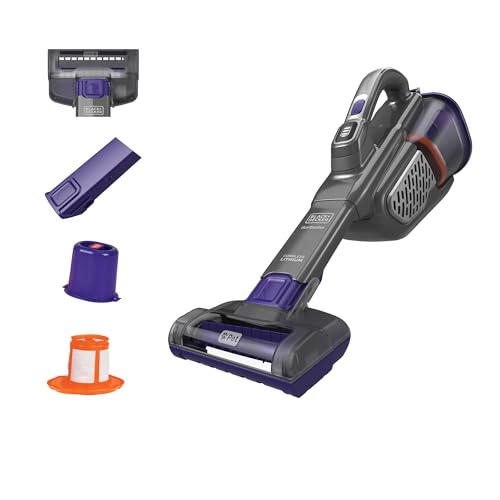
1. BLACK+DECKER dustbuster furbuster Pet Hair Vacuum — Best Overall for Cat Litter
Cat litter is a specific kind of mess: heavy granules that scatter in a radius around the box, fine dust that settles into grout and floor texture, and the occasional tracked trail down the hall. The furbuster is the dustbuster variant built for pet households — a cordless handheld with a motorized pet hair brush, rechargeable, portable, and listed with powerful suction. The motorized brush is what earns it the top spot here: litter dust and the fine clay film that builds up around a litter box do not lift with suction alone from hard floors, and a powered brush agitates that film loose while the vacuum takes in granules and tracked hair in the same pass.
Strengths
- Motorized pet hair brush agitates litter dust and the fine film around the box that suction-only handhelds leave behind.
- Cordless and rechargeable, so it lives by the litter box and deploys in the ten seconds the job actually takes.
- Built for pet messes generally, so the same tool handles tracked litter, scattered kibble and hair on the mat.
Trade-offs
- A handheld’s bin fills fast during a full litter-box-area deep clean; it is a daily-maintenance tool, not a whole-house vacuum.
- The motorized brush is meant for floors and mats — keep it off delicate surfaces you would not brush.
- Like all dustbusters, runtime is sized for spot jobs; a multi-room litter trail on one charge is its limit.
| Spec | Detail (from the listing) |
|---|---|
| Type | Cordless handheld vacuum |
| Brush | Motorized pet hair brush |
| Power | Rechargeable |
Think about how litter cleanup actually happens: nobody schedules it. You notice scatter when you feed the cat, and the vacuum that gets used is the one within arm’s reach that starts instantly. The furbuster’s whole design serves that moment — grab, run the brush around the box perimeter and over the mat, empty, dock. The brush roll matters more than raw suction claims for this job, because litter dust bonds lightly to hard floors and tile texture, and granules hide along baseboards where a plain suction nozzle bridges over them.
Position it honestly in your cleaning system: this is the daily driver that keeps the litter zone civilized between real cleans. Once a week, a full-size vacuum or a mop still owns the deep clean. But the daily scatter — the mess that makes a home feel like it smells of litter even when the box is clean — is exactly what this tool erases, and the pet-specific brush makes it better at that one job than the general-purpose dustbusters below.
Best for: cat owners who want one dedicated, brush-equipped handheld living next to the litter box / Not suited for: anyone expecting a handheld to replace a full-size vacuum for whole-home cleaning
Check the current price on Amazon

2. BLACK+DECKER dustbuster Reveal Pet Hair Vacuum — Best for Seeing Litter Dust
The Reveal’s distinguishing feature is in its name: an LED light on a cordless pet hair vacuum, sold with a pet brush and a crevice tool among its included accessories. Litter dust is nearly invisible on light tile and pale wood until the sun hits it at an angle — the LED solves the seeing problem, which is half the cleaning problem around a litter box. It is a handheld for home and car, rechargeable, with the listing claiming powerful suction, so the same unit that reveals dust under the box also handles the car seat after a vet trip.
Strengths
- LED light exposes the pale litter-dust film on light floors that you otherwise only find with your socks.
- Includes pet brush and crevice tool per the listing — the crevice tool is the right shape for litter trapped along baseboards and box edges.
- Home-and-car positioning makes it the natural second home for the tool between litter duty shifts.
Trade-offs
- The LED is a genuinely useful feature that also reveals every other dust problem in the room — prepare to clean more than you planned.
- Handheld bin capacity applies here too; a neglected litter corner will need two empties.
- Newer model positioning means it sits in a higher tier than the long-running classic dustbusters below.
| Spec | Detail (from the listing) |
|---|---|
| Type | Cordless handheld vacuum |
| Light | LED |
| Includes | Pet brush and crevice tool (per listing) |
Every cat owner knows the sock test: the litter area looks clean, and then a damp sock proves otherwise. Fine litter dust is pale, matte and spread thin, and ordinary room light hides it completely. A light at floor level, raking across the surface, turns that film visible — the same reason detailers and house cleaners work with lamps at low angles. The Reveal builds that lamp into the vacuum, so the seeing and the cleaning happen in one pass instead of two.
The accessory mix suits the litter zone specifically. Use the pet brush on the mat and the floor around the box, then switch to the crevice tool for the line where the box meets the wall and the grout channels where granules lodge. If your litter area is a laundry room or a tiled corner with pale flooring, this is the pick; on dark floors the LED matters less and the furbuster’s brush takes the lead.
Best for: owners with light-colored floors around the litter box, and anyone who cleans by the ‘looks clean, feels gritty’ standard / Not suited for: dark-floor households where litter dust is already visible and the LED adds little
Check the current price on Amazon

3. BLACK+DECKER dustbuster AdvancedClean Handheld Vacuum — Best Classic With Charging Station
The AdvancedClean is the long-running dustbuster formula done completely: a cordless handheld with a crevice tool, a rotating nozzle and a charging station included in the listing. The rotating nozzle is the litter-relevant detail — it angles the intake into the corners where the litter box meets the wall and where scatter collects against the baseboard, places a fixed straight nozzle skims over. The charging station matters for the same reason a litter scoop lives in a caddy: a tool with a home is a tool that is charged, present and used daily instead of found dead in a drawer.
Strengths
- Rotating nozzle reaches litter in corners, along baseboards and under the lip of the box where scatter settles.
- Charging station included, so the vacuum has a fixed home by the litter area and is always ready.
- Crevice tool included for the narrow channels — grout lines, mat edges, the gap behind the box — where granules lodge.
Trade-offs
- No motorized brush, so the fine dust film needs a slower pass or a follow-up wipe compared with the furbuster.
- An older, proven design means fewer headline features than the Reveal — no LED, no pet-specific brush.
- Handheld format and bin size keep it in spot-clean territory, like every pick here.
| Spec | Detail (from the listing) |
|---|---|
| Type | Cordless handheld vacuum |
| Nozzle | Rotating nozzle |
| Includes | Crevice tool and charging station (per listing) |
There is a reason this basic shape has sold for years: for the litter zone, the fundamentals are a nozzle that gets into corners, suction that starts instantly, and a dock that keeps the tool where the mess is. The AdvancedClean covers all three without asking you to pay for features aimed at other jobs. The rotating nozzle sounds minor until you clean around a litter box daily; the box lives in a corner, the scatter lives in the corner’s edges, and a nozzle that pivots to meet the floor-wall junction cleans in one motion what a fixed nozzle takes three angled attempts to reach.
Buy it as infrastructure. Mount or place the charging station in the litter room, keep the crevice tool on it, and the daily thirty-second cleanup becomes a habit instead of a project. In a multi-cat home, that habit is the difference between a litter area that is maintained and one that is periodically rescued.
Best for: households that want the proven dustbuster formula with a dock, for a fixed litter station / Not suited for: anyone who wants a motorized brush or an LED for the litter zone
Check the current price on Amazon

4. BLACK+DECKER dustbuster Handheld Vacuum, Wide Mouth (HHVI315JO42) — Best Wide Mouth for Pellets and Scatter
Most handhelds sip through a narrow nozzle; this dustbuster is listed with a wide mouth, and for litter that geometry is a real advantage. Pellet litters, crystal litters and the coarse scatter from a vigorous digger are chunkier than dust — a wide intake takes them in without the nozzle clogging or snowplowing granules ahead of it. The listing describes a cordless, rechargeable handheld with powerful suction for car and home, which matches the litter use case: frequent, short, wide sweeps across the scatter zone rather than precision work.
Strengths
- Wide mouth intake swallows pellet and crystal litter and heavy scatter without clogging or pushing granules ahead of the nozzle.
- Cordless and rechargeable for the grab-and-go rhythm litter cleanup demands.
- Simple, focused design — no accessory ecosystem to manage, just a wide intake and a bin.
Trade-offs
- A wide mouth is the wrong tool for edges and grout lines; baseboard litter still needs a crevice tool from another pick or a brush and pan.
- No powered brush, so fine dust film on hard floors needs a damp wipe to finish the job properly.
- Wide-mouth handhelds trade precision for volume — upholstery and car detailing are not its strengths.
| Spec | Detail (from the listing) |
|---|---|
| Type | Cordless handheld vacuum |
| Intake | Wide mouth |
| Power | Rechargeable |
Match the tool to your litter type and this pick explains itself. Fine clay litter mostly makes dust and light scatter, which brushes handle best. Pellet, crystal and coarse litters make debris — and debris defeats narrow nozzles, which jam a pellet sideways and then push the rest around the floor like a plow. A wide mouth simply ingests the scatter zone in a couple of broad passes. If your cat uses pellet litter, or digs like they are paid by the granule, this is the most satisfying tool in the roundup for the daily sweep.
It also earns a place as the second vacuum in a two-tool system: the wide mouth for the daily scatter field, a crevice-equipped model for the weekly edges. That sounds like a lot of handhelds until you price the alternative — dragging a full-size vacuum to the litter room every day, which in practice means it happens weekly and the scatter wins the other six days.
Best for: pellet, crystal and coarse-litter households, and enthusiastic diggers’ owners / Not suited for: anyone whose main litter problem is fine dust film or edge-and-grout detail work
Check the current price on Amazon

5. BLACK+DECKER dustbuster QuickClean Cordless Handheld Vacuum (HNVC215B10) — Best Compact Wall-Mount Pick
The QuickClean is the small, wall-mount dustbuster: a cordless handheld that stores on the wall, out of the way, in exactly the rooms where litter boxes live — laundry rooms, bathrooms, mudrooms and closets where floor and counter space are already spoken for. Wall mounting is not a cosmetic feature in a litter room; it is what makes a dedicated litter vacuum possible in a small space at all. The QuickClean’s job in this roundup is to be the vacuum that fits the room, charges on its mount, and handles the daily scatter without demanding a footprint.
Strengths
- Wall mount storage keeps it charged, visible and off the floor in small litter rooms where space is the constraint.
- Compact handheld format suits the tight geometry around a box tucked into a bathroom or laundry corner.
- Simple quick-clean positioning matches the daily scatter job — frequent, short, uncomplicated.
Trade-offs
- The compact format means a compact bin; heavy scatter days need an empty mid-job.
- No motorized brush or LED, so it is the maintenance tool, not the deep-clean tool, for the litter zone.
- Wall mounting needs a suitable wall and outlet position near the litter area to pay off.
| Spec | Detail (from the listing) |
|---|---|
| Type | Cordless handheld vacuum |
| Storage | Wall mount |
| Format | Compact |
Small-space cat keeping is a logistics problem: the box, the litter bin, the mat, the scoop — and then a vacuum that also wants a home. The QuickClean’s wall mount resolves the vacuum’s part of that problem completely, and a vacuum that is visibly hanging by the box gets used; a vacuum stored in another room’s closet gets used eventually. For apartment and small-home cat owners, that difference in friction is the whole ballgame for litter control.
Set expectations by the name: quick cleans. The scatter sweep after a box cleaning, the trail to the door, the mat shake-out zone — that is its shift. Pair it with a monthly visit from a full-size vacuum and the litter room stays ahead of the mess. If your litter area is a spacious utility room with a dock-friendly corner, the AdvancedClean above is the better buy; if the room is a closet with ambitions, this is the one.
Best for: apartments and small homes where the litter area has no spare floor or counter space / Not suited for: large multi-cat homes whose daily scatter volume outruns a compact bin
Check the current price on Amazon

6. BLACK+DECKER dustbuster Cordless Lithium Handheld Vacuum (HNV220BCZ10FF) — Best Everyday Lithium Handheld
The HNV220BCZ10 dustbuster is the everyday lithium-ion handheld in the line, sold with a wall mount base and charger in the listing. Lithium power is the relevant upgrade for litter duty: it holds its charge on the mount between uses and delivers consistent suction across the short jobs litter cleanup consists of, instead of the fade that older battery chemistries showed as they aged. In white, it also suits bathroom and laundry-room litter stations where a black appliance reads as visual clutter. It is the generalist of the roundup — no pet brush, no LED, no wide mouth — and its case rests on being the reliable, always-ready baseline tool.
Strengths
- Lithium-ion power holds charge on the mount and keeps suction consistent across short daily jobs.
- Wall mount base and charger included per the listing, so the litter-station setup is complete out of the box.
- White finish suits bathroom and laundry litter areas where the vacuum lives in plain sight.
Trade-offs
- Generalist tool: no motorized brush for dust film, no wide mouth for pellets, no crevice-focused rotating nozzle.
- Handheld bin and runtime sized for spot work, like every pick in this guide.
- If you only clean litter with it, the specialized picks above each beat it at one specific litter job.
| Spec | Detail (from the listing) |
|---|---|
| Type | Cordless handheld vacuum |
| Battery | Lithium-ion (per listing) |
| Includes | Wall mount base and charger (per listing) |
Why include a generalist in a specialist roundup? Because many litter areas share their vacuum with the rest of the home’s small messes — the entryway grit, the kitchen crumbs, the car footwell — and a household buying one handheld for all of it should buy the one with the battery chemistry that tolerates being mounted, charged and grabbed twenty times a week. Lithium’s tolerance for partial use and long standby is exactly the duty cycle of a litter-room vacuum.
It is also the safest recommendation for a first dedicated litter vacuum when you do not yet know your litter problem’s shape. Live with it for a month and the gaps will announce themselves: dust film you cannot lift means add the furbuster’s brush; pellets jamming means add the wide mouth. Most owners, honestly, will find the baseline tool plus a mat and a routine is enough — which is why this unglamorous model closes the list.
Best for: households wanting one mounted, always-ready handheld for litter plus everyday small messes / Not suited for: owners who already know their litter problem is dust film, pellets or edges specifically
Check the current price on Amazon
Comparison Table
| Pick | Badge | Key spec | Best for |
|---|---|---|---|
| dustbuster furbuster Pet | Best Overall for Cat Litter | Motorized pet brush | Clay litter dust and daily scatter |
| dustbuster Reveal Pet | Best for Seeing Litter Dust | LED light, pet brush + crevice tool | Pale floors, tiled litter corners |
| dustbuster AdvancedClean | Best Classic With Charging Station | Rotating nozzle, charging station | Fixed litter station, corner boxes |
| dustbuster Wide Mouth HHVI315JO42 | Best Wide Mouth for Pellets | Wide mouth intake | Pellet and crystal litter scatter |
| dustbuster QuickClean HNVC215B10 | Best Compact Wall-Mount Pick | Wall mount, compact | Small litter rooms and apartments |
| dustbuster Lithium HNV220BCZ10FF | Best Everyday Lithium Handheld | Lithium-ion, wall mount base | One handheld for litter plus small messes |
How to Choose a Vacuum for Cat Litter
Identify your litter type first. Fine clay litter makes dust film and light scatter — prioritize a brush. Pellet, crystal and coarse litters make debris — prioritize intake width. Paper and grass litters track far and light — prioritize a vacuum that lives where the trail ends, which usually means the most mountable model wins. The litter bag in your closet decides more about the right vacuum than any specification sheet.
Then audit the room. Where will the vacuum live? A laundry room with a free corner suits a charging station. A bathroom closet suits a wall mount. A box in a hallway suits whichever model you will tolerate seeing daily, because a hidden vacuum is an unused one. Measure the litter zone’s edges too: boxes wedged into corners and against baseboards argue for a crevice tool or rotating nozzle in the kit.
Finally, plan the two-layer system. Handheld daily, full clean weekly. If you currently own no full-size vacuum, be honest that the handheld will be stretched beyond its design for a while, and choose the largest-bin, brush-equipped model — the furbuster — as the least-bad single tool. If you do own a full-size machine, the handheld choice gets easier: pick purely for daily convenience and storage fit.
How to Set Up a Litter Station That Stays Clean
Start with the mat: a textured litter-trapping mat under and in front of the box catches the majority of tracked granules before they reach the floor, and every pick in this guide vacuums a mat more easily than a bare floor. Place the box so one side is open for the cat and one edge is reachable by you; a box sealed into a corner by furniture creates exactly the unreachable edges where litter accumulates. Mount or dock the vacuum within arm’s reach of the box — on the wall beside it, or on its station in the same room — and keep the crevice tool attached or adjacent, not in a box of accessories elsewhere.
Build the thirty-second routine: when you scoop, sweep. Run the handheld around the box perimeter, across the mat, and along the exit trail the cat actually walks. Empty the bin into the litter waste at the same moment, so the vacuum is never stored full. Once a week, do the edges properly — crevice tool along the baseboards, behind the box, and into grout lines — and damp-wipe the dust film the brush loosened. That rhythm, honestly kept, is the entire secret; the vacuum model matters less than the routine it enables, which is why storage format gets so much weight in this guide.
A word on noise and the cat’s vote. Handhelds are loud in a small room, and a vacuum that terrifies the cat into avoiding the litter area creates a worse problem than litter scatter. Run the daily pass when the cat is elsewhere, keep sessions short, and never chase the trail toward the cat. Most cats habituate quickly to a thirty-second routine that never approaches them; what they remember is being cornered. If your cat is genuinely sound-sensitive, the quietest strategy is timing — vacuum during the post-meal nap in another room — rather than any equipment change, because every pick in this guide is a real vacuum with a real motor.
And a word on guests, because it motivates many buyers: the litter area is the room guests judge. A kept perimeter, a clean mat and no grit underfoot read as ‘this home is clean’ far more than any air freshener. That is the actual product being bought here — not suction, but the confidence that the litter room can be walked into barefoot, by you or by a visitor, on any day of the week. Choose the pick that makes the daily pass effortless in your specific room, and that confidence follows.
Common Buying Mistakes
Buying a big vacuum for a small daily mess. A full-size machine dragged out daily will, in practice, be dragged out weekly. The litter wins the other six days. Buy the handheld for the daily job.
Ignoring litter type. A narrow-nozzle precision tool in a pellet-litter home clogs and frustrates; a wide mouth in a clay-dust home leaves the film. Match intake and brush to the litter in your closet.
Storing the vacuum in another room. Distance is the enemy. If the vacuum is not in the litter room, mounted or docked, it will not be used at litter frequency.
Skipping the mat. Owners blame vacuums for tracking that a mat would have halved. The mat is part of the vacuum system; budget for both.
Expecting suction claims to rank these tools. Litter is heavy debris that any of these models ingests. Geometry — brush, mouth width, nozzle shape — is what differs, and geometry is what to buy.
Cost of ownership, briefly: a dustbuster litter system has almost none beyond the purchase. There are no bags in these models, filters are washable or long-lived when tapped out regularly, and the electricity involved in thirty-second daily runs is negligible. The realistic consumable is time — your thirty seconds — and the realistic failure is neglect of the filter, covered above. Compared with the ongoing cost of litter itself, the vacuum is a rounding error, which is another reason to buy the model that fits your room and litter rather than the cheapest unit on the shelf: the price difference amortizes to nothing over the years of daily use, while the friction difference is paid every single day.
Final Recommendation
For most cat owners, the furbuster pet model is the buy: the motorized brush handles the dust film that defines the litter problem, and it lives happily on daily duty. Pale-floor homes should take the Reveal for its LED, pellet-litter homes the wide mouth dustbuster, small spaces the wall-mounted QuickClean, and anyone setting up a fixed litter station with a dock the AdvancedClean. The lithium handheld is the safe generalist when the vacuum must serve the whole home’s small messes too. Check the current price on Amazon for the one that matches your litter.
More vacuum guidance from the same program: Best B And D Hand Held Cordless Vacuums, Best Hand Held Vacuums For Dog Hair, Best Cordless Hand Held Vacuums For Stairs, Best Handheld Vacuums For House, and Best Bagged Vacuums For Pet Hair.
Litter Types, Matched to Tools
Clumping clay, the most common litter, produces the full spectrum of mess: coarse scatter near the box, a mid-zone of tracked granules, and a far film of fine dust that migrates on socks and air currents. It is the litter the furbuster and the Reveal were born for — brush for the film, light for finding it, and any intake for the granules themselves. Non-clumping clay behaves similarly with slightly less dust. Silica crystal litter makes almost no dust but scatters far and hard; crystals are the wide mouth’s home turf, and a mat matters even more because a rolling crystal travels. Pellet litters — pine, paper, walnut — produce the chunkiest debris and the least film; again the wide mouth leads, and brushes matter least. Grass seed and tofu litters are light and track far on static and paws; for them the best vacuum is whichever one is mounted closest to the trail’s end, which is why the QuickClean and the lithium model stay relevant even without specialist features.
Two litters deserve a caution. Flushable and fine natural litters can turn gummy with any moisture, and a gummy granule in a handheld’s bin or filter is a smell that stays; empty promptly and keep the bin dry. And any litter in a carpeted room changes the calculus: the daily handheld still owns the surface, but schedule the full-size vacuum’s beater bar weekly, because granules work down into pile where no handheld reaches. Matching tool to litter is not fussiness — it is the difference between a vacuum that feels designed for your home and one that feels like a compromise you tolerate.
Caring for a Handheld That Lives in a Litter Room
A litter-room vacuum works in the dustiest microclimate in the house, and its maintenance rhythm should reflect that. Empty the bin after every use — litter dust is fine enough to pack into filter pleats, and a bin left full is a bin whose contents migrate into the filter. Tap or rinse the filter on the schedule the manual sets, and actually do it: most ‘my handheld lost suction’ stories are filter stories, and litter dust accelerates them. If your model uses a washable filter, let it dry completely before refitting; a damp filter in a litter room becomes a smell amplifier.
Brush-equipped models need one extra minute a week: clear the brush roll of the hair and string that wrap it, because a furbuster that cannot spin its brush is just a suction nozzle with ambitions. Check the intake path monthly for the pellet or crystal that wedged sideways and halved the airflow. Store the vacuum mounted or docked, never loose on the litter-room floor where it becomes another obstacle gathering dust. Five small habits, and the tool you bought for a daily thirty-second job will keep doing it for years instead of fading into the appliance graveyard by spring.
The Litter Box Itself: Placement Choices That Cut Your Vacuuming in Half
The cheapest litter-vacuum upgrade is not a vacuum. A high-sided or top-entry box throws less scatter. A box placed with its entrance facing a wall or a mat channel forces exiting paws across the mat instead of onto open floor. A mat that extends a full cat-length beyond the entrance catches the second and third paw-steps, where most granules actually drop. Even the litter depth matters: an overfilled box is a scatter fountain, while a level three-inch fill digs cleanly and throws little. None of this replaces the daily handheld pass — but owners who fix placement first routinely report that the pass shrinks from a room-wide patrol to a one-minute perimeter sweep, which is the difference between a routine that survives busy weeks and one that quietly dies.
Multi-Cat Homes: Scaling the System
Everything in this guide scales with cat count, but not linearly. Two cats in one box roughly double the scatter; two boxes in two rooms change the problem’s shape entirely, because now the vacuum has to be in two places. The honest multi-room answer is either the wall-mount strategy — a QuickClean at the second station — or accepting one ‘home base’ vacuum and a scoop-and-mat routine at the satellite box. What does not scale is bin neglect: multi-cat litter dust loads filters faster, so the filter rhythm in the care section above should be tightened, not loosened, as cats are added. Multi-cat owners also feel the dust film most, since more paws track it further; the brush-equipped furbuster earns its top ranking again here, and the weekly full-size pass stops being optional. Budget-wise, the dustbuster strategy stays kind: even two handhelds, one per station, cost less in money and vastly less in daily effort than one premium full-size machine asked to patrol two litter rooms.
Frequently Asked Questions
Can a handheld vacuum really handle cat litter?
Yes — litter is the ideal handheld job. Granules are heavy, dry and localized, and the mess appears in small daily amounts around one spot. A cordless handheld stored at the litter station handles that better than a full-size vacuum precisely because it gets used every day instead of weekly.
Which BLACK+DECKER model is best for clay litter dust?
The furbuster, because its motorized brush agitates the fine film that clay litter leaves on hard floors. Suction-only models pick up the granules but skate over the film; the Reveal’s LED is the other clay-dust weapon, since it makes the film visible on pale floors.
What about pellet or crystal litter?
Choose intake width over brushes. The wide mouth dustbuster ingests pellets and crystals without clogging or plowing them across the floor, which is the failure mode of narrow nozzles on coarse litter.
How often should I empty the bin?
Every use is the right habit — it takes seconds while you are already disposing of scoop waste, and a bin stored full loses suction and smells of the litter room. The bin is small because the job is daily.
Will these vacuums pick litter out of carpet?
They will lift surface scatter from low carpet and mats, especially the brush-equipped furbuster. Litter worked deep into pile is a job for your full-size vacuum’s weekly pass; the handheld’s role is preventing that buildup from forming.
Is a robot vacuum a better answer for litter?
It is a different answer: robots patrol open floors well but cannot do the box perimeter, the mat’s texture or the baseboard line where litter concentrates, and litter can be rough on their brushes. Most litter rooms end up best served by the handheld-at-the-station system in this guide, with or without a robot elsewhere in the home.
How long do dustbuster batteries last on litter duty?
Litter duty is the gentlest duty cycle a handheld battery can have: short bursts, long rests on the charger, no deep discharges. Lithium models like the HNV220BCZ10 in this guide are particularly well suited to that pattern, holding charge on the mount and avoiding the memory effects of older chemistries. Expect years of service from the battery when the tool is used as intended — daily and briefly — rather than run flat on whole-house jobs.
Can I use one of these for the whole apartment instead?
You can, briefly and unhappily. These are spot tools with small bins; a whole-apartment clean means many empties and a filter loaded with dust. If a handheld must be your only vacuum for a while, the brush-equipped furbuster is the least-bad choice, but plan on adding a full-size machine when you can — the two-layer system in this guide exists because each tool is genuinely better at its own layer.
Where should the litter vacuum be stored?
In the litter room, mounted or docked, within arm’s reach of the box. Storage location is the single strongest predictor of whether a litter vacuum gets used daily. A wall mount suits small rooms, a charging station suits a free corner — both appear among the picks — but a closet in another room defeats any model.


