Disclosure: airfryerkitchensupply.com is reader-supported. When you buy through links on our site, we may earn an affiliate commission at no extra cost to you.
Where to buy
The fastest way to shop this list is to start with the top pick for your situation, then compare the runner-up in the same tier. Every linked pick below was matched against the Amazon catalog data available to us at research time, so use the links to check the current configuration, size and color before you order. If a pick is described in words rather than linked, that is deliberate: it means we could not confirm a clean catalog match for it, and we would rather point you at the right kind of product than send you to the wrong listing.
Jumbo Vacuum Storage Bags, 12 Pack (Best Compression System): Check the current price on Amazon.
Amazon Basics Vacuum Storage Bags, X-Jumbo, 4 Pack (Best Brand-Name Compression): Check the current price on Amazon.
SLEEPING LAMB 120L Extra Large Blanket Storage Bags (Best Breathable Blanket Storage): Check the current price on Amazon.
StorageWorks Low Profile Under Bed Storage Containers (Best Under-Bed, Structured): Check the current price on Amazon.
Lifewit 90L Large Storage Bags, 6 Pack (Best Closet System): Check the current price on Amazon.
ZOBER Under Bed Storage Bags, 90L, 4 Pack (Best Under-Bed, Soft): Check the current price on Amazon.
The best storage solution for clothes and blankets is not one product — it is the right container for the right fabric in the right space. Vacuum bags compress bulky comforters and off-season clothing to a fraction of their loft; breathable fabric bins protect blankets you still reach for; under-bed containers reclaim the largest dead space in most homes. This list verifies six real, distinct storage products and assigns each to the job it actually does best, so you can build a system instead of buying a pile of mismatched bags.
Two honesty rules shaped the picks. First, compression is not free: vacuum storage is brilliant for duvets, comforters and puffer jackets, and genuinely unkind to delicate knits, leather and anything with a structure you want to keep — those belong in the breathable options here. Second, capacity claims in this category are marketing poetry; where a listing states a measurable size — liters, dimensions, bag count — we quote it, and where it does not, we say what the container is for rather than inventing a number.
Every pick is a complete storage product for clothes or blankets: bags, bins and under-bed containers. Vacuum sealer machines for food, moving blankets and furniture pads also live in this corner of the catalog and were excluded — they answer different questions.
In this guide
Quick Picks
If you only have a minute, here is the short version of the best storage solution for clothes and blankets shortlist. Each pick earned its badge for a different reason, and the detailed reviews further down explain the trade-offs behind every one of them.
- Jumbo Vacuum Storage Bags, 12 Pack — Best Compression System. Twelve jumbo vacuum bags aimed squarely at blankets, comforters and pillows — the seasonal-swap workhorse. — check price on Amazon
- Amazon Basics Vacuum Storage Bags, X-Jumbo, 4 Pack — Best Brand-Name Compression. X-jumbo Amazon Basics vacuum bags with a hand pump included — compression without hunting for the vacuum cleaner. — check price on Amazon
- SLEEPING LAMB 120L Extra Large Blanket Storage Bags — Best Breathable Blanket Storage. A breathable 120L fabric container with reinforced handles, sized for a king comforter — no crushing, no vacuum. — check price on Amazon
- StorageWorks Low Profile Under Bed Storage Containers — Best Under-Bed, Structured. Six-inch low-profile under-bed containers with clear lids, reinforced structure and label holders. — check price on Amazon
- Lifewit 90L Large Storage Bags, 6 Pack — Best Closet System. Six 90L fabric closet bins with lids and reinforced handles — a uniform wardrobe of storage for shelves and closet floors. — check price on Amazon
- ZOBER Under Bed Storage Bags, 90L, 4 Pack — Best Under-Bed, Soft. Four 90L soft under-bed bags with clear tops and dual zippers — the flexible alternative to structured containers. — check price on Amazon
Key Takeaways
- Vacuum bags for bulky, resilient items: comforters, duvets, puffer jackets, spare pillows.
- Breathable fabric bins for blankets and knits you access often or that should not be crushed.
- Under-bed containers turn the biggest dead space in the home into the seasonal wardrobe.
- Stated capacities here run from 35L organizers to 120L blanket bags — match the container to the load, not the headline.
- Label and photograph every sealed bag; a compressed bag’s contents are invisible by design.
How These Picks Were Chosen
We organized the category by storage physics rather than brand: compression storage, breathable soft storage, and rigid or semi-rigid under-bed storage. A valid list for this search has to cover all three, because clothes and blankets fail in different ways — crushed, musty, or simply lost in an unmarked bag at the back of a closet.
We kept complete storage products only and rejected food vacuum sealers, moving blankets and generic baskets whose listings do not address clothes or blanket storage. Where two cached listings were the same product family in different pack counts, we kept one representative to avoid padding.
Capacities and dimensions are quoted only from the listings themselves. Several listings state their space-saving percentage; we report those as the makers’ claims in the sources context, not as measurements of our own.
The 6 Best Storage Solutions for Clothes and Blankets

Jumbo Vacuum Storage Bags, 12 Pack — Best Compression System
This 12-pack is the compression anchor of the list: jumbo vacuum bags whose listing names blankets, bedding, comforters and pillows as their purpose, with the maker’s stated space-saving figure of 80% for bulky bedding. Twelve bags is the right count for a household seasonal swap — roughly a bag per comforter or per two blankets — so the whole winter layer can go away in one session and come back labeled.
Strengths
- Jumbo format sized for comforters and blankets, per the listing
- 12 bags covers a full household seasonal rotation
- Vacuum compression reclaims closet and loft space dramatically
Trade-offs
- Compression is wrong for delicate knits, leather and structured garments
- A punctured or badly sealed bag silently re-inflates over weeks
- Contents are invisible once sealed — labeling is on you
| Format | Vacuum storage bags, jumbo |
| Count | 12 bags (per listing) |
| Intended for | Blankets, comforters, pillows, bedding (per listing) |
| Maker’s claim | 80% space-saving for bulky bedding (per listing) |
The physics is the appeal: a comforter is mostly air, and a vacuum bag removes the air. What remains is flat, stackable and light enough to shelve high. The discipline is in the sorting — this system should swallow duvets, spare blankets, beach towels and puffer jackets, and it should never be fed the hand-knit throw, the leather jacket or the good wool coat, which compression creases and stresses in ways a season of storage makes permanent.
Work bag by bag, room by room, and write the contents on the bag with a marker before sealing, plus a phone photo of each filled bag. Future you, standing in the loft in November, will be grateful in direct proportion to how boringly systematic present you was.
Best for: Seasonal comforters, duvets and bulky bedding / Not suited for: Delicate, structured or frequently accessed items
Check on Amazon to see the current configuration and check price on Amazon before ordering.

Amazon Basics Vacuum Storage Bags, X-Jumbo, 4 Pack — Best Brand-Name Compression
The Amazon Basics entry competes on completeness: X-jumbo bags for blankets and clothes packing, with a hand pump included in the pack per the listing. The pump matters more than it sounds — it frees the system from the vacuum cleaner’s hose, which makes small, frequent compressions (one guest duvet, one returning holiday sweater box) practical instead of a production.
Strengths
- Hand pump included — compress anywhere, no vacuum hose needed
- X-jumbo size for the largest comforters and blanket sets
- Four-pack suits a single bed’s seasonal swap or a guest set
Trade-offs
- Four bags is a starter count; whole-house swaps need more
- Hand-pumping a jumbo bag is real arm work compared with a vacuum hose
- Same compression cautions: keep delicates out
| Format | Vacuum storage bags, X-jumbo |
| Count | 4 bags (per listing) |
| Included | Hand pump (per listing) |
| Intended for | Blankets and clothes packing (per listing) |
Choose this pack when your storage problem is one or two huge items rather than a whole wardrobe: the king comforter that eats a closet shelf, the guest bedding that lives in a hallway cupboard. The X-jumbo format takes them whole, without folding gymnastics, and the pump means the bag can be re-compressed in the room where it will be stored.
It is also the sensible first purchase for a vacuum-storage skeptic: four bags is enough to learn whether your fabrics and your patience suit compression, before committing to a twelve-bag system.
Best for: One or two oversized comforters; first-time compression users / Not suited for: Whole-household seasonal swaps
Check on Amazon to see the current configuration and check price on Amazon before ordering.
SLEEPING LAMB 120L Extra Large Blanket Storage Bags — Best Breathable Blanket Storage
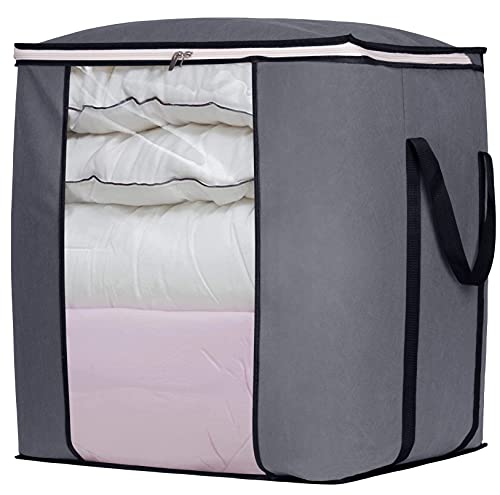
The SLEEPING LAMB bag is the breathable counterweight to the vacuum picks: a stated 120 liters of soft-sided storage, explicitly breathable per the listing, with reinforced handles, sized by its maker for a king comforter plus bedding, pillows and sheets. Breathability is the feature with a real argument behind it — natural fibers and down prefer air exchange over a sealed season, and a blanket you might pull out on a cold snap should not require a vacuum and a hose to access.
Strengths
- Stated 120L capacity — king-comforter scale
- Breathable fabric suits natural fibers and frequent access
- Reinforced handles for a heavy, full load
Trade-offs
- No compression: a full bag is a big bag, and shelves must fit it
- Soft sides stack less neatly than rigid bins
- Not airtight — not the choice for damp-prone storage spaces
| Capacity (listing) | 120 L |
| Construction | Breathable fabric container (per listing) |
| Handles | Reinforced (per listing) |
| Intended for | King comforter, bedding, pillows, sheets, clothes (per listing) |
This is the right home for the good blankets: the wool throw, the down comforter in its off season, the quilt with a family history. They rest at natural loft, in moving air, and they come out smelling like a closet rather than like a vacuum bag. The handles are not decoration — a 120L bag of bedding is an armful, and reinforced handles are the difference between carrying it and dragging it.
Place it where air moves: a bedroom closet shelf or under a bed with clearance, rather than a sealed plastic tub in a damp garage. Breathable storage assumes a dry room, and rewards it.
Best for: King comforters, wool and down blankets, heirloom quilts / Not suited for: Damp storage spaces or maximum space saving
Check on Amazon to see the current configuration and check price on Amazon before ordering.

StorageWorks Low Profile Under Bed Storage Containers — Best Under-Bed, Structured
Under-bed space is the largest storage most homes waste, and it has one hard rule: height. The StorageWorks containers state a 6-inch low profile, which fits the clearance under most standard bed frames, and they add the details that separate a system from a shove: a clear lid so contents are visible, a reinforced structure that resists sagging, handles, and a label holder. The listing names clothes and blankets among their intended contents.
Strengths
- Stated 6-inch profile fits most bed-frame clearances
- Clear lid plus label holder — contents identifiable at a glance
- Reinforced structure resists the sag that jams soft bags under beds
Trade-offs
- Measure your frame’s clearance first; 6 inches is low, not universal
- Structured containers hold less than a same-footprint soft bag
- Lids and structure cost more than bag-style under-bed storage
| Profile (listing) | 6 inch low profile |
| Lid | Clear (per listing) |
| Structure | Reinforced, resists sagging (per listing) |
| Extras | Handles and label holder (per listing) |
The under-bed zone fails in a predictable way: soft bags get shoved in, sag, snag on the frame, and become a excavation project. A low, structured container with a lid slides like a drawer, and the label holder means the sweater bin and the blanket bin stop being a guessing game. For clothes and blankets you rotate seasonally — out-of-season sweaters under the bed in summer, spare blankets in winter — this is the most civilized format on the list.
Reserve it for the bed you sleep in rather than a guest bed: the whole point is weekly-life access, and a container you slide out without waking anyone is a container that gets used properly.
Best for: Seasonal clothes and blankets under standard frames / Not suited for: Very low platform frames under 6 inches of clearance
Check on Amazon to see the current configuration and check price on Amazon before ordering.

Lifewit 90L Large Storage Bags, 6 Pack — Best Closet System
The Lifewit set is the closet-system pick: six matching 90L fabric bins with lids, foldable when empty, with reinforced handles, intended per the listing for clothing, blankets, bedding and comforters. Uniformity is the system’s value — six identical bins turn a chaotic closet floor or top shelf into a grid you can label by season and person, and 90L per bin is the versatile middle size: a folded blanket stack, a season of sweaters, a child’s outgrown-but-kept clothes.
Strengths
- Six matching 90L bins build a real closet system
- Lids keep dust off stored textiles
- Foldable when empty; reinforced handles for full loads
Trade-offs
- Fabric bins are breathable, not airtight — dry rooms only
- 90L bins full of blankets are heavy; handles help, physics remains
- Soft sides need a shelf or floor, not stacking under weight
| Capacity (listing) | 90 L per bag |
| Count | 6 pack (per listing) |
| Construction | Foldable fabric bins with lids (per listing) |
| Intended for | Clothing, blankets, bedding, comforters (per listing) |
The closet-floor problem in most homes is not space but entropy: bags of different shapes slump into each other until retrieving anything means moving everything. A run of identical lidded bins ends that — each bin is a category, each category has a place, and the seasonal swap becomes a matter of exchanging bin positions rather than re-stuffing irregular sacks.
Assign them deliberately: two for blankets and bedding, two for off-season clothes, one for the children’s keep-box, one flex. Write the assignment on the bin, not in your memory, and the system survives other people putting things away.
Best for: Closet shelves and floors; whole-wardrobe organization / Not suited for: Airtight or damp-proof storage needs
Check on Amazon to see the current configuration and check price on Amazon before ordering.

ZOBER Under Bed Storage Bags, 90L, 4 Pack — Best Under-Bed, Soft
The ZOBER bags are the soft-format answer to the same under-bed question: 90L per bag in a four-pack, non-woven fabric, foldable, with a clear top for visibility, dual zippers and reinforced handles, intended for clothes and blankets per the listing. Where the StorageWorks containers win on structure, these win on forgiveness — a soft bag conforms to an awkward frame, squeezes past a center leg, and folds away to nothing when empty.
Strengths
- Clear top keeps contents visible without opening
- Dual zippers open wide for bulky blankets
- Soft format fits awkward frames and folds away empty
Trade-offs
- Soft bags can sag and snag; pull by the handles, not the fabric
- Non-woven fabric is light-duty versus woven containers
- No rigid protection for anything crushable
| Capacity (listing) | 90 L per bag |
| Count | 4 pack (per listing) |
| Material | Non-woven fabric (per listing) |
| Access | Dual zippers; clear top (per listing) |
Choose soft under-bed bags when the bed frame is low, leggy or irregular — platform frames and storage beds often leave pockets that a rigid container cannot use and a soft bag fills happily. The clear top is the feature you will thank monthly: a glance tells you which bag holds the spare blankets without unzipping four bags on the floor.
Keep the loads textile-only and evenly filled, and slide them on a smooth floor or a low-friction surface; treated gently, the format’s convenience comfortably outweighs its softness. Treated as a drag bag across rough flooring, it will not — the handles exist for a reason.
Best for: Low or irregular bed frames; flexible under-bed loads / Not suited for: Crush protection or rough-floor dragging
Check on Amazon to see the current configuration and check price on Amazon before ordering.
Comparison Table
| Pick | Badge | Key spec | Best for |
|---|---|---|---|
| Jumbo Vacuum Storage Bags, 12 Pack | Best Compression System | 12 jumbo vacuum bags | Seasonal comforters, duvets and bulky bedding |
| Amazon Basics Vacuum Storage Bags, X-Jumbo, 4 Pack | Best Brand-Name Compression | X-jumbo vacuum bags with hand pump, 4-pack | One or two oversized comforters; first-time compression users |
| SLEEPING LAMB 120L Extra Large Blanket Storage Bags | Best Breathable Blanket Storage | 120L breathable blanket bag | King comforters, wool and down blankets, heirloom quilts |
| StorageWorks Low Profile Under Bed Storage Containers | Best Under-Bed, Structured | 6 in under-bed container, clear lid | Seasonal clothes and blankets under standard frames |
| Lifewit 90L Large Storage Bags, 6 Pack | Best Closet System | 90L fabric bins with lids, 6-pack | Closet shelves and floors; whole-wardrobe organization |
| ZOBER Under Bed Storage Bags, 90L, 4 Pack | Best Under-Bed, Soft | 90L soft under-bed bags, 4-pack | Low or irregular bed frames; flexible under-bed loads |
How to Choose: Compression, Breathable or Under-Bed
Sort your textiles before you sort containers, into three honest piles. Pile one — bulky and resilient: synthetic and down comforters you can spare, spare pillows, puffer jackets, beach towels. These are vacuum-bag candidates, and they will give you back the most space per dollar. Pile two — valued and delicate: wool blankets, heirloom quilts, good knits, anything structured. These go in breathable storage, at natural loft, in a dry room. Pile three — seasonal rotation: the clothes and blankets that swap twice a year and need dignified access. These belong in lidded bins or under-bed containers where you can reach them without a ceremony.
Then measure the spaces, because containers fail on millimeters: under-bed clearance in inches, shelf depth, the loft hatch’s awkward angle. The listings here state their key dimensions or capacities — 6-inch profile, 90L, 120L — and those stated figures are the ones to plan against. A storage system that fits is a system; one that almost fits is clutter with handles.
Finally, count access frequency. Anything you touch monthly should be breathable, lidded and reachable; anything you touch twice a year can be compressed and shelved high. Most storage misery comes from inverting that rule.
What Vacuum Storage Does to Fabrics, Honestly
Compression removes air, and with it, loft — temporarily for resilient fills, sometimes permanently for delicate ones. Synthetic comforter fills and most puffer insulation recover well when the bag is opened and the item is shaken and aired. Down recovers if it was clean and dry when sealed and is given time and a gentle tumble. Wool and hand-knits are the cautionary tale: a season fully compressed can set creases and stress fibers, which is why this list keeps a breathable 120L option in the top tier rather than treating vacuum bags as a universal answer.
Moisture is the second law: never seal anything even slightly damp. A vacuum bag is a sealed microclimate, and trapped moisture in a warm closet becomes mildew with no ventilation to save it. Wash, dry completely — then one more hour of air — and only then compress. The same rule, gentler, applies to breathable bins in damp rooms: breathable storage assumes the room’s air is worth breathing.
Labeling: The Step That Decides Whether Storage Works
Every container on this list is opaque, clear-topped or compressed — in all three cases, its contents are a memory test you will eventually fail. The systems that work share one habit: the label goes on when the container is filled, in the format of the person retrieving it. ‘Winter blankets — king + spare room’ beats ‘blankets’ the first time a guest bed needs making in the dark.
A phone photo of each filled, open container, kept in a single album, is the modern version of the same habit and costs ninety seconds per container. Between the label and the photo, a household’s stored textiles become an inventory instead of an archaeology project.
Digital redundancy helps the analog system: keep the container photos and a one-line inventory in a notes file named for the room, and update it at each swap. When a pipe leaks or a move is announced, that small file becomes the household’s fastest answer to ‘what do we own and where is it’ — a question that is otherwise only ever asked under stress.
The Seasonal Swap, Done as a System
Twice a year, most homes perform the same ritual badly: hauling textiles down in a panic when the weather turns. Run as a system with these containers, the swap has a shape. Wash and fully dry the outgoing season. Sort into the three piles from the buying guide. Compress the resilient bulk into the jumbo vacuum bags, one labeled bag per bed or per category. Rest the valued pieces in the breathable bags at natural loft. Slide the incoming season’s rotation pieces into the under-bed containers and closet bins, labels out.
The swap’s hidden dividend is the audit: twice a year you handle every stored textile you own, which is when the stained blanket gets washed properly, the torn duvet cover gets retired, and the bag of baby clothes gets its honest decision. Storage systems do not just hold things; at their best, they schedule the moments when you reconsider holding them.
Small Homes: Storage as Square Footage
In a small apartment, storage containers are not accessories — they are the cheapest square footage available. The under-bed zone of a single bed is roughly the footprint of a small closet, which is why two of the six picks compete for it. The vacuum bags convert vertical closet air into usable shelf. The closet bins convert a slumping floor pile into a labeled grid. Combined deliberately, a one-bedroom home can hold a full four-season textile inventory without a single storage unit across town.
The discipline that makes it work is the same at small scale as at large: every container has a category, every category has a container, and anything that fits neither gets a decision rather than a hiding place. The moment a miscellaneous bag appears, the system has started its slow slide back into archaeology.
Protecting Textiles From Their Real Enemies
Stored clothes and blankets are rarely ruined by the container; they are ruined by moisture, pests and light, in that order. Moisture is handled by the dry-before-storing rule and by keeping breathable storage in dry rooms. Pests — principally clothes moths — target natural fibers that were stored with skin oils and food traces on them, which is why the wash-before-storing step is pest control, not fussiness; clean wool in a closed bin is a far smaller target than worn wool in an open pile. Light fades whatever it touches through a window, so stored textiles belong in closed containers or dark closets, both of which every pick here provides.
What no container here claims — and what you should not assume — is airtight or waterproof protection. For a damp basement or a garage with a history of leaks, the correct move is to store textiles somewhere else in the house, in these containers, rather than to ask any fabric bag or bin to be a submarine.
Moving House and Long-Term Storage: Where the Rules Tighten
A move compresses every storage mistake into one expensive week, and the system in this guide doubles as the moving system with two tightenings. First, vacuum bags earn their keep twice in a move — the same compression that reclaims a closet reclaims van space — but bags that will be stacked under boxes should be the season’s resilient items only, because a puncture under load re-inflates a bag into exactly the space you no longer have. Second, labels stop being a convenience and become the manifest: room, contents and priority on every container is the difference between a first night with bedding and a first night of excavation.
For storage measured in years rather than seasons — a deployment, a long rental of the house, a child’s things kept for a sibling — breathable beats sealed for almost everything, because years amplify whatever microclimate you created on packing day. Wash, dry, air, rest at loft, in the driest room available, and schedule a yearly opening of the breathable containers to air their contents. Textiles survive decades in such care; they survive months in a damp sealed bag.
Kids’ Clothes, Keepsakes and the Sentimental Pile
The hardest storage category in most homes is not seasonal — it is sentimental: outgrown children’s clothes kept for a sibling or a memory, a grandparent’s quilt, the blanket from a first apartment. These items fail differently. They are stored longest, handled least, and mourned most if damaged, so they deserve the system’s best treatment rather than its leftovers: washed, fully dried, rested in breathable bins — the Lifewit set’s uniformity suits a keepsake shelf — and labeled with names and dates, because the story is half the keepsake.
Be honest about volume while you are kind about value. One bin of chosen pieces, kept well, preserves the memory better than five bags of everything, kept badly — and the child who inherits one labeled bin of treasures will thank you in a way the inheritor of an unlabeled storage unit will not.
The Closet Audit: Deciding What Deserves Storage at All
Every container in this guide costs money and space, and the cheapest storage decision is the item you do not store. The seasonal swap’s handling of every textile is the natural audit moment, and three questions do the work. Has it been used in its last two seasons? Does it fit the people and beds in the house now, rather than the ones from three years ago? And if it vanished, would anyone notice before the next swap? Items that fail all three are donations wearing a storage costume.
This is not minimalism preaching; it is arithmetic. A household that stores twenty percent less textile needs fewer bags, shallower shelves and shorter swaps, and the blankets that remain are the ones that actually warm people. The containers above were chosen to hold a considered inventory beautifully — the audit is what keeps the inventory considered.
Rental, Guests and the Spare-Bedding Problem
Spare bedding for guests is the category that quietly eats closets: it is bulky, rarely used, and needed instantly when it is needed. It is also the perfect vacuum-bag citizen — resilient, infrequent, and bulky out of all proportion to its use. One jumbo bag per guest set, labeled with the bed size, turns a shelf of chaos into a flat file, and the hand-pump Amazon Basics pack suits households whose guest bedding lives far from the vacuum cleaner’s usual room.
Hosts in rental properties run the same logic at scale: sealed, labeled, per-bed sets survive between-season storage cleanly and come back into service in minutes. The breathable picks take over only where the bedding is down or wool — the valued end of the guest inventory — which is the same fabric rule, applied by a landlord instead of a parent.
How to Store Clothes and Blankets, Step by Step
This is the full routine, in order, that the picks in this guide were chosen to support. It takes an afternoon twice a year and returns order every other day.
- Wash everything first. Clean textiles resist pests and mildew; worn or used textiles attract both. Wash and rinse thoroughly.
- Dry completely, then air one extra hour. This is the step that prevents every mildew story you have ever heard. Nothing gets sealed or binned while cool-damp in a fold.
- Sort into the three piles: compress (bulky, resilient), breathe (valued, delicate), rotate (seasonal access). The container follows the pile, never the reverse.
- Fill vacuum bags to the line, not beyond. Lay the bag flat, fold the comforter to the bag’s shape, seal the zip fully, vacuum until the bag is firm and flat, then close the valve cap. Overfilled bags stress their seams.
- Rest breathable items at natural loft. Fold blankets loosely into the breathable bag or bin; do not pack them tight — the air around them is the feature.
- Slide under-bed containers in labels-out. Seasonal rotation pieces go under the bed you sleep in; deep storage goes high or far.
- Label and photograph every container as you fill it — contents, size, room it belongs to. Ninety seconds now, an hour saved later.
- Calendar the swap. Put the two seasonal swaps in the calendar with the other household maintenance, so the system renews itself instead of decaying.
Six months from now, the test of this routine is simple: can another member of the household find the spare king blanket, in the dark, without asking you? If yes, the system works.
Common Buying Mistakes
Vacuum-sealing everything because it shrinks the most. Compression is a tool with a fabric list, not a philosophy. Wool, knits, leather and heirlooms belong in breathable storage at natural loft.
Sealing textiles that feel dry. Surface-dry is not fold-dry. The extra hour of airing after drying is the cheapest mildew insurance in the entire process.
Buying containers before measuring clearance. Under-bed products state profiles like 6 inches for a reason. A container that almost fits under the bed fits nowhere else either.
Skipping labels because ‘I’ll remember’. You will not, and neither will anyone else in the house. Compressed and closed containers are anonymous by design; the label is the product’s second half.
Storing textiles in damp spaces in fabric containers. Breathable and fabric storage assumes a dry room. For damp basements and leak-prone garages, relocate the textiles — no bag in this category is waterproof.
Using storage to postpone decisions indefinitely. An unlabeled ‘miscellaneous’ bag is a decision deferred at rent. The system’s categories exist so that postponement has nowhere to hide.
Final Recommendation
Build the system in the order of your piles: the 12-pack of jumbo vacuum bags for the bulky resilient load, the SLEEPING LAMB breathable bag for the blankets you value, and either the StorageWorks containers or the ZOBER bags under the bed — structured if your frame is standard, soft if it is awkward — with the Lifewit bins gridding the closet. The Amazon Basics X-jumbo pack is the right scale for a single huge comforter or a first experiment with compression.
Storage is a solved problem the moment every textile you own has a category, a container and a label. These six verified products cover the categories; the afternoon of sorting is yours, and it pays for itself at the first seasonal swap.
Start smaller than your ambition if you must: one vacuum 12-pack and one breathable bag, honestly sorted and labeled, will teach you your own household’s ratios in a single swap — and every later purchase in the system will be the right size because of it.
Start here: Jumbo Vacuum Storage Bags, 12 Pack — check price on Amazon and confirm the size or configuration matches your space before ordering.
Related reading on this site: Best Storage For Quilts · Best Plastic Tubs For Storage · Best Airplane Blankets · Best Baby Blankets Organic · Best Bathroom Storage For Small Apartment
Rental, Guests and the Spare-Bedding Problem
Spare bedding for guests is the category that quietly eats closets: it is bulky, rarely used, and needed instantly when it is needed. It is also the perfect vacuum-bag citizen — resilient, infrequent, and bulky out of all proportion to its use. One jumbo bag per guest set, labeled with the bed size, turns a shelf of chaos into a flat file, and the hand-pump Amazon Basics pack suits households whose guest bedding lives far from the vacuum cleaner’s usual room.
Hosts in rental properties run the same logic at scale: sealed, labeled, per-bed sets survive between-season storage cleanly and come back into service in minutes. The breathable picks take over only where the bedding is down or wool — the valued end of the guest inventory — which is the same fabric rule, applied by a landlord instead of a parent. The principle survives every scale: match the container to the fabric and the access pattern, label it for a stranger, and the system will still be working when the people who built it have forgotten its details — which is precisely when a storage system earns its name.
Read the list above as a kit rather than a contest: most households will end up owning three or four of these six products, one per pile of textiles, and the badge on each simply marks the strongest verified option for that pile’s particular job.
Frequently Asked Questions
Are vacuum storage bags safe for all blankets?
No — and this guide’s structure is built on that answer. Synthetic and down comforters, spare pillows and puffer-style items compress and recover well. Wool blankets, hand-knits, heirloom quilts and anything structured should rest in breathable storage at natural loft instead, which is why the list includes a 120L breathable option alongside the vacuum picks.
How much space do vacuum bags actually save?
The jumbo bags’ listing states an 80% space-saving figure for bulky bedding, which we report as the maker’s claim. In practice the saving depends on how much of the item was air: a plump comforter compresses dramatically, a thin blanket barely changes. Expect the biggest wins exactly where the storage pain is — duvets, comforters and pillows.
What fits under a standard bed?
Measure the clearance from floor to frame rail first. The structured containers here state a 6-inch low profile, which suits most standard frames; lower platform frames may need the soft ZOBER bags, which conform rather than demand an exact height. Never buy under-bed storage on the phrase ‘low profile’ alone — buy it on a stated number against your measured one.
How many containers does a household need?
A workable starting system for a family home: one jumbo vacuum bag per bed’s worth of bulky bedding, one breathable bag for valued blankets, two under-bed containers for seasonal clothes, and a run of closet bins for the wardrobe overflow. The six-packs and twelve-packs in this list are sized to those ratios deliberately.
Can I store clothes and blankets in a garage or basement?
Only if the space is genuinely dry. None of the fabric or breathable products here is waterproof or airtight, and sealed vacuum bags trap whatever moisture went in with the textiles. In a damp-prone space, the correct storage location is a different room — the containers will do their job wherever the air is dry.
How do I keep stored blankets smelling fresh?
Start clean and completely dry, store in a dry room, and let breathable items actually breathe. A wash before storing does more for freshness than any scented addition, and vacuum bags should be opened and the contents aired when the season turns — an hour of fresh air is the whole refreshing routine.
Should I add anything inside the containers to protect the contents?
The most effective additions are boring: cleanliness, complete dryness and a label. Cedar and scented products are matters of preference rather than protection, and anything placed inside should be clean and dry itself. If pests are a known problem in your home, address the room — traps and cleaning — rather than asking a storage bag to win that fight alone.


