Disclosure: airfryerkitchensupply.com is reader-supported. When you buy through links on our site, we may earn an affiliate commission at no extra cost to you.
Key Takeaways
- The best lift chairs for small spaces solve two different problems: a smaller overall footprint, and wall clearance — wall-hugger and zero-wall designs recline fully with the chair almost touching the wall.
- Petite sizing is a fit feature, not a compromise: a shorter seat depth and lower seat height keep a smaller user’s feet flat, which is what makes the lift work safely.
- Every chair here was verified against Amazon’s catalog data before receiving a link; stated clearances and capacities below come from the listings themselves.
- Measure three things before ordering: the doorway the box must pass, the floor footprint including full recline, and the path a walker or cane needs in front of the chair.
- A small chair still weighs like a big one — plan for room-of-choice delivery or a second pair of hands.
Where to buy
All six chairs below are sold on Amazon and were verified against the catalog data Amazon returns for each model before this guide was written. Powered furniture prices move often, so this page prints no fixed prices — follow the link on any pick to see its current price, available fabrics, and delivery options. For small-space buyers the delivery option matters doubly: the chair has to fit through the door before it can fit the room.
- EZZUP Power Lift Recliner Chair (Petite, Faux Leather) (Best Overall for Small Rooms): Check the current price on Amazon
- MCombo Small Power Lift Recliner Chair 7111 (Best Petite with Power Headrest): Check the current price on Amazon
- EONIX Wall Hugger Power Lift Recliner Chair (Best Wall Clearance): Check the current price on Amazon
- MCombo Zero Wall Recliner Chair PR644 (Best Zero-Wall Design): Check the current price on Amazon
- LITVZ Small Power Lift Recliner Chair (Best Lay-Flat Small Chair): Check the current price on Amazon
- QKFF Wall Hugger Power Recliner Chair (Best Space-Saving Standard Size): Check the current price on Amazon
Introduction
The best lift chairs for small spaces exist because the standard lift chair is quietly enormous. A typical full-size model wants a corner to itself, a foot and a half of clearance behind it before it can recline, and a doorway generous enough to admit a box the size of a wardrobe. Apartments, small bungalows, spare-room setups, and RV living offer none of that — yet the need to sit down and stand up safely does not shrink with the floor plan.
Small-space lift chairs attack the problem from two directions. The first is honest downsizing: petite chairs with narrower frames, shorter seat depths, and lower seat heights, designed for smaller users and smaller rooms at once. The second is geometry: wall-hugger and zero-wall mechanisms that slide the chair forward as it reclines, so the back can go down with the chair sitting an inch or two from the wall — in the zero-wall case, effectively against it. The two approaches suit different people. A petite user in a normal room needs the first. An average user in a tight room needs the second. Some chairs in this guide combine both.
A warning before the picks: small refers to the chair’s footprint, not its ability. Every chair below is a full power lift recliner with a real lift mechanism, and most carry massage, heat, charging ports, and lay-flat or near-flat reclines. What you give up in a compact chair is seat width and sometimes capacity — the picks below state their figures where the listings state them, and flag the ones where you should ask the seller first. Choose by the user’s body first and the room second; a chair that fits the room but not the person is just expensive clutter.
In this guide
Quick Picks
EZZUP Power Lift Recliner Chair (Petite, Faux Leather) — Best Overall for Small Rooms. A petite lift chair in faux leather with infinite positioning, vibration massage and heat, a side pocket, and a simple remote — the default recommendation for a smaller user in a smaller room. Check price on Amazon
MCombo Small Power Lift Recliner Chair 7111 — Best Petite with Power Headrest. A small lift chair for petite users with an adjustable power headrest, lumbar and seat heating with massage, charging ports, and tool-free assembly. Check price on Amazon
EONIX Wall Hugger Power Lift Recliner Chair — Best Wall Clearance. A wall-hugger lift chair that needs just 1.2 inches of wall clearance, with a 3.5-inch extended footrest and USB/Type-C charging — full recline in rooms where a standard chair cannot recline at all. Check price on Amazon
MCombo Zero Wall Recliner Chair PR644 — Best Zero-Wall Design. A zero-wall power recliner with lift, made for small spaces and RV living, with USB and USB-C charging — the chair can sit flush to the wall and still recline. Check price on Amazon
LITVZ Small Power Lift Recliner Chair — Best Lay-Flat Small Chair. A small lift chair for petite users with a stated 300 lb capacity and a 160° lay-flat recline, plus heat, massage, and cup holders. Check price on Amazon
QKFF Wall Hugger Power Recliner Chair — Best Space-Saving Standard Size. A zero-wall electric recliner in snowflake velvet with USB charging, sized as a large recliner — space-saving geometry without petite dimensions. Check price on Amazon
How These Picks Were Chosen
Each pick was verified through Amazon’s catalog data: we searched by brand and model, matched the returned listing to the chair we meant to recommend, and took the ASIN from that response. Only confirmed matches received purchase links. Specifications quoted in the spec boxes — wall clearances, capacities, recline angles — are the ones the listings themselves state; where a listing is silent on a figure, the review says so instead of estimating it.
Screening then ran on small-space criteria. Footprint and clearance came first: petite frames, wall-hugger geometry, and zero-wall designs earned priority, and any chair whose recline demanded a large empty arc behind it had to justify itself. Fit came second — a compact chair must still fit its user, so petite chairs were matched to petite users and the one standard-width space-saver (the QKFF) is flagged as such. Third came the everyday details that decide whether a chair works in a small home: assembly that one person can manage in a tight room, charging ports that remove the need for a side table the room cannot fit, and fabrics suited to the room the chair will actually live in.
Massage and heat appear across these picks because the category bundles them almost universally. They are comfort features and are treated as such in this guide — pleasant warmth and vibration, no medical claims attached — and no chair was picked because of them. The picks stand on footprint, clearance, fit, and verified data.
The 6 Best Lift Chairs for Small Spaces

EZZUP Power Lift Recliner Chair (Petite, Faux Leather) — Best Overall for Small Rooms
The EZZUP is the chair this guide would hand to most small-space buyers, because it downsizes the right things. It is built for petite users — a smaller frame, a seat scaled so shorter legs reach the floor — and a smaller user in a smaller chair takes up less of a small room twice over: the chair is compact, and the clearance it needs shrinks with it. The faux leather finish suits small homes practically, too, wiping clean in a room that may also be the dining room.
Infinite positioning means the recline stops anywhere along its travel rather than at fixed notches, which matters for smaller users whose perfect angle is rarely the manufacturer’s preset. Vibration massage and lumbar heat are fitted, the remote is a straightforward handset, and a side pocket swallows the remote, a book, and a phone — storage that replaces the side table a tight room may not have.
Strengths
- Genuinely petite proportions fit smaller users and smaller rooms at once
- Infinite positioning stops at any angle, not fixed presets
- Faux leather wipes clean — practical in multi-use small rooms
Trade-offs
- Petite sizing is wrong for tall or large users — see the QKFF pick for a space-saving standard size
- Capacity is not stated in the verified listing data; petite users are the audience, but confirm if in doubt
- Faux leather can feel warm in un-air-conditioned rooms
| Spec | Verified detail |
|---|---|
| Size class | Petite / small lift chair (per listing) |
| Positions | Infinite position |
| Comfort extras | Vibration massage and heat |
| Upholstery | Faux leather, Brown |
| Extras | Side pocket, remote control |
Fit is this chair’s whole argument, so take it seriously: the user should sit with feet flat, back supported, and the seat front ending just behind the knees. A petite chair under a tall user is worse than a standard chair in a tight room — it will pinch the thighs and lift from the wrong geometry. For the right user, though, the EZZUP disappears into a small room in a way standard chairs never do.
Fabric versions of this same chair exist in the catalog in other finishes; they are variants of one product, so this guide lists the chair once, in the faux leather configuration, and the link will show you the current options.
Best for: petite users in apartments and small rooms who want one chair that does everything / Not suited for: tall or large users

MCombo Small Power Lift Recliner Chair 7111 — Best Petite with Power Headrest
A power headrest sounds like a luxury until you watch a petite user recline. In a small chair, reclining drops the head below the line of sight to a television or a conversation; a powered headrest tips the head back up independently, so the user can recline their body without craning their neck. On the 7111 it is the headline feature, and for smaller users who recline deeply it is the difference between a chair that fits and a chair that fits and works.
The rest of the specification is unusually complete for a compact chair: heating in both the lumbar region and the seat, massage, charging ports for a phone, and faux leather upholstery. Assembly deserves its own mention — the listing promises a no-tool build, which in a small room is not a nicety but a plan: the chair can be carried in pieces through a narrow door and built where it will stand.
Strengths
- Power headrest keeps a reclined petite user’s head at a natural viewing angle
- Seat heating as well as lumbar heating — rare in compact chairs
- No-tool assembly suits narrow doors and one-person setup
Trade-offs
- Premium feature set for the size class — check the current price against your budget
- Petite-only sizing; no use to average or large users
- FSC certification noted in the listing relates to materials sourcing, not to chair performance
| Spec | Verified detail |
|---|---|
| Size class | Small, for petite users (per listing) |
| Headrest | Adjustable power headrest |
| Comfort extras | Lumbar and seat heating, massage |
| Charging | Charging ports |
| Assembly | No-tool assembly |
| Upholstery | Faux leather |
The listing notes FSC certification, which concerns responsibly sourced wood-based materials in the product’s supply chain. It does not change how the chair lifts or sits, and this guide mentions it only because buyers ask; judge the 7111 on its headrest, its heat, and its fit.
Choose the 7111 over the EZZUP if the user reclines a lot — readers, television watchers, nappers — because the headrest earns its keep every single recline. Choose the EZZUP if the chair is mostly a sit-stand aid used upright, where the headrest would sit idle.
Best for: petite users who recline often and want head support at any angle / Not suited for: upright-only users, who would pay for a headrest they never move
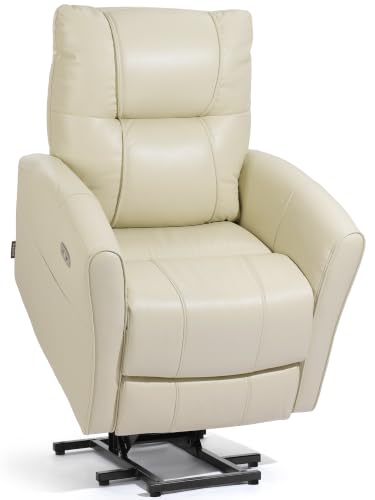
EONIX Wall Hugger Power Lift Recliner Chair — Best Wall Clearance
The wall hugger is the cleverest idea in small-space seating: instead of the back swinging backward into the wall’s territory as the chair reclines, the whole seat slides forward on its base, trading space in front of the chair — where there is usually open floor — for space behind it, where there is a wall. The EONIX needs just 1.2 inches of clearance behind it. In a room where a standard lift chair would have to float a foot and a half off the wall, wasting a strip of floor the length of the chair, that is the difference between a layout that works and one that does not.
Unlike the petite picks, this is a chair for average-sized users in tight rooms. The 3.5-inch extended footrest supports the full lower leg in recline, USB and Type-C ports cover both phone generations, and side pockets handle the remote and reading material.
Strengths
- 1.2-inch wall clearance unlocks full recline against almost any wall
- Extended footrest supports longer legs despite the space-saving design
- Both USB and Type-C charging built in
Trade-offs
- The forward slide means the chair’s front footprint grows as it reclines — keep the floor ahead clear
- Capacity is not stated in the verified listing data; larger users should confirm with the seller
- Wall-hugger mechanisms are more complex than standard lift bases
| Spec | Verified detail |
|---|---|
| Wall clearance | 1.2 inches (per listing) |
| Footrest | 3.5″ extended footrest |
| Charging | USB and Type-C ports |
| Extras | Side pockets |
| Certification note | Listing notes FSC certification (materials sourcing) |
Placement is the whole game with a wall hugger. Push it to its 1.2 inches, recline fully, and check the front: the user’s feet and the extended footrest will occupy floor that a coffee table might currently own. In most small rooms the trade is obviously right — dead space behind a chair becomes usable floor in front of it — but walk the layout once before committing.
The listing notes FSC certification for its materials; as with the MCombo above, that is a sourcing credential, not a performance one. The performance story here is the clearance figure, and 1.2 inches is the best verified number in this guide.
Best for: average-sized users whose room cannot spare recline clearance behind the chair / Not suited for: rooms where the floor in front of the chair is also fully committed

MCombo Zero Wall Recliner Chair PR644 — Best Zero-Wall Design
Zero wall goes one step beyond the wall hugger: the mechanism is designed so the chair can be placed essentially flush against the wall and still travel through its full recline, the seat sliding forward as the back descends. The PR644 is MCombo’s take, explicitly aimed at small spaces and RVs — two environments where every inch of floor is already spoken for and a chair that floats off the wall is a chair that does not fit.
RV buyers should read this pick carefully. A powered recliner with lift assistance, dual USB and USB-C charging, and a footprint designed for tight quarters answers a real need in motorhome and fifth-wheel living, where the factory seating is often the least comfortable furniture in the vehicle. Check the chair’s dimensions against your slide-out and door width — RV doors are the narrowest filter any chair must pass.
Strengths
- True zero-wall placement reclaims the full recline strip behind the chair
- Designed and marketed for small spaces and RVs, not merely sized down
- Dual USB and USB-C charging reduces reliance on scarce outlets in small rooms and RVs
Trade-offs
- Recline and capacity figures are not stated in the verified listing data — confirm with the seller
- Beige faux leather shows marks more readily than dark finishes
- Zero-wall mechanisms command a premium over standard chairs of similar size
| Spec | Verified detail |
|---|---|
| Wall clearance | Zero wall (per listing) |
| Intended spaces | Small space, living room, RV (per listing) |
| Charging | USB and USB-C dual charge ports |
| Upholstery | Faux leather, Beige |
| Model | PR644 |
Between this and the EONIX, the choice is arithmetic: if you can spare 1.2 inches, the EONIX’s published clearance and extended footrest make a strong case; if the chair must sit truly flush — an RV slide, a narrow room where an inch is an inch — the PR644 is the verified zero-wall option in this guide.
One caution that applies to every zero-wall and wall-hugger chair: the forward slide needs the floor in front kept clear, and the user’s feet travel with it. Do not place a footstool, a pet bed, or a grandchild’s toy box in the slide path.
Best for: the tightest rooms and RV living, where the chair must sit flush to the wall / Not suited for: buyers who need published capacity and recline figures before ordering

LITVZ Small Power Lift Recliner Chair — Best Lay-Flat Small Chair
Small chairs often stop reclining where big chairs keep going. The LITVZ is the exception in this guide: a petite-framed chair with a 160-degree lay-flat recline, so a smaller user who naps in the chair — or occasionally sleeps in it — gets the full flat position without moving up to a full-size chair and its full-size footprint. It is also one of the few compact picks whose listing states its capacity outright: 300 pounds, a sensible rating for a petite frame and a figure buyers can actually plan around.
Heat and massage are fitted for comfort during long sits, and cup holders are built in — a detail that matters in small rooms, where the chair may be the user’s whole world and a side table may not fit beside it.
Strengths
- 160° lay-flat recline in a petite footprint — rare in this size class
- Capacity stated in the listing (300 lbs), so fit can be verified before buying
- Cup holders built in for rooms with no space for a side table
Trade-offs
- 300 lb capacity is a hard ceiling — larger users must look elsewhere in this guide
- Petite seat dimensions will not suit average or tall users despite the deep recline
- Newer brand; long-term support less proven than MCombo
| Spec | Verified detail |
|---|---|
| Capacity | 300 lbs (per listing) |
| Recline | 160° lay flat |
| Size class | Small, for petite people (per listing) |
| Comfort extras | Heat and massage |
| Extras | Cup holders |
Lay-flat in a small chair changes the room math in one specific way: the chair’s length at full recline is its real footprint, and in a small room that length may reach further than you expect. Measure the reclined length against the room before ordering, including where the user’s head ends up — ideally not inches from a radiator, a doorway swing, or a walkway.
For the petite user who wants one compact chair for sitting, standing help, and genuine naps, this is the most complete verified package in the guide. The EZZUP remains the safer default for pure upright use; the LITVZ wins when the chair doubles as a bed for an afternoon.
Best for: petite users who nap in the chair and want a stated capacity / Not suited for: anyone over the 300 lb rating or of average-to-tall build

QKFF Wall Hugger Power Recliner Chair — Best Space-Saving Standard Size
Every other pick in this guide saves space by shrinking the chair or the user it fits. The QKFF saves space purely by geometry: it is a large recliner — the listing says so — on a zero-wall base, so an average or larger user in a tight room gets a full-size seat that can still sit flush to the wall. If the petite picks would fit your room but not your body, this is your chair.
The snowflake velvet upholstery gives it a softer, more decorative face than the faux leathers around it, aimed at living rooms and home theaters where the chair is on show. A USB port covers charging. What the verified listing data does not state is a weight capacity or a recline angle, and for a large chair those are not details to guess at — ask the seller, and keep the reply.
Strengths
- Full-size seat with zero-wall placement — no petite compromise
- Velvet upholstery suits living rooms where the chair is visible furniture
- Zero-wall base suits RV and home-theater rows as the listing suggests
Trade-offs
- Capacity and recline angle not stated in the verified listing data — confirm before ordering
- Velvet needs more care than wipe-clean faux leather, especially with spills
- Large seat plus slide-forward travel needs the most clear floor of any pick here
| Spec | Verified detail |
|---|---|
| Wall clearance | Zero wall (per listing) |
| Size class | Large recliner (per listing) |
| Upholstery | Snowflake velvet |
| Charging | USB port |
| Intended spaces | Living room, RV, home theater (per listing) |
Treat this pick as the guide’s honest flag: space-saving and large are compatible, but only the geometry is verified. The chair’s zero-wall claim and size class come from its listing; its limits do not appear there. A five-minute message to the seller closes that gap, and a buyer spending this much on a chair should close it.
Placed well — flush to the wall, slide path clear, a lamp within reach — the QKFF is the pick that proves a small room does not have to mean a small chair.
Best for: average-to-large users in tight rooms who refuse a petite chair / Not suited for: buyers unwilling to confirm capacity with the seller first
Comparison Table
| Pick | Badge | Key spec | Best for | Where |
|---|---|---|---|---|
| EZZUP Power Lift Recliner Chair (Petite, Faux Leather) | Best Overall for Small Rooms | Petite size; infinite position; massage and heat | petite users in apartments and small rooms who want one chair that does everything | Check price |
| MCombo Small Power Lift Recliner Chair 7111 | Best Petite with Power Headrest | Petite; power headrest; lumbar & seat heat; no-tool assembly | petite users who recline often and want head support at any angle | Check price |
| EONIX Wall Hugger Power Lift Recliner Chair | Best Wall Clearance | 1.2″ wall clearance; 3.5″ extended footrest; USB/Type-C | average-sized users whose room cannot spare recline clearance behind the chair | Check price |
| MCombo Zero Wall Recliner Chair PR644 | Best Zero-Wall Design | Zero wall clearance; USB & USB-C; small space / RV | the tightest rooms and RV living, where the chair must sit flush to the wall | Check price |
| LITVZ Small Power Lift Recliner Chair | Best Lay-Flat Small Chair | 300 lbs capacity (stated); 160° lay flat; petite | petite users who nap in the chair and want a stated capacity | Check price |
| QKFF Wall Hugger Power Recliner Chair | Best Space-Saving Standard Size | Zero wall; large recliner size; snowflake velvet; USB | average-to-large users in tight rooms who refuse a petite chair | Check price |
How to Choose a Lift Chair for a Small Space
Measure in the right order. First the doorway and the tightest turn on the delivery path — a chair that cannot enter the room has a footprint of exactly zero use. Second, the user’s body: seat height so their feet rest flat when lowered, seat depth ending just behind the knees, seat width with an inch to spare at the hips. Third, the room at full recline, not at rest: a chair’s honest footprint includes its reclined length and, for wall huggers, the forward slide. Buyers who measure only the resting chair are the ones surprised a week later by problems they could have taped out on the floor in advance — painter’s tape, laid to the chair’s reclined outline, is the cheapest fitting room there is.
Then choose your space-saving strategy. Petite chairs (the EZZUP, MCombo 7111, and LITVZ here) save space in every dimension and fit smaller users properly — the right answer when the user is small. Wall-hugger and zero-wall chairs (the EONIX, PR644, and QKFF) save only the strip behind the chair but keep standard or large seats — the right answer when the user is not small but the room is. Confusing the two strategies is the classic small-space mistake: a petite chair bought for a large user because the room was tight, or a wall hugger bought for a petite user whose feet then dangle.
Finally, audit the room’s supporting cast. A compact chair with built-in charging and side pockets may let you delete the side table entirely, freeing more floor than the chair choice itself saved. A chair placed to share the room’s one good lamp beats a chair with its own floor lamp. In small rooms, furniture is a team, and the lift chair — the largest single object — should be picked to make the rest of the team smaller.
Wall Hugger vs Zero Wall vs Petite: The Geometry Explained
A standard recliner’s back swings on an arc. To recline fully it needs the depth of that arc behind it — commonly a foot or more of empty wall clearance — or the backrest meets the wall halfway down. A wall hugger mounts the seat on a track: as the chair reclines, the seat glides forward, so the back descends into space the seat has just vacated. Clearance drops to an inch or two. A zero-wall mechanism refines the same trick until the required clearance is effectively nothing; the chair can be positioned flush and still reach full recline. Both designs spend floor in front of the chair instead of behind it, which is why their reviews in this guide keep repeating one instruction: keep the slide path clear.
A petite chair is a different answer entirely — not geometry but scale. Its frame, seat, and lift are sized for a smaller body, so its resting and reclined footprints are both smaller, and a smaller user gets the flat-feet, supported-back fit that makes a lift chair safe. The strategies combine happily: nothing stops a petite chair from also being a wall hugger, and buyers with both constraints — small user, small room — should look for exactly that overlap, or accept the petite chair’s modest standard clearance as the workable compromise.
How to Set Up a Lift Chair in a Small Room
Build the chair where it will live. Compact chairs often arrive in two pieces — base and back — that pass narrow doors separately and join without tools or with a handful of bolts; the MCombo 7111 in this guide lists no-tool assembly outright. Carry the pieces in, assemble in place, and only then position the chair: a built lift chair is heavy and its base does not love being dragged sideways across carpet.
- Tape the chair’s reclined outline on the floor before final placement
- Set wall clearance to the manufacturer’s figure — 1.2 inches for the EONIX, flush for the zero-wall picks — then recline fully and verify
- Route the power cord along the wall, never under the chair’s slide path or base
- Keep the forward slide path empty: no footstools, baskets, or pet beds
- Place a reachable surface — however small — for a drink, phone, and the remote
- Test the lift and recline through their full travel before pushing any other furniture back into place
Live with it for a week before finalizing the room. Small-space layouts reveal their flaws in use: the door that clips the reclined footrest, the walkway that narrows to a shuffle, the outlet the cord almost reaches. Nudge, retest, and only then let the rest of the furniture settle. The chair’s position is the room’s foundation; everything else is decoration around it.
Small Rooms, Big Habits: Making the Chair the Room’s Anchor
In a small home, the lift chair is rarely just a chair — it is the user’s headquarters. That argues for placing it first and best: the spot with the view of the television and the window, within reach of the room’s light, near enough the door for the user’s daily path. Every other piece of furniture then justifies itself around that anchor. This is the opposite of the usual instinct to tuck the big medical-looking object into the leftover corner, and it produces rooms that work noticeably better for the person who spends the most time in them.
It also argues for the details the picks above compete on: charging ports that end the tangle of extension leads across a small floor, pockets that hold the day’s small necessities, upholstery that survives being the room’s hardest-working surface. Choose the chair as the anchor it will be, and the small room stops being a constraint and becomes simply the room, well arranged.
Fitting a Petite User: The Three Measurements That Matter
Petite fit is decided by three numbers, and all three can be checked with a tape measure and an ordinary dining chair before you spend anything. First, seat height: sit the user in a hard chair with their feet flat on the floor and measure from the floor to the crease behind the knee. The lift chair’s lowered seat height should match that figure within about half an inch — higher, and their feet dangle and every lift starts with a slide forward; lower, and their knees rise above their hips and standing becomes a climb. Second, seat depth: measure from the back of the buttocks to behind the knee and subtract an inch. A seat deeper than that forces a choice between back support and circulation behind the knees, and petite users in standard chairs make that bad choice every day. Third, the lift itself: at full lift, the chair should bring the user to a near-standing position where a small step forward completes the stand — if they still have to haul themselves up the armrests, the geometry is wrong for their height.
These measurements explain why this guide treats petite chairs as fit equipment rather than small furniture. The EZZUP, the MCombo 7111, and the LITVZ are built around shorter seat heights and depths; a petite user in one of them sits the way an average user sits in a standard chair, which is to say properly. If the user’s measurements fall between petite and standard, prioritize seat height first — it is the measurement the lift mechanism cares about most — and use a small cushion behind the back to absorb excess depth if needed.
Common Buying Mistakes
- Measuring only the resting chair and discovering the reclined length later
- Buying a petite chair for a non-petite user because the room was small
- Buying a wall hugger for a petite user and leaving their feet dangling
- Blocking the forward slide path with a footstool or coffee table
- Forgetting the delivery path — stairs, turns, and the narrowest door decide first
- Skipping capacity checks on chairs whose listings do not state them
- Dragging an assembled chair across carpet instead of assembling in place
The most common small-space failure is optimism: assuming the chair will somehow take less room in your home than its dimensions promise. It will not. The chairs in this guide earn their place by publishing their tricks — a clearance figure, a petite frame, a zero-wall base — and the buyer’s job is simply to believe the numbers and measure against them.
Final Recommendation
Start with the user. Petite users in small rooms should begin at the EZZUP — the guide’s default — and step up to the MCombo 7111 if they recline constantly and want the power headrest, or to the LITVZ if naps and a stated capacity matter most. Average and larger users in tight rooms should look at the geometry picks: the EONIX when 1.2 inches of clearance is available and an extended footrest appeals, the MCombo PR644 when the chair must sit truly flush or live in an RV, and the QKFF when nothing but a full-size seat will do — with a message to its seller about capacity first.
One encouragement for hesitant buyers: a lift chair is often the purchase that lets someone stay in a smaller home — the apartment near family, the bungalow they love — rather than moving somewhere bigger and less familiar purely for furniture reasons. Sized honestly, the chair adapts the home to the person, which is the entire point. The six verified options above cover the realistic combinations of small user, small room, and both at once.
Whichever direction you go, tape the outline, check the doorway, and keep the slide path clear. A small room fitted honestly around the right chair feels larger than a big room arranged around the wrong one. These companion guides cover the neighboring decisions:
EZZUP Power Lift Recliner Chair (Petite, Faux Leather) (Best Overall for Small Rooms): Check the current price on Amazon
MCombo Small Power Lift Recliner Chair 7111 (Best Petite with Power Headrest): Check the current price on Amazon
EONIX Wall Hugger Power Lift Recliner Chair (Best Wall Clearance): Check the current price on Amazon
MCombo Zero Wall Recliner Chair PR644 (Best Zero-Wall Design): Check the current price on Amazon
LITVZ Small Power Lift Recliner Chair (Best Lay-Flat Small Chair): Check the current price on Amazon
QKFF Wall Hugger Power Recliner Chair (Best Space-Saving Standard Size): Check the current price on Amazon
Best Lift Chairs Available Best Lift Chairs With Heat Best Heated Recliner Lift Chairs Best Lift Chairs For Handicapped Best Sleep Lift Chairs
Frequently Asked Questions
How much wall clearance does a lift chair really need?
A standard lift chair commonly needs a foot or more behind it to recline fully. Wall-hugger designs cut that dramatically — the EONIX in this guide lists 1.2 inches — and zero-wall designs such as the MCombo PR644 and the QKFF are built to sit flush against the wall. Always use the specific chair’s stated figure rather than a category average, and verify by reclining fully after placement.
Is a petite lift chair safe for an average-sized adult?
It is the wrong tool. A petite chair’s seat height, depth, and capacity are scaled for a smaller body; an average adult will sit with knees too high, thighs unsupported, and possibly beyond the chair’s intended load. Average and larger users in small rooms should choose a wall-hugger or zero-wall standard chair instead — that is exactly the problem those mechanisms solve.
Will a zero-wall chair work in an RV?
It is one of the designs aimed at RV life — the MCombo PR644 lists RV use explicitly. The checks are physical: the chair must pass the RV door (often the narrowest door in any home), fit the slide-out or floor space at full recline and full forward slide, and have a power supply the RV can provide. Measure all three before ordering; RV returns are nobody’s idea of fun.
Do small lift chairs have lower weight capacities?
Often, yes — a petite frame is engineered for a petite load. The LITVZ states 300 lbs in its listing. Several compact chairs do not state a capacity in their verified listing data at all, which this guide flags wherever it occurs; for any chair without a published figure, ask the seller before buying, especially if the user is anywhere near an average adult weight.
Can one person assemble and place a compact lift chair alone?
Usually, yes, if you assemble in place. Most arrive as a base and a back that join together — the MCombo 7111 lists no-tool assembly — and the pieces individually pass doors the assembled chair would not. The assembled chair is still heavy, so position it by nudging before it is fully loaded with cushions and accessories, and never drag it by the arms.
What is the smallest room a lift chair can work in?
There is no universal figure, because the chair’s reclined outline plus a standing space in front is the real requirement. As a working test: if you can tape out the chair’s full recline length, stand in front of the tape, and still open the room door, the room can host the chair. Zero-wall and petite models shrink that outline the most, which is why they anchor this guide. Remember that the tape test must include the user standing at full lift with their walker or cane in hand, since that standing space — not the chair alone — is what the room truly has to hold every single day.


