Disclosure: airfryerkitchensupply.com is reader-supported. When you buy through links on our site, we may earn an affiliate commission at no extra cost to you.
Where to buy
The fastest way to shop this shortlist is Amazon, where every verified pick below is listed with its full specifications, size and color options, and current availability. Start with the STRICH Guitar Stool with Backrest (SGT-30B) if you want the safest first click, and use the comparison table further down to narrow the field before you buy. Prices move around, so check the current price on Amazon on the listing itself rather than relying on any number quoted second-hand.
- STRICH Guitar Stool with Backrest (SGT-30B) — Best Overall
- Rockville RDS42 Portable Adjustable Guitar Chair — Best Portable Pick
- Gator Frameworks Guitar Seat (GFW-GTR-SEAT) — Best Seat-and-Stand Combo
- EASTROCK Guitar Stool with Backrest — Best Simple Backrest Stool
- SKAEHP Collapsible Guitar Stool — Best Budget Pick
- Pyle Guitar Stool with Backrest — Best Foldable with Backrest
The best inexpensive guitar chairs solve a specific ergonomic problem: ordinary chairs have arms that collide with the guitar body, seats that are too low or too soft, and backs shaped for desks rather than for holding an instrument. A proper guitar chair or stool keeps your feet planted, your thighs roughly level, and the guitar free to move — and it does not need to cost much. Every pick below was confirmed in a fresh search for this article, and every one sits in the genuinely inexpensive tier of the category; we checked the listed prices as an internal sanity check only, and as always we print no prices here — check the current price on Amazon.
The six picks split into two families: backrest stools with guitar hangers or stands built in (STRICH, Gator Frameworks, EASTROCK, SKAEHP) and portable padded chairs that fold away (Rockville, Pyle). All six were designed for guitarists rather than adapted from office furniture — we deliberately excluded generic drafting and task stools that appeared in the same searches, because a rolling office stool with a ring footrest is a compromise, not a guitar chair.
Key Takeaways
- No armrests, correct height and a footrest matter more than padding.
- Built-in guitar storage (hanger or fold-out stand) prevents the most common home guitar damage.
- Every pick here was price-checked against the API internally and sits in the genuine budget tier.
- Folding models trade a little rigidity for portability — check locking pins each setup.
In this guide
Quick Picks
STRICH Guitar Stool with Backrest (SGT-30B) — Best Overall. A height-adjustable stool with a backrest and a hanger for acoustic, electric and bass guitars — the most complete inexpensive package in the search results. Check price on Amazon
Rockville RDS42 Portable Adjustable Guitar Chair — Best Portable Pick. A foldable steel-frame chair with a padded backrest, a 12-inch padded seat and a footrest — built for players who rehearse in more than one place. Check price on Amazon
Gator Frameworks Guitar Seat (GFW-GTR-SEAT) — Best Seat-and-Stand Combo. From an established accessories brand: a padded seat with an ergonomic backrest and a fold-out stand that holds acoustic and electric guitars. Check price on Amazon
EASTROCK Guitar Stool with Backrest — Best Simple Backrest Stool. A straightforward stool with back support and a footrest, sized for acoustic, electric and bass players — no gimmicks, just the essentials done plainly. Check price on Amazon
SKAEHP Collapsible Guitar Stool — Best Budget Pick. The least expensive route to a guitar-specific seat in our search results: a collapsible stool with a padded seat and a retractable hook that doubles as a guitar stand. Check price on Amazon
Pyle Guitar Stool with Backrest — Best Foldable with Backrest. A foldable, portable stool with both a backrest and a footrest and padding on seat and back — from a brand better known for audio gear. Check price on Amazon
How These Picks Were Chosen
Selection started from fresh Amazon listing data searches on the airfry site’s own provider — ‘guitar chair’, ‘guitar stool padded’, ‘musician chair’ and ‘guitar chair with backrest’ — run for this batch. From the results we kept only products designed for playing guitar: a backrest or a guitar-specific seat shape, a footrest or foot ring at playing height, no armrests to foul the instrument, and a frame a guitarist can sit on daily. Brand-name logo barstools and premium musician chairs also appeared in the results; they were excluded on tier, because this search promises inexpensive, and a logo stool with no backrest is decor before it is equipment.
Prices returned by the listing were used for one purpose only: confirming that each pick genuinely belongs to the budget tier of its category before we linked it. No price or rating figure from the listing appears anywhere in this article.
The 6 Best Inexpensive Guitar Chairs

STRICH Guitar Stool with Backrest (SGT-30B) — Best Overall
The STRICH SGT-30B is what happens when a maker designs for guitarists first and furniture second. The confirmed listing describes a height-adjustable seat with a backrest and a built-in hanger that holds acoustic, electric and bass guitars, pitched at adult drummers and guitarists alike. The hanger matters more than it sounds: the moment you stand up, the guitar goes on the stool instead of leaning against an amp or a wall, which is where most inexpensive-chair budgets eventually get spent on repairs.
Strengths
- Built-in guitar hanger keeps the instrument safe and off the floor between sessions
- Height-adjustable seat lets you set thigh angle correctly for classical or casual posture
- Backrest supports longer practice sessions without armrests fouling the guitar body
Trade-offs
- Stool format means no arm support at all — correct for playing, less lounge-like for listening
- Hanger holds one guitar; multi-instrument players still need a separate stand
- Assembly required, and height mechanisms on budget stools reward gentle handling
| Seat | Height adjustable, padded |
| Backrest | Yes |
| Extras | Built-in guitar hanger |
| Suits | Acoustic, electric and bass guitar (per listing) |
In daily use the STRICH behaves like a small practice station rather than a chair: sit, play, hang the guitar, walk away. The adjustable height is the feature to set carefully — for most players the right height puts feet flat with thighs sloping very slightly down from hip to knee, which keeps the guitar stable on the leg without a footstool. Drummers cross-shopping this category will find the same seat works as a throne, which the listing itself acknowledges. For a single inexpensive purchase that covers sitting, resting and storing, this is the strongest all-round answer in the category.
Ownership details worth knowing: the hanger makes the STRICH the pick most likely to change your practice habits, because the guitar lives on the chair you sit in — visible, reachable, and safe. Set the hanger side away from walkways so a passing shoulder cannot clip a headstock. The adjustable seat mechanism benefits from being set once and left; constant height changes are what wear budget mechanisms out. Drummers in the household will borrow it, which the listing anticipates, and the seat serves both instruments without modification. For a student upgrading from a kitchen chair, the STRICH is the largest single-step improvement available at this tier: posture, storage and back support arriving in one box, at the inexpensive end of a category that happily charges several times more for less guitar-specific thinking.
Best for: Most guitarists who want one inexpensive seat that also stores the guitar / Not suited for: Players who want a wide, lounge-style chair rather than a stool
Check on Amazon — check the current price on Amazon before you decide.

Rockville RDS42 Portable Adjustable Guitar Chair — Best Portable Pick
The Rockville RDS42 is the gigging and teaching pick: a portable, adjustable guitar chair with a padded backrest, a foldable steel frame, a 12-inch padded seat and a footrest, with a stated capacity of 300 lb in the confirmed listing title. That capacity figure is worth noting in a budget category where frames are often the first compromise. It folds flat enough to live in a car boot or a cupboard, which makes it the natural choice for teachers who travel to students and players whose practice space is also their living room.
Strengths
- Foldable steel frame stores flat and travels easily between rooms and venues
- Stated 300 lb capacity is generous for the inexpensive tier
- Padded backrest and footrest cover the two comfort features guitarists actually use
Trade-offs
- 12-inch seat is compact — larger players should check the fit
- No built-in guitar storage, unlike the STRICH or Gator picks
- DJ and multi-instrument positioning means a plainer look than furniture-style stools
| Frame | Foldable steel |
| Seat | 12″ padded |
| Capacity | 300 lb (per listing) |
| Extras | Footrest, padded backrest |
Portability changes how a chair gets used. A fixed stool anchors one practice corner; the RDS42 follows the player — to a lesson, a rehearsal room, a friend’s house — and folds away when the room has to be a room again. The padded backrest is modest but correctly placed for playing posture, supporting the lower back during reading and theory work between playing stretches. If your inexpensive chair needs to earn its keep in three locations a week rather than one, this is the design that fits that life.
The RDS42’s stated 300 lb capacity deserves emphasis because it answers the question larger players ask of every folding chair: will it hold me without complaint? A foldable steel frame rated and stated at that level, with a padded seat and backrest, is a genuinely inclusive design at an inexpensive tier. Teachers will also appreciate that it reads as professional equipment in a student’s home rather than as furniture borrowed from the dining room. Keep the folding joints clean, check the locks when you set it up — the universal folding-chair liturgy — and it will travel for years. If your guitar life happens in more than one postcode, or your practice room must periodically become a guest room, this is the chair that respects both facts.
Best for: Teachers, gigging players and anyone whose practice space is temporary / Not suited for: Players who want built-in guitar storage in the chair itself
Check on Amazon — check the current price on Amazon before you decide.

Gator Frameworks Guitar Seat (GFW-GTR-SEAT) — Best Seat-and-Stand Combo
Gator Frameworks is a name guitarists already trust for cases and stands, and its guitar seat applies the same thinking: a padded cushion, an ergonomic backrest, and a fold-out guitar stand that holds both acoustic and electric guitars, all confirmed in the Amazon listing title. The fold-out stand is the differentiator — it deploys when you need it and disappears when you do not, so the seat works in tight corners where a separate stand would crowd the floor.
Strengths
- Fold-out guitar stand holds acoustic and electric guitars, then tucks away
- Ergonomic backrest shaped for playing posture rather than desk work
- Established accessories brand with a track record in guitar hardware
Trade-offs
- Stand and seat share one footprint — set it up where the guitar cannot be knocked
- Backrest is fixed in position; taller players should confirm the fit
- A specialist design that looks like equipment, not furniture
| Seat | Padded cushion |
| Backrest | Ergonomic, fixed |
| Extras | Fold-out guitar stand (acoustic and electric) |
| Model | GFW-GTR-SEAT |
The GFW-GTR-SEAT makes most sense in a dedicated practice corner. The stand removes the daily friction of fetching the guitar from another room — a small thing that measurably changes how often people pick the instrument up — and the backrest supports the half-leaning posture of reading charts or watching lesson videos between exercises. Players with classical posture should note the seat is a cushion stool format rather than a high classical chair; set your foot support separately if you use one. For electric and acoustic players who want seat plus storage in one inexpensive footprint, it is the neatest solution here.
Gator’s background in cases and stands shows in the detail that the fold-out stand accepts both acoustic and electric guitars — body depths differ enormously between the two, and a stand that genuinely holds both is not a given at this tier. The seat itself is sized for playing rather than lounging, which keeps your posture honest. In a small room the GFW-GTR-SEAT replaces two objects with one footprint, and floor space is the scarcest resource in most practice corners. Pair it with a small amp at elbow height and you have the complete inexpensive practice station: sit, play, stand the guitar, done. For players whose previous system was a bed, a sofa arm and a leaning guitar, the upgrade in both comfort and instrument safety is difficult to overstate.
Best for: Players building a permanent practice corner with minimal floor space / Not suited for: Classical guitarists who need a specific high-seat and footstool setup
Check on Amazon — check the current price on Amazon before you decide.

EASTROCK Guitar Stool with Backrest — Best Simple Backrest Stool
Not every guitarist wants a hanger or a fold-out stand; some just want to sit properly. The EASTROCK stool answers with the essentials confirmed in its Amazon title: a backrest with back support, a footrest, and a fit for acoustic, electric and bass guitar players. The footrest is the quietly important part — raising one foot slightly is the oldest trick in guitar ergonomics, stabilizing the instrument on the leg for both casual and classical-leaning postures.
Strengths
- Backrest plus footrest covers core guitar ergonomics in one simple stool
- Suited to acoustic, electric and bass per the listing
- Uncomplicated design that fits a bedroom or studio without visual fuss
Trade-offs
- No guitar storage — pair it with a separate stand
- Fewer extras than the STRICH at a similar tier position
- Padding is functional rather than plush
| Backrest | Yes, with back support |
| Footrest | Yes |
| Suits | Acoustic, electric and bass guitar (per listing) |
Think of the EASTROCK as the honest baseline of this category: the seat you buy when the practice room just needs to work. The footrest bar sits where a guitarist’s foot naturally wants to rest mid-session, and the backrest is there for the pauses — tuning, listening back, reading — that make up half of real practice time. It will not store your guitar or fold into a car, but it also asks nothing of you: no mechanisms to learn, no stand to deploy. For a first dedicated guitar seat on a budget, simple is a genuine virtue.
The EASTROCK rewards a closer look at its footrest, because footrest placement is where simple stools quietly succeed or fail. A rest at natural mid-shin height lets the raised foot stabilize the guitar without lifting the knee into the instrument or dropping it out of reach, and it doubles as the place your feet land during listening pauses. Bass players, whose instruments are longer and heavier, are explicitly included in this listing’s fit — a detail many stool makers skip. There is no storage and no folding trick here, and that is the point: fewer mechanisms, fewer failures, a seat that simply works every day. For a practice room that already has a stand and needs a proper chair-shaped answer, the EASTROCK is the uncomplicated correct choice.
Best for: Players who want core ergonomics without extras / Not suited for: Anyone who needs the chair to double as guitar storage
Check on Amazon — check the current price on Amazon before you decide.

SKAEHP Collapsible Guitar Stool — Best Budget Pick
The SKAEHP stool is the true budget entry in this roundup, and it still manages to be guitar-specific: the Amazon title confirms a collapsible guitar playing chair with a padded seat, a guitars stand function and a retractable hook, designed to fold flat for portability. Collapsible frames always trade a little rigidity for convenience, and at this tier that trade is explicit — but for students, spare-room players and anyone testing whether a dedicated guitar seat improves their practice, it is the lowest-risk way to find out.
Strengths
- Collapsible frame folds flat for storage and transport
- Padded seat plus guitar stand function with retractable hook
- Sits at the most inexpensive end of the verified results for this article
Trade-offs
- Folding frames flex more than fixed frames under heavier players
- Comfort is adequate rather than generous on long sessions
- Newer brand with a shorter track record than Gator or Rockville
| Frame | Collapsible / foldable |
| Seat | Padded |
| Extras | Guitar stand function, retractable hook |
The right way to judge the SKAEHP is by the problem it solves per pound spent: a student in a small flat gets a seat that stores in a cupboard, holds the guitar between sessions, and sets the correct playing height — three real improvements over a kitchen chair — at the bottom of the category’s price ladder. Treat the frame kindly, check the locking points when you unfold it, and it will do its job. Players who practice for hours daily should step up to a fixed-frame pick; occasional and student players will find this covers the need.
Set expectations precisely and the SKAEHP satisfies them: it is a student-grade, space-grade solution, not a lifetime throne. Its collapsible frame and retractable hook make it the only pick here that can live in a wardrobe and still present the guitar ready to play, which in a small flat is the difference between practicing and not practicing. The padded seat is honest foam over a folding frame — comfortable for lessons and daily practice sessions of ordinary length. Inspect the locking points when you unfold it, keep it for the loads it was designed for, and it returns remarkable value per pound. Many players will eventually graduate to a fixed-frame stool; nearly all of them will keep the SKAEHP as the travel and spare-room seat, because nothing else in the category disappears so completely when the music stops.
Best for: Students and small-space players on the tightest budget / Not suited for: Heavy daily use or players who need maximum frame rigidity
Check on Amazon — check the current price on Amazon before you decide.
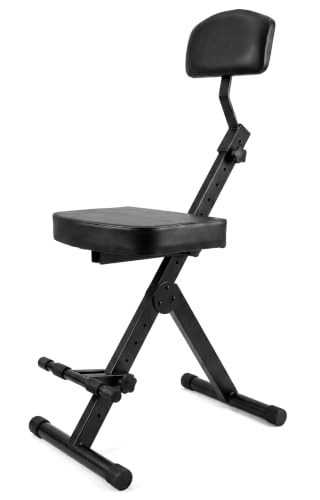
Pyle Guitar Stool with Backrest — Best Foldable with Backrest
Pyle’s entry combines the two features that usually split this category: it folds like the portable picks and supports like the fixed ones. The listing-confirmed title describes a foldable and portable chair with backrest and footrest, an adjustable build for adults, and a padded cushioned seat and back. That combination suits players who host practice in shared spaces — set it up for a session, fold it away after — but do not want to give up back support to get the folding frame.
Strengths
- Folds for storage yet keeps both a backrest and a footrest
- Padded seat and padded back for longer sessions
- Adjustable height to suit different players sharing one stool
Trade-offs
- Sold as a drum throne as well as a guitar stool, so the styling is utilitarian
- No guitar hanger or stand function
- Folding joints need periodic checks, as with any portable frame
| Frame | Foldable, portable |
| Backrest | Yes, padded |
| Footrest | Yes |
| Seat | Padded cushion |
Shared households are where the Pyle earns its place: one stool serves the guitarist, the drummer in the family, and the spare-room studio, then disappears into a closet. The padded back is the detail players notice after forty minutes, when an unpadded bar would have ended the session. Height adjustment makes it the natural household stool where two players of different sizes share one seat. If your practice life is one fixed corner, a fixed frame is sturdier still; if it moves around the house, this is the flexible inexpensive answer.
Pyle’s dual identity as a drum throne and guitar stool is an asset in musical households: one purchase serves the kit player and the guitarist, and the padded back — the feature drummers usually forgo — is what guitarists reading charts will appreciate most. The foldable frame and adjustable height make it the natural spare-room and lesson-space seat. As with all folding designs, its longevity lives in its joints: keep them clean, lock them fully, and store the stool folded rather than leaning. Judged as what it is — an inexpensive, portable, back-supported seat for players whose music happens in shared spaces — it has no real rival on this page except the Rockville, and the choice between them is portability style: the Rockville reads as a chair, the Pyle as a throne. Pick the silhouette your room prefers.
Best for: Households sharing one stool between players and instruments / Not suited for: Players who want a fixed, furniture-weight seat
Check on Amazon — check the current price on Amazon before you decide.
Comparison Table
| Pick | Badge | Key spec | Best for |
|---|---|---|---|
| STRICH Guitar Stool with Backrest (SGT-30B) | Best Overall | Height adjustable, built-in guitar hanger, backrest | Most guitarists who want one inexpensive seat that also stores the guitar |
| Rockville RDS42 Portable Adjustable Guitar Chair | Best Portable Pick | Foldable steel frame, 12″ padded seat, 300 lb capacity | Teachers, gigging players and anyone whose practice space is temporary |
| Gator Frameworks Guitar Seat (GFW-GTR-SEAT) | Best Seat-and-Stand Combo | Padded cushion, ergonomic backrest, fold-out guitar stand | Players building a permanent practice corner with minimal floor space |
| EASTROCK Guitar Stool with Backrest | Best Simple Backrest Stool | Backrest and footrest, fits acoustic, electric and bass | Players who want core ergonomics without extras |
| SKAEHP Collapsible Guitar Stool | Best Budget Pick | Collapsible, padded seat, retractable hook, guitar stand function | Students and small-space players on the tightest budget |
| Pyle Guitar Stool with Backrest | Best Foldable with Backrest | Foldable and portable, backrest and footrest, padded seat and back | Households sharing one stool between players and instruments |
Read the table as a filter, not a ranking. The right inexpensive guitar chairs for you is the one whose key spec matches the way you will actually use it week after week, and the sections below explain how to judge that fit before any money changes hands. See the top pick on Amazon.
How to Choose the Best Inexpensive Guitar Chairs
Begin with the three ergonomic non-negotiables. First, no armrests: arms foul the guitar body, force the right shoulder up, and are the reason ordinary chairs fail guitarists. Every pick above is armless by design. Second, height: your feet should rest flat (or one foot on a footrest) with thighs roughly level, so the guitar sits stable without you gripping it with your legs. Adjustable-height stools — most of this list — let you dial that in; fixed barstools at counter height force a posture that tires the back within half an hour. Third, a footrest or foot ring at the right height, which quietly does more for playing comfort than any amount of seat padding.
Then decide what else the chair must do. Built-in storage — the STRICH hanger, the Gator fold-out stand, the SKAEHP hook — turns the chair into a practice station and keeps the guitar off the floor, the single most common source of avoidable damage. Portability points the other way: the Rockville and Pyle fold flat for teachers, gig players and shared rooms. Fixed frames feel the most solid and suit a permanent practice corner. None of these is the right answer in the abstract; the right answer is the one that matches where and how often you play.
Finally, be honest about the inexpensive tier. Budget guitar chairs use lighter frames, simpler height mechanisms and thinner padding than premium musician chairs costing several times more — the listing result for this article included those premium chairs, and we excluded them on tier, not quality. What the inexpensive tier does deliver, when you choose a guitar-specific design, is correct posture and real convenience. What it will not deliver is decade-long heavy-duty service under a touring schedule. Match the chair to student, home or teaching use and the value is genuine.
Guitar Stool vs Guitar Chair vs Barstool
The names blur, so judge by structure. A guitar stool is a padded seat, often with a foot ring, sometimes with a small backrest; it is compact, usually adjustable, and the most common inexpensive format — four of our six picks are stools. A guitar chair adds a fuller backrest and sometimes a fold-out stand, trading compactness for support in longer sessions. A barstool — including the handsome logo stools from famous guitar brands that appeared in our searches — is a fixed-height pub seat: charming in a music room, but the height rarely suits playing posture and there is no footrest at playing level.
Classical players should be the pickiest: traditional classical posture uses a footstool or leg support and a seat height that lets the raised leg hold the guitar at an angle. An adjustable stool plus a footrest bar covers this well. Electric and acoustic players in casual posture are more forgiving — level thighs, flat feet, and a backrest for the pauses will carry most practice comfortably.
Setting Up Your Practice Seat Correctly
Set the height first: sit, place both feet flat, and adjust until your thighs are level or sloping very slightly downward toward the knees. If you use the footrest, raise the foot on your guitar side only if that is your playing style — classical players raise the fretting-side leg; most casual players keep both feet grounded. The guitar should rest on your leg without your left hand supporting its weight; if you are holding the neck up, the seat is too low or the guitar is sliding.
Position the backrest as a pause tool, not a playing crutch: during active playing most guitarists sit forward of it, and lean back between exercises. If you find yourself slumping into the backrest while playing, the seat is probably too deep or too low. Give the setup a week before judging it — posture habits from a bad kitchen chair take a few sessions to unwind, and the improvement in left-hand freedom is usually what converts skeptics.
How to Set Up and Care for an Inexpensive Guitar Chair
Assemble on a soft surface and tighten every fastener fully before first use; budget frames rely on correct assembly for their rigidity, and a half-tight bolt is the usual source of the wobble people blame on the design. Re-check the main fasteners after the first week of use, once the frame has settled under load.
If your stool has a height mechanism, set it under no load where the design requires it, and never force a stuck adjustment pin — clean it and try again. Keep folding joints on portable models free of grit, especially if the chair travels in a car boot, and check that locking pins seat fully every time you unfold a folding frame; a partially locked frame is the one real safety issue in this category.
Wipe padded seats with a damp cloth rather than soaking them, keep the chair out of damp storage so steel frames stay rust-free, and hang or stand the guitar on the built-in holder rather than leaning it against the chair leg. That last habit alone justifies the hanger-equipped picks: most inexpensive-chair owners eventually spend more on one guitar repair than the chair cost.
What Guitarists Actually Notice After a Month
The first week with a proper guitar chair is about novelty; the first month is about habits. Players consistently report three changes. Practice sessions get longer, because the low-grade discomfort that used to end sessions — the numb leg, the aching lower back, the shoulder creeping up toward the ear — has been designed out. Practice gets more frequent, especially with hanger and stand models, because the guitar is visibly waiting rather than cased in another room; the distance between thinking about playing and playing shrinks to the width of a chair. And technique work gets more honest, because a stable seat and a stable guitar remove the background fidgeting that masks sloppy left-hand position.
None of that requires an expensive chair. It requires the correct chair: armless, the right height, a footrest where your foot wants one, and a backrest for the thinking pauses. That is why this category rewards guitar-specific design over furniture budget — a costly office chair fails every one of those tests, while the least expensive pick on this page passes them all. Buy the ergonomics first and let the chair’s looks be whatever they are; your hands will file the only review that matters.
Accessories That Complete an Inexpensive Setup
A guitar chair works inside a small system, and two inexpensive additions multiply its value. The first is a footstool or a simple raised footrest if your stool lacks one at the right height — classical and fingerstyle players feel this immediately, because the raised leg is what presents the guitar at its working angle. The second is a small side table or amp-top surface within arm’s reach for a tuner, capo, picks and water; the practice session that does not require standing up every four minutes is the session that lasts forty. Neither addition needs to be guitar-branded, and both together cost less than the difference between the budget and premium ends of this category.
Lighting deserves a mention it rarely gets: a chair placed where you can read music or a tablet screen without squinting will be used more than a technically superior chair in a dark corner. When you assemble your stool, place it where the practice life of the room actually happens, not where furniture logic says a chair belongs. The inexpensive tier’s real promise is not that it saves money — it is that for the price of a single premium accessory, it assembles an entire working practice environment: seat, support, storage and light, all pointed at the same goal of playing more, more comfortably, more often.
Guitar Chair Buying Checklist
Before you order, walk the chair through these seven checks — they take two minutes and they are the difference between a practice station and a piece of furniture:
- Armless, without exception — if it has arms, it is not a guitar chair, whatever the listing calls it.
- Height adjustable, or a fixed height you have verified against your own leg length with your feet flat and thighs level.
- A footrest or foot ring at playing height, or a separate footstool already in your setup.
- A backrest if your sessions run past half an hour — most do, once the chair stops ending them.
- Storage decided: hanger, fold-out stand, separate stand, or a conscious acceptance that the guitar leans somewhere you trust.
- Frame matched to use: fixed for a permanent corner and heavy daily practice, folding for travel and shared rooms, with locking pins checked at every setup.
- Capacity respected — where a listing states one, as the Rockville does, stay inside it; where none is stated, be conservative.
A chair that passes all seven will not feel like a compromise purchase, even at the bottom of the price ladder, because every item on the list is a function rather than a finish. That is the inexpensive tier’s genuine opportunity: the functions are cheap to build correctly, and the makers on this page built them. What the premium tiers add — finer materials, longer warranties, furniture presence — is real but secondary, and it can wait for the player whose practice has already been transformed by a chair that simply fits the instrument.
Common Buying Mistakes
Buying an office chair for guitar. Armrests and a deep bucket seat fight the instrument. Guitar-specific designs exist at the same prices — buy one of those instead.
Choosing a fixed barstool for the look. Logo barstools are decor. Counter height, no footrest and no backrest make them poor practice seats.
Ignoring capacity and frame type. The Rockville states a 300 lb capacity in its listing; where a listing does not state one, be conservative, and prefer fixed frames for heavy daily use.
Forgetting guitar storage. A chair with a hanger or stand removes the lean-it-on-the-wall habit that causes most home guitar damage.
Judging comfort in five minutes. Posture problems announce themselves at minute forty. Padding, backrest placement and footrest height matter more than first-sit softness.
Final Recommendation
For most players the STRICH SGT-30B is the inexpensive guitar chair to buy first: adjustable, backrest-equipped, and with a hanger that turns it into a complete practice station. If the chair must travel, take the Rockville RDS42; if it must fold away at home without losing back support, take the Pyle. Gator’s seat-and-stand combo suits a permanent corner, the EASTROCK is the simple honest stool, and the SKAEHP is the budget door into the category.
Whichever you pick, you are buying posture, not furniture: set the height carefully, use the footrest, and let the chair hold the guitar between sessions. Your hands will notice the difference before your back does.
A last word on value, because inexpensive invites the wrong suspicion. In this category the budget tier is not a compromise version of the real thing — it is where the real thing lives. The functions that define a guitar chair (armless seat, correct height, footrest, backrest, somewhere safe for the guitar) are simple engineering, and the makers in this guide — STRICH, Rockville, Gator, EASTROCK, SKAEHP, Pyle — build them at prices a student can reach in a month of small sacrifices. The premium chairs excluded from this list add refinement, not correctness. So buy without the anxiety that you have settled: set the height carefully, use the footrest, hang the guitar where the chair offers to hold it, and let the sessions lengthen. Months from now the chair will have disappeared from your attention entirely, which is the highest compliment practice furniture can earn — what remains in your attention is the playing, and that was the purchase all along.
Start with the STRICH Guitar Stool with Backrest (SGT-30B) if you want the safest first choice, or compare it with the Rockville RDS42 Portable Adjustable Guitar Chair before you decide — and check the current price on Amazon for whichever you choose.
Keep exploring the same corner of the catalog with these related guides from our team: Best Ergonomic Chairs For Posture Best Customizable Office Chairs Best Easy Rolling Office Chairs Best Chairs With Adjustable Lumbar Support Best Chairs For Bedroom Office
Frequently Asked Questions
What height should a guitar chair be?
The right height puts your feet flat on the floor or footrest with thighs roughly level. For most adults that means a seat somewhere in the standard chair-to-counter range, which is why adjustable stools are the safest inexpensive buy — they fit the player instead of forcing the player to fit them.
Are guitar stools good for classical guitar?
An adjustable stool with a footrest works well for classical posture: raise the fretting-side foot on the rest and set the seat so the guitar rests at the traditional angle. Players who use a dedicated footstool or leg support can pair either with any armless stool here.
Why do guitar chairs have no armrests?
Armrests collide with the guitar body and lift the strumming shoulder into a strained position. Every proper guitar chair is armless; the backrest, not arms, provides the rest support during pauses.
Is a folding guitar chair sturdy enough?
For home, teaching and rehearsal use, yes — provided you check that locking pins seat fully and respect the frame. Fixed frames remain the better choice for very heavy daily use or larger players who want maximum rigidity.
Do I need a chair with a built-in guitar stand?
Not strictly, but it is the feature owners appreciate most over time. Keeping the guitar on the chair’s hanger or stand instead of leaning on furniture prevents the most common and most expensive home accident an inexpensive setup can have.
Can a guitar stool double as a drum throne?
Several picks here, including the STRICH and Pyle, are explicitly pitched for drummers as well as guitarists. The seat requirements overlap heavily; guitarists should simply confirm the model includes the backrest or footrest they want.


