Disclosure: airfryerkitchensupply.com is reader-supported. When you buy through links on our site, we may earn an affiliate commission at no extra cost to you.
Where to Buy
If you are shopping for the best pillows for side sleepers with back pain this season, start here: every pillow in this guide was confirmed against Amazon’s own catalog data before it earned a link, and each one is sold through Amazon, where sizing, fill details and current availability are listed on the product page. Start with the pick that matches your shoulder width and mattress firmness, and check the current price on Amazon before you order, because pillow pricing and size availability move around a lot:
- Coop Home Goods Original Adjustable Pillow, Queen — check price on Amazon
- Sidney Sleep Adjustable Curved Pillow, Queen — check price on Amazon
- Royal Therapy Memory Foam Pillow, Queen — check price on Amazon
- Turmerry Organic Latex Pillow, Queen, High Loft — check price on Amazon
- ORGANIC TEXTILES Organic Latex Contour Pillow — check price on Amazon
- Everlasting Comfort Memory Foam Knee Pillow — check price on Amazon
Introduction
Shopping for the best pillows for side sleepers with back pain starts with an honest point: a pillow cannot fix a back problem, and no pillow in this guide is presented as a medical treatment. What a well-chosen pillow can do is remove the nightly strain that a bad pillow adds — the bent neck, the shoulder jammed into the mattress, the hips twisting because the knees knock together. Side sleepers put more load through the shoulder and hip than any other sleep position, so the gap between the head and the mattress has to be filled at exactly the right height. Too low and the neck tilts down toward the bed all night; too high and it tilts up, and either way the spine spends eight hours out of line.
The second honest point is that the head pillow is only half of the side-sleeping system. The other half sits between the knees. When the top leg drops forward and down, the pelvis rotates and the lower back twists with it, which is why this guide includes one dedicated knee pillow alongside five head pillows. If you wake up with a stiff, achy lower back after side sleeping, the combination of a correctly lofted head pillow and a knee spacer is the setup most likely to change how the night feels — as a comfort matter, not a cure.
Every pick below was verified, so the sizes, fills and certifications quoted are the ones Amazon’s catalog actually records. The six picks split into three families: adjustable shredded foam you can tune handful by handful, molded contour foam with a fixed shape, and natural latex for sleepers who want a responsive, breathable pillow that never needs fluffing. One of them will match your body and your mattress; the buying guide further down explains how to measure the gap your pillow needs to fill before you spend anything.
Key Takeaways
- Loft is the whole game for side sleepers: the pillow must fill the distance between your ear and the outside of your shoulder, compressed, all night.
- Adjustable shredded foam is the safest first buy, because you can remove fill until your neck sits level instead of guessing a fixed height.
- A knee pillow is the cheapest comfort upgrade in this guide — it stops the top leg dragging the pelvis, and the lower back, into a twist.
- Latex suits hot sleepers and anyone tired of pillows going flat; it springs back instead of packing down.
- Your mattress matters: a soft mattress lets the shoulder sink deeper, which lowers the loft you need; a firm mattress raises it.
- Give any new pillow a full week before judging it, and change one thing at a time so you know what actually helped.
In this guide
Quick Picks
Best Overall — Coop Home Goods Original Adjustable Pillow, Queen. Cross-cut memory foam you add or remove until the loft is exactly right, in a medium-firm feel that suits most side sleepers. Check the current price on Amazon
Best for Broad Shoulders — Sidney Sleep Adjustable Curved Pillow, Queen. A curved cutout gives the shoulder somewhere to go, and the box ships with extra shredded fill for building height. Check the current price on Amazon
Best Firm Contour — Royal Therapy Memory Foam Pillow, Queen. A molded contour shape at a true 5-inch high side for sleepers who want the pillow to hold the head in one supported position. Check the current price on Amazon
Best Natural Latex — Turmerry Organic Latex Pillow, Queen, High Loft. A 5-inch high-loft Dunlop latex pillow with a pinhole design that breathes, for side sleepers who run hot. Check the current price on Amazon
Best Organic Contour — ORGANIC TEXTILES Organic Latex Contour Pillow. Certified organic latex in a medium-loft contour shape with an organic cotton cover, for sleepers who want structure without synthetic foam. Check the current price on Amazon
Best Between-the-Knees Companion — Everlasting Comfort Memory Foam Knee Pillow. A contoured knee spacer with a removable strap that keeps the legs, hips and spine stacked while you side sleep. Check the current price on Amazon
How These Picks Were Chosen
We started from the geometry of side sleeping rather than from brand names. A side sleeper’s pillow has one job — keep the head and neck in line with the rest of the spine — and that job is measurable: shoulder width, mattress sink, and compressed loft decide whether a pillow can do it. So every candidate had to state its size and, where the design allows, its loft in the manufacturer’s own catalog data. Pillows with no verifiable dimensions were dropped, however good their marketing sounded.
Each surviving product was then checked against the live Amazon catalog: the ASIN, the exact title, the fill, the size and any certification named in the listing all had to match. Certifications were read strictly — CertiPUR-US speaks to the foam’s content and emissions, GREENGUARD Gold to low chemical emissions, GOLS to organic latex and GOTS to organic textiles — and we describe them only as what they are.
Finally, we balanced the six slots across the three ways of solving the loft problem — tune it yourself with shredded fill, trust a molded contour, or take the spring and airflow of latex — plus the knee pillow that completes the position. Prices were deliberately not used as a filter and are never printed here; check the current price on Amazon for the pick you shortlist.
One more filter deserves stating plainly: every pick had to be a complete, standard bed or knee pillow sold for adult sleepers — no travel sizes, no novelty shapes, no inserts or replacement fills standing in for the pillow itself. A surprising number of listings in this category fail that simple test, and a guide about fixing your sleep position is no place for a half-size cushion wearing a bed pillow’s title.
The 6 Best Pillows for Side Sleepers With Back Pain

Coop Home Goods Original Adjustable Pillow, Queen — Best Overall
If you only buy one pillow from this list, make it the adjustable one. The Coop Home Goods Original is filled with cross-cut memory foam — small pieces rather than one solid slab — and the whole point is that you unzip the cover and remove handfuls of fill until the pillow matches your shoulder gap exactly. That adjustability is why it leads this guide: most side sleepers who wake up stiff are not using a bad pillow, they are using a pillow at the wrong height, and this is the design that lets you correct the height at home in five minutes. It suits average-to-broad shoulders, works on medium and firm mattresses, and the medium-firm feel holds the head up without the board-like pushback some contour pillows have.
Strengths
- Loft is fully tunable at home — add or remove cross-cut foam until your neck sits level.
- Medium-firm support holds side-sleeping height through the night instead of collapsing by 3 a.m.
- The foam carries CertiPUR-US certification and the pillow carries GREENGUARD Gold low-emission certification, both confirmed in the catalog listing.
Trade-offs
- Shredded fill needs a shake and a refluff every few days to stay even.
- Dialing in the loft takes two or three nights of small adjustments, not one.
- The removed fill has to be stored somewhere if you want to add it back later.
| Spec | Verified detail |
|---|---|
| Size | Queen |
| Fill | Cross-cut memory foam, adjustable |
| Feel | Medium firm |
| Certifications | CertiPUR-US foam; GREENGUARD Gold |
The deeper reason this pillow works for side sleepers with achy backs is indirect but real: when the head and neck sit level, the shoulder stops hiking up toward the ear, the upper back unclenches, and the rest of the spine follows into a straighter line. Pair it with the knee pillow further down and both ends of the side-sleeping posture are addressed. Start with the fill as shipped, sleep two nights, then remove a modest handful at a time — small changes, judged over full nights, beat one big guess. Sleepers who switch between side and back will also get on with this pillow, because a mid-height shredded fill compresses more under back sleeping than a molded contour does.
Best for: side sleepers who have already bought one wrong-height pillow and want control instead of another gamble. / Not suited for: sleepers who want a set-and-forget pillow that never needs fluffing.

Sidney Sleep Adjustable Curved Pillow, Queen — Best for Broad Shoulders
Broad-shouldered side sleepers run into a specific problem: the shoulder itself takes up so much room that a standard pillow either jacks the head too high or forces the sleeper to scrunch the shoulder forward. The Sidney Sleep answers with a curved cutout along the lower edge — a crescent the shoulder can tuck into — so the head can sit lower and closer while the pillow still fills the neck gap. It is an adjustable shredded-fill design, and the box includes extra fill, which matters because broad shoulders usually need more loft, not less. At a verified Queen size of 19 x 29 inches it also gives taller sleepers more surface than a standard pillow does.
Strengths
- The curved shoulder cutout solves the scrunch-and-hike problem that flat pillows cause on wide frames.
- Extra shredded fill is included in the box, so building height costs nothing extra.
- CertiPUR-US certified fill, confirmed in the catalog listing.
Trade-offs
- The curve only works in one orientation — flip the pillow over in your sleep and the benefit is gone until you flip it back.
- Narrow-shouldered sleepers may find the cutout leaves the neck under-filled.
- Like all shredded fills, it wants regular refluffing to keep the loft even.
| Spec | Verified detail |
|---|---|
| Size | Queen, 19 x 29 inches |
| Fill | Shredded fill, adjustable, extra fill included |
| Shape | Curved shoulder cutout |
| Certification | CertiPUR-US |
In practice, the cutout changes where the pressure lands. Instead of the shoulder’s edge digging into the pillow’s lower border all night, the shoulder nests into the curve and the neck gets a clean, supported run from the pillow’s thick section. For side sleepers whose back discomfort starts as shoulder and upper-back tension, that is the right mechanical fix. Set the loft with the extra fill before the first night — broad shoulders on a firm mattress is the highest-loft combination there is — then fine-tune downward over the following nights rather than starting low and sleeping crooked while you experiment.
Best for: wide-framed side sleepers and anyone who wakes with a bunched, sore shoulder. / Not suited for: petite sleepers, or anyone who flips their pillow repeatedly through the night.

Royal Therapy Memory Foam Pillow, Queen — Best Firm Contour
Some side sleepers do not want to tune anything; they want the pillow to hold a shape and keep holding it. The Royal Therapy is a molded memory foam contour pillow with a verified profile of 24 x 14 x 5 inches — the 5-inch dimension is the high side of the contour, and for side sleeping that high side is the one that goes under the neck. The raised edge fills the shoulder gap while the contoured dip cradles the head, keeping the head from rolling forward or tipping back. It is the firmest-feeling approach in this guide, and sleepers who move a lot tend to like that the support is in the same place every time they roll back onto it.
Strengths
- Fixed 5-inch high side gives consistent, repeatable loft with zero adjustment.
- The contour shape discourages the head tipping into a bent-neck angle.
- Solid foam cannot migrate or bunch the way loose fill can.
Trade-offs
- The loft cannot be changed — if 5 inches is wrong for your frame, the pillow is wrong, full stop.
- The 24 x 14 inch footprint is smaller than a standard bed pillow, which some sleepers find cramped.
- Solid memory foam sleeps warmer than shredded fill or latex.
| Spec | Verified detail |
|---|---|
| Size | Queen, 24 x 14 x 5 inches |
| Fill | Molded memory foam |
| Shape | Contour, dual-height profile |
Judge this pillow by the measurement in the buying guide below: lay your head’s gap out honestly, and if your ear-to-shoulder distance lands near the high side of this contour once mattress sink is accounted for, the Royal Therapy is a tidy, no-maintenance answer. If your gap is clearly smaller — narrow shoulders, soft mattress — a fixed high contour will push your head up at an angle and you will feel it in the neck by morning, so choose one of the adjustable picks instead. Back sleepers sharing the bed should note the low side of the contour works for back sleeping, which makes this a reasonable compromise pillow for couples with different positions.
Best for: side sleepers with average-to-broad shoulders who want firm, fixed support and no tinkering. / Not suited for: narrow shoulders, soft mattresses, or hot sleepers.
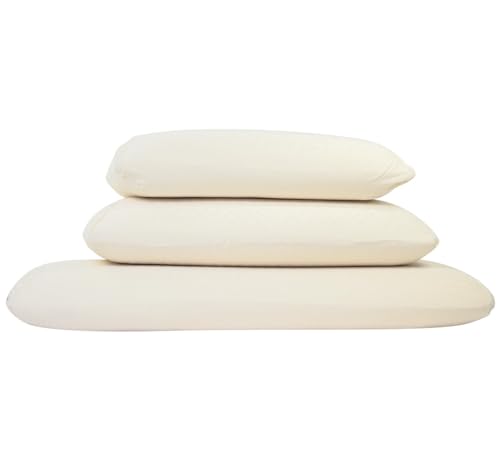
Turmerry Organic Latex Pillow, Queen, High Loft — Best Natural Latex
Latex behaves differently from every foam in this guide: it pushes back. The Turmerry is a high-loft Queen pillow — a verified 5-inch loft in the soft feel — made from GOLS-certified Dunlop latex with a pinhole design and an organic cotton cover. For side sleepers, that springy response is valuable, because the pillow supports the head at the top of its loft instead of slowly sinking through the night. The pinholes are not decoration; they let air move through the core, which makes this the coolest-sleeping solid pillow here. It suits side sleepers who are tired of foam pillows packing flat within a year, and anyone who prefers natural materials with the certification to prove the latex itself is organic — GOLS is the standard that certifies organic latex, and it is named in the listing.
Strengths
- Responsive latex holds its 5-inch loft all night and springs back every morning.
- Pinhole core breathes noticeably better than solid memory foam.
- GOLS-certified Dunlop latex with an organic cotton cover, both confirmed in the catalog listing.
Trade-offs
- The loft is fixed — 5 inches in a soft feel will be too much for narrow shoulders on a soft bed.
- Latex has a springy, buoyant feel that committed memory-foam fans describe as pushy.
- It is a heavier pillow than the shredded options, so it stays where you put it — good or bad depending on your habits.
| Spec | Verified detail |
|---|---|
| Size | Queen |
| Loft | High loft, 5 inches |
| Material | GOLS-certified Dunlop latex |
| Cover | Organic cotton, zippered |
The durability argument deserves emphasis, because it is where latex quietly wins this category. A shredded foam pillow can be re-lofted; a molded foam pillow cannot be un-flattened; a latex pillow simply resists flattening for years. For a side sleeper managing back discomfort, consistency is a feature in itself — the support you dialed in during week one is still the support you get in year three, so your body is not constantly readapting to a pillow that is slowly changing height underneath you. Choose the soft feel listed here if your mattress is medium or soft; the same line’s firmer feels exist for very firm beds and very broad shoulders.
Best for: hot-sleeping side sleepers with average-to-broad shoulders who want natural, long-lasting support. / Not suited for: sleepers who love the slow sink of memory foam, or narrow frames.

ORGANIC TEXTILES Organic Latex Contour Pillow — Best Organic Contour
This pick combines the two previous ideas: the fixed, supportive geometry of a contour pillow, executed in certified organic latex instead of synthetic foam. The ORGANIC TEXTILES contour uses GOLS-certified organic latex in a medium-loft, medium-feel profile, with a GOTS-certified organic cotton cover — GOTS certifies the textile, GOLS certifies the latex, and the listing names both, which is exactly the paperwork a shopper paying for organic materials should look for. The contour’s raised edge supports the neck while the center hollow keeps the head from perching too high, a shape that suits side sleepers whose shoulders are average width and who found the Royal Therapy’s foam too warm or too dead-feeling.
Strengths
- Contour support with latex’s spring and airflow instead of foam’s heat and sink.
- Both certifications check out in the listing: GOLS for the latex, GOTS for the cotton cover.
- Medium loft suits the middle of the shoulder-width range better than high-loft designs.
Trade-offs
- Fixed shape and loft — no adjustment if the medium profile misses your gap.
- Contour pillows take a few nights to get used to if you have always slept on a traditional shape.
- Natural latex has a faint natural scent at first that airing out handles, but sensitive noses notice it.
| Spec | Verified detail |
|---|---|
| Shape | Contour |
| Loft / feel | Medium loft, medium feel |
| Material | GOLS-certified organic latex |
| Cover | GOTS-certified organic cotton |
Think of this as the pillow for the side sleeper who read the contour section, liked the logic, and then balked at sleeping on a block of synthetic foam. You give up the Turmerry’s extra height and gain a shape that actively positions the neck. It also pairs well with the knee pillow below for sleepers building a fully natural-materials bed, since the contour handles the top of the spine and the knee spacer handles the bottom. As with every fixed pillow in this guide, measure your gap first — medium loft on a medium mattress with average shoulders is the sweet spot, and outside that triangle the adjustable picks are the safer money.
Best for: average-shouldered side sleepers who want certified organic materials in a supportive contour shape. / Not suited for: very broad or very narrow shoulders, or anyone who needs to fine-tune height.

Everlasting Comfort Memory Foam Knee Pillow — Best Between-the-Knees Companion
The only non-head pillow in this guide earns its place because side sleeping twists from the bottom as much as it bends at the top. When you lie on your side with nothing between your knees, the upper leg slides forward and drops toward the mattress, dragging the pelvis into a rotation that the lower back has to absorb for hours. A contoured knee pillow fills that gap, keeps the legs parallel and the hips stacked, and the Everlasting Comfort version adds a removable strap so the pillow travels with your leg when you roll over instead of ending up at the foot of the bed. Its hourglass contour is shaped to sit between the knees rather than the calves, which is where the spacing actually controls hip angle.
Strengths
- The strap keeps the pillow in place through position changes — the feature most knee pillows lack.
- Contoured shape locks between the knees instead of wandering down to the ankles.
- Addresses the hip-twist half of side sleeping that no head pillow can touch.
Trade-offs
- It does nothing for the head and neck — it is a companion to a good head pillow, not a replacement.
- Some sleepers find the strap fussy and prefer to use the pillow without it.
- Memory foam between the knees can feel warm in summer bedding.
| Spec | Verified detail |
|---|---|
| Type | Knee pillow for side sleepers |
| Fill | Memory foam |
| Feature | Removable positioning strap |
A note on honesty: this pillow’s own catalog listing uses medical language we deliberately do not repeat in this guide. We include it for a simple mechanical reason — spacing the knees keeps the pelvis level — and level hips are a comfort upgrade any side sleeper can feel within a night or two, whatever the state of their back. If you buy one thing beyond a head pillow, buy this; it costs a fraction of the head pillows here and completes the posture they start. Sleepers who also use a pillow between the ankles for extra alignment can layer the two, but start with the knees — that is where the leverage on the pelvis is.
Best for: every side sleeper in this guide, as the second purchase after a correctly lofted head pillow. / Not suited for: back sleepers, or anyone shopping for a head pillow substitute.
Comparison Table
| Pick | Badge | Key spec | Best for |
|---|---|---|---|
| Coop Home Goods Original Adjustable, Queen | Best Overall | Adjustable cross-cut memory foam, medium firm | Getting the loft exactly right |
| Sidney Sleep Adjustable Curved, Queen | Best for Broad Shoulders | Curved shoulder cutout, 19 x 29 in, extra fill included | Wide frames, sore shoulders |
| Royal Therapy Memory Foam, Queen | Best Firm Contour | Molded contour, 24 x 14 x 5 in | Fixed, firm, repeatable support |
| Turmerry Organic Latex, Queen High Loft | Best Natural Latex | GOLS Dunlop latex, 5 in loft, pinhole core | Hot sleepers, long-term loft |
| ORGANIC TEXTILES Latex Contour | Best Organic Contour | GOLS latex contour, medium loft, GOTS cotton cover | Organic materials with structure |
| Everlasting Comfort Knee Pillow | Best Between-the-Knees Companion | Memory foam contour with removable strap | Keeping hips stacked all night |
How to Choose a Pillow for Side Sleeping Without Wrecking Your Back
Start with the measurement everything else depends on. Stand with your shoulder against a wall and measure from the wall to the side of your head — that is your uncompressed shoulder gap. Your pillow’s job is to fill that gap as it will be at 3 a.m.: compressed by the weight of your head and reduced by however far your shoulder sinks into the mattress. Broad shoulders on a firm mattress need the most loft; narrow shoulders on a plush mattress need surprisingly little. Most side sleepers land somewhere in the middle, which is why medium-to-high loft dominates this guide — and why adjustable fill is such insurance, because it lets the pillow meet the measurement instead of your body meeting the pillow.
Next, be honest about your mattress. A soft mattress swallows the shoulder, shrinking the gap; a firm mattress holds the shoulder up and keeps the gap wide. The same pillow that is perfect on one bed can be wrong on the other, and this is the single most common reason a well-reviewed pillow disappoints. If you are also changing mattresses soon, buy the adjustable pillow first and re-tune it after the bed changes.
Starting Loft by Shoulder Width and Mattress Feel
Numbers make this easier, so here are honest starting ranges — compressed loft, meaning the height under your head at rest, not the fluffy height on the shelf. Narrow shoulders (a wall measurement under roughly 4 inches of gap) on a soft or medium mattress: start low, around 3 to 4 inches compressed, which points you at the ORGANIC TEXTILES contour or a well-thinned adjustable. Average shoulders on a medium mattress — the most common case — start around 4 to 5 inches: the Coop as shipped, the Royal Therapy’s high side, or the Turmerry all land in this territory. Broad shoulders, or any shoulders on a firm mattress that refuses to let them sink: start at 5 inches and expect to go higher, which is exactly why the Sidney Sleep ships with extra fill in the box.
Two adjustments refine the starting point. A mattress topper adds sink, so subtract a little loft for a thick plush topper and add a little for a firm one. And body weight changes compression: heavier heads and shoulders compress shredded fill more, which is another argument for adjustable designs in larger bodies — you can simply put back what the compression takes. Treat these ranges as the first night’s setting, not a verdict. The two-week rule from the setup section still governs: small change, several nights, honest notes in the morning about where the stiffness sits — neck, shoulder or lower back — because each location points at a different fix.
Shredded, Molded or Latex: Which Fill Behaves Best on Your Side?
Shredded adjustable fill — the Coop and the Sidney Sleep — is the forgiving option. It molds around the head, can be re-lofted with a shake, and its height is a decision you can revise nightly. Its weakness is maintenance and migration: the fill shifts, and sleepers who hate fluffing will eventually sleep on a lumpy wedge. Molded contour foam — the Royal Therapy — is the opposite trade: zero maintenance, a shape engineered to hold the neck, and no forgiveness if the fixed height misses your frame. Latex splits the difference in behavior but not in adjustability: it cannot be tuned, yet it neither migrates nor packs down, and it sleeps the coolest of the three. Choose by your own habits — tinkerers take shredded, minimalists take molded, hot sleepers and long-term planners take latex.
How to Set Up Your Side-Sleeping Pillow System
Setting up correctly takes one evening and pays off every night after:
- Step 1: Put the head pillow on the bed at its as-shipped loft. Lie on your side in your real sleep position, with a partner or a phone on a timer checking your alignment from behind: your spine should run straight, with the head neither tipped toward the bed nor propped upward.
- Step 2: Adjust in small steps. For shredded pillows, remove or add a small handful at a time; for fixed pillows, fold a thin towel under the pillow to test extra height, or accept that the loft is wrong if even the bare pillow tips your head up.
- Step 3: Place the knee pillow between your knees, strap on if you roll often, with your knees slightly bent and your ankles roughly under your knees — legs parallel, hips stacked.
- Step 4: Check the shoulder. It should rest on the mattress just in front of the pillow’s edge, not jammed into the pillow itself; with the curved Sidney Sleep, the shoulder belongs in the cutout.
- Step 5: Sleep a full week before changing anything else. One variable at a time, judged over several nights, tells you the truth; nightly tinkering tells you nothing.
Not All Side Sleeping Is the Same: Curl, Log and the Arm-Under-Pillow Habit
Side sleeping is a family of positions, and the variations change what the pillow has to do. The tight fetal curl — knees drawn well up, chin tucked — shortens the distance the knee pillow has to manage but rounds the back for hours; curlers often do better with the knee pillow placed a little lower, between the lower thighs, and with a head pillow at the lower end of their loft range, because the tucked chin already flexes the neck forward. The straight “log” position — legs extended, arms by the sides — is the kindest to the spine and the easiest to equip: standard loft guidance applies, the knee pillow sits squarely between the knees, and the main risk is the shoulder bearing full weight, which correct loft handles.
The third habit causes more trouble than the other two combined: sleeping with an arm under the pillow or under the head. It feels like support, but it lifts one side of the pillow unevenly, tilts the neck, and puts the shoulder into a loaded, rotated position for hours — and it usually signals that the pillow itself is too low, so the sleeper is supplementing it with their own arm. If that is you, treat it as a loft diagnosis, not a quirk: move up a loft class or add fill to an adjustable pillow until the arm stays down by your side where it belongs. Waking with a numb or tingling arm is the same signal in stronger form.
Position also shifts through the night, and combination sleepers — side to back and back again — should weight the adjustable and latex picks more heavily than the deep contour. A molded contour that is perfect on your side can feel like a wall when you roll onto your back; shredded fill compresses forgivingly, and latex gives a flatter central ride than its edges suggest. Buy for the position you fall asleep in, but do not buy a pillow that punishes the position you wake up in.
When the Pillow Is Not the Problem
Honest guidance matters here, because pillows get blamed for two things they cannot fix. The first is a worn-out mattress. If your mattress sags in the middle, your hips sink below your shoulders all night, and no pillow geometry at the head end can straighten a spine that is being bent at the waist. Test it: if you sleep noticeably better in a hotel bed or a guest room with your own travel habits unchanged, suspect the mattress before you buy a third pillow. The second is a pillow-independent pattern of pain — discomfort that is identical whether you sleep on your side, your back, or the sofa, and that does not shift at all when you change loft for a week. That pattern is information for a clinician, not for a product page.
There is also a middle case worth knowing: the pillow is fine and the mattress is fine, but the bed is shared and your partner’s pillow, duvet habits or a too-narrow mattress keeps pulling you out of position. A Queen or King pillow that holds its own territory, a knee pillow with a strap that survives a duvet tug, and enough bed width to keep your stacked position are the practical answers. Comfort is a system — head height, hip spacing, mattress support, and room to hold the position — and this guide’s six picks were chosen to cover the parts of that system a pillow purchase can actually control.
Common Buying Mistakes
- Buying by softness words instead of loft. “Plush” and “firm” describe feel, not height. A plush high-loft pillow can support a side sleeper better than a firm low one.
- Ignoring the mattress. Ordering the internet’s favorite pillow without asking how far your shoulder sinks into your own bed is how good pillows get returned.
- Skipping the knees. Spending on a premium head pillow while the top leg twists the pelvis all night treats half the posture.
- Judging on night one. Your neck has adapted to the old pillow, however bad it was. A week is the honest trial.
- Believing cure language. A pillow is a comfort and alignment tool. Listings that promise to fix medical conditions are selling, not informing — persistent or worsening back pain belongs in front of a clinician, not a shopping cart.
Final Recommendation
For most side sleepers, start with the Coop Home Goods Original Adjustable: it is the only design here that cannot be the wrong height, because you set the height yourself. Add the Everlasting Comfort Knee Pillow in the same order — together they address the full side-sleeping posture, top and bottom. Broad-shouldered sleepers should look at the Sidney Sleep curved pillow first, and hot sleepers or natural-materials shoppers should go straight to the Turmerry latex. If your discomfort runs more through the neck and shoulders than the lower back, our companion guide to Best Pillows For Back And Side Sleepers With Neck Pain narrows the field further, while Best Contour Side Sleeping Pillows compares molded shapes in depth. Wide frames can also browse Best Side Sleeper Pillows For Broad Shoulders, and anyone building a full support setup should see Best Support Pillows Side Sleepers and Best Pillows For Bad Back And Neck.
Related guides
Frequently Asked Questions
How high should a side sleeper’s pillow be?
High enough that, lying on your side, your head and neck continue the line of your spine — neither dipping toward the mattress nor propped above it. In practice that means filling your ear-to-shoulder gap after mattress sink and compression, which is why adjustable pillows are the safest buy: the right height is personal, and they let you find it instead of guessing it.
Can the wrong pillow make my back feel worse?
A pillow that holds your neck bent all night can leave the whole back feeling stiff and achy by morning, because the spine works as one chain. The reverse is also true: correct the head height and add a knee spacer, and many side sleepers find mornings noticeably more comfortable. A pillow is not a medical treatment, though — pain that persists, radiates, or comes with numbness needs a clinician’s assessment.
Why does my shoulder hurt when I side sleep?
Usually because the shoulder is bearing weight at a bad angle — either crushed under you with the pillow too low, or hiked toward your ear with the pillow arranged badly. A pillow at the correct loft, placed so the shoulder sits just in front of its edge (or inside a curved cutout like the Sidney Sleep’s), takes the jam out of the joint.
Is a knee pillow really necessary?
Not necessary, but it is the highest-value accessory in this guide. Without spacing, the top leg drops and rotates the pelvis, and the lower back absorbs that twist for hours. A contoured knee pillow with a strap keeps the hips stacked with no effort from you, which is exactly what you want from something that has to work while you are asleep.
Memory foam or latex for side sleeping?
Memory foam — shredded or molded — gives a cradled, low-movement feel and the only real adjustability. Latex gives spring, airflow and years of loft retention, at a fixed height. Hot sleepers and long-term buyers lean latex; tinkerers and first-time buyers lean adjustable foam. Both beat a flat, worn-out pillow by a wide margin.
Should I use two pillows stacked instead of one high-loft pillow?
Almost never. Two stacked pillows slide against each other through the night, so the height you fall asleep on is not the height you wake on, and the top pillow usually ends up angled, tipping the head sideways. One pillow built to the right loft — or one adjustable pillow tuned to it — holds a stable, level surface. The only exception is a deliberate wedge arrangement for reading in bed, which should come out before sleep.
Does pillow size matter, or only height?
Height does the alignment work, but size decides how much freedom you have to move. A standard pillow suits smaller frames; a Queen like most of the picks here gives restless side sleepers more surface to roll across without falling off the edge, and the Sidney Sleep’s 19 x 29 inch Queen footprint is the roomiest in this guide. If your head regularly ends up half off the pillow by morning, size — not loft — is your problem.
How often should I replace my pillow?
When it stops holding its working loft: fold a shredded or foam pillow in half and if it stays folded, its support life is over. Latex lasts considerably longer. As a rough rhythm, expect a few years from quality foam and longer from latex — but judge by the fold test and your morning stiffness, not the calendar.

