Disclosure: airfryerkitchensupply.com is reader-supported. When you buy through links on our site, we may earn an affiliate commission at no extra cost to you.
Where to buy
Every rug in this guide to the best rugs for baby room no allergen asthma concerns is sold on Amazon, and every link below goes to a listing confirmed before writing. Most nursery shoppers should start with the RUGSURE Washable Area Rug, built and positioned specifically for nurseries and kids’ rooms. For a soft pink nursery theme, see the CAPALOCA Washable Low Pile Nursery Rug; for a small nursery, the Keeko 4×6 Low Pile Washable Rug; for a large room, the 8×10 Washable Low Pile Area Rug or the cotiled Boho Washable Rug; and for a playful playroom corner, the Lahome Rainbow Washable Rug. Prices change constantly, so check the current price on Amazon rather than trusting any figure printed in a guide.
Shopping for the best rugs for baby room no allergen asthma concerns starts with an honesty test most rug guides fail: no rug is allergen-free, and no rug treats asthma. Bare hard flooring is always the lowest-allergen surface in a nursery, full stop. What a rug can be — if you choose it for the softness, warmth, and tummy-time comfort that make nurseries work — is manageable: low-pile so it traps and holds less dust than a plush rug, machine washable so the dust, pollen, and dander it does collect can actually be removed on a regular cycle, non-slip so it is safe under crawling and cruising babies, and made of materials whose claims check out. Every pick in this guide meets that practical standard, and the guide explains the reasoning in plain terms so you can judge any rug, here or elsewhere, by it.
That framing matters because the marketing in this category leans hard the other way. You will see rugs elsewhere advertised with sweeping “hypoallergenic” and “asthma-friendly” language that no textile can fully honor: any soft surface collects some household dust, and what decides a nursery’s air is how often and how thoroughly that surface gets cleaned. A washable low-pile rug washed monthly will carry a fraction of the allergen load of a beautiful shag rug vacuumed weekly, because vacuuming redistributes and only partly removes what washing takes away entirely. So this guide ranks by cleanability first, pile second, and softness third — the reverse of most nursery rug guides, and deliberately so, because a nursery’s air rewards the family that cleans on schedule far more than the family that shops on adjectives.
The six picks that follow were all confirmed through the API. They are all washable, all low-pile or flat and thin by design, and all positioned by their own listings for nurseries, kids’ rooms, or family spaces. They range from a compact 4×6 for a small nursery to a room-anchoring 9×12, and one carries an OEKO-TEX certification — which, to be precise, means the textile was tested for harmful substances; it is a safety screen for what is in the rug, not a promise about the air around it, and this guide will describe it as exactly that. If your child has diagnosed asthma or allergies, treat this guide as product research to discuss with your pediatrician or allergist, not as medical advice — that boundary matters more than any rug, any routine, or any buying guide, including this one.
In this guide
Quick Picks
- Best Overall: RUGSURE Washable Area Rug — positioned for nursery and kids’ rooms, stain and water resistant, non-slip.
- Best for a Pink Nursery: CAPALOCA 5×7 Washable Low Pile Nursery Rug — low pile, non-slip, sized right for most nurseries.
- Best Small Nursery: Keeko 4×6 Low Pile Washable Rug — compact footprint with a soft, cushioned feel.
- Best Large Room: 8×10 Washable Low Pile Area Rug — big neutral coverage, low pile, non-slip.
- Best Playful Design: Lahome Abstract Washable Rug, Rainbow, 5×7 — ultra-thin, non-slip, made for kids’ rooms and playrooms.
- Best Certified Materials: cotiled Boho Washable Area Rug, 9×12 — OEKO-TEX certified, thin, non-slip, stain resistant.
How These Picks Were Chosen
We searched the program’s Amazon listing data cache for area rugs and applied this search’s filters without mercy. Every pick had to be machine washable — the single most important allergen-management feature — and low-pile, thin, or flat by design, because pile is where dust lives. Every pick had to be non-slip, because a nursery rug sits under crawling babies, cruising toddlers, and parents carrying both at 3 a.m. And every pick’s own listing had to position it for a nursery, kids’ room, playroom, or family space; general living-room rugs that never claimed a child’s room were passed over unless their specifications were exceptional.
The exclusions tell the story as clearly as the picks. Shag and high-pile rugs — including cute rainbow shags marketed for nurseries — were excluded entirely: their long fibers trap dust and are nearly impossible to clean to the standard this search demands, however adorable they photograph. Wool rugs were excluded from the top ranks too; wool is a lovely natural fiber, but it is not machine washable in area-rug sizes and can shed fibers of its own. What remains is the honest category: synthetic low-pile washable rugs, the workhorses that can go in the machine monthly and come out genuinely clean.
Specifications printed here come only from each listing as recorded through the API: sizes, pile descriptions, backing and resistance claims, and certifications. Where a listing’s recorded title does not state a size — the RUGSURE’s case — the spec box says so rather than borrowing a number. And per standing rules we print no fixed prices and no star ratings or review counts; check the current price on Amazon.
The 6 Best Rugs for a Baby Room, Chosen for Cleanability
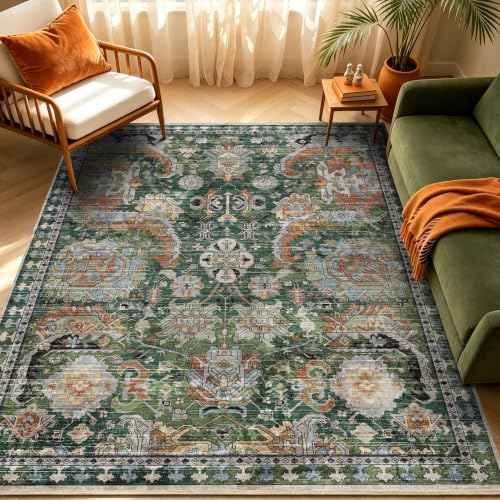
RUGSURE Washable Area Rug — Best Overall
The RUGSURE earns the top spot because its own listing aims it exactly at this search’s room: it is positioned for living rooms, bedrooms, kids’ rooms, and nurseries, with stain and water resistance, a non-slip build, and a pet-and-child-friendly design — and it is machine washable, the feature this whole guide is organized around. It is the balanced default for a nursery that needs to be soft underfoot and serious about cleaning.
Strengths
- Explicitly positioned for nurseries and kids’ rooms in its listing.
- Stain and water resistant — nursery spills bead up instead of soaking in.
- Non-slip backing for crawling, cruising, and night-time parent traffic.
Trade-offs
- The listing record we verified does not state a specific size for this configuration — confirm the size options on the listing before ordering.
- Washable rugs are thinner than plush nursery rugs; pair with a pad if your floor is hard and cold.
- Stain resistance helps with spills but does not replace the washing routine.
| Specifications (as confirmed by the listing) | |
|---|---|
| Type | Washable area rug |
| Rooms | Nursery, kids’ room, bedroom, living room (per listing) |
| Features | Stain and water resistant, non-slip |
| Size | Not stated in our verified record — check the listing |
The RUGSURE’s real argument is the combination, not any single feature. Washability without stain resistance means every spill becomes a wash; stain resistance without washability means a rug that looks clean and is not. Together, plus the non-slip backing, they describe the rug a nursery actually needs at 2 a.m. with a bottle spill and a half-asleep parent. If you buy one rug from this guide without reading further, buy this one in the size your room needs, put it on the monthly wash cycle described later, and the allergen-management brief is as well handled as a rug can handle it. It is also the easiest pick here to live with decoratively: nothing about its brief forces a theme on the room, so it can sit under a pink nursery this year and a dinosaur playroom in three years without arguing with either — a small mercy for a product category where tastes change at toddler speed.
Best for: most nurseries wanting one balanced, washable, nursery-positioned rug. / Not suited for: buyers who want plush, high-pile softness above all.
Check the current price on Amazon

CAPALOCA 5×7 Washable Low Pile Nursery Rug, Pink — Best for a Pink Nursery
The CAPALOCA is the design pick with its credentials in order: a 5×7 washable rug whose listing specifies low pile — the pile height this guide demands — in a soft pink nursery pattern, non-slip, positioned for bedrooms, kids’ rooms, and playrooms. Five by seven is the workhorse nursery size: big enough to anchor the crib-and-chair zone, small enough to fit a home washing machine’s drum in most households.
Strengths
- Low pile stated in the listing — traps less dust and vacuums and washes thoroughly.
- 5×7 size balances room coverage with home-machine washability.
- Soft pink nursery pattern that commits to the theme.
Trade-offs
- Pink is a palette commitment; it will not follow a redecoration quietly.
- Low pile means less cushion — add a pad for tummy time on hard floors.
- Light colors show the nursery’s daily evidence sooner between washes.
| Specifications (as confirmed by the listing) | |
|---|---|
| Type | Washable area rug, low pile |
| Size | 5 x 7 ft |
| Color | Pink, printed pattern |
| Backing | Non-slip |
Design and hygiene rarely coexist in nursery products, which is why this rug matters: it proves the washable low-pile category can still deliver the soft pink room of the plan. The 5×7 footprint deserves emphasis for a practical reason — it is about the largest rug that most home washing machines can genuinely agitate and rinse, which means this rug can be kept to the monthly standard this guide recommends without laundromat trips. For a themed nursery where the rug is part of the look, this is the pick that does not ask you to choose between the look and the cleaning. It also ages more gracefully than its pinkness suggests: in a toddler’s room the same rug reads as playful rather than babyish, and in a guest room afterward it becomes the soft accent nobody questions.
Best for: pink-themed nurseries and standard-size rooms. / Not suited for: neutral schemes or very large nurseries.
Check the current price on Amazon

Keeko 4×6 Low Pile Washable Rug — Best Small Nursery
Small nurseries — the converted office, the apartment’s second room — need a rug that fits the crib zone without wall-to-wall ambitions, and the Keeko is built to that brief: a 4×6 low-pile washable rug with a soft, cushioned feel (its listing describes a memory-foam softness), a minimalist look, and a non-slip build positioned for kids’ and nursery use. Four by six also washes easily in any home machine.
Strengths
- 4×6 footprint suits small nurseries and fits any home washer.
- Low pile with a cushioned, soft feel — comfort without the dust trap of shag.
- Minimalist design survives redecoration and second children of any theme.
Trade-offs
- Coverage is local — it defines a zone rather than flooring the room.
- Cushioned thin rugs feel different from plush carpet; set expectations accordingly.
- One rug this size may leave the rocking-chair zone uncovered — measure both spots.
| Specifications (as confirmed by the listing) | |
|---|---|
| Type | Washable area rug, low pile |
| Size | 4 x 6 ft |
| Feel | Soft, cushioned (memory-foam style, per listing) |
| Backing | Non-slip |
The small-rug strategy has a hidden hygiene advantage: a 4×6 is light enough to shake out outdoors between washes and quick enough to wash on a whim after a bad night, so small rugs tend to be cleaned more often than big ones — and frequency, as this guide keeps insisting, is the variable that actually decides a nursery’s dust load. Place it where the baby actually spends floor time — beside the crib and under the feeding chair’s landing zone — and a small rug covers the nursery’s real geography better than a large rug centered for the photograph. When the second child arrives or the first graduates to a bigger room, a 4×6 also redeploys gracefully — beside a bed, under a desk, inside a reading nook — which makes it the lowest-regret square footage in this entire guide.
Best for: small nurseries, apartments, and targeted crib-zone coverage. / Not suited for: large rooms needing a single anchoring rug.
Check the current price on Amazon

8×10 Washable Low Pile Area Rug — Best Large Room
For the big nursery, the shared kids’ room, or the open-plan family space, this 8×10 answers with scale: a washable, low-pile, non-slip rug in a neutral modern abstract design whose listing names the nursery among its rooms. Eight by ten covers the whole play geography — crib, chair, floor play, and the parent path between them — in one cleanable surface.
Strengths
- 8×10 coverage anchors a whole room, not just a zone.
- Low pile and washable — the hygiene brief at large scale.
- Neutral abstract design outlasts nursery themes into the kids’-room years.
Trade-offs
- An 8×10 wash needs a large-capacity machine or a laundromat trip — plan the logistics before buying.
- Neutral abstract will not deliver a themed nursery’s look on its own.
- Big rugs are a two-person job to hang and dry.
| Specifications (as confirmed by the listing) | |
|---|---|
| Type | Washable area rug, low pile |
| Size | 8 x 10 ft |
| Design | Modern abstract, neutral |
| Backing | Non-slip |
The honest conversation about this pick is the washing plan, so have it before the rug arrives: measure your machine, or locate the laundromat with oversize drums, and put the rug on the same monthly rhythm as the smaller picks. Households that solve that logistics question get the best of both scales — room-wide softness and warmth with a genuinely cleanable surface — and the neutral design means this rug graduates from nursery to playroom to family room without a redecoration argument. It is, in the end, the grown-up version of the nursery rug: less theme, more floor. Households that cannot wash an 8×10 should buy two smaller rugs instead and wash them in rotation; the guide’s principles matter more than any single product.
Best for: large nurseries and shared kids’ rooms with a washing plan. / Not suited for: small machines and no laundromat access.
Check the current price on Amazon

Lahome Abstract Washable Rug, Rainbow, 5×7 — Best Playful Design
The Lahome brings the color: a 5×7 washable rug in a rainbow abstract design, ultra-thin — the thinnest profile class in this guide, and therefore the easiest of all to wash, dry, and keep genuinely clean — soft, non-slip, and positioned by its listing for living rooms, kids’ rooms, and playrooms. As babies become toddlers and the nursery becomes a playroom, this is the rug that grows with the brief.
Strengths
- Ultra-thin profile washes and dries fastest of any pick here.
- Rainbow design delights toddlers and defines a play zone visually.
- 5×7 size fits home machines and most rooms.
Trade-offs
- Ultra-thin means minimal cushion — use a pad on hard floors for baby floor time.
- Bold rainbow colors anchor the room’s palette.
- Thin rugs can curl at corners if the backing is abused in hot washes — wash cool and dry flat.
| Specifications (as confirmed by the listing) | |
|---|---|
| Type | Washable area rug, ultra-thin |
| Size | 5 x 7 ft |
| Design | Rainbow abstract |
| Backing | Non-slip |
There is a developmental honesty to this pick: the newborn nursery is for the parents, but by month twelve the room belongs to a crawling, cruising, color-noticing person, and a rug that invites play while surviving the washing machine weekly if needed becomes the room’s hardest worker. Parents also report a side benefit that no listing mentions: a brightly defined play rug teaches the room’s geography — toys live on the rainbow, books happen on the rainbow — and a boundary a toddler can see is a boundary a toddler sometimes respects. The ultra-thin profile also makes this the safest pick here for door clearances and for laying over existing carpet — it sits flat where thicker rugs bunch. If your allergen-management plan leans on very frequent washing, this is the rug whose format makes that plan effortless.
Best for: playrooms, toddler rooms, and the most frequent washing routines. / Not suited for: newborn nurseries wanting maximum cushion without a pad.
Check the current price on Amazon

cotiled Boho Washable Area Rug, 9×12 — Best Certified Materials
The cotiled is the largest and the most credentialed pick: a 9×12 washable rug in a Moroccan boho pattern, thin and non-slip, stain resistant — and OEKO-TEX certified, per its listing. Precision matters with that label: OEKO-TEX certification means the textile has been tested for harmful substances. It is not an organic certification (that would be a different standard entirely), and it is not a promise about allergens in the room’s air. What it does give a nursery shopper is verified assurance about what the rug itself is made of — a reasonable thing to want under a baby who will spend hours face-down on it.
Strengths
- OEKO-TEX certified textile — tested for harmful substances, as stated in the listing.
- 9×12 room-defining coverage in a thin, washable, non-slip build.
- Stain resistant Moroccan pattern hides the nursery’s daily evidence gracefully.
Trade-offs
- 9×12 is a laundromat-scale wash for almost every household — plan for it.
- Boho pattern is a style commitment at a room-dominating size.
- Our verification record for this listing carries no recorded date (see _SOURCES), though the listing was confirmed in the program’s cache.
| Specifications (as confirmed by the listing) | |
|---|---|
| Type | Washable area rug, thin |
| Size | 9 x 12 ft |
| Certification | OEKO-TEX certified (harmful-substance testing) |
| Features | Stain resistant, non-slip |
Choose the cotiled when the nursery is a genuinely large room — a master-sized second bedroom, a combined nursery and playroom — and when materials documentation is part of your brief. The pattern earns its keep too: a busy Moroccan design is the most forgiving surface a family owns, camouflaging the interval between washes without hiding the need for them. Just be honest about the wash logistics, as with the 8×10: a 9×12 that cannot be washed becomes exactly the kind of dust reservoir this guide exists to prevent, while a 9×12 on a real washing schedule is the most complete nursery floor in this guide. If your household’s laundry reality sits between those poles, the two-rug rotation in a smaller size will serve you better than this flagship — and there is no shame in that answer, only in buying the flagship and quietly never washing it.
Best for: large rooms and materials-conscious buyers who have a washing plan. / Not suited for: small nurseries or households without oversize laundry access.
Check the current price on Amazon
What About Wool, Cotton, and Jute Nursery Rugs?
Parents ask about natural fibers constantly, usually because “natural” feels safer for a baby than “synthetic.” The honest answer is that fiber origin and allergen management are different questions. Wool is naturally resilient, flame-resistant, and beautiful, and a low-pile wool rug vacuumed diligently serves many families well — but wool area rugs in nursery sizes are rarely machine washable, wool can shed loose fibers in its early life, and some people are sensitive to lanolin and wool proteins themselves. For a household whose brief is frequent, thorough washing, wool asks you to substitute professional cleaning for the home routine, at intervals few families actually keep. Cotton flatweaves wash beautifully and feel wholesome, but cotton holds moisture longer than synthetics after washing and in humid rooms, and a slow-drying nursery rug works against the dust-mite strategy, which depends on keeping textiles dry. Jute and other plant fibers are the hardest to clean of all — they absorb spills into the fiber, resist vacuuming deep down, and cannot be machine washed — making them the wrong choice for this search however lovely they look in a boho nursery photograph. The synthetic low-pile washable category that fills this guide is not a compromise forced by budget; for the specific job of a frequently washed baby-room rug, it is the technically correct material class, and the OEKO-TEX certified cotiled exists precisely for parents who want that practicality with tested materials.
Nursery Rug Safety Checklist Beyond Allergens
Allergen management brought you here, but a nursery rug has a second job description: being safe under a person who will crawl, cruise, fall, and eventually run across it. Work through the checklist with any rug you buy. Grip: the rug must not slide on your floor under a running-start toddler or a parent carrying a baby in the dark — every pick here is non-slip per its listing, and you should still test yours on your floor, in socks, before the baby does. Edges: corners must lie flat; a curled corner is a trip edge and catches tiny toes. Weight curling corners for a day, and prefer rugs whose backings stay supple after washing. Fiber behavior: no loose loops or long strands that tiny fingers can pull, wrap, or mouth — another structural reason this guide bans shag in the nursery. Small parts: no glued embellishments, tassels a baby can worry loose, or surface decorations that can detach; flat printed patterns, like the CAPALOCA’s and Lahome’s designs, carry their visuals in the print rather than in attachments. Placement: keep the rug’s field away from the crib’s drop zone for thrown objects only in the sense that matters — under the crib is wasted rug; beside it is where babies land, play, and get dressed. Care products: wash with mild, fragrance-light detergent and rinse thoroughly, since the baby’s skin contact with this surface is total and prolonged; skip scented softeners entirely, which this guide already bans for the backing’s sake. A rug that passes the allergen routine and this checklist is doing the whole job of a nursery rug, and anything less is décor borrowing a nursery’s credibility.
Comparison Table
| Pick | Badge | Key spec | Best for |
|---|---|---|---|
| RUGSURE Washable Area Rug | Best Overall | Washable, stain and water resistant, non-slip | Most nurseries |
| CAPALOCA Nursery Rug 5×7 | Best for a Pink Nursery | Low pile, washable, non-slip | Themed nurseries |
| Keeko Rug 4×6 | Best Small Nursery | Low pile, cushioned, washable | Small rooms, crib zones |
| Washable Low Pile Rug 8×10 | Best Large Room | 8×10, low pile, neutral | Big nurseries, shared rooms |
| Lahome Rainbow Rug 5×7 | Best Playful Design | Ultra-thin, washable, rainbow | Playrooms, frequent washing |
| cotiled Boho Rug 9×12 | Best Certified Materials | OEKO-TEX certified, thin, 9×12 | Large rooms, materials focus |
The Honest Allergen Conversation: What a Rug Can and Cannot Do
Since this search pairs “no allergen” with “asthma,” the guide owes you the unvarnished version. Household dust is a mixture — dust mite waste, pet dander, pollen tracked in from outdoors, skin flakes, fibers — and it settles on every surface in a room, rugs included. A rug’s contribution to the problem depends on two variables: how much dust it can hold, and how completely its cleaning removes what it holds. Pile height drives the first variable, which is why every pick here is low-pile or thinner: short, dense fibers present a fraction of the holding volume of a shag’s long strands, and they give dust up to a vacuum far more willingly. Washability drives the second variable, and it is the decisive one, because machine washing in hot-enough water with detergent physically removes the accumulated load — mites, waste, dander, pollen — rather than redistributing part of it into the air the way dry vacuuming does.
What a rug cannot do is purify a room. If a child has diagnosed asthma, the nursery’s air quality will be decided by the whole system — the rug’s cleaning schedule, hard-surface dusting with a damp cloth, bedding washed hot and often, soft toys rotated through the wash, humidity kept in the range dust mites dislike, and the pediatrician’s management plan — with the rug as one component. That is why this guide’s strongest recommendation is not a product at all: it is the routine in the next sections, applied to whichever pick you choose. It is also why we excluded every shag and plush “nursery” rug we found, however soft their marketing: a rug that cannot be washed thoroughly is a reservoir with a cute pattern, and no family managing asthma needs one of those.
A word on materials claims, since nursery shoppers meet them constantly. “Hypoallergenic” on a rug listing is an unregulated comfort word; it usually means synthetic fibers that do not themselves shed protein fibers the way wool can, which is a real but modest point. OEKO-TEX certification — carried by the cotiled pick — is a regulated, testable claim about harmful substances in the textile, and it deserves more weight than adjectives. Neither word, however, changes the cleaning math above. Judge rugs by pile and washability, treat certifications as information about the rug’s own composition, and be skeptical of any product that promises a room’s air as its feature.
How to Choose a Nursery Rug for an Allergy-Sensitive Home
Size the rug to your washing machine first, your room second. This is the guide’s most practical rule and the one most often violated. A rug you cannot wash at home will be washed rarely, at effort, and a rarely washed rug fails this search’s brief no matter how low its pile. For most home machines, 5×7 is the comfortable ceiling and 4×6 is effortless; 8×10 and 9×12 are laundromat commitments — fine if you make them knowingly, as the big picks above ask you to. When in doubt, two smaller rugs in rotation beat one giant: one on the floor, one in the wash, no bare-floor days and no excuses.
Low pile, dense weave, synthetic fiber. The picks here share that recipe because it is what survives the routine: short fibers release dust to the vacuum between washes, dense construction keeps the surface smooth for crawling knees, and synthetic fibers tolerate repeated machine washing without felting, shedding, or holding moisture the way natural fibers can. Wool and cotton rugs have real virtues in other rooms; in an allergy-managed nursery washed monthly, they are the wrong tools.
Non-slip is a safety feature, not a convenience. A rug that slides on hard flooring is a fall hazard precisely where falls matter most — under a parent carrying a baby, and under a toddler learning to cruise along furniture. Every pick here is non-slip per its listing. If you add a pad for cushion, choose a pad that grips both sides, and check the combination on your actual floor before the baby does.
Cushion honestly. Washable low-pile rugs are thinner than the plush nursery rugs in photographs of other people’s nurseries. For tummy time and early crawling on hard floors, that thinness is a real cost, and the honest solutions are a rug pad beneath (which also extends the rug’s life), a separate washable play mat for floor sessions, or choosing the cushioned Keeko among the picks. Do not solve it by buying shag — that trades a comfort detail for the entire hygiene brief.
Plan the room’s whole soft-surface budget. The rug is one reservoir among several: curtains, the nursing chair’s upholstery, stuffed animals, and bedding all collect the same dust. An allergy-managed nursery keeps that total low and washable — blinds or washable curtains, a chair with removable covers, a small rotating cast of washable plush toys rather than a permanent pile of them. The rug you choose should be the easiest item on that list to clean, not the hardest.
Think in cost per wash, not cost per rug. The low-cost logic of this category is unusual: the rug’s job is to be cleaned aggressively and replaced when its backing tires, so a modestly priced washable rug that survives two years of monthly washing beats a precious rug you are afraid to wash hot or often. Every pick here sits in the value-to-mid tiers where that math works. Buy the size your machine handles, keep the routine, and let the rug be a working textile rather than an heirloom — in an allergy-managed nursery, that mindset is a feature of the plan, not a failure of the product.
How to Set Up and Clean a Nursery Rug: The Routine That Does the Work
Setup first. Unroll the rug and let it relax flat for a day; if corners curl, weight them or use rug tape at the corners — a curling edge is a trip hazard and a dust pocket. Vacuum it before first use to remove manufacturing lint, and place it so its main field covers the crib-side floor and the feeding chair’s surroundings, where floor time and spills actually happen. If you use a pad, trim it an inch smaller than the rug on all sides so it never peeks out.
The cleaning rhythm for an allergy-managed nursery: vacuum twice a week with slow, overlapping passes — speed is what makes vacuuming theater instead of cleaning — using a machine with a sealed HEPA filtration system if your household has one, and ideally while the baby is out of the room, letting any stirred dust settle before floor time resumes. Shake smaller rugs outdoors weekly if you can; it is the cheapest deep-clean there is. Machine wash the rug monthly — more often during pollen season or after illness — following its care label: cool to warm water for most washable synthetics, a gentle cycle, mild detergent, no fabric softener (it coats fibers and reduces the rug’s grip and cleanability), and a full, complete dry before it goes back down, because a damp rug returned to the floor undoes the entire exercise. Inspect the backing after each wash; a crumbling non-slip backing is the rug’s retirement notice. Follow that rhythm and the rug in a baby’s room stays what it should be: the most frequently and thoroughly cleaned surface in the house.
Common Buying Mistakes
- Buying the plush shag because it photographs like a nursery. Long pile is a dust reservoir that cannot be washed clean. It is the single worst choice for this search, whatever its marketing says.
- Buying a rug too big to wash. An unwashed 9×12 fails the brief that a washed 5×7 passes. Size to your machine or commit to the laundromat in writing, to yourself, before ordering.
- Believing “hypoallergenic” is a certification. It is an adjective. Pile height and washability are facts; OEKO-TEX is a certification about the textile’s substances. Weight them in that order.
- Forgetting the pad decision. Thin washable rugs on hard floors need a plan for cushion — a gripping pad or a play mat — or tummy time migrates off the rug you bought for it.
- Washing with fabric softener or returning the rug damp. Softener coats fibers and backing; damp returns grow the very problem the wash removed. Gentle detergent, full dry, every time.
- Treating the rug as the whole allergy plan. Bedding, curtains, plush toys, and dusting habits share the load. A perfect rug in an unmanaged room changes little; a good rug in a managed room changes a lot.
Final Recommendation
For most nurseries, the RUGSURE Washable Area Rug is the balanced buy: nursery-positioned, stain and water resistant, non-slip, and washable. Themed rooms get the CAPALOCA in pink or the Lahome Rainbow for play; small rooms get the Keeko 4×6; large rooms with a laundry plan get the 8×10 or the OEKO-TEX certified cotiled 9×12. Whichever you choose, the routine is the recommendation: low pile, monthly washing, twice-weekly vacuuming, and the rest of the room’s soft surfaces kept washable too. Write the wash date on a note inside the laundry cupboard door if that is what it takes to keep the rhythm honest — the families who manage this well are not the ones with the most expensive rug, they are the ones whose calendar quietly does the work. Do that, and a rug in the baby’s room is a comfort you have managed with open eyes — not a risk you have decorated with and hoped for the best.
Furnishing the rest of the children’s spaces with the same cleanable-first logic? See Best Area Rugs For Children’s Bedrooms, Best Area Rugs For Kids Playroom, Best Area Rugs For Kids And Pets, and Best Area Rugs For Family Rooms.
Frequently Asked Questions
Are rugs a bad idea in a baby’s room if asthma runs in the family?
Not automatically — but the rug has to earn its place in the room, every single month, through the washing routine. Bare hard flooring is the lowest-allergen surface, so a rug is a comfort choice, and the comfort should be bought in its most manageable form: low pile, machine washable, non-slip, and actually washed on a monthly rhythm. A shag or unwashed rug is a bad idea in any nursery; a washable low-pile rug on a real cleaning schedule is a reasonable one. If your child has diagnosed asthma, make the decision with their clinician, who knows the severity involved.
How often should a nursery rug be washed?
Monthly is the working standard for an allergy-managed nursery, with twice-weekly vacuuming between washes and a shake outdoors whenever the weather and the week allow. Wash more often during high-pollen weeks, after the baby has been ill, or after any major spill. The practical limit is your machine: a rug sized to your washer, like a 5×7 or smaller, makes the monthly rhythm effortless, which is why this guide weighs size-to-machine so heavily.
What does OEKO-TEX certified mean on the cotiled rug?
It means the textile was independently tested for harmful substances and met the standard’s limits — a claim about what is in the rug itself. It is not an organic certification, and it is not a promise about the room’s air or allergens. We credit it as exactly what it is: verified information about the material your baby will lie on, which many parents reasonably value.
Is a low-pile rug comfortable enough for tummy time?
On a soft subfloor or over carpet, yes. On hard flooring, most parents add one of two things: a gripping rug pad under the rug, which adds cushion and extends the rug’s life, or a separate washable play mat for floor sessions. The Keeko pick also builds a cushioned feel into a low-pile design. What not to do is solve cushion by choosing high pile — that trades away the washability and low dust retention the whole choice depends on.
Can I put a washable rug over existing carpet?
Yes, and thin rugs do it best — the ultra-thin Lahome lies flattest over carpet without bunching. It is a legitimate strategy in rentals where the installed carpet is plush and cannot be removed: the washable rug becomes the cleanable surface the baby actually touches, while the carpet underneath is vacuumed on the same rhythm. Make sure the combination does not create a tripping ridge at the edges.
What temperature water should I wash a nursery rug in?
Follow the rug’s own care label first — washable synthetics typically specify cool to warm water to protect their non-slip backing, and backing damage from hot water is a common way these rugs die early. The allergen work in a wash comes mostly from the combination of detergent, agitation, and complete rinsing and drying, not from extreme heat, so a label-compliant warm wash done monthly outperforms a backing-destroying hot wash done twice. For the rest of the nursery, reserve the hot washes for the textiles built for them — crib sheets, sleep sacks, and washable plush — and let each textile be cleaned at the strongest setting it can survive repeatedly.
When should a nursery rug be replaced?
When its non-slip backing crumbles or loses grip, when washing no longer brings it back to clean, or when the surface pills and roughens enough to hold dust against honest effort. Washable rugs in hard nursery service live a working life, not a forever one — and because every pick in this guide sits in the value-to-mid tiers, planned replacement is part of the hygiene math rather than a failure of the purchase.


