Disclosure: airfryerkitchensupply.com is reader-supported. When you buy through links on our site, we may earn an affiliate commission at no extra cost to you.
Where to buy
Shopping for the best slippers for 18 month old starts with the shortlist below. Every linked pick in this guide was matched against a live Amazon listing before it earned a link, and each one opens on the same product page a shopper would use at checkout: check price on Amazon for the top pick, or work through the Quick Picks section for the full set of six.
Availability, sizes and colours move around more than the products themselves do, especially in seasonal categories. If a first-choice size is out of stock, the comparison table further down shows which alternative covers the same need most closely, so you do not have to start the search from scratch.
The full shortlist in one place, in the order this guide ranks them: check price on Amazon check price on Amazon check price on Amazon check price on Amazon check price on Amazon check price on Amazon. Each link opens the verified listing for that pick.
Key Takeaways
- At 18 months the job is grip and staying on: a non-slip sole and a slipper that a toddler cannot kick off in two steps beat every cute extra.
- Measure the foot, then check the maker’s size chart: toddler sizing varies wildly between brands, and an age label is a guess, not a measurement.
- This guide excludes baby booties on purpose: an 18 month old walks, runs and climbs, and needs a real house slipper with a sole, not a newborn bootie.
- Soft, flexible soles let new walkers feel the floor, which is how balance develops; stiff, chunky soles belong to outdoor shoes.
- Expect one season per pair: feet at this age grow faster than slippers wear out, so value and fit beat heirloom construction.
The best slippers for 18 month old toddlers are a different product from baby slippers, and this guide starts by enforcing that difference. At eighteen months your child is walking, running, climbing the sofa and attempting the stairs gate: they need a house slipper with a real non-slip sole, a shape that stays on a moving foot, and enough flexibility for a new walker to feel the floor. Baby booties, however charming, are for babies who do not yet walk, so they were excluded from this guide entirely, along with sandals and anything pitched with medical claims.
The six picks below are true toddler house slippers and walking sock shoes, verified, with every size statement reported exactly as its listing gives it. That last point matters more here than in any other guide in this batch: toddler sizes are not standardised, one brand’s 12-18 months is another’s distant memory, so each review tells you how that listing expresses size, and the buying guide tells you to measure the foot and trust the ruler over the label.
In this guide
Quick Picks
OWIF Toddler Dinosaur Slippers (Green) — Best Overall. A warm, fuzzy dinosaur house slipper with a non-slip sole per the listing: the design toddlers actually want to wear, on a construction that does the safety job. Check the current price on Amazon.
SITAILE Toddler Slippers (Warm, Memory Foam, With Grips) — Best for Cold Floors. A plush-lined winter slipper with a non-slip sole, grips and a memory foam footbed per the listing: the warmest, most cushioned construction in this guide. Check the current price on Amazon.
OWIF Toddler Slippers (Warm, Non-Slip Sole) — Best Plain and Practical. The straightforward sibling: a cute, warm, soft indoor slipper with a non-slip sole per the listing, for boys and girls, without the character design. Check the current price on Amazon.
L-RUN Toddler Slipper (Beige, 5.5-6 Infant = EU22-23) — Best Stated Sizing. An indoor house slipper whose listing states its size three ways, 5.5-6 infant and EU22-23: the most checkable sizing statement in this guide. Check the current price on Amazon.
Hstyle Baby Walking Sock Shoes (Grey, 12-18 Month) — Best for New Walkers. A walking sock shoe with a soft rubber, non-slip sole, sized 12-18 months per the listing: the floor-feel pick for toddlers still polishing their walking. Check the current price on Amazon.
Fadezar Toddler Bunny Slippers (Pink, 8-9 Toddler) — Best Character Pick, Sized Up. A warm bunny slipper with a non-slip rubber sole and a half-cover heel per the listing, stated at size 8-9 toddler: included with a sizing warning this review will not soften. Check the current price on Amazon.
How These Picks Were Chosen
Scope came first. We included only house slippers and walking sock shoes for toddlers: soft-soled, non-slip, indoor designs. We excluded baby booties, including fleece bootie listings for this age, because a bootie has no real sole structure for a walking child; we excluded sandals, slides and outdoor shoes; and we excluded any listing whose pitch was primarily medical.
Deduplication came second. Several brands list the same slipper in multiple colours and in boy and girl variants; where two listings were the same product in different dress, we kept one and said so in the sources. The OWIF range appears twice in this guide only because the dinosaur design and the plain warm design are distinct listings with distinct constructions.
Finally, we ranked by the toddler realities: grip as stated, staying-on power of the shape, warmth for the season, and how honestly the listing handles sizing. A slipper an 18 month old removes in the first minute is not a slipper; it is a toy, and the reviews judge closures and shapes with that standard in mind.
The 6 Best Slippers for 18 Month Old
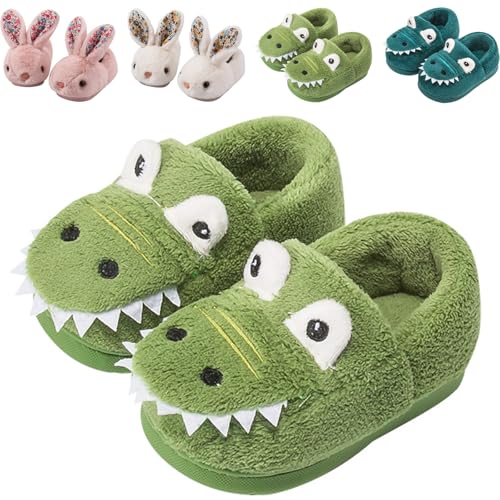
OWIF Toddler Dinosaur Slippers (Green) — Best Overall
The dinosaur wins this guide on a piece of toddler logic adults forget: a slipper a child asks for is a slipper that stays on. OWIF’s dinosaur design wraps that motivation in the right construction: a warm, soft, fuzzy house slipper with a non-slip sole as listed, made for indoor and bedroom floors in winter.
Strengths
- Non-slip sole stated in the listing, the first safety requirement at this age
- Warm, fuzzy build suits cold floors and winter mornings
- A design toddlers volunteer to wear, which solves the staying-on problem better than any strap
Trade-offs
- The listing title does not state a numeric size, so use the size chart on the product page against your child’s measured foot
- Fuzzy warmth is a winter feature; summer feet will want the lighter picks below
- Character designs are outgrown emotionally as fast as feet outgrow them physically
| Detail | What the listing states |
|---|---|
| Style | House slipper, dinosaur design |
| Sole | Non-slip (as listed) |
| Build | Warm, soft, fuzzy (as listed) |
| Use | Indoor, bedroom (as listed) |
| Colour | Green (as listed) |
Start here unless you have a reason not to. The construction covers the brief, warmth, grip and indoor manners, and the dinosaur does the persuading that no parent should have to do twice a day. The homework is sizing: this listing’s title does not carry a numeric size, and toddler sizing is a wild west, so measure your child’s foot in centimetres, stand them on paper and trace it, and match that measurement to the chart on the product page rather than to any age label. Do that, and this is the pair most likely to be worn, which at 18 months is the highest praise a slipper can earn.
Best for: Most 18 month olds, especially reluctant slipper wearers / Not suited for: Summer use or anyone who cannot verify size from the chart
Check the current price on Amazon

SITAILE Toddler Slippers (Warm, Memory Foam, With Grips) — Best for Cold Floors
The SITAILE is the winter-heavy pick: soft plush lining, a memory foam insole as listed, and a non-slip sole with grips, which is the listing’s way of describing a sole built to hold on smooth floors. For a toddler padding around a cold house in January, that is the whole wish list in one slipper.
Strengths
- Non-slip sole with grips stated in the listing, ideal for wood and tile
- Plush lining and memory foam make it the warmest, softest step here
- Unisex positioning suits hand-me-downs to siblings
Trade-offs
- Memory foam and plush are warm; this is a winter slipper, not a year-rounder
- Cushioned soles give slightly less floor feel than the thin sock shoes below
- As with all toddler listings, size by measured foot and the maker’s chart, not by age
| Detail | What the listing states |
|---|---|
| Style | House slipper, warm |
| Sole | Non-slip, with grips (as listed) |
| Lining | Soft plush (as listed) |
| Insole | Memory foam (as listed) |
| Use | Bedroom, home, indoor, winter (as listed) |
Cold floors change toddler behaviour: children avoid them, or run on them and slip. A plush, grippy slipper fixes both problems, and the SITAILE’s stated grips are the detail to value, because at 18 months a fall a day is normal and the sole is the difference between a tumble and a slide. The memory foam is a comfort extra rather than a necessity at this weight, and we rank it accordingly: nice, not decisive. Buy it for winter, size it by measurement, and expect it to be outgrown before it wears out, which is the correct economics for this age.
Best for: Cold houses, winter mornings and hard cold floors / Not suited for: Summer or warm-climate everyday wear
Check the current price on Amazon

OWIF Toddler Slippers (Warm, Non-Slip Sole) — Best Plain and Practical
Not every family wants a dinosaur on each foot. This second OWIF design is a distinct listing with a plainer brief: warm, soft indoor bedroom slippers for boys and girls with a non-slip sole. It is the practical pick for nursery spares, grandparents’ houses and anyone buying two pairs to rotate.
Strengths
- Non-slip sole stated, covering the core safety requirement
- Warm, soft build for everyday indoor wear
- Plain styling suits hand-me-downs and nursery spare-pair duty
Trade-offs
- Less toddler-persuasion power than the dinosaur design for reluctant wearers
- The listing title states no numeric size; the chart and a ruler must decide
- A second design from one brand means the range’s sizing habits repeat; measure once, carefully
| Detail | What the listing states |
|---|---|
| Style | House slipper, plain design |
| Sole | Non-slip (as listed) |
| Build | Warm, soft (as listed) |
| Use | Indoor, bedroom (as listed) |
| For | Boys and girls (as listed) |
There is a real case for the plain pair: it goes with everything, hands down to any sibling, and lives happily at a grandparent’s house where the main pair is forever being forgotten. Its construction brief matches the dinosaur’s on the points that matter, warmth and a stated non-slip sole, and it gives up only the theatre. If your toddler wears slippers without negotiation, save the dinosaur money. If yours does not, you already know which of these two to buy, and this one becomes the spare.
Best for: Spare pairs, grandparents’ houses and plain-preference families / Not suited for: Toddlers who need a character to cooperate
Check the current price on Amazon

L-RUN Toddler Slipper (Beige, 5.5-6 Infant = EU22-23) — Best Stated Sizing
The L-RUN earns its place on a point of honesty: its listing states a concrete size, 5.5-6 in infant sizing, equated to EU22-23. In a category of vague age labels, a number you can compare with a measured foot and a conversion chart is worth real money, and for many 18 month olds this size band is exactly the neighbourhood their feet live in.
Strengths
- Stated numeric sizing, US and EU, so fit can be checked before ordering
- Indoor house slipper design for girls and boys as listed
- A defined size band suits gift-buyers who know the child’s shoe size
Trade-offs
- One stated size means one chance: if your child’s foot is outside 5.5-6, this listing is not their pair
- The listing title is spare, so confirm sole and material details on the product page
- Beige is the listed colour; it shows nursery-floor evidence honestly
| Detail | What the listing states |
|---|---|
| Size | 5.5-6 infant = EU22-23 (as listed) |
| Style | Indoor house slipper |
| For | Girl/boy (as listed) |
| Colour | Beige (as listed) |
Buy this slipper the way you would buy a shoe: measure, convert, compare. Stand your toddler on paper in the evening, trace both feet, measure the longer one, and hold that number against the stated EU22-23 band using the maker’s chart. If it lands inside with a thumb’s width to spare, you have the most predictable fit in this guide. If it lands outside, believe the ruler and choose another pick; a stated size is only a virtue if you obey it, and at 18 months a month of growth can move a foot across a whole band.
Best for: Gift buyers and anyone who knows the child’s current shoe size / Not suited for: Children whose measured size falls outside the stated band
Check the current price on Amazon

Hstyle Baby Walking Sock Shoes (Grey, 12-18 Month) — Best for New Walkers
The Hstyle is a sock shoe, and this review names it as such: a soft, sock-like upper on a thin, flexible rubber sole, listed as non-slip and lightweight for 12-18 months. For a toddler at the younger, wobblier end of 18 months, that construction is a feature, because a thin flexible sole lets the foot feel the floor and learn from it.
Strengths
- Soft rubber sole with non-slip grip per the listing, and maximum floor feel
- Sock format is the hardest style here for a toddler to kick or pull off
- Lightweight and packable: the ideal bag and nursery spare
Trade-offs
- A sock shoe is not a warm winter slipper; cold floors want the plush picks
- Thin soles offer little cushion on hard floors for all-day wear
- Listed at 12-18 months, so a big 18 month old may be at the very end of its range; measure first
| Detail | What the listing states |
|---|---|
| Size | 12-18 months (as listed) |
| Style | Walking sock shoe |
| Sole | Soft rubber, non-slip (as listed) |
| Build | Lightweight (as listed) |
| Colour | Grey (as listed) |
Developmentally, this is the thoughtful pick: new walkers build balance through their feet, and a thin, flexible sole interferes least while still providing the grip that bare socks on wood floors dangerously lack. The sock format also stays on, which any parent who has retraced a hallway collecting kicked-off slippers will value. Its limits are seasonal and temporal: it is a light, thin product, and its stated band ends at 18 months, so a toddler at the top of the band needs the measurement check more than any other pick here. Treat it as the training-wheels pair, in the best sense.
Best for: Younger and newer walkers, and as a packable spare pair / Not suited for: Cold floors or toddlers already beyond the 18-month size band
Check the current price on Amazon

Fadezar Toddler Bunny Slippers (Pink, 8-9 Toddler) — Best Character Pick, Sized Up
The Fadezar bunny is a charming, well-specified slipper: warm plush, a non-slip rubber sole and a half-cover heel that helps it stay on, all stated in the listing. It is in this guide with its size printed in lights: 8-9 toddler, which for many children is a size reached well after 18 months. Buy it for the foot that measures into it, or buy it ahead for later, but do not buy it by the age in this guide’s title.
Strengths
- Non-slip rubber sole stated, a proper sole rather than grips alone
- Half-cover heel design helps the slipper stay on a moving toddler
- Warm plush build with a design toddlers love
Trade-offs
- Stated size 8-9 toddler will be too big for many 18 month olds; oversizing slippers causes the trips slippers exist to prevent
- Half-cover heel is a compromise: better than backless, less secure than a full back
- Pink bunny styling is a strong taste commitment for a hand-me-down
| Detail | What the listing states |
|---|---|
| Size | 8-9 toddler (as listed) |
| Sole | Non-slip rubber (as listed) |
| Heel | Half cover (as listed) |
| Build | Warm, plush (as listed) |
| Design | Bunny, pink, unisex (as listed) |
This pick is the guide’s sizing lesson made furry. Everything about its construction suits the brief, and its stated size may not suit your child at all, and both facts deserve equal print. An oversized slipper folds at the toe, catches on floor edges and turns a safe product into a trip hazard, so the kindest thing a review can do is insist on the measurement. If your 18 month old is a genuinely big-footed 8-9, this is a delightful, warm, grippy choice. If not, admire it, note it for next winter, and buy the pair that fits today.
Best for: Toddlers whose measured size is genuinely 8-9, or buying ahead / Not suited for: Average-sized 18 month olds buying for right now
Check the current price on Amazon
Comparison Table
| Pick | Badge | Key spec | Best for |
|---|---|---|---|
| OWIF Toddler Dinosaur Slippers (Green) | Best Overall | Non-slip sole, warm fuzzy dinosaur design | Most 18 month olds, especially reluctant slipper wearers |
| SITAILE Toddler Slippers (Warm, Memory Foam, With Grips) | Best for Cold Floors | Plush-lined, grips, memory foam insole | Cold houses, winter mornings and hard cold floors |
| OWIF Toddler Slippers (Warm, Non-Slip Sole) | Best Plain and Practical | Warm soft slipper, non-slip sole | Spare pairs, grandparents’ houses and plain-preference families |
| L-RUN Toddler Slipper (Beige, 5.5-6 Infant = EU22-23) | Best Stated Sizing | Stated size 5.5-6 / EU22-23 | Gift buyers and anyone who knows the child’s current shoe size |
| Hstyle Baby Walking Sock Shoes (Grey, 12-18 Month) | Best for New Walkers | Sock shoe, soft rubber sole, 12-18 months | Younger and newer walkers, and as a packable spare pair |
| Fadezar Toddler Bunny Slippers (Pink, 8-9 Toddler) | Best Character Pick, Sized Up | Bunny plush, rubber sole, size 8-9 toddler | Toddlers whose measured size is genuinely 8-9, or buying ahead |
The table is a shortcut, not a substitute for the reviews above it. Two picks can share a headline spec and still feel completely different in daily use, which is why each review separates what a product does well from the compromises that come with it.
How to Choose Slippers for an 18 Month Old
Measure the foot. That is the first, second and third rule of toddler footwear, because brands size by age, by US numbers, by EU numbers and by optimism, sometimes in the same listing. Stand your child on a sheet of paper in the evening, when feet are at their largest, trace both feet, and measure the longer tracing in centimetres. Then use each maker’s own chart. Leave a small growing margin, about a thumb’s width at the toe, and no more: excess length is a trip hazard, not a saving.
Next, the sole. For indoor slippers at this age you want two things that sound contradictory and are not: grip and flexibility. Grip, stated as a non-slip sole, rubber sole or grips, because toddlers run on the same wood and tile adults walk on. Flexibility, because a new walker’s foot is still learning its job, and a sole that bends with the foot teaches balance while a rigid one merely transports it.
Then staying power. Judge shapes by whether an 18 month old can defeat them: sock shoes and half or full heel coverage stay on; loose backless styles become projectiles. Warmth is the last variable and the simplest: plush and fleece for cold floors and winter, light sock shoes for warm homes and summer, and no shame in owning one of each at this age’s prices.
Why booties are not in this guide
Listings for this age include many fleece booties, and they were excluded deliberately. A bootie is a pre-walker product: soft, unstructured and without a real sole. An 18 month old walks, runs and climbs, and needs the grip and shape of a house slipper or sock shoe. If your child is a late walker still mostly crawling, a bootie can still serve at home, but it is not the product this search asks for, and we have not blurred the line to fill the list.
Sizing honesty, brand by brand
The picks here express size three different ways: an EU/US number from L-RUN, an age band from Hstyle, and chart-only sizing from the OWIF listings. None of these is the true one; the true one is your child’s measured foot. Treat any age label, including the 18 months in this guide’s title, as a starting guess that the ruler overrules.
Budget Tiers for Toddler Slippers, in Plain Terms
This guide prints no prices, because they change too often to trust in print, and toddler slippers are the category where tier discipline is easiest: feet at 18 months grow out of shoes in a season, so the correct spend is the value-to-mid lane for a pair that fits now, grips properly and will be replaced by spring.
Within that discipline, spend on the sole and the fit, not the licence or the fluff. A character design earns its money only as motivation for a reluctant wearer, which is a real function at this age and the reason the dinosaur leads this guide. A second, plainer pair for nursery or grandparents is a better use of money than one premium pair, because the most-missed toddler item in the world is the slipper left at someone else’s house.
Premium construction, heirloom leathers and orthopaedic marketing are all wasted at 18 months: the first two are outgrown, and the third is a claim a slipper cannot cash. Buy fit, grip and warmth, in that order, twice a year.
How to Fit and Look After Toddler Slippers
Fitting a toddler is a two-minute job with a cooperative subject about half the time. These steps make the measurement reliable and the slippers last their one glorious season.
- Measure in the evening: stand your child on paper, trace both feet, and measure the longer tracing in centimetres.
- Compare the measurement with the specific maker’s chart for the pair you are buying; never carry a size across brands.
- Fit with the socks your child will actually wear, and check for a thumb’s width of space at the toe, no more.
- Watch the first walk across your hardest floor: you are looking for grip without tripping, and a heel that stays seated.
- Check weekly for the two toddler failure modes: toes reaching the end, and sole grip wearing smooth.
- Wash or wipe as the listing allows, and air slippers out; toddler slippers live hard and benefit from a rest day.
- Keep a spare pair where mornings happen, nursery bag or grandparents’ house, because the lost slipper is a genre of its own.
When the toe check fails, replace without nostalgia, and hand down only pairs whose soles still grip; a smooth-soled hand-me-down is a skating rink with a cute design. At this age the calendar of feet is measured in months, and the budget tiers in this guide assume it.
Slippers in the Life of an 18 Month Old: Grip, Growth and the Hallway Test
An 18 month old experiences a house as a circuit: kitchen to hallway to living room, at speed, with sudden stops and sharper turns than any adult attempts. Slippers for that life are safety equipment wearing a cute disguise, and the sole is where the safety lives. The practical test is your own hardest floor: if the pair grips there at a toddler’s sprint-and-stop, it passes; if it slides on the kitchen tile, no amount of plush redeems it, and the pair belongs in the returns pile while the window is open.
Growth is the second governing fact, and it is faster than intuition says. Feet at this age can move a full size in a few months, which is why this guide keeps returning to the weekly toe check: it converts a surprise, the cramped slipper discovered at a growth spurt’s end, into a routine. It also justifies the guide’s budget discipline. Money spent on construction meant to last two years is money spent on a pair that will fit for one season; money spent on fit and grip, refreshed each season, is money spent on the thing itself.
The third fact is social: slippers live at nursery, at grandparents’ houses and in changing bags, and they go missing with a reliability that would be impressive in any other object. The two-pair strategy, one character pair that motivates and one plain pair that travels, is not consumer excess; it is the accumulated wisdom of everyone who has ever searched a car for one small dinosaur at nursery time.
OWIF Toddler Dinosaur Slippers (Green)
The dinosaur’s real specification is compliance: every other feature in this guide is worthless on a slipper that lives under the sofa, and a design a toddler fetches by themselves is a feature no lab can measure.
SITAILE Toddler Slippers (Warm, Memory Foam, With Grips)
The SITAILE’s grips show their worth on the two most-slippery domestic surfaces, the bathroom doorway and the kitchen’s polished patch by the sink, which is exactly where toddlers insist on standing.
OWIF Toddler Slippers (Warm, Non-Slip Sole)
The plain OWIF is the pair that makes grandparents’ houses work: it lives there, it fits the routine there, and it ends the Sunday-night discovery that the slippers are in the wrong house.
L-RUN Toddler Slipper (Beige, 5.5-6 Infant = EU22-23)
The L-RUN’s stated size makes it the only pick a relative can buy confidently from a text message, and in the economy of toddler gifts, that certainty is worth more than any design flourish.
Hstyle Baby Walking Sock Shoes (Grey, 12-18 Month)
The Hstyle sock shoe is the pair most likely to be forgotten on the feet at bedtime, which is the sincerest review a toddler product can get: it interferes with nothing, so nobody campaigns to remove it.
Fadezar Toddler Bunny Slippers (Pink, 8-9 Toddler)
The Fadezar bunny will have its season: bought for the foot that fits it, whether that is a big-footed toddler now or this same child next winter, it is a warm, grippy delight. Timing is its only flaw, and timing is the buyer’s job.
Real-World Scenarios: Which Pair for Which Toddler
The confident runner in a tiled kitchen. This child’s slippers are safety equipment, full stop. The SITAILE’s stated grips or the dinosaur’s non-slip sole are the shortlist, fitted snugly with the toe check passed, and the sock shoe is the spare rather than the main pair, because a sprint-and-stop on tile deserves the most sole you can reasonably put on a toddler. Watch the first kitchen crossing yourself; it is the only review that cannot be wrong.
The late walker still finding their feet. Floor feel is the curriculum, and the Hstyle sock shoe is the teacher: thin, flexible, grippy and impossible to kick off. Resist the family’s instinct to buy the sturdiest-looking pair; at this stage sturdy is a synonym for clumsy, and the child’s feet are doing developmental work that a rigid sole interrupts. The plush pairs can wait a season.
The grandparent gift, bought from a text message. The sender knows a shoe size, or thinks they do. The L-RUN’s stated 5.5-6 and EU22-23 sizing is the only pick a remote buyer can choose with a straight face, and even then the wise grandparent asks for a foot measurement in centimetres and keeps the receipt. A gift slipper that fits is remembered fondly; a gift slipper that almost fits is remembered at every visit.
The nursery starter. The bag needs a pair that lives there, survives industrial washing rhythms and does not cause a morning incident if forgotten. The plain OWIF is built for this exile: warm, grippy, unprecious. Label it, photograph it for the lost-property chat, and accept the nursery’s law that any item can vanish; the spare-pair strategy exists because that law has no appeals.
Toddler Slipper Ownership: The Season System
Think of toddler slippers as a season ticket rather than a possession. At the season’s start, measure, buy for fit and grip, and photograph the pair on the child’s feet, because that photograph settles every future argument about which size, which brand and which dinosaur. During the season, the weekly toe check and the occasional grip check on your hardest floor are the whole maintenance department; there is nothing to polish, condition or repair, and that simplicity is correct for the price of the things.
Build the season’s small infrastructure once: a hook or basket where the slippers live, a labelled spare at nursery or the grandparents’, and a note in your phone with the current foot measurement in centimetres and the date. That note is worth more than any loyalty scheme, because the next purchase, shoes, slippers or wellingtons, starts from a number that is true, and toddler footwear bought from true numbers fits the first time.
At the season’s end, judge the retirees honestly before they enter the hand-me-down bag. Grip worn smooth, toes that have pushed the upper out of shape, or a sole that has gone hard all disqualify a pair, however cute it remains. Hand down only what you would put on your own child for a sprint down a tiled hallway, and recycle the rest without sentiment; at this age, that discipline is the difference between a hand-me-down culture and a hazard exchange.
One More Scenario Worth Planning For
The childcare-bag commuter. This toddler’s slippers travel daily and are handled by people who did not buy them, so the brief is survival and clarity: the plain OWIF or the sock shoe, labelled with the child’s name in permanent marker on the sole’s edge, in a wet bag that contains the day’s evidence. Character pairs stay home where their motivational power is needed at 7 a.m.; the travelling pair’s job is to exist, grip and come back, and any pair that does all three for a whole term is a champion.
Accepting hand-me-downs without the grip test. A handed-down slipper with a polished sole is a skating aid. Run the hardest-floor test on every inherited pair, and retire failures to the dressing-up box where sliding is part of the fun.
A final checklist before you buy:
- Foot measured in centimetres, in the evening, both feet
- Maker’s own chart used; no size carried across brands
- Non-slip or rubber sole stated in the listing
- Shape that stays on: sock format or heel coverage
- Thumb’s width at the toe, checked weekly
- Booties left for pre-walkers; walkers get real soles
Common Buying Mistakes
Buying by age label. Age sizing is a guess wearing a uniform. Two 18 month olds can be three sizes apart. Measure the foot and use each maker’s chart, every brand, every time.
Sizing up generously ‘to grow into’. Oversized slippers fold, catch and trip the exact child they were bought to protect. A thumb’s width is growing room; a size and a half is a hazard.
Choosing booties for a walker. Booties are for pre-walkers. A walking, running 18 month old needs a real non-slip sole and a shape that stays on, not a fleece sock with ambitions.
Prioritising cute over grip. The design matters, as motivation, but the sole is the safety product. If a listing does not state a non-slip or rubber sole, it is not a main pair for hard floors.
Believing medical marketing for toddlers. Listings that pitch correction or therapy for healthy toddler feet are selling anxiety. Ordinary, well-fitting, grippy slippers are what this age needs; concerns about walking belong with your health visitor or paediatrician.
Final Recommendation
For most 18 month olds, start with the OWIF dinosaur: grippy, warm and, crucially, wanted by its wearer. The SITAILE is the cold-floor specialist, the plain OWIF is the sensible spare, and the L-RUN offers the most checkable sizing in the guide for gift-buyers. The Hstyle sock shoe serves the newest walkers best, and the Fadezar bunny is a lovely pair for the toddler whose foot genuinely measures into its stated 8-9, or for next season.
Measure, fit, watch the first walk, and replace on the toe check rather than the calendar. At 18 months, that rhythm is the whole art of slippers.
Keep exploring the wider category with these related guides from the same programme: Best Baby Slippers With Velcro Best Baby Walking Slippers Best Affordable House Slippers For Women Best Allday Comfort Slippers Best Bootie Slippers Womens
If you only open one product page today, make it the top pick: OWIF Toddler Dinosaur Slippers (Green). It is the one we would hand to a friend first, and the reviews above explain exactly where its limits are.
One More Thing Worth Knowing
One underrated test for this age: the hallway test at full toddler speed. A slipper that survives a sprint down your longest hard floor, a sudden stop and a direction change without leaving the foot or sliding has passed the only examination that matters. Every pick in this guide was chosen to be capable of passing it, and any pair that fails it at home should go back while the return window is open.
Finally, keep expectations kind: at 18 months slippers are also toys, teethers of opportunity and things to hide in toy boxes. A missing slipper is not a failed purchase, and a chewed one is not a defective product. Buy two pairs if the budget allows, and let the second pair absorb the chaos that the first one cannot.
Finish with the toddler’s own verdict, because at 18 months the market research is refreshingly honest: the right pair is fetched, worn and forgotten on the feet, while the wrong pair is removed, hidden and presented to you at inconvenient moments like a legal objection. Everything in this guide, the grip, the sizing discipline, the bootie exclusion, the shape that stays on, exists to earn that simple verdict, and no specification outranks it. So measure the foot, buy the sole, watch the first hallway sprint, and then let the child’s behaviour mark the homework: worn all morning without a campaign is a pass no laboratory could improve on. Replace on the toe check, hand down only what still grips, and keep the spare pair where the mornings happen. Do that, and slippers stop being a recurring problem of toddlerhood and become what they should be: two small, warm, grippy non-events at the bottom of a child who has much bigger things to do.
Related guides
Frequently Asked Questions
What size slippers does an 18 month old wear?
There is no single answer, which is the point of this guide’s sizing section: toddlers of the same age can differ by several sizes. Measure your child’s foot in centimetres and use each brand’s own chart; the picks here variously state EU/US sizes, age bands or chart-only sizing.
Are booties suitable for an 18 month old?
For a walking toddler, generally no: booties are pre-walker products without a real sole. An 18 month old who walks and runs needs a house slipper or sock shoe with a stated non-slip sole. A late walker who is still mostly crawling is the exception, at home, supervised.
Should toddler slippers have hard or soft soles?
Soft and flexible, with grip. New walkers learn balance through floor feel, so a thin, bendy, non-slip sole is the right indoor construction; stiff, chunky soles belong to outdoor shoes.
How do I stop my toddler removing their slippers?
Choose shapes that resist removal: sock shoes, and slippers with heel coverage, stay on far better than loose backless styles. A design your child loves, like the dinosaur pick here, is the other half of the solution.
How often will I replace toddler slippers?
Expect roughly a season per pair at this age, driven by growth rather than wear. Check the toe space weekly; when the thumb’s width is gone, the pair is done, however good it still looks.
Can my toddler wear slippers outside?
These picks are indoor house slippers and sock shoes as listed. Their soles are for grip on indoor floors, not for wet pavements and playgrounds; outdoor adventures need outdoor shoes.
Can my 18 month old wear slippers with socks?
Yes, and on cold floors socks under slippers are sensible, but fit the pair with the socks on: a combination that is snug without socks can cramp with them, and a combination fitted barefoot can slide with them.


