Disclosure: airfryerkitchensupply.com is reader-supported. When you buy through links on our site, we may earn an affiliate commission at no extra cost to you.
Where to buy
Every linked product below was verified against Amazon’s own product data connection before it earned a link. Three of the six were verified fresh on 2026-11-22 and three come from the programme’s earlier verified cache, and each is a different pad construction — plain felt, felt-and-EVA for vinyl, felt-and-rubber, dual surface, a thin gripper, and felt-and-natural-rubber — because with rug pads, the construction is the decision. The verified picks in this guide are the RUGPADUSA Basics Felt Rug Pad, 8’x10′, 3/8″ Thick (best overall), the RUGPADUSA Vinyl Lock Rug Pad, 8’x10′, Felt and EVA (best for vinyl and lvp floors), the GORILLA GRIP Felt Rug Pad with Rubber Backing, 2×8 ft Runner, 1/8″ Thick (best for runners), the Mohawk Home Rug Pad, 2′ x 3′, 1/4″ Thick Dual Surface (best small-rug pad), the Veken Non Slip Rug Pad Gripper, 2×3 ft (best thin gripper), and the BAGAIL Felt and Natural Rubber Rug Pad, 1/4″ Thick, 2 x 3 ft (best felt-plus-grip combo). Check the current price on Amazon from these links — we print no fixed prices and no ratings, because both change too often to publish honestly.
Why the best rug pads to use for area rugs are bought by floor type, not by brand
The best rug pads to use for area rugs are the invisible half of every rug you own, and they are bought wrong more often than rugs themselves — usually by treating ‘rug pad’ as one product. It is at least four: a cushion pad that makes a rug feel expensive, a grip pad that stops a rug travelling, a protection pad that keeps grit from sanding your floor’s finish, and a floor-specific pad that will not react with a sensitive surface like vinyl. Most rugs need two or three of those jobs done at once, and the six verified picks below are organised by which jobs each construction actually does.
The first question is always the floor. Hardwood wants felt against it: soft, non-abrasive, and safe for finishes. Vinyl and luxury vinyl plank want a pad labelled for vinyl, because some rubber compounds can mark or react with vinyl over time — the one genuinely consequential warning in this category, and the reason a dedicated vinyl pick appears below. Tile wants grip above all, since tile is the smoothest common floor. Carpet underneath wants a dual-surface pad, because a pad made for hard floors will skate on pile. Answer the floor question first and half the catalogue eliminates itself.
The second question is thickness, and the honest range is 1/8 inch to 1/2 inch. Thin pads (around 1/8 inch) are grip tools: they stop sliding without changing how the rug feels or catching door bottoms. Medium pads (1/4 inch) add felt cushion you can notice. Thick pads (3/8 to 1/2 inch) transform a flatweave into something that feels woven over carpet. Thicker is not better — a thick pad under a rug that a door swings over is a daily annoyance, and a thick pad under a dining rug makes chairs wobble at the edge. Match thickness to the room’s clearances and traffic, not to a more-is-more instinct.
A word on what verification means here: every size, thickness and material in the spec boxes comes from the listed listing title, and where a title does not state a figure — the Vinyl Lock pad’s thickness, the Veken gripper’s thickness — the review says ‘not stated’ rather than estimating. Rug pads are a category full of inflated claims; the discipline of only printing verified numbers is worth more than any single recommendation.
What a rug pad actually does all day
A pad works three shifts. During the day it absorbs the shear of foot traffic, so the rug’s fibres and backing are not ground against the floor with every step — this is why padded rugs last visibly longer. Under furniture, it spreads point loads, so a sofa leg’s weight is distributed instead of denting floorboards or telegraphing through LVP. And continuously, it catches the grit that migrates through the rug — the sand that would otherwise act as sandpaper between rug and finish. Lift a rug that has lived without a pad for two years and read the floor beneath: the dull, scratched rectangle is the pad’s job description, written by its absence.
There is also a safety shift. The rug most likely to slide is the one in the transition zone — hallway, entry, kitchen, bathroom — and those are the zones where people turn, carry, and step with wet feet. A grip pad in a transition zone is not a furnishing decision; it is the cheapest fall-prevention device in the house, and the runner and small-rug picks below are chosen with that framing in mind.
In this guide
Quick Picks
| Pick | Badge | Key spec | Best for |
|---|---|---|---|
| RUGPADUSA Basics Felt Rug Pad, 8’x10′, 3/8″ Thick | Best Overall | 8×10 ft felt pad, 3/8 in thick | A living-room area rug on hardwood that needs real cushion and floor protection |
| RUGPADUSA Vinyl Lock Rug Pad, 8’x10′, Felt and EVA | Best for Vinyl and LVP Floors | 8×10 ft felt + EVA pad made for vinyl/LVP | Anyone with luxury vinyl plank or sheet vinyl under an area rug |
| GORILLA GRIP Felt Rug Pad with Rubber Backing, 2×8 ft Runner, 1/8″ Thick | Best for Runners | 2×8 ft felt + rubber runner pad, 1/8 in thick | Hallway and kitchen runners that slide every time someone walks through |
| Mohawk Home Rug Pad, 2′ x 3′, 1/4″ Thick Dual Surface | Best Small-Rug Pad | 2×3 ft dual-surface pad, 1/4 in thick | Door mats, bath-area rugs and small accents that need cushion plus grip |
| Veken Non Slip Rug Pad Gripper, 2×3 ft | Best Thin Gripper | 2×3 ft thin gripper pad for hard floors and tile | Anyone whose only problem is sliding, and who wants zero added height |
| BAGAIL Felt and Natural Rubber Rug Pad, 1/4″ Thick, 2 x 3 ft | Best Felt-Plus-Grip Combo | 2×3 ft felt + natural rubber pad, 1/4 in thick | Small-to-mid rugs on hardwood that need both cushion and real grip |
One sizing reality before the table: the verified area-rug listings cluster at 8×10 feet because that is the size under most living-room rugs, while the verified small-rug and runner listings cluster at 2×3 and 2×8. If your rug is a 5×7 or a 9×12, buy the construction recommended here in your rug’s size rather than forcing a listed size to fit — the construction is the transferable advice, and a pad that stops four inches short of a rug’s edge leaves exactly the curling border you bought a pad to prevent.
Two picks share the RUGPADUSA brand because they are genuinely different products — a plain felt cushion pad and a felt-and-EVA pad built for vinyl floors — and the guide flags the distinction rather than pretending wider brand diversity than the verified listings offer. Everything else is a different maker and a different construction.
How These Picks Were Chosen
Verification came first: each pad had to be confirmed connection, with the Amazon title as the source of every stated size, thickness and material. Pads that were actually something else — kitchen comfort mats and non-slip rugs that surface in rug-pad searches — were excluded, because a mat is not a pad and a rug is not a pad, whatever the search results imply.
Selection then covered the construction matrix deliberately: plain felt (cushion and protection), felt-and-EVA (vinyl-safe), felt-and-rubber (runner grip), dual surface (hard floor or carpet), thin gripper (grip only, zero height), and felt-and-natural-rubber (the premium sandwich). Sizes in the verified listings cluster at 8×10 for area rugs and 2×3 / 2×8 for small rugs and runners; where a pick’s listing is a small size, the review says the construction is the recommendation and the size must match your rug.
Excluded on principle: pads with no stated material, pads sold as ‘extra thick’ with no thickness figure, and any rubber pad recommended without the vinyl warning. No prices or ratings are printed; check the current price on Amazon at the moment you buy.
The 6 Best Rug Pads to Use for Area Rugs, Verified Pick by Pick

RUGPADUSA Basics Felt Rug Pad, 8’x10′, 3/8″ Thick — Best Overall
This is the pad most area rugs on hardwood actually need: 8 by 10 feet of 3/8-inch felt, the thickness that turns a decorative rug into a comfortable surface and protects the floor beneath from the grit that works its way through a rug’s backing. It suits the standard living-room layout — sofa front legs on the rug, coffee table in the middle, traffic across it all day.
Strengths
- 3/8 inch of dense felt is the classic under-rug upgrade: it makes a thin flatweave feel like a much more expensive rug and spreads point loads from furniture legs
- Felt grips the rug above it well and is kind to hardwood finishes, which is why felt is the default recommendation for wood floors
- A pad this size anchors an 8×10 rug’s edges, cutting the corner-curl and creeping that make a room look untidy
Trade-offs
- Pure felt has no rubber grip layer for the floor side, so on very smooth polished floors a light rug can still travel slowly; the dual-surface picks below grip harder
- 3/8 inch raises the rug noticeably — check door swing clearance before ordering for a rug that passes under a door
- The Amazon title does not state a rubber backing or a non-slip rating, so this review claims cushion and protection, not maximum grip
| Size | 8 x 10 ft, as stated in the Amazon title |
|---|---|
| Thickness | 3/8 inch, as stated in the Amazon title |
| Material | Felt, as stated in the Amazon title |
| Backing | No rubber backing stated in the Amazon title |
Felt works by friction and by cushion. Against the rug it grips the backing fibres so the rug and pad move as one; against the floor it presents a soft, non-abrasive face that will not scratch finishes and will catch the sand and grit that otherwise grind between rug and boards. The 3/8-inch loft also quietens a room: footsteps land softer, chair legs scrape less, and the rug stops sounding hollow on a suspended wood floor.
Be honest about its one limit before you buy: felt alone is a cushion-and-protection pad, not the strongest anti-slip device. On a polished floor with a light rug and an enthusiastic dog, add the grip question to your decision — the felt-and-rubber picks below exist for exactly that case. For the average 8×10 on ordinary hardwood, this is the balanced default.
Best for: A living-room area rug on hardwood that needs real cushion and floor protection / Not suited for: Vinyl or LVP floors, where a pad made specifically for vinyl is the safer match
Check on Amazon — check price on Amazon from the product page; we print no fixed prices here.

RUGPADUSA Vinyl Lock Rug Pad, 8’x10′, Felt and EVA — Best for Vinyl and LVP Floors
Luxury vinyl plank is now the floor under a huge share of area rugs, and it has a specific vulnerability: certain rubber and latex pad materials can discolour or react with vinyl finishes over months of contact, and the damage appears exactly where you cannot see it until the rug is lifted. This pad’s entire reason to exist is that problem — felt for the rug side, EVA for the vinyl side, labelled by the maker for vinyl and LVP.
Strengths
- It exists for the one floor type where the wrong pad does real damage: some rubber pads can react with vinyl finishes over time, and this pad is built and labelled specifically for vinyl and LVP
- Felt face cushions and grips the rug while the EVA layer faces the vinyl, giving cushion plus a vinyl-safe contact layer in one product
- Full 8×10 coverage protects a large area of click-lock LVP from the point loads and grit abrasion that void flooring warranties and dull the wear layer
Trade-offs
- If your floor is hardwood, the vinyl specialisation buys you nothing — the plain felt Basics pad is the more direct tool
- The Amazon title does not state a thickness, so this review cannot promise a specific cushion depth; judge it as a protection-first pad
- EVA is a plastic foam: it will compress slowly under very heavy furniture over years, as all foam layers do
| Size | 8 x 10 ft, as stated in the Amazon title |
|---|---|
| Construction | Felt and EVA, as stated in the Amazon title |
| Intended floors | Vinyl and luxury vinyl plank (LVP), as stated in the Amazon title |
| Thickness | Not stated in the Amazon title |
That specialisation matters more than extra thickness for this floor type. LVP is a thin, hard surface over a rigid core; a rug pad’s jobs on it are to stop the rug skating on the smooth planks, to keep grit from sanding the wear layer, and to spread furniture loads so chair legs do not telegraph through and dent the click joints. A felt-and-EVA pad does all three without the chemical question mark that hangs over generic rubber on vinyl.
If you are shopping for vinyl, the discipline is simple: only use a pad whose listing explicitly names vinyl or LVP as an intended floor. This is the one verified pick in the guide that does, which is why it carries its own badge despite sharing a brand with the Best Overall pick — the two are different constructions for different floors, and the review treats them that way.
Best for: Anyone with luxury vinyl plank or sheet vinyl under an area rug / Not suited for: Hardwood owners who do not need a vinyl-specific pad and can use plain felt
Check on Amazon — check price on Amazon from the product page; we print no fixed prices here.
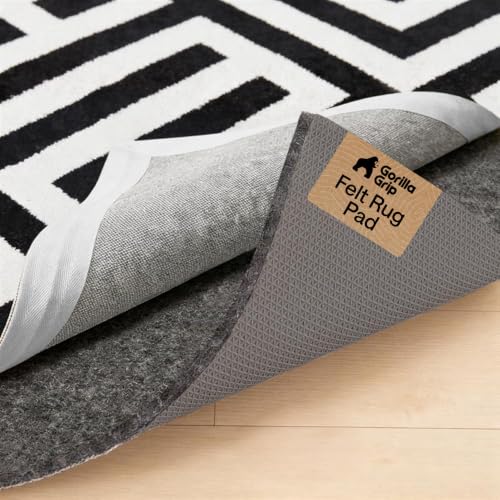
GORILLA GRIP Felt Rug Pad with Rubber Backing, 2×8 ft Runner, 1/8″ Thick — Best for Runners
Every house has one runner that will not stay put: the hallway strip that bunches against the skirting by Friday, the kitchen runner that travels towards the sink. This 2-by-8-foot felt pad with a rubber backing is the direct answer — felt up, rubber down, 1/8 inch thick — verified on 2026-11-22, and sized for exactly the textile that causes the trouble.
Strengths
- A runner is the highest-slip-risk textile in the house — long, narrow and walked along its length — and the rubber backing is the strongest grip format in this guide
- At 1/8 inch it adds grip and a little cushion without lifting the runner enough to catch door bottoms or become a trip edge
- Felt face protects the hardwood along the highest-traffic strip in the home, where grit does the most damage per square foot
Trade-offs
- 1/8 inch is a grip pad, not a comfort pad: anyone wanting a plush hallway should look at thicker felt and accept less grip
- Rubber-backed pads should not be used on vinyl floors (see the Vinyl Lock pick) and should be lifted periodically on any floor to check the finish beneath
- The Amazon title states hardwood use; on tile or stone, check the Veken and Mohawk picks, whose titles cover more floor types
| Size | 2 x 8 ft runner, as stated in the Amazon title |
|---|---|
| Thickness | 1/8 inch, as stated in the Amazon title |
| Construction | Felt with rubber backing, as stated in the Amazon title |
| Intended floor | Hardwood, as stated in the Amazon title |
The physics of a runner explain the design. A rug pad grips two interfaces: pad-to-rug and pad-to-floor. Felt wins the first interface; rubber wins the second. On a runner, the floor interface is the one that fails, because every footstep pushes along the runner’s length. A rubber backing resists that shear force far better than felt alone, which is why runner pads should be chosen grip-first and thickness-second — and why this pick is deliberately thin.
Two disciplines come with rubber. First, lift the runner and pad every few months and check the floor beneath: any pad can trap moisture after a spill, and early catching is the whole game. Second, keep rubber off vinyl flooring — that combination is the known problem pairing this guide steers around with the Vinyl Lock pick.
Best for: Hallway and kitchen runners that slide every time someone walks through / Not suited for: Large area rugs — this listing is a runner size; buy the size that matches your rug
Check on Amazon — check price on Amazon from the product page; we print no fixed prices here.

Mohawk Home Rug Pad, 2′ x 3′, 1/4″ Thick Dual Surface — Best Small-Rug Pad
Small rugs are where pads get skipped, and where they matter most per square foot: the mat inside the front door, the rug in front of the sink, the accent by the bed. These are the rugs that slide on the exact step where a person is turning, carrying shopping or stepping out of a shower. This Mohawk Home pad — 2 by 3 feet, 1/4 inch, dual surface, verified 2026-11-22 — is built for that job.
Strengths
- Dual surface means it works on both hard floors and over carpet — one side grips hard floors, the other is made to sit on carpet without creeping, which suits small rugs that move between rooms
- 1/4 inch at this size gives a doormat or bath rug a noticeably softer landing without making it a trip ridge
- The Amazon title lists noise reduction among its jobs, and small hard-floor rugs are exactly where a pad’s damping is most audible
Trade-offs
- A 2×3 pad is a specialist size: under-sizing a pad is the classic small-rug mistake, and this one only earns its keep under rugs of roughly its own dimensions
- Dual-surface pads ask you to put the right side down; the wrong way up halves the grip and the instructions matter
- 1/4 inch under a bathroom rug holds moisture longer than a thin gripper after a soaking — lift and air it after a flood, not just a splash
| Size | 2 x 3 ft, as stated in the Amazon title |
|---|---|
| Thickness | 1/4 inch, as stated in the Amazon title |
| Construction | Dual surface with rubber grip, as stated in the Amazon title |
| Trimming | Easy trim, as stated in the Amazon title |
The dual-surface construction is the useful detail. One face is the rubber grip side for hard floors; the other is designed to rest on carpet, where ordinary pads skate on the pile. Small rugs migrate between those situations — a mat that starts in a hard-floor hallway ends up in a carpeted bedroom — and a pad that handles both saves buying twice. The stated easy trimming means the pad can be cut an inch inside the rug’s edge on all sides, which is the correct fit: a pad should never peek out from under its rug.
At 1/4 inch it also gives a thin cotton mat a padded feel underfoot, the difference between stepping onto fabric and stepping onto furniture. Keep it out of the soak zone directly inside a shower door if your bathroom floods regularly; for normal splashes, lift it during the weekly clean and let both sides dry.
Best for: Door mats, bath-area rugs and small accents that need cushion plus grip / Not suited for: Big area rugs — a 2×3 pad under a large rug leaves the edges unanchored
Check on Amazon — check price on Amazon from the product page; we print no fixed prices here.
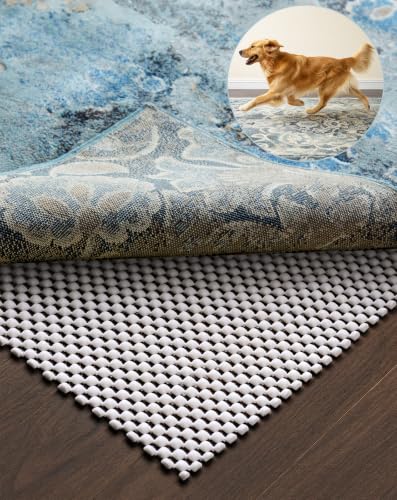
Veken Non Slip Rug Pad Gripper, 2×3 ft — Best Thin Gripper
Some rugs do not need cushion at all — they need to stop moving. The Veken gripper, 2 by 3 feet, verified 2026-11-22, is the minimalist tool: a non-slip mat whose Amazon title promises grip for hardwood and tile and nothing more. Under a kitchen mat, a bathroom rug or a small entry rug, that single promise, kept, is enough.
Strengths
- The thinnest solution in the guide: a gripper mat stops the slide without raising the rug, so doors swing over it and nobody trips on a padded edge
- The Amazon title covers tile as well as hardwood, making it the pick for kitchens, bathrooms and entryways where felt pads are less at home
- Gripper mats are the easiest pads to lift, wash down and relay after mopping — the right format for rooms that are wet-mopped weekly
Trade-offs
- It adds essentially no cushion: a thin rug on this mat still feels like a thin rug, and anyone chasing comfort should buy felt instead
- Grippers lose their bite as they load with dust and mop water; they need rinsing to stay grippy, which felt pads do not
- Under a large rug a small gripper only anchors where it sits — full coverage or corner placement must match the rug’s size
| Size | 2 x 3 ft, as stated in the Amazon title |
|---|---|
| Type | Non-slip gripper mat, as stated in the Amazon title |
| Intended floors | Hardwood and tile, as stated in the Amazon title |
| Thickness | Not stated in the Amazon title |
Thin grippers have one underappreciated virtue: hygiene logistics. A felt pad under a kitchen rug is a commitment — heavy to lift, slow to dry. A gripper mat comes up with the rug on mop day, gets rinsed in the sink or shaken outside, and goes back down in minutes. In rooms cleaned properly every week, the pad that survives the cleaning routine is the pad that keeps working; the luxurious one gets left in a corner by March.
Judge it on its one job. If your rug slides, this stops it. If your rug also feels thin and hard, you have two problems and this solves one — pair the diagnosis honestly: grip problems get grippers, comfort problems get felt, and rugs with both problems get a felt-and-rubber dual pad like the Gorilla Grip or BAGAIL picks.
Best for: Anyone whose only problem is sliding, and who wants zero added height / Not suited for: Buyers wanting cushion — a gripper mat is not a comfort pad
Check on Amazon — check price on Amazon from the product page; we print no fixed prices here.

BAGAIL Felt and Natural Rubber Rug Pad, 1/4″ Thick, 2 x 3 ft — Best Felt-Plus-Grip Combo
If the guide has a connoisseur’s pick, it is this one: felt for cushion and rug-grip, natural rubber for floor-grip, 1/4 inch thick, in a 2-by-3-foot listing verified on 2026-11-22. It is the construction flooring professionals describe when asked what a rug pad should be, applied to the small and runner sizes where most homes actually buy pads.
Strengths
- The felt-plus-rubber sandwich is the best-of-both construction: felt cushions and grips the rug, natural rubber grips the floor, and 1/4 inch is thick enough to feel
- Natural rubber is the premium grip material — it stays grippy for years where cheap PVC grippers go smooth or sticky
- The Amazon title covers runners as well as area rugs, so the same construction serves the hallway in the matching size
Trade-offs
- Rubber backing means the vinyl warning applies: do not put this pad on LVP or sheet vinyl
- At 2×3 this listing is a small-rug size; the construction is the recommendation, and larger rugs need the same build in their own size
- Felt-plus-rubber is the heaviest format per square foot here — a consideration for anyone who lifts the rug weekly to clean beneath
| Size | 2 x 3 ft, as stated in the Amazon title |
|---|---|
| Thickness | 1/4 inch, as stated in the Amazon title |
| Construction | Felt with natural rubber backing, as stated in the Amazon title |
| Intended use | Under area rugs and runners on hardwood, as stated in the Amazon title |
The two layers divide the labour exactly as the physics demands. The felt face locks to the rug’s backing so rug and pad behave as one heavier, better textile. The rubber face locks to the hardwood so the combined unit resists the shear of foot traffic. Between them, the felt’s loft does the cushioning and the floor protection, catching grit before it can grind the finish. A quarter inch is the sweet spot for a small rug: felt underfoot, invisible at the edge.
Respect the one exclusion: rubber, natural or otherwise, does not go on vinyl flooring in this guide’s advice. On hardwood, stone or tile it is the strongest all-round build here, and the pad to choose when you intend to solve the rug’s problems once and stop thinking about them.
Best for: Small-to-mid rugs on hardwood that need both cushion and real grip / Not suited for: Vinyl floors (rubber contact) and very large rugs in this listing size
Check on Amazon — check price on Amazon from the product page; we print no fixed prices here.
Comparison Table
| Pick | Badge | Key spec | Best for |
|---|---|---|---|
| RUGPADUSA Basics Felt Rug Pad, 8’x10′, 3/8″ Thick | Best Overall | 8×10 ft felt pad, 3/8 in thick | A living-room area rug on hardwood that needs real cushion and floor protection |
| RUGPADUSA Vinyl Lock Rug Pad, 8’x10′, Felt and EVA | Best for Vinyl and LVP Floors | 8×10 ft felt + EVA pad made for vinyl/LVP | Anyone with luxury vinyl plank or sheet vinyl under an area rug |
| GORILLA GRIP Felt Rug Pad with Rubber Backing, 2×8 ft Runner, 1/8″ Thick | Best for Runners | 2×8 ft felt + rubber runner pad, 1/8 in thick | Hallway and kitchen runners that slide every time someone walks through |
| Mohawk Home Rug Pad, 2′ x 3′, 1/4″ Thick Dual Surface | Best Small-Rug Pad | 2×3 ft dual-surface pad, 1/4 in thick | Door mats, bath-area rugs and small accents that need cushion plus grip |
| Veken Non Slip Rug Pad Gripper, 2×3 ft | Best Thin Gripper | 2×3 ft thin gripper pad for hard floors and tile | Anyone whose only problem is sliding, and who wants zero added height |
| BAGAIL Felt and Natural Rubber Rug Pad, 1/4″ Thick, 2 x 3 ft | Best Felt-Plus-Grip Combo | 2×3 ft felt + natural rubber pad, 1/4 in thick | Small-to-mid rugs on hardwood that need both cushion and real grip |
Read the table by interface: felt faces are kind to floors and grip rugs; rubber faces grip floors hardest and stay off vinyl; EVA is the vinyl-safe contact layer; a plain gripper solves sliding and nothing else. Thickness then tunes comfort against door clearance.
How to Choose a Rug Pad for an Area Rug
Measure the rug, then buy the pad an inch smaller on every side. A pad should be invisible: 1 to 2 inches of rug margin all round keeps the pad hidden and stops the rug’s edge from curling over a pad edge that is too big. If no stock size matches, buy the next size up and trim — felt and gripper pads cut cleanly with heavy scissors or a utility knife and a straight edge, and several picks above state easy trimming in their titles. Never fold a pad to fit; a folded ridge telegraphs through the rug forever.
Match the pad to the rug’s weight as well as its size. A heavy wool rug mostly needs cushion and floor protection — it is its own anchor. A light flatweave or a synthetic rug with a smooth backing needs grip at both interfaces, which means felt-and-rubber or a dual-surface pad. A rug on carpet needs the carpet side of a dual-surface pad, because hard-floor grippers skate on pile. Diagnosing which of your rug’s two interfaces is slipping — rug-on-pad or pad-on-floor — tells you which face to upgrade.
Budget the thickness against the room. Dining rooms want thin pads: chairs slide on and off the rug all evening, and a thick pad’s edge becomes a chair-leg obstacle course. Living rooms and bedrooms take the full 3/8 inch gladly. Hallways and anywhere a door swings over the rug want 1/8 to 1/4 inch, checked against the door’s actual clearance — measure the gap with the rug in place before ordering, not after.
Finally, plan the inspection habit at purchase time. Every pad should be lifted and checked a few times a year: for trapped moisture after spills, for a rubber backing that has gone sticky with age (retire it immediately if it has — a degrading backing can mark a floor), and for the grit layer that should be vacuumed off the pad and the floor. A pad is a consumable with a multi-year life, not a permanent installation, and treating it that way keeps both rug and floor young.
Felt, Rubber, EVA and Grippers: The Four Pad Materials
Felt — usually recycled synthetic fibre, needled dense — is the protection and cushion standard: soft against finishes, grippy against rug backings, silent, and long-lived. Its weakness is floor-side grip on very smooth surfaces. Rubber — natural or synthetic — is the grip standard, unbeatable against the floor, and the material to keep away from vinyl and from any floor finish you have not checked compatibility for. Natural rubber is the premium form: grippier for longer, without the plasticiser issues of cheap PVC.
EVA foam appears in this guide as the vinyl-safe contact layer: it gives a pad a smooth, chemically quieter face for LVP while felt does the cushioning above it. Thin PVC-style gripper mats are the budget grip solution — effective, washable, and comfort-free. None of the four is ‘best’; each is the right answer to a different floor-and-rug pairing, which is why this guide refuses to crown a single material and instead badges each pick by the job it does.
How to Fit a Rug Pad Correctly, Step by Step
Start with a clean, dry floor: vacuum and, if the floor allows, a damp mop left to dry fully. A pad laid over grit locks the grit in place to do its damage, and a pad laid on a damp floor traps the moisture. Roll the rug back or remove it entirely; this is also your inspection moment for the floor’s current condition.
Unroll the pad where the rug will sit and let it relax flat for an hour if it arrives tightly rolled — felt relaxes quickly, rubber-backed pads may need the corners weighted briefly. Check the size against the rug: you want 1 to 2 inches of rug extending beyond the pad on every side. Trim any excess now, on a board, with a straight edge, cutting the pad — never the rug.
Place the pad with the correct face down: felt face up against the rug for plain felt; rubber face down against the floor for backed pads; the vinyl-safe EVA face down for the Vinyl Lock; the grip side down for dual-surface pads on hard floors, carpet side down when the pad sits on carpet. Walk the pad flat from the centre outward, smoothing any crease with your feet.
Roll the rug out over the pad from one end, keeping it aligned as you go — rolling, rather than dragging a laid rug, is what preserves the alignment. Then walk the whole surface, shuffle-test the traffic lanes, and push the furniture back on. Recheck in a week: new pads settle, rugs relax, and a half-inch of creep corrected early saves a season of crooked edges.
Common Buying Mistakes
Buying a rubber pad for a vinyl floor
The one mistake in this category that damages property: some rubber compounds react with vinyl finishes over months, leaving a ghost of the rug on the floor. On vinyl or LVP, use only a pad whose listing names vinyl — in this guide, the felt-and-EVA Vinyl Lock pick.
Sizing the pad equal to the rug
A pad the same size as the rug peeks out, catches dirt at the edge and gives the rug a ridge to curl over. One to two inches smaller on every side is the correct fit, and trimming a larger pad is normal, not a compromise.
Chasing maximum thickness
A 1/2-inch pad under a dining rug or in a door swing is a daily irritant. Thickness is comfort only where clearance and furniture allow it; elsewhere the thin grip picks are the better engineering.
Never lifting the pad again
Pads hide spills, grit and their own ageing. A backing that has turned sticky is actively threatening the floor it was bought to protect. Lift, inspect and vacuum under the rug a few times a year.
Using a gripper when the problem is comfort
A thin grip mat stops sliding and adds nothing underfoot. If the rug feels hard and thin, the diagnosis is cushion — felt — and no gripper will fix it. Match the pad to the problem you actually have.
Final Recommendation
Default answer for a standard area rug on hardwood: the RUGPADUSA Basics felt pad — 3/8 inch of cushion and protection in the size most living rooms need. On vinyl or LVP, the answer changes completely: the Vinyl Lock felt-and-EVA pad, because floor compatibility outranks every other virtue. Runners get the Gorilla Grip felt-and-rubber; small rugs get the Mohawk dual surface or the BAGAIL felt-and-natural-rubber sandwich; and a rug whose only sin is sliding gets the Veken gripper and nothing more.
Whichever you choose, fit it an inch inside the rug, check the door clearances, and put a note in your own calendar to lift it in six months. A rug pad is the cheapest way to make a rug feel more expensive and a floor live longer — but only the right construction, on the right floor, at the right thickness.
If you are choosing the rug itself as well, the companion guides in this programme cover the floors these pads serve:
Shortlist again, with links for the verified picks: RUGPADUSA Basics Felt Rug Pad, 8’x10′, 3/8″ Thick, RUGPADUSA Vinyl Lock Rug Pad, 8’x10′, Felt and EVA, GORILLA GRIP Felt Rug Pad with Rubber Backing, 2×8 ft Runner, 1/8″ Thick, Mohawk Home Rug Pad, 2′ x 3′, 1/4″ Thick Dual Surface, Veken Non Slip Rug Pad Gripper, 2×3 ft, BAGAIL Felt and Natural Rubber Rug Pad, 1/4″ Thick, 2 x 3 ft.
Best Area Rugs For Family Rooms Best Area Rugs For Homes With Dogs Best 8 X 10 Wool Area Rugs Best Area Rugs For Vinyl Floors
Frequently Asked Questions
What thickness rug pad is best for an area rug?
For living rooms and bedrooms, 3/8 inch of felt is the comfort sweet spot. For dining rooms, hallways and door swings, 1/8 to 1/4 inch avoids edge and clearance problems. Thickness should follow the room’s clearances, not a thicker-is-better rule.
Can I use a rubber rug pad on vinyl plank flooring?
This guide advises against it: some rubber compounds can react with vinyl finishes over time. Use a pad whose listing explicitly names vinyl or LVP — here, the felt-and-EVA Vinyl Lock pick — and check under it periodically regardless.
Should a rug pad be smaller than the rug?
Yes — 1 to 2 inches smaller on every side, so the pad stays hidden and the rug’s edge lies flat on the floor. Buy the next size up and trim if your rug falls between stock sizes.
Do rug pads really protect hardwood floors?
Yes, in two ways: they stop grit that migrates through the rug from grinding the finish, and they spread furniture loads. A felt pad is the kindest contact layer for hardwood; the damage pattern under an unpadded rug after a few years is visibly different.
How often should a rug pad be replaced?
Inspect it a few times a year and replace it when the backing degrades, the felt packs down flat, or a gripper stops gripping after a rinse. Quality felt pads last for years; a backing that has gone sticky should be retired immediately.
Can one pad work on both hard floors and carpet?
A dual-surface pad can — one face grips hard floors, the other is made to sit on carpet. The Mohawk pick in this guide is the verified example. Single-surface pads should stay on the floor type they were made for.


