Disclosure: airfryerkitchensupply.com is reader-supported. When you buy through links on our site, we may earn an affiliate commission at no extra cost to you.
Where to buy
If you are comparing vacuums for bare wood floors, start with the verified shortlist in this box. Every vacuum below was matched to a live Amazon listing in our verification pass, so the suction figures, runtimes and dust capacities in the reviews are the numbers the listings themselves publish. Vacuum pricing moves with configuration and season, so each pick carries a check-price link instead of a printed number.
- Miele Classic C1 Pure Suction Vacuum (Best Overall for Wood): Check on Amazon — check the current price on Amazon before you buy, because sizes and colors change what you pay.
- Dyson V8 Plus Cordless Vacuum (Best Premium Cordless): Check on Amazon — check the current price on Amazon before you buy, because sizes and colors change what you pay.
- Shark Pet Cordless Stick Vacuum (IX141) (Best for Pet Hair on Wood): Check on Amazon — check the current price on Amazon before you buy, because sizes and colors change what you pay.
- Levoit Cordless Vacuum Cleaner (LVAC-200) (Best Value Cordless): Check on Amazon — check the current price on Amazon before you buy, because sizes and colors change what you pay.
- Tineco A20 Cordless Stick Vacuum (Best Dust Capacity Stick): Check on Amazon — check the current price on Amazon before you buy, because sizes and colors change what you pay.
- roborock Q5+ Robot Vacuum with Self-Empty Dock (Best Robot for Daily Grit Control): Check on Amazon — check the current price on Amazon before you buy, because sizes and colors change what you pay.
Bare wood floors change the vacuum brief completely. Carpet wants a spinning brush roll that beats debris out of pile; wood wants the opposite — strong suction, a floor head that glides without scratching, and no aggressive brush roll grinding grit across a finish you spent real money on. The best vacuums for bare wood floors are therefore not simply the most powerful vacuums. They are the ones whose cleaning head, wheels and suction profile respect the floor while still picking up the fine dust that wood shows so mercilessly, plus the grit that acts like sandpaper underfoot when it is left to accumulate.
This guide compares six verified machines across the three formats that make sense on wood: a pure-suction canister (the traditional wood-floor specialist), four cordless sticks spanning premium to value, and a self-emptying robot for daily maintenance. Suction figures quoted below — in air watts (AW) or pascals (Pa) depending on the brand’s convention — come from the listings themselves, and the buying guide explains why those two units cannot be compared across brands, so you do not get fooled by the biggest number on the page.
One principle runs through every review: on bare wood, the floor head matters more than the motor. A soft roller or a suction-only parquet head protects the finish; a stiff brush roll switched off still drags its housing across the floor. We weighted head design, scratch risk and dust pickup accordingly, and we say plainly in each review what the listing does and does not tell us about the head, because that honesty is what a wood floor owner actually needs.
Finally, a note on what this guide refuses to do: rank these machines by a single suction number. You will find each listing’s own figure in its spec box, in its own units, labeled as the maker’s figure. That restraint is deliberate. A wood floor does not care which brand’s marketing department owns the largest number; it cares about the head that touches it and the grit that is no longer on it. Judge the six systems below the way your floor experiences them.
In this guide
Quick Picks
Six verified machines: one canister specialist, four cordless sticks and one robot. Start with the format that matches how you actually clean.
| Pick | Badge | Key spec | Best for | Link |
|---|---|---|---|---|
| Miele Classic C1 Pure Suction Vacuum | Best Overall for Wood | Pure suction canister, for hard floors & low-pile carpet (per listing) | wood-floor purists who want the gentlest possible clean with corded, fade-free power | Check on Amazon |
| Dyson V8 Plus Cordless Vacuum | Best Premium Cordless | 115AW suction, up to 40 minutes, converts to handheld (per listing) | daily cordless cleaning of wood floors in small-to-mid-size homes | Check on Amazon |
| Shark Pet Cordless Stick Vacuum (IX141) | Best for Pet Hair on Wood | 40-minute runtime, XL dust cup, LED headlights (per listing) | pet-owning wood-floor homes where hair and litter grit are the daily enemy | Check on Amazon |
| Levoit Cordless Vacuum Cleaner (LVAC-200) | Best Value Cordless | Up to 50 minutes, anti-tangle, 180° lay-flat (per listing) | value-first buyers who still want long runtime and under-furniture reach | Check on Amazon |
| Tineco A20 Cordless Stick Vacuum | Best Dust Capacity Stick | 1L dustbin, 3 modes, dual-handle design, LED headlight (per listing) | larger wood-floor homes tired of emptying a small cup mid-clean | Check on Amazon |
| roborock Q5+ Robot Vacuum with Self-Empty Dock | Best Robot for Daily Grit Control | 2700Pa max suction, 180-min runtime, self-empty dock (per listing) | owners who want the floor maintained daily without pushing anything | Check on Amazon |
How These Picks Were Chosen
The first filter was wood-floor legitimacy. A pick had to be a complete vacuum cleaner — no replacement heads, filters, batteries or accessories standing in for a machine — whose listing positions it for hard floors or multi-surface use including hard floors. Machines whose listings describe carpet-only tools were cut. Each pick’s headline specifications were then transcribed from the verified listing data: suction in the brand’s own units, runtime where the listing states it, dust cup capacity where stated, and format-defining features like a self-empty dock or a lay-flat body.
The second filter was scratch logic. We favored, in order: pure suction with no rotating brush (the canister pick), sticks whose listings support hard-floor use and whose brush systems are designed to detangle rather than scour, and a robot whose daily gentle passes prevent the grit buildup that does the real damage to wood finishes. Where a listing does not specify a soft roller or parquet head, the review says so and frames the machine’s wood use accordingly — as a capable multi-surface tool to be used with its brush settings managed, not as a wood specialist.
Third, we spread the six slots across price tiers and ownership styles deliberately, described qualitatively rather than by printed prices: a corded canister for whole-house deep cleans, premium and mid-tier cordless sticks for daily cordless freedom, a value stick with an oversized dustbin, and a robot for owners who would rather supervise than push. A single-format list would have been easier to write and useless to read, because the real question in this category is which cleaning system fits a household, and only secondarily which model within it.
The 6 Best Vacuums for Bare Wood Floors

1. Miele Classic C1 Pure Suction Vacuum — Best Overall for Wood
The Miele Classic C1 Pure Suction is the traditional answer to this exact question, and tradition is right. “Pure suction” means there is no rotating brush roll in the floor head at all — the machine cleans by suction alone through a combination floor tool, which the listing positions for hard floors and low-pile carpet. On bare wood that is the safest possible architecture: nothing spins against the finish, nothing drags grit in circles, and the suction does the whole job, which on a hard surface is all the job there is.
The canister format brings the other wood-floor virtues: the weight sits on the floor behind you rather than in your hand, the head is light and flat enough for under-furniture work, and corded power means the suction on the last room equals the suction on the first — no battery fade, no runtime arithmetic. Miele’s build quality in this class is the reason these machines are measured in decades, and the bagged system keeps fine wood dust contained at disposal time instead of puffing it back into the room.
The honest costs are the cord and the format. You will move an outlet plug room to room, you will carry a canister up stairs by its handle, and if your home is mostly plush carpet this is the wrong Miele — the listing itself scopes it to hard floors and low pile. Within its scope, which is precisely this article’s scope, it is the reference machine.
A word on running costs, since canister ownership differs from stick ownership: bags and the occasional filter are the whole consumable story, and they are predictable, shelf-stable and cheap to keep ahead of. Owners who stock a year of bags in a drawer never face the bagless owner’s ritual of shaking a dusty cup over a bin. Neither system is wrong; they are different relationships with maintenance, and the Miele’s is the tidier one.
Strengths
- Pure suction head — no brush roll touches the floor, the lowest scratch-risk design in this guide
- Listing explicitly scopes it to hard floors and low-pile carpet: a specialist, honestly labeled
- Corded canister power never fades mid-clean; bagged disposal contains fine dust
Trade-offs
- Corded: outlet changes and cord management are part of every session
- Not the tool for medium or high-pile carpet — buy the turbo or power-head sibling instead
- Bagged consumables are an ongoing cost and a storage item
| Format | Canister, corded, bagged |
|---|---|
| Cleaning system | Pure suction (no brush roll) |
| Listing scope | Hard floors & low-pile carpet |
| Head | Combination floor tool (per listing class) |
If this guide had to be one vacuum, it would be this one, because it is the only pick whose entire design premise is the premise of the article. Everything else here is a multi-surface machine that also does wood well; the C1 Pure Suction is a wood-and-hard-floor machine, full stop, from a maker whose reputation rests on exactly such specialization. Floors are a decades-long asset. The vacuum that treats them that way earns the top badge.
Check on Amazon to see the current configuration, size run and color options for the Miele Classic C1 Pure Suction.
Best for: wood-floor purists who want the gentlest possible clean with corded, fade-free power / Not suited for: anyone who wants cordless convenience or has mostly medium/high-pile carpet

2. Dyson V8 Plus Cordless Vacuum — Best Premium Cordless
The Dyson V8 Plus is the premium cordless benchmark in this guide: the listing states 115AW of suction, up to 40 minutes of runtime across two power modes, detangling cleaner-head technology, and conversion to a handheld for stairs, cars and upholstery. On wood floors its virtues are agility and availability — a stick this light and this grabbable gets used for the two-minute crumb emergency, which is the cleaning that actually keeps grit off a finish.
Dyson’s detangling head design matters on mixed floors: hair wraps less, and the head transitions between wood and the low rugs most wood-floor homes actually have. Manage the brush intelligently on delicate finishes — the listing describes a head built to clean hard floors and carpets, and like all brush-roll sticks it rewards an owner who treats a prized softwood floor with the gentler end of its settings and keeps the head’s wheels and soleplate clean of trapped grit.
Runtime honesty applies: “up to 40 minutes” is the listing’s figure in its gentler mode, and max-power minutes are fewer, as with every cordless in this guide. For an apartment or a modest house cleaned room-by-room, that envelope is plenty. For a large open-plan wood floor, plan the clean in zones or look at the robot pick for maintenance and keep the Dyson for detail work.
Consider also the storage reality that makes sticks the default in smaller homes: the V8 class hangs on a wall dock and occupies less visual space than a coat hook row, while a canister wants a cupboard. In a wood-floor apartment, where the vacuum is used in every room daily, a machine that lives openly and charges in place gets grabbed without thought — and thought-free grabbing is precisely the behavior that keeps grit off finishes.
Strengths
- 115AW suction (listing figure) in a light, balanced stick that gets used daily
- Detangling head handles the wood-to-low-rug transitions of real homes
- Converts to handheld — one machine covers floors, stairs and car
Trade-offs
- Up to 40 minutes is the gentle-mode ceiling; max mode drains far faster
- Brush-roll head is a managed tool on delicate finishes, not a pure-suction specialist
- Premium tier positioning — the value picks below deliver much of the experience
| Suction | 115AW (per listing) |
|---|---|
| Runtime | Up to 40 minutes, 2 power modes (per listing) |
| Format | Cordless stick, converts to handheld |
| Head | Detangling cleaner head (per listing) |
The V8 generation is the mature form of the cordless idea — old enough that its ergonomics are sorted, current enough that its suction embarrasses early sticks. For wood floors specifically, its case is behavioral: the best vacuum for a finish is the one that removes grit frequently, and frequency follows convenience. No pick here is more convenient to start, steer and put away.
Check on Amazon to see the current configuration, size run and color options for the Dyson V8 Plus.
Best for: daily cordless cleaning of wood floors in small-to-mid-size homes / Not suited for: large homes needing more than 40 minutes of full-power runtime per charge

3. Shark Pet Cordless Stick Vacuum (IX141) — Best for Pet Hair on Wood
The Shark IX141 is the pet-household pick: a cordless stick with a stated 40-minute runtime, an XL dust cup, LED headlights, and a tool set — crevice and pet tools — aimed at the hair problem, in a listing that names carpet and hard floors as its surfaces. On wood, pet hair behaves differently than on carpet: it drifts, mats in corners and mixes with litter grit, and the combination is exactly what scratches finishes when shoes grind it in. Frequent, easy pickup is the defense, and this machine is built around frequent, easy pickup.
The LED headlights deserve their reputation. Wood floors hide dust and grit in plain sight under normal room light; a headlight at floor level rakes across the surface and reveals the debris field, which changes how thoroughly people actually clean. It is the rare feature that sounds like a gimmick and functions like an instrument.
As a brush-roll stick, it asks the same managed use on delicate finishes as the Dyson — and its removable handheld format covers the sofa, the car and the pet’s favorite chair. Homes without pets can save the pet-tool premium and take the Levoit or Tineco below; homes with pets will use every attachment in the box.
One more pet-specific note: litter is the sharpest common grit in a pet home, and it concentrates exactly where cats decide it does — usually a hallway of beautiful wood between the box and the food. The IX141’s combination of headlights and an XL cup is aimed at that hallway. Run it there twice as often as the rest of the house and the finish in the litter corridor will age like the rest of the floor instead of years faster.
Strengths
- Pet-focused tool set and XL dust cup sized for hair-heavy debris
- LED headlights reveal the grit and dust that wood floors otherwise hide
- 40-minute stated runtime with a removable handheld for furniture and car
Trade-offs
- Brush-roll head needs the usual care on delicate finishes
- Pet tools are wasted money for pet-free households
- XL cup helps, but heavy shedding seasons still mean frequent emptying
| Runtime | 40 minutes (per listing) |
|---|---|
| Dust cup | XL (per listing) |
| Format | Cordless stick, removable handheld |
| Lighting | LED headlights |
| Surfaces | Carpet & hard floors (per listing) |
Pets plus wood is a specific flooring regime: the hair is visible, the grit is invisible, and both are constant. The IX141 is specified for that regime — capacity for the hair, light for the grit, runtime for the whole floor, and tools for the furniture where hair starts. It is the least generic pick in this guide and, for its intended household, the most precisely right.
Check on Amazon to see the current configuration, size run and color options for the Shark IX141.
Best for: pet-owning wood-floor homes where hair and litter grit are the daily enemy / Not suited for: pet-free homes paying for pet tools they will not use
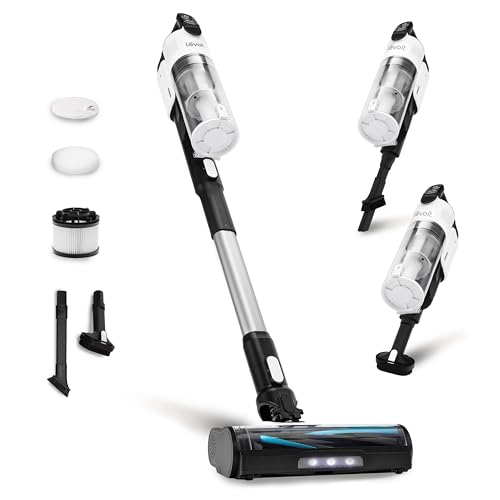
4. Levoit Cordless Vacuum Cleaner (LVAC-200) — Best Value Cordless
The Levoit LVAC-200 makes the value argument with specifications rather than adjectives: the listing states up to 50 minutes of runtime — the longest figure among the sticks here — an anti-tangle brush design for pet hair, a lightweight body, and a 180-degree lay-flat design that slides the whole machine under sofas and beds. On wood floors, that lay-flat reach matters disproportionately, because the dust that lives under furniture migrates out onto the visible floor all week.
Anti-tangle is the second specification with real wood-floor relevance. Hair wrapped around a brush roll changes the roll’s behavior and can hold grit against the floor; a head designed to resist wrapping keeps the cleaning action consistent between maintenance sessions. The listing positions the LVAC-200 for carpets and hard floors, and it should be used with the same brush awareness as the other sticks on delicate finishes.
What the value tier gives up is ecosystem: no self-empty dock, no premium fit-and-finish, and a brand whose vacuum line is younger than the heritage names here. What it keeps — runtime, reach, tangle resistance — is the functional core. For a first cordless in a wood-floor apartment, that is the right trade.
The lay-flat design has a second, quieter benefit on wood: dust under low furniture is the reservoir that refills the visible floor within a day of a standard clean, which is why rooms cleaned without under-furniture reach never feel finished. A machine that slides fully flat breaks that cycle. Owners upgrading from a bulky upright routinely report that the house stays cleaner longer with the Levoit, and the mechanism is this paragraph, not suction.
Strengths
- Up to 50 minutes stated runtime — best figure among the sticks in this guide
- 180° lay-flat body reaches the under-furniture zones where wood-floor dust breeds
- Anti-tangle brush design suits pet households and long hair generally
Trade-offs
- No self-empty or charging dock ecosystem at this tier
- Multi-surface brush head requires managed use on delicate finishes
- Younger vacuum brand — long-term parts ecosystem is less proven than the heritage makers
| Runtime | Up to 50 minutes (per listing) |
|---|---|
| Design | 180° lay-flat (per listing) |
| Brush | Anti-tangle (per listing) |
| Surfaces | Carpets & hard floors (per listing) |
Value picks earn their place by keeping the specifications that change daily life and cutting the ones that change brochures. Fifty minutes and a lay-flat body change daily life on wood floors; a dock and a badge do not. The LVAC-200 is the guide’s clearest example of that discipline, and the pick we would hand a first-time cordless buyer without a single caveat beyond brush care.
Check on Amazon to see the current configuration, size run and color options for the Levoit LVAC-200.
Best for: value-first buyers who still want long runtime and under-furniture reach / Not suited for: anyone wanting a self-empty dock or a bagged system

5. Tineco A20 Cordless Stick Vacuum — Best Dust Capacity Stick
The Tineco A20’s headline is capacity: a 1-litre dustbin, larger than the typical stick cup, in a three-mode cordless with an ergonomic dual-handle design, a wall-mount dock and an LED headlight, per its listing. Capacity sounds mundane until you clean a whole wood-floor house: fine dust fills cups faster than it appears to, suction falls as the cup packs, and a 1-litre bin is the difference between one clean and a clean interrupted twice.
The three power modes map sensibly onto wood-floor reality — a gentle default for daily dust, a middle for grit at entries, and a max reserved for the rug and the doormat zone. The dual-handle ergonomics address the stick format’s known flaw, wrist load during long sessions, which matters in the larger homes this bin size targets.
The listing describes the A20 for multi-level messes rather than wood specifically, and its brush head should be managed on delicate finishes like the other sticks here. Its case is throughput: more floor per charge-cycle of your attention, fewer interruptions, and a headlight to keep the work honest. For the big-house wood-floor owner who found compact sticks fussy, this is the grown-up format.
The wall-mount dock deserves its sentence too: a stick that lives charged on a wall at the utility point gets used for the thirty-second entry-grit emergency, while a stick that lives in a cupboard with an empty battery does not. In the large homes the A20 targets, that difference compounds across a week into visibly cleaner wood. Dock placement is a cleaning decision, and this pick ships with the hardware to make it a good one.
Strengths
- 1L dustbin — the largest capacity among the sticks here, fewer mid-clean stops
- Three modes let you match suction to dust, grit and rugs without waste
- Dual-handle ergonomics and wall-mount dock suit longer, whole-house sessions
Trade-offs
- Capacity and structure add heft versus the lightest grab-and-go sticks
- Positioned as a general multi-surface machine, not a wood specialist
- Wall-mount dock requires a permanent spot and basic installation
| Dustbin | 1L (per listing) |
|---|---|
| Modes | 3 suction modes (per listing) |
| Format | Cordless stick, wall-mount dock |
| Lighting | LED headlight (per listing) |
Every format has a buyer it fails, and compact sticks fail the owner of 2,000 square feet of wood. The A20 is built for that owner: capacity, modes and ergonomics for a full-house session, with the headlight discipline that wood demands. It is less charming than the premium picks and more useful across a long Saturday morning, which is its own kind of premium.
Check on Amazon to see the current configuration, size run and color options for the Tineco A20.
Best for: larger wood-floor homes tired of emptying a small cup mid-clean / Not suited for: buyers who want the lightest possible stick for quick grabs
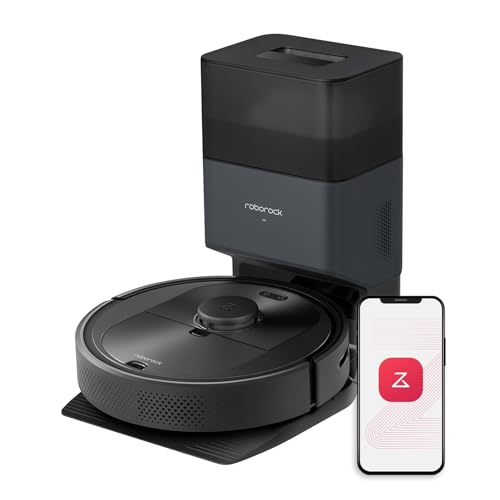
6. roborock Q5+ Robot Vacuum with Self-Empty Dock — Best Robot for Daily Grit Control
The roborock Q5+ approaches wood floors from the direction that matters most: frequency. Its listing states 2700Pa maximum suction, up to 180 minutes of runtime, LiDAR-based navigation implied by its mapping class, Alexa compatibility, and a self-empty dock rated for up to seven weeks of hands-free operation. Run daily, a robot never lets grit accumulate — and since it is accumulated grit, ground under shoes, that dulls wood finishes, daily gentle cleaning is arguably better protection than a weekly heroic one.
The self-empty dock is the feature that makes the frequency real. A robot whose bin you must empty after every run becomes a robot that runs twice a week; a dock that holds weeks of debris removes the friction, and the Q5+ becomes infrastructure — the floor is simply always recently vacuumed. The listing positions it for hard floors, carpets and pet hair, and its navigation class handles the wood-to-rug transitions of real rooms.
The boundaries are the format’s own: no stairs, no upholstery, no edging tool work, and a brush system to keep clean of hair so it stays gentle. Most robot households keep a stick for detail work — several picks above pair naturally — but as the daily maintenance layer for bare wood, nothing else in this guide competes with a machine that cleans while you are out.
A scheduling tip that separates satisfied robot owners from disappointed ones: run the Q5+ when the house is empty or asleep, on the days keyed to your traffic — after the weekend, after the dog’s muddy days — rather than on a rigid daily timer nobody adjusts. Robots succeed as systems, and the system includes a schedule that matches the household’s real grit calendar. Set it thoughtfully once and the dock does the rest for weeks at a time.
Strengths
- Self-empty dock holds weeks of debris — the feature that makes daily running realistic
- 180-minute stated runtime covers large wood floors in one session
- Daily passes prevent the grit accumulation that actually damages finishes
Trade-offs
- No stairs, upholstery or spot-detail capability — a stick or handheld still needed
- Dock bags are an ongoing consumable
- Brush and wheels need regular hair removal to stay floor-gentle
| Suction | 2700Pa max (per listing) |
|---|---|
| Runtime | Up to 180 minutes (per listing) |
| Dock | Self-empty, up to 7 weeks hands-free (per listing) |
| Control | App/scheduling class; Alexa compatible (per listing) |
Judge the Q5+ as a maintenance system rather than a vacuum and it wins its category easily. Wood floors do not need to be rescued weekly; they need to never be dirty for long. A self-emptying robot is the only product class that delivers that outcome with near-zero ongoing effort, and the Q5+ is its balanced representative — strong suction, long runtime, and a dock that closes the convenience loop.
Check on Amazon to see the current configuration, size run and color options for the roborock Q5+.
Best for: owners who want the floor maintained daily without pushing anything / Not suited for: homes wanting one machine to also deep-clean stairs and upholstery
Comparison Table
The Miele wins on gentleness and depth, the sticks win on convenience at four different balances of price, capacity and runtime, and the robot wins on frequency. Most wood-floor homes end up happiest with one primary machine plus the robot as a maintenance layer.
| Pick | Badge | Key spec | Best for |
|---|---|---|---|
| Miele Classic C1 Pure Suction Vacuum | Best Overall for Wood | Pure suction canister, for hard floors & low-pile carpet (per listing) | wood-floor purists who want the gentlest possible clean with corded, fade-free power |
| Dyson V8 Plus Cordless Vacuum | Best Premium Cordless | 115AW suction, up to 40 minutes, converts to handheld (per listing) | daily cordless cleaning of wood floors in small-to-mid-size homes |
| Shark Pet Cordless Stick Vacuum (IX141) | Best for Pet Hair on Wood | 40-minute runtime, XL dust cup, LED headlights (per listing) | pet-owning wood-floor homes where hair and litter grit are the daily enemy |
| Levoit Cordless Vacuum Cleaner (LVAC-200) | Best Value Cordless | Up to 50 minutes, anti-tangle, 180° lay-flat (per listing) | value-first buyers who still want long runtime and under-furniture reach |
| Tineco A20 Cordless Stick Vacuum | Best Dust Capacity Stick | 1L dustbin, 3 modes, dual-handle design, LED headlight (per listing) | larger wood-floor homes tired of emptying a small cup mid-clean |
| roborock Q5+ Robot Vacuum with Self-Empty Dock | Best Robot for Daily Grit Control | 2700Pa max suction, 180-min runtime, self-empty dock (per listing) | owners who want the floor maintained daily without pushing anything |
How to Choose a Vacuum for Bare Wood Floors
Choosing for wood is mostly choosing a head and a system. Work through these four decisions and the right format — and then the right pick — becomes clear.
The floor head decides scratch risk
Three head types exist. Pure suction heads (the Miele) never spin anything against the finish and are the safest. Soft-roller heads, where offered, cradle debris and are designed for hard floors. Standard brush-roll heads clean everything well but should be managed on delicate finishes — brush off where the machine allows, soleplate kept clean, and never drag a grit-loaded head across softwood. Whatever you buy, the head is the part that touches your floor; interrogate it harder than the motor.
Suction numbers: AW and Pa do not compare
Dyson quotes air watts; roborock quotes pascals; other brands quote either or neither. These are different measurements taken under different conditions, and a bigger number in one unit says nothing about the other. Within a brand’s own line the figures rank models usefully. Across brands, judge by format, head design and the cleaning system as a whole — which is how this guide’s picks were actually chosen.
Corded depth versus cordless frequency
A corded canister delivers unlimited, unfading power and the gentlest head; a cordless stick delivers the two-minute clean that happens five times as often; a robot delivers a clean that happens daily with no one home. Wood floors reward all three virtues, so the honest question is which deficit your household feels: deep-clean power, daily convenience, or maintenance consistency. The final recommendation pairs formats for households that feel two deficits at once.
Dust handling is part of floor care
Fine dust is the wood-floor enemy that becomes airborne at emptying time. Bagged systems (the Miele, the robot’s dock) contain it best. Bagless cups should be emptied outdoors or into a bag, gently, and filters washed or replaced on schedule — a clogged filter quietly taxes suction on every machine in this guide, and the floor pays for it in leftover grit.
How to Vacuum Bare Wood Floors Without Scratching Them
Technique protects a finish as much as equipment does. This is the routine that keeps wood floors clean and unmarked with any machine in this guide.
- Start with the head, not the switch: inspect the soleplate, wheels and brush for embedded grit before every session, and pick out anything sharp. The scratch you prevent here is the one that would have run the length of the room.
- Vacuum with the grain where the room layout allows, in slow overlapping passes. Speed is what leaves debris behind; on hard floors the suction needs a moment over each strip.
- Work from the far corner toward the door, and do the entry zones last and most carefully — that is where outdoor grit concentrates.
- Use the crevice tool along baseboards weekly. Dust lines at the edges migrate onto the open floor and are the main source of the grey film wood develops.
- Empty the cup or check the bag before it is full, and clean or replace filters on the maker’s schedule. Suction lost to a packed cup is debris left on the floor.
- Never use a beater-bar upright with the brush spinning on a delicate or softwood finish. If your machine cannot disable the brush, it is the wrong machine for that floor — see the pure-suction pick.
Complement vacuuming with a dry microfiber dust mop between sessions for the fine film, and keep grit outside with a real doormat system. The vacuum then does weekly deep work instead of fighting a daily losing battle.
Common Buying Mistakes
Buying the most powerful carpet vacuum for a wood house
Carpet flagships are engineered around an aggressive brush roll — the exact component wood floors need least. Power is not the constraint on a hard surface; head design is. Several households in this category own a superb vacuum that is slowly sanding their floors.
Comparing suction figures across brands
Air watts and pascals are not convertible by shoppers and are measured differently by every brand. A cross-brand number contest picks the best marketing department, not the best machine. Compare within a brand, and compare systems across brands.
Ignoring the wheels and soleplate
Scratches on wood more often come from a grit-loaded wheel or a worn soleplate than from the brush. Inspect and clean them; replace a head whose wheels no longer roll freely. Maintenance is floor care.
Letting a robot run with a hair-wrapped brush
A robot is gentle only when it is maintained. Hair and grit accumulate around its brush and wheels exactly as with any machine, and an unmaintained robot drags its dirt collection across the floor daily. Five minutes weekly keeps the system honest.
Vacuuming less because the floor “looks clean”
Wood hides its most damaging debris — fine grit reads as shine until it is ground in. Clean on a schedule set by traffic, not by appearance: entries and kitchens twice as often as bedrooms, and pet zones most of all.
Final Recommendation
For a wood-first home, the Miele Classic C1 Pure Suction is the anchor recommendation: the gentlest head architecture, unfading corded power, and a specialist’s honesty about its scope. Cordless households should take the Dyson V8 Plus for premium agility, the Shark IX141 for pets, the Levoit LVAC-200 for value with real runtime, or the Tineco A20 for whole-house capacity. The roborock Q5+ is the maintenance layer that protects the finish every day between deep cleans — and the Miele-plus-Q5+ pairing is, in our judgment, the complete wood-floor system.
Whichever machine you choose, adopt the technique section as household policy: inspect the head, slow passes, edge work weekly, filters on schedule. Wood floors forgive almost everything except grit and neglect, and a good vacuum properly used eliminates both.
- Best Overall for Wood: Miele Classic C1 Pure Suction Vacuum — wood-floor purists who want the gentlest possible clean with corded, fade-free power.
- Best Premium Cordless: Dyson V8 Plus Cordless Vacuum — daily cordless cleaning of wood floors in small-to-mid-size homes.
- Best for Pet Hair on Wood: Shark Pet Cordless Stick Vacuum (IX141) — pet-owning wood-floor homes where hair and litter grit are the daily enemy.
- Best Value Cordless: Levoit Cordless Vacuum Cleaner (LVAC-200) — value-first buyers who still want long runtime and under-furniture reach.
- Best Dust Capacity Stick: Tineco A20 Cordless Stick Vacuum — larger wood-floor homes tired of emptying a small cup mid-clean.
- Best Robot for Daily Grit Control: roborock Q5+ Robot Vacuum with Self-Empty Dock — owners who want the floor maintained daily without pushing anything.
Narrowing the vacuum decision further? These guides in the same program cover the neighboring formats:
- Dyson Hard Floor Vacuums
- Lightweight Vacuum For Hardwood Floors And Area Rugs
- Robot Vacuum For Hardwood Floors And Area Rugs
- Upright Vacuums For Hardwood Floors
- Bagged Vacuums For Carpet And Hardwood
- Vacuum For Braided Rugs
Frequently Asked Questions
Can a brush-roll vacuum scratch wood floors?
It can, which is why head management matters. The risks are a stiff brush grinding grit, and grit trapped in wheels or the soleplate. Pure-suction heads like the Miele pick eliminate the brush risk entirely; brush-roll sticks should be used with clean heads, appropriate settings, and extra care on softwood or delicate finishes.
Is a robot vacuum enough for wood floors on its own?
For daily maintenance, largely yes — a self-emptying robot like the roborock Q5+ keeps grit from accumulating, which is the main threat to a finish. It cannot do stairs, upholstery, or deep edge work, so most homes pair it with a stick or canister for weekly detail cleaning.
Why do brands quote suction in different units?
Air watts (AW) and pascals (Pa) measure different things under different test conditions, and there is no shopper-side conversion. Use the figures to rank models within one brand only. Across brands, compare format, floor head, dust handling and runtime — the system, not the number.
How often should bare wood floors be vacuumed?
High-traffic zones (entries, kitchen) benefit from twice-weekly vacuuming or daily robot passes; bedrooms weekly. The schedule should follow grit, not visible dirt — by the time a wood floor looks dirty, the damaging debris has been underfoot for days.
Bagged or bagless for wood dust?
Bagged systems contain fine dust best at disposal and keep suction consistent as they fill; the Miele and the robot dock in this guide use them. Bagless sticks are cheaper to run and perfectly effective if emptied carefully — outdoors or into a bag — and their filters are maintained on schedule.
What is the safest vacuum type for delicate or antique wood floors?
A pure-suction canister with a soft parquet-style floor tool — the architecture of our top pick. No rotating brush, a light head, and suction doing all the work. Pair it with slow technique and a clean soleplate, and it is the gentlest powered cleaning a delicate floor can receive.
Do I still need to dust mop if I vacuum regularly?
A dry microfiber dust mop and a vacuum do different work. The vacuum removes grit and debris — the damaging fraction. The dust mop lifts the fine film that settles between vacuumings and keeps the floor’s sheen even. Most wood-floor households vacuum weekly (or run a robot daily) and pass a dust mop in traffic zones every few days. The combination, not either tool alone, is what keeps bare wood looking newly finished.


