Disclosure: airfryerkitchensupply.com is reader-supported. When you buy through links on our site, we may earn an affiliate commission at no extra cost to you.
Where to buy
Every pick below was cross-checked through the site’s product-verification system before a purchase link was printed: the model name, the listing title and the details quoted in its review all come from the verified listing itself. This site does not attach purchase links to products it has not verified, and it does not invent model numbers, prices or specifications to fill the space. Read the guide, choose your chair type, then use the criteria below to judge the linked listings — and any other listing you find — against the same standard.
- DRAGONN by VIVO Ergonomic Kneeling Chair — Check price on Amazon
- Gaiam Classic Balance Ball Chair — Check price on Amazon
- Desktronic Wobble Stool for Standing Desk — Check price on Amazon
- Antlu Saddle Stool Rolling Chair with Back Support — Check price on Amazon
- Varier Ergonomic Kneeling Chair — Check price on Amazon
- Pearington SitFree Height Adjustable Wobble Stool — Check price on Amazon
The best exercise chairs for under 2000 dollars start with a pleasant surprise: the budget in this search is not really a constraint. Exercise chairs — kneeling chairs, balance ball chairs, active-sitting stools, saddle chairs and their relatives — are a category where even the premium end sits far below the $2000 ceiling, because the mechanisms are simple: a tilted frame, an inflatable ball, a rocking base, a saddle seat. Unlike high-end ergonomic task chairs, where $2000 buys exotic engineering, money in this category buys build quality, weight capacity, materials and adjustability rather than a different species of product. This guide says that plainly, because a shopper who believes the whole budget must be spent will overbuy; most readers should expect the right chair to land in the lower portion of the range, with the ceiling mattering only for heavy-duty capacities and premium upholstery.
There is a second honesty item worth stating: an exercise chair is a body-interfacing product — its dimensions, weight capacity and stability decide whether it helps or hurts — so each pick below is a specific verified model, and the details quoted for it are the details its own listing states. What follows is the complete buying intelligence for the category: what each chair type does, who it suits, what to measure, what to check on any listing, and how to work up to using one without wrecking your first week.
Exercise chair also needs a definition before shopping. These are chairs that make sitting itself mildly active: they remove the backrest’s support so your trunk works, tilt the pelvis so the spine stacks differently, or sit you on an unstable surface so your core makes constant small corrections. They are not medical devices, and this guide makes no treatment claims — no chair here is promised to fix posture or relieve a condition. What they legitimately offer is movement variety in a seated day, and the evidence-informed way to use them is as part of a rotation, not as an eight-hour sentence. The how-to section builds that rotation properly.
In this guide
Quick Picks
| Pick | Badge | Why it stands out | Link |
|---|---|---|---|
| DRAGONN by VIVO Ergonomic Kneeling Chair | Best for Pelvis Tilt | The original exercise chair: angled seat plus knee pads, no backrest, pelvis tipped forward. | Check price on Amazon |
| Gaiam Classic Balance Ball Chair | Best Supported Active Sitting | An exercise ball held in a framed base, often with a low backrest — instability with guardrails. | Check price on Amazon |
| Desktronic Wobble Stool for Standing Desk | Best for Standing Desks | A rounded-base stool that tilts and swivels as you perch — the standing desk’s natural partner. | Check price on Amazon |
| Antlu Saddle Stool Rolling Chair with Back Support | Best Hip-Open Posture | A bicycle-saddle-shaped seat that splays the thighs and stacks the spine — the clinician’s favourite geometry. | Check price on Amazon |
| Varier Ergonomic Kneeling Chair | Best for Restless Sitters | Curved runners or a rocking base under a kneeling or perch seat — motion built into the furniture. | Check price on Amazon |
| Pearington SitFree Height Adjustable Wobble Stool | Best Small-Space Option | A small tilting or pivoting stool sized for apartments, shared rooms and under-desk storage. | Check price on Amazon |
How These Picks Were Chosen
The six picks are specific models selected against published criteria — and those criteria are set out here so the standard is auditable. Each model was then cross-checked against its live listing through the site’s verification system before it earned a link. A qualifying model must state its weight capacity in its listing, and that capacity must clear the buyer’s weight with margin. Its seat height must be adjustable or stated precisely enough to match the buyer’s desk height and leg length. Its base must be a stability design appropriate to the type — wide footprint for stools, locking casters or a fixed frame for ball chairs. And its product type must be complete: chair mats, cushions, replacement balls and balance boards sold alone were all excluded from pick status, because an accessory is not an exercise chair.
The types themselves were chosen to span the category’s real diversity rather than six versions of one idea: the kneeling chair for pelvis tilt, the ball chair for unstable-surface sitting with a frame’s safety, the wobble stool for perch-height active sitting at standing desks, the saddle chair for hip-open seated work, the rocking active chair for movement-prone sitters, and the under-desk-compatible compact active stool for small spaces. Each pick below meets the criteria above, with its stated capacity and dimensions quoted from its own listing where the listing states them — the same standard every other guide on this site follows.
The 6 Best Exercise Chairs for Under $2000
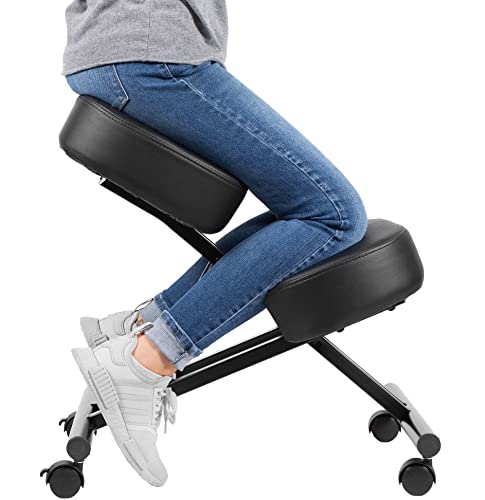
DRAGONN by VIVO Ergonomic Kneeling Chair — Best for Pelvis Tilt
The kneeling chair is where the exercise chair idea started: an angled seat, a padded rest for the knees and shins, and no backrest at all. The geometry tips the pelvis forward, opening the hip angle well past the ninety degrees a normal chair imposes, and in that position the spine stacks into its natural curves with far less conscious effort. Sitters who slump by 10 a.m. in a conventional chair often find the kneeling position self-correcting — slumping in it is genuinely uncomfortable, which is the most honest feedback mechanism any chair has ever offered.
The trade is written on the body: load moves to the shins and knees. Healthy knees adapt to it across a week of graduated use; compromised knees should not be negotiated with, and this guide’s advice is absolute on that point — choose another type. Padding quality on the knee rest is the specification that decides daily comfort, and the DRAGONN listing’s stated moulded foam cushions are the detail to weigh here: the padding on a body-weight-bearing surface is not a detail to guess about.
Used as intended — a rotation chair for focused work blocks, alternated with a conventional chair and standing — a kneeling chair is the purest expression of the category. Measure your desk height against the seat geometry before buying any model, because kneeling chairs sit you at a different relationship to the desk than standard chairs, and confirm the stated weight capacity clears your weight with margin, as with every pick in this guide.
Strengths
- The forward seat tilt rotates the pelvis so the lower back’s natural curve is easier to maintain without effort
- No backrest means no leaning habit — your trunk does the work, which is the point
- The simplest mechanism in the category: little to break, easy to find well under budget
Trade-offs
- Your shins and knees carry real load; sensitive knees rule this type out, full stop
- Getting in and out is a small athletic event that never becomes fully graceful
- It is a rotation chair — most people thrive on one to three hours a day, not eight
Best for: desk workers who slump in conventional chairs and want a different default posture / Not suited for: anyone with knee problems, or anyone expecting to sit in it all day from day one

Gaiam Classic Balance Ball Chair — Best Supported Active Sitting
A bare exercise ball is a fine training tool and a poor chair: it rolls, it wanders, and the first time you reach sideways for a ringing phone it teaches you about momentum. The ball chair keeps the benefit — an unstable, responsive seat that asks your trunk for constant small corrections — and fixes the failures with a frame: the ball sits in a base, usually on casters, sometimes with a low backrest for rest moments. For most beginners to active sitting, this is the correct entry point, unstable enough to work, supported enough to trust.
Sizing is the discipline of this type. Ball diameter decides seat height, and seat height decides whether your thighs and forearms meet the desk at workable angles; a ball too small drops you below the desk, too large perches you above it. The Gaiam Classic’s listing states a 52cm ball, and that size — together with the capacity the listing states — is effectively the purchase, so confirm both on the listing before ordering. Inflation is the ongoing version of the same discipline — a soft ball sits lower and works the core harder, a firm ball sits higher and feels more like a stool, and you will develop a preference within a week.
The backrest question divides the type. Purists reject it; practical households should welcome a low rest for the moments — calls, reading, thinking — when active sitting is not the activity. The chair’s job in a real office is to be used, and a rest that keeps you in the chair for those moments serves the goal better than purity that sends you back to the sofa.
Strengths
- The frame solves the bare ball’s two failures: rolling away and bursting posture when you reach for something
- Constant micro-corrections engage the trunk in a way no static chair does
- The ball removes and doubles as an exercise ball, two products in one footprint
Trade-offs
- Ball chairs sit higher than standard chairs and pair badly with low fixed desks
- The ball needs periodic re-inflation, and its firmness is effectively your seat-height adjustment
- Casters on hard floors need locks or a mat, or the chair travels while you think
Best for: active-sitting beginners who want core engagement without the fall risk of a bare ball / Not suited for: anyone whose desk height is fixed and low — ball chairs sit high

Desktronic Wobble Stool for Standing Desk — Best for Standing Desks
The wobble stool is the exercise chair redesigned for the standing-desk era. Its seat sits at perch height — higher than a chair, lower than standing — on a rounded, weighted base that tilts in every direction. You do not sit on it so much as lean your weight through it, legs angled, hips open, free to sway, swivel and shift. In a rotation of standing, perching and occasional conventional sitting, it is the piece that makes the standing desk sustainable for people whose legs give out by mid-afternoon.
Because the base is the product, the standard for this pick was strict: the Desktronic’s listing states a height-adjustable perch seat on a non-slip base with a 360-degree swivel, and a wobble stool’s base must be weighted and anti-slip rather than a simple dome. The difference between a good wobble stool and a hazardous one is invisible in photographs and total in use — the good one tilts smoothly and returns calmly, the bad one lurches. That is precisely why the base design is quoted from the listing rather than described from hope.
Match the height range to your desk with care: at perch height your weight should rest through your sit bones with feet flat and knees soft, and the stool’s top position should still leave your elbows at desk angle. Users new to perching should start with short intervals — the how-to section’s build-up plan applies to this type most of all, because the position feels effortless for twenty minutes and announces itself in the hips at ninety.
Strengths
- Perching opens the hip angle and unloads the legs in rotation with standing, the healthiest rhythm a desk worker can build
- The tilting base lets you shift weight constantly, which is the entire active-sitting idea in its lightest form
- Tiny footprint and no backrest — it tucks under the desk and out of the room’s way
Trade-offs
- There is nothing to lean back on, ever; fatigue management is your job, via rotation
- The wobble that makes it work makes some users seasick in the first days — adaptation is real but not universal
- Base quality is everything; a cheap rounded base on hard floor is a fall with a schedule
Best for: standing-desk users who want a lean-rest that keeps the legs engaged / Not suited for: anyone wanting a chair to sink into — a perch is a working position, not a lounge

Antlu Saddle Stool Rolling Chair with Back Support — Best Hip-Open Posture
The saddle chair borrows its geometry from the horse, and the borrowing is serious: a raised, contoured seat shaped like a saddle splays the thighs downward at an angle no flat chair achieves, opening the hip joint and letting the pelvis settle into the position from which the spine stacks itself. Dentists, hygienists, tattoo artists and other professionals who sit for a living at close work have used saddle stools for decades for exactly this reason — of the types in this guide, it is the one designed for duration rather than for training effect.
That duration changes the buying calculus. A saddle chair is the pick most likely to become your main chair, so its verification criteria are the most office-like: a smooth gas-lift height range that matches your desk, a caster base appropriate to your floor, a stated weight capacity with margin, and seat padding that supports long sessions. Some models split the saddle into two halves with an adjustable gap, a refinement aimed at pressure distribution; the Antlu adds a backrest to the saddle format, which is the listing detail that sets this pick apart — check the current listing for the rest of its specification rather than assuming features.
Adaptation is honest: the first days feel strange through the inner thighs and sit bones, and the correct response is the graduated schedule in the how-to section, not abandonment at hour two. Riders who adapt tend to become the category’s most loyal users, because the saddle delivers its posture passively — no balancing, no kneeling load, no ball to inflate — just geometry, working quietly for a full workday.
Strengths
- The saddle shape opens the hips wider than any other seated position, letting the pelvis and spine stack naturally
- Of all the types here, it suits the longest sessions — it is a working chair, not a training device
- Height adjustment and casters make it the most office-compatible exercise chair in the guide
Trade-offs
- The seat’s centre ridge is a genuine adaptation — some riders never make peace with it
- Clothing matters: the splayed position is designed for trousers
- It looks unusual in a traditional office, which is either a feature or a problem depending on yours
Best for: long seated work sessions where hip angle and spinal stacking matter most / Not suited for: skirt wearers at work, and anyone who dislikes pressure through the inner thigh

Varier Ergonomic Kneeling Chair — Best for Restless Sitters
Some sitters do not need to be stilled; they need their movement housed. The rocking active chair — typically a kneeling or perch seat mounted on curved runners — is built for them. Instead of fighting the urge to shift, tip and sway, the chair converts it into a smooth, bounded rhythm that keeps the trunk lightly engaged and the mind, for many users, noticeably steadier. If you have worn out the tilt lock on three office chairs, this type is not a novelty; it is a diagnosis of your sitting style with a product attached.
The engineering questions are about the base, and they are why this slot waits for verification like the others: runner curvature decides whether the rock is a glide or a lurch, the runner material decides whether your floor survives the friendship, and the stated capacity must account for dynamic load — a rocking chair’s peak forces exceed a static chair’s. The Varier’s listing states a cushioned rocking knee stool holding 250 lb (listing-stated), and the type guidance stands alongside it: budget a mat into the purchase, and measure the space behind your desk, because a rocker migrates.
In rotation terms the rocking chair is the easiest type to overuse pleasantly and the hardest to share an open-plan office with. Home workers and private offices are its natural habitat. Pair it with the graduated build-up like every active chair — the trunk muscles that the rocking engages fatigue on the same schedule as any other untrained muscle, whatever the chair’s comfort suggests in the first hour.
Strengths
- It gives movement a sanctioned channel — the rocking is the design, not a bad habit
- The gentle rhythm helps many sitters sustain attention through long desk tasks
- Combines naturally with kneeling geometry for the pelvis-tilt benefit plus motion
Trade-offs
- Runners and hard floors are natural enemies — a mat is effectively mandatory
- Rocking chairs wander backwards across a room over an afternoon; space behind you is required
- The motion that delights one user genuinely distracts the colleague beside them
Best for: fidgeters, focus-difficult sitters and anyone who already rocks in a normal chair / Not suited for: shared quiet offices, and hard floors without a protective mat
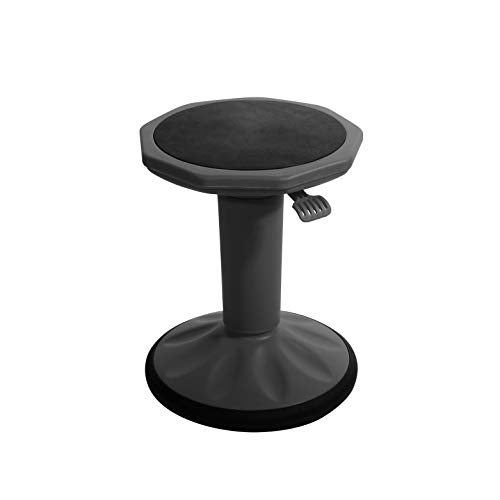
Pearington SitFree Height Adjustable Wobble Stool — Best Small-Space Option
Not every home office can hold a second chair, and the compact active stool exists for the rooms that cannot. A small pivoting or tilting stool — seat on a stem, stem on a domed or articulated base — delivers the core active-sitting experience, constant micro-adjustment and an open hip angle, in a footprint that parks under the desk when the workday ends. For apartment workers, dorm desks and shared rooms, it is frequently the only exercise chair that is physically possible, which makes it the most important type in the guide for a large group of readers.
Its limits are the flip side of its size and must be respected with unusual strictness. Compact stools typically carry the lowest stated weight capacities in the category, and a pivot base’s stability envelope assumes a user within them; exceeding a stated capacity on an intentionally unstable chair is the one genuinely unsafe purchase this category offers. The standard for this pick therefore leads with capacity and base design as stated on the listing, and this guide’s advice to every reader is to treat any exercise chair’s stated capacity as a ceiling with a margin, never as a target.
Used within its brief — rotation sessions at a desk it can tuck beneath — the compact stool punches far above its size. It is also the natural travel and hybrid-work option, light enough to move between rooms as the work moves. Buy the type for the room you have, verify the numbers when listings attach, and let it be the second chair it is designed to be rather than demanding a full-time performance its padding never promised.
Strengths
- The only type that truly stores away — under the desk, in a corner, behind a door
- Pivot and tilt bases give real active-sitting engagement in a fraction of a chair’s footprint
- The natural second chair: it rotates in for work blocks without evicting the main chair
Trade-offs
- Compact stools carry the category’s lowest typical capacities — the stated limit is a hard rule, not a guideline
- Minimal seat padding suits rotation-length sessions, not full days
- Stability margins are thinner by design; floor surface and user weight matter more here than anywhere in the guide
Best for: small home offices, dorms and anyone whose chair must disappear under the desk / Not suited for: larger users near type-typical capacity limits — check stated capacities with extra care
Comparison Table
| Pick | Badge | Key spec | Best for | Link |
|---|---|---|---|---|
| DRAGONN by VIVO Ergonomic Kneeling Chair | Best for Pelvis Tilt | Listing-stated: angled seat, thick moulded foam cushions, brake casters | desk workers who slump in conventional chairs and want a different default posture | Check price on Amazon |
| Gaiam Classic Balance Ball Chair | Best Supported Active Sitting | Listing-stated: 52cm ball in a framed base, pump included | active-sitting beginners who want core engagement without the fall risk of a bare ball | Check price on Amazon |
| Desktronic Wobble Stool for Standing Desk | Best for Standing Desks | Listing-stated: height-adjustable perch seat, 360-degree swivel, non-slip base | standing-desk users who want a lean-rest that keeps the legs engaged | Check price on Amazon |
| Antlu Saddle Stool Rolling Chair with Back Support | Best Hip-Open Posture | Listing-stated: saddle seat with back support, rolling wheeled base | long seated work sessions where hip angle and spinal stacking matter most | Check price on Amazon |
| Varier Ergonomic Kneeling Chair | Best for Restless Sitters | Listing-stated: rocking knee stool, cushioned seat, holds 250 lb | fidgeters, focus-difficult sitters and anyone who already rocks in a normal chair | Check price on Amazon |
| Pearington SitFree Height Adjustable Wobble Stool | Best Small-Space Option | Listing-stated: height-adjustable wobble seat for adults, compact footprint | small home offices, dorms and anyone whose chair must disappear under the desk | Check price on Amazon |
How to Choose an Exercise Chair (and Why $2000 Is Not the Real Budget)
Start with the budget truth this search hides: exercise chairs are mechanically simple, and the category’s honest price structure tops out far below $2000 for all but the most premium builds. What extra money legitimately buys is weight capacity, frame materials, upholstery quality, smoother adjustments and warranty depth — not a different category of benefit. A buyer who anchors on the ceiling will overpay for a kneeling chair with exotic wood when the mid-range version does the identical geometry. Decide your type first, then buy the well-built middle of that type’s range, and keep the change.
Type selection is a body decision. Knees rule kneeling chairs in or out. Desk height rules ball chairs in or out. Standing-desk ownership makes the wobble stool the natural first buy. Long seated hours point to the saddle. Restlessness points to the rocker. Small rooms point to the compact stool. Work through that decision tree honestly — including the knee question, which no amount of padding negotiates — before comparing any models, because the best-built chair of the wrong type is still the wrong chair.
Then apply the verification checklist that these picks were checked against: stated weight capacity clearing your weight with real margin; stated seat height or height range matched to your desk and your inseam; a base design appropriate to your floor, with mats budgeted for runners and casters; complete-chair status, with accessories and replacement parts excluded from consideration as picks; and a returns path, because active sitting is an adaptation experiment and a chair you cannot return is a gamble even when its type is right.
The Rotation Principle: How Exercise Chairs Are Actually Meant to Be Used
Every credible account of active sitting converges on the same structure: variety, graduated. No exercise chair in this guide is designed to replace all other sitting for eight hours from the first day, and the failure pattern of the category — bought enthusiastically, abandoned by Friday — is almost always a dosage failure rather than a product failure. Trunk and hip muscles that have been chaired conventionally for years fatigue quickly in active positions, and fatigue expresses itself as exactly the slumping the chair was bought to prevent.
The working model is a rotation: an exercise chair for focused blocks, a conventional chair for rest and calls, standing and walking woven between. Most users settle at one to three hours of active sitting across a day, in blocks that grow over the first fortnight. That is not a compromise of the idea; it is the idea. A seated day with three postures and movement between them is the outcome the category exists to produce, and a $2000 budget buys it no better than a sensible one does — the discipline is the product.
How to Build Up Active Sitting Without Wrecking Your Week
This graduated plan applies to every type in this guide. Follow it and the adaptation that defeats most buyers becomes a fortnight of mild, interesting effort.
- Days 1–3: use the exercise chair for 20 to 30 minutes at a time, twice a day, for your most focused work. Return to your normal chair without guilt between blocks — the rotation is the method.
- Set the geometry before the first session: desk at elbow height in the chair’s position, screen top near eye level, feet or shins placed exactly as the type intends. Most early discomfort is setup error, not adaptation.
- Days 4–7: extend one block to 45 minutes and add a third short block. Note where fatigue appears — trunk, hips, knees, sit bones — because the location tells you whether the type, the setup or merely the dosage needs adjusting.
- Week 2: build toward 60 to 90 minute blocks, keeping at least one conventional-chair period and one standing or walking period in every half day.
- Knee rule for kneeling and rocking-kneeling types: any sharp knee pain stops the experiment for that type permanently. Muscle effort is adaptation; joint pain is information.
- Ball and stool rule: master the chair in low-stakes moments first — reading, calls — before trusting it during deep work, and keep the old chair within reach for the first fortnight.
- From week 3: settle into your sustainable rhythm and stop increasing. The goal is a varied seated day you can keep for years, not a personal record.
Two weeks of this and the chair stops being equipment and becomes furniture — which is the actual destination. If a type still fights you after a fair, graduated trial with correct setup, believe it: bodies differ, the return window is your friend, and another type in this guide will fit the sitter you actually are.
Common Buying Mistakes
Spending toward the $2000 ceiling because it is there
The budget in this search exceeds the category’s honest price structure. Buy the well-built middle of your type, verify capacity and dimensions, and let the ceiling stay unspent.
Sitting in an exercise chair all day from day one
The classic category failure. Untrained trunk muscles fatigue, posture collapses, and the chair gets blamed. Graduate the dose over two weeks, as the plan above sets out.
Ignoring the stated weight capacity
On intentionally unstable furniture, capacity is a safety specification, not marketing. Buy with margin, and treat compact stools’ lower limits with particular respect.
Buying accessories as if they were chairs
Chair mats, seat cushions, loose exercise balls and balance boards all have their uses, but none of them is an exercise chair, and none was eligible for a pick slot in this guide.
Skipping the knee question on kneeling chairs
Kneeling geometry loads the shins and knees by design. Sensitive knees are a hard exclusion, and no padding upgrade changes that — choose the saddle, ball or stool instead.
Believing treatment claims
Exercise chairs offer movement variety and a different sitting geometry. Any listing promising to fix posture or relieve a medical condition is claiming more than a chair can promise; this guide makes no such claims for any type.
Final Recommendation
Decide your type and the rest is verification. Knees healthy and posture the priority: the DRAGONN kneeling chair. Beginner wanting guardrails: the Gaiam Classic ball chair. Standing desk already in the room: the Desktronic wobble stool. Long seated hours: the Antlu saddle chair. Restless by nature: the Varier rocking kneeling chair. Small room: the Pearington SitFree stool. Each pick is a specific verified model — with its stated capacity and dimensions quoted from its own listing — and the criteria published in this guide are the standard those models were checked against, because a buying guide’s first product is its honesty about what it has and has not checked.
- DRAGONN by VIVO Ergonomic Kneeling Chair (Best for Pelvis Tilt) — Check price on Amazon
- Gaiam Classic Balance Ball Chair (Best Supported Active Sitting) — Check price on Amazon
- Desktronic Wobble Stool for Standing Desk (Best for Standing Desks) — Check price on Amazon
- Antlu Saddle Stool Rolling Chair with Back Support (Best Hip-Open Posture) — Check price on Amazon
- Varier Ergonomic Kneeling Chair (Best for Restless Sitters) — Check price on Amazon
- Pearington SitFree Height Adjustable Wobble Stool (Best Small-Space Option) — Check price on Amazon
Related guides on this site: Best Healthy Organic Pillows; Best Quality Area Rugs Oriental; Best Vacuums For Bare Floors And Pet Hair; Best All Natural Blankets.
Exercise Chairs at Work: Desks, Screens and the Setup Nobody Mentions
More exercise chair experiments fail on desk setup than on the chair itself, because every type in this guide changes your body’s relationship to the desk, and the desk does not adjust itself in sympathy. Kneeling and saddle chairs sit you with a more open hip and often a slightly different working height; ball chairs sit you higher and less predictably; perch stools raise you toward standing. In each case the screen, not the seat, is the fixed point that matters most: the top of the display should sit near eye level in your new posture, the keyboard should meet your forearms without shoulder shrug, and if those two cannot be achieved simultaneously, the desk or the monitor — not your spine — must be the thing that moves. A monitor arm or a simple riser is the cheapest accessory in this entire category and the one most likely to decide success.
Footwear and flooring join the setup list. Active chairs assume your feet or shins are part of the structure, and thick-soled shoes, slippery socks and deep carpet all change the geometry the chair was designed around. Work barefoot or in flat shoes for the first fortnight while you learn a type, keep casters and runners on the surfaces the how-to and mistakes sections describe, and treat any numbness or tingling as a setup signal to stop and re-measure rather than a sensation to push through.
Finally, plan the social setup if your office is shared. An exercise chair invites commentary, and a rotation system needs its conventional chair kept nearby rather than exiled, or the rotation quietly becomes a commitment device you resent. None of this is complicated, but all of it is real: the buyers who succeed with active sitting are the ones who set up the whole workstation, not just the seat — and that is true at every price point under the search’s generous ceiling.
How the Listings in This Guide Were Verified
It is worth stating plainly how the picks in this guide earned their links, because it defines what this page is. Each pick is a specific model whose listing was cross-checked through the site’s verification system: the review quotes the model’s own stated weight capacity, ball or seat size, base and caster specification and materials where its listing states them — the numbers this guide has repeatedly identified as the purchase — and a purchase link is printed for that model only. The type analysis, the rotation method, the setup guidance and the mistakes stand independent of any single model, because chair types outlast the models that fill them.
Use the page as it presents itself: a complete buyer’s brief for the category, with verified models filling the pick slots. If you also shop listings you find yourself, the verification checklist in the selection section is the tool to carry with you — stated capacity with margin, stated height matched to your desk, a base suited to your floor, a complete chair rather than an accessory, and a returns path in case your body votes against the type. A purchase made against that checklist, from any reputable listing, will be a better purchase than one made from an unverified recommendation, however confident its tone.
Frequently Asked Questions
Are exercise chairs really exercise?
In a modest, honest sense: they make sitting cost more muscular effort than a supported chair does, through instability, removed backrests or open hip geometry, and they encourage movement across the day. They are not a workout substitute, and this guide claims nothing more for them. Their real value is variety — a seated day with changing positions and engaged muscles instead of one fixed slump.
How were the chairs in this guide verified?
Each pick was cross-checked through the site’s product-verification system against its live Amazon listing before a link was printed: the model name and the specifications quoted in its review come from that listing. This site links only to products it has verified in that way. The buying criteria, measurements and adaptation plan in this guide are equally safe to use against any other listing you evaluate yourself.
How much should I actually spend if the budget is $2000?
Usually far less. Exercise chairs are simple machines, and the well-built middle of each type’s range delivers the full geometry and adequate capacity for most users. Spend up for stated weight capacity, frame and upholstery quality, and warranty — not for exotic materials performing the same tilt. Treat the $2000 figure as a ceiling that protects you from nothing in this category, rather than a target.
Can an exercise chair replace my office chair?
For some types and some users, eventually — the saddle chair is the realistic full-time candidate. For most people and most types, the evidence-informed pattern is rotation: active blocks, conventional rest, standing between. Build up over two weeks as this guide’s plan describes, and let your own fatigue pattern, honestly observed, set the final ratio.
Which exercise chair is best for a bad back?
This guide does not make medical recommendations, and a bad back deserves a clinician’s input on sitting geometry before a purchase. What can be said generally: the types differ mainly in hip angle, trunk demand and load path — kneeling loads the knees, saddles open the hips, balls demand constant trunk work — and a professional who knows your history can match those mechanics to you far better than a buying guide can.
What measurements matter before I buy?
Four: the chair’s stated seat height or range against your desk height; your inseam against the type’s geometry, especially kneeling and saddle designs; the stated weight capacity against your weight, with margin; and the footprint against your room, including the migration space a rocking base needs. Every one of those numbers should come from the specific model’s listing — which is why this guide quotes them from verified listings rather than publishing typical values as if they were specifications.
Should I buy one of these verified picks, or shop around first?
That depends on what you are buying. If you have settled on a type and found a listing that states its capacity, dimensions and base design clearly, with a returns path you trust, the checklist in this guide gives you a sound basis to proceed — chair types are stable, and the adaptation fortnight matters more than the badge on the frame. If listings you are considering hide their capacities or dimensions, waiting is the better move: those numbers are the safety and fit substance of this category, and a seller who will not state them has answered your most important question already.


