Disclosure: airfryerkitchensupply.com is reader-supported. When you buy through links on our site, we may earn an affiliate commission at no extra cost to you.
Where to buy
Shopping for the best stick vacuums cat litter pickup? The fastest way to buy any pick in this guide is through Amazon, where stock, delivery and returns are handled in one place. Start with our top recommendation, the Shark Pet Cordless Stick Vacuum IX141 (Check the current price on Amazon), then compare it against the other picks below before you decide. Prices move with stock and season, so we never print a fixed price in the article itself — use the check-price links to see the current figure on Amazon.
- Shark Pet Cordless Stick Vacuum IX141 — Check price on Amazon
- Tineco A30S Cordless Vacuum Cleaner — Check price on Amazon
- Levoit Cordless Vacuum Cleaner LVAC-200 — Check price on Amazon
- Dyson V8 Plus Cordless Vacuum — Check price on Amazon
- BISSELL PowerClean FurGuard Pet Cordless Stick Vacuum — Check price on Amazon
- Tineco Pure ONE S15 Essentials Cordless Vacuum — Check price on Amazon
The best stick vacuums cat litter pickup is a more specific contest than ‘best stick vacuum’, because cat litter is a peculiar debris. The granules are dense, angular and heavy for their size; they scatter on hard floors exactly where the cat tracks them; they lodge in grout lines and rug edges; and the area around a litter box needs cleaning daily, briefly and without ceremony — which is precisely the workload a cordless stick vacuum exists for. A machine that excels at carpet pet hair but skates over litter, or one that needs a plug, a closet expedition and a filter ritual for a two-minute job, fails this search however good it is at other things.
So the judging criteria here are litter-shaped. Suction and floorhead behaviour on hard floors first, because litter lives on hard floors: the head must ingest dense granules rather than snowploughing them forward, and ratings need care — air watts (AW) and motor watts (W) are different measures and are never compared across brands in this guide. Runtime second, but with a twist: the litter run itself takes minutes, so runtime matters for the whole-home clean the same machine will also do. Bin capacity and emptying third, because litter is heavy and dusty, and a tiny bin that puffs dust back at you over the litter box undoes the point. Weight and grab-and-go handling run through everything.
One labelling note, stated once and plainly: the verified listings below emphasise pet hair, hard floors and runtime; none of them names cat litter in its title. We do not pretend otherwise. Six verified machines follow, from three of the biggest cordless families and three challenger brands, and every one of them can be grabbed, run around a litter zone and put away in less time than it takes to make tea.
In this guide
Quick Picks
Six verified cordless sticks assessed for litter duty: the Shark Pet IX141 as the pet-focused all-rounder, the Tineco A30S for stated suction and bin size, the Levoit for lightweight daily runs, the Dyson V8 Plus for the premium ecosystem, the BISSELL FurGuard for pet-tool completeness, and the Tineco S15 for hard-floor visibility. Litter judging is by hard-floor debris behaviour, not carpet scores.
| Pick | Badge | Why it is here | Link |
|---|---|---|---|
| Shark Pet Cordless Stick Vacuum IX141 | Best Overall for Litter Zones | Shark’s pet-focused cordless with a stated 40-minute runtime, XL dust cup and LED headlights — the litter-area package. | Check price on Amazon |
| Tineco A30S Cordless Vacuum Cleaner | Best Stated Suction and Bin | A stated 200AW of suction, 60 minutes of runtime and a 1L bin — the biggest numbers in the guide, in Tineco’s own units. | Check price on Amazon |
| Levoit Cordless Vacuum Cleaner LVAC-200 | Best Lightweight Daily Runner | Up to 50 minutes in a lightweight anti-tangle design with a 180-degree lay-flat head — built for the daily two-minute litter run. | Check price on Amazon |
| Dyson V8 Plus Cordless Vacuum | Best Premium Ecosystem | Dyson’s long-running platform: 115AW as Dyson states it, detangling head, handheld conversion and a 40-minute ceiling. | Check price on Amazon |
| BISSELL PowerClean FurGuard Pet Cordless Stick Vacuum | Best Pet-Tool Package | A pet-specialist package: 280W motor as BISSELL states it, HEPA filtration, a fur-remover tool and 50 minutes of stated runtime. | Check price on Amazon |
| Tineco Pure ONE S15 Essentials Cordless Vacuum | Best for Hard-Floor Visibility | Tineco’s hard-floor-focused stick with an anti-tangle brush and LED headlights, aimed at pet hair and home cleaning. | Check price on Amazon |
How These Picks Were Chosen
Picks were chosen by filtering the verified cordless stick listings in our cache through the litter brief: cordless stick format only (no corded models, no uprights, no replacement batteries or parts — one battery listing surfaced in the cache and was excluded as an accessory, not a vacuum), a pet or hard-floor orientation stated in the listing, and specifications stated in figures we could print honestly. Runtime and suction figures are reproduced exactly as each brand states them, in each brand’s own units, and are never converted or ranked across brands — a 280W motor rating and a 200AW suction rating measure different things, and any guide that lines them up as one league table is inventing precision.
Verification followed the standing rule: every pick was cross-checked against the Amazon catalog, each ASIN comes from that response, and the mini spec boxes contain only listing-stated facts. A Renewed Shark model that appeared in the cache was excluded rather than labelled, because six new-machine picks were available and the litter brief does not need a refurbished complication. Prices from the listing were used only as an internal sanity check and are never printed; no ratings or review counts appear anywhere in this guide.
The 6 Best stick vacuums cat litter pickup

1. Shark Pet Cordless Stick Vacuum IX141 — Best Overall for Litter Zones
The Shark IX141 is the pick that reads the litter brief most literally. Pet-focused from its name down, it pairs a stated 40-minute runtime — far beyond the litter run, enough for the whole floor the litter escaped across — with an XL dust cup, the specification that matters disproportionately for litter because granules are dense: a bin that looks adequate for dust is full after two serious litter sessions. The removable handheld conversion covers the second half of litter geography, the granules tracked onto stairs, mats and the sofa-side rug, without dragging the whole machine around by its stick.
The LED headlights sound like a gimmick until you clean a litter zone in a hallway at night: litter granules on hard floors are nearly invisible in flat light and obvious in a raking beam, and a litter clean you can see is a litter clean that finishes. Shark’s floorhead behaviour on hard floors is the brand’s home turf — the head is designed to ingest debris rather than push it — though, as the intro states, the listing claims pet performance generally, not litter by name, and we assess it on that basis. For a cat household wanting one cordless that owns the litter zone and the rest of the hard floors, this is the default buy.
Strengths
- XL dust cup suits dense, heavy litter debris
- 40-minute stated runtime covers whole-floor cleans
- LED headlights reveal scattered granules on hard floors
Trade-offs
- Suction figure not stated in the verified listing title
- Handheld conversion is a convenience, not a deep-clean tool
- Runtime is a maximum figure — high modes shorten it
| Specification | Detail from the verified listing |
|---|---|
| Runtime | Up to 40 minutes (listing-stated) |
| Bin | XL dust cup (listing-stated) |
| Visibility | LED headlights (listing-stated) |
| Format | Cordless stick; removable handheld (listing-stated) |
| Colour in listing | Grey |
Best for: Cat households wanting one cordless for litter zones and hard floors / Not suited for: Buyers who need a stated suction figure before purchasing

2. Tineco A30S Cordless Vacuum Cleaner — Best Stated Suction and Bin
On stated figures, the A30S is the heavyweight of this guide: 200AW of suction as Tineco states it, up to 60 minutes of runtime, and a 1-litre dustbin — the largest bin figure any pick prints, and the one that speaks most directly to litter, which fills bins by weight and volume faster than any other household debris. Suction matters for litter in a specific way: granules in grout lines and at rug edges need genuine pull at the head, not just a brush sweeping them into a pile, and a high stated AW figure is the brand’s way of claiming exactly that pull. We reproduce the figure in Tineco’s units and compare it with nothing across brands, as this guide’s method requires.
The ZeroTangle brush addresses the other half of a cat household — the hair that accompanies the litter — by resisting the wrap that slowly strangles a conventional brushroll, and the PureCyclone system is Tineco’s stated approach to keeping suction consistent as the bin fills, which is when litter machines usually fade. The trade-offs are the usual companions of big numbers: maximum runtime is achieved in the gentlest mode, not the one you will use on a litter spill, and a 1L bin of litter is a heavy bin to carry to the trash. For larger homes, multiple cats, or litter tracked across several rooms, this is the capacity pick, bought on figures its own listing is willing to print.
Strengths
- Highest stated suction and joint-longest runtime here
- 1L bin — the litter-capacity pick
- Anti-tangle brush suits combined hair-and-litter homes
Trade-offs
- Max runtime is in the gentlest mode, not litter-spill mode
- A full 1L bin of litter is heavy to empty
- Figures are brand-stated and not cross-comparable
| Specification | Detail from the verified listing |
|---|---|
| Suction | 200AW (listing-stated, Tineco’s figure) |
| Runtime | Up to 60 minutes (listing-stated) |
| Bin | 1L larger dustbin (listing-stated) |
| Brush | ZeroTangle brush (listing-stated) |
| System | PureCyclone tech (listing-stated) |
Best for: Multi-cat homes and larger hard-floor areas / Not suited for: Small flats where a compact, light machine matters more
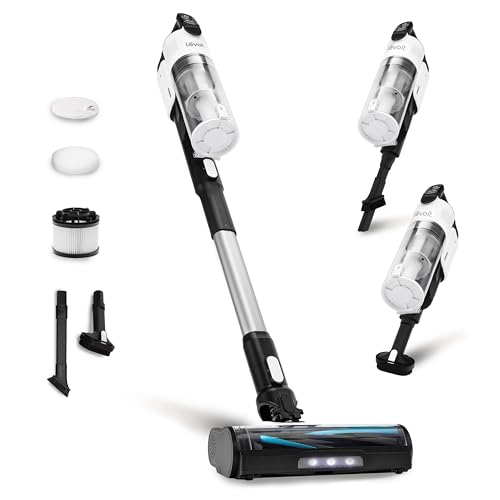
3. Levoit Cordless Vacuum Cleaner LVAC-200 — Best Lightweight Daily Runner
Litter cleaning is a frequency game, and frequency is a weight game: the machine that gets used daily is the light one hanging within reach, not the powerful one in the back of a closet. The Levoit LVAC-200 is built for that reality — a lightweight cordless with a stated 50-minute runtime, an anti-tangle brush the listing directs at pet hair, and a 180-degree lay-flat head that slides under the low furniture cats favour and litter migrates beneath. For the actual litter workflow — out of the box area, around the mat, under the nearby cabinet, done — this is the most ergonomic package in the guide.
The honest limits are capacity and ceiling. The listing does not state a bin size or a suction figure in the material we verified, so buyers who want those numbers in writing should look at the Tineco picks; what the Levoit states is runtime, handling and the anti-tangle pet brief, and on those it is coherent. Levoit is better known for air treatment than vacuums, which cuts both ways — less floor-care heritage than Shark or Dyson, and a challenger brand’s incentive to over-deliver on the basics. For a single-cat flat or a house where the litter zone is one room and two minutes, the daily-runner logic wins: buy the machine whose weight guarantees the habit.
Strengths
- Lightweight — the machine that actually gets used daily
- Lay-flat head reaches under low furniture where litter hides
- 50-minute stated runtime is generous for the format
Trade-offs
- Bin size and suction not stated in the verified listing
- Less floor-care heritage than the big vacuum brands
- Anti-tangle claim is the listing’s, aimed at hair
| Specification | Detail from the verified listing |
|---|---|
| Runtime | Up to 50 minutes (listing-stated) |
| Brush | Anti-tangle, for pet hair (listing-stated) |
| Head | 180° lay-flat design (listing-stated) |
| Format | Lightweight, rechargeable stick (listing-stated) |
| Model | LVAC-200 (listing-stated) |
Best for: Single-cat homes and daily two-minute litter routines / Not suited for: Buyers who want every figure stated before purchase

4. Dyson V8 Plus Cordless Vacuum — Best Premium Ecosystem
The V8 is the elder statesman of cordless sticks, and its case for litter duty rests on the floorhead: Dyson’s detangling design, stated in the listing for hard floors and carpets, is built to ingest debris and shed hair rather than accumulate either — and around a litter box, where hair and granules arrive mixed, that combination is the daily reality. The stated 115AW, in Dyson’s own measure, with two power modes, gives a sensible litter strategy: the lower mode for the daily scatter, the higher for the weekly deep pass and the rug edges where granules lodge. Conversion to handheld covers stairs and the car, where tracked litter also ends up.
The V8 Plus sits in a range that has since grown flagships above it, and its 40-minute stated ceiling is matched or beaten by challengers in this guide — what the Dyson premium buys is the ecosystem and the engineering finish: parts, filters and attachments with long availability, a wall-dock culture that keeps the machine charged and grabbable, and resale value no challenger matches. For litter specifically, none of that is trivial: a docked, charged machine by the door is the one that does the two-minute run. Buy it if you are already in, or value, Dyson’s system; buy on the litter mechanics and you will find the Shark and Tineco picks arguing hard for your money.
Strengths
- Detangling head suits mixed hair-and-litter debris
- Two modes map neatly to daily vs deep litter cleans
- Ecosystem, parts availability and docking culture
Trade-offs
- 40-minute ceiling is matched by cheaper rivals here
- Premium tier of this guide
- Bin size not stated in the verified listing title
| Specification | Detail from the verified listing |
|---|---|
| Suction | 115AW (listing-stated, Dyson’s figure) |
| Runtime | Up to 40 minutes (listing-stated) |
| Modes | 2 power modes (listing-stated) |
| Head | Detangles; hard floor and carpet (listing-stated) |
| Format | Converts to handheld (listing-stated) |
Best for: Dyson loyalists and buyers valuing ecosystem and finish / Not suited for: Value-first buyers — rivals state bigger figures for less positioning

5. BISSELL PowerClean FurGuard Pet Cordless Stick Vacuum — Best Pet-Tool Package
BISSELL is the pet-specialist brand in this guide, and the FurGuard reads like it was specced by someone who lives with animals: HEPA filtration — the feature that matters when you are vacuuming fine litter dust and dander daily, metres from where you breathe — a dedicated fur remover tool for the upholstery the cat actually owns, LED headlights for the scatter, a removable battery that can be swapped or replaced without retiring the machine, and a stated 50 minutes of runtime. For litter zones specifically, filtration is the sleeper specification: granules are the visible problem, but the dust that rises when you empty and clean is the invisible one, and HEPA is the listing-stated answer to it.
The figure discipline matters most with this pick: its 280W is a motor wattage, a different measure from the air watts (AW) quoted by Tineco and Dyson, and this guide does not rank them against each other — anyone who tells you 280 beats 200 by subtraction is selling you arithmetic, not information. Judge the FurGuard on its package: filtration, tools, battery flexibility and a pet brief stated in its name. BISSELL’s pet focus also means the machine’s compromises, such as they are, lean toward pet messes over pristine carpet grooming. For a cat household that wants the specialist’s toolkit, this is the coherent buy.
Strengths
- HEPA filtration — the litter-dust specification
- Fur remover tool and LED headlights included
- Removable battery extends machine life
Trade-offs
- 280W is motor watts — not comparable with rivals’ AW figures
- Pet-first tuning over carpet-grooming finesse
- Bin size not stated in the verified listing title
| Specification | Detail from the verified listing |
|---|---|
| Motor | 280W (listing-stated — motor watts, NOT air watts; not comparable with AW figures) |
| Filtration | HEPA (listing-stated) |
| Runtime | Up to 50 minutes (listing-stated) |
| Tools | Fur remover tool; LED headlights (listing-stated) |
| Format | 2-in-1 handheld; removable battery (listing-stated) |
Best for: Cat households prioritising filtration and pet tools / Not suited for: Buyers who want a single cross-brand suction league table (which does not honestly exist)

6. Tineco Pure ONE S15 Essentials Cordless Vacuum — Best for Hard-Floor Visibility
The S15 Essentials closes the guide with the hard-floor specialist’s argument. Its listing aims it at hard floors and pet hair, equips it with an anti-tangle brush and LED headlights — the visibility feature this guide keeps crediting, because litter pickup is a seeing problem before it is a suction problem — and keeps the package in Tineco’s essentials tier rather than its flagship one. In a home that is mostly hard flooring with a litter zone at its heart, that focus is worth more than all-floor versatility you will never use.
The spec discipline cuts hardest here, and we apply it to ourselves: the verified listing title does not state a runtime or a suction figure, so this pick is recommended on its stated hard-floor and pet brief, its anti-tangle brush and its headlights — and buyers who need the numbers should either check the live listing’s full specification or take the A30S, whose figures Tineco does state. That is not a dismissal; it is the guide’s method working as designed, ranking what is verified and flagging what is not. For hard-floor homes that clean by eye and by habit, the S15 is the focused, sensibly-tiered option.
Strengths
- Hard-floor and pet focus stated in the listing
- LED headlights for litter visibility
- Anti-tangle brush for the hair that travels with litter
Trade-offs
- Runtime and suction not stated in the verified title — check live
- Essentials tier, not Tineco’s flagship specification
- Carpet performance is not its stated brief
| Specification | Detail from the verified listing |
|---|---|
| Brush | Anti-tangle brush (listing-stated) |
| Visibility | LED headlights (listing-stated) |
| Focus | Hard floor, pet hair and home cleaning (listing-stated) |
| Format | Cordless stick, rechargeable (listing-stated) |
| Runtime/suction | Not stated in the verified listing title |
Best for: Mostly-hard-floor homes with a defined litter zone / Not suited for: Carpet-heavy homes, or buyers needing stated figures
Comparison Table
| Pick | Badge | Key spec | Best for | Link |
|---|---|---|---|---|
| Shark Pet Cordless Stick Vacuum IX141 | Best Overall for Litter Zones | 40-min runtime; XL dust cup; LED headlights (listing-stated) | Cat households wanting one cordless for litter zones and hard floors | Check price on Amazon |
| Tineco A30S Cordless Vacuum Cleaner | Best Stated Suction and Bin | 200AW suction; 60-min runtime; 1L bin (listing-stated) | Multi-cat homes and larger hard-floor areas | Check price on Amazon |
| Levoit Cordless Vacuum Cleaner LVAC-200 | Best Lightweight Daily Runner | 50-min runtime; anti-tangle; lay-flat 180° (listing-stated) | Single-cat homes and daily two-minute litter routines | Check price on Amazon |
| Dyson V8 Plus Cordless Vacuum | Best Premium Ecosystem | 115AW; up to 40 min; detangles (listing-stated) | Dyson loyalists and buyers valuing ecosystem and finish | Check price on Amazon |
| BISSELL PowerClean FurGuard Pet Cordless Stick Vacuum | Best Pet-Tool Package | 280W motor; HEPA; 50-min runtime (listing-stated) | Cat households prioritising filtration and pet tools | Check price on Amazon |
| Tineco Pure ONE S15 Essentials Cordless Vacuum | Best for Hard-Floor Visibility | Anti-tangle brush; LED headlights (listing-stated) | Mostly-hard-floor homes with a defined litter zone | Check price on Amazon |
How to Choose a Stick Vacuum for Cat Litter: The Four Tests
Test one is the snowplough test, and it is decided by floorhead design. On hard floors, a poor head pushes dense granules ahead of it and flicks them sideways; a good litter head ingests them on the first pass. Listings rarely say ‘litter’, so judge by the proxies this guide used: a head designed for hard floors and debris pickup, anti-tangle or detangling systems that keep the brush working, and headlights — genuinely — because the second pass over invisible scatter is where litter cleans go to die. Test two is bin behaviour: litter fills by weight, so stated bin size (the Tineco A30S’s 1L, the Shark’s XL cup) predicts your emptying rhythm, and one-touch, bottom-emptying bins keep the dust puff away from your face — over the bin, not over the litter box you just cleaned.
Test three is the numbers, read with discipline. Runtime figures are maximums in the gentlest mode; a litter household should care less about the ceiling than about whether the machine is docked, charged and grabbable, because the winning litter vacuum is the one used for two minutes daily. Suction figures are brand-local currencies: AW (air watts) from Dyson and Tineco, W (motor watts) from BISSELL, and silence from several others — compare within a brand if you must compare, and never across. Test four is filtration and upkeep: HEPA, stated on the FurGuard, is the litter-dust feature; washable filters and available replacements are the ownership features; and an anti-tangle brush is worth real money in a cat home because a hair-wrapped brushroll quietly halves a machine’s litter performance between maintenances.
Finally, place the machine in the routine before you buy it. The litter zone wants the vacuum stored within a few steps, on its dock, charged — a hallway cupboard near the box beats a utility room across the house, whatever the spec sheet says. Mats matter too: a low-pile litter mat under and around the box catches the bulk of the scatter, and the vacuum’s job becomes the mat’s edges and the tracked remainder. Buy the machine and the routine together, and the litter problem shrinks to the two minutes a day it should always have been.
Litter Types and Floors: What Changes the Vacuum’s Job
Clumping clay litter is the standard case this guide assumes: dense granules that track, lodge in grout, and turn to dust at the bin. Crystal litter is larger and lighter, easier for any head to ingest but more prone to being flicked by a fast brushroll — a gentler mode near the box helps. Pellet litters, paper or pine, produce the bulkiest debris and fill bins fastest, which pushes the big-bin picks up the list. Lightweight litters track furthest of all, sometimes whole rooms from the box, and reward the lay-flat, whole-floor machines over the litter-zone specialists. Name your litter honestly before ranking the picks; the same vacuum is not first for all four.
Floors divide the work just as much. Tile with deep grout is the suction test — granules sit in the lines below the head’s easy reach, and stated pull plus a slow pass is the answer. Wood and laminate are the scatter test — smooth surfaces let granules travel metres, so visibility (headlights) and daily frequency beat raw power. Low-pile rugs at the room’s edge are the lodging test, where a brushroll earns its keep and anti-tangle design pays for itself in cat hair. A household with all three floors, which is most households, should buy the all-rounder (the Shark) or the capacity pick (the A30S) and accept the specialists’ compromises knowingly.
How to Run a Two-Minute Litter Routine (and the Weekly Deep Pass)
The daily routine, in order. Start at the box: vacuum the mat first, slowly, in two directions, because the mat holds most of the scatter and a rushed pass redistributes it. Work outward in a rough spiral — the tracking path to the door, the baseboards where granules settle, under the nearest low furniture with the lay-flat or handheld as your machine allows. Use the standard mode for the scatter; save maximum power for visible piles, because max modes halve your runtime for debris that did not need it. Empty the bin when it approaches half full of litter — dense debris degrades suction and cyclone behaviour earlier than dust does, and a half-bin habit keeps the machine performing like the one you tested.
The weekly pass adds the depth. Slow down over grout lines and rug edges, where the week’s granules have lodged; switch to the crevice tool along baseboards and the box’s own perimeter; and take the handheld to stairs and any upholstery on the tracking route. Then maintain the machine, because litter duty is hard duty: check the brushroll for hair wrap even on anti-tangle designs, tap or wash the filter on the maker’s schedule — litter dust loads filters faster than household dust — and wipe the bin rather than letting fine dust cake in its corners. Five weekly minutes of machine care is what keeps a litter vacuum honest for years.
Troubleshooting, briefly, in the form this category actually fails. Problem: the head pushes litter forward instead of eating it → slow down, approach piles from two directions, and check the brushroll is turning and the bin is not full. Problem: granules scatter sideways at speed → drop a power mode near the pile; brushroll aggression is a setting, not a virtue. Problem: suction fades across the week → the filter is loaded with litter dust; clean it before blaming the motor. Problem: the area still looks gritty after cleaning → it is a light problem, not a dirt problem; clean with the headlights on and the room light low, and the scatter will show itself. Each fix is a habit, and the habits are the product.
Common Buying Mistakes
Comparing suction figures across brands. AW and motor watts are different measures, and several listings state neither. This guide prints each figure in its own units and ranks none across brands — do the same, or you are buying arithmetic fiction.
Buying for carpet scores in a litter house. Litter lives on hard floors, in grout and at rug edges. A carpet champion with a ploughing hard-floor head loses this contest to a hard-floor specialist every day of the week.
Storing the vacuum far from the litter box. Litter cleaning is a two-minute daily habit, and distance kills habits. The docked, charged machine near the zone beats the superior machine across the house.
Letting the bin fill completely with litter. Dense debris degrades performance well before the max line. Half-bin emptying keeps suction and cyclone behaviour where the tests measured them.
Ignoring the filter in litter service. Litter dust loads filters faster than ordinary dust. A fading machine is usually a clogged filter asking for its scheduled clean, not a motor dying.
Final Recommendation
For most cat households, the Shark IX141 is the buy: pet-focused, big-binned, headlit and handheld-convertible, in the format the litter routine wants. Take the Tineco A30S if your home is large or your cats are many and stated capacity is your language; the Levoit if lightness and the daily habit are; the Dyson V8 Plus if you are buying into an ecosystem and a dock; the BISSELL FurGuard if filtration and pet tools lead your list — reading its watts correctly; and the S15 if your floors are hard, your zone is defined and you clean by eye. Every pick is verified, every figure is printed in its own brand’s units, and the litter assessment rests on stated hard-floor and pet properties, because no listing here claims litter by name and this guide does not claim it for them.
Set the dock by the litter zone, run the two minutes daily, do the deeper pass weekly, and keep the filter honest. That system — machine plus routine — is the actual best stick vacuum for cat litter pickup, and any of these six will serve as its engine.
- Shark Pet Cordless Stick Vacuum IX141 (Best Overall for Litter Zones) — Check price on Amazon
- Tineco A30S Cordless Vacuum Cleaner (Best Stated Suction and Bin) — Check price on Amazon
- Levoit Cordless Vacuum Cleaner LVAC-200 (Best Lightweight Daily Runner) — Check price on Amazon
- Dyson V8 Plus Cordless Vacuum (Best Premium Ecosystem) — Check price on Amazon
- BISSELL PowerClean FurGuard Pet Cordless Stick Vacuum (Best Pet-Tool Package) — Check price on Amazon
- Tineco Pure ONE S15 Essentials Cordless Vacuum (Best for Hard-Floor Visibility) — Check price on Amazon
Best Shark Stick Vacuums Best Five Stick Vacuums Best Stick Vacuums Carpet And Floor Under $100 Best Powerful Floor Stick Vacuums With Brush Best Quality Bath Towels
Docking, Storage and the Geography of the Litter Zone
Where the vacuum lives is a specification, and for litter duty it outranks several printed ones. The ideal is a dock or hook within a few steps of the litter box, on a wall the machine’s owner passes daily, with the charger connected permanently so the battery is always at the top of its range. Every metre of distance and every closed door between the machine and the mess subtracts cleans per week; every week of skipped cleans adds scatter to floors, grout and rugs. If your only outlet is across the room, a removable-battery model like the BISSELL, charged at a kitchen counter, can beat a fixed dock in the wrong place — geography is a system property, not a furniture detail.
Storage also decides the handheld half of the routine. Attachments that live in a drawer in another room do not exist, operationally; the crevice tool for baseboards and the upholstery tool for the tracking-route sofa should hang with the machine or not be counted in your routine at all. Wall space near the litter zone is unglamorous and decisive. Fit the storage to the two-minute workflow — machine, crevice tool, and a small brush for the mat — and the routine in the how-to section becomes the path of least resistance rather than a project requiring assembly.
Finally, plan for the bin’s journey. Litter bins are emptied more often and carry heavier, dustier loads than general vacuum bins; a route from dock to an outside or lidded bin that does not cross food-preparation surfaces is worth arranging once. Empty with the bin low inside the receiving bag or bin to keep the dust puff down, and wash your hands after the weekly deep pass as a matter of litter-zone hygiene. None of this appears on a spec sheet, and all of it appears in whether the system still works in month six.
When a Stick Vacuum Is Not Enough: Robot and Deep-Clean Backups
Honesty about the category’s ceiling belongs in a guide that wants to be believed. A stick vacuum owns the daily litter scatter, but two jobs exceed it. The first is the deep extraction of litter dust and hair from rugs over months: a full-size upright or a canister with a powered head, run monthly, resets a rug in a way no stick’s convenience format matches, and households with wall-to-wall carpet in the cat’s territory should budget for that partnership rather than asking a stick to be both sprinter and weightlifter. The second is automation: a robot vacuum running daily on hard floors can hold the scatter at bay between your own passes, and in multi-cat homes that division of labour — robot for the floor’s background state, stick for the litter zone and the incidents — is often the genuinely best system, at a genuinely higher total cost.
Wet messes are the third boundary, and the simplest: litter zones produce them, and no dry stick vacuum in this guide is the tool. A dedicated mop or a wet-cleaning device handles the accident; the stick returns when the floor is dry. Respecting that boundary protects the machine’s filters and motor and the floor’s finish alike. The stick vacuum’s kingdom is dry, daily and brief — within it, the six picks here are excellent; outside it, buy the partner tool rather than blaming the stick for a job description it never claimed.
A Note on Batteries, Filters and Owning a Cordless for Years
A cordless vacuum is a battery with a cleaning business attached, and its long-term value is set by consumables. Batteries fade over years of charge cycles; a model with a removable, replaceable battery — the BISSELL in this guide states one — can be renewed for a fraction of a new machine’s cost, while a sealed-battery model is a countdown. Filters are the second consumable: in litter service they load with fine dust faster than in any other household duty, and the difference between a washable filter with available spares and a proprietary filter on back-order is the difference between a five-minute maintenance and a machine in a cupboard. Before buying any pick here, spend two minutes on its live listing confirming the replacement battery and filter story; it is the cheapest longevity research in the category.
The third consumable is the brushroll, and litter is hard on it: granules are abrasive, hair wraps, and the anti-tangle designs in this guide reduce rather than abolish the maintenance. A brushroll that removes without tools will be cleaned; one that needs a screwdriver will be cleaned eventually, which is to say rarely, at the cost of the performance you paid for. Judge the picks partly by their hands: the machine you will maintain is the machine that will still perform in year three, and in litter duty that judgement outweighs any single figure on the box.
One Last Check Before You Order
Walk the litter zone before you order and count the decisions there: where the dock will live, which floor types the machine must cross, where the bin will be emptied, and which of the six picks’ stated strengths matches that geography. The right machine chosen for the real zone will outperform the ‘best’ machine chosen for an imagined one, every day of the week.
Related guides
Frequently Asked Questions
What makes a stick vacuum good for cat litter specifically?
Hard-floor debris behaviour: a head that ingests dense granules instead of ploughing them, enough stated suction to pull granules from grout lines, a bin sized for heavy debris, and grab-and-go cordless handling for a two-minute daily run. Pet-focused design, anti-tangle brushes and headlights all help, because litter arrives mixed with hair and hides in flat light.
Can I compare the suction numbers between these vacuums?
Not across brands. Tineco and Dyson state air watts (AW); BISSELL states motor watts (W); others state neither in their titles. These are different measures, and this guide deliberately never ranks them against each other. Compare runtime, bin size, filtration and format — the figures that share a meaning — and treat suction claims as within-brand information only.
How often should I vacuum around the litter box?
Daily, briefly — two minutes with the machine docked nearby beats a weekly expedition. Scatter compounds: granules walked on are granules ground into grout and tracked further. A weekly deeper pass over grout lines, rug edges and baseboards, plus filter care, completes the system.
Is HEPA filtration worth it for litter?
For many cat households, yes. Vacuuming litter raises fine dust and dander at face height, and emptying the bin raises it again. The BISSELL FurGuard states HEPA filtration; if anyone in the home is dust-sensitive, that stated feature deserves real weight in your decision — as a filtration specification, not a health promise.
Why was a cheaper corded stick not included?
The search’s workload — daily, brief, around a fixed zone — is the cordless use case, and every verified pick here is cordless. A corded stick can be a fine second machine, but a cord across the litter area is friction the daily habit does not survive. This guide ranks the format the routine needs.
Do I still need a litter mat with a good vacuum?
Yes — the mat is the first line, catching the bulk of scatter at the box, and the vacuum handles the mat, its edges and everything that escaped. Mat plus two-minute routine is the system; either half alone leaves the other half’s work undone.


