Disclosure: airfryerkitchensupply.com is reader-supported. When you buy through links on our site, we may earn an affiliate commission at no extra cost to you.
Where to buy
Every slipper below was checked against Amazon’s catalog data, and its width claim comes from its own listing — nothing was assumed from a brand’s reputation: the FitVille Extra Wide Men’s Slippers for the widest slip-on fit, the Ravelier Men’s Adaptive Wide Width Slipper Shoe for width sizing that runs to a 15W, the relxfeet Men’s Wide Width Adjustable Slippers for a strap you can tune through the day, the EUROPEAN SOFTEST Men’s Memory Foam Slippers for the roomiest adjustable plush fit, the Orthofeet Vito Men’s Slip-On Slippers for a hands-free wide fit with structure, and the Dearfoams Men’s Brendan Clog for a breathable wide-width clog from a mainstream brand. Check the current price on Amazon for the pair that matches your feet, and read the width notes under each pick — in this category, the difference between “wide” on a label and wide on your foot is the whole purchase.
Introduction: What “4E” Really Means When You Buy Slippers
If you are hunting for the best mens slippers 4e width, you have probably already discovered the frustrating truth: slippers almost never come graded in E widths. The 4E label belongs to the shoe world, where a last is built in measured widths — B, D, 2E, 4E, 6E — and a 4E is a genuinely extra-wide last, roughly two width grades beyond the standard D. Slipper makers mostly skip that system. They sell “wide,” “extra wide,” or a single roomy fit, and the actual room inside varies enormously from brand to brand. So this guide does two things. First, it only includes slippers whose own listings state a wide or extra-wide fit — no standard-width slippers with optimistic photography. Second, it favors the two features that actually deliver a 4E-equivalent result on a real foot: a genuinely wide last, and an adjustable upper that can open up for a high instep or a foot that is wider by evening than it was in the morning.
That second point matters more than most buyers expect. A fixed wide slipper fits the foot you have at 8 a.m. An adjustable-strap slipper fits the foot you have at 8 p.m. as well. Four of the six picks below use an adjustable closure or a stretch, open-up design for exactly that reason, and the two fixed-fit picks — the FitVille and the Dearfoams clog — earn their places with lasts that are cut wide to begin with. Where a listing uses a numbered width (the Ravelier runs to a 15W in its title), we say so; where a brand only says “extra wide,” we say that instead, and we tell you what to measure on your own foot so you can judge the claim instead of trusting it.
One more piece of honesty up front: several wide-fit slippers are marketed with medical vocabulary in their titles. We have ignored that vocabulary entirely. This guide judges these slippers as what they are — comfortable, roomy house footwear — on fit, materials, soles and adjustability. If you need footwear for a diagnosed foot condition, that is a conversation for your clinician; what we can do here is make sure the slipper you buy actually has room in it, verified from its own listing rather than from advertising.
In this guide
Quick Picks
| Pick | Badge | Why it is here | Link |
|---|---|---|---|
| FitVille Extra Wide Men’s Slippers | Best Overall | Listing states extra wide; slip-on build, non-slip sole, indoor/outdoor use | Check on Amazon |
| Ravelier Men’s Adaptive Wide Width Slipper Shoe | Best True Width Sizing | Sized in wide widths up to 15W per the listing; adjustable, memory foam, machine washable | Check on Amazon |
| relxfeet Men’s Wide Width Adjustable Slippers | Best Adjustable Fit | Wide width with an adjustable fit strap, removable insole, non-slip rubber sole | Check on Amazon |
| EUROPEAN SOFTEST Men’s Memory Foam Slippers | Best for Feet That Swell | Listing states wide and extra wide with an adjustable closure and plush fleece lining | Check on Amazon |
| Orthofeet Vito Men’s Slip-On Slippers | Best Structured Wide Fit | Hands-free slip-on, adjustable, water-repellent upper, faux fur lining | Check on Amazon |
| Dearfoams Men’s Brendan Clog | Best Breathable Wide Clog | Offered in wide widths per the listing; perforated breathable upper, memory foam | Check on Amazon |
Short on time? The FitVille is the default answer for a genuinely wide foot, and the Ravelier is the pick if you already know your width in shoe terms and want a slipper sold the same way.
How These Picks Were Chosen
The first filter was the listing’s own words. A pick had to state a wide, extra-wide, or numbered-wide fit in its Amazon listing — verified against the catalog data for this site — because a standard slipper photographed on a narrow foot tells you nothing. Slippers that were merely “roomy” in marketing copy without a width statement were cut. The second filter was construction that suits a wide foot in practice: adjustable closures, stretch or open clog shapes, and wide toe boxes scored ahead of fixed moccasin uppers, which tend to be cut on a standard last even in their “wide” versions. The third filter was basic house-shoe competence: a real sole you can step outside in, a lining suited to the season it claims, and a build that is a complete slipper — not a sock, not an insert, not a liner sold as footwear.
We also enforced the house-slipper rule strictly: no sandals, slides or flip-flops standing in for slippers, and no novelty or costume footwear. Every pick below is a closed or clog-style house slipper you can wear all day at home. Finally, a note on duplication: some brands sell near-identical wide slippers under several listings. Where two listings were the same product family in different words, we kept one and said so in our sources, so the six picks are six genuinely different choices.
The 6 Best Men’s Slippers for 4E Width Feet

FitVille Extra Wide Men’s Slippers — Best Overall
FitVille built its name on wide-fit footwear, and this slipper is the straightforward expression of that: the listing states “Extra Wide” in the product name itself, in a slip-on house slipper with a non-slip sole rated by the listing for indoor and outdoor use. There is no strap to manage and no closure to set — you step in, and the width is simply there, which is what most men with wide feet actually want at the start and end of the day. The winter-weight build makes it a cold-floor slipper first; if your home runs warm or you want a summer pair, the Dearfoams clog below is the better seasonal match. It suits men who wear wide shoes all day and are tired of slippers that feel like a size smaller than everything else they own. It is less suited to feet that change size through the day, because a fixed slip-on cannot be loosened — for that foot, the adjustable picks are the honest recommendation.
Strengths
- Extra-wide fit stated in the listing itself, from a brand whose range is built around wide fits
- True slip-on: no straps, no closure, nothing to adjust with stiff morning hands
- Non-slip sole the listing rates for indoor and outdoor steps — mail, bins, garage
Trade-offs
- Fixed fit: no way to open the upper up if your feet are wider by evening
- Winter-weight build will run warm in summer or in heated homes
- Width is stated as “extra wide” rather than a measured 4E grade — see the measuring section below
Spec box
- Fit: extra wide (as listed)
- Style: slip-on house slipper (as listed)
- Sole: non-slip, indoor/outdoor (as listed)
- Season: winter weight (as listed)
The deeper reason this pick leads the guide is predictability. Adjustable slippers are wonderful when you need them, but every strap is also a fit variable; a wide last that simply fits removes the variable. If your feet are consistently wide — the same width in the morning as at night — a fixed extra-wide slipper is the lower-fuss, longer-wearing choice, because hook-and-loop closures collect lint and lose grip over a year of daily use while a well-cut upper does not. Measure your foot as described in the how-to-choose section, compare it honestly with the listing’s size guidance, and if you fall between sizes, the wide-foot rule applies: size up, because a slipper that is slightly long is comfortable and a slipper that is slightly narrow is a return.
Best for: consistently wide feet that want a simple, warm slip-on / Not suited for: feet that swell significantly through the day
Check on Amazon — check the current price on Amazon.

Ravelier Men’s Adaptive Wide Width Slipper Shoe — Best True Width Sizing
This is the pick that speaks the shoe world’s language. The Ravelier listing sells the slipper in wide widths — the listing we verified is the 15W — with an adjustable closure, a memory foam footbed, an indoor/outdoor sole, and a machine-washable build. For a man who buys his shoes in a W or E width and wants his slippers chosen the same way, that sizing honesty is rare and valuable: you are not guessing whether “extra wide” means your wide. The adaptive, adjustable upper opens wide to get the foot in and then closes down to the fit you set, which also makes it the easiest pick here for anyone who finds bending and pulling at a tight slipper genuinely difficult. It suits big and tall men — a 15W exists precisely because feet at that end of the chart are real — and anyone whose width, not length, has always been the problem. It is less suited to minimalists: it looks and wears more like a soft shoe than a traditional slipper.
Strengths
- Sold in numbered wide widths (listing verified at 15W) instead of vague “wide” claims
- Adjustable closure opens fully for easy entry, then sets the fit you want
- Machine washable per the listing — unusual and practical for a daily-wear slipper
Trade-offs
- Shoe-like appearance: more structure and coverage than a classic house slipper
- Hook-and-loop closures need occasional lint cleaning to keep their grip
- Memory foam footbeds compress over time; expect the first-month softness to settle
Spec box
- Fit: wide width sizing, verified listing 15W (as listed)
- Closure: adjustable (as listed)
- Footbed: memory foam (as listed)
- Care: machine washable (as listed)
- Sole: indoor/outdoor, non-slip (as listed)
What “adaptive” means in practice is range. The same pair can be worn snug on a normal morning and opened a full notch on a hot evening, and it can accommodate a thick sock in winter without a second pair. That range is the closest thing slippers offer to a true 4E last, because a genuine 4E shoe is, in effect, a fixed version of the room this closure gives you on demand. If you have spent years buying shoes by width letter, buy this slipper by width letter too — and if you are between widths, choose the wider: the closure can take up slack far more gracefully than a too-narrow upper can stretch.
Best for: men who buy shoes by width letter, including large sizes to 15W / Not suited for: anyone who wants a minimal, traditional slipper look
Check on Amazon — check the current price on Amazon.

relxfeet Men’s Wide Width Adjustable Slippers — Best Adjustable Fit
The relxfeet pick is built around one idea: the fit should be set by you, not by the factory. Its listing states a wide width with an adjustable fit, a soft upper, a cozy lining, a removable insole and a non-slip rubber sole, in an all-black finish that reads more like a casual shoe than bedroom footwear. The removable insole is the detail worth pausing on: it lets you tune the internal volume — insole in for a closer fit, out for maximum room — and it lets you air or replace the footbed instead of replacing the slipper. It suits men whose feet sit between “wide” and “extra wide” depending on the day, and anyone who wears their slippers for hours of standing in a kitchen or workshop. It is less suited to a barefoot-in-summer brief; the cozy lining is a cool-weather feature.
Strengths
- Adjustable strap fit on a wide-width base — two layers of width control
- Removable insole lets you tune internal volume and refresh the footbed
- Non-slip rubber sole with real outdoor-step credibility
Trade-offs
- Cozy lined build runs warm; not a summer slipper
- All-black, shoe-like styling will not suit everyone
- Strap hardware and hook-and-loop need the same periodic lint care as any adjustable closure
Spec box
- Fit: wide width, adjustable (as listed; verified listing size 12)
- Insole: removable (as listed)
- Sole: non-slip rubber (as listed)
- Lining: cozy lined upper (as listed)
Think of this as the slipper for the man who has returned wide slippers before. “Wide” failed him because it was one fixed guess; this design replaces the guess with a range and then adds the insole trick on top. Set the strap at the loosest setting that still holds your heel, walk a full day at home, and only then fine-tune — most people overtighten an adjustable slipper in the first five minutes and conclude it runs small, when the truth is they set it like a shoe. A house slipper should hold without squeezing; if your toes can spread fully when you stand, the fit is right.
Best for: in-between widths and long hours of standing at home / Not suited for: warm-weather wear
Check on Amazon — check the current price on Amazon.
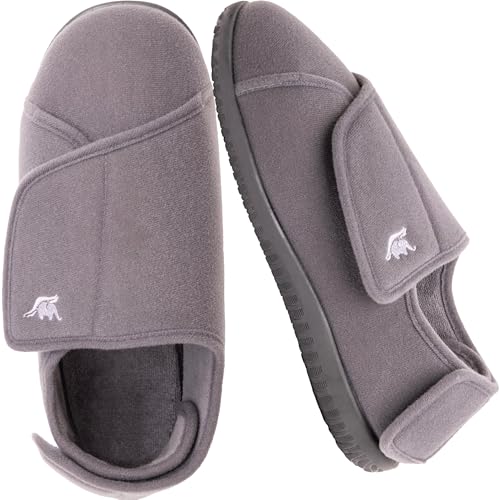
EUROPEAN SOFTEST Men’s Memory Foam Slippers — Best for Feet That Swell
Feet are not one size all day. By evening, most people’s feet are measurably fuller than they were in the morning, and for some men the difference is a whole width grade. This is the pick designed around that reality: the listing states wide and extra wide sizing with an adjustable closure, a memory foam footbed and a warm plush fleece lining. The closure opens the top of the slipper so the foot goes in without forcing, then settles at whatever volume the foot actually is at that hour. It suits men who find their evening feet bursting out of slippers that fit fine at breakfast, and anyone who wears slippers over thick socks in winter. It is not a warm-weather pick — plush fleece is a heating system — and the soft, unstructured build gives less lateral support than the Orthofeet below, which matters if you want a slipper that feels like a shoe.
Strengths
- Wide and extra wide options with an adjustable closure — the most forgiving fit system in this guide
- Opens up for easy entry; kind to feet that are fuller by evening
- Plush fleece lining and memory foam make it the comfort-first winter pick
Trade-offs
- Too warm for summer or strongly heated homes
- Soft structure offers comfort over support — not the pick for all-day standing
- Plush linings hold moisture; air them out regularly
Spec box
- Fit: wide and extra wide, adjustable closure (as listed)
- Footbed: memory foam (as listed)
- Lining: plush fleece (as listed)
- Style: adjustable house slipper (as listed)
A note on honesty: this slipper’s listing title carries medical marketing language, as do several listings in the wide-fit category. We have not repeated any of it, because a slipper is comfort footwear, not a treatment. What can be said truthfully is mechanical: an adjustable, extra-wide, soft-lined slipper accommodates a foot whose volume changes, and accommodation is a fit property you can judge for yourself in the first evening you wear them. Buy through a listing with a workable return policy, test them at the end of a day rather than the start, and judge them by whether your toes can spread and your heel stays put — those two checks tell you more than any label.
Best for: feet that are wider by evening, and winter wear over socks / Not suited for: summer use or anyone wanting structured support
Check on Amazon — check the current price on Amazon.

Orthofeet Vito Men’s Slip-On Slippers — Best Structured Wide Fit
Orthofeet’s Vito takes the opposite approach to the plush picks: structure first. The listing describes a hands-free slip-on — a heel design you can step into without bending or using your hands — with an adjustable fit, a water-repellent upper, and a faux fur lining, in black. For a wide foot, the hands-free entry is more than a convenience: forcing a wide foot into a snug slipper usually means crushing the heel counter down with your toes, which destroys the slipper and never quite fits. A step-in design with an adjustable fit sidesteps that entirely. It suits men who want their house footwear to behave like real footwear — quick trips outside, hard floors, a sole with intent — and anyone with limited flexibility who should not have to wrestle a slipper on. It is less suited to shoppers who want the softest possible lounge feel; structure is the point here, and the price tier is generally the premium end of this guide, so check the current price on Amazon before deciding.
Strengths
- Hands-free step-in design — no forcing a wide foot through a narrow opening
- Adjustable fit on a structured build: support and width control together
- Water-repellent upper shrugs off kitchen splashes and damp porches
Trade-offs
- Firmer, shoe-like feel — not a plush lounge slipper
- Premium tier of this guide; value depends on how many hours a day you wear them
- Faux fur lining adds warmth some wearers will not want year-round
Spec box
- Fit: adjustable, wide-foot friendly slip-on (as listed; verified listing size 12)
- Entry: hands-free slip-on (as listed)
- Upper: water-repellent (as listed)
- Lining: faux fur (as listed)
The Vito is the pick we would hand to the man who says slippers never feel like enough shoe. The structure that makes it feel substantial is the same structure that holds a wide foot securely instead of letting it spill over the footbed edges — the quiet failure mode of soft wide slippers, where the width exists but the foot never sits in it properly. If you divide your day between floors and quick outdoor steps, and you want one pair to cover both without a shoe change, this is the pair built for that pattern.
Best for: men who want shoe-like structure and hands-free entry / Not suited for: plush-lounge comfort seekers
Check on Amazon — check the current price on Amazon.
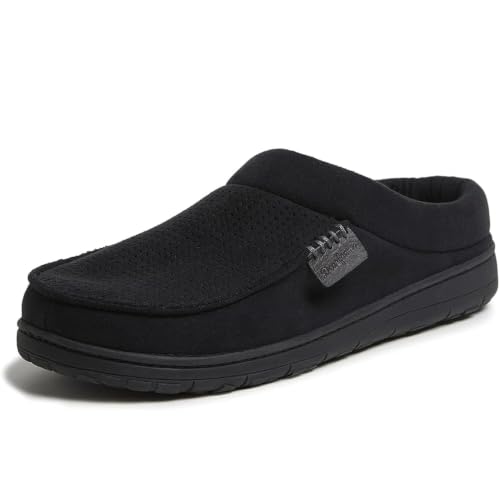
Dearfoams Men’s Brendan Clog — Best Breathable Wide Clog
Dearfoams is the mainstream name in this guide, and the Brendan earns its place on specifics rather than brand: the listing states the clog is offered in wide widths, with a breathable perforated upper over a memory foam footbed, in an indoor/outdoor clog shape. A clog is a genuinely good answer for a wide foot — the open back removes the heel squeeze entirely, and the roomy toe box of a clog last gives width where feet actually need it, across the forefoot. The perforations make this the one pick here aimed at warm feet and warm months. It suits men whose feet run hot, who want a slipper for three seasons rather than one winter, and who prefer a known brand’s sizing consistency. It does not suit anyone who needs a secure heel — a clog can slip at the back on stairs — or anyone shopping for deep-winter warmth.
Strengths
- Wide widths stated in the listing, from a mainstream brand with consistent sizing
- Perforated breathable upper — the coolest-wearing pick in this guide
- Clog shape gives forefoot room with zero heel squeeze and easy on/off
Trade-offs
- Open back means less heel security, especially on stairs
- Breathable build is not a cold-weather slipper
- Fixed fit — no adjustment if your width changes through the day
Spec box
- Fit: wide widths offered (as listed)
- Style: clog, indoor/outdoor (as listed)
- Upper: breathable, perforated (as listed)
- Footbed: memory foam (as listed)
There is a quiet logic to ending the guide with the simplest design. If your width problem is concentrated in the forefoot — wide toes, standard heel — a clog solves it with geometry instead of hardware, and the Brendan does it in a breathable build you can wear from spring through fall. Judge it the way you would judge any clog: your heel should land inside the footbed’s raised edge, not on it, and your toes should never touch the front. Get those two things right and a wide clog is the lowest-maintenance wide slipper you can own.
Best for: warm feet, forefoot width, and three-season wear / Not suited for: stairs-heavy homes or deep winter
Check on Amazon — check the current price on Amazon.
Comparison Table
| Pick | Badge | Key spec (as listed) | Best for |
|---|---|---|---|
| FitVille Extra Wide Slippers | Best Overall | Extra wide slip-on, non-slip sole | Consistently wide feet |
| Ravelier Adaptive Slipper Shoe | Best True Width Sizing | Wide widths to 15W, adjustable, washable | Buying by width letter |
| relxfeet Wide Adjustable Slippers | Best Adjustable Fit | Adjustable strap, removable insole | In-between widths |
| EUROPEAN SOFTEST Slippers | Best for Feet That Swell | Wide/extra wide, adjustable, plush fleece | Evening width changes |
| Orthofeet Vito Slippers | Best Structured Wide Fit | Hands-free entry, water-repellent upper | Shoe-like support |
| Dearfoams Brendan Clog | Best Breathable Wide Clog | Wide widths, perforated upper | Warm feet, forefoot width |
How to Choose Slippers for a 4E Foot
Measure your foot, in the evening, standing. Width numbers on a screen mean little until you know your own. Stand on a sheet of paper in the socks you will wear with slippers, in the evening when your feet are at their fullest, and trace both feet. Measure the widest point of the tracing — usually across the ball of the foot. As a rough guide for men’s shoe sizing, a standard D width at size 10 is about 4 inches across the ball; each width grade adds roughly 3/16 of an inch, so a true 4E at that size is around 4.4 inches or more. If your tracing is in that territory, you need the genuine wide lasts and adjustable designs in this guide, not a standard slipper in a bigger length.
Never buy width by length. The oldest mistake in wide footwear is sizing up until the width works, which leaves you swimming in length: the heel slips, the toe drags, and the slipper becomes a trip hazard on stairs. If a brand does not offer a wide fit in your length, that brand does not make your slipper — move to one that does.
Choose fixed or adjustable by your foot’s daily pattern. Consistently wide from morning to night: a fixed extra-wide last like the FitVille is simpler and longer-wearing. Wider by evening, or different after a day on your feet: an adjustable closure — Ravelier, relxfeet, or the EUROPEAN SOFTEST — is not a luxury, it is the mechanism that makes one pair fit your whole day.
Mind the toe box shape. Width across the ball is wasted if the toe box tapers to a point. Clogs and round-toe slip-ons preserve width to the front; pointed moccasin toes take it away. Look at the top-down silhouette of the slipper, not just its width label.
Check the sole like it matters — because it does. A wide foot on a narrow, soft sole rolls over the edge and wears the slipper out from the side. Every pick here has a defined sole rather than a sock bottom, and the structured picks — Vito, relxfeet, Ravelier — keep a wide foot centered on the footbed, which is where its width does you good.
Do not forget the heel. Wide feet are not wide everywhere, and a common wide-slipper failure is a roomy forefoot paired with a heel cup so loose the foot wanders. If your heel is narrower than your forefoot — a combination foot — adjustable uppers and hands-free structured designs like the Vito earn their keep, because they can hold a standard heel while the front stays open. When you test a pair, walk briskly and turn sharply: a heel that lifts out or shifts sideways on the turn will only get looser as the upper relaxes, so treat early heel slip as a fail, not as something to break in.
Use the return window as a fitting room. Order through a listing with returns, test the slippers at home in the evening on hard floors, and judge by three checks: toes spread fully when standing, heel stays seated when walking, no pressure across the top of the foot after twenty minutes. Pass all three and you have found your 4E-equivalent fit, whatever the label calls it.
Width Grades, Explained for Slipper Shoppers
The letter system comes from lasted footwear, where a shoe is built over a foot-shaped form called a last, and the last is made in widths as well as lengths. For men, the common ladder runs B (narrow), D (standard or medium), 2E (wide), 4E (extra wide) and 6E (the widest common grade). Each step is worth roughly 3/16 of an inch across the ball of the foot at a given length, which sounds tiny until you remember that a slipper upper has almost no structure to redistribute pressure: three-sixteenths of an inch is the difference between a toe box your forefoot fills comfortably and one that presses on the joints of your big and little toes all evening. Two consequences follow for slipper shopping. First, a slipper brand that grades its widths — even in the simpler language of W sizes, as the Ravelier does — is giving you a real measurement system, and that is worth more than adjectives. Second, “extra wide” from a brand whose standard fit already runs generous may equal “wide” from a brand whose standard runs narrow. There is no regulator of slipper adjectives, which is why this guide leans on adjustable designs: a closure converts an adjective into a range you control.
Instep height is the hidden half of width. Two feet can measure identically across the ball and need completely different slippers because one carries its volume on top — a high instep that presses into every fixed upper — while the other carries it at the sides. If your problem is pressure across the top of the foot rather than squeezing at the sides, prioritize open designs: clogs, and adjustable uppers that open from the top, like the relxfeet and EUROPEAN SOFTEST picks. If your problem is side pressure with a normal instep, a wide fixed last like the FitVille addresses it directly. Diagnosing which of the two you have takes ten seconds: look at your current slippers. Crushed-down uppers and top pressure mean instep; uppers bulging outward over the sole edge mean ball width. Buy for the problem you actually have.
Choosing by Season and Material
Width is the headline, but the lining decides whether a pair gets worn in July. The guide deliberately spans the calendar. For winter and cold floors, the plush and lined builds — the EUROPEAN SOFTEST with its fleece, the Vito with faux fur, the winter-weight FitVille — trap warmth around a wide foot without needing a tight fit to stay on, which is exactly what a wide foot wants. For warm months and warm homes, the Dearfoams Brendan’s perforated upper is the only pick designed to move air, and it is the pair most likely to still be on your feet in August. Memory foam appears across the guide because it molds to a wide forefoot instead of fighting it, but treat it as a comfort layer with a lifespan: it will take a permanent set over months of daily wear, which is why the relxfeet’s removable insole is a genuine longevity feature — a fresh insole restores the fit of an otherwise sound slipper. Finally, soles: a wide foot benefits from a sole at least as wide as the footbed, in a rubber or rubber-like compound that does not skate on hardwood. Every pick here clears that bar; the soft-soled novelty slippers that flood this category do not, and none were considered.
How to Fit and Care for Wide Slippers
Fitting: 1. Try slippers on in the evening, wearing your usual house socks. 2. Stand with full weight — feet spread wider standing than sitting, and standing width is the width that matters. 3. Set adjustable closures to the loosest setting that keeps your heel seated, then walk twenty steps on a hard floor. 4. If your forefoot presses the upper outward beyond the sole’s edge, the last is too narrow regardless of the label — return and move to a wider design. 5. For the first week, re-set straps after long wear; uppers relax slightly and the fit you want on day seven is a touch different from day one. Care: air lined slippers out overnight rather than sealing them in a closet; brush lint out of hook-and-loop closures monthly so they keep their grip; wash only the picks whose listings say they are washable, in cold water, and air-dry — heat shrinks linings and warps memory foam. Replace slippers when the footbed stays compressed or the sole edge wears unevenly; a worn-out wide slipper stops holding the foot where its width is.
Common Buying Mistakes
Sizing up in length to get width. You get a long, heel-slipping trip hazard instead of a wide slipper. Buy your length, in a wide fit, or change brands.
Trusting the word “wide” without a mechanism. A wide claim with a standard last and a fixed narrow opening is a label, not a fit. Look for an extra-wide last, numbered wide sizing, or an adjustable upper.
Overtightening adjustable slippers. Setting a strap like a shoe lace defeats the design. Loose enough for toes to spread, snug enough for the heel to stay — that is the whole technique.
Ignoring the evening foot. Testing new slippers at 9 a.m. and concluding they fit is how wide-footed men end up with morning-only slippers. Fit them when your feet are at their biggest.
Choosing plush over structure for all-day standing. Memory foam feels wonderful for an hour on the sofa and bottomless by hour four at a kitchen counter. Match the build to how you actually spend your time at home.
Wearing a clog on stairs without thinking. Open-back slippers and stairs are a poor combination, especially in socks. If your home has stairs you use constantly, choose a closed-back pick.
Judging a wide slipper while sitting down. A seated foot is a narrower foot. Every fit check in this guide — spread, heel hold, top pressure — has to happen standing with your full weight down, or you will approve slippers that fail you by the second evening.
Final Recommendation
For most men with genuinely wide feet, start with the FitVille Extra Wide: a real wide last, no fuss, warm and simple. If you buy shoes by width letter, the Ravelier speaks your language, up to a 15W. If your feet change through the day, choose adjustability — the relxfeet for its removable insole, or the EUROPEAN SOFTEST for maximum plush room. If you want structure and hands-free entry, the Orthofeet Vito is the shoe-like answer, and if your feet run hot, the Dearfoams Brendan clog in wide widths is the breathable one. Whatever you choose, fit it in the evening and judge it standing — that is how a 4E foot actually lives in a slipper.
Related guides in this series: Best Arch Support Slippers Mens, Best Big And Tall Slippers, Best Allday Comfort Slippers, Best Mens Slippers For Foot Support, Best Anti Fatigue Slippers.
Frequently Asked Questions
Do any slippers actually come in a true 4E width?
Very few use the E-grade system at all — it belongs to lasted shoes. The realistic equivalents are slippers sold in numbered wide widths (the Ravelier in this guide runs to a 15W), slippers built on a stated extra-wide last (the FitVille), and adjustable designs whose closures create 4E-class room on demand. Judge by your evening foot measurement and the standing fit test, not by the label.
How do I know if my foot is really a 4E?
Trace your foot standing, in the evening, and measure across the ball. Compare it with a men’s width chart for your shoe size: at a size 10, a D width is roughly 4 inches across the ball and each grade adds about 3/16 of an inch, putting a 4E near 4.4 inches. A simpler field test: if standard slippers in your correct length always squeeze across the forefoot while the length is right, you are shopping in the correct guide.
Are adjustable slippers better than fixed wide slippers?
They solve different problems. Adjustable closures fit a foot whose volume changes through the day and forgive in-between sizes; fixed wide lasts are simpler, with no straps to maintain, and hold their fit longer. Consistently wide feet usually prefer fixed; feet that swell prefer adjustable. Many men end up with one of each — a structured adjustable pair for long days and a simple wide slip-on by the bed.
Can I wear wide slippers outdoors?
The picks here with defined rubber or indoor/outdoor soles — the FitVille, Ravelier, relxfeet and Vito among them — handle porches, garages, mailboxes and dry pavement without complaint. They are not walking shoes: distance, wet leaves and gravel will wear them fast and support fades over long walks. Treat outdoor use as short trips, and keep a pair of real shoes for anything longer.
Why do my wide slippers wear out on the outer edge?
That wear pattern means your foot is sitting partly outside the footbed — the last is narrower than your foot even if the label says wide, or the upper has stretched until it no longer centers you. It is the clearest sign to move to a genuinely wider or more structured design, like the Vito or Ravelier here, rather than reordering the same model.
Should I buy wide slippers a size up to wear with thick socks?
Buy your normal length in a wide or adjustable fit, and let the width — not extra length — make room for the sock. A size up adds length your heel will slip in, sock or no sock. If you know you will always wear a heavy sock, the adjustable picks are the safest route: set the closure over the sock once, and the same pair still fits barefoot in summer by closing a notch further. The one exception is a fixed clog like the Brendan: a half-size of extra length in an open-back clog is harmless, because there is no heel fit to spoil.
Why do so few slippers use real width grades?
Cost and simplicity. Grading a last in multiple widths means more tooling and more sizes to stock, and most slipper brands sell one forgiving fit instead, relying on soft uppers and foam to absorb the differences. That works for feet near the standard width and fails exactly the men this guide is for. The brands that do grade widths, build extra-wide lasts, or fit adjustable uppers are a minority — which is why the six picks here were chosen from dozens of wide-claimed listings that did not hold up to their own descriptions.
How long should a good pair of house slippers last?
With daily wear, expect a year of honest service from the footbed and sole of a well-made pair, longer from structured models and less from pure plush builds. Rotate two pairs if you wear slippers all day — foam recovers between wears — and replace a pair when the footbed stays flat, the heel counter collapses, or the sole edge wears unevenly, because at that point the slipper is changing how you stand.


