Disclosure: airfryerkitchensupply.com is reader-supported. When you buy through links on our site, we may earn an affiliate commission at no extra cost to you.
Where to buy
Every chair below was verified against Amazon’s own catalog data before earning a link, and every pick is a genuine mesh desk chair — no chair mats, no seat cushions, and no leather executive chairs borrowing mesh keywords. Start with the SIHOO M18 for the best all-round balance, the CAPOT if you need a verified 400 lb capacity, or the Furmax if the budget is the whole conversation.
- SIHOO M18 Ergonomic Office Chair — Check on Amazon
- CAPOT Ergonomic Mesh Office Chair — Check on Amazon
- Furmax Office Chair — Check on Amazon
- Sweetcrispy Ergonomic Computer Desk Chair — Check on Amazon
- DUMOS Home Office Chair — Check on Amazon
- GABRYLLY Ergonomic Office Chair — Check on Amazon
The best desk chairs mesh have become the default choice for home offices for one honest reason: the material breathes. A mesh back moves air against your back through an eight-hour day in a way no foam-and-vinyl chair can, it does not crack or peel the way bonded leather does in year three, and it keeps a home office looking light instead of anchored by a black leather monolith. But “mesh desk chair” covers an enormous quality range — from genuinely ergonomic chairs with adjustable lumbar support, headrests, and tilt locks, down to the thinnest task chairs whose mesh is stretched over a frame with no adjustment at all. This guide to the best desk chairs mesh separates those tiers. Every pick here has, at minimum, a breathable mesh back and real lumbar support; the better picks add adjustable lumbar depth, multi-direction armrests, tilt locking, and verified weight capacities up to 400 lbs. A note on language: these are comfort products. A well-fitted chair supports good posture and makes long sitting more comfortable — it is furniture, not a medical device, and this guide makes no health claims beyond that.
The other axis is fit. A mid-back chair suits shorter torsos and smaller desks; a high-back chair with a headrest suits taller sitters and anyone who leans back to think or take calls. Armrest style decides whether the chair tucks under your desk — flip-up arms exist precisely for tight home offices. And capacity is not a footnote: two picks here publish capacities (330 lbs on the SIHOO, 400 lbs on the CAPOT), and where a listing does not state a capacity, the spec box says “not stated” rather than guessing.
In this guide
Quick Picks
| Pick | Badge | Why it stands out | Link |
|---|---|---|---|
| SIHOO M18 Ergonomic Office Chair | Best Overall | Mesh back, headrest, adjustable lumbar, 330 lb capacity, 2D armrests | Check on Amazon |
| CAPOT Ergonomic Mesh Office Chair | Best Heavy-Duty | 400 lb capacity, 4D flip-up arms, 3-level tilt, 3D headrest | Check on Amazon |
| Furmax Office Chair | Best Budget | Mid-back mesh, lumbar support, adjustable height at the entry tier | Check on Amazon |
| Sweetcrispy Ergonomic Desk Chair | Best for Small Spaces | Flip-up arms tuck the chair fully under the desk | Check on Amazon |
| DUMOS Home Office Chair | Best Rocking Value | Mid-back mesh with rocking mode and height adjustment | Check on Amazon |
| GABRYLLY Ergonomic Office Chair | Best High-Back with Headrest | High-back mesh, headrest, flip-up arms, 90–120° tilt lock, wide cushion | Check on Amazon |
How These Picks Were Chosen
The first cut was categorical: only complete mesh desk chairs qualified. The search results for this search are polluted with chair mats, seat cushions, and gaming chairs in PU leather — all excluded, however good they may be at their own jobs. The second cut was ergonomic substance: a pick needed a mesh back (not merely a mesh accent), lumbar support, and height adjustment as the floor; headrests, adjustable lumbar, multi-way armrests, tilt locks, and stated weight capacities then determined the badges. The third consideration was range honesty: this category’s buyers span students furnishing a first desk and professionals sitting ten hours a day, so the list deliberately runs from the entry-tier Furmax to the feature-loaded CAPOT rather than clustering at one price. Specifications quoted — capacities, tilt ranges, armrest dimensionality — come from the verified listing titles, and anything not stated there is marked “not stated” in the spec boxes. No fixed prices appear anywhere (chair pricing is variant- and promotion-driven; check the current price on Amazon), and no star ratings or review counts are printed, because they change constantly.
A word on assembly and ownership, since it shapes real satisfaction with every chair here: all six are flat-pack chairs that the buyer assembles, typically with an included hex key in well under an hour. Mesh chairs reward one ownership habit — periodically re-tightening the armrest and back bolts after the first month, as new hardware settles — and the setup section below builds that in.
The 6 Best Desk Chairs Mesh

1. SIHOO M18 Ergonomic Office Chair — Best Overall
The M18 is the chair that defined the modern budget-ergonomic category, and its verified spec sheet shows why it still anchors this list: a mesh back with a headrest, adjustable lumbar support, a stated 330 lb capacity, 2D armrests, a wide cushion, and a tilt lock. That combination is the complete checklist most home-office buyers actually need. The adjustable lumbar is the feature that separates it from the entry tier — instead of a fixed curve hoping to match your back, the support moves to meet it. The headrest extends the chair’s usefulness to taller sitters and to lean-back work like calls and reading. SIHOO’s long run with this model also means the design’s quirks are known quantities rather than launch-day surprises.
Strengths
- Adjustable lumbar support — the single most valuable ergonomic feature at this tier
- Headrest included, with a stated 330 lb capacity in the verified title
- 2D armrests and tilt lock round out a complete adjustment set
Trade-offs
- The seat is a cushion, not mesh — buyers wanting a full-mesh seat should note the distinction
- 2D armrests adjust less completely than the CAPOT’s 4D set
- Mid-to-high-back proportions suit most, but very tall sitters should compare the GABRYLLY
Spec box
- Back: mesh, with headrest
- Lumbar: adjustable support
- Stated capacity: 330 lbs
- Armrests: 2D adjustable
- Tilt: tilt lock
Mid-tier positioning and the best balance of features per dollar in this roundup. If you buy one chair from this page without a specialized need, buy this one.
Best for: home-office workers who want real ergonomic adjustment at a mid tier. / Not suited for: buyers needing 400 lb capacity, or a full-mesh seat.

2. CAPOT Ergonomic Mesh Office Chair — Best Heavy-Duty
The CAPOT is the specification maximalist of the group: its verified title states a 400 lb capacity, 4D flip-up arms, a 3-level tilt backrest, a 3D headrest, PU wheels, and adjustable lumbar in a high-back mesh design. Each of those numbers earns its place. The 400 lb capacity is the headline for bigger and taller sitters, who are underserved by the mesh category’s many unstated-capacity chairs. 4D armrests adjust in height, width, depth, and angle — and because they also flip up, the chair still tucks under a desk, which most 4D-arm chairs cannot do. The 3-level tilt lock lets you fix the backrest at working, thinking, and resting angles instead of floating freely. PU wheels are the floor-friendly choice for hard surfaces, rolling quietly and marking less than hard nylon casters.
Strengths
- Stated 400 lb capacity — the highest verified figure in this roundup
- 4D flip-up armrests: full adjustment that still tucks under the desk
- 3-level tilt lock and 3D headrest for genuine fit range
Trade-offs
- The most features also mean the most setup time and the highest tier here
- Smaller sitters may find the seat and back proportions generous
- Feature density is wasted on anyone who sets a chair once and never adjusts it
Spec box
- Back: mesh, high-back, adjustable lumbar
- Stated capacity: 400 lbs
- Armrests: 4D, flip-up
- Tilt: 3-level lockable backrest
- Wheels: PU
Premium-tier within this list, and the clear pick for big-and-tall buyers and for anyone who has worn out lesser chairs. Capacity stated in the title is a promise a buyer can hold the maker to — value it accordingly.
Best for: bigger and taller sitters, long daily hours, and buyers who adjust their chair often. / Not suited for: petite sitters, or minimalists who want the simplest possible chair.
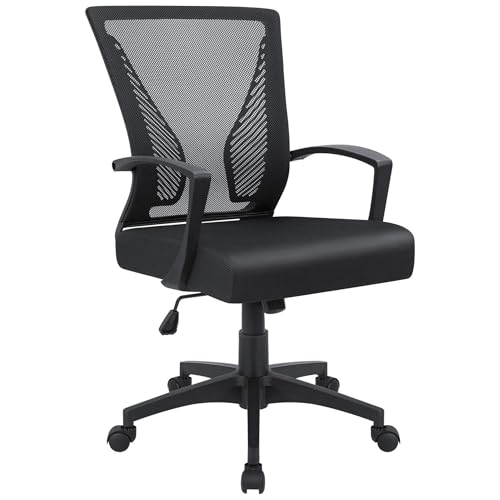
3. Furmax Office Chair — Best Budget
The Furmax is the entry tier done honestly: a mid-back mesh chair with lumbar support, adjustable height, a breathable backrest, 360-degree swivel, and armrests, aimed at home offices, conference rooms, and study desks. There is no headrest and no multi-way armrest ballet — the value proposition is that the fundamentals are present and the mesh back does the cooling job that brings buyers to this category in the first place. For a student desk, a spare-room office, a first apartment, or a household furnishing two workstations at once, the Furmax’s tier is the point. It is also a common bulk buy for small offices for the same reason: simple, consistent, and easy to assemble repeatedly.
Strengths
- Mesh back with lumbar support at the friendliest tier in this roundup
- Adjustable height and 360° swivel cover the daily basics completely
- Straightforward assembly, suited to furnishing multiple desks
Trade-offs
- No headrest; taller sitters get mid-back support only
- Armrests are fixed-position rather than multi-adjustable
- Weight capacity is not stated in the listing title — flagged as not stated here
Spec box
- Back: mesh, mid-back
- Lumbar: support (fixed design)
- Stated capacity: not stated in listing title
- Armrests: fixed, with swivel base
Judge it against its tier, not against the CAPOT: as a breathable, supportive seat for a few hours a day, it is exactly right; as an all-day professional chair, spend up the list.
Best for: students, spare desks, first apartments, and multi-desk furnishing. / Not suited for: ten-hour daily sitters or anyone needing a headrest and high capacity.

4. Sweetcrispy Ergonomic Computer Desk Chair — Best for Small Spaces
The Sweetcrispy solves the small-room problem that defeats most office chairs: its flip-up arms rotate out of the way so the chair slides completely under the desk, returning floor space to the room. Around that trick it is a complete mid-back mesh chair — lumbar support, rolling swivel base, breathable mesh — in a grey colorway that suits bedrooms and study corners better than the standard black. For the enormous population now working from bedroom desks and dining-table offices, the flip-up arm is not a novelty; it is the feature that decides whether the chair lives in the room or colonizes it.
Strengths
- Flip-up arms let the chair tuck fully under the desk — the small-space killer feature
- Mid-back mesh with lumbar support in a room-friendly grey
- Rolling swivel base suited to bedroom and study setups
Trade-offs
- Flip-up arms give up the multi-axis adjustment of fixed ergonomic arms
- Mid-back design: no headrest for lean-back calls
- Weight capacity is not stated in the listing title — flagged as not stated here
Spec box
- Back: mesh, mid-back
- Lumbar: support
- Armrests: flip-up
- Stated capacity: not stated in listing title
- Colorway verified: Gray
Budget-to-mid tier, and the smartest buy in this list for anyone whose office is also their bedroom. Measure your desk’s underside height before ordering — the tuck-under trick needs the chair’s back to clear it too.
Best for: small rooms, bedroom desks, and anyone who needs the chair to disappear after work. / Not suited for: buyers wanting a headrest or fully adjustable armrests.

5. DUMOS Home Office Chair — Best Rocking Value
The DUMOS entry is built around one comfort feature the task-chair crowd forgets: a rocking mode. Its verified title lists an ergonomic mid-back mesh design with lumbar support, height adjustment, fixed armrests, and a 360-degree swivel — plus the ability to rock rather than sit bolt upright or locked. For sitters who think better in motion, take frequent calls, or simply fidget, a gentle rock changes the feel of a long afternoon more than another centimeter of foam does. DUMOS positions this chair across home office, conference, and study use, and the mid-back mesh format keeps it visually light in any of them.
Strengths
- Rocking mode adds movement that fixed task chairs deny
- Mid-back mesh with lumbar support and height adjustment covers the ergonomic basics
- Value tier with a swivel base for home and study use
Trade-offs
- Fixed armrests; no flip-up or multi-axis adjustment
- No headrest, and rocking is a preference — disciplined upright sitters may never use it
- Weight capacity is not stated in the listing title — flagged as not stated here
Spec box
- Back: mesh, mid-back
- Lumbar: support
- Tilt: rocking mode
- Stated capacity: not stated in listing title
Budget-to-mid tier. If you know you are a rocker — the person whose current chair is perpetually tipped back on its mechanism — this is your pick; if you sit still and upright, the SIHOO’s adjustment set serves you better.
Best for: restless sitters, call-heavy work, and value shoppers who want movement. / Not suited for: buyers needing adjustable arms, a headrest, or a stated high capacity.

6. GABRYLLY Ergonomic Office Chair — Best High-Back with Headrest
The GABRYLLY is the tall-back traditionalist: a high-back mesh chair with a headrest, flip-up arms, a 90–120° tilt lock, and a wide cushion, pitched by its maker at big-and-tall buyers as well as anyone who wants full back coverage. The tilt range deserves a precise read: 90° is upright work, 120° is a genuine lean-back for reading and calls, and the lock holds positions between — a more honest range than chairs advertising extreme recline angles nobody uses at a desk. The wide cushion matters for longer sits, spreading contact instead of concentrating it, and the flip-up arms preserve the tuck-under option that high-back chairs usually sacrifice.
Strengths
- High-back mesh with headrest — full coverage for taller torsos
- 90–120° tilt lock covers working and leaning angles honestly
- Wide cushion plus flip-up arms: comfort without losing desk clearance
Trade-offs
- High-back proportions can crowd a small desk nook visually
- Weight capacity figure is not stated in the title despite the big-and-tall positioning — flagged as not stated here; check the listing’s full specs before relying on it
- Armrests flip up but do not offer the CAPOT’s 4D adjustment
Spec box
- Back: mesh, high-back, with headrest
- Tilt: 90–120°, lockable
- Seat: wide cushion
- Armrests: flip-up
- Stated capacity: not stated in listing title
Mid-tier. Buy it for the back coverage and the honest tilt range; verify the capacity on the listing if that number is decisive for you, because we will not invent it here.
Best for: taller sitters who want headrest support and a wide seat. / Not suited for: small nooks, or buyers who need a stated capacity figure in the title itself.
Comparison Table
| Pick | Badge | Key spec | Best for | Link |
|---|---|---|---|---|
| SIHOO M18 | Best Overall | Adjustable lumbar, headrest, stated 330 lb capacity | All-round home office | Check on Amazon |
| CAPOT Ergonomic Mesh Chair | Best Heavy-Duty | Stated 400 lb capacity, 4D flip-up arms, 3-level tilt | Big and tall sitters | Check on Amazon |
| Furmax Office Chair | Best Budget | Mid-back mesh, lumbar support, adjustable height | Students, spare desks | Check on Amazon |
| Sweetcrispy Desk Chair | Best for Small Spaces | Flip-up arms, mid-back mesh, grey | Bedroom desks | Check on Amazon |
| DUMOS Home Office Chair | Best Rocking Value | Rocking mode, mid-back mesh, lumbar support | Restless sitters | Check on Amazon |
| GABRYLLY Ergonomic Chair | Best High-Back with Headrest | High-back mesh, headrest, 90–120° tilt lock | Tall torsos | Check on Amazon |
How to Choose a Mesh Desk Chair
Fit the back to your torso. Mid-back chairs support up to roughly the shoulder blades and suit shorter torsos and smaller desks. High-back chairs with headrests support the full spine line and the head during lean-backs, and suit taller sitters. The honest test is your own seated shoulder height against the chair’s back height in the listing’s dimensions — a headrest that lands at your neck instead of your head is worse than none.
Prioritize lumbar adjustability over lumbar presence. Nearly every chair claims lumbar support; the meaningful question is whether it adjusts. The SIHOO M18’s adjustable lumbar and the CAPOT’s adjustable system can be moved to your back’s curve; fixed supports are a bet that the designer’s average matches your body. If you sit long hours, adjustable lumbar is the feature most worth paying for in this entire category.
Decide the armrest question by your desk. Fixed arms are simplest and sturdiest. Height- and multi-axis-adjustable arms fit the widest range of bodies and desks. Flip-up arms (Sweetcrispy, CAPOT, GABRYLLY) solve the storage problem — the chair tucks under the desk — at the cost of some adjustment range. Measure your desk’s underside clearance before falling for any arm style.
Respect stated capacities — and notice unstated ones. A capacity printed in the listing title (330 lbs SIHOO, 400 lbs CAPOT) is a verifiable commitment. Where capacity is not stated, as with three picks here, check the full listing specifications before buying if the number matters to you, and treat the omission itself as information about the chair’s intended tier.
Seat construction is the quiet variable. Most mesh chairs, including all six here, pair the mesh back with a foam cushion seat. Foam density decides whether month six feels like month one; wide cushions (GABRYLLY) spread load for longer sits. If you specifically want a mesh seat as well, note that none of these six claims one — shop that as a separate, rarer category rather than assuming.
Wheels and floors. Standard nylon casters suit carpet; on hard floors they are louder and can mark. PU wheels (CAPOT) are the hard-floor-friendly upgrade. Whatever chair you choose, a chair mat on soft carpet reduces rolling resistance and floor wear — but buy the chair first and the mat second, sized to the real footprint.
How to Assemble and Set Up a Mesh Desk Chair
Step 1: Assemble on carpet or a blanket to protect both the chair’s finish and your floor, and lay out every bolt before starting — flat-pack chairs reward a full inventory check before the first screw turns. Step 2: Attach the casters and gas lift first, then the seat, then the back, leaving the back and armrest bolts finger-tight until everything is aligned; mesh frames align best when the final tightening happens as one pass, in a cross pattern, once the chair sits square. Step 3: Set seat height so your feet rest flat on the floor with thighs roughly parallel to it; if your feet dangle, the desk is too high for the chair and a footrest is the correct fix, not a lower chair that wrecks your desk posture. Step 4: Position the lumbar support into the small of your back — it should fill the curve, not push you forward — and spend a day before judging; small adjustments over the first week find the real setting. Step 5: Set armrests so your forearms rest level with elbows near 90 degrees and shoulders relaxed; arms that shrug your shoulders are worse than no arms. Step 6: Set the tilt tension so the backrest supports a lean without either dumping you backward or requiring a leg press to move, and lock the tilt for focused typing if that is your preference. Step 7: Re-tighten every bolt after two to four weeks. New chair hardware settles; the five-minute re-torque is the difference between a chair that feels solid in year two and one that creaks by Christmas.
Common Buying Mistakes
Buying a chair mat or cushion and calling it a chair. Search results for this search mix accessories with furniture. Everything in this guide is a complete chair; check that what you are ordering has a back, a base, and a gas lift.
Assuming “ergonomic” on the box means adjustable. The word is unregulated. Read for the specific adjustments — lumbar movement, armrest axes, tilt lock — as this guide’s spec boxes do.
Ignoring the capacity question. Chairs fail at their limits, and an unstated capacity is not an unlimited one. Bigger sitters should buy from the picks that publish their numbers.
Choosing a headrest chair for a short torso. A headrest positioned at the neck pushes the head forward and ruins the chair’s comfort. Match back height to your seated measurements.
Judging by the first sit. A chair’s foam and your posture adapt over days. Use the return window deliberately: assemble carefully, keep the packaging, and evaluate across a full work week before deciding.
Never re-tightening the bolts. Most “cheap chair” creaks and wobbles at month three are loose hardware, not failed parts. The re-torque habit in the setup section prevents the majority of them.
Final Recommendation
The SIHOO M18 is the default buy: adjustable lumbar, a headrest, a stated 330 lb capacity, and a complete adjustment set at a mid tier — check the current price on Amazon. Bigger and taller sitters should go straight to the CAPOT, whose stated 400 lb capacity and 4D flip-up arms are the strongest verified spec in this roundup — check the current price on Amazon. On a budget, the Furmax covers the mesh basics honestly, and in a small room the Sweetcrispy’s flip-up arms are worth more than any other single feature — check the current price on Amazon. Compare against our sibling guides before you decide: Best Desk Chairs Around 300, Best Desk Chairs Cool Back, Best Desk Chairs For Extended Use, and Best Desk Chairs With Headrest.
Fitting a Mesh Chair to Your Body: A Measurement Guide
Ergonomic marketing collapses into four measurements, and taking them before you order converts chair shopping from gambling into fitting. Seat height range vs. your lower leg: sit with feet flat and measure from the floor to the crease behind your knee; the chair’s seat, at its working height, should sit at or just below that number so your feet rest flat without pressure under the thighs. Every pick here adjusts in height, but their ranges differ — petite and tall sitters should confirm the listing’s range covers their measurement with room to spare. Seat depth vs. your thigh: you want two to three fingers of clearance between the seat’s front edge and the back of your knee. A seat that is too deep pushes you into a slouch or cuts circulation; too shallow leaves your thighs unsupported. Wide cushions like the GABRYLLY’s add comfort but often add depth too — another reason tall and petite sitters are different markets. Back height vs. your torso: measure from your seat surface to the top of your shoulders. Mid-back chairs support to the shoulder blades — enough for upright desk work — while high-back models with headrests (SIHOO, CAPOT, GABRYLLY) support the head only if the headrest lands behind your skull, not your neck; a headrest at neck height is an anti-feature that pushes the head forward. Armrest height vs. your desk: your forearms should rest level with elbows near a right angle and shoulders dropped, and the whole chair — arms included — should roll under your desk at day’s end. Flip-up arms delete this measurement anxiety entirely, which is their underrated ergonomic virtue in small rooms. Spend ten minutes with a tape measure and these four numbers, and the six reviews above sort themselves: most readers will find exactly two chairs that fit every measurement, and choosing between those two is a matter of budget and taste, as it should be.
Mesh Chair Ownership: Floors, Casters, and Keeping the Chair Alive
A desk chair is a five-to-ten-year object, and its ownership story is written by small habits. Floors first: standard nylon casters are designed for carpet; on hardwood and laminate they roll loud, track debris into the finish, and can wear a visible arc in front of a desk over years. The fixes are PU wheels (fitted to the CAPOT in this guide, and a common aftermarket swap elsewhere) or a chair mat sized generously beyond the chair’s rolling range. On carpet, the mat question reverses — deep pile strangles caster movement and makes any chair feel broken, and a rigid mat restores the glide the chair was designed with. Mesh care is simpler than upholstery care and different in kind: vacuum the back and seat with a brush attachment monthly to keep dust out of the weave, spot-clean spills immediately because mesh passes liquid through to the foam beneath, and keep the chair out of prolonged direct sun, which ages synthetic mesh fibers. The gas lift is the component with a lifespan: a chair that slowly sinks overnight is announcing a tired cylinder, a replaceable part on most designs, not a dead chair. Hardware discipline returns from the setup section because it matters most: bolts loosen with use, especially under armrests and the back bracket, and a quarterly five-minute pass with the hex key keeps the chair silent and solid. Foam seats — fitted to every pick here — compress with years of sitting; rotating where you sit is impossible in one chair, but standing for calls and varying your posture through the day spreads the wear and is better for the sitter as well as the seat. Treat the chair as the long-term equipment it is, and even the budget Furmax in this guide will outserve a neglected chair three times its price.
The Desk Around the Chair: Heights, Distances, and the Rest of the Setup
A chair can only do its half of the ergonomic bargain; the desk does the other half, and mismatches between them are behind many “uncomfortable chair” verdicts that the chair did not earn. Desk height is the fixed variable in most homes — a standard desk surface sits around 28 to 30 inches — and the chair’s job is to place your elbows at that height with feet flat. If the chair must rise so high for the desk that your feet dangle, the correct purchase is a footrest, not a different chair; dangling feet undo every lumbar feature downstream. If the desk is low — a dining table pressed into service — expect the chair to sit low and the armrests to fight the tabletop’s edge, which is the flip-up arm’s home turf. Monitor position completes the chain the chair starts: the screen’s top third at eye level, roughly an arm’s length away, so your head balances over the spine the chair is supporting. A headrest chair (SIHOO, CAPOT, GABRYLLY) pays off precisely here — lean-back moments for reading and calls only relax you if the screen and the headrest agree about where your head goes. Keyboard and mouse belong at elbow height with wrists floating or lightly resting; a tray can rescue a too-high desk more cheaply than any chair upgrade. Light and heat are the mesh-specific footnote: mesh’s airflow advantage is real in a sun-warmed room or a small office heated by computers, and irrelevant in a cold basement office, where the same breathability reads as draftiness and a cushion-backed chair might serve better — context this guide flags rather than hiding, because mesh is the keyword, not a religion. Set the room up honestly, fit the chair by the measurement section above, give the combination a week before judging, and adjust one variable at a time: that sequence resolves nearly every comfort complaint that survives the first assembly.
Troubleshooting Mesh Chairs: Squeaks, Sinking, and Wobble
Most mesh chair complaints trace to five fixable causes, and working this list rescues more chairs than returns departments ever see. The chair slowly sinks: the gas lift cylinder is tiring — confirm by sitting and marking the height morning and evening; a confirmed sinker needs a replacement cylinder, a standard part on most designs in this guide’s class, not a new chair. Creaking when you lean: almost always hardware, not structure — work through the back bracket, armrest, and mechanism bolts with the hex key, tightening in a cross pattern, and add a drop of thread-locking compound to repeat offenders. A wobble that appeared over months: check caster stems first (one bent or debris-choked caster rocks the whole chair), then the five-star base’s bolts, then whether the floor itself — a rug edge under one caster — is the culprit. Mesh that feels slack: mesh tension is set at the factory and is not user-adjustable; genuine sag within the warranty window is a warranty conversation, and the prevention is respecting the chair’s capacity class rather than treating stated limits as suggestions. Armrests that loosen weekly: the bolts are likely being asked to carry lifting loads — many sitters haul themselves up by the arms, which armrest hardware tolerates poorly; retighten, add thread-locker, and break the habit. Run this list before judging any pick in this guide, because the chair you already own may be one hex key away from feeling new.
Furnishing for Two: Partner Desks and Shared Home Offices
Households increasingly buy desk chairs in pairs, and the pair changes the calculus in ways single-chair reviews miss. Match the chairs to the sitters, not to each other: two identical chairs suit two similar bodies, but a tall-and-petite pair is better served by different picks from this guide — say the GABRYLLY’s high back for one desk and the Sweetcrispy’s compact fit for the other — even at the cost of visual symmetry. Exploit the tier ladder: the partner who sits ten hours inherits the SIHOO or CAPOT; the partner who sits two inherits the Furmax or DUMOS, and the household’s total spend lands lower than two mid-tier compromises that serve neither sitter well. Plan the floor as one system: two chairs double the caster traffic, so the mat-or-PU-wheels decision from the ownership section matters twice as much, and matching that decision across both chairs keeps the room’s acoustics and floor wear uniform. Buy once, together, when you can: colorways and model revisions drift between production runs, and a pair bought in one order matches in shade and hardware in a way two orders a year apart may not. Finally, keep the spare-parts channel shared: a household running two chairs from this guide’s class benefits from one set of spare casters and one hex key in the desk drawer — small logistics, but they are the difference between a five-year chair fleet and a slow drift back to the dining chairs.
Buying a Mesh Chair Online Without Sitting in It
Most desk chairs are now bought unsat-in, and the risk is manageable if you treat the purchase as a fitting exercise with a return policy as the safety net. Measure first, using this guide’s fitting section: lower-leg length, thigh length, seated shoulder height, and desk underside clearance eliminate most bad fits before money moves — a chair whose published ranges do not cover your four numbers is not a gamble, it is a known mismatch. Weight the stated specs over the adjectives: a published capacity (330 lbs on the SIHOO, 400 lbs on the CAPOT), a published tilt range (GABRYLLY’s 90–120°), and named adjustment axes are commitments; “ergonomic” and “executive” are weather reports. Where a spec is not stated — flagged honestly in three of this guide’s spec boxes — decide whether that unknown is one you can afford. Use the return window as a trial, not a formality: assemble the chair without destroying packaging, work in it for several full days rather than several minutes, and run the fitting checks again at day five, because foam and posture both settle. Photograph the unboxing if anything looks transit-damaged, and keep hardware bags until the trial ends. Bought this way, an online chair purchase carries less real risk than a showroom sit, which tests a chair for ninety seconds under sales-floor lighting with your posture on its best behavior — the tape measure and the week-long trial are the more honest fitting room.
One Last Check Before You Order
Five questions, answered honestly, close the purchase. One: do the chair’s published ranges — seat height, back height — cover your four body measurements from the fitting section? Two: if capacity matters to you, did you choose a pick that states it (SIHOO at 330 lbs, CAPOT at 400 lbs), or consciously accept checking an unstated figure on the full listing? Three: do the armrests match your desk — flip-up for tuck-under storage, multi-axis for all-day adjustment, fixed for simplicity? Four: have you planned the floor — PU wheels or a mat for hard floors, a rigid mat for deep carpet? Five: is the packaging staying intact through a several-day home trial, so the return window remains a real option? A chair chosen through those five gates rarely comes back.
Frequently Asked Questions
Are mesh desk chairs better than foam or leather chairs?
Mesh wins on airflow and longevity of appearance: a mesh back breathes through long sits and cannot crack or peel the way bonded leather does. Foam-and-upholstery chairs can feel plusher in the first minutes and warmer in cold rooms. For all-day desk work in normal indoor temperatures, most people find mesh the more comfortable long-session material — which is why it dominates this category.
What weight capacity should I look for in a mesh chair?
Choose a chair whose stated capacity comfortably exceeds your weight, and prefer chairs that publish the figure. In this guide, the SIHOO M18 states 330 lbs and the CAPOT states 400 lbs; three picks do not state a capacity in their titles, which we flag in their spec boxes — check those listings’ full specifications if capacity is decisive for you.
Do I need adjustable lumbar support?
If you sit more than a few hours a day, adjustable lumbar is the single feature most worth having, because it lets the chair match your back rather than the reverse. Fixed lumbar designs can still be comfortable — three picks here use them well — but they are a fit gamble that adjustable designs remove.
Mid-back or high-back: which is right for me?
Match the back to your torso. Mid-back chairs (Furmax, Sweetcrispy, DUMOS here) support to about the shoulder blades and suit shorter torsos and compact desks. High-back chairs with headrests (SIHOO M18, CAPOT, GABRYLLY) support the full back and head and suit taller sitters and lean-back work. Measure your seated shoulder height against the listing’s back height if you are between sizes.
How long does it take to assemble a mesh desk chair?
Typically well under an hour with the included tool, following the sequence in our setup section: casters and lift first, then seat and back, final tightening as one aligned pass. The step owners skip — re-tightening all bolts after two to four weeks — is the one that most affects how solid the chair feels long-term.
Will a mesh chair work on carpet?
Yes, with standard casters; rolling resistance is simply higher on deep pile, and a chair mat restores easy movement while protecting the carpet. On hard floors, PU wheels like the CAPOT’s roll quieter and mark less than hard nylon casters.
How long should a mesh desk chair last?
With the ownership habits in this guide — bolt re-tightening, mesh vacuuming, capacity respected — a chair in this class should serve five years and well beyond; the budget picks justify themselves if they deliver several solid years, and the feature picks are built to be re-tightened, re-wheeled, and re-gassed rather than replaced. The earliest failure is almost never the mesh: it is loose hardware ignored, a tired gas lift, or casters worn on the wrong floor, all of which the troubleshooting section addresses before replacement enters the conversation.
Is a mesh chair a good choice for a standing-desk setup?
Yes, with one adjustment: at a sit-stand desk the chair works fewer hours but gets moved more, so casters and floor pairing matter even more than usual, and a chair that tucks fully under the desk — the flip-up-arm picks in this guide — keeps the standing zone clear. The fitting rules do not change; a chair fitted honestly for sitting remains fitted when it is used for half the day instead of all of it.


