Disclosure: airfryerkitchensupply.com is reader-supported. When you buy through links on our site, we may earn an affiliate commission at no extra cost to you.
Where to buy
Every pick below was verified against Amazon’s catalog before it earned a link, so the names, sizes and constructions quoted in this guide match real, current listings. If a slipper could not be confirmed, it does not appear here with a link.
- Orthofeet Asheville Orthopedic Men House Slippers — Best Overall: Check the current price on Amazon
- FitVille Extra Wide Men Slippers — Best for Wide Feet: Check the current price on Amazon
- VALSOLE Orthopedic Slippers for Women and Men — Best for Heavier Wearers: Check the current price on Amazon
- KuaiLu Men’s Slippers Orthopedic Arch Support Suede Plush Clogs — Best Plush Comfort: Check the current price on Amazon
- ONCAI Men’s Slippers Arch Support Bedroom House Shoes — Best Warm Everyday Pick: Check the current price on Amazon
- Orthofeet Tuscany Orthopedic Men’s Moccasin Slippers — Best Moccasin Style: Check the current price on Amazon
Sizes and colorways rotate on these listings, and several of these models are sold in half-size or wide variants on the same page. Pick your size on the listing itself rather than assuming the size named in a title is the only option.
Finding the best men’s house slippers for flat feet is mostly a search for one thing most slippers do not have: a footbed with actual shape. The typical men’s house slipper is a flat slab of memory foam stitched into a soft upper. It feels wonderful for the first ten minutes and then compresses into the same flat surface your feet were trying to escape, which is why men with low arches so often end up padding around the house in outdoor shoes instead. A supportive house slipper works differently. It keeps a raised, contoured arch under the midfoot, a defined heel cup that stops the foot rolling inward, and enough firmness in the sole that the structure is still there at the end of the day, not just at the start of it.
The six picks in this guide were chosen for exactly that structure, and every one of them was confirmed as a real men’s house slipper listing whose title or verified details describe arch support, an orthopedic or orthotic-style footbed, or an explicit flat-feet fit. This is a comfort guide, not a medical one: a supportive slipper can make standing on hard kitchen floors and long evenings at home noticeably more comfortable, but no house slipper diagnoses, treats or corrects a foot condition, and persistent foot pain belongs in a conversation with a clinician, not in a shopping cart. Within that honest frame, the differences between these six are real — hands-free slip-on designs, adjustable straps, extra-wide fits, plush winter linings and firmer orthopedic footbeds — and the right choice depends on how you actually move around your home.
In this guide
Quick Picks: The Best men’s house slippers for flat feet
Short on time? These are the six supportive men’s house slippers that survived verification, in the order most buyers with flat feet should consider them.
| Pick | Badge | Key spec | Best for |
|---|---|---|---|
| Orthofeet Asheville Orthopedic Men House Slippers | Best Overall | Hands-free slip-on, adjustable strap, arch support, wide toe box | all-day home wear on hard floors |
| FitVille Extra Wide Men Slippers | Best for Wide Feet | Extra-wide fit, slip-on, non-slip sole, stated flat-feet design | wide feet that standard slippers squeeze |
| VALSOLE Orthopedic Slippers for Women and Men | Best for Heavier Wearers | Unisex orthopedic design, marketed for 220+ lb wearers, flat-feet positioning | heavier men who flatten ordinary foam footbeds |
| KuaiLu Men’s Slippers Orthopedic Arch Support Suede Plush Clogs | Best Plush Comfort | Suede upper, plush lining, orthopedic arch support, clog entry | cold floors and wearers who want warmth with support |
| ONCAI Men’s Slippers Arch Support Bedroom House Shoes | Best Warm Everyday Pick | Memory foam with arch support, warm lining, indoor/outdoor sole | everyday winter wear around the house and yard |
| Orthofeet Tuscany Orthopedic Men’s Moccasin Slippers | Best Moccasin Style | Moccasin styling, faux fur lining, supportive arch-support footbed | men who want support in a classic moccasin look |
Two things to notice in the table. First, every pick here is a closed or semi-closed house slipper — open slides and sandals were excluded on purpose, because a heel that can slide sideways off the footbed wastes the arch support you are paying for. Second, the widest and most adjustable fits sit at the top of the list, because men with flat feet very often also have wider feet, and a supportive footbed in a too-narrow upper is a compromise, not a solution.
How These Picks Were Chosen
The starting pool for this guide was every men’s house slipper listing Amazon listing data returned for arch-support, orthopedic, orthotic and flat-feet searches — a pool that includes a great deal of marketing noise. The first filter was structural honesty: the listing had to describe a contoured or supportive footbed in its own verified title or details, not merely use the word ‘comfort’. Pure flat memory-foam slippers, however plush, were cut at this stage, because unstructured foam is the opposite of what a low arch needs at home.
The second filter was category discipline. House slippers only: ballet-style flats, dance shoes, sandals, slides and flip-flops were excluded even when their listings mentioned arch support, because an open shoe cannot hold the heel in the cup that makes support work. Massage shoes and anything making post-surgery or treatment claims were also excluded — this guide stays inside comfort and everyday wellness, and no pick here is presented as a medical device.
The third filter was fit range. Men shopping for flat-feet slippers disproportionately need wide widths, adjustable uppers or half sizes, so listings offering wide variants, adjustable straps or a roomy toe box scored ahead of equally supportive models sold in a single standard width. Each surviving listing was then deduplicated, so size and color variants of one product count as a single pick rather than padding the list.
Finally, every pick was cross-checked as a complete, finished slipper — no replacement insoles, no orthotic inserts sold separately, and no accessories standing in for the shoe itself. An insert can be a fine purchase, but it is not a house slipper, and it does not belong in this ranking. What remains is six genuinely different answers to the same problem, from a premium orthopedic moccasin to a value-priced unisex clog.
The 6 Best men’s house slippers for flat feet

1. Orthofeet Asheville Orthopedic Men House Slippers — Best Overall
The Asheville is the pick that treats a house slipper like real footwear, and for men with flat feet that is exactly the point. The verified listing describes a hands-free, adjustable slip-on design with faux fur lining, a supportive footbed with arch support, comfortable cushioning and a wide toe box, in brown. The hands-free entry matters more than it sounds: you step in without bending and crushing the heel counter, so the structure that supports your arch survives months of daily use instead of being folded flat in the first week.
Strengths
- Contoured supportive footbed with stated arch support, not a flat foam slab
- Adjustable strap lets you dial the fit as feet swell through the day
- Wide toe box gives low-arch feet room to spread naturally instead of being squeezed
Trade-offs
- The structured build feels firmer at first than plush foam slippers
- Faux fur lining runs warm outside the colder months
- It looks like a shoe, not a lounge slipper, which not everyone wants at home
| Style | Slip-on house slipper with heel |
|---|---|
| Upper | Not stated in Amazon title |
| Lining | Faux fur (per Amazon title) |
| Footbed | Supportive with arch support (per Amazon title) |
| Fit notes | Adjustable; wide toe box; wide variant listed separately |
What separates the Asheville from the rest of this list is how many of the usual flat-feet compromises it refuses to make. The heel is enclosed, so the foot stays centered over the arch contour instead of drifting off it. The strap adjusts, so the same pair works with thin socks in the morning and bare, end-of-day feet at night. And the toe box is wide, which matters because feet with low arches tend to pronate and splay under load; cramming them into a narrow moccasin toe undoes the benefit of the footbed underneath.
It is also the most honest pick here about what support feels like. A contoured footbed does not disappear under your foot the way memory foam does — you can feel the arch, especially in the first few days. Most wearers read that as the slipper doing its job; if you know you prefer a slipper you cannot feel at all, the plusher KuaiLu or ONCAI picks below will suit you better. For standing-heavy home routines — cooking, workshop time, working from a standing desk — the Asheville is the one we would buy first.
One more practical note on the Asheville: because the entry is hands-free and the strap does the fitting, it is the easiest pick here for men with limited mobility or a bad back — no bending, no finger-pulling a collapsed heel into place. That convenience also protects the heel counter, the part of a supportive slipper that usually dies first, which is a quiet durability advantage over every pull-on rival in this guide.
Best for: all-day home wear on hard floors / Not suited for: buyers who want a backless mule

2. FitVille Extra Wide Men Slippers — Best for Wide Feet
FitVille built its name on wide footwear, and this slip-on house slipper is the verified listing that names flat feet directly in its title, alongside an extra-wide fit, a non-slip sole and an orthopedic designation. If your history with house slippers is that the supportive ones are always too narrow and the roomy ones are always flat, this is the pick designed to end that trade.
Strengths
- Extra-wide last is the roomiest fit in this guide
- Listing explicitly positions the design for flat feet
- Non-slip sole suits hard kitchen, tile and wood floors
Trade-offs
- Extra-wide fit will feel sloppy on a standard-width foot
- Winter-weight build is more than you need in a warm climate
- Styling is functional rather than refined
| Style | Slip-on house slipper |
|---|---|
| Fit | Extra wide (per Amazon title) |
| Sole | Non-slip (per Amazon title) |
| Footbed | Orthopedic positioning (per Amazon title); detailed construction not stated |
| Use | Indoor and outdoor (per Amazon title) |
Width is the most under-discussed variable in supportive slippers. Arch support is a shape, and a shape only works when the foot sits on it in the right place. A wide foot forced into a medium last rolls off the inner edge of the footbed, which both loses the support and creates a new pressure point along the outside of the foot. The FitVille avoids that failure mode by starting from the last outward: the footbed is wide enough for the foot to actually rest on it.
The trade is precision. A very roomy slipper will never feel as locked-in as the adjustable Orthofeet Asheville, and on stairs a loose heel deserves respect — walk a new pair around the house on day one and exchange the size if your heel lifts clear of the sole with every step. For men whose flat feet come with genuine width, though, this is the safest first purchase in the guide, and the non-slip sole makes it the practical choice for homes that mix carpet with a lot of bare hard flooring.
Sizing strategy for the FitVille: if you are between sizes, take the larger one. An extra-wide last already gives the forefoot room, and a structured footbed forgives a little extra length far more readily than a little too little — a heel that lands on the back edge of the cup is the one fit failure this design cannot adjust away. Wear them on your hardest floor for the first trial, since that is where both the support and the non-slip sole have to prove themselves.
Best for: wide feet that standard slippers squeeze / Not suited for: narrow feet, which will swim in the fit
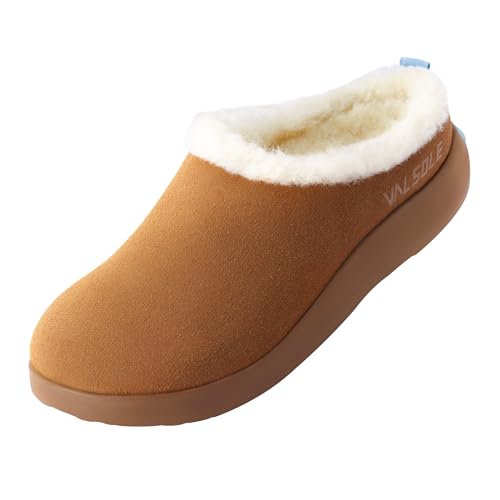
3. VALSOLE Orthopedic Slippers for Women and Men — Best for Heavier Wearers
The VALSOLE listing is unisex and unusually direct: it describes orthopedic house shoes with arch support, positions them for flat feet, and markets them for wearers of 220 pounds and up. That last detail is the reason it earns a slot here. Body weight is what crushes a weak footbed, and a slipper designed and sold for heavier wearers starts from a firmer, more load-tolerant structure than one designed for the average foot.
Strengths
- Firm, load-tolerant structure aimed at heavier wearers
- Arch support and flat-feet positioning stated in the listing
- Unisex sizing gives more size options than most men’s-only lines
Trade-offs
- Unisex last will not fit every men’s foot shape equally well
- Firmer footbed feels less plush on first wear
- Check the size chart carefully — unisex conversions trip people up
| Style | House slipper / house shoe |
|---|---|
| Fit | Unisex sizing (per Amazon title) |
| Footbed | Orthopedic with arch support (per Amazon title) |
| Load positioning | Marketed for 220+ lbs (per Amazon title) |
| Use | Indoor comfort wear |
Every foam footbed has a load at which it stops being a shape and becomes a pancake, and heavier men reach that load in ordinary slippers within weeks. The result is a slipper that still looks supportive on the shelf but behaves like a flat shoe in use — the worst of both worlds for a low arch. A model built for higher loads uses denser structure that keeps its contour under pressure, which is why this unisex pick outperforms several men’s-branded alternatives for the buyers it suits.
Read the sizing carefully before ordering. Unisex listings typically key sizes to one scale and convert to the other, and a half-size error in a structured slipper matters more than in a soft one, because the arch contour has to land under your arch, not in front of it. When the size is right, this is the value end of genuine support: less refined than the Orthofeet picks, more durable under load than the plush picks, and honest about who it is built for.
The VALSOLE also deserves a word about value. It sits at the accessible end of this guide’s quality tiers, and for a first experiment with supportive slippers that matters: you can learn whether a firm contoured footbed suits your feet without committing to a premium orthopedic price. If the experiment succeeds and you later upgrade, the VALSOLE still earns its keep as the pair that lives by the back door.
Best for: heavier men who flatten ordinary foam footbeds / Not suited for: buyers who want a men’s-specific last

4. KuaiLu Men’s Slippers Orthopedic Arch Support Suede Plush Clogs — Best Plush Comfort
The KuaiLu is the comfort-first entry in this guide: a men’s clog-style house slipper in suede with a fluffy plush lining, built over an orthopedic arch-support footbed. Its listing leans on comfort language, and that is the right way to read it — this is the pick for men who want the warmth and softness of a traditional winter slipper without giving up the contoured footbed entirely.
Strengths
- Suede-and-plush build is the warmest, coziest upper here
- Clog entry is effortless for quick on-and-off wear
- Orthopedic arch-support footbed under the plush lining
Trade-offs
- Backless clog holds the heel less securely than full-heel picks
- Plush lining is hot in summer and slow to dry after washing
- Support is gentler than the firm Orthofeet footbeds
| Style | Clog / mule house slipper |
|---|---|
| Upper | Suede (per Amazon title) |
| Lining | Plush (per Amazon title) |
| Footbed | Orthopedic arch support (per Amazon title) |
| Use | Indoor home wear |
There is a real tension in this category between support and coziness, and the KuaiLu is the pick that refuses to surrender the second to get the first. The plush lining and suede upper make it the slipper you will actually reach for on a cold morning, and a supportive slipper that stays in the closet supports nothing. Under the lining, the contoured footbed gives the arch something to rest against that a pure plush slipper never provides.
Be honest with yourself about the clog shape, though. With no heel enclosure, your foot does more work to keep the slipper on, and on stairs or during quick direction changes the heel can drift. Men whose flat feet come with balance concerns should take the enclosed Orthofeet or FitVille picks instead. As a stationary-comfort slipper — reading chair, desk, evening television, short trips to the kitchen — the KuaiLu is the most pleasurable wear in this guide.
A care note specific to the KuaiLu: plush linings absorb moisture and hold odor more readily than smooth ones, so give this pair a full day of rest between heavy wears if you can, and air it lining-out overnight. Suede uppers should be kept away from kitchen splashes and wet floors — this is a dry, warm, indoor slipper, and treating it as one doubles its useful life.
Best for: cold floors and wearers who want warmth with support / Not suited for: warm climates or anyone who overheats in lined slippers

5. ONCAI Men’s Slippers Arch Support Bedroom House Shoes — Best Warm Everyday Pick
The ONCAI pairs the two things men usually have to choose between: a memory foam layer for immediate softness and an arch-support structure underneath it, in a warm, cozy bedroom slipper with an indoor/outdoor sole. Its verified listing describes arch support and memory foam together, in black, sized as a men’s house shoe for winter wear at home.
Strengths
- Memory foam top layer softens the feel of the support beneath
- Warm lining suits cold-season, cold-floor homes
- Indoor/outdoor sole handles mail runs and patio trips
Trade-offs
- Foam layer will compress over time faster than the firm picks
- Warm build is seasonal for many homes
- Support feel is moderate, not corrective in character
| Style | Bedroom house slipper |
|---|---|
| Footbed | Memory foam with arch support (per Amazon title) |
| Lining | Warm, cozy (per Amazon title) |
| Sole | Indoor/outdoor (per Amazon title) |
| Color in listing | Black |
Think of the ONCAI as the compromise candidate, in the good sense. The full orthopedic picks ask you to accept a firm, noticeable footbed; the pure plush picks ask you to give up support. This design stacks a cushioning layer over a shaped base, so the first impression is soft while the arch still meets a contour as the foam settles. For men trying supportive slippers for the first time — unsure whether they will tolerate a firm footbed — that staged feel is often the difference between keeping the pair and returning it.
The honest limitation is longevity of feel. The foam layer is the wear item here, and after months of daily use the slipper will feel progressively more like its firm base and less like the plush shoe that arrived. That is not a defect so much as the physics of foam, but it means the ONCAI works best as an everyday winter slipper you expect to refresh every season or two, rather than as a multi-year investment piece like the Orthofeet moccasin below.
For the ONCAI, manage the foam honestly: rotate it with another pair if you wear slippers all day every day, because a rest day lets the memory foam recover some of its loft. That single habit meaningfully extends the period during which the slipper feels like the product you bought rather than the firm base underneath it — and when the foam finally does tire, the arch structure beneath still leaves you with a serviceable supportive slipper.
Best for: everyday winter wear around the house and yard / Not suited for: buyers who dislike any memory foam in the footbed

6. Orthofeet Tuscany Orthopedic Men’s Moccasin Slippers — Best Moccasin Style
The Tuscany takes the same orthopedic approach as the Asheville and wraps it in a traditional men’s moccasin silhouette, with a faux fur lining and a supportive, arch-support footbed, in brown. If the Asheville’s hands-free shoe styling is more than you want from a house slipper, the Tuscany is the same philosophy in the shape men have worn at home for decades.
Strengths
- Classic moccasin looks with a genuinely supportive footbed
- Faux fur lining adds warmth for cold floors
- Orthofeet’s structured build outlasts soft foam slippers
Trade-offs
- No adjustable strap — fit depends on choosing the right size
- Faux fur lining is warm for year-round use
- Moccasin toe is roomier than a snug slipper, looser than the Asheville
| Style | Moccasin house slipper |
|---|---|
| Lining | Faux fur (per Amazon title) |
| Footbed | Supportive with arch support (per Amazon title) |
| Color in listing | Brown |
| Fit notes | Fixed fit; no adjustable strap stated |
Moccasins are where supportive design usually goes to die — the classic construction is a soft leather bag around a flat insole. The Tuscany keeps the silhouette and replaces the substance: the footbed carries the arch contour, the lining adds the warmth, and the result is a slipper that looks like the one your father wore while behaving like a modern supportive shoe. For men who resist orthopedic-looking footwear, that disguise has genuine value, because the best slipper is the one that gets worn.
Choosing between the two Orthofeet picks is simple. Take the Asheville if you want adjustment, hands-free entry and the most secure heel. Take the Tuscany if you prefer the moccasin shape and a simpler, pull-on fit, and accept that sizing has to be right the first time since there is no strap to forgive an error. Either way you are getting the firmest, most structured support in this guide, and the pair most likely to still feel supportive a year from now.
The Tuscany rewards a particular kind of buyer: the man who has worn moccasins for years, likes everything about them except how his feet feel by evening, and does not want to change the ritual — just the result. If that is you, do not overthink the Asheville’s extra features. The familiar shape you will wear every single day beats the technically superior slipper that feels like a costume.
Best for: men who want support in a classic moccasin look / Not suited for: buyers who need an adjustable fit
Comparison Table
The comparison table compresses the decision into the four variables that actually separate these slippers: how the support is built, how the fit is achieved, and what each design quietly asks you to give up.
| Pick | Badge | Key spec | Best for |
|---|---|---|---|
| Orthofeet Asheville Orthopedic Men House Slippers | Best Overall | Hands-free slip-on, adjustable strap, arch support, wide toe box | all-day home wear on hard floors |
| FitVille Extra Wide Men Slippers | Best for Wide Feet | Extra-wide fit, slip-on, non-slip sole, stated flat-feet design | wide feet that standard slippers squeeze |
| VALSOLE Orthopedic Slippers for Women and Men | Best for Heavier Wearers | Unisex orthopedic design, marketed for 220+ lb wearers, flat-feet positioning | heavier men who flatten ordinary foam footbeds |
| KuaiLu Men’s Slippers Orthopedic Arch Support Suede Plush Clogs | Best Plush Comfort | Suede upper, plush lining, orthopedic arch support, clog entry | cold floors and wearers who want warmth with support |
| ONCAI Men’s Slippers Arch Support Bedroom House Shoes | Best Warm Everyday Pick | Memory foam with arch support, warm lining, indoor/outdoor sole | everyday winter wear around the house and yard |
| Orthofeet Tuscany Orthopedic Men’s Moccasin Slippers | Best Moccasin Style | Moccasin styling, faux fur lining, supportive arch-support footbed | men who want support in a classic moccasin look |
Notice what is not in the table: softness. Every one of these feels comfortable in the first minute. The differences that matter at hour six — heel enclosure, width, adjustability and how the footbed behaves under your full weight — are the ones listed here, and they are the ones worth paying for.
How to Choose Men’s House Slippers for Flat Feet
Start with the footbed, because everything else is decoration. Turn the slipper over in your mind and ask what your arch will actually rest on. A supportive slipper has a visible, molded rise under the midfoot and a cupped heel; a slipper whose insole is flat from heel to toe will feel flat no matter how thick its foam is. Thickness is not support — a deep slab of soft foam compresses to nothing under load, while a thinner contoured footbed keeps its shape. When a listing cannot describe its footbed shape at all, assume there is no shape to describe.
Next, match the enclosure to your feet. A defined heel — full slip-ons like the Orthofeet and FitVille picks — keeps the foot centered on the arch contour, which is where support either works or does not. Backless clogs like the KuaiLu are easier to live with minute-to-minute and are fine for mostly stationary wear, but the heel drifts, and a drifted heel is an unsupported arch. If you do real mileage at home — cooking, cleaning, stairs, a workshop — enclose the heel.
Then be honest about width and volume. Low arches and width travel together often enough that you should check for a wide variant before ordering any supportive slipper, and prefer adjustable straps or laces when your feet swell noticeably between morning and evening. The arch contour has a correct address on your foot; a slipper that is too narrow, too wide or a half size off delivers the support to the wrong address.
- Contoured footbed with a real arch rise and heel cup — non-negotiable
- Enclosed heel for active home wear; clog only for mostly stationary use
- Wide or adjustable fit if your feet are wide or swell during the day
- Non-slip outsole if your home is mostly hard flooring
- Lining matched to your climate — faux fur and plush are winter tools
- A return-friendly first order: structured slippers must be sized precisely
Finally, set expectations correctly. A supportive house slipper is a comfort purchase: it gives a low arch something structured to rest on during the many hours you spend barefoot-equivalent at home, and for many men that is the difference between feet that ache by dinner and feet that do not. It is not a medical device, it does not rebuild an arch, and it is not a substitute for assessment if you have persistent pain, swelling or numbness. Buy it as the most comfortable version of your home hours, and it will not disappoint you.
Sizing and Fit: Getting the Arch in the Right Place
Supportive slippers punish sizing errors that soft slippers forgive. In a plush foam slipper, a half size too big means a slightly sloppy shoe; in a contoured slipper, it means the arch rise sits ahead of your arch and presses into the midfoot like a stone in your shoe. Order your true size first, stand in the slipper with your full weight, and check three things: your heel sits inside the heel cup rather than on its back edge, the arch rise meets the hollow of your foot rather than your heel or forefoot, and your toes can spread without pressing the front of the toe box.
Fit at the end of the day, not the morning. Feet are at their smallest early and their largest — in both length and volume — after hours of standing, which is also when you will wear house slippers most. If a pair feels perfect at 8 a.m. and tight at 8 p.m., it is the wrong size or the wrong last. Adjustable designs like the Asheville forgive this daily change; fixed moccasins like the Tuscany demand you size for the evening foot from the start. When a listing offers wide widths, men with flat feet should default to trying the wide version first — the extra room lets the foot sit flat on the footbed instead of spilling over its edges.
How to Break In and Care for Supportive House Slippers
A contoured footbed asks your feet to adapt, and a short break-in makes that adaptation pleasant instead of sore. Wear a new supportive pair for an hour or two at a time over the first few days, around your normal home routine, before committing to a full day in them. A mild awareness of the arch is normal during this period; sharp pain is not, and it means the size or the model is wrong for your foot — exchange rather than endure.
Care is simple but not optional. Air lined slippers out overnight rather than sealing them in a closet, especially plush and faux-fur models, so the lining dries fully between wears. Keep memory foam footbeds out of radiators and direct heat, which age foam quickly. Check the outsole tread every few months on hard-floor homes — a worn-smooth sole on tile is a fall risk no arch support can compensate for. And know the retirement signal: when the arch contour has visibly flattened or the heel cup no longer holds its shape, the slipper has become the flat shoe you bought it to replace, whatever the upper still looks like.
- Break in over several days, a few hours at a time
- Air lined pairs overnight; never store them damp
- Keep foam footbeds away from direct heat
- Inspect outsole tread on hard floors every few months
- Retire the pair when the arch contour flattens, not when the upper wears out
Supportive Slippers vs. Regular Slippers: What Actually Changes
Put a supportive slipper and a regular plush slipper side by side and the uppers may look identical — the difference is entirely underneath your foot. A regular slipper is built around cushioning: its job is to put something soft between you and the floor, and for short, mostly seated wear it does that job well. A supportive slipper is built around contact: its contoured footbed meets the arch and cups the heel, spreading load across more of the foot’s surface instead of concentrating it at the heel and forefoot. On hard floors, over long evenings, that redistribution is what your feet notice.
The change is not dramatic in the first minute — it is cumulative across the day. Men who switch usually report the difference at the end of the evening rather than the start: less of the dull, tired ache that builds from standing on tile and hardwood in flat footwear. That is also why this guide insists on enclosed heels, honest widths and verified footbed descriptions. Support is a system, and every shortcut — a drifting heel, a squeezed forefoot, a foam slab pretending to be a contour — quietly switches the system off.
Common Buying Mistakes
Most disappointing slipper purchases follow the same handful of patterns. None of them require bad luck — just a reasonable-sounding assumption that turns out to be wrong for flat feet.
- Buying the thickest foam. A deep memory-foam slab feels like the supportive choice in the hand and behaves like a flat floor under your full weight. Shape supports; thickness only cushions.
- Choosing a backless slide for all-day wear. Open shoes let the heel wander off the footbed, so the arch support you paid for spends the day somewhere your arch is not. Slides were excluded from this guide for exactly that reason.
- Ignoring width. A supportive footbed in a too-narrow upper pushes a wide, low-arched foot off the contour entirely. If you regularly take wide shoes, take the wide slipper.
- Expecting treatment from a slipper. These are comfort products. Persistent pain, numbness or swelling needs a professional assessment, not a firmer purchase.
- Judging in the first ten minutes. Plush slippers win every ten-minute test and lose the six-hour one. Judge support at the end of a day on your feet, during the break-in window, while exchanges are still easy.
- Keeping them past their structure. Uppers outlive footbeds. A handsome slipper with a flattened arch is a flat slipper wearing a costume.
Avoid those six and the choice narrows to taste: how warm, how adjustable, how firm. That is a much better decision to be making.
Final Recommendation
For most men with flat feet, the Orthofeet Asheville is the right first purchase: enclosed heel, adjustable fit, wide toe box and the most complete support structure in the guide. If width is your primary problem, start with the FitVille Extra Wide instead, and if your weight flattens ordinary slippers, the VALSOLE is built for exactly that load. Choose the KuaiLu when warmth and plush comfort lead, the ONCAI when you want a softer first step into supportive footwear, and the Orthofeet Tuscany when you want orthopedic substance in a classic moccasin shape.
One last sizing reminder that applies to every pick above: order a single pair first, even if a multi-pair deal tempts you. Supportive slippers are the most fit-sensitive footwear in the house, and the right model in the wrong size teaches you nothing except that returns are tedious. Get one pair right, live in it for a week, and only then decide whether a second pair — for the bedroom, the workshop or the other floor of the house — makes sense for your routine.Whichever pair you choose, size it carefully, break it in over a few days, and judge it at the end of a long day rather than the start of a short one. Support you can verify — a contoured footbed, an enclosed heel, a fit that matches your width — will still be working for you months after the plushest flat slipper has given up.
- Best Arch Support Slippers Mens
- Best Arch Support Indoor Slippers
- Best Anti Fatigue Slippers
- Best House Slippers For Supination
- Best Cushioned Slippers With Arch Support
- Best Allday Comfort Slippers
Related guides
- Best Men's House Slippers For Sweaty Feet
- Best Men's Slippers For Diabetic Feet
- Best Men's Fleece House Slippers
- Best Men's Slippers For Cold Feet
Frequently Asked Questions
Are house slippers with arch support actually helpful for flat feet?
For comfort, yes — with honest limits. A contoured footbed gives a low arch structured contact during the hours you spend on hard home floors, and many men find that noticeably more comfortable than flat foam. A slipper does not correct foot structure or treat any condition, so treat it as better home footwear, not as therapy.
Should I choose a slip-on or a backless clog?
Choose a slip-on with an enclosed heel if you walk much at home, climb stairs, or cook and clean in your slippers — the heel cup keeps your foot centered on the arch support. A backless clog is fine for mostly seated, stationary wear and is easier to kick on and off.
Why does the arch feel strange at first?
Because a flat foot in a flat slipper has never met a contour before. A mild sense of presence under the arch during the first few days of short wears is normal break-in. Sharp or increasing pain is a sizing or model problem — stop and exchange rather than pushing through it.
Do I need the wide version?
If you take wide shoes, yes, start there. Low arches commonly come with wider feet, and a foot that spills over the edge of the footbed cannot use the arch contour in the middle of it. An adjustable strap is the other good answer if your feet change volume through the day.
How long will the support last?
It depends on the footbed. Firm contoured footbeds like the Orthofeet picks hold their shape far longer than soft foam layers, which compress steadily with daily use. When the arch rise has visibly flattened or the heel cup collapses, the slipper has stopped doing the job you bought it for.
Can I wear supportive house slippers outdoors?
Several picks here have indoor/outdoor soles and handle a patio, porch or mailbox trip happily. They are still house slippers — not walking shoes — so keep outdoor use brief and occasional, and remember that outdoor grit tracked back in is hard on both floors and linings.


