Disclosure: airfryerkitchensupply.com is reader-supported. When you buy through links on our site, we may earn an affiliate commission at no extra cost to you.
Where to buy
Every linked pick in this guide to the best head and neck pillows was cross-checked against the Amazon catalog data available to this site before publication, and only listings we could confirm get a buy link. Prices move constantly, so we never print a fixed price here: use the links below to check the current price on Amazon for the exact size, color, or configuration you want, because options on the same listing can sit in different tiers.
- Tempur-Pedic TEMPUR-Ergo Neck Pillow, Medium Profile (Best Overall) — Check the current price on Amazon
- EPABO Contour Memory Foam Pillow (Best Value Contour) — Check the current price on Amazon
- DONAMA Cervical Pillow (Best Cooling Contour) — Check the current price on Amazon
- Osteo Cervical Pillow (Best Adjustable Contour) — Check the current price on Amazon
- Coop Home Goods Cool+ Adjustable Pillow, King (Best Adjustable Loft (Non-Contour)) — Check the current price on Amazon
- Sleep Innovations Cooling Gel Ventilated Memory Foam Pillow (Best for Head-and-Neck Alignment Without a Contour) — Check the current price on Amazon
The best head and neck pillows share one purpose: keep your head, neck, and spine in a neutral line for the whole night, in whatever position you actually sleep. A pillow that is too high cranes the neck; too low lets the head drop; too soft collapses by 3 a.m. and does both in sequence. The six picks below approach that single job four different ways — molded contours, a dual-height contour, an adjustable hollow design, an adjustable shredded fill, and a traditional-shaped foam pillow — because the right mechanism depends on your position, your build, and how much change you will tolerate from the pillow you have now.
A note on honesty before the picks: this guide talks about comfort and support, the legitimate language of pillows. Pillow listings are full of stronger claims, and we do not repeat them as promises — a pillow can support a comfortable sleeping posture, and persistent pain, numbness, or symptoms that travel into the arms are a conversation for a clinician, not a product page. Within that frame, the differences between these six are real and worth choosing between carefully.
Every pick was verified against the Amazon catalog data available to this site. Where a listing states a certification, a size, or a design feature, we attribute it to the listing; where a listing is silent, we say nothing rather than guess. We print no prices and no fixed ratings — both change too quickly to be honest in print — so each pick links out for a current price check on Amazon.
In this guide
Quick Picks
Tempur-Pedic TEMPUR-Ergo Neck Pillow, Medium Profile — Best Overall. The original contoured neck pillow from the brand that defined the category: a firm, sculpted TEMPUR foam wave in a medium profile, sized for back and side sleepers who want their head and neck held in alignment. Check price on Amazon.
EPABO Contour Memory Foam Pillow — Best Value Contour. A long-running budget contour pillow with the classic cervical wave shape for side, back, and stomach sleepers — the low-risk way to find out whether a contoured pillow suits you at all. Check price on Amazon.
DONAMA Cervical Pillow — Best Cooling Contour. A cooling contour memory foam pillow with dual-height ergonomic neck support — two neck-edge heights in one pillow, so you can flip it to match your build and position. Check price on Amazon.
Osteo Cervical Pillow — Best Adjustable Contour. A hollow-center contour design in odorless memory foam with a cooling case — and, crucially, an adjustable build, for sleepers who want contour support they can fine-tune. Check price on Amazon.
Coop Home Goods Cool+ Adjustable Pillow, King — Best Adjustable Loft (Non-Contour). Not a contour at all: a plus-shaped, adjustable shredded memory foam pillow with cooling gel, in king size, carrying CertiPUR-US and GREENGUARD Gold certifications per its listing — for sleepers who want head and neck support they can add to or take away. Check price on Amazon.
Sleep Innovations Cooling Gel Ventilated Memory Foam Pillow — Best for Head-and-Neck Alignment Without a Contour. A traditional-shaped memory foam pillow whose listing promises head and neck alignment with medium support, a cooling gel core, and ventilation — the gentlest step up from a regular pillow. Check price on Amazon.
How These Picks Were Chosen
We built this shortlist from listings verified through this site’s Amazon catalog access, requiring each pillow to address head and neck support as its primary purpose — through a cervical contour, a stated alignment design, or adjustable support — rather than being a generic bed pillow with the word ‘neck’ in its marketing. Travel pillows, wedge pillows, and body pillows were excluded; they solve different problems.
Within that rule we diversified by mechanism and by sleeper. The list includes the category’s benchmark molded contour, a value contour for first-time buyers, a dual-height design that removes the profile gamble, an adjustable hollow-center design, a fully adjustable shredded fill with named foam certifications, and a traditional-shaped gel foam pillow for the pillow-conservative. Firmness runs from the TEMPUR-Ergo’s deliberate density to the Coop’s whatever-you-make-it.
We also weighed the failure modes buyers actually report: wrong profile height, new-foam smell, sleeping hot, and fill that dies by morning. Picks earned their places partly by answering one of those — dual height, odorless foam claims, cooling designs, gel ventilation — and we flag in each review which complaint it answers and which it does not.
The 6 Best Head and Neck Pillows

Tempur-Pedic TEMPUR-Ergo Neck Pillow, Medium Profile — Best Overall
A head and neck pillow has one job: fill the gap between your head, your neck, and the mattress so the spine stays neutral instead of kinking at the neck all night. The TEMPUR-Ergo’s sculpted wave — higher under the neck, dipped under the head — is the classic execution of that idea, and the medium profile suits average builds and the majority of back sleepers, plus side sleepers whose shoulder width is not extreme.
Be honest about the feel before ordering: TEMPUR foam is firm and slow-responding, and this pillow does not feel like a hotel pillow in any way. It feels like a support device, which is what it is. People who want to sink, scrunch, and reshape their pillow through the night will dislike it no matter how well it aligns them; people who wake with a stiff neck from a flat or overstuffed pillow are exactly who it is built for.
Strengths
- Purpose-sculpted contour from the category’s defining brand
- Firm, dense foam holds its shape and support for years rather than months
- Medium profile fits the broad middle of back and side sleepers
- A single-piece molded design: no fill to shift, clump, or redistribute
Trade-offs
- Firm feel is a genuine adjustment — expect a break-in period of nights, not minutes
- Fixed shape cannot be adjusted; if the profile height is wrong for your build, there is no adding or removing fill
- Premium tier within this category
| Profile (per Amazon title) | Medium Profile |
| Color (per Amazon title) | White |
| Brand line (per Amazon title) | TEMPUR-Ergo Neck Pillow |
Contour pillows live or die on profile height, and Tempur-Pedic’s decision to sell this design in distinct profiles is the most useful thing about the line: the neck roll must match the length of your neck and the width of your shoulders, or the contour becomes the problem. Medium is the right starting point for most adults; the large profile exists in the same line for broader shoulders, and choosing between them by build rather than by guess is the whole game.
A comfort-only note, stated plainly: a pillow can support a comfortable sleeping posture, and many sleepers find a well-matched contour more comfortable than a flat pillow. No pillow treats a medical condition, and persistent neck pain, numbness, or pain that travels into the arm belongs with a clinician, not a shopping guide. Within the comfort frame, this is the benchmark the rest of the list is measured against.
Best for: Back and side sleepers who want firm, molded head and neck support / Not suited for: Stomach sleepers and anyone who reshapes their pillow all night
Check on Amazon — check price on Amazon for the current configuration before you order.
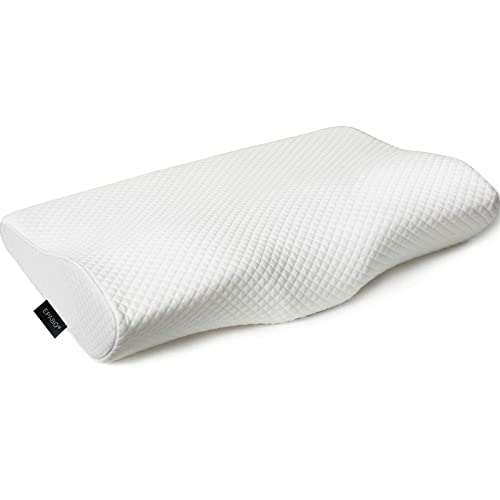
EPABO Contour Memory Foam Pillow — Best Value Contour
EPABO’s contour pillow is the category’s value staple: the same ergonomic wave as the premium picks — raised neck edge, head dip, shoulder cutaway — in memory foam at a fraction of the flagship cost. For a first-time contour buyer, that matters more than any spec, because contour sleeping is a genuine change in how your head rests, and an inexpensive, correct-shaped pillow is the cheapest honest test of whether your neck likes the idea.
Its listing addresses side, back, and stomach sleepers; treat the stomach claim cautiously, as most stomach sleepers do better on thin pillows (two picks below address that directly). Where the EPABO earns its place is back and side sleeping on a budget, and as a guest-room or second pillow that still offers real contour support.
Strengths
- Classic cervical contour shape at a value tier
- Memory foam feel is softer and more forgiving than the firmest molded picks
- A low-cost, low-regret first test of contour sleeping
- Shape supports both back and side positions in one pillow
Trade-offs
- Foam density and longevity trail the premium molded picks
- Fixed contour with no loft adjustment
- Value-tier cover and finish — check the listing for cover details before ordering
| Design (per Amazon title) | Contour memory foam, ergonomic cervical shape |
| Positions (per Amazon title) | Side, back, and stomach sleepers (see review note) |
The honest way to read the value contour segment is that the shape does most of the work and the foam does the rest. EPABO gets the shape right — that is not nothing; plenty of cheap pillows get it wrong, with neck rolls so high they push the head forward. What the premium tier buys beyond this is foam that keeps its exact molded resilience for many years and a denser, more deliberate feel. For many sleepers, the value shape is enough, and it certainly answers the first question — do I sleep better contoured? — for very little money.
One fitting tip applies to every contour pillow here and matters most at this price: give it a genuine trial of several nights. Night one on a contour feels strange to almost everyone; night five is the data. If you wake on your back with the pillow shoved aside, the profile is likely too high; if your head still drops sideways, too low. EPABO’s price makes it the pillow to learn those lessons on.
Best for: First-time contour buyers and value-focused back/side sleepers / Not suited for: Anyone who already knows they want maximum-density molded foam
Check on Amazon — check price on Amazon for the current configuration before you order.

DONAMA Cervical Pillow — Best Cooling Contour
Dual height is the smartest idea in the contour category, and DONAMA builds this pillow around it: one edge of the contour sits higher than the other, so rotating the pillow 180 degrees changes the support height. Broader shoulders and side sleeping generally want the higher edge; narrower builds and back sleeping often prefer the lower. Instead of guessing a profile from a product page, you get both options in the bed.
The cooling positioning suits warm sleepers, who are memory foam’s natural skeptics: dense foam holds heat, and a contour holds your head still in it. A cooling-focused cover design does not make memory foam cold, but it takes the edge off the warmth complaint that drives hot sleepers back to flat pillows. If you sleep very hot, compare the shredded, adjustable Coop pick below, whose loose fill breathes differently again.
Strengths
- Dual-height contour: two support heights in one pillow
- Cooling-focused design answers memory foam’s warmth problem
- Ergonomic shape for head and neck support across back and side positions
- Removes the profile-guessing risk that sinks many contour purchases
Trade-offs
- Cooling is mitigation, not refrigeration — very hot sleepers may still prefer loose-fill designs
- Contour shape remains fixed in every other dimension
- Dual-height edges can confuse the first nights until the orientation becomes habit
| Design (per Amazon title) | Cooling contour memory foam |
| Support (per Amazon title) | Dual-height ergonomic neck support |
Fit is the contour category’s whole failure mode, and it is worth understanding why dual height helps so much. The support your neck needs is roughly the distance from the side of your neck to the outside of your shoulder when lying down — a distance that changes with your build, your mattress’s softness (a soft mattress lets the shoulder sink, shrinking the gap), and your position. A single fixed profile bets on one number. Two heights bet on the two most likely numbers, and let you A/B them across a week of real sleep.
Use that week deliberately: alternate edges every two nights and notice the morning, not the evening. The right height is the one where you stop thinking about the pillow — where your head feels held rather than propped, and your shoulders are not creeping up toward your ears. That experiential test, which this design makes possible in one purchase, is worth more than any dimension printed on a box.
Best for: Sleepers unsure of their profile height, and warm sleepers who want a contour / Not suited for: Anyone who wants to reshape or scrunch their pillow
Check on Amazon — check price on Amazon for the current configuration before you order.
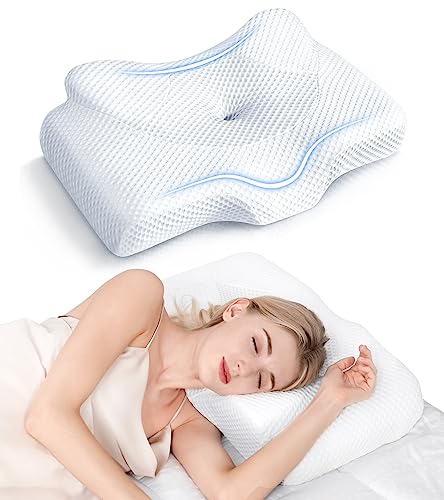
Osteo Cervical Pillow — Best Adjustable Contour
Osteo’s design departs from the standard wave in two ways worth understanding. The hollow center cradles the back of the head with a deliberate dip, which back sleepers often experience as the head being settled rather than perched, and the raised surround supports the neck and the sides of the head — side sleepers get a defined place to land when they roll. The listing also describes the pillow as adjustable, which in this design family means the support can be modified rather than accepted as-is.
The odorless claim deserves a welcome note: new memory foam commonly carries a manufacturing smell for the first days, and a maker who addresses it in the title is answering a real and frequent complaint. The cooling case pairs with that for sleepers sensitive to either warmth or new-product smell. As with every pick here, we frame this as comfort equipment: it supports a comfortable posture, and that is the whole claim this guide makes for it.
Strengths
- Hollow-center cradle gives back sleepers a settled, defined head position
- Adjustable design reduces the fixed-profile gamble
- Odorless memory foam claim answers the new-foam smell complaint
- Cooling case included per the listing title
Trade-offs
- The hollow design feels distinctly different from both flat and wave-contour pillows — a real adjustment period
- Shaped surround suits back and side sleeping; stomach sleepers should look at the thin picks
- Adjustability adds setup decisions some buyers would rather not make
| Design (per Amazon title) | Hollow design, adjustable |
| Foam (per Amazon title) | Odorless memory foam |
| Case (per Amazon title) | Cooling case |
The hollow-center idea has a sensible logic: on a standard contour, the head rests on a surface shaped mostly for the neck; here, the head gets its own shallow bowl, which resists the slow sideways roll that leaves back sleepers waking at an angle. Side sleepers use the raised sides almost like a pair of bookends. If you are a combination sleeper who starts on your back and finishes on your side — the most common pattern of all — that combination of cradle plus side support is a genuinely thoughtful answer.
Adjustability is the other half of the value. Every other fixed contour in this guide asks you to choose correctly once; an adjustable design lets you converge on your fit over a week of small changes. Change one thing at a time, sleep at least two nights per setting, and judge by mornings. That methodical approach sounds fussy, but a pillow is a multi-year, every-night object — a week of tuning buys years of not thinking about it.
Best for: Combination back/side sleepers who want to fine-tune their support / Not suited for: Stomach sleepers and anyone who dislikes shaped pillows on principle
Check on Amazon — check price on Amazon for the current configuration before you order.

Coop Home Goods Cool+ Adjustable Pillow, King — Best Adjustable Loft (Non-Contour)
Some sleepers need head and neck support but will never accept a molded shape. The Coop Cool+ is their answer: shredded memory foam fill you can add or remove to set the loft exactly, in a plus-shaped cut that gives side sleepers a shoulder-friendly profile, with cooling gel in the fill for warm sleepers. Its listing names back, neck support, and stomach or side sleeping — and adjustability is what makes that breadth plausible, because a stomach sleeper can pull fill out to go flat while a side sleeper packs it firm.
The certifications named in the title — CertiPUR-US for the foam and GREENGUARD Gold — are the kind of verifiable, third-party details we weight heavily, because they concern what the foam is made of and what it emits, in a product you breathe against for eight hours a night. King size is this listing; check the listing family if you need queen or standard.
Strengths
- Fully adjustable loft: add or remove fill to match build, position, and mattress
- Cooling gel fill for warm sleepers
- CertiPUR-US and GREENGUARD Gold certifications stated in the listing title
- Plus shape gives side sleepers a natural shoulder arrangement
Trade-offs
- Shredded fill needs occasional fluffing to stay even — it is not set-and-forget like a molded pillow
- No fixed contour: sleepers who need a defined neck roll should choose a molded pick
- King size is generous; confirm your pillowcase and bed width suit it
| Size (per Amazon title) | King Size |
| Fill (per Amazon title) | Plus shaped memory foam with cooling gel, adjustable |
| Certifications (per Amazon title) | CertiPUR-US / GREENGUARD Gold |
Adjustability reframes the fitting problem. A molded pillow must match you as manufactured; a fill-adjustable pillow converges to you in your own bed, on your own mattress — and mattress softness changes the right loft more than most buyers realize, because a shoulder that sinks into a plush mattress needs less pillow than the same shoulder on a firm one. Coop’s model of shipping with extra fill and letting the sleeper subtract is the most forgiving system in this guide.
The discipline is to adjust slowly. Remove a handful, sleep two nights, repeat. Most people overshoot downward first because a new pillow feels high compared with the tired one it replaced — but the tired one’s loft is not the reference; your alignment is. A partner or a phone photo from the side settles arguments your neck cannot: head, neck, and spine should read as one relaxed line.
Best for: Sleepers who reject molded shapes, warm sleepers, and anyone between sizes / Not suited for: Anyone wanting a fixed, defined neck roll with zero setup
Check on Amazon — check price on Amazon for the current configuration before you order.

Sleep Innovations Cooling Gel Ventilated Memory Foam Pillow — Best for Head-and-Neck Alignment Without a Contour
This is the pick for the pillow-conservative: it looks like a normal pillow, feels recognizably like one, and simply does the alignment job better than a basic polyester fill. The listing’s own words are ‘head and neck alignment’ with medium support, aimed at side sleepers — the position where a too-thin pillow drops the head toward the mattress and a too-thick one cranes it upward, and where a supportive foam core earns its keep by not collapsing through the night.
The cooling gel core and ventilated build address the standard memory foam objection, and the soft breathable cover keeps the surface feel familiar. What it does not offer is a sculpted neck roll: if your problem is specifically an unsupported neck curve on your back, the contour picks above are the more deliberate tools. This pillow is the balanced, medium, familiar-shaped option.
Strengths
- Traditional shape with memory foam support — the easiest transition from a regular pillow
- Cooling gel core and ventilated design for warm sleepers
- Medium support suits the broad middle of side sleepers
- Listing explicitly targets head and neck alignment
Trade-offs
- No contour: back sleepers wanting a defined neck roll should choose a molded pick
- Standard size only in this listing
- Memory foam still sleeps warmer than loose synthetic fill, cooling gel notwithstanding
| Size (per Amazon title) | Standard Size |
| Core (per Amazon title) | Cooling gel memory foam core, ventilated |
| Support (per Amazon title) | Medium support; head and neck alignment |
There is a real segment of sleepers — probably the majority — for whom the best pillow is not a device but a better version of what they already use. Sleep Innovations has sold into that segment for years with exactly this formula: a solid memory foam core that holds the head at a consistent height, a gel layer to moderate temperature, and ventilation channels to move air. Medium support is the honest center of the market, and for side sleepers of average build it is usually the correct firmness.
Judge this pillow, and any solid-core pillow, by the 3 a.m. test rather than the first lie-down: quality foam feels similar at hour six to hour one, while cheap fill and foam compress into a ramp that tips the head. If you are replacing a pillow because yours dies by morning, that consistency — not contour, not gel — is the upgrade you are actually buying here.
Best for: Side sleepers wanting a familiar-shaped pillow with real support / Not suited for: Back sleepers who specifically need a sculpted neck roll
Check on Amazon — check price on Amazon for the current configuration before you order.
Comparison Table
| Pick | Badge | Key spec | Best for |
|---|---|---|---|
| Tempur-Pedic TEMPUR-Ergo Neck Pillow, Medium Profile | Best Overall | Molded TEMPUR contour, medium profile | Back and side sleepers who want firm, molded head and neck support |
| EPABO Contour Memory Foam Pillow | Best Value Contour | Memory foam cervical contour, value tier | First-time contour buyers and value-focused back/side sleepers |
| DONAMA Cervical Pillow | Best Cooling Contour | Dual-height cooling contour memory foam | Sleepers unsure of their profile height, and warm sleepers who want a contour |
| Osteo Cervical Pillow | Best Adjustable Contour | Hollow-center adjustable contour, cooling case | Combination back/side sleepers who want to fine-tune their support |
| Coop Home Goods Cool+ Adjustable Pillow, King | Best Adjustable Loft (Non-Contour) | Adjustable shredded memory foam + cooling gel, king | Sleepers who reject molded shapes, warm sleepers, and anyone between sizes |
| Sleep Innovations Cooling Gel Ventilated Memory Foam Pillow | Best for Head-and-Neck Alignment Without a Contour | Cooling gel ventilated memory foam, medium support, standard | Side sleepers wanting a familiar-shaped pillow with real support |
How to Choose the Best Head and Neck Pillows for How You Sleep
Start with your dominant position, honestly assessed — not the position you fall asleep in, but the one you wake in. Back sleepers need the neck curve supported without the head pushed forward: a contour’s neck roll or a medium-loft pillow. Side sleepers need loft equal to their shoulder width so the head stays level: the higher profiles, the plus-shaped adjustable, or a firm traditional pillow. Stomach sleepers need thin and soft, full stop — and should be skeptical of any thick pillow, however it is marketed, including contour listings that claim stomach suitability.
Then account for your mattress, the variable almost nobody mentions. On a soft mattress your shoulder sinks in, shrinking the gap a side sleeper’s pillow must fill; on a firm mattress the full shoulder width stands. The same person can need a high pillow on a firm guest bed and a medium at home. This is the practical argument for adjustability — the DONAMA’s two heights, the Osteo’s tuning, the Coop’s add-or-remove fill all exist because one fixed number cannot fit every bed you will ever sleep on.
Finally, match the mechanism to your temperament. If you want to unbox a pillow and never think again, a molded contour in the right profile is the cleanest answer. If you enjoy dialing things in, adjustable designs converge to a better personal fit. If you scrunch, fold, and rearrange your pillow through the night, no contour will survive your habits — take the traditional-shaped Sleep Innovations or the adjustable Coop and be happy.
Contour, Adjustable Fill, and Traditional Foam: Three Mechanisms Compared
Molded contours support the neck with shape: a raised roll under the neck curve, a dip for the head, sometimes wings for side sleeping. Their strength is precision — the support is exactly where the design puts it, every night, for years. Their weakness is the same precision: your anatomy must match the mold, which is why profile selection and the dual-height idea matter so much, and why a contour is the worst gift and the best deliberate purchase in this category.
Adjustable shredded fill supports with volume. The support is less anatomically specific — no roll targets the neck curve — but the loft is exactly yours, changeable in minutes, and the pillow still permits the scrunching and folding that molded designs forbid. Its costs are maintenance (fluff it or it lumps) and a less defined neck cradle. For combination sleepers who use every position in one night, that flexibility often beats precision.
Traditional solid foam — the Sleep Innovations model — is the middle path: a consistent, supportive slab in a familiar shape. It will not target the neck curve like a contour or adapt like shredded fill, but it holds its height through the night, which is the single most common failure of the basic pillows it replaces. Many sleepers need exactly that and nothing more exotic.
Loft and Profile: Getting the Height Right
Height is the spec that decides success, and it is personal: neck length, shoulder width, head size, and mattress softness all feed it. As working guidance, back sleepers generally land in low-to-medium loft, side sleepers in medium-to-high scaled by shoulder width, and stomach sleepers as low as they can find. Contour profiles labeled medium suit the statistical middle of adults; broader shoulders argue up, petite builds argue down.
Use the mirror test before the first night is over: lie in your position and have someone look — or photograph — the line from your head through your spine. Nose and sternum aligned, chin neither tucked to chest nor tipped back, shoulders relaxed rather than shrugged: that is neutral. On a contour, also check the roll: it should fill the neck curve with gentle pressure, not push the head forward like a headrest in a car.
Then give any new pillow a fair trial — several nights minimum. Your neck has habits built around the old pillow’s failures, and night one on correct support commonly feels odd. Judge by mornings across a week. Two signals mean the fit is wrong rather than merely new: you consistently wake with the pillow pushed away, or you fold an arm under it to add or subtract height. Both mean adjust or exchange, not endure.
Foam, Fill, and Certifications: What You Are Breathing Next To
A pillow sits inches from your airway for a third of your life, so materials deserve one clear-eyed paragraph. Memory foams vary in density and quality; certifications such as CertiPUR-US, named in the Coop listing, attest that the foam meets standards for content and emissions, and GREENGUARD Gold is a further low-emissions certification. They are not medical guarantees, but they are verifiable, third-party, and worth preferring over unexamined claims when two pillows otherwise tie.
New foam smell is real and usually temporary: unbox any foam pillow in a ventilated room for a day before first use, and note that one pick in this guide, the Osteo, makes odorless foam a headline claim for buyers who know they are sensitive. Cooling designs — gel infusions, ventilated cores, cooling covers — moderate foam’s natural warmth; they do not refrigerate, and the very hottest sleepers may still prefer loose fills or buckwheat-style pillows outside this guide’s scope.
Covers and care complete the picture: a removable, washable cover is worth real money in hygiene terms, and foam itself should not be machine-washed unless the maker allows it. Replace a pillow when it stops recovering its shape overnight — support, not the calendar, is the expiry signal.
How to Fit and Break In a New Head and Neck Pillow
A structured first week turns the contour gamble into a fitting process. Follow it with any pick in this guide.
- Air the pillow out of its packaging in a ventilated room for a day before first use, especially any solid memory foam design.
- Set it up in your real sleep position and run the alignment check: head, neck, and spine in one relaxed line; on a contour, the roll filling the neck curve without pushing the head forward.
- For adjustable designs, start at the default or fuller setting and remove height only after two nights — first impressions overestimate loft because your old pillow had collapsed.
- For dual-height contours, sleep two nights on each edge before choosing; judge by the morning, not by which feels familiar at lights-out.
- Commit to at least five nights before a verdict, unless you wake with the pillow on the floor repeatedly — that is a fit verdict already.
- Keep the rest of the bed constant during the trial: same mattress, same position habits, no new variables, so the pillow gets a fair reading.
- Once fitted, note the winning configuration (edge, fill level, profile) somewhere you will find it at replacement time.
A pillow fitted this way disappears from your attention, which is the entire point: the best head and neck pillow is the one you stop thinking about by the second week.
Pillowcases, Protectors, and the Details That Change the Feel
The pillow you sleep on is really a system: foam or fill, its own cover, your pillowcase, and sometimes a protector — and each layer measurably changes the feel. A stiff, tight pillowcase can fight a contour’s shape, tenting across the dip and blunting the neck roll; a stretch-knit case follows the mold and preserves the design. If a new contour feels oddly flat or oddly tight on night one, change the case before you judge the pillow. Similarly, a thick waterproof protector adds a drum-like tension and a degree of warmth that neither the foam maker nor the pillow’s cooling cover signed up for; if you need protection, choose the thinnest breathable option and re-run the alignment check with it fitted, because loft is loft whether it comes from foam or from bedding.
Size discipline matters too. A standard pillow in a queen case swims and bunches; a king pillow in a standard case compresses into a harder, higher object than its maker designed. Match case to pillow size — king for the Coop pick in this guide, standard for the Sleep Innovations — and keep a second case in rotation so the weekly wash never forces a mismatched substitute. These are small, unglamorous details, but pillows are judged in millimeters of height and degrees of neck angle, and small details are exactly the size of the problem.
When a Pillow Is Not the Answer
Honesty requires one section that sells nothing. If neck discomfort persists through two properly fitted pillows, wakes you at night regardless of position, or comes with numbness, weakness, or pain traveling into the shoulder or arm, the next step is a medical professional, not a third pillow. Mattresses also matter: a sagging mattress defeats any pillow by misaligning everything below the neck, and no pillow purchase fixes a bed that has failed.
Within the comfort frame, though, most pillow dissatisfaction really is a fitting problem — wrong height, wrong mechanism, dead foam — and those are solvable by the method in this guide. Solve the solvable thing first, and escalate the rest appropriately.
Common Buying Mistakes
Buying a contour in a random profile. Profile height is the fit. Medium suits the middle of adults; broader shoulders argue up, petite builds down — and dual-height designs exist precisely to remove this guess.
Judging a pillow on night one. Correct support feels strange to a neck trained by a bad pillow. Five nights is a trial; one night is a mood.
Ignoring the mattress. A soft mattress shrinks the loft a side sleeper needs; a firm one grows it. The same pillow is not the same height on every bed.
Expecting a pillow to treat a medical problem. Pillows support comfortable posture. Persistent pain or neurological symptoms need a clinician, and any listing that promises more should be read with suspicion.
Keeping a pillow until it is visibly dead. Foam loses resilience long before it looks worn. If it no longer recovers its shape overnight, its support is already gone.
Washing foam that should not be washed. Wash the cover; spot-clean the foam unless the maker explicitly allows more. Soaked foam dries slowly and mildews.
Final Recommendation
Start with the Tempur-Pedic TEMPUR-Ergo in the profile that matches your build if you want the benchmark molded contour and a set-and-forget answer. Choose the DONAMA if profile uncertainty is what has stopped you buying a contour until now, the Osteo if you want to tune an adjustable hollow design, and the EPABO if you want to test the contour idea at a value price. Reject molds entirely and the Coop Cool+ gives you adjustable loft with named certifications; want the gentlest upgrade of all, and the Sleep Innovations gel pillow improves a familiar shape.
Whichever mechanism you choose, fit it deliberately over the first week and judge it by mornings. Head and neck support is a fitting exercise disguised as a purchase — treat it that way and it will pay you back every night.
- Tempur-Pedic TEMPUR-Ergo Neck Pillow, Medium Profile — Check on Amazon
- EPABO Contour Memory Foam Pillow — Check on Amazon
- DONAMA Cervical Pillow — Check on Amazon
- Osteo Cervical Pillow — Check on Amazon
- Coop Home Goods Cool+ Adjustable Pillow, King — Check on Amazon
- Sleep Innovations Cooling Gel Ventilated Memory Foam Pillow — Check on Amazon
Keep exploring the cluster: Best Foam Pillows For Neck Best Pillows For Neck Pain Best Hypoallergenic Pillows For Neck Pain Best Inexpensive Pillows For Neck Pain Best Natural Neck Pillows Best Gel Pillows 2 Inches
Frequently Asked Questions
What is the difference between a cervical pillow and a regular pillow?
A cervical (contour) pillow is molded with a raised roll that supports the neck curve and a dip for the head, holding alignment by shape. A regular pillow supports by volume alone. Contours are more precise and less adaptable; regular shapes are more forgiving and less targeted.
Which pillow height is right for side sleepers?
Enough to keep the head level with the spine, which scales with shoulder width and mattress firmness — generally medium-to-high loft. Adjustable and dual-height designs let you find your number experimentally instead of guessing from a size chart.
Are memory foam pillows hot to sleep on?
Dense foam sleeps warmer than loose fill. Cooling gel cores, ventilated designs, and cooling covers — all represented in this guide — moderate that warmth but do not eliminate it. The very hottest sleepers often do best with adjustable shredded fill.
How long does a memory foam neck pillow last?
Quality molded foam holds its support for years; the signal to replace is loss of overnight recovery — a pillow that stays compressed or no longer holds the head at height has finished its working life regardless of age.
Can a pillow help my neck feel better in the morning?
A properly fitted pillow supports a neutral, comfortable posture all night, and many sleepers find mornings more comfortable than on a collapsed or wrong-height pillow. That is a comfort claim, not a treatment claim — persistent symptoms deserve medical advice.
Why does my new contour pillow feel strange?
Because your neck adapted to your old pillow, including its failures. A structured trial of several nights, judging by mornings, separates new-but-right from genuinely wrong; repeated pillow-on-the-floor mornings mean wrong.

