Disclosure: airfryerkitchensupply.com is reader-supported. When you buy through links on our site, we may earn an affiliate commission at no extra cost to you.
Where to buy
Every purifier below was verified against Amazon’s catalog data for this site, and every CADR figure, coverage number, and noise level we print comes from the manufacturer’s own listing data returned by that verification. CADR claims are exactly where this industry plays games, so use the links to check the current price on Amazon and confirm the ratings on the listing before you order:
- Medify MA-40 Air Purifier with HEPA Filter — Check the current price on Amazon
- WINIX 5510 Air Purifier — Check the current price on Amazon
- Levoit Core 300-P Air Purifier — Check the current price on Amazon
- LEVOIT Core 300S-P Smart Air Purifier — Check the current price on Amazon
- BLUEAIR Blue Pure 311i Max Air Purifier — Check the current price on Amazon
- COWAY Airmega 150 Air Purifier — Check the current price on Amazon
Introduction
The best CADR air purifiers for home use are the ones whose Clean Air Delivery Rate you can actually verify — because CADR is the one number in this category that is a measurement rather than an adjective. CADR, expressed in cubic feet per minute (CFM), tells you how much filtered air a purifier delivers for three test pollutants: smoke, dust, and pollen. It is measured under a standard test overseen by AHAM, the Association of Home Appliance Manufacturers, and a purifier carrying the AHAM Verifide mark has had its CADR independently confirmed rather than merely asserted by its marketing department. Everything else on a purifier box — “cleans rooms up to X square feet,” “removes 99.97% of particles” — is either derived from CADR or describes the filter, not the machine’s real-world pace.
That is why this guide is organized differently from most. We only print a CADR number where the manufacturer’s own verified listing data states one — you will find exact smoke, dust, and pollen figures for the two Levoit models and a confirmed CADR for the Medify MA-40 — and where a listing instead states an AHAM room-size rating or a coverage pace, we print that and say plainly that the listing does not state a numeric CADR. No estimated figures, no numbers borrowed from review sites, no arithmetic dressed up as specification. If you take one skill from this guide, take the habit behind it: a purifier purchase should start from a verified CADR matched to your room size, using the two-thirds rule explained in the buying guide — the smoke CADR should be at least two-thirds of the room’s square footage for the standard five air changes per hour that AHAM’s ratings assume.
The six machines below span the realistic home range: a high-CADR workhorse for big, smoky, or pet-heavy spaces; a large-room AHAM-verified tower; two compact Levoits whose CADR figures are published to the last CFM; a fast Blueair for open-plan rooms; and a design-led Coway whose coverage pace suits bedrooms and living rooms. Match them to rooms with the method in the buying guide and any of them will do measurable, verifiable work.
In this guide
Quick Picks
- Best Overall: Medify MA-40 — a manufacturer-stated CADR of 406 with HEPA H13 filtration, cleaning up to 1,793 sq ft in an hour. Check on Amazon
- Best for Large Rooms: WINIX 5510 — the new generation of the 5500-2, AHAM Verifide for rooms up to 392 sq ft, cleaning up to 1,882 sq ft in an hour with True HEPA and auto mode. Check on Amazon
- Best Verified Bedroom Pick: Levoit Core 300-P — AHAM Verifide CADR of 143 CFM smoke, 153 dust, 167 pollen, refreshing a 222 sq ft room 4.8 times per hour. Check on Amazon
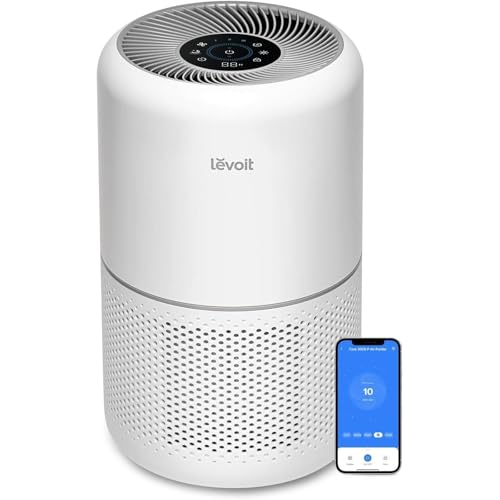
- Best Smart Pick: LEVOIT Core 300S-P — AHAM Verifide CADR of 141 CFM smoke, 156 dust, 175 pollen, with WiFi, Alexa control, and a 24 dB sleep mode. Check on Amazon
- Best for Open-Plan Spaces: BLUEAIR Blue Pure 311i Max — AHAM Verified, cleans 439 sq ft in 12.5 minutes and up to 2,107 sq ft in an hour, at a quiet 23 dB. Check on Amazon
- Best Design-Led Pick: COWAY Airmega 150 — HyperCaptive filtration with a washable pre-filter, cleaning 518 sq ft in 30 minutes, with an air quality monitor and auto mode. Check on Amazon
How These Picks Were Chosen
The first gate was verifiability. Each pick had to be confirmed in Amazon’s catalog data through this site’s own product verification, and the performance figures in its review had to come from that returned data — listing titles, stated AHAM ratings, and manufacturer feature data — not from third-party roundups. Where the returned data states a numeric CADR, we print it with its source. Where it states an AHAM room size or a coverage pace instead, we print that and flag the absence of a numeric CADR rather than estimating one. That discipline excluded several famous models whose current marketplace data did not expose verifiable figures during this batch’s verification window; absence from this guide means “not verified here,” not “bad machine.”
The second gate was genuine home range coverage. CADR needs scale with rooms, so the six picks deliberately span from compact-bedroom CADR in the low hundreds of CFM to the MA-40’s stated 406, with coverage paces from a few hundred square feet per hour to over two thousand. The third gate was filtration substance behind the airflow: every pick pairs its fan with true HEPA-grade filtration (HEPA, True HEPA, H13, or Blueair’s HEPASilent as each listing states it), because a high CADR pushing air through a weak filter is just fast, partially cleaned air. Noise earned a mention wherever the listing states it — a purifier’s CADR is only real at the speed you can live with, and a machine that is loud at full speed will be run at half speed, at half its promised delivery.
A final note on scope: CADR measures particle delivery — smoke, dust, pollen. It does not measure gas and odor removal, which depends on carbon mass and contact time. Homes whose main problem is cooking odor, VOCs, or wildfire gas-phase pollutants should weight the carbon stage heavily too, and the reviews below note each machine’s odor hardware where the listing describes it.
The 6 Best CADR Air Purifiers for Home Use

Medify MA-40 Air Purifier — Best Overall
The MA-40 leads this guide because its manufacturer states the number this search is about: a CADR of 406, published in its own listing data, paired with HEPA H13 filtration. At that delivery rate the MA-40 cleans up to 1,793 sq ft in an hour, or 896 sq ft in thirty minutes — figures the listing also states — which makes it the machine for large living rooms, open-plan floors, wildfire-season smoke duty, and pet-heavy homes where the particle load is continuous rather than occasional.
Strengths
- Manufacturer-stated CADR of 406 — the highest confirmed numeric CADR in this guide.
- HEPA H13 filtration rated by the listing to remove particles down to 0.1 microns, across smoke, pollen, pet dander, dust, and VOCs.
- Full control set: touch panel, 0–8 hour timer, sleep mode, filter replacement indicator, and child lock; CARB and ETL tested per the listing.
Trade-offs
- Noise runs 46 dB at minimum to 66 dB at maximum per the listing — full-CADR duty is not quiet, and bedrooms will live at lower speeds.
- The replacement filter is rated for about 3,000 hours or roughly six months per the listing, so heavy users should budget filters as a running cost.
- Its CADR is a manufacturer-published figure in listing data; it is not presented here as an AHAM Verifide rating, unlike the Levoit and Winix picks.
Key specs (from the manufacturer’s listing data): CADR: 406 (manufacturer-stated) · Coverage: 1,793 sq ft in 1 hr / 896 sq ft in 30 min · Filter: HEPA H13 · Noise: 46–66 dB · Certifications stated: CARB, ETL
Judge the MA-40 as a throughput machine. A CADR of 406 against the two-thirds rule covers a room of roughly 600 sq ft at the standard rating pace — a great room, a finished basement, a primary suite with an office corner. The H13 filter behind that airflow is the finer grade of HEPA, and the listing’s smoke-and-wildfire positioning matches the hardware: this is the purifier for the week the sky turns orange, the house with two large dogs, or the workshop-adjacent living space. Run it on auto, let the high speeds do their loud work when you are out, and it will hold a large room at a particle level the compact picks cannot reach.
Best for: large rooms, open plans, smoke and wildfire duty, and heavy pet homes. / Not suited for: light sleepers’ bedrooms at full speed, or buyers who only accept AHAM-published CADR figures.

WINIX 5510 Air Purifier — Best for Large Rooms
The 5510 is Winix’s new generation of the long-running 5500-2 formula — True HEPA, a high-deodorization carbon filter, a washable fine mesh pre-filter, smart sensors with auto mode, and app support — and its listing data carries the credential this guide respects most: AHAM Verifide at a 392 sq ft room size. Its stated pace cleans up to 1,882 sq ft in an hour (941 in thirty minutes, 627 in twenty, 470 in fifteen), which is the coverage ladder of a serious large-room machine.
Strengths
- AHAM Verifide room rating of 392 sq ft — an independently verified sizing credential, not a marketing maximum.
- Three-stage defense: washable pre-filter for large particles, True HEPA for fine particles, and a dedicated deodorization carbon filter for odors and VOCs.
- Smart sensors and auto mode adjust fan speed to real-time air quality, with an LED air quality indicator.
Trade-offs
- The listing data verified for this guide does not state a numeric CADR — the AHAM room size is the verifiable figure, and we print that instead of estimating.
- Large-room towers need floor space and clearance around intakes; this is furniture, not a desktop accessory.
- Carbon filters are consumables; heavy odor duty shortens their effective life regardless of the HEPA’s condition.
Key specs (from the manufacturer’s listing data): AHAM Verifide room size: 392 sq ft · Coverage pace: up to 1,882 sq ft in 1 hr · Filtration: washable pre-filter, True HEPA, deodorization carbon · Controls: smart sensors, auto mode, app support · Numeric CADR: not stated in the verified listing data
The 5510 is the grown-up’s purifier: verified where it counts, strong on the gas-and-odor side that CADR does not measure, and automated enough to disappear into a room’s routine. The AHAM 392 sq ft rating means a bedroom-plus or a mid-size living room gets the standard’s full air-change pace, while the 1,882 sq ft hourly figure tells you it can recover a much larger space when given time — the distinction our buying guide explains. Kitchens that open into living rooms, homes with indoor smokers’ residue or strong cooking odors, and anyone who distrusts unverified numbers should start their shortlist here.
Best for: large bedrooms and living rooms, odor-conscious homes, and buyers who want AHAM verification. / Not suited for: buyers who need a published numeric CADR before purchase, or very small rooms where it is simply oversized.

Levoit Core 300-P Air Purifier — Best Verified Bedroom Pick
The Core 300-P is the transparency champion of this guide. Its verified listing data publishes the full AHAM Verifide CADR line — 143 CFM for smoke, 153 for dust, 167 for pollen — and translates it honestly: a 222 sq ft room refreshed 4.8 times per hour, a 1,073 sq ft room once per hour. Behind the numbers sits a 56W high-torque motor and Levoit’s 3-in-1 HEPA-grade filter, in a compact cylinder that has become the default bedroom purifier shape for good reason.
Strengths
- Complete, published AHAM Verifide CADR figures for all three test pollutants — nothing to estimate.
- Correctly sized for real bedrooms: the 222 sq ft at 4.8 air changes figure matches the two-thirds rule almost exactly.
- Quiet sleep mode per the listing, in a footprint that fits a nightstand corner or a dorm floor.
Trade-offs
- This is a bedroom-class machine: its CADR cannot hold a large open-plan room, and no honest reading of its figures claims otherwise.
- The non-smart version — buyers wanting app control and air quality display should take the 300S-P below.
- Compact filters are replaced, not washed; factor the filter cycle into ownership cost.
Key specs (from the manufacturer’s listing data): CADR (AHAM Verifide): smoke 143 CFM, dust 153 CFM, pollen 167 CFM · Sizing: 222 sq ft at 4.8 air changes/hr; up to 1,073 sq ft at 1 change/hr · Motor: 56W · Filter: 3-in-1 with HEPA-grade media
Every purifier guide needs one machine it can point to and say: this is what honest specification looks like. The Core 300-P’s published trio of CADR values lets you do the two-thirds check yourself in ten seconds — 143 CFM of smoke CADR against a 200-ish sq ft bedroom passes with margin — and its coverage figures distinguish between air-change paces instead of quoting only the flattering one. For bedrooms, nurseries, home offices, and dorms, this is the verified, right-sized, no-drama purchase, and it is the pick we would hand a family member who asked.
Best for: bedrooms, nurseries, offices, and dorms up to roughly 220 sq ft. / Not suited for: large or open-plan rooms, or buyers wanting smart controls.
LEVOIT Core 300S-P Smart Air Purifier — Best Smart Pick
The 300S-P takes the Core platform connected: WiFi with app and Alexa control, an air quality monitor, auto mode, and a sleep mode the listing rates at a quiet 24 dB — while keeping the family’s verified-numbers discipline. Its AHAM Verifide CADR line reads 141 CFM smoke, 156 dust, and 175 pollen: essentially the 300-P’s particle performance, with the pollen figure notably stronger, wrapped in a machine that watches the air so you do not have to.
Strengths
- Full AHAM Verifide CADR publication, like its sibling — verified performance with smart features, not instead of them.
- Air quality monitoring with auto mode: the purifier responds to the cooking event or the open window on its own.
- 24 dB sleep mode per the listing — genuinely bedroom-compatible at night speeds.
Trade-offs
- Same bedroom-class ceiling as the 300-P: smart features do not add CADR, and large rooms still need a larger machine.
- App and voice ecosystems add setup and an account to a product category that also works fine with a dial.
- Smart functionality is the first thing to age on any appliance; buy it for the CADR, enjoy the app as a bonus.
Key specs (from the manufacturer’s listing data): CADR (AHAM Verifide): smoke 141 CFM, dust 156 CFM, pollen 175 CFM · Noise: 24 dB sleep mode · Controls: WiFi app, Alexa, auto mode, air quality monitor · Coverage class: bedrooms and home-large-room positioning per listing title (up to 1,073 sq ft family coverage class)
The case for the smart version is the auto mode’s honesty about human behavior: nobody manually raises purifier speed when the stir-fry starts, and nobody lowers it at bedtime, either. A sensor-driven machine actually delivers its CADR when the air needs it and its quiet when the room does, which means its verified numbers describe real life more closely than a manual machine’s do. If your room is bedroom-sized and your household runs on routines and voice assistants, the 300S-P is the Core to buy — the pollen CADR of 175 CFM also makes it the allergy-season pick of the pair.
Best for: smart homes, allergy-season bedrooms, and set-and-forget owners. / Not suited for: large rooms, or buyers who avoid app-dependent appliances.

BLUEAIR Blue Pure 311i Max — Best for Open-Plan Spaces
Blueair’s 311i Max plays the speed game with its own filtration technology: HEPASilent dual filtration, which the listing credits with capturing 99.97% of airborne particles down to 0.1 microns, in a machine AHAM Verified and rated by its maker to clean 439 sq ft in 12.5 minutes and up to 2,107 sq ft in an hour — the fastest stated coverage pace in this guide — while running at a quiet 23 dB on its low settings, with WiFi, auto mode, and a washable pre-filter.
Strengths
- Fastest stated room-turnover in this guide: 439 sq ft in 12.5 minutes per the listing data.
- AHAM Verified with HEPASilent technology capturing particles down to 0.1 microns per the listing.
- Quiet 23 dB operation and a washable pre-filter that trims consumable costs; app control with auto mode.
Trade-offs
- The verified listing data for this guide states coverage pace and AHAM verification, not a numeric CADR — we print the pace and do not back-calculate a figure.
- Blueair’s proprietary filter ecosystem means replacements come from one source; check the filter program before buying.
- Its fabric pre-filter aesthetic suits modern rooms and collects visible dust by design — it wants regular washing to look its best.
Key specs (from the manufacturer’s listing data): Coverage pace: 439 sq ft in 12.5 min; up to 2,107 sq ft in 1 hr · Verification: AHAM Verified · Filtration: HEPASilent, 99.97% down to 0.1 microns (listing) · Noise: 23 dB (low) · Numeric CADR: not stated in the verified listing data
Open-plan rooms defeat purifiers in a specific way: the air volume is one space, but the pollution is zoned — kitchen plume at one end, dog bed at the other — and a slow machine cleans the air near itself while the far end waits. The 311i Max’s turnover pace is the counter: moving the room’s air through the filter roughly five times an hour at its AHAM-scale room size means the whole space converges to clean, not just the corner by the couch. For loft-style living, great rooms, and studio apartments where one machine must serve every zone, that pace — AHAM Verified — is the argument, and the quiet low speed makes it livable at night in a studio’s single room.
Best for: open-plan living, lofts, studios, and fast smoke or cooking-event recovery. / Not suited for: buyers who require a printed numeric CADR, or multi-room houses expecting one machine to serve closed rooms.

COWAY Airmega 150 Air Purifier — Best Design-Led Pick
The Airmega 150 is the purifier for people who look at their appliances. Coway’s compact tower carries a HyperCaptive filtration system — HEPA filter, carbon filter, and a washable pre-filter — cleaning 518 sq ft in thirty minutes or 1,035 sq ft in an hour per its listing data, with an air quality monitor, auto mode, a touch display, and a cartridge design that makes filter changes a clean, contained job instead of a dusty wrestling match. The listing also states a 3-year warranty, a meaningful signal in this category.
Strengths
- Stated coverage pace (518 sq ft / 30 min) lets you size it honestly for bedrooms and mid-size living rooms.
- Cartridge filter system: cleaner, faster filter changes — the maintenance detail owners actually feel.
- Air quality monitor with auto mode, touch controls, and a stated 3-year warranty in the listing title.
Trade-offs
- No numeric CADR appears in the verified listing data; the coverage pace is the sizing figure, as with the Winix and Blueair picks.
- Its pace class suits one room at a time; it is not the open-plan or wildfire-duty machine the MA-40 is.
- Design-led products price their design; value-first buyers should compare the Levoit pair.
Key specs (from the manufacturer’s listing data): Coverage pace: 518 sq ft in 30 min; 1,035 sq ft in 60 min · Filtration: HyperCaptive (HEPA + carbon + washable pre-filter), 99.97% of 0.3-micron particles per listing · Controls: AQI monitor, auto mode, touch display · Warranty stated: 3 years · Numeric CADR: not stated in the verified listing data
Do not let the design framing undersell the engineering: a washable pre-filter extending the HEPA’s life, a carbon stage for the odor side of the ledger, and a cartridge that keeps the captured dust in the filter instead of on your hands are the choices of a company that has thought about year two, not just unboxing. Sized by its stated pace, the Airmega 150 covers a primary bedroom or a modest living room at a proper air-change rate, and it does so as the best-looking object in this guide. For the design-conscious one-room buyer, it is the complete package.
Best for: primary bedrooms and living rooms where the purifier is visible furniture. / Not suited for: very large rooms, smoke emergencies, or strict numeric-CADR shoppers.
Comparison Table
| Pick | Badge | Key spec | Best for |
|---|---|---|---|
| Medify MA-40 | Best Overall | CADR 406 (manufacturer-stated), HEPA H13, 1,793 sq ft/hr | Large rooms, smoke duty |
| WINIX 5510 | Best for Large Rooms | AHAM Verifide 392 sq ft room, True HEPA + carbon | Verified sizing, odors |
| Levoit Core 300-P | Best Verified Bedroom Pick | AHAM CADR 143/153/167 CFM | Bedrooms to ~220 sq ft |
| LEVOIT Core 300S-P | Best Smart Pick | AHAM CADR 141/156/175 CFM, WiFi, 24 dB sleep | Smart homes, allergies |
| BLUEAIR 311i Max | Best for Open-Plan Spaces | 439 sq ft in 12.5 min, AHAM Verified, 23 dB | Lofts, great rooms |
| COWAY Airmega 150 | Best Design-Led Pick | 518 sq ft in 30 min, HyperCaptive, cartridge filters | Visible-furniture rooms |
How to Choose a CADR Air Purifier for Your Home
Begin with the two-thirds rule, the arithmetic AHAM’s system is built on: for the standard rating pace, a purifier’s smoke CADR should be at least two-thirds of the room’s square footage. A 300 sq ft room wants a smoke CADR of 200 CFM or more; a 150 sq ft bedroom is well served by 100–150. Work it for the verified figures in this guide and the picks sort themselves — the Levoit pair lands in bedrooms, the MA-40’s stated 406 covers great rooms, and the AHAM room-size ratings on the Winix (392 sq ft) encode the same rule from the other direction. More CADR than the rule requires is not waste: it buys faster recovery after a cooking event or a smoky day, and it lets the machine hold the room at a lower, quieter speed once the air is clean.
Next, learn to read coverage claims, because they are CADR in a trench coat. “Cleans X sq ft” is meaningless without a time and an air-change rate: the same machine honestly cleans a small room five times an hour or a room five times larger once an hour, and listings choose which figure to headline. The picks in this guide state their paces with the time attached — 518 sq ft in 30 minutes, 439 sq ft in 12.5 minutes, a 222 sq ft room 4.8 times per hour — and you should demand that format from any purifier you consider. A coverage number with no time attached is a number with no meaning attached.
Then separate the two jobs. CADR governs particles: smoke, dust, pollen, dander. Gases and odors — cooking smells, VOCs from paint and furniture, the chemical edge of wildfire smoke — are handled by activated carbon, and carbon performance scales with the carbon’s mass and the air’s contact time, neither of which CADR measures. If odor is your primary complaint, weight the Winix’s deodorization carbon stage and the Coway’s carbon filter heavily; if particles are the complaint, CADR is your whole decision. Finally, price the filters before the machine: every purifier in this guide is a subscription in disguise, and the filter’s replacement interval — stated per model in the reviews where the listing gives one — decides the true annual cost far more than the purchase tier does.
How to Set Up and Run a Home Air Purifier for Rated Performance
Placement decides whether rated CADR becomes real CADR. Put the purifier in the room where you spend the hours — the bedroom first, the living room second — with clear space around its intakes and outlet; a machine shoved behind a sofa is filtering the sofa. Keep doors to the served room closed when you can, because a purifier rates a room, not a house, and an open door to a hallway doubles the air volume it owes you. In wildfire or heavy-pollen events, seal the room as best you can and run the machine on its higher speeds during the day so the sleep hours can run quiet.
Run it continuously. Air cleaning is a steady-state game: particles infiltrate and generate constantly, and a purifier run only when the air “seems bad” spends its life catching up. Auto mode, fitted to four of the six picks here, exists precisely to make continuous running efficient — low and quiet when the air is clean, fast when the sensor sees an event. Maintain the chain in order: wash or vacuum the pre-filter on the maker’s schedule (a clogged pre-filter starves everything behind it), replace HEPA and carbon stages at their stated intervals rather than by vibes, and wipe the sensor lens if your model has one, because a blind sensor makes auto mode a guess. Do those things and the CADR on the box becomes the air in the room; skip them and you own a fan with ambitions.
CADR in the Real House: Air Changes, Open Doors, and the Speed You Will Actually Use
The laboratory version of CADR assumes a sealed room of a stated size and a purifier running at full speed. Your house offers neither, and understanding the gaps is what turns a good specification into clean air. Air changes per hour is the concept that bridges them: divide the purifier’s hourly delivered air by the room’s volume and you get how often the room’s air passes the filter. The verified figures in this guide speak this language natively — the Levoit Core 300-P refreshing a 222 sq ft room 4.8 times per hour is a statement about a real bedroom at a real pace, and it is why that machine’s modest CFM numbers outperform bigger unverified claims in the rooms it was sized for. As a working target, four to five air changes per hour is the pace allergy and asthma guidance commonly designs around for the room you sleep in; two to three is a reasonable living-room standard; one is a brochure number.
Open doors are the silent tax. A purifier serves the air volume it can reach, and an open door marries your bedroom’s volume to the hallway’s, the landing’s, and effectively the house’s — diluting your air changes by whatever factor the architecture chooses. This is why placement strategy beats raw power in real homes: a right-sized machine behind a closed bedroom door outperforms a flagship in an open-plan doorway for the sleeper it serves. The second tax is speed discipline. CADR is measured at the top speed, and top speeds are loud — the MA-40’s stated 66 dB maximum is honest about what 406 CFM sounds like. Real households run purifiers a notch or two down, at a fraction of rated delivery. The defense is the oversizing margin from the buying guide: buy enough CADR that the speed you can live with still meets the two-thirds rule, and let auto mode spend the loud speeds only when you are out of the room or the air genuinely demands it. Specified honestly and run intelligently, these machines deliver their ratings; bought by headline and run by hope, none of them can.
Which Rooms Deserve the CADR: A Placement Priority List
Most homes cannot put a verified purifier in every room at once, so the order of purchase matters, and CADR thinking supplies it. First, the primary bedroom — you spend a third of your life breathing its air at the slowest, deepest breathing rate of the day, and it is a closable room where a right-sized machine (the Levoit class) achieves its full rated air changes. Second, the room of the most sensitive person: the nursery, the allergic teenager’s room, the home office of the asthmatic — sensitivity outranks square footage in this queue. Third, the main living space, sized by the two-thirds rule or served by a high-delivery machine like the MA-40 or the fast-turnover Blueair, accepting that open plans dilute every rating. Fourth, the secondary bedrooms and offices, which can inherit machines as the front rooms upgrade — purifiers cascade through a house over years exactly the way televisions do, and a verified machine bought once serves somewhere for a long time.
Two placements are usually mistakes. The hallway purifier, bought to “do the whole floor,” does no room at its rating and every room at a fraction of it — the architecture defeats it. And the kitchen purifier, bought for cooking odors, fights a battle CADR does not measure against a source a range hood handles better; if kitchen air is the problem, ventilation is the first purchase and a carbon-weighted purifier like the Winix is the second. Spend the CADR where closed doors and long hours let it work, and the ratings in this guide stop being numbers and start being the air your family actually sleeps in.
A Word on Wildfire Smoke, the Stress Test This Category Exists For
Smoke events are where CADR stops being a specification and becomes a plan. Smoke particles are the smallest of the three rated pollutants and the benchmark CADR is named for, which is why this guide insists on the smoke figure wherever one is published: it is the conservative number, the one that describes performance against the hardest common load. In a smoke event, the playbook is the placement section executed with urgency — one sealed room, door closed, the highest-CADR machine you own running at full speed while the house is awake and at the fastest tolerable speed overnight, windows and exterior doors kept shut, and the HVAC fan’s role considered with your own system’s guidance. The MA-40’s stated 406 CADR and smoke-duty positioning exist for exactly this week of the year, and the Levoit pair’s published smoke figures — 143 and 141 CFM — tell you precisely which bedroom each can hold at rating pace. Homes in fire country should buy for the smoke week, not the average week, and let the quiet seasons enjoy the surplus.
Common Buying Mistakes
Shopping by maximum coverage. The biggest “up to” number on a listing assumes one air change per hour — the weakest useful pace. Shop by CADR against your room size, or by an AHAM room rating, and let the maximums go.
Believing CADR covers odors. CADR is a particle metric. Gas and odor removal lives in the carbon stage, which CADR does not measure at all. Match the machine to the pollutant you actually have.
Undersizing to save money. An undersized purifier runs at full, loud speed forever and still loses. A correctly sized one — two-thirds rule, minimum — runs quietly at partial speed and wins. The cheaper machine that cannot do the job is the expensive one.
Ignoring noise at the speed you will use. CADR is quoted at top speed, and top speeds range from discreet to conversation-killing. Check the stated decibel figures, and remember the MA-40’s honesty here: 46–66 dB tells you exactly what full power sounds like.
Forgetting the filter subscription. Every purifier’s performance decays with its filter. A machine whose filters you cannot afford or find is a machine on its way to being furniture. Check filter intervals and availability before the purchase, not at the first indicator light.
Final Recommendation
If you want the strongest verified throughput in this guide, buy the Medify MA-40 and its manufacturer-stated CADR of 406 — it is the large-room and smoke-duty answer. If you want independent verification above all, the WINIX 5510 and its AHAM Verifide 392 sq ft rating are the conservative buyer’s machine, with the carbon stage odor sufferers need. Bedrooms belong to the Levoit pair — the Core 300-P for simple verified value, the Core 300S-P for smart auto operation — while open plans belong to the fast-turnover BLUEAIR 311i Max and design-led rooms to the COWAY Airmega 150. Run the two-thirds rule against your room, and the right pick names itself.
Related guides in this series: Best Air Purifiers For Dust, Best Air Purifiers For Pet Dander, Best Air Purifiers With Air Quality Sensors, Best Carbon Air Purifiers, and Best Home Air Purifiers Ratings.
Frequently Asked Questions
What is CADR, in plain terms?
CADR — Clean Air Delivery Rate — is the volume of filtered air a purifier delivers per minute, measured in cubic feet per minute under a standard test for three pollutants: smoke, dust, and pollen. It is the purifier equivalent of a flow rate: filter quality tells you how clean the air is per pass, and CADR tells you how much air gets a pass. AHAM oversees the test program, and machines marked AHAM Verifide have had their figures independently confirmed.
How much CADR does my room need?
Use the two-thirds rule: the smoke CADR should be at least two-thirds of the room’s square footage for the standard rating pace of about five air changes per hour. A 220 sq ft bedroom is therefore well matched by the Levoit Core 300-P’s verified 143 CFM smoke CADR, while a 500–600 sq ft great room wants something in the MA-40’s stated 406 class. Oversizing modestly is fine and buys quieter operation; undersizing cannot be fixed by running longer.
Why do some listings in this guide not show a numeric CADR?
Because the verified listing data for those models states an AHAM room-size rating or a coverage pace rather than a CFM figure, and we print what the data confirms rather than estimating the rest. An AHAM room rating encodes CADR through the same standard — the Winix 5510’s Verifide 392 sq ft room size is a verified sizing credential — so those picks are sized honestly, just expressed differently. When a number matters to you, the Levoit pair and the MA-40 publish theirs outright.
Does a higher CADR mean better filtration?
No — CADR is speed, filtration is quality per pass, and a complete purifier needs both. A high-CADR machine with a mediocre filter moves a lot of partly cleaned air; a superb filter on a weak fan cleans a small volume beautifully. Every pick in this guide pairs its airflow with HEPA-grade media as its listing states it, which is why we screened on filtration substance after screening on delivery rate.
Can one purifier clean my whole house?
Not in the way the ratings mean. CADR and room ratings describe one enclosed space; walls and closed doors divide a house into separate air volumes, and a purifier in the living room does little for a closed bedroom. The standard strategy is one right-sized machine per key room — bedroom first — rather than one giant machine in a hallway. Open-plan homes are the exception, and they are exactly what the Blueair and MA-40 picks are sized for.
Do air purifiers use a lot of electricity?
Less than their reputation suggests, and the verified data in this guide includes a concrete anchor: the Levoit Core 300-P’s motor is rated at 56W, in the range of a bright light bulb, and bedroom-class machines generally sip rather than gulp. Larger machines draw more at full speed — which is one more reason auto mode and right-sizing matter, since a correctly sized purifier spends its life at partial speed. Run continuously, a bedroom purifier is a minor line in a home’s energy budget; the filter replacements, not the watts, are the real cost of ownership.
How often do the filters need replacing?
It varies by model and by your air: the MA-40’s listing, for example, rates its replacement filter at about 3,000 hours or roughly six months, while washable pre-filters on the Winix, Blueair, and Coway picks extend their main filters’ lives by catching the coarse load first. Treat indicator lights as the authority for your machine, keep the pre-filter clean, and budget filters as a predictable running cost — a purifier with a fresh filter performs at its rating; one on an exhausted filter does not.


