Disclosure: airfryerkitchensupply.com is reader-supported. When you buy through links on our site, we may earn an affiliate commission at no extra cost to you.
Where to buy
Every purifier below was verified. The six split into nursery-designed models — with night lights, child locks and sleep modes in their listings — and quiet bedroom models that suit a nursery by size and sound. Filtration language is kept factual throughout: we describe what each listing confirms about its filter and coverage, and we make no medical claims. A purifier cleans air; it does not treat any condition. Use the links to check the current price on Amazon.
Frida Baby 3-in-1 Air Purifier with Sound Machine and Nightlight — check price on Amazon
Pure Enrichment PureBaby Bear True HEPA Air Purifier — check price on Amazon
Momcozy Air Purifier for Bedroom with Dimmable Night Light — check price on Amazon
Sereniby Air Purifier for Baby — check price on Amazon
Levoit Core Mini-P Air Purifier — check price on Amazon
Coway Airmega 50 Air Purifier — check price on Amazon
Best Baby Air Purifiers: Quiet, Filtered Air for the Nursery, Without the Hype
The best baby air purifiers are really the best quiet air purifiers, chosen with a nursery’s rules: low noise on the setting that runs all night, a real HEPA filter rather than a ‘HEPA-type’ imitation, no unnecessary extras competing with sleep, and controls that a toddler cannot turn into a game. The six verified picks in this guide include three models designed specifically for babies — one that doubles as a sound machine, one with a child lock, one with a dimmable night light — alongside compact bedroom purifiers whose listings confirm the quiet sleep modes and coverage numbers a small nursery actually needs.
Two honesty rules govern everything below. First, comfort framing only: a purifier reduces airborne particles like dust and pollen in the room, and this guide claims nothing more — no purifier in this article is presented as treating allergies, asthma or any other condition, whatever marketing language surrounds the category. Second, numbers stay factual: where a listing states a coverage area, a decibel figure or a certification such as AHAM VERIFIDE, we report it as the listing’s own figure; where it does not, we say not stated rather than guessing. Nursery air decisions deserve that discipline.
Placement and sizing matter as much as the model. A purifier sized for a vast living room is wasted — and often louder — in a small nursery, while a desktop unit cannot turn over the air in a large nursery-plus-playroom. The buying guide below walks through sizing by room, why the sleep-mode noise figure is the only noise figure that matters, and what filter replacement really commits you to. Read it before you fall for the cutest bear-shaped unit — although, as it happens, the bear-shaped unit in this guide is also a genuinely sensible purifier.
In this guide
Quick Picks
Frida Baby 3-in-1 Air Purifier with Sound Machine and Nightlight — Best Overall for Nurseries. A nursery-native design: HEPA filtration plus the two devices every nursery already owns — a sound machine and a nightlight — in one unit with an auto-off timer. Check the current price on Amazon.
Pure Enrichment PureBaby Bear True HEPA Air Purifier — Best Child-Focused Design. A bear-shaped true HEPA purifier with four-stage filtration and — the detail that sells it — a child lock, sized by its listing for medium to large nurseries and kids’ rooms. Check the current price on Amazon.
Momcozy Air Purifier for Bedroom with Dimmable Night Light — Best for Small Nurseries. A small-room purifier that names the baby use case in its own title, with true HEPA plus carbon filtration, a real-time PM2.5 monitor and a sleep mode the listing rates at 21dB. Check the current price on Amazon.
Sereniby Air Purifier for Baby — Best Purpose-Built Baby Design. A purifier designed exclusively for babies, with HEPA filtration and air quality plus temperature sensing — the specialist option for parents who want nursery-first engineering. Check the current price on Amazon.
Levoit Core Mini-P Air Purifier — Best Compact Simplicity. A desktop-sized Levoit for the smallest nurseries and nursing corners — simple, small and easy to place where a floor unit simply does not fit. Check the current price on Amazon.
Coway Airmega 50 Air Purifier — Best Quiet Bedroom All-Rounder. A bedroom purifier rated by its listing to 500 square feet with HEPA plus deodorisation filtration, an air quality monitor, auto mode and a night light — the grown-up option that outlasts the nursery stage. Check the current price on Amazon.
How These Picks Were Chosen
We verified candidates in two passes: a nursery-specific search that surfaced baby-designed models, and a quiet-bedroom search that surfaced compact HEPA units with sleep modes. Each pick’s returned title was matched before a link was earned. Selection then weighted, in order: true HEPA filtration confirmed in the listing, a quiet or sleep mode suitable for overnight running, nursery-appropriate size and coverage, and practical safety touches such as child lock or a dimmable — not bright — night light.
We excluded large whole-house towers whose coverage dwarfs a nursery, replacement filters listed as if they were purifiers, and any model whose listing leaned on ioniser technology as its main event rather than filter-based cleaning. Models that combine functions — the Frida Baby’s sound machine and nightlight — were judged as purifiers first; the extras counted only after the HEPA filter checked out.
The 6 Best Baby Air Purifiers

Frida Baby 3-in-1 Air Purifier with Sound Machine and Nightlight — Best Overall for Nurseries
Frida Baby built this purifier from the nursery’s floor plan outward. Most nurseries already run three devices — purifier, sound machine, nightlight — competing for sockets and shelf space. This unit combines all three around a HEPA filter with three fan speeds, and adds the detail parents actually use: an auto-off timer, so the sound and light can retire after the baby is asleep rather than running till dawn. The listing also promises an easy-change filter, which matters at 3 a.m. levels of parental energy more than any specification.
Strengths
- Three nursery devices in one footprint and one socket
- HEPA filter with three fan speeds, per the listing
- Auto-off timer suits sleep routines
Trade-offs
- Combined design means one failure retires three functions
- Small-room focus — not for large open-plan spaces
- Sound options are built-in only; app libraries are bigger
| Detail | What the listing confirms |
|---|---|
| Filtration | HEPA filter (per Amazon title) |
| Speeds | 3 fan speeds (per Amazon title) |
| Extras | Sound machine, nightlight, auto-off timer (per Amazon title) |
Judge it as a purifier first and it holds up: HEPA filtration, speed choice for day versus night, and a filter change designed to be painless. The integration is the bonus that declutters the nursery. Place it on a stable surface away from the crib itself, run the higher speed during the day when the room is active, and drop to the quiet setting with the timer for the night shift.
One caution from the category generally: keep the nightlight expectations modest. Nursery nightlights should be dim and warm for feeds without full waking, and the timer means you are not relying on it all night anyway. Check the current price on Amazon, and price the replacement filter at the same time so the running cost is part of the decision.
Best for: nurseries short on sockets and shelf space / Not suited for: large rooms needing whole-space coverage

Pure Enrichment PureBaby Bear True HEPA Air Purifier — Best Child-Focused Design
The bear shape gets the attention; the child lock deserves it. Toddlers treat every button as an invitation, and a purifier whose settings survive small fingers keeps cleaning the air at the speed you chose. The listing confirms true HEPA within a four-stage filtration system, a UV-C feature, a nightlight, and sizing for medium-large nurseries — a bigger footprint than most nursery units, which makes this the pick for nurseries that double as playrooms or for a child’s bedroom beyond the baby stage.
Strengths
- Child lock keeps settings safe from toddler fingers
- True HEPA in a four-stage system, per the listing
- Sized for medium-large nurseries and kids’ rooms
Trade-offs
- Character shape may age out as the child grows
- Larger room rating means a larger unit on the shelf
- UV-C is a listing feature we note, not a benefit we claim
| Detail | What the listing confirms |
|---|---|
| Filtration | True HEPA, 4-stage (per Amazon title) |
| Controls | Child lock (per Amazon title) |
| Room size | Medium-large nurseries (per Amazon title) |
This is the purifier to grow with: it starts in the nursery and migrates to the child’s own room, where the child lock matters even more and the nightlight earns its keep at bedtime stories. The four-stage system means pre-filter care matters — vacuum or rinse the pre-filter as directed so the HEPA stage is not doing the coarse work.
We report the listing’s UV-C feature factually and make no germ-related claims for it; the buying case here is HEPA filtration, sensible sizing and the lock. As ever, confirm the replacement filter’s availability when you buy — a four-stage system is a small ecosystem of its own.
Best for: medium-large nurseries and children who press every button / Not suited for: tiny nurseries needing the smallest possible unit
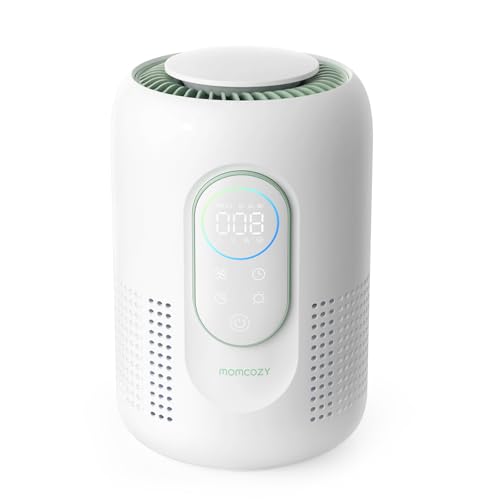
Momcozy Air Purifier for Bedroom with Dimmable Night Light — Best for Small Nurseries
Small nurseries punish big purifiers: no floor space, no shelf depth, and noise that fills the room. The Momcozy is built to that scale, and its listing is unusually specific — true HEPA with an activated carbon filter for odours (nappy pails are a nursery reality), four fan speeds, a PM2.5 monitor so you can see the room’s particle level rather than guess, and a sleep mode quoted at 21dB, which is genuinely quiet territory for overnight running beside a sleeping baby.
Strengths
- Sleep mode quoted at 21dB in the listing
- True HEPA plus activated carbon for odours
- Dimmable night light — adjustable, not fixed-bright
Trade-offs
- Small-room coverage limits it to nurseries and small bedrooms
- Monitor display must be dimmable for night use — check settings
- Carbon filters need replacing to keep odour control working
| Detail | What the listing confirms |
|---|---|
| Filtration | True HEPA + activated carbon (per Amazon title) |
| Noise | 21dB sleep mode (per Amazon title) |
| Speeds | 4 fan speeds (per Amazon title) |
The PM2.5 monitor changes how you use a purifier: instead of running it on faith, you learn your nursery’s rhythm — particles up when the door opens and bedding changes, down after an hour of running — and the auto habits follow. The dimmable light is the right kind of nursery light, adjustable down for night feeds rather than a fixed glow.
For a small nursery this is the most complete spec in the guide at its scale. Place it with clearance around the intake, keep the sleep mode as the default overnight setting, and let the higher speeds do the work during daytime play when noise matters less.
Best for: small nurseries wanting quiet running and odour control / Not suited for: large open-plan family rooms
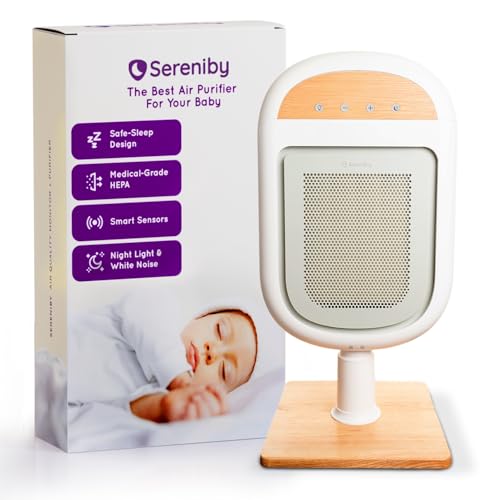
Sereniby Air Purifier for Baby — Best Purpose-Built Baby Design
Sereniby is the only pick here designed for babies and nothing else, and its listing leans into that specialism: a ‘safe-sleep design’, HEPA filtration (the listing’s wording is ‘medical-grade’, which we quote rather than adopt), and sensors for both air quality and temperature. The temperature sensing is a quietly useful nursery feature — room temperature is something parents already monitor for sleep, and having it on the same device as the air quality readout consolidates the nightly check into one glance.
Strengths
- Designed specifically for baby rooms, not adapted from a generic unit
- Air quality and temperature sensors in one device
- HEPA filtration confirmed in the listing
Trade-offs
- Specialist positioning — expect a premium tier
- Listing confirms fewer hard coverage numbers than rivals
- Smart features depend on the maker’s app ecosystem
| Detail | What the listing confirms |
|---|---|
| Filtration | HEPA (per Amazon title) |
| Sensors | Air quality + temperature (per Amazon title) |
| Design | Baby-specific safe-sleep design (per Amazon title) |
Choose this when the nursery is a long-term project and you value the integrated sensing. The honest caveat is in the specs row: the listing language is more evocative than numerical, so compare its stated coverage against your room before ordering, and treat sensor readouts as guidance rather than laboratory measurement. Within those limits, a purpose-built unit with consolidated monitoring is a coherent buy.
As with every pick here, we make no health claims for the filtration — it cleans the room’s air, and the sensors tell you about the room. That is a worthwhile job, honestly described.
Best for: parents wanting a baby-only design with temperature sensing / Not suited for: buyers who compare strictly on stated coverage numbers

Levoit Core Mini-P Air Purifier — Best Compact Simplicity
Not every nursery has floor space for a purifier; some have a dresser top and good intentions. The Core Mini-P is the desktop answer — a small unit from a major purifier brand, listed for bedrooms and dorms, that filters the nursery’s air at the scale a small room needs. The listing mentions a fragrance sponge; for a nursery, our advice is to leave the sponge empty — a baby’s room wants clean air, not scented air — and value the unit for its size and simplicity instead.
Strengths
- Desktop size fits dresser tops and nursing corners
- Major-brand simplicity — minimal controls to manage
- Suits the smallest nurseries where floor units cannot go
Trade-offs
- Small size means small-room coverage only
- Skip the fragrance sponge for nursery use
- Fewer speeds and features than the nursery-designed picks
| Detail | What the listing confirms |
|---|---|
| Model | Core Mini-P (per Amazon title) |
| Placement | Desktop / small room (per Amazon title) |
This is the pragmatic pick for a box-room nursery, a baby corner in the parents’ bedroom, or a temporary setup at grandparents’ houses. It will not turn over a large room’s air, and it does not pretend to. What it does is keep a small sleeping space’s air moving through a filter, quietly and without fuss, at the most accessible tier in this guide.
Place it elevated — dresser or shelf — with the intake unobstructed, and run it continuously on its quiet setting rather than in bursts; small purifiers work by steady accumulation, not by occasional blasts.
Best for: tiny nurseries, parents’ bedroom baby corners and grandparents’ houses / Not suited for: medium or large nurseries needing real coverage

Coway Airmega 50 Air Purifier — Best Quiet Bedroom All-Rounder
The Airmega 50 is the buy-once answer: a compact Coway bedroom unit whose listing states coverage to 500 square feet — more than any nursery, which means it runs a nursery on its lower, quieter speeds and still has a second life in a child’s bedroom or your own. The listing confirms the features that matter for overnight use: an air quality monitor with auto mode, so the unit responds to the room rather than a guess; a filter indicator, so replacements happen on evidence; and a night light for the nursery years.
Strengths
- Listing states coverage to 500 sq ft — nursery duty on quiet speeds
- Auto mode driven by an air quality monitor
- Filter indicator and a stated 2-year warranty in the listing
Trade-offs
- More purifier than a small nursery strictly needs
- Bedroom-first design — no child lock in the listing
- Deodorisation filter is a recurring replacement cost
| Detail | What the listing confirms |
|---|---|
| Coverage | Up to 500 sq ft (per Amazon title) |
| Filtration | HEPA + deodorization filter (per Amazon title) |
| Extras | AQI monitor, auto mode, night light (per Amazon title) |
Auto mode is the feature parents underrate: nursery air changes when doors open, bedding is changed and the day’s clothes come off, and a monitor-driven unit speeds up and settles down without anyone remembering to touch it. At night it settles to its quiet baseline, which is exactly the behaviour you want beside a cot.
The two-year warranty stated in the listing adds ownership confidence the nursery-designed novelties cannot match. If you prefer established appliances to baby-brand gadgets, this is your pick — and when the nursery becomes a child’s room, it simply stays.
Best for: parents wanting one purifier that outlasts the nursery stage / Not suited for: anyone wanting the smallest, cheapest nursery-only unit
Comparison Table
| Pick | Badge | Key spec | Best for |
|---|---|---|---|
| Frida Baby 3-in-1 Air Purifier with Sound Machine and Nightlight | Best Overall for Nurseries | HEPA, 3 speeds, sound + nightlight | nurseries short on sockets and shelf space |
| Pure Enrichment PureBaby Bear True HEPA Air Purifier | Best Child-Focused Design | True HEPA 4-stage, child lock | medium-large nurseries and children who press every button |
| Momcozy Air Purifier for Bedroom with Dimmable Night Light | Best for Small Nurseries | True HEPA + carbon, 21dB sleep mode | small nurseries wanting quiet running and odour control |
| Sereniby Air Purifier for Baby | Best Purpose-Built Baby Design | HEPA, air + temp sensors | parents wanting a baby-only design with temperature sensing |
| Levoit Core Mini-P Air Purifier | Best Compact Simplicity | Compact desktop, small-room | tiny nurseries, parents’ bedroom baby corners and grandparents’ houses |
| Coway Airmega 50 Air Purifier | Best Quiet Bedroom All-Rounder | 500 sq ft stated, auto mode, AQI monitor | parents wanting one purifier that outlasts the nursery stage |
How to Choose an Air Purifier for a Nursery
Start with the filter, because everything else is furniture. You want a listing that says HEPA — ideally ‘true HEPA’ — and means a sealed filter stage, not ‘HEPA-type’ or ‘HEPA-style’ marketing. A carbon stage alongside it earns its place in a nursery specifically, because nappy pails and feeding spills are odour sources a particle filter alone does not address. Then size to the room: the listing’s stated coverage should meet or exceed your nursery’s floor area with room to spare, because a purifier working at half capacity is a quieter purifier — and in a nursery, quiet is a feature, not a luxury.
Noise deserves its own paragraph. Ignore the headline speeds; the only figure that matters is the sleep or lowest mode, because that is what runs beside your baby for ten hours. The Momcozy in this guide quotes 21dB for its sleep mode in its listing — that is the register to look for. If a listing will not state a low-speed noise figure at all, treat that silence as information. Finally, think like a toddler’s parent: stable placement out of reach, controls that lock or resist fiddling, no loose filter doors at floor level, and a night light that dims rather than glows if it has one at all.
- True HEPA in the listing — not ‘HEPA-type’
- Stated coverage at or above your room size, run on lower speeds
- Sleep-mode noise is the only noise figure that matters
- Child lock, stable placement and dimmable light for nursery life
What a Nursery Purifier Can and Cannot Do
Honesty protects babies better than hype. A HEPA purifier captures airborne particles — dust, pollen, pet dander and similar — as room air passes through it, and a carbon stage reduces odours. That is a real and worthwhile job: nursery air gets visibly dusty, and filtered air is cleaner air. What a purifier does not do is treat, prevent or cure any medical condition, and this guide makes no such claim for any pick, regardless of the language swirling around the category. If your child has a diagnosed condition, your clinician’s advice governs; the purifier is household equipment, not a medical device.
A purifier also does not replace source control. The biggest wins in a nursery are boring: wash bedding, vacuum with the baby out of the room, keep soft-toy piles manageable, ventilate when outdoor air is clean, and never smoke anywhere near the home. The purifier then handles the remainder — the particles that ordinary living keeps airborne. Framed that way, it earns its socket honestly, and you will judge it by the right standard: a cleaner-smelling, less dusty room, not a promise no machine can keep.
Filter Costs and the Real Price of Clean Air
Every purifier in this guide is a subscription in disguise: the filter. Before buying, find the replacement filter for your model, note its stated service life, and do the honest arithmetic over three years. A cheaper unit with costly, short-lived filters can outspend a better unit quickly — and the Coway and Levoit ecosystems score here because their filters are widely stocked. Filter indicators, like the Airmega 50’s, help because nursery life is not a calendar; a filter changed on evidence beats one changed on a guess in either direction.
Care between changes is mostly pre-filter care: many units have a washable or vacuumable pre-filter that catches the coarse dust, and keeping it clean extends the HEPA stage’s life. Keep the intake and outlet unobstructed — a purifier pushed into a corner against curtains is a decoration, not an appliance — and run it continuously on a low setting rather than in occasional bursts, because steady turnover is how small rooms stay clean.
Nursery Air, Hour by Hour: Running the Purifier With the Routine
A nursery purifier works best when it is choreographed with the day rather than simply switched on. The high-traffic moments are predictable: the morning change and dress, the midday play on the floor, the evening bath-and-bed routine. Each stirs the room — bedding moves, clothes change, doors open — and each is when particles peak. An auto-mode unit like the Coway handles this by itself; a manual unit asks for a simple habit: a higher speed during and just after the active periods, and the sleep setting as the room settles for the night.
Night is the purifier’s main shift, and the settings should be boring: lowest quiet speed, displays dimmed, night light at its lowest or off, door in its usual position so the airflow pattern the room has learned stays constant. Parents often ask whether the purifier should sit near the crib; the better rule is near the room’s air path — where air enters and circulates — with clear space around the intake, rather than crowding the cot itself. The whole room is the patient, not the square metre above the mattress.
Seasonal rhythms matter too. Pollen seasons and wildfire-smoke days are when the nursery purifier earns its purchase price in a week; windows stay shut, the unit runs a speed higher, and outdoor clothes change at the door. In clean-air seasons the same unit idles at its quiet baseline and mostly minds the dust. Thinking of it as a seasonal appliance with a nightly job, rather than a gadget with a button, is how families end up still using — and valuing — it in the child’s fourth year.
Second Rooms and Second Lives: Where the Purifier Goes Next
Few nursery purchases get a planned second life, and the purifier is the exception worth planning. Its first migration is usually within childhood: from nursery to the child’s own bedroom, where the same quiet running and — for the PureBaby Bear — the same child lock keep serving. The night light that soothed feeds becomes the night light that settles a three-year-old, and the filter subscription you already manage simply continues. Buying a unit with that migration in mind is why this guide includes bedroom all-rounders alongside the nursery natives.
The second migration is out of childhood entirely: the parents’ bedroom, where a quiet HEPA unit is suddenly the answer to a partner’s dust complaints; the home office, where it minds the printer and the dog’s corner; the grandparents’ spare room, where it freshens a rarely used space before visits. Compact units like the Levoit Core Mini travel these routes most easily, while a monitor-equipped unit like the Coway becomes the household’s reference instrument — the one that tells you whether the other rooms have a problem at all.
Plan the filter, not just the box, across these lives. A purifier whose filters remain available and affordable in five years is a decade appliance; one orphaned by a discontinued filter line is a two-year rental at a purchase price. The brands in this guide were chosen partly on that ecosystem logic, and it is worth more than any single feature on any single listing.
Grandparents, Second Homes and the Travel Question
Nurseries multiply. The baby who sleeps at home also naps at grandparents’, stays in holiday rentals and occasionally occupies a hotel cot, and parents reasonably ask whether the purifier travels. The compact end of this guide answers best: the Levoit Core Mini’s desktop footprint is the one that fits a car boot and a grandparent’s spare-room dresser without a negotiation, and a small unit running in a small spare room does the same steady job it does at home. The nursery-designed units travel less happily — their value is integration, and integration lives on a shelf, not in a suitcase.
For the grandparents’ house as a standing arrangement, the economics favour a second, simple unit kept there over a good unit ferried back and forth: filters forgotten, cords left behind and a purifier that is always in the wrong house are the ferry system’s taxes. A basic, quiet, true-HEPA unit living permanently in the spare room — set up once, on the routine in this guide — makes the second nursery as considered as the first, and grandparents reliably report that the room simply feels fresher for their own sleeping too.
Hotels and rentals are the honest limit: you cannot re-engineer a holiday room’s air in a weekend, and you do not need to. Ventilate when outdoor air is good, keep the cot away from the bathroom’s damp corner, and let the home nursery — where the baby actually lives — carry the purifier investment. Perspective is a parenting skill, and air is one of the places it pays best.
Reading Air Quality Numbers Without Losing Your Mind
Several picks here show you numbers — PM2.5 readouts, air quality indices, traffic-light displays — and numbers invite obsession, so here is the calm way to read them. PM2.5 counts the fine particles that HEPA filtration exists to catch; the number rises when doors open, bedding changes, cooking happens nearby or outdoor air is poor, and falls as the purifier works. A spike during the evening routine is the room being lived in, not the purifier failing. A number that never falls is information: check the filter, the intake clearance and whether a window is open to a smoky street.
Use the display the way you use a room thermometer — a glance at the evening check, a trend across the week — and resist the hourly audit. Babies have thrived in imperfect air since long before sensors; the purifier’s job is to make the nursery’s air measurably cleaner on average, and the monitor’s job is to confirm the average, not to grade every hour. Parents who treat the readout as a reassurance instrument sleep better than parents who treat it as an alarm, and parental sleep is a nursery input too.
One calibration of expectations: consumer sensors are guides, not laboratory instruments, and two units in one room will disagree cheerfully by small margins. Believe the direction and the trend, doubt the third significant figure, and let the filter indicator and the calendar — not the display’s moods — govern maintenance.
The Nursery Environment as a Whole: Air Is One of Five
It is worth placing the purifier in its proper company before this guide closes, because parents are sold nursery equipment one anxiety at a time and the room works as a whole. The five systems that decide a nursery’s nights are darkness, temperature, sound, air and the sleep surface — and the purifier touches exactly one of them. Blackout that actually blacks out, a room temperature in the comfortable band your clinician’s guidance describes, a consistent sound environment, a firm and bare sleep surface, and then air: filtered, moving gently, monitored if you wish. A family that buys the purifier first and the blackout blind last has the order backwards, and this guide would rather tell you so than sell you a tower.
The good news is that the systems cooperate. The Frida Baby’s integration of purifier, sound and light is the market noticing that nurseries run routines, not appliances. The Coway’s auto mode cooperates with the evening routine by itself. Even the humble Core Mini cooperates by disappearing — a device that asks nothing is a system that cannot be forgotten. Choose the purifier that fits the routine you actually run at 7 p.m. and 3 a.m., not the one with the longest feature list at noon in a shop.
And keep the perspective this guide opened with: the purifier’s promise is a cleaner, fresher-smelling, less dusty room, maintained quietly in the background of your baby’s first years. Kept to that promise, every pick here delivers it. Asked for more — asked to be medicine — no machine in this category can comply, and any seller who says otherwise has told you what you needed to know about the seller.
When to Run What: A Simple Nursery Air Schedule
For parents who prefer a timetable to an app, here is the whole routine on one card. Morning, during and after the first change and dress: a medium speed for an hour, because the room has been stirred and the day has begun. Daytime naps: the sleep setting, door in its usual position, displays dimmed — the nap is a rehearsal for the night and the room should behave identically. Playtime on the floor: medium again, because floor level is where the dust lives and where the baby now spends the afternoon. Evening routine: medium through bath and story, then the sleep setting as the light goes, where it stays until morning. That is four touches a day on a manual unit, none on an auto-mode one, and it covers the nursery’s air life completely.
Layer the exceptions over the timetable rather than rebuilding it. A visitor with a cold, a smoky day outside, a freshly painted hallway, a pet newly banished to the nursery by a storm — each earns the higher speed for the hours it lasts, and then the timetable resumes. Filter care sits outside the daily rhythm entirely: a glance at the indicator during the weekly room clean, a pre-filter rinse when you do the month-end jobs, and a filter change when evidence or calendar says so. A schedule this plain survives tired parents, helpful grandparents and the general entropy of a house with a baby in it — which is the only kind of schedule worth printing.
How to Set Up a Nursery Air Purifier Safely
Setup is fifteen minutes that decide years of performance. Placement first: on a stable surface or floor spot with clear air around the intake, away from the crib itself, with the cord routed where neither a crawling baby nor a tired parent can catch it. Then run the unit before the baby sleeps in the room, so the first turnover happens in an empty room.
- Place the purifier with clear space around its intake and outlet
- Route the cord out of reach and out of walkways — no trailing cables
- Keep the unit out of the crib and away from where a standing toddler can pull it
- Run it for an hour before first bedtime to turn the room’s air over
- Set the sleep or lowest speed as the overnight default
- Use auto mode if fitted, so daytime disturbances get a response
- Dim or disable display lights for the night; use night lights on their dimmest setting
- Note the filter date in your phone calendar the day you install it
After setup, the routine is almost nothing — which is the point. A glance at the air quality readout when you do the evening check, a pre-filter clean when you deep-clean the room, and a filter change when the indicator or the calendar says so. Nursery equipment that demands daily attention gets abandoned; a purifier set up properly simply becomes part of the room’s quiet background, like the blackout blind and the white-noise habit it now shares a shelf with.
Common Buying Mistakes
Buying a whole-house tower for a small nursery. Oversized units cost more, take the floor space you need, and often run louder. Match stated coverage to the room with modest headroom.
Believing medical promises. A purifier cleans air; it does not treat conditions. Buy filtration, sizing and quiet — and take medical questions to your clinician.
Ignoring the sleep-mode noise figure. The loud speeds are irrelevant at 2 a.m. Only the lowest setting’s noise decides whether the unit stays on all night.
Forgetting the filter subscription. Price the replacement filter and its service life before buying the unit. The three-year cost is the real price.
Scenting a baby’s room. Skip fragrance sponges and scented features in a nursery. The goal is clean air, not perfumed air.
Final Recommendation
For most nurseries, the Frida Baby 3-in-1 is the neatest answer — HEPA filtration plus the sound machine and nightlight you were buying anyway. Choose the PureBaby Bear if toddlers and buttons are your reality, the Momcozy for a small nursery’s quietest nights, the Sereniby for a purpose-built baby design with temperature sensing, the Levoit Core Mini where only a desktop fits, and the Coway Airmega 50 if you want one appliance that serves long past the nursery years. Check the current price on Amazon, and the replacement filter’s price beside it.
Related nursery and home-air guides in this programme: Best Air Purifiers For Dirty Diapers, Best Air Purifiers For Dust, Best Air Purifiers For Pet Dander, Best Air Purifiers Under $100 and Best Air Purifiers For 150 Square Feet.
Best Air Purifiers For Dirty Diapers Best Air Purifiers For Dust Best Air Purifiers For Pet Dander Best Air Purifiers Under $100 Best Air Purifiers For 150 Square Feet
Frequently Asked Questions
Is an air purifier safe to run in a baby’s room all night?
A filter-based HEPA purifier is designed for continuous running, and the sleep modes in this guide exist exactly for overnight use. Place it stably with the cord out of reach, keep it out of the crib, and use the lowest quiet setting overnight. This guide covers household comfort only and makes no medical claims.
What size purifier does a nursery need?
Match the listing’s stated coverage to your room’s floor area, with modest headroom so the unit can run on its quieter speeds. A typical nursery is a small room — most picks here are small-room units, and the Coway’s stated 500 sq ft coverage is generous headroom rather than a requirement.
True HEPA or HEPA-type — does the wording matter?
Yes. ‘True HEPA’ in a listing denotes the genuine filter grade; ‘HEPA-type’ and ‘HEPA-style’ are marketing for lesser filters. Every pick in this guide was chosen with HEPA wording confirmed in its Amazon listing title.
How loud is too loud beside a sleeping baby?
Judge by the sleep-mode figure, not the maximum speed. The Momcozy’s listing quotes 21dB for its sleep mode, which is the quiet register to look for. If a listing states no low-speed noise figure, that absence is worth weighing against models that publish one.
How often do nursery purifier filters need changing?
It depends on the model and the room; follow the maker’s stated service life and any filter indicator. Before buying, confirm the replacement filter is available and note its cost — filter changes are the real running cost of any purifier in this guide.
Should a nursery purifier have a nightlight?
It is a convenience, not a requirement — and only a dimmable one is worth having, so night feeds do not fully light the room. The Frida Baby, PureBaby Bear, Momcozy and Coway picks all include a night light in their listings; the timer on the Frida is particularly well judged.

